HBSE Class 11 Syllabus 2027 Biology
Finished viewing? Save it for later —
Download HBSE Class 11 Syllabus 2027 Biology (PDF · 14 pages)About HBSE Class 11 Syllabus 2027 Biology
HBSE Class 11 Syllabus 2027 Biology is available here for free download. Published by Haryana Board for Class 11, this syllabus can be viewed online or downloaded as a PDF (14 pages). Candidates preparing for Class 11 can use HBSE Class 11 Syllabus 2027 Biology to understand the exam pattern, the type of questions asked, and the overall difficulty level.
Frequently Asked Questions
How can I download HBSE Class 11 Syllabus 2027 Biology?
Open this page and click the Download button to save HBSE Class 11 Syllabus 2027 Biology as a PDF. It is completely free on AglaSem Docs.
Is HBSE Class 11 Syllabus 2027 Biology free to download?
Yes. HBSE Class 11 Syllabus 2027 Biology can be viewed online and downloaded as a PDF free of cost on AglaSem Docs.
How many pages does HBSE Class 11 Syllabus 2027 Biology have?
HBSE Class 11 Syllabus 2027 Biology contains 14 pages, which you can read online or download together as a single PDF.
Where can I find more Class 11 study material?
You can find more Class 11 question papers, sample papers, syllabus, and answer keys on AglaSem Docs.
HBSE Class 11 Syllabus 2027 Biology – Text
Read the full text of this syllabus below — useful to quickly search, copy and reference the content online without downloading the PDF.
📄 View text version (15 pages)
Page 1
HBSE Class 11 Syllabus
2027 Biology
EXAM YEAR TYPE SUBJECT
Haryana Class 11 2027 Syllabus Biology
Notes · Sample Papers · Previous Year Papers · Mock Tests
Page 2
m .co s e m HBSE Class 11 Syllabus 2027 Biology
s e l a
a ag
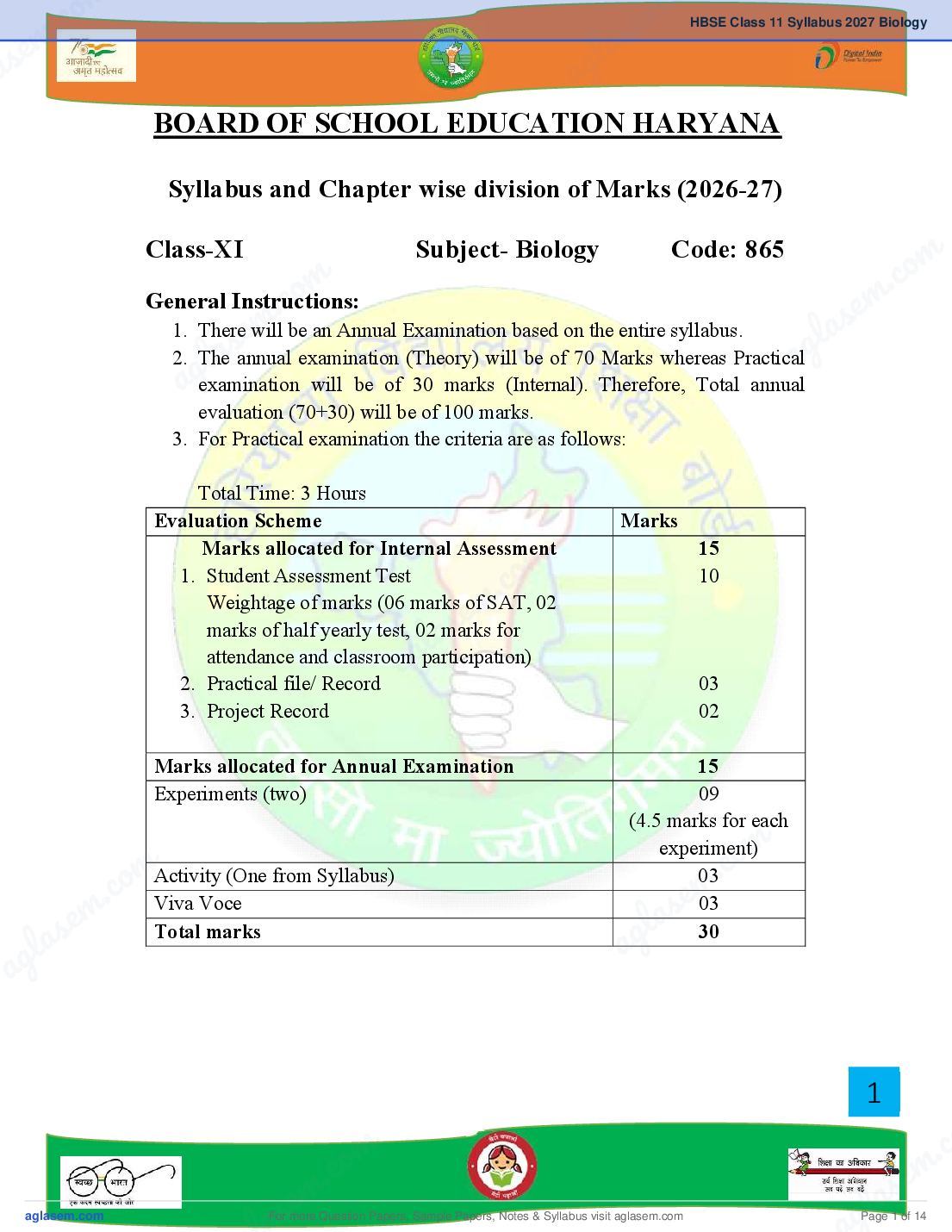
BOARD OF SCHOOL EDUCATION HARYANA
Syllabus and Chapter wise division of Marks (2026-27)
Class-XI Subject- Biology Code: 865 m
m . c o
. co
General Instructions:
s e m
m be an Annual Examination based on the entire syllabus.
1. Thereewill l a
s
la annual examination (Theory) will be of 70 Marks whereas Practicala
2. The g
g
a examination will be of 30 marks (Internal). Therefore, Total annual
evaluation (70+30) will be of 100 marks.
3. For Practical examination the criteria are as follows:
Total Time: 3 Hours
Evaluation Scheme Marks
Marks allocated for Internal Assessment 15
1. Student Assessment Test
. c om 10
Weightage of marks (06 marks of SAT, 02
e m
as
marks of half yearly test, 02 marks for
l
2. Practical file/ Record
ag
attendance and classroom participation)
03
3. Project Record 02
Marks allocated for Annual Examination 15
Experiments (two) 09
(4.5 marks for each
m
.co
experiment)
m
c. o Activity (One from Syllabus)
s e
03
m
e m Viva Voce
la
03
las Total marks
ag 30
ag
1
m . c
c. o s e m
s em
For more Question Papers, Sample Papers, Notes & Syllabus visit
gl a
Page 1 of 14
Page 3
Course Structure (2026-27)
Class-XI Subject- Biology Code: 865
Sr. No Chapters Total
Marks
I Diversity of Living Living World 15
Organisms Biological Classification
Plant Kingdom
Animal Kingdom
II Structural Morphology of Flowering 10
Organization in Plants plants
and Animals Anatomy of Flowering plants
Structural Organization in
Animals
III Cell: Structure and Cell: The Unit of Life 15
Function Biomolecules
Cell Cycle and Cell Division
IV Plant Physiology Photosynthesis in Plants 12
Respiration in Plants
Plant Growth and
Development
V Human Physiology Breathing and Exchange of 18
Gases
Body Fluid and its Circulation
Excretory Products and their
Elimination
Locomotion and Movement
Neural Control and
Coordination
Chemical Control and
Integration
Total 70
Practical 30
Grand Total 100
2
For more Question Papers, Sample Papers, Notes & Syllabus visit Page 2 of 14
Page 4
m .co s e m HBSE Class 11 Syllabus 2027 Biology
s e l a
a ag
Unit I: Diversity in the living World:
Chapter 1: The Living World
Diversity in the living world, Taxonomic Categories- Species, Genus,
Family, Order, Class, Phylum, Kingdom. o m
m . c
. co Classification
Chapter 2: Biological
s e m
s em Monera: Archaebacteria, Eubacteria, Kingdom Protista: gla
Kingdom
g la
Chrysophytes, Dinoflagellates, Euglenoids, Slime-Moulds, Protozoans, a
a Kingdom Fungi: Phycomycetes, Ascomycetes, Basidiomycetes,
Deuteromycetes. Kingdom Plantae, Kingdom Animalia, Viruses,
Viroid, Prions, Lichens.
Chapter 3: Plant Kingdom
Algae: Chlorophyceae, Phaeophyceae, Rhodophyceae; Bryophytes:
liverworts, mosses, Pteridophytes, Gymnosperms, Angiosperms.
m
Chapter 4: Animal Kingdom
m .co
e
Basis of classification-levels of organization, symmetry, diploblastic and
s
triploblastic l
organization, coelom,a segmentation, notochord,
ag
Classification of animals: Phylum-Porifera, Coelenterates, (cnidaria),
Ctenophora, Platyhelminthes, Aschelminths, Annelida, Arthropoda,
Mollusca, Echinodermata, Hemi-Chordata, Phylum Chordata- Subphyla:
Urochordata, Cephalo-Chordata, Vertebrata-class-Cyclostomata,
Chondrichthyes, Osteichthyes, Amphibia, Reptilia, Aves, Mammalia.
Unit II Structural Organisation in Plants and Animals
m
m
c. o Chapter 5: Morphology of Flowering Plants mphyllotaxy; .co
s e
s em The root- regions of root; The leaf- venation, types of
g acalyx, corolla,
leaves
l
la The Inflorescence; The flower, Parts of flower:
a
ag androecium, gynoecium, The Fruit; The seed- structure of a
dicotyledonous seed, structure of monocotyledonous seed. Semi-
technical description of a typical flowering plant, Solanaceae.
3
m . c
c. o s e m
s em
For more Question Papers, Sample Papers, Notes & Syllabus visit
gl a
Page 3 of 14
Page 5
Chapter 6: Anatomy of flowering plants:
The tissue system- Epidermal tissue system, the ground tissue system,
T h e vascular tissue system; Anatomy of dicotyledonous and
monocotyledonous plants – Dicotyledonous root, Monocotyledonous
root, Dicotyledonous stem, Monocotyledonous stem and Dorsiventral
(Dicotyledonous) leaf, Isobilateral (Monocotyledonous) leaf.
Chapter 7: Structural Organisation in Animals:
Organ and organ systems, Frogs- morphology, anatomy.
Unit III: Cell: Structure and Functions
Chapter 8: Cell the Unit of Life
What is a cell? cell theory, an overview of cell, prokaryotic cells, cell
envelope and its modifications, ribosome and inclusion bodies;
Eukaryotic cells, cell membrane, cell wall, endomembrane system:
endoplasmic reticulum (ER), Golgi apparatus, lysosomes, Vacuoles;
Mitochondria, Plastids, Ribosomes, cytoskeleton, cilia and flagella,
centrosome and centrioles, Nucleus, microbodies.
Chapter 9: Biomolecules
How to analyze chemical composition? Primary and secondary
metabolites, biomacromolecules, proteins, polysaccharides, nucleic
acid, Structure of Proteins, Enzymes- chemical reactions, how do
enzymes bring about such high rate of chemical conversions? Nature of
enzyme action, factors affecting enzymes activity- temperature and pH,
concentration of substrate, Classification and nomenclature of Enzymes,
co-factors.
Chapter 10: Cell Cycle and Cell division
Cell cycle, phases of cell cycle, M phase-Prophase, metaphase, anaphase,
telophase, cytokinesis, Significance of mitosis; Meiosis- meiosis I,
meiosis II, Significance of meiosis.
4
For more Question Papers, Sample Papers, Notes & Syllabus visit Page 4 of 14
Page 6
m .co s e m HBSE Class 11 Syllabus 2027 Biology
s e l a
a ag
Unit IV: Plant Physiology
Chapter 11: Photosynthesis in Higher Plants:
What do we know? Early experiments, Where does photosynthesis
take place? How many types of pigments are involved in
photosynthesis? What is light reaction? The electron transport-
m
splitting of water, cyclic and noncyclic photophosphorylation,
om . co
c
chemiosmotic hypothesis, Where are the ATP and NADPH used?- the
. e m
m
primary acceptor of CO2, The Calvin cycle, The C4 pathway,
e l as
as
Photorespiration, Factors affecting Photosynthesis- Light, carbon
l ag
ag
dioxide concentration. temperature, water.
Chapter 12: Respiration in Plants:
Do plants breath? Glycolysis, Fermentation, Aerobic Respiration,
Tricarboxylic acid cycle, electron transport system and oxidative
phosphorylation, The respiratory balance sheet, Amphibolic pathway,
Respiratory quotient.
m
.co
Chapter 13: Plant Growth and Development:
e m
Growth- Plant growth generally is indeterminate, growth is measurable,
l as
phases of growth, growth rates, conditions for growth, Differentiation,
ag
dedifferentiation and redifferentiation. Development, Plant growth
regulators- Characteristics, discovery of plant growth regulators,
physiological effects of plant growth regulators- auxins, gibberellins,
cytokinin, ethylene, abscisic acid.
Unit V: Human Physiology
m
m
c. o Chapter 14: Breathing and Exchange of Gases m .co
m s e
s e Respiratory organs- Human respiratory system, Mechanism of
g la
g la Breathing- Respiratory volumes and capacities- tidal volume, IRV, ERV, a
a RV, IC, EC, FRC, VC, TLC, Exchange of Gases, Transport of gases-
transport of oxygen, transport of carbon-dioxide, Regulation of
respiration, Disorders of Respiratory system.
5
m . c
c. o s e m
s em
For more Question Papers, Sample Papers, Notes & Syllabus visit
gl a
Page 5 of 14
Page 7
Chapter 15: Body fluids and Circulation
Blood- Plasma, Formed elements, Blood groups- ABO grouping, Rh
grouping; Coagulation of blood, Lymph (Tissue fluid), Circulatory
pathways- Human circulatory system, Cardiac cycle, Electrocardiograph
(ECG), Double circulation, Regulation of cardiac activity, Disorders
of circulatory system.
Chapter 16: Excretory Products and their Elimination
Human Excretory system, Urine formation, Function of tubules,
Mechanism of concentration of the filtrate, Regulation of Kidney
function, Micturition, Role of other organs in excretion. Disorders of
excretory system.
Chapter 17: Locomotion and Movement
Types of movement, Muscle, structure of contractile proteins,
mechanism of muscle contraction; Skeletal system, Joints, Disorders of
muscular and skeletal system.
Chapter 18: Neural control and coordination
Neural system, Human Neural system, Neuron as structural and
functional unit of neural system, generation and conduction of nerve
impulse, transmission of impulses, Central Neural System-Forebrain,
midbrain, hindbrain.
Chapter 19: Chemical coordination and Integration:
Endocrine glands and hormones, Human endocrine system, the
hypothalamus, t h e pituitary gland, the Pineal gland, thyroid gland,
parathyroid gland, thymus, adrenal gland, Pancreas, Testis Ovary,
Hormones of heart, kidney and gastrointestinal tract, Mechanism of
hormone action.
6
For more Question Papers, Sample Papers, Notes & Syllabus visit Page 6 of 14
Page 8
m .co s e m HBSE Class 11 Syllabus 2027 Biology
s e l a
a ag
Practicals:
1. Study parts of a compound microscope.
2. Identify and study the morphology of representative types of bacteria,
m
fungi and different plant groups.
m
3. Study somecoselected animals on the basis of their external features.
. co
. e m
m
4. Studyeand identify different types of inflorescences. l as
l as ag
5. gStudy and describe flowering plants of family Solanaceae.
a
6. Study anatomy of stem and root of monocots and dicots.
7. Study the distribution of stomata on the upper and lower surfaces of
leaves.
8. Detect the presence of carbohydrates, proteins and fats in different plants
and animal materials.
m
.co
9. Study the effect of temperature and pH on the activity of salivary amylase.
m
10. Study of mitosis.
s e
g l a
11. Separation of plant pigments (chloroplast pigments) by paper
chromatography.
a
12. Study the rate of respiration in flower buds/ germinating seeds.
13.Detect the presence of urea, sugar, albumin, bile salts in the given sample
of urine.
14. Study the human skeleton.
m
m 15. Study different types of joints in human skeleton.
.co
m .co s e m
s e g la
g la a
a
7
m . c
c. o s e m
s em
For more Question Papers, Sample Papers, Notes & Syllabus visit
gl a
Page 7 of 14
Page 9
Month wise Syllabus Teaching Plan (2026-27)
Class-XI Subject- Biology Code: 865
Month Chapter No. Teaching Revision Periods
Periods Periods (Practical)
April Chapter-1: The Living 03 01
World
Chapter-2: Biological 10 02
classification
Practical: Study parts of 04
a compound
microscope.
May Chapter-3: Plant 07 04
kingdom
Practical: Identify and
study the morphology
06
of representative types
of bacteria, fungi and
different plant groups.
Chapter-4: Animal 10 02
Kingdom
Practical: Study some 06
selected animals on the
basis of their external
features.
June Summer Vacation: Project work, Biology terminology exercise
and diagram notebook will be prepared by learners.
8
For more Question Papers, Sample Papers, Notes & Syllabus visit Page 8 of 14
Page 10
m .co s e m HBSE Class 11 Syllabus 2027 Biology
s e l a
a ag
July Chapter-5: Morphology 07 02
of Flowering Plants
Practical: Study and
identify different types 02
of inflorescences.
m
om
Practical: Study and . co
. c
describe flowering 02
e m
m
eplants of family l as
l as Solanaceae ag
ag
Chapter-6: Anatomy of 08 01
Flowering Plants
Practical: Study 04
anatomy of stem and
root of monocots and
dicots.
m
Practical: Study the
m .co
distribution of stomata
s e 02
on the upper and lower l a
surfaces of leaves. ag
August Chapter-7: Structural 03 01
Organisation in animals
Chapter-8: Cell: The 09 02
Unit of Life
m
m .co
.co
Chapter 9:
Biomolecules 12 02
e m
e m las
las Practical: Detect the ag
ag presence of 06
carbohydrates, proteins
and fats in different
plants and animal
materials.
9
m . c
c. o s e m
s em
For more Question Papers, Sample Papers, Notes & Syllabus visit
gl a
Page 9 of 14
Page 11
Practical: Study the
effect of temperature
and pH on the activity 04
of salivary amylase.
September Chapter-10: Cell Cycle 06 02
and Cell Division
Practical: Study of 06
mitosis.
Revision for half yearly 10
examination
Half Yearly
Examination
October Chapter-11: 08 02
Photosynthesis in
Higher Plants
Practical: Separation of
plant pigments 04
(chloroplast pigments)
by paper
chromatography.
Chapter-12: Respiration 08
in Plants 02
Practical: Study the rate
of respiration in flower 04
buds/ germinating
seeds.
Chapter-13: Plant
Growth and 06 02
Development
10
For more Question Papers, Sample Papers, Notes & Syllabus visit Page 10 of 14
Page 12
m .co s e m HBSE Class 11 Syllabus 2027 Biology
s e l a
a ag
November Chapter-14: Breathing 06 02
and exchange of Gases
Chapter-15: Body 08 02
Fluids and Circulation
m
o m Excretory . co
. c
December Chapter-16: 08 02
e m
mProducts and their
e Elimination l as
l as ag
a g Practical: Detect the 06
presence of urea, sugar,
albumin, bile salts in
the given sample of
urine
Chapter-17: 08 02
Locomotion and
m
Movement
m .co
s e
Practical: Study the
l a 02
human skeleton.
ag
Practical: Study
different types of joints 02
in human skeleton.
Chapter-18: Neural
Control and 06 02
Coordination m
m
c. o January m .co
m 08 02 s e
s e Chapter-19: Chemical
g la
la
Coordination and
g Integration a
a
February Revision 20
March Annual Examination
11
m . c
c. o s e m
s em
For more Question Papers, Sample Papers, Notes & Syllabus visit
gl a
Page 11 of 14
Page 13
Note:
Subject teachers are advised to direct the students to prepare
notebook of the Terminology/ Definitional Words used in the
chapters for enhancement of vocabulary or clarity of concepts.
The NCERT textbooks present information in boxes across the
book. These help students to get conceptual clarity. However,
the information in these boxes would not be assessed in the year
end examination.
Prescribed Books:
1. Biology Class-XI, BSEH Publications © NCERT
2. Laboratory Manual: Biology, Class XI, NCERT Publications
3. Exemplar Problems, Class XI, NCERT Publications
12
For more Question Papers, Sample Papers, Notes & Syllabus visit Page 12 of 14
Page 14
m .co s e m HBSE Class 11 Syllabus 2027 Biology
s e l a
a ag
QUESTION PAPER DESIGN (2026-27)
Class: 11 Subject: Biology Subject Code: 865
Time: 3 Hours
Competencies Marks Percentage
m
Knowledge
om 28 40% . co
. c e m
e m
Understanding 21 30%
l as
as
Application
l Skill 14 20%
ag
ag 7 10%
Total 70 100%
Type of Marks Number Description Total Marks
Questions of m
Questions
m .co
Objective 1 18
e
09 Multiple Choice
s
18
Type
l a
Questions
Questions
ag
03 Fill in the blanks
03 One-word
answers
03 Assertion Reason
type Questions
Very Short 2 7 Internal Choice will 14
Answer be given in any 3
Type questions
Questions m
m Short 3 5 Internal Choice will 15.co
m .co Answer be given in any 2
s em
s e Type questions
g la
g la Questions
a
a Case Study
Based
4 2 Internal Choice will
be given only in one
8
Questions part of both
questions
13
m . c
c. o s e m
s em
For more Question Papers, Sample Papers, Notes & Syllabus visit
gl a
Page 13 of 14
Page 15
Long 5 3 Internal Choice will 15
Answer be given in all
Type questions
Questions
TOTAL 35 70
14
For more Question Papers, Sample Papers, Notes & Syllabus visit Page 14 of 14
Document Details
| Board / Org | Haryana Board |
| Exam | Class 11 |
| Type | Syllabus |
| Pages | 14 |
| Updated | 04 Nov 2026 |