CBSE Class 12 Business Studies Question Paper 2019 Set 1 Solutions
Finished viewing? Save it for later —
Download CBSE Class 12 Business Studies Question Paper 2019 Set 1 Solutions (PDF · 62 pages)About CBSE Class 12 Business Studies Question Paper 2019 Set 1 Solutions
CBSE Class 12 Business Studies Question Paper 2019 Set 1 Solutions is available here for free download. Published by CBSE for Class 12, this solution can be viewed online or downloaded as a PDF (62 pages). Candidates preparing for Class 12 can use CBSE Class 12 Business Studies Question Paper 2019 Set 1 Solutions to understand the exam pattern, the type of questions asked, and the overall difficulty level.
Frequently Asked Questions
How can I download CBSE Class 12 Business Studies Question Paper 2019 Set 1 Solutions?
Open this page and click the Download button to save CBSE Class 12 Business Studies Question Paper 2019 Set 1 Solutions as a PDF. It is completely free on AglaSem Docs.
Is CBSE Class 12 Business Studies Question Paper 2019 Set 1 Solutions free to download?
Yes. CBSE Class 12 Business Studies Question Paper 2019 Set 1 Solutions can be viewed online and downloaded as a PDF free of cost on AglaSem Docs.
How many pages does CBSE Class 12 Business Studies Question Paper 2019 Set 1 Solutions have?
CBSE Class 12 Business Studies Question Paper 2019 Set 1 Solutions contains 62 pages, which you can read online or download together as a single PDF.
Where can I find more Class 12 study material?
You can find more Class 12 question papers, sample papers, syllabus, and answer keys on AglaSem Docs.
CBSE Class 12 Business Studies Question Paper 2019 Set 1 Solutions – Text
Read the full text of this solution below — useful to quickly search, copy and reference the content online without downloading the PDF.
📄 View text version (82 pages)
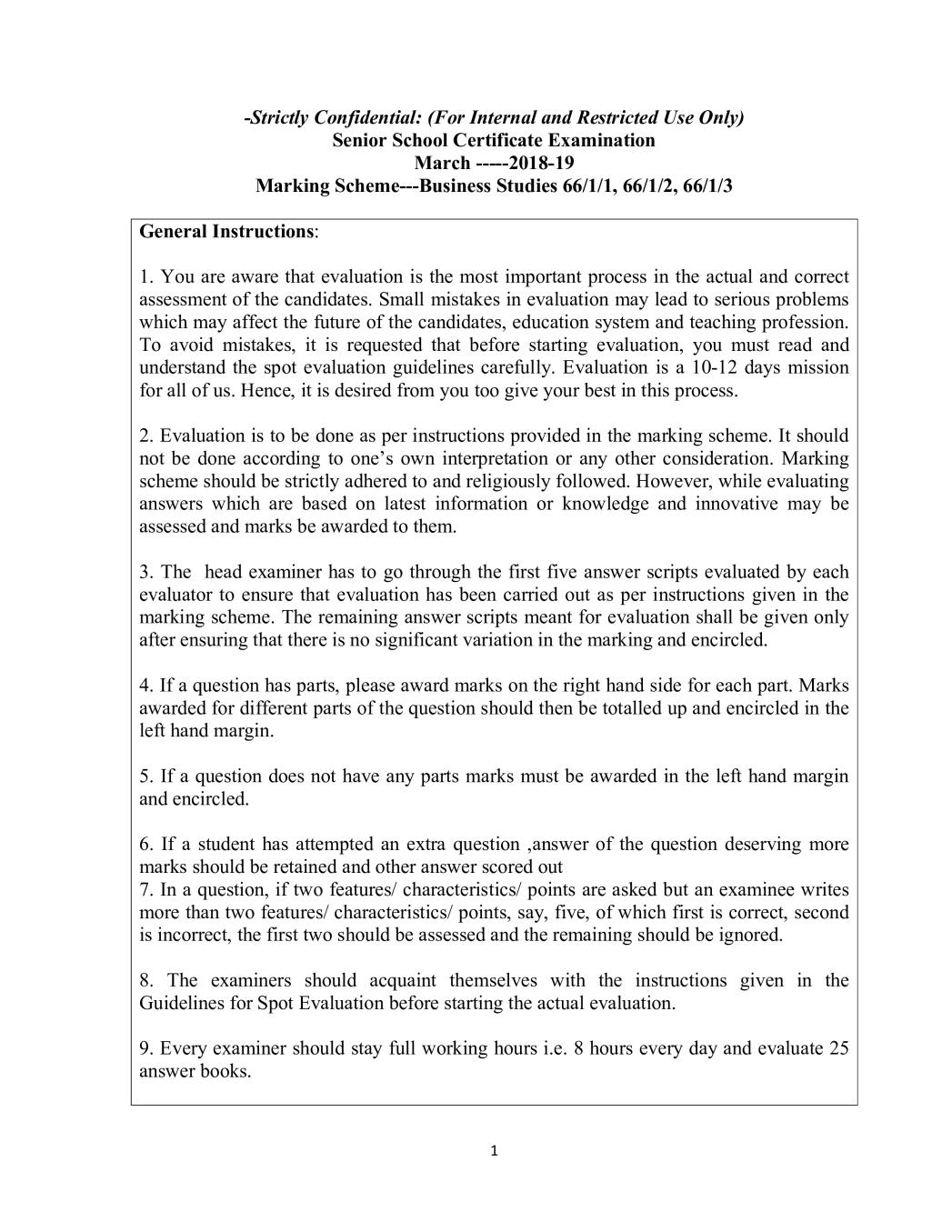
Page 1
Senior School Certificate Examination
March -----2018-19
Marking Scheme---Business Studies 66/1/1, 66/1/2, 66/1/3
General Instructions:
1. You are aware that evaluation is the most important process in the actual and correct
assessment of the candidates. Small mistakes in evaluation may lead to serious problems
which may affect the future of the candidates, education system and teaching profession.
To avoid mistakes, it is requested that before starting evaluation, you must read and
understand the spot evaluation guidelines carefully. Evaluation is a 10-12 days mission
for all of us. Hence, it is desired from you too give your best in this process.
2. Evaluation is to be done as per instructions provided in the marking scheme. It should
not be done according to one’s own interpretation or any other consideration. Marking
scheme should be strictly adhered to and religiously followed. However, while evaluating
answers which are based on latest information or knowledge and innovative may be
assessed and marks be awarded to them.
3. The head examiner has to go through the first five answer scripts evaluated by each
evaluator to ensure that evaluation has been carried out as per instructions given in the
marking scheme. The remaining answer scripts meant for evaluation shall be given only
after ensuring that there is no significant variation in the marking and encircled.
4. If a question has parts, please award marks on the right hand side for each part. Marks
awarded for different parts of the question should then be totalled up and encircled in the
left hand margin.
5. If a question does not have any parts marks must be awarded in the left hand margin
and encircled.
6. If a student has attempted an extra question ,answer of the question deserving more
marks should be retained and other answer scored out
7. In a question, if two features/ characteristics/ points are asked but an examinee writes
more than two features/ characteristics/ points, say, five, of which first is correct, second
is incorrect, the first two should be assessed and the remaining should be ignored.
8. The examiners should acquaint themselves with the instructions given in the
Guidelines for Spot Evaluation before starting the actual evaluation.
9. Every examiner should stay full working hours i.e. 8 hours every day and evaluate 25
answer books.
1
Page 2
quality evaluation. For instance, if an examinee scores 24 marks, then the marks should
not be inflated to 27 simply to pass him/ her.
11. Avoid the following common type of errors committed by the examiners in the pat-
Leaving answers or parts thereof unassessed in the answer script.
Giving more marks for an answer than assigned to it or deviation from the marking
scheme.
Wrong transference of marks from the inside pages of the answer books to the
title page.
Wrong question wise totaling on the title page.
Wrong totaling of marks of the two columns on the title page.
Wrong grand total.
Marks in words and figures not tallying.
Wrong transference of marks from answer books to award list.
Answer marked as correct but marks not awarded.
Half or a part of answer marked correct and the rest as wrong but no marks
awarded.
12. Marks should be awarded keeping in view the total marks of a particular question and
not the total marks of the question paper. For example, if one mark is given to a 3 marks
question even if nothing is correct, then that one mark constitutes 33% of the total marks
for this answer.
13. The examiner shall also have to certify in the answer book that they have evaluated
the answer book strictly in accordance with the value points given in the marking scheme
and correct set of question papers.
14. While evaluating the answer scripts, if the answer is found to be totally incorrect, it
should be marked as (x) and awarded zero (0) marks.
15. A full scale of marks 0-80 has to be used. Please do not hesitate to award full marks if
the answer deserves it. Similarly, wherever an examinee writes an answer upto the mark,
his/ her marks should not be deducted unnecessarily.
16. As per the orders of Hon’ble Supreme Court, the candidates would now be permitted
to obtain photocopy of the Answer Book on request on payment of the prescribed fee. All
examiners/ Head Examiners are once again reminded that they must ensure that
evaluation is carried out strictly as per value points for each answer as given in the
Marking Scheme.
2
Page 3
ZONE 1
66 66 66 MARKING SCHEME – 2018-19
/1 /1 /1 BUSINESS STUDIES Marks
/1 /2 /3 66/1/1
EXPECTED ANSWERS / VALUE POINTS
SECTION A
1 3 5 Q. Define ‘Workforce Analysis’.
Ans. Workforce Analysis is an assessment of the
number and type of human resources available for the 1 mark
performance of various jobs and accomplishment of
organisational objectives.
OR OR
Q. Define ‘Selection’.
Ans. Selection is defined as the process of choosing 1 mark
from among the pool of prospective job candidates
developed at the stage of recruitment.
or
Ans. Selection is defined as the process of identifying
and choosing the best person(s) out of a number of
prospective candidates for the job.
(or any other correct definition)
2 4 6 Q. Appliances India Ltd is engaged in
manufacturing and distribution of home appliances
since 1987.
It has a good name in the market as the company is
producing good quality appliances. It has separate
departments for manufacturing, finance, sales,
maintenance services and technical services to
achieve specialisation.
Since the areas of operation of the company have
3
Page 4
demanding, the company decided to modify the
existing principle of management to meet the
changing requirements of the environment.
State the general principle of management which
the company wants to modify to meet the changing ½ mark for
requirements. identifying
the principle
+
Ans. The general principle of management which the ½ mark for
company wants to modify is the Principle of Division stating the
of work which states that the work should be divided principle
into small tasks/ jobs each performed by a specialist. =
1 mark
3 5 7 Q. How does Financial Market facilitate ‘Price
Discovery’ of financial assets?
Ans. Financial Market facilitates price discovery for 1 mark
financial assets by interaction of forces of demand and
supply.
4 6 8 Q. Biru Nandan, Chairman of Lalit group of
companies founded ‘Biru University’ for
undergraduate and postgraduate courses in diverse
disciplines. The Information Technology
department of the Lalit Power Ltd., had few
vacancies related to Cyber security. The Human
Resource Department of the Company decided to
recruit fresh engineering graduates from ‘Biru
University’ for the same. Identify the type of source
of recruitment.
Ans. External source of recruitment/ Campus 1 mark
Recruitment
5 7 1 Q. Varsha Jain after completing her fashion
designing course from Indian Institute of Fashion
Technology planned to enter into designer clothing
venture. She had to address issues like her target
customers, channel of distribution to be used,
4
Page 5
Varsha Jain needs to develop to provide direction
and scope to her organisation in the long run.
Ans. Strategy 1 mark
6 8 2 Q. State any two ‘Developmental Functions’ of
Securities and Exchange Board of India.
Ans. Developmental functions of SEBI: (Any two)
(i) It trains intermediaries of the securities market.
½x2
(ii) It conducts research and publishing information =
useful to all market participants. 1 mark
(iii) It undertakes measures to develop the capital
markets by adapting a flexible approach.
OR
OR
Q. What is meant by ‘Allocative Function’ of
Financial Markets?
Ans. Allocative function of financial market means
allocating or directing funds available for investment
into their most productive investment opportunity.
or 1 mark
Allocative function of financial market means
mobilization of savings and channelizing them into the
most productive use.
7 1 3 Q. Beena has been using ‘Klean’, a famous
detergent available in the market. On watching
numerous advertisements in the television, she
decided to try a new brand of detergent. When she
went to the near-by store to purchase the same, she
saw detergents of other producers making similar
claims of whiteness and stain removing abilities.
5
Page 6
detergent to purchase. Name the objection of
advertising being discussed in this case.
Ans. Advertising confuses the buyers 1 mark
8 2 4 Q. Give the meaning of ‘Physical Distribution’ as
an element of Marketing Mix.
Ans. Place or Physical Distribution means set of
activities that make firm’s products available to the
target customers. It consists of all the activities 1 mark
involved in transferring ownership and physical
possession of the product to the consumers.
(or any other correct meaning)
OR OR
Q. What is meant by ‘ Marketing Management’?
Ans. Marketing management is the art and science of
choosing target markets and getting, keeping and
growing customers through creating, delivering and
communicating superior customer values of
management.
or
Marketing management refers to planning, organising, 1 mark
directing and control of the activities which facilitate
exchange of goods and services between producers
and consumers or users of products and services.
SECTION B
9 11 13 Q. JTM Ltd launched ‘Buddyline’, an exercise
book and comprehensive stationery brand name
comprising of ball pens, gel pens and geometry
boxes after identifying the target market and
understanding the needs and wants of the
consumers of that market. All their products were
of good quality and eco-friendly but expensive.
They wanted to distinguish their product from that
6
Page 7
and money in creating the brand name, as they
knew that without a brand name, they can only
create awareness for the generic product and can
never be sure of the sale of their products. The
effort paid off and the demand for the products
started growing. The customers liked the brand
and became habitual to it. They did not mind
paying a higher price.
Over a period of time, it became a status symbol to
buy ‘Buddyline’ brand because of its quality. The
consumers felt pride in using them.
(i) Identify the marketing management philosophy
followed by JTM Ltd.
(ii) Explain the advantages of branding to the
marketers highlighted in the above case.
Ans. (i) Societal marketing philosophy. 1 mark
½ mark for
(ii) Advantages of branding highlighted in the above heading
case are: (Any two) +
½ mark for
(a) Helps in product differentiation. its
explanation
(b) Helps in advertising and display programmes. 1x2
=
(c) Differential pricing. 2 marks
=
1+2
=
3 marks
10 12 9 Q. Mita has a successful ice cream business at
Bikaner, namely ‘Smartflavours’. Her ice creams
are utterly delicious. She makes ice creams from
fresh milk and the same are available in a wide
range of flavours and packs. She sets viable
business objectives and works with the same in
mind in order to ensure that the customers will
come back for purchasing.
Having the first mover advantage, her business was
7
Page 8
cutting down costs. This would sometimes lead to
delay in delivery and the ice cream was not
reaching the market in time. Over a period of time,
the demand for her ice cream declined and because
of it the competitors entered the market. She lost
some of her market share to competitors.
At the beginning of summer season, she got back to
back orders for supply of 4,000 ice cream packs of
different flavours for special occasions. To ensure
that the task was completed and orders delivered in
time she hired additional workers. She was, thus
able to produce and deliver the ice cream packs but
at a high production cost.
While completing activities and finishing the given
task for achieving goals, Mita realised that she was
ignoring one of the important aspects of
management.
Identify the aspects of management that has been
ignored by Mita. Also explain the same with the
help of an example.
Ans. Efficiency
Efficiency means doing the task correctly and with
minimum cost. 1 mark for
identifying
Example the aspect
+
Say, a company’s target production is 5,000 units in a 1 mark for
year. The manager wants to achieve the production its
target by cutting down costs. He was able to cut down explanation
costs but could not achieve the target production. In +
this case, the manager was efficient but not effective. 1 mark for
correct
(or any other correct example) example
=
or 3 marks
Effectiveness
8
Page 9
activities and achieving goals.
Example
Say, a company’s target production is 5,000 units in a
year. To achieve this target the manager has to operate
on double shifts due to power failure most of the time.
The manager is able to produce 5,000 units but at a
higher production cost. In this case, the manager was
effective but not so efficient.
(or any other correct example)
or
Efficiency and Effectiveness
Efficiency means doing the task correctly and with
minimum cost.
Effectiveness means doing the right task, completing
activities and achieving goals.
Example
Say, a company’s target production is 5,000 units in a
year. To achieve this target the manager has to operate
on double shifts due to power failure most of the time.
The manager is able to produce 5,000 units but at a
higher production cost. In this case, the manager was
effective but not so efficient.
In the above situation, if the manager was able to
achieve the production target but at a higher cost, he
would have been effective but not efficient.
(or any other correct example)
11 13 10 Q. State ‘Job Enrichment’ and ‘Employee
Participation’ as non-financial incentives. How do
they motivate employees?
Ans. Job Enrichment
9
Page 10
greater variety of work content, require higher level
of knowledge and skill, give workers more 1 ½ marks
autonomy and responsibility and provide the
opportunity for personal growth and a meaningful
work experience.
If jobs are enriched and made more interesting, the
job itself becomes a source of motivation to the
individual.
+
Employee Participation
Employee Participation means giving more
autonomy and powers to the employees.
1 ½ marks
It makes them feel that their jobs are important and =
this feeling makes them contribute positively to the
use of their skills and talents in the job 3 marks
performance.
12 - - Q. Explain the objectives of Financial Planning.
Ans. Objectives of financial planning:
(i) To ensure availability of funds whenever required
which involves estimation of the funds required, the 1 ½ marks
time at which these funds are to be made available and
the sources of these funds. +
(ii) To see that the firm does not raise resources
unnecessarily as excess funding is almost as bad as 1 ½ marks
inadequate funding. Financial planning ensures that =
enough funds are available at right time. 3 marks
OR OR
Q. What is meant by ‘Financial Management’?
State the primary objective of Financial
Management.
Ans. Financial Management means management of
10
Page 11
procurement of funds, investment of funds and
distribution of earnings to the owners.
+
or
Financial Management means planning, organising,
directing and controlling the financial activities of an
organisation.
Primary objective of Financial Management:
The primary objective of financial management is to
maximize shareholders wealth. i.e. to maximize the 1 ½ marks
market price of equity shares of the company.
=
3 marks
13 - - Q. Science is a systematized body of knowledge that
explains certain general truths or the operation of
general laws.’ In the light of this statement,
describe management as a science.
Ans. Science is a systematized body of knowledge that
explains certain general truths or the operation of
general laws.’ Management is a science but not an
exact science. The reasons are:
(i) Systematised body of knowledge.
Like science, management is a systematised body of
knowledge with its own theories and principles that
have developed over a period of time.
So, this feature of science is present in management.
(ii) Principles based on observation and
experimentation 1x3
Like science, management principles are derived =
through observation and repeated experimentation.
So, this feature of science is present in management.
However since management deals with human beings 3 marks
the outcome of these experiments are not capable of
11
Page 12
(iii) Universal validity.
Principles of management like principles of pure
science provide managers with certain standardised
techniques that can be used in different situations.
Since they have to be modified according to a given
situation, their application and use is not universal.
So, this feature of science is not fully present in
management.
(The statement that Management is not an exact
science may be given at the beginning or at the end of
the question)
OR OR
Q. Management is a complex activity that has three ½ mark for
main dimensions. Explain these dimensions. heading
+
Ans. Management is a complex activity that has three ½ mark for
main dimensions. The dimensions are: its
explanation
(i) Management of work =
(ii) Management of people 1x3
(iii) Management of operations =
3 marks
SECTION C
14 17 15 Q. Mahinder Agro Ltd. started a new venture for
distribution of harmful and chemical free fertilizers
vegetables. They conducted a survey to find out
consumer preferences for such vegetables.
They found that most of the consumers were
concerned about the harmful chemicals being used
in growing the vegetables. They found out that
90% of the households were searching for
alternatives. The company contacted a group of
agricultural experts to lay down the procedure for
growing the vegetables by the farmers. They
12
Page 13
grow chemical free vegetables according to new
innovative methods. The experts also suggested soil
management techniques through which farmers
would be able to create an abundant and lasting
harvest.
Identify and explain the two dimensions of business 1 mark for
environment highlighted in the above para. identifying
each
Ans. Dimensions of business environment highlighted dimension
above are: +
1 mark for
(i) Social Dimension its
explanation
Social Environment includes social forces like custom =
and traditions, values, social trends and society’s 2+2
expectation from business. =
4 marks
(ii) Technological Dimension
Technological Environment of business includes
forces relating to scientific improvements and
innovations which provide new ways of producing
goods and services and new methods and techniques
of operating a business.
15 18 16 Q. Mega Ltd. holds an Annual Management
Programme every year in the month of March in
which the top managerial personnel formulate
plans for the next year by analysing and
predicting the future to meet future events
effectively.
As they are responsible for providing direction to
the organisation, facts are thoroughly checked
through scientific calculations. Detailed plans are
prepared after discussion with professional
experts. Preliminary investigations are also
undertaken to find out the viability of the plan.
Since it is an intellectual activity requiring
13
Page 14
mainly done by the top management. Usually rest
of the members just implement the plans. Middle
level managers are neither allowed to deviate from
the plans nor are they permitted to act on their
own. The top management ensures that the
expenses incurred in formulating the plans justify
the benefits derived from them.
State two limitations and two features of planning
discussed above.
Ans. Two limitations of planning discussed above are:
(i) Planning reduces creativity as it is mostly done by
the top management; rest of the members just carry
out orders and think on the same lines as others. 1x4
(ii) Planning involves huge costs in terms of time and =
money. The costs incurred sometimes may not justify
the benefits derived from the plans. 4 marks
(If an examinee has given only the headings, ½
mark for each heading should be awarded)
Two features of planning discussed above are:
(i) Planning is futuristic as it involves looking ahead
and preparing for the future to meet future events
effectively to the best advantage of the organisation.
(ii) Planning is a mental exercise as it requires
application of mind involving foresight, intelligent
imagination and sound judgement. It is an intellectual
activity of thinking rather than doing.
(If an examinee has given only the headings, ½
mark for each heading should be awarded)
16 19 17 Q. Vinber Ltd. set up a manufacturing unit at
Bhiwadi at Himachal Pradesh to manufacture
electric geysers and supply them to dealers all over
the country. Their production target was 500 geysers
per week. It was decided by the management that
14
Page 15
acceptable.
At the end of the first week, the production was 450
geysers. The next week, production increased to 470
geysers. A week later, production was 460 geysers.
On investigation, it was found out that fluctuation in
production was due to irregular supply of electricity.
(a) The above para discusses some of the steps of one
of the functions of management. Explain the steps.
(b) Also, state the step(s) not discussed in the above
para.
Ans.
(a) Steps in the process of controlling discussed in
the above case: (½ mark for
naming
(i) Setting performance standards the step
+
(ii) Measuring actual performance ½ mark for
its
(iii) Comparing actual performance with standards explanation
and Analysing deviations 1x3
=
(In case the examinee has not written the steps in the 3 marks)
right sequence, ½ mark may be deducted)
(b) Step not discussed in the above para: +
Taking corrective action if deviations go beyond the (1 mark)
acceptable limits. =
3+1
(In case the examinee has not written the steps in the =
right sequence, ½ mark may be deducted) 4 marks
or or
(a) Steps in the process of controlling discussed in
the above case: (½ mark for
naming
(i) Setting performance standards the step
+
(ii) Measuring actual performance ½ mark for
its
15
Page 16
1x3
=
3 marks)
+
(b) Steps not discussed in the above para:
(i) Comparing actual performance with standards to
find out the deviation.
(½ x 2
(ii) Taking corrective action if deviations go beyond the =
acceptable limits. 1 mark)
(In case the examinee has not written the steps in =
the right sequence, ½ mark may be deducted) 3+1
=
4 marks
17 - - Q. Organising involves a series of steps that need to
be taken in order to achieve the desired goal.
Explain the steps.
Ans. Steps in the process of organising:
½ mark for
(i) Identification and division of work. heading
+
(ii) Departmentalisation. ½ mark for
its
(iii) Assignment of duties/ Assignment of duties to job explanation
positions. 1x4
=
(iv) Establishing reporting relationships. 4 marks
(If an examinee has not given the headings as above
but has given the correct explanation, no marks
should be deducted)
OR OR
Q. Explain any four points of importance of
‘Organising’.
Ans. Importance of organising: (Any four)
16
Page 17
½ mark for
(b) Clarity in working relationships. heading
+
(c) Optimum utilisation of resources. ½ mark for
its
(d) Adaptation to change. explanation
1x4
(e) Effective administration. =
4 marks
(e) Development of personnel.
(f) Expansion and growth.
(If an examinee has not given the headings as above
but has given the correct explanation, full credit
should be given)
18 15 19 Q. Stock exchange acts as a regulator of the
securities market. It creates a continuous market
where the securities are bought and sold. It gives
investors the chance to disinvest and reinvest.
Through this process of disinvestment and
reinvestment, savings get channelised into their
most productive investment avenues.
To ensure that the investing public gets a safe and
fair deal in the market, the membership of the
stock exchange is well regulated and its dealings
are well defined according to the existing legal
framework. It also ensures wider share ownership
by regulating new issues, better trading practices
and taking effective steps in educating the public
about investments.
Various functions performed by the Stock
Exchange are discussed in the above para.
By quoting the lines from the above para, state any
four functions of stock exchange.
Ans. Various functions performed by the Stock
Exchange are:
(i) Providing liquidity and marketability to existing
securities as the stock exchange creates a continuous
17
Page 18
gives investors the chance to disinvest and reinvest.
It creates a continuous market where the securities are
bought and sold. It gives investors the chance to
disinvest and reinvest. ½ mark for
quoting the
line
(ii) Contributes to economic growth as through +
process of disinvestment and reinvestment, savings get ½ mark for
channelised into their most productive investment the
avenues. statement
1x4
Through this process of disinvestment and =
reinvestment, savings get channelised into their most 4 marks
productive investment avenues.
(iii) Safety of transactions as the membership of the
stock exchange is well regulated and its dealings are
well defined according to the existing legal
framework. This ensures that the investing public gets
a safe and fair deal on the market.
Membership of the stock exchange is well regulated
and its dealings are well defined according to the
existing legal framework
(iv) Spreading of equity cult as the stock exchange
ensures wider share ownership by regulating new
issues, better trading practices and taking effective
steps in educating the public about investments.
Ensures wider share ownership by regulating new
issues, better trading practices and taking effective
steps in educating the public about investments.
19 - - Explain any four points of difference between
Marketing and Selling.
Ans. Difference between marketing and selling are:
(Any four)
Basis Marketing Selling
18
Page 19
process vs wider term the process of
wider term consisting of marketing and is
number of activities concerned with
like identification promoting and
of customers needs, transferring
developing the possession and
products to satisfy ownership of goods
those needs, fixing from the seller to
prices and the buyer.
persuading the
potential buyers to
buy the same.
Transfer to Marketing focuses Selling focuses on 1x4
title vs on achieving affecting transfer =
satisfying maximum of title and 4 marks
customers satisfaction of the possession of goods
needs customer’s needs from sellers to
and wants. consumers or users.
Profit Aims at Selling aims at
through maximizing of maximising profits
maximizing customer through sales
sales vs satisfaction as a volume
customer route to profit
satisfaction maximisation.
Start and Marketing begins Selling begins after
end of before production production and
activities and continues even ends with the sale
after the sale has of goods.
taken place.
Difference In marketing, the In selling, the
in the attempt is to emphasis is on
Emphasis develop the product bending the
and other strategies customer according
as per the customer to the product
needs.
Difference Marketing uses Selling involves
in the integrated efforts like
Strategies marketing efforts promotion and
involving strategies persuasion
in respect of
product, promotion,
pricing and
physical
distribution.
19
Page 20
Q. Explain the following functions of marketing:
(i) Product designing and development
(ii) Standardization and Grading
Ans. (i) Product designing and development
- Product designing and development helps to make
the product attractive to the target customers.
2 marks
- A good design can improve performance of a product
and also give it a competitive advantage in the market.
(ii) Standardisation and Grading +
- Standardisation ensures uniformity and consistency
in output reducing the need for inspection and testing
of the products. 2 marks
- Grading ensures that the goods belong to a particular
quality and helps in realising higher prices for better =
quality products. 4 marks
SECTION D
20 - - Q. Explain any five points of significance of
Principles of Management.
Ans. Importance of principles of management:
(Any five)
(i) Provide the mangers with useful insights into
reality. ½ mark for
heading
(ii) Help in optimum utilisation of resources and +
effective administration. ½ mark for
its
(iii) Help in taking scientific decisions. explanation
1x5
(iv) Help in meeting changing environment =
requirements. 5 marks
(v) Help in fulfilling social responsibility.
20
Page 21
education and research.
(If an examinee has not given the headings as above
but has given the correct explanation, full credit be
given)
OR OR
Q. Explain the following Techniques of Scientific
Management:
(a) Fatigue Study
(b) Differential Piece Wage System
Ans.
(a) Fatigue Study
Fatigue Study determines the amount and frequency
of rest intervals in completing task.
2½ marks
The rest intervals help the workers to regain
stamina and work again with the same capacity
resulting in increased productivity.
(b) Differential Piece Wage System
Differential Piece Wage System is a technique
which differentiates between efficient and less
efficient workers. It rewards the efficient workers
and motivates the less efficient ones to improve
their efficiency.
2½ marks
In this plan, there are two piece rates – one for
those workers who produce the standard output or
more, and the other for those who produce less than
the standard output. =
5 marks
This acts as an incentive for a less efficient worker
to be motivated to perform better.
21 22 20 Voltage fluctuations have been common and quite
high in India. They harm our electrical appliances
21
Page 22
often leaving them in a permanently damaged
condition.
N-Guard Company decided to manufacture
stabilizers for North India where the voltage
fluctuation ranges from 220V-230V. Once the
demand for the North India was taken care of, they
decided to launch stabilizers of varying voltages
from 90 V -260V for meeting the requirements of
voltage fluctuations in other regions of India also.
Three engineers were appointed for South, West
and East regions of India, as the voltage was
different in all the three regions. Though all the 1 mark
engineers were appointed to manufacture
stabilizers but the product differed from region to
region. +
(a) Identify the organisational structure of N-
Guard Company.
(b) State any two advantages and two limitations of
the structure identified in the above para.
Ans. FUNCTIONAL STRUCTURE
Advantages of Functional structure: (Any two)
1x2
(a) It leads to occupational specialisation since =
emphasis is placed on specific functions. 2 marks
(b) It promotes control and coordination within a
department because of similarity in the tasks being
performed.
(c) It increases managerial and operational efficiency
resulting in increased profit.
+
(d) It lowers cost as it reduces duplication of effort.
(e) It makes training of employees easier as it focuses
on a limited range of skills.
(f) It ensures that different functions get due attention.
(If an examinee has given only the heading, ½ mark
22
Page 23
Two limitations of Functional structure are: (Any
two)
(a) Creation of functional empires where less emphasis
is placed on overall objectives of the enterprise and
more on the objectives pursued by a functional head.
1x2
(b) Problems in coordination as information has to be =
exchanged across functionally differentiated 2 marks
departments.
(c) Inter-departmental conflicts may arise when the
interest of two or more departments are not
compatible.
(d) Inflexibility as people with the same skills and =
knowledge may develop a narrow perspective 1+2+2
(If an examinee has given only the heading, ½ mark =
for each heading should be awarded) 5 marks
22 20 21 Nisha Sethi was working as a Human Resource
Manager in a famous consultancy firm, KLI Global
Services. Her job included preparing job
descriptions, recruitment, developing compensation
and incentive plans and facilitating employee
learning. They had entered into alliances with
institutes to ensure continuous learning of their
employees. With the jobs becoming more and more
complex, KLI Global Services invested large
amount of money in making the employees learn
the skills necessary to complete the jobs. State by
giving any five points, how this investment is likely
to benefit the organisation.
Ans. Benefits of training to the organisation:
(i) It avoids wastage of efforts and money as training
is systematic learning, better than hit and trial 1x5
methods. =
23
Page 24
quantity and quality leading to higher profits.
(iii) It equips the future manager to take over in an
emergency.
(iv) It reduces employees’ turnover as it increases
employee morale and reduces absenteeism.
(v) It helps in obtaining effective response in a fast
changing environment
(If an examinee has given only the headings, ½
mark for each heading should be awarded)
SECTION E
23 - - Q. Determining the relative proportion of various
types of funds depends upon various factors.
Explain any six such factors.
Ans. Following are the factors affecting the choice of
capital structure of a company: (any six)
(i) Cash flow position
(ii) Interest coverage ratio
(iii) Debt service coverage Ratio
(iv) Return on Investment
(v) Cost of debt
(vi) Tax rate ½ mark for
heading
(vii) Cost of equity +
½ mark for
(viii) Floatation costs its
explanation
(ix) Fixed operating costs 1x6
=
(x) Risk consideration 6 marks
24
Page 25
(xii) Control
(xiii) Regulatory framework
(xiv) Stock market conditions
(xv) Capital structure of other companies
(If an examinee has not given the headings as above
but has given the correct explanations, full credit
should be given)
OR OR
Q. Explain any six factors affecting the decision
that determines the amount of profit earned to be
distributed and to be retained in the business.
Ans. Factors affecting dividend decision of a company
are: (Any six)
(i) Amount of earnings.
½ mark for
(ii) Stability of earnings. heading
+
(iii) Stability of dividends. ½ mark for
its
(iv) Growth opportunities. explanation
1x6
(v) Cash Flow position. =
6 marks
(vi) Shareholders preference.
(vii) Taxation policy.
(viii) Stock market reaction.
(ix) Access to capital market.
(x) Legal constraints.
(xi) Contractual constraints.
25
Page 26
but has given the correct explanations, full credit
should be given)
24 25 23 ‘VOICE’ is an an important consumer
organisation. It organised workshops in the months
of December in Delhi/ NCR for consumers. The
theme was ‘Organic Food –From Farm to Plate’ to
spread awareness on the importance of organic
farming and to encourage consumers to switch
from conventional food that contains chemicals and
pesticides to organic food. Expert speakers from
farmers’ community explained the harmful effects
of usage of pesticides in farming and the
importance of organic food. People were informed
that the organisation regularly tests samples to
detect adulteration like presence of heavy metals or
pesticides. The results of the tests are published in
their monthly magazine’ Consumer Voice’ to make
people aware of quality of different products. It
also provides aid and legal advice to the consumers
in seeking a remedy.
State the functions performed by the Consumer
Voice for the protection and promotion of
consumer interest by quoting lines from the above
para.
Ans. Functions performed by the Consumer Voice for
the protection and promotion of consumer interest:
(a) Educating the general public about consumer rights
by organising training programmes, seminars and
workshops.
‘organised consumer workshops in the months of 1 mark for
December in Delhi/ NCR on the theme, of ‘Organic stating
Food –From Farm to Plate’, as a part of its initiative +
to spread awareness on the importance of organic ½ mark for
farming’ quoting
1½ x4
=
(b) Publishing periodicals and other publications to 6 marks
26
Page 27
reporting, reliefs available and other matters of
interest.
‘The results of the tests are published in their monthly
magazine’ Consumer Voice’ to make people aware of
quality of different products’
(c) Carrying out comparative testing of consumer
products in accredited laboratories to test relative
qualities of competing brands and publishing the test
results for the benefit of consumers.
‘People were informed that the organisation regularly
tests samples to detect adulteration like presence of
heavy metals or pesticides’
(d) Providing legal assistance to consumers by the way
of providing aid, legal advice etc. in seeking legal
remedy.
‘It also provides aid and legal advice to the consumers
in seeking a remedy’
25 23 24 Pratap Singh is the Chief Executive Officer of Nissar
Enterprises. It is an automobile parts manufacturing
company. The enterprise has a functional structure,
in which jobs of similar nature have been grouped
together as Production, Finance, Marketing and
Human Resource. Nissar Enterprises has its
manufacturing unit at Manesar. The factory has
been plagued with many problems for a long time
which was in the knowledge of the Production
Manager, Varun Sharma. The workers had internal
differences. Time and again, there were
misunderstandings between the management and the
workers. Keeping the problems in mind, Varun
Sharma appointed, Siyaram Singh who had 14 years
of experience of working with the actual work force
and passing on instructions of the middle
management to the workers.
Siyaram Singh met Varun Sharma to understand
what the management wanted. Thereafter he met the
27
Page 28
them. He also promised the workers to convey their
problems to the management. In this way, he cleared
the misunderstanding between the management and
the workers.
He also sorted out internal differences and was able
to unite the workers within a month of his joining.
His work was acknowledged and he was given a
certificate of good performance along with 10%
increase in salary.
(i) Siyaram Singh performed some of the functions
which are required to be performed at the position
he is working at. State any five other functions
Siyaram Singh is expected to perform.
(ii) Name the incentives provided to Siyaram Singh.
Ans.
(i) Five other functions Siyaram Singh is expected to
perform are:
(a) Maintaining day to day contact and friendly
relations with the workers. He should act as a friend,
philosopher and a guide to the workers.
1x5
(b) Providing good on the job training to the workers =
to build an efficient team. 5 marks
(c) Building up high morale among workers through
good leadership.
(d) Giving feedback to the workers after analysing
their work and suggesting ways of developing their
work skills
+
(e) Ensuring performance of work according to the
targets set.
(f) To oversee the efforts of the workforce.
(g) To ensure that the quality of output is maintained
and wastage of material is minimized.
(h) To ensure safety standards are maintained .
28
Page 29
(a) Pay and allowances/ Financial Incentive ½x2
=
(b) Employee Recognition Programmes/ Non Financial 1 mark
Incentive
=
5+1
=
6 marks
29
Page 30
66 66 66 MARKING SCHEME – 2018-19
/1 /1 /1 BUSINESS STUDIES Marks
/1 /2 /3 66/1/2
EXPECTED ANSWERS / VALUE POINTS
SECTION A
7 1 3 Q. Beena has been using ‘Klean’, a famous detergent
available in the market. On watching numerous
advertisements in the television, she decided to try a
new brand of detergent. When she went to the near-
by store to purchase the same, she saw detergents of
other producers making similar claims of whiteness
and stain removing abilities. Hence she could not
make up her mind as which detergent to purchase.
Name the objection of advertising being discussed in
this case.
Ans. Advertising confuses the buyers 1 mark
8 2 4 Q. Give the meaning of ‘Physical Distribution’ as an
element of Marketing Mix.
Ans. Place or Physical Distribution means set of
activities that make firm’s products available to the target
customers. It consists of all the activities involved in 1 mark
transferring ownership and physical possession of the
product to the consumers.
(or any other correct meaning)
OR OR
Q. What is meant by ‘ Marketing Management’?
Ans. Marketing management is the art and science of
choosing target markets and getting, keeping and
growing customers through creating, delivering and
communicating superior customer values of management.
or
30
Page 31
directing and control of the activities which facilitate 1 mark
exchange of goods and services between producers and
consumers or users of products and services.
1 3 5 Q. Define ‘Workforce Analysis’.
Ans. Workforce Analysis is an assessment of the number
and type of human resources available for the 1 mark
performance of various jobs and accomplishment of
organisational objectives.
OR OR
Q. Define ‘Selection’.
Ans. Selection is defined as the process of choosing from 1 mark
among the pool of prospective job candidates developed
at the stage of recruitment.
or
Ans. Selection is defined as the process of identifying
and choosing the best person(s) out of a number of
prospective candidates for the job.
(or any other correct definition)
2 4 6 Q. Appliances India Ltd is engaged in manufacturing
and distribution of home appliances since 1987.
It has a good name in the market as the company is
producing good quality appliances. It has separate
departments for manufacturing, finance, sales,
maintenance services and technical services to achieve
specialisation.
Since the areas of operation of the company have
increased and customers have become more
demanding, the company decided to modify the
existing principle of management to meet the
31
Page 32
State the general principle of management which the
company wants to modify to meet the changing
requirements. ½ mark for
identifying
the
Ans. The general principle of management which the principle
company wants to modify is the Principle of Division of +
work which states that the work should be divided into ½ mark for
small tasks/ jobs each performed by a specialist. stating the
principle
=
1 mark
3 5 7 Q. How does Financial Market facilitate ‘Price
Discovery’ of financial assets?
Ans. Financial Market facilitates price discovery for 1 mark
financial assets by interaction of forces of demand and
supply.
4 6 8 Q. Biru Nandan, Chairman of Lalit group of
companies founded ‘Biru University’ for
undergraduate and postgraduate courses in diverse
disciplines. The Information Technology department
of the Lalit Power Ltd., had few vacancies related to
Cyber security. The Human Resource Department of
the Company decided to recruit fresh engineering
graduates from ‘Biru University’ for the same.
Identify the type of source of recruitment.
Ans. External source of recruitment/ Campus
Recruitment 1 mark
5 7 1 Q. Varsha Jain after completing her fashion designing
course from Indian Institute of Fashion Technology
planned to enter into designer clothing venture. She
had to address issues like her target customers,
channel of distribution to be used, pricing policy etc.
Identify the type of plan that Varsha Jain needs to
develop to provide direction and scope to her
organisation in the long run.
32
Page 33
6 8 2 Q. State any two ‘Developmental Functions’ of
Securities and Exchange Board of India.
Ans. Developmental functions of SEBI: (Any two)
(i) It trains intermediaries of the securities market.
½x2
(ii) It conducts research and publishing information =
useful to all market participants. 1 mark
(iii) It undertakes measures to develop the capital markets
by adapting a flexible approach.
OR
OR
Q. What is meant by ‘Allocative Function’ of
Financial Markets?
Ans. Allocative function of financial market means
allocating or directing funds available for investment into
their most productive investment opportunity.
or 1 mark
Allocative function of financial market means
mobilization of savings and channelizing them into the
most productive use.
SECTION B
- 9 - Q. What is meant by ‘Capital structure’? Explain any
two factors that affect the capital structure of a
company.
Ans. The capital structure means the proportion of debt 1 mark
and equity used for financing the operations of a
business.
OR
It refers to the mix between owner’s funds and borrowed
33
Page 34
(or any other correct meaning) +
Following are the factors affecting the choice of capital
structure of a company: (any two)
(i) Cash flow position ½ mark for
(ii) Interest coverage ratio heading
(iii) Debt service coverage Ratio +
(iv) Return on Investment ½ mark for
(v) Cost of debt its
(vi) Tax rate explanation
(vii) Cost of equity 1x2
(viii) Floatation costs =
(ix) Fixed operating costs 2 marks
(x) Risk consideration =
(xi) Flexibility 1+2
(xii) Control =
(xiii) Regulatory framework 3 marks
(xiv) Stock market conditions
(xv) Capital structure of other companies
(If an examinee has not given the headings as above
but has given the correct explanations, full credit
should be given)
OR OR
Q. Explain any three factors that affect the working
capital requirements of a company.
Ans. Factors which affect the requirements of working
capital are: (Any three)
(i) Nature of business
(ii) Scale of operations ½ mark for
(iii) Business cycle heading
(iv) Seasonal factors +
(v) Production Cycle ½ mark for
(vi) Credit allowed its
(vii) Credit availed explanation
(viii) Operating efficiency 1x3
(ix) Availability of raw materials. =
(x) Growth prospects 3 marks
34
Page 35
(xii) Inflation
(If an examinee has given only the heading, ½ mark
for each heading should be awarded)
- 10 - Q. Coordination is needed at all levels of management
and is the responsibility of all managers. Explain.
Ans.
Coordination is needed at all levels of management
Coordination is required at all levels of management
due to the interdependent nature of activities of various 1 ½ marks
departments.
It integrates the efforts of different departments and
different levels.
Coordination is the responsibility of all managers:
Coordination is the function of every manager in the
organisation.
Top level managers need to coordinate with their
subordinates to ensure that the overall policies for the
organisation are duly carried out. 1 ½ marks
Middle level management coordinates with both the
top level and first line managers.
Operational level management coordinates the
activities of its workers to ensure that work proceeds =
according to plans. 3 marks
OR OR
Q. Explain any three reasons, which clarify that
management is gaining importance day by day.
Ans. Importance of management: (Any three) ½ mark for
the heading
(i) Helps in achieving group goals. +
½ mark for
(ii) Increases efficiency. explanation
=
(iii) Creates a dynamic organisation. 1x3
=
35
Page 36
(v) Helps in the development of society.
(If an examinee has not given the headings as above
but has given the correct explanations, full credit
should be given)
9 11 13 Q. JTM Ltd launched ‘Buddyline’, an exercise book
and comprehensive stationery brand name
comprising of ball pens, gel pens and geometry boxes
after identifying the target market and understanding
the needs and wants of the consumers of that market.
All their products were of good quality and eco-
friendly but expensive. They wanted to distinguish
their product from that of their competitors. They
spent lot of effort, time and money in creating the
brand name, as they knew that without a brand name,
they can only create awareness for the generic
product and can never be sure of the sale of their
products. The effort paid off and the demand for the
products started growing. The customers liked the
brand and became habitual to it. They did not mind
paying a higher price.
Over a period of time, it became a status symbol to
buy ‘Buddyline’ brand because of its quality. The
consumers felt pride in using them.
(i) Identify the marketing management philosophy
followed by JTM Ltd.
(ii) Explain the advantages of branding to the
marketers highlighted in the above case.
Ans. (i) Societal marketing philosophy.
1 mark
(ii) Advantages of branding highlighted in the above case ½ mark for
are: (Any two) heading
+
(a) Helps in product differentiation. ½ mark for
its
(b) Helps in advertising and display programmes. explanation
1x2
36
Page 37
2 marks
=
1+2
=
3 marks
10 12 9 Q. Mita has a successful ice cream business at
Bikaner, namely ‘Smartflavours’. Her ice creams are
utterly delicious. She makes ice creams from fresh
milk and the same are available in a wide range of
flavours and packs. She sets viable business objectives
and works with the same in mind in order to ensure
that the customers will come back for purchasing.
Having the first mover advantage, her business was
doing well. To earn higher profits, she started cutting
down costs. This would sometimes lead to delay in
delivery and the ice cream was not reaching the
market in time. Over a period of time, the demand for
her ice cream declined and because of it the
competitors entered the market. She lost some of her
market share to competitors.
At the beginning of summer season, she got back to
back orders for supply of 4,000 ice cream packs of
different flavours for special occasions. To ensure that
the task was completed and orders delivered in time
she hired additional workers. She was, thus able to
produce and deliver the ice cream packs but at a high
production cost.
While completing activities and finishing the given
task for achieving goals, Mita realised that she was
ignoring one of the important aspects of management.
Identify the aspects of management that has been
ignored by Mita. Also explain the same with the help
of an example.
Ans. Efficiency
Efficiency means doing the task correctly and with
minimum cost.
Example 1 mark for
identifying
37
Page 38
year. The manager wants to achieve the production target +
by cutting down costs. He was able to cut down costs but 1 mark for
could not achieve the target production. In this case, the its
manager was efficient but not effective. explanation
+
(or any other correct example) 1 mark for
correct
example
or =
Effectiveness 3 marks
Effectiveness means doing the right task, completing
activities and achieving goals.
Example
Say, a company’s target production is 5,000 units in a
year. To achieve this target the manager has to operate on
double shifts due to power failure most of the time. The
manager is able to produce 5,000 units but at a higher
production cost. In this case, the manager was effective
but not so efficient.
(or any other correct example)
or
Efficiency and Effectiveness
Efficiency means doing the task correctly and with
minimum cost.
Effectiveness means doing the right task, completing
activities and achieving goals.
Example
Say, a company’s target production is 5,000 units in a
year. To achieve this target the manager has to operate on
double shifts due to power failure most of the time. The
manager is able to produce 5,000 units but at a higher
38
Page 39
but not so efficient.
In the above situation, if the manager was able to achieve
the production target but at a higher cost, he would have
been effective but not efficient.
(or any other correct example)
11 13 10 Q. State ‘Job Enrichment’ and ‘Employee
Participation’ as non-financial incentives. How do
they motivate employees?
Ans. Job Enrichment
Job Enrichment means designing jobs that include
greater variety of work content, require higher level of
knowledge and skill, give workers more autonomy and 1 ½ marks
responsibility and provide the opportunity for personal
growth and a meaningful work experience.
If jobs are enriched and made more interesting, the job
itself becomes a source of motivation to the individual.
Employee Participation
+
Employee Participation means giving more autonomy
and powers to the employees.
It makes them feel that their jobs are important and
this feeling makes them contribute positively to the use 1 ½ marks
of their skills and talents in the job performance. =
3 marks
SECTION C
- 14 - Q. Give the meaning of ‘Informal Organisation’. State
its any three advantages.
Ans. Informal organisation is a network of personal and
social relations which emerges spontaneously from
within the formal organisation as people associate with 1 mark
one another beyond their officially defined roles. It has
no written rules, is fluid in form and scope and does not
39
Page 40
+
(or any other correct meaning)
Advantages of informal organisation:
1. It leads to faster spread of information as well a quick
feedback. 1x3
=
2. It fulfills the social needs of the members. 3 marks
=
3. It contributes towards fulfillment of organisational 1+3
objectives by compensating for inadequacies in the =
formal organisation. 4 marks
(If an examinee has given only the heading, ½ mark for
each heading should be awarded)
OR OR
Q. What is meant by ‘Delegation’? State any three
points which highlight the importance of delegation in
an organisation.
Ans. ‘Delegation is the entrustment of responsibility and
authority to another and the creation of accountability for 1 mark
performance.’
(or any other correct meaning)
+
Importance of delegation of authority: (Any three)
(i) It helps in effective management as the managers get
more time to concentrate on important matters.
(ii) It helps in development of employees as the 1x3
employees get more opportunities to utilize their talent. =
3 marks
(iii) It helps to motivate employees as the employees feel =
encouraged and try to improve their performance further. 1+3
=
(iv) It facilitates growth by providing a ready workforce 4 marks
40
Page 41
(v) It establishes a management hierarchy through clear
superior subordinate relationships.
(vi) It helps in better co-ordination by avoiding
overlapping of duties.
(If an examinee has given only the heading, ½ mark
for each heading should be awarded)
18 15 19 Q. Stock exchange acts as a regulator of the securities
market. It creates a continuous market where the
securities are bought and sold. It gives investors the
chance to disinvest and reinvest.
Through this process of disinvestment and
reinvestment, savings get channelised into their most
productive investment avenues.
To ensure that the investing public gets a safe and fair
deal in the market, the membership of the stock
exchange is well regulated and its dealings are well
defined according to the existing legal framework. It
also ensures wider share ownership by regulating new
issues, better trading practices and taking effective
steps in educating the public about investments.
Various functions performed by the Stock Exchange
are discussed in the above para.
By quoting the lines from the above para, state any
four functions of stock exchange.
Ans. Various functions performed by the Stock Exchange
are:
(i) Providing liquidity and marketability to existing
securities as the stock exchange creates a continuous
market where the securities are bought and sold. It gives
investors the chance to disinvest and reinvest.
It creates a continuous market where the securities are
bought and sold. It gives investors the chance to disinvest
and reinvest.
½ mark for
quoting the
41
Page 42
of disinvestment and reinvestment, savings get +
channelised into their most productive investment ½ mark for
avenues. the
statement
Through this process of disinvestment and reinvestment, 1x4
savings get channelised into their most productive =
investment avenues. 4 marks
(iii) Safety of transactions as the membership of the
stock exchange is well regulated and its dealings are well
defined according to the existing legal framework. This
ensures that the investing public gets a safe and fair deal
on the market.
Membership of the stock exchange is well regulated and
its dealings are well defined according to the existing
legal framework
(iv) Spreading of equity cult as the stock exchange
ensures wider share ownership by regulating new issues,
better trading practices and taking effective steps in
educating the public about investments.
Ensures wider share ownership by regulating new issues,
better trading practices and taking effective steps in
educating the public about investments.
- 16 - Differentiate between ‘Advertising’ and ‘Personal
selling’ on any four bases.
Ans. Difference between advertising and personal
selling: (Any four)
Basis Advertising Personal Selling
Nature It is an impersonal It is a personal form
form of of communication.
communication.
Message It involves In adjusts the sales
transmission of talk keeping in view
standardised customer’s
messages. background and
needs.
Flexibility It is inflexible as It is highly flexible.
42
Page 43
be adjusted to the be adjusted. 1x4
needs of the buyer. =
Reach It reaches masses. Only a limited 4 marks
number of people
can be contacted.
Cost The cost per person The cost per person
is very low. is quite high.
Coverage It can cover the It takes a lot of time
market in a short to cover the entire
time. market.
Media It makes use of It makes use of sales
used mass media such as staff, which has
television, radio, limited reach.
newspaper, and
magazines.
Feedback It lacks direct It provides direct
feedback. and immediate feed
Marketing research back.
efforts are needed
to judge customers’
reactions.
Role It is more useful in It plays important
creating and role at the
building interest of awareness stage of
the decision making.
consumers in the
firm’s products.
Suitability It is more useful in It is more helpful in
marketing to the selling products to
ultimate consumers the industrial buyers
who are large in or to intermediaries
number. who are relatively
few in number.
OR OR
Explain the following functions of marketing:
(i) Marketing planning
(ii) Customer support services and
43
Page 44
(i) Marketing Planning
- Marketing Planning involves development of marketing
plans to achieve the marketing objectives of the
organisation. 2 marks
- A complete marketing plan will include important
aspects like increasing the level of production, promotion
of the products, etc.
+
(ii) Customer support services
- Customer support services include services like after
sales services, handling customer complaints and
adjustments, maintenance services, technical services etc. 2 marks
- These services are very effective in bringing repeat
sales from the customers and developing brand loyalty =
for a product. 4 marks
14 17 15 Q. Mahinder Agro Ltd. started a new venture for
distribution of harmful and chemical free fertilizers
vegetables. They conducted a survey to find out
consumer preferences for such vegetables.
They found that most of the consumers were
concerned about the harmful chemicals being used in
growing the vegetables. They found out that 90% of
the households were searching for alternatives. The
company contacted a group of agricultural experts to
lay down the procedure for growing the vegetables by
the farmers. They decided to train the farmers in new
technology to grow chemical free vegetables according
to new innovative methods. The experts also suggested
soil management techniques through which farmers
would be able to create an abundant and lasting
harvest.
Identify and explain the two dimensions of business
environment highlighted in the above para.
Ans. Dimensions of business environment highlighted
above are: 1 mark for
identifying
44
Page 45
dimension
Social Environment includes social forces like custom +
and traditions, values, social trends and society’s 1 mark for
expectation from business. its
explanation
=
(ii) Technological Dimension 2+2
=
Technological Environment of business includes forces 4 marks
relating to scientific improvements and innovations
which provide new ways of producing goods and services
and new methods and techniques of operating a business.
15 18 16 Q. Mega Ltd. holds an Annual Management
Programme every year in the month of March in
which the top managerial personnel formulate plans
for the next year by analysing and predicting the
future to meet future events effectively.
As they are responsible for providing direction to the
organisation, facts are thoroughly checked through
scientific calculations. Detailed plans are prepared
after discussion with professional experts.
Preliminary investigations are also undertaken to
find out the viability of the plan.
Since it is an intellectual activity requiring intelligent
imagination and sound judgement, it is mainly done
by the top management. Usually rest of the members
just implement the plans. Middle level managers are
neither allowed to deviate from the plans nor are
they permitted to act on their own. The top
management ensures that the expenses incurred in
formulating the plans justify the benefits derived
from them.
State two limitations and two features of planning
discussed above.
Ans. Two limitations of planning discussed above are:
(i) Planning reduces creativity as it is mostly done by the
45
Page 46
orders and think on the same lines as others.
1x4
(ii) Planning involves huge costs in terms of time and
money. The costs incurred sometimes may not justify the =
benefits derived from the plans.
4 marks
(If an examinee has given only the headings, ½ mark
for each heading should be awarded)
Two features of planning discussed above are:
(i) Planning is futuristic as it involves looking ahead and
preparing for the future to meet future events effectively
to the best advantage of the organisation.
(ii) Planning is a mental exercise as it requires application
of mind involving foresight, intelligent imagination and
sound judgement. It is an intellectual activity of thinking
rather than doing.
(If an examinee has given only the headings, ½ mark
for each heading should be awarded)
16 19 17 Q. Vinber Ltd. set up a manufacturing unit at Bhiwadi
at Himachal Pradesh to manufacture electric geysers
and supply them to dealers all over the country. Their
production target was 500 geysers per week. It was
decided by the management that variation in
production upto 10 units would be acceptable.
At the end of the first week, the production was 450
geysers. The next week, production increased to 470
geysers. A week later, production was 460 geysers. On
investigation, it was found out that fluctuation in
production was due to irregular supply of electricity.
(a) The above para discusses some of the steps of one of
the functions of management. Explain the steps.
(b) Also, state the step(s) not discussed in the above
para.
46
Page 47
(a) Steps in the process of controlling discussed in the
above case: (½ mark for
naming
(i) Setting performance standards the step
+
(ii) Measuring actual performance ½ mark for
its
(iii) Comparing actual performance with standards explanation
and Analysing deviations 1x3
=
(In case the examinee has not written the steps in the 3 marks)
right sequence, ½ mark may be deducted)
(b) Step not discussed in the above para: +
Taking corrective action if deviations go beyond the (1 mark)
acceptable limits. =
3+1
(In case the examinee has not written the steps in the =
right sequence, ½ mark may be deducted) 4 marks
or or
(a) Steps in the process of controlling discussed in the
above case: (½ mark for
naming
(i) Setting performance standards the step
+
(ii) Measuring actual performance ½ mark for
its
(iii) Analysing deviations explanation
1x3
=
3 marks)
+
(b) Steps not discussed in the above para:
(i) Comparing actual performance with standards to find
out the deviation.
(½ x 2
(ii) Taking corrective action if deviations go beyond the =
acceptable limits. 1 mark)
47
Page 48
right sequence, ½ mark may be deducted) 3+1
=
4 marks
SECTION D
22 20 21 Nisha Sethi was working as a Human Resource
Manager in a famous consultancy firm, KLI Global
Services. Her job included preparing job descriptions,
recruitment, developing compensation and incentive
plans and facilitating employee learning. They had
entered into alliances with institutes to ensure
continuous learning of their employees. With the jobs
becoming more and more complex, KLI Global
Services invested large amount of money in making
the employees learn the skills necessary to complete
the jobs. State by giving any five points, how this
investment is likely to benefit the organisation.
Ans. Benefits of training to the organisation:
(i) It avoids wastage of efforts and money as training is
systematic learning, better than hit and trial methods.
1x5
(ii) It enhances employee productivity both in terms of =
quantity and quality leading to higher profits.
5 marks
(iii) It equips the future manager to take over in an
emergency.
(iv) It reduces employees’ turnover as it increases
employee morale and reduces absenteeism.
(v) It helps in obtaining effective response in a fast
changing environment
(If an examinee has given only the headings, ½ mark
for each heading should be awarded)
- 21 - Q. Explain any five features of principles of
management.
Ans. Features of principles of management: (Any five)
48
Page 49
(ii) General guidelines. heading
(iii) Formed by practice and experimentation. +
(iv) Flexible. ½ mark for
(v) Mainly behavioural. its
(vi) Cause and effect relationship. explanation
(vii) Contingent 1x5
=
(If an examinee has not given the headings as above 5 marks
but has given the correct explanation, full credit
should be given)
OR OR
Q. Explain the following principles of management:
(a) Harmony, not discord
(b) Development of Each and Every Person to His or
Her Greatest Efficiency and prosperity
Ans. (a) Harmony Not Discord
The principle emphasises that there should be complete
harmony between the management and the workers.
This requires ‘Mental revolution’ on the part of both
management and workers. Both management and the 2 ½ marks
workers should transform their thinking.
Management should share gains of the company if any
with the workers and workers should work hard and be
wiling to embrace change for the good of the company. +
(b) Development of Each and Every Person to His or Her
Greatest Efficiency
This principle is concerned with efficiency of
employees which could be built in right from the
process of employee selection.
The work assigned to employees should suit their 2 ½ marks
capabilities. They should be given the required
training to increase their efficiency.
49
Page 50
more. This will ensure their greatest efficiency and =
prosperity for both the company and the workers. 5 marks
21 22 20 Voltage fluctuations have been common and quite
high in India. They harm our electrical appliances like
television, refrigerators and air conditioners, often
leaving them in a permanently damaged condition.
N-Guard Company decided to manufacture
stabilizers for North India where the voltage
fluctuation ranges from 220V-230V. Once the
demand for the North India was taken care of, they
decided to launch stabilizers of varying voltages from
90 V -260V for meeting the requirements of voltage
fluctuations in other regions of India also. Three
engineers were appointed for South, West and East
regions of India, as the voltage was different in all the
three regions. Though all the engineers were
appointed to manufacture stabilizers but the product 1 mark
differed from region to region.
(a) Identify the organisational structure of N-Guard
Company. +
(b) State any two advantages and two limitations of
the structure identified in the above para.
Ans. FUNCTIONAL STRUCTURE
Advantages of Functional structure: (Any two)
(a) It leads to occupational specialisation since emphasis
is placed on specific functions. 1x2
=
(b) It promotes control and coordination within a 2 marks
department because of similarity in the tasks being
performed.
(c) It increases managerial and operational efficiency
resulting in increased profit.
(d) It lowers cost as it reduces duplication of effort.
+
(e) It makes training of employees easier as it focuses on
50
Page 51
(f) It ensures that different functions get due attention.
(If an examinee has given only the heading, ½ mark for
each heading should be awarded)
Two limitations of Functional structure are: (Any
two)
(a) Creation of functional empires where less emphasis is
placed on overall objectives of the enterprise and more on
the objectives pursued by a functional head.
(b) Problems in coordination as information has to be
exchanged across functionally differentiated departments. 1x2
=
(c) Inter-departmental conflicts may arise when the 2 marks
interest of two or more departments are not compatible.
(d) Inflexibility as people with the same skills and
knowledge may develop a narrow perspective
(If an examinee has given only the heading, ½ mark
for each heading should be awarded) =
1+2+2
=
5 marks
SECTION E
25 23 24 Pratap Singh is the Chief Executive Officer of Nissar
Enterprises. It is an automobile parts manufacturing
company. The enterprise has a functional structure, in
which jobs of similar nature have been grouped
together as Production, Finance, Marketing and
Human Resource. Nissar Enterprises has its
manufacturing unit at Manesar. The factory has been
plagued with many problems for a long time which was
in the knowledge of the Production Manager, Varun
Sharma. The workers had internal differences. Time
and again, there were misunderstandings between the
management and the workers. Keeping the problems in
mind, Varun Sharma appointed, Siyaram Singh who
51
Page 52
work force and passing on instructions of the middle
management to the workers.
Siyaram Singh met Varun Sharma to understand what
the management wanted. Thereafter he met the
workers and conveyed the ideas of management to
them. He also promised the workers to convey their
problems to the management. In this way, he cleared
the misunderstanding between the management and the
workers.
He also sorted out internal differences and was able to
unite the workers within a month of his joining. His
work was acknowledged and he was given a certificate
of good performance along with 10% increase in salary.
(i) Siyaram Singh performed some of the functions
which are required to be performed at the position he is
working at. State any five other functions Siyaram
Singh is expected to perform.
(ii) Name the incentives provided to Siyaram Singh.
Ans.
(i) Five other functions Siyaram Singh is expected to
perform are:
(a) Maintaining day to day contact and friendly relations
with the workers. He should act as a friend, philosopher
and a guide to the workers.
(b) Providing good on the job training to the workers to
build an efficient team. 1x5
=
(c) Building up high morale among workers through 5 marks
good leadership.
(d) Giving feedback to the workers after analysing their
work and suggesting ways of developing their work skills
(e) Ensuring performance of work according to the
targets set.
+
(f) To oversee the efforts of the workforce.
(g) To ensure that the quality of output is maintained and
52
Page 53
(h) To ensure safety standards are maintained .
(ii) Incentives provided to Siyaram Singh are:
(a) Pay and allowances/ Financial Incentive ½x2
=
(b) Employee Recognition Programmes/ Non Financial 1 mark
Incentive
=
5+1
=
6 marks
- 24 - Q. “Sound Financial Planning is essential for the
success of any enterprise.” Explain this statement by
giving any six reasons.
Ans. Financial planning is important because (any six):
(a) It helps in avoiding business shocks and surprises and
helps the company to prepare for the future.
(b) It helps in coordinating various business functions by
providing clear policies and procedures
1x6
(c) Detailed plans of action prepared under financial =
planning helps in reducing waste, duplication of efforts 6 marks
and gaps in planning.
(d) It tries to link the present with the future.
(e) It provides a link between investment and financing
decisions on a continuous basis
(f) It makes the evaluation of actual performance easier
by spelling out detailed objectives for various business
segments.
(If an examinee has given only the headings, ½ mark
for each heading should be awarded)
OR OR
53
Page 54
has to take while performing the finance function.
Ans. The three major decisions every manager has to
take while performing the finance function are:
(a) Investment decision ½ mark for
identifying
(b) Financing decision the decision
+
(c) Dividend decision 1 ½ marks
for its
explanation
=
2x3
=
6 marks
24 25 23 ‘VOICE’ is an an important consumer organisation.
It organised workshops in the months of December in
Delhi/ NCR for consumers. The theme was ‘Organic
Food –From Farm to Plate’ to spread awareness on
the importance of organic farming and to encourage
consumers to switch from conventional food that
contains chemicals and pesticides to organic food.
Expert speakers from farmers’ community explained
the harmful effects of usage of pesticides in farming
and the importance of organic food. People were
informed that the organisation regularly tests samples
to detect adulteration like presence of heavy metals or
pesticides. The results of the tests are published in
their monthly magazine’ Consumer Voice’ to make
people aware of quality of different products. It also
provides aid and legal advice to the consumers in
seeking a remedy.
State the functions performed by the Consumer Voice
for the protection and promotion of consumer interest
by quoting lines from the above para.
Ans. Functions performed by the Consumer Voice for the
protection and promotion of consumer interest:
(a) Educating the general public about consumer rights
54
Page 55
workshops.
‘organised consumer workshops in the months of
December in Delhi/ NCR on the theme, of ‘Organic Food
–From Farm to Plate’, as a part of its initiative to spread 1 mark for
awareness on the importance of organic farming’ stating
+
½ mark for
(b) Publishing periodicals and other publications to quoting
impart knowledge about consumer problems, legal 1½ x4
reporting, reliefs available and other matters of interest. =
6 marks
‘The results of the tests are published in their monthly
magazine’ Consumer Voice’ to make people aware of
quality of different products’
(c) Carrying out comparative testing of consumer
products in accredited laboratories to test relative
qualities of competing brands and publishing the test
results for the benefit of consumers.
‘People were informed that the organisation regularly
tests samples to detect adulteration like presence of
heavy metals or pesticides’
(d) Providing legal assistance to consumers by the way of
providing aid, legal advice etc. in seeking legal remedy.
‘It also provides aid and legal advice to the consumers in
seeking a remedy’
55
Page 56
66 66 66 MARKING SCHEME – 2018-19 Marks
/1 /1 /1 BUSINESS STUDIES
/1 /2 /3 66/1/3
EXPECTED ANSWERS / VALUE POINTS
A1 A2 A3 SECTION A
5 7 1 Q. Varsha Jain after completing her fashion
designing course from Indian Institute of Fashion
Technology planned to enter into designer clothing
venture. She had to address issues like her target
customers, channel of distribution to be used,
pricing policy etc. Identify the type of plan that
Varsha Jain needs to develop to provide direction
and scope to her organisation in the long run.
Ans. Strategy 1 mark
6 8 2 Q. State any two ‘Developmental Functions’ of
Securities and Exchange Board of India.
Ans. Developmental functions of SEBI: (Any two)
(i) It trains intermediaries of the securities market.
½x2
(ii) It conducts research and publishing information =
useful to all market participants. 1 mark
(iii) It undertakes measures to develop the capital
markets by adapting a flexible approach.
OR
OR
56
Page 57
Financial Markets?
Ans. Allocative function of financial market means
allocating or directing funds available for investment
into their most productive investment opportunity.
or 1 mark
Allocative function of financial market means
mobilization of savings and channelizing them into the
most productive use.
7 1 3 Q. Beena has been using ‘Klean’, a famous
detergent available in the market. On watching
numerous advertisements in the television, she
decided to try a new brand of detergent. When she
went to the near-by store to purchase the same, she
saw detergents of other producers making similar
claims of whiteness and stain removing abilities.
Hence she could not make up her mind as which
detergent to purchase. Name the objection of
advertising being discussed in this case.
Ans. Advertising confuses the buyers 1 mark
8 2 4 Q. Give the meaning of ‘Physical Distribution’ as an
element of Marketing Mix.
Ans. Place or Physical Distribution means set of
activities that make firm’s products available to the
target customers. It consists of all the activities 1 mark
involved in transferring ownership and physical
possession of the product to the consumers.
(or any other correct meaning)
OR OR
Q. What is meant by ‘ Marketing Management’?
57
Page 58
choosing target markets and getting, keeping and
growing customers through creating, delivering and
communicating superior customer values of
management.
or
Marketing management refers to planning, organising, 1 mark
directing and control of the activities which facilitate
exchange of goods and services between producers and
consumers or users of products and services.
1 3 5 Q. Define ‘Workforce Analysis’.
Ans. Workforce Analysis is an assessment of the
number and type of human resources available for the 1 mark
performance of various jobs and accomplishment of
organisational objectives.
OR OR
Q. Define ‘Selection’.
Ans. Selection is defined as the process of choosing
from among the pool of prospective job candidates
developed at the stage of recruitment.
1 mark
or
Ans. Selection is defined as the process of identifying
and choosing the best person(s) out of a number of
prospective candidates for the job.
(or any other correct definition)
2 4 6 Q. Appliances India Ltd is engaged in
manufacturing and distribution of home appliances
since 1987.
It has a good name in the market as the company is
producing good quality appliances. It has separate
58
Page 59
maintenance services and technical services to
achieve specialisation.
Since the areas of operation of the company have
increased and customers have become more
demanding, the company decided to modify the
existing principle of management to meet the
changing requirements of the environment.
State the general principle of management which
the company wants to modify to meet the changing ½ mark for
requirements. identifying
the principle
+
Ans. The general principle of management which the ½ mark for
company wants to modify is the Principle of Division stating the
of work which states that the work should be divided principle
into small tasks/ jobs each performed by a specialist. =
1 mark
3 5 7 Q. How does Financial Market facilitate ‘Price
Discovery’ of financial assets?
Ans. Financial Market facilitates price discovery for 1 mark
financial assets by interaction of forces of demand and
supply.
4 6 8 Q. Biru Nandan, Chairman of Lalit group of
companies founded ‘Biru University’ for
undergraduate and postgraduate courses in diverse
disciplines. The Information Technology
department of the Lalit Power Ltd., had few
vacancies related to Cyber security. The Human
Resource Department of the Company decided to
recruit fresh engineering graduates from ‘Biru
University’ for the same. Identify the type of source
of recruitment.
Ans. External source of recruitment/ Campus 1 mark
Recruitment
SECTION B
59
Page 60
Bikaner, namely ‘Smartflavours’. Her ice creams
are utterly delicious. She makes ice creams from
fresh milk and the same are available in a wide
range of flavours and packs. She sets viable business
objectives and works with the same in mind in order
to ensure that the customers will come back for
purchasing.
Having the first mover advantage, her business was
doing well. To earn higher profits, she started
cutting down costs. This would sometimes lead to
delay in delivery and the ice cream was not reaching
the market in time. Over a period of time, the
demand for her ice cream declined and because of it
the competitors entered the market. She lost some of
her market share to competitors.
At the beginning of summer season, she got back to
back orders for supply of 4,000 ice cream packs of
different flavours for special occasions. To ensure
that the task was completed and orders delivered in
time she hired additional workers. She was, thus
able to produce and deliver the ice cream packs but
at a high production cost.
While completing activities and finishing the given
task for achieving goals, Mita realised that she was
ignoring one of the important aspects of
management.
Identify the aspects of management that has been
ignored by Mita. Also explain the same with the
help of an example.
Ans. Efficiency
Efficiency means doing the task correctly and with
minimum cost. 1 mark for
identifying
Example the aspect
+
Say, a company’s target production is 5,000 units in a 1 mark for
year. The manager wants to achieve the production its
target by cutting down costs. He was able to cut down explanation
costs but could not achieve the target production. In +
60
Page 61
correct
(or any other correct example) example
=
or 3 marks
Effectiveness
Effectiveness means doing the right task, completing
activities and achieving goals.
Example
Say, a company’s target production is 5,000 units in a
year. To achieve this target the manager has to operate
on double shifts due to power failure most of the time.
The manager is able to produce 5,000 units but at a
higher production cost. In this case, the manager was
effective but not so efficient.
(or any other correct example)
or
Efficiency and Effectiveness
Efficiency means doing the task correctly and with
minimum cost.
Effectiveness means doing the right task, completing
activities and achieving goals.
Example
Say, a company’s target production is 5,000 units in a
year. To achieve this target the manager has to operate
on double shifts due to power failure most of the time.
The manager is able to produce 5,000 units but at a
higher production cost. In this case, the manager was
effective but not so efficient.
In the above situation, if the manager was able to
61
Page 62
would have been effective but not efficient.
(or any other correct example)
11 13 10 Q. State ‘Job Enrichment’ and ‘Employee
Participation’ as non-financial incentives. How do
they motivate employees?
Ans. Job Enrichment
Job Enrichment means designing jobs that include
greater variety of work content, require higher level
of knowledge and skill, give workers more 1 ½ marks
autonomy and responsibility and provide the
opportunity for personal growth and a meaningful
work experience.
If jobs are enriched and made more interesting, the
job itself becomes a source of motivation to the
individual.
+
Employee Participation
Employee Participation means giving more
autonomy and powers to the employees.
1 ½ marks
It makes them feel that their jobs are important and =
this feeling makes them contribute positively to the
use of their skills and talents in the job performance. 3 marks
- - 11 Q. Give the meaning of Financial Management.
State its main objective.
Ans. Financial Management is concerned with
management of flow of funds and involves decisions 1 mark
relating to procurement of funds, investment of funds
and distribution of earnings.
or
Financial Management may be defined as planning,
organising, directing and controlling the financial
activities of an organisation.
62
Page 63
The objective of financial management is to maximize
shareholders wealth i.e. to maximize the market price
of equity shares of the company. 2 marks
This is because a company’s funds belong to the
shareholders and the manner in which these are =
invested and the return earned on them determines the
market value or price of shares. 3 marks
OR OR
Q. State any three points of importance of financial
planning.
Ans. Importance of Financial planning: (any three):
(a) It helps in avoiding business shocks and surprises
and helps the company to prepare for the future.
(b) It helps in coordinating various business functions
by providing clear policies and procedures
(c) Detailed plans of action prepared under financial
planning helps in reducing waste, duplication of efforts
and gaps in planning.
(d) It tries to link the present with the future. 1x3
=
(e) It provides a link between investment and financing 3 marks
decisions on a continuous basis
(f) It makes the evaluation of actual performance easier
by spelling out detailed objectives for various business
segments.
(If an examinee has given only the headings, ½ mark
for each heading should be awarded)
- - 12 Q. ‘Coordination is the essence of management.’
Explain.
Ans. Co-ordination is not a separate function of
63
Page 64
functions and thus called the essence of management.
The process of coordinating the activities begins at
the planning stage in which the top management
plans for the entire organization.
At the organizing stage, the organizational structure
is developed as per plans.
The staffing function is performed thereafter as per 3 marks
the structure developed in the organization structure.
Directing is then required to ensure that these plans
are executed accordingly.
Controlling function ensures that the discrepancies
between actual and planned activities are taken care
of.
Coordination, therefore, synchronises the efforts
through all functions of management and ensures that
the organizational objectives are achieved with a
minimum of conflict.
OR OR
Q. “Art is concerned with personal application of
knowledge.” In the light of this statement compare
all the features of management with art and prove
that it is an art.
Ans. “Art is concerned with personal application of
knowledge”. Management is an art because of the
following reasons:
1. Existence of theoretical knowledge.
As in art, in management too, there is a lot of literature
available in various areas of management, which the
manager has to specialise in. 1x3
=
2. Personalised application. 3 marks
Like in any art, in management too, a manager applies
his acquired knowledge in a personalised and unique
manner.
3. Based on continuous practice and creativity
Management satisfies this criteria as a manager gains
experience through regular practice and becomes more
64
Page 65
various situations, formulates his own theories for use
in a given situation. This gives rise to different styles
of management.
As all the criteria of art are satisfied by management, it
qualifies as an art.
9 11 13 Q. JTM Ltd launched ‘Buddyline’, an exercise book
and comprehensive stationery brand name
comprising of ball pens, gel pens and geometry
boxes after identifying the target market and
understanding the needs and wants of the
consumers of that market. All their products were
of good quality and eco-friendly but expensive. They
wanted to distinguish their product from that of
their competitors. They spent lot of effort, time and
money in creating the brand name, as they knew
that without a brand name, they can only create
awareness for the generic product and can never be
sure of the sale of their products. The effort paid off
and the demand for the products started growing.
The customers liked the brand and became habitual
to it. They did not mind paying a higher price.
Over a period of time, it became a status symbol to
buy ‘Buddyline’ brand because of its quality. The
consumers felt pride in using them.
(i) Identify the marketing management philosophy
followed by JTM Ltd.
(ii) Explain the advantages of branding to the
marketers highlighted in the above case.
Ans. (i) Societal marketing philosophy. 1 mark
½ mark for
(ii) Advantages of branding highlighted in the above heading
case are: (Any two) +
½ mark for
(a) Helps in product differentiation. its
explanation
(b) Helps in advertising and display programmes. 1x2
=
65
Page 66
=
1+2
=
3 marks
SECTION C
- - 14 Q. Price of a product is influenced by many factors.
Explain any four such factors.
Ans. Factors affecting Price: (Any four) ½ mark for
heading
(i) Product Cost +
½ mark for
(ii) Utility and Demand its
explanation
(iii) Extent of competition 1x4
=
(iv) Marketing methods used 4 marks
(v) Pricing objectives
OR
(If an examinee has not given the headings as above
but has given the correct explanation, full credit
should be given)
OR
Q. Distinguish between ‘Product’ and ‘Production’
concepts of marketing philosophies on the following
bases:
(i) Starting Point;
(ii) Main Focus;
(iii) Means:
(iv) Ends.
Basis Product Production
concept concept
1.Starting The marketing The marketing
point efforts start after efforts start after
the product is the product is
produced in the produced in the
Factory Factory
2.Main Its focus is on Its focus is on
66
Page 67
performance, product
features of 1x4
product =
3.Means It uses Product It uses Availability 4 marks
improvement as a and affordability
means to achieve of product as a
the objective means to achieve
the objective
4.Ends Its objective is to Its objective is to
earn Profit earn Profit
through through
Product quality production
volume
14 17 15 Q. Mahinder Agro Ltd. started a new venture for
distribution of harmful and chemical free fertilizers
vegetables. They conducted a survey to find out
consumer preferences for such vegetables.
They found that most of the consumers were
concerned about the harmful chemicals being used
in growing the vegetables. They found out that 90%
of the households were searching for alternatives.
The company contacted a group of agricultural
experts to lay down the procedure for growing the
vegetables by the farmers. They decided to train the
farmers in new technology to grow chemical free
vegetables according to new innovative methods.
The experts also suggested soil management
techniques through which farmers would be able to
create an abundant and lasting harvest.
Identify and explain the two dimensions of business
environment highlighted in the above para. 1 mark for
identifying
Ans. Dimensions of business environment highlighted each
above are: dimension
+
(i) Social Dimension 1 mark for
its
Social Environment includes social forces like custom explanation
and traditions, values, social trends and society’s =
expectation from business. 2+2
=
4 marks
67
Page 68
Technological Environment of business includes forces
relating to scientific improvements and innovations
which provide new ways of producing goods and
services and new methods and techniques of operating
a business.
15 18 16 Q. Mega Ltd. holds an Annual Management
Programme every year in the month of March in
which the top managerial personnel formulate
plans for the next year by analysing and predicting
the future to meet future events effectively.
As they are responsible for providing direction to
the organisation, facts are thoroughly checked
through scientific calculations. Detailed plans are
prepared after discussion with professional
experts. Preliminary investigations are also
undertaken to find out the viability of the plan.
Since it is an intellectual activity requiring
intelligent imagination and sound judgement, it is
mainly done by the top management. Usually rest
of the members just implement the plans. Middle
level managers are neither allowed to deviate from
the plans nor are they permitted to act on their
own. The top management ensures that the
expenses incurred in formulating the plans justify
the benefits derived from them.
State two limitations and two features of planning
discussed above.
Ans. Two limitations of planning discussed above are:
(i) Planning reduces creativity as it is mostly done by
the top management; rest of the members just carry out
orders and think on the same lines as others.
1x4
(ii) Planning involves huge costs in terms of time and
money. The costs incurred sometimes may not justify =
the benefits derived from the plans.
68
Page 69
(If an examinee has given only the headings, ½ mark
for each heading should be awarded)
Two features of planning discussed above are:
(i) Planning is futuristic as it involves looking ahead
and preparing for the future to meet future events
effectively to the best advantage of the organisation.
(ii) Planning is a mental exercise as it requires
application of mind involving foresight, intelligent
imagination and sound judgement. It is an intellectual
activity of thinking rather than doing.
(If an examinee has given only the headings, ½ mark
for each heading should be awarded)
16 19 17 Q. Vinber Ltd. set up a manufacturing unit at
Bhiwadi at Himachal Pradesh to manufacture electric
geysers and supply them to dealers all over the
country. Their production target was 500 geysers per
week. It was decided by the management that
variation in production upto 10 units would be
acceptable.
At the end of the first week, the production was 450
geysers. The next week, production increased to 470
geysers. A week later, production was 460 geysers. On
investigation, it was found out that fluctuation in
production was due to irregular supply of electricity.
(a) The above para discusses some of the steps of one
of the functions of management. Explain the steps.
(b) Also, state the step(s) not discussed in the above
para.
Ans.
(a) Steps in the process of controlling discussed in
the above case: (½ mark for
naming
(i) Setting performance standards the step
+
(ii) Measuring actual performance ½ mark for
its
69
Page 70
and Analysing deviations 1x3
=
(In case the examinee has not written the steps in the 3 marks)
right sequence, ½ mark may be deducted)
(b) Step not discussed in the above para: +
Taking corrective action if deviations go beyond the (1 mark)
acceptable limits. =
3+1
(In case the examinee has not written the steps in the =
right sequence, ½ mark may be deducted) 4 marks
or or
(a) Steps in the process of controlling discussed in
the above case: (½ mark for
naming
(i) Setting performance standards the step
+
(ii) Measuring actual performance ½ mark for
its
(iii) Analysing deviations explanation
1x3
=
3 marks)
+
(b) Steps not discussed in the above para:
(i) Comparing actual performance with standards to
find out the deviation. (½ x 2
=
(ii) Taking corrective action if deviations go beyond the 1 mark)
acceptable limits.
=
(In case the examinee has not written the steps in 3+1
the right sequence, ½ mark may be deducted) =
4 marks
- - 18 Q. What is meant by ‘Decentralisation’? State any
three points that highlight the importance of
decentralisation in an organisation.
70
Page 71
authority through all the levels of management and in 1 mark
all the departments except that which can be exercised
only at central points. +
(or any other correct meaning)
Importance of decentralisation: (Any three)
(i) It gives relief to the top management as, when the
subordinates are given the freedom to act, the top
management gets more time to devote on important
policy decisions rather than handling operational
decisions.
(ii) It develops initiative amongst subordinates by
promoting self reliance and confidence among them.
This is because when lower managerial levels are given
freedom to take their own decisions they learn to
depend on their own judgement. 1x3
=
(iii) It develops managerial talent for the future by 3 marks
giving the subordinates a chance to prove themselves, =
thus, creating reservoir of qualified manpower to fill up
challenging positions in future.
(iv) It facilitates growth by fostering competition
amongst the departments leading to increase in
productivity, thereby generating to higher profits which
can be used for growth and expansion.
(v) It helps in quick decision making as there is no
requirement for approval from many levels. There are
also less chances of information getting distorted as it
doesn’t have to go through many levels.
(vi) It leads to better control by evaluating performance
at each level of management. The departments can be
held accountable for their results.
1+3
(If an examinee has given only the headings, ½ mark =
for each heading should be awarded) 4 marks
71
Page 72
Q. Give the meaning of ‘Formal Organisation’.
State its any three advantages.
Ans. Formal organisation refers to the organisation
structure which is deliberately created by the
management to accomplish a particular task. It
specifies clearly the boundaries of authority and 1 mark
responsibility and there is systematic co-ordination
among the various activities to achieve organisational
goals.
+
(or any other correct meaning)
Advantages of Formal organisation: (any three)
(a) It is easier to fix responsibility since mutual
relationships are clearly defined. 1x3
=
(b) It avoids duplication of effort since there is no 3 marks
ambiguity in the role that each member has to play.
(c) It maintains unity of command through an
established chain of command
(d) It leads to accomplishment of goals by providing a
framework for the operations to be performed.
(e) It provides stability to the organisation because
there are specific rules to guide behaviour of =
employees. 1+3
=
(If an examinee has given only the heading, ½ mark 4 marks
for the heading should be awarded)
18 15 19 Q. Stock exchange acts as a regulator of the
securities market. It creates a continuous market
where the securities are bought and sold. It gives
investors the chance to disinvest and reinvest.
Through this process of disinvestment and
reinvestment, savings get channelised into their
72
Page 73
To ensure that the investing public gets a safe and
fair deal in the market, the membership of the stock
exchange is well regulated and its dealings are well
defined according to the existing legal framework. It
also ensures wider share ownership by regulating
new issues, better trading practices and taking
effective steps in educating the public about
investments.
Various functions performed by the Stock Exchange
are discussed in the above para.
By quoting the lines from the above para, state any
four functions of stock exchange.
Ans. Various functions performed by the Stock
Exchange are:
(i) Providing liquidity and marketability to existing
securities as the stock exchange creates a continuous
market where the securities are bought and sold. It
gives investors the chance to disinvest and reinvest.
It creates a continuous market where the securities are
bought and sold. It gives investors the chance to
disinvest and reinvest. ½ mark for
quoting the
line
(ii) Contributes to economic growth as through +
process of disinvestment and reinvestment, savings get ½ mark for
channelised into their most productive investment the
avenues. statement
1x4
Through this process of disinvestment and =
reinvestment, savings get channelised into their most 4 marks
productive investment avenues.
(iii) Safety of transactions as the membership of the
stock exchange is well regulated and its dealings are
well defined according to the existing legal framework.
This ensures that the investing public gets a safe and
fair deal on the market.
73
Page 74
and its dealings are well defined according to the
existing legal framework
(iv) Spreading of equity cult as the stock exchange
ensures wider share ownership by regulating new
issues, better trading practices and taking effective
steps in educating the public about investments.
Ensures wider share ownership by regulating new
issues, better trading practices and taking effective
steps in educating the public about investments.
SECTION D
21 22 20 Voltage fluctuations have been common and quite
high in India. They harm our electrical appliances
like television, refrigerators and air conditioners,
often leaving them in a permanently damaged
condition.
N-Guard Company decided to manufacture
stabilizers for North India where the voltage
fluctuation ranges from 220V-230V. Once the
demand for the North India was taken care of, they
decided to launch stabilizers of varying voltages
from 90 V -260V for meeting the requirements of
voltage fluctuations in other regions of India also.
Three engineers were appointed for South, West
and East regions of India, as the voltage was
different in all the three regions. Though all the 1 mark
engineers were appointed to manufacture stabilizers
but the product differed from region to region.
(a) Identify the organisational structure of N-Guard +
Company.
(b) State any two advantages and two limitations of
the structure identified in the above para.
Ans. FUNCTIONAL STRUCTURE
Advantages of Functional structure: (Any two)
(a) It leads to occupational specialisation since 1x2
emphasis is placed on specific functions. =
2 marks
74
Page 75
department because of similarity in the tasks being
performed.
(c) It increases managerial and operational efficiency
resulting in increased profit.
(d) It lowers cost as it reduces duplication of effort. +
(e) It makes training of employees easier as it focuses
on a limited range of skills.
(f) It ensures that different functions get due attention.
(If an examinee has given only the heading, ½ mark for
each heading should be awarded)
Two limitations of Functional structure are: (Any
two)
(a) Creation of functional empires where less emphasis
is placed on overall objectives of the enterprise and
more on the objectives pursued by a functional head.
(b) Problems in coordination as information has to be 1x2
exchanged across functionally differentiated =
departments. 2 marks
(c) Inter-departmental conflicts may arise when the
interest of two or more departments are not compatible.
(d) Inflexibility as people with the same skills and
knowledge may develop a narrow perspective
=
(If an examinee has given only the heading, ½ mark 1+2+2
for each heading should be awarded)
=
5 marks
22 20 21 Nisha Sethi was working as a Human Resource
Manager in a famous consultancy firm, KLI Global
Services. Her job included preparing job
descriptions, recruitment, developing compensation
and incentive plans and facilitating employee
75
Page 76
institutes to ensure continuous learning of their
employees. With the jobs becoming more and more
complex, KLI Global Services invested large
amount of money in making the employees learn the
skills necessary to complete the jobs. State by giving
any five points, how this investment is likely to
benefit the organisation.
Ans. Benefits of training to the organisation:
(i) It avoids wastage of efforts and money as training is
systematic learning, better than hit and trial methods. 1x5
=
(ii) It enhances employee productivity both in terms of
quantity and quality leading to higher profits. 5 marks
(iii) It equips the future manager to take over in an
emergency.
(iv) It reduces employees’ turnover as it increases
employee morale and reduces absenteeism.
(v) It helps in obtaining effective response in a fast
changing environment
(If an examinee has given only the headings, ½ mark
for each heading should be awarded)
- - 22 Q. Explain the following techniques of scientific
management:
(a) Motion Study and
(b) Time Study
Ans. (a) Motion Study
It is a technique to study the movements which are
undertaken while doing a well defined job.
The movement could be productive, incidental and
unproductive.
2 ½ marks
It seeks to eliminate unnecessary and wasteful
76
Page 77
job efficiently.
(b) Time Study +
Time study is a technique used to determine the
standard time taken by a worker of reasonable skill
and efficiency to perform a well defined job.
It helps in deciding the number of workers to be
employed, frame suitable incentive schemes and 2 ½ marks
determine labour costs.
The method of time study will depend upon volume
and frequency of the task, the cycle time of the =
operation and time measurement costs. 5 marks
OR OR
Q. Explain how principles of management:
(i) help the managers in taking scientific decisions,
and
(ii) in providing the managers with useful insights
into real world situations.
Ans. (i) Principles of management help the managers in
taking scientific decisions:
- Principles of management help in taking scientific
decisions because the decisions based on principles are
free from bias. 2 ½ marks
- They are based on the objective assessment of the
situation.
+
(ii) Principles of management provide the managers
with useful insights into real world situations
- Principles of management provide useful insights into
reality by enabling the managers to learn from past 2 ½ marks
mistakes and conserve time by solving recurring
problems quickly.
77
Page 78
knowledge, ability and understanding of managerial
situations and circumstances.
=
5 marks
SECTION E
24 25 23 ‘VOICE’ is an an important consumer organisation.
It organised workshops in the months of December
in Delhi/ NCR for consumers. The theme was
‘Organic Food –From Farm to Plate’ to spread
awareness on the importance of organic farming
and to encourage consumers to switch from
conventional food that contains chemicals and
pesticides to organic food. Expert speakers from
farmers’ community explained the harmful effects
of usage of pesticides in farming and the importance
of organic food. People were informed that the
organisation regularly tests samples to detect
adulteration like presence of heavy metals or
pesticides. The results of the tests are published in
their monthly magazine’ Consumer Voice’ to make
people aware of quality of different products. It also
provides aid and legal advice to the consumers in
seeking a remedy.
State the functions performed by the Consumer
Voice for the protection and promotion of consumer
interest by quoting lines from the above para.
Ans. Functions performed by the Consumer Voice for
the protection and promotion of consumer interest:
(a) Educating the general public about consumer rights
by organising training programmes, seminars and
workshops.
‘organised consumer workshops in the months of
December in Delhi/ NCR on the theme, of ‘Organic 1 mark for
Food –From Farm to Plate’, as a part of its initiative to stating
spread awareness on the importance of organic +
farming’ ½ mark for
quoting
78
Page 79
(b) Publishing periodicals and other publications to =
impart knowledge about consumer problems, legal 6 marks
reporting, reliefs available and other matters of interest.
‘The results of the tests are published in their monthly
magazine’ Consumer Voice’ to make people aware of
quality of different products’
(c) Carrying out comparative testing of consumer
products in accredited laboratories to test relative
qualities of competing brands and publishing the test
results for the benefit of consumers.
‘People were informed that the organisation regularly
tests samples to detect adulteration like presence of
heavy metals or pesticides’
(d) Providing legal assistance to consumers by the way
of providing aid, legal advice etc. in seeking legal
remedy.
‘It also provides aid and legal advice to the consumers
in seeking a remedy’
25 23 24 Pratap Singh is the Chief Executive Officer of Nissar
Enterprises. It is an automobile parts manufacturing
company. The enterprise has a functional structure,
in which jobs of similar nature have been grouped
together as Production, Finance, Marketing and
Human Resource. Nissar Enterprises has its
manufacturing unit at Manesar. The factory has been
plagued with many problems for a long time which
was in the knowledge of the Production Manager,
Varun Sharma. The workers had internal differences.
Time and again, there were misunderstandings
between the management and the workers. Keeping
the problems in mind, Varun Sharma appointed,
Siyaram Singh who had 14 years of experience of
working with the actual work force and passing on
instructions of the middle management to the
workers.
Siyaram Singh met Varun Sharma to understand
79
Page 80
workers and conveyed the ideas of management to
them. He also promised the workers to convey their
problems to the management. In this way, he cleared
the misunderstanding between the management and
the workers.
He also sorted out internal differences and was able to
unite the workers within a month of his joining. His
work was acknowledged and he was given a
certificate of good performance along with 10%
increase in salary.
(i) Siyaram Singh performed some of the functions
which are required to be performed at the position he
is working at. State any five other functions Siyaram
Singh is expected to perform.
(ii) Name the incentives provided to Siyaram Singh.
Ans.
(i) Five other functions Siyaram Singh is expected to
perform are:
(a) Maintaining day to day contact and friendly
relations with the workers. He should act as a friend,
philosopher and a guide to the workers.
1x5
(b) Providing good on the job training to the workers to =
build an efficient team. 5 marks
(c) Building up high morale among workers through
good leadership.
(d) Giving feedback to the workers after analysing their
work and suggesting ways of developing their work
skills
+
(e) Ensuring performance of work according to the
targets set.
(f) To oversee the efforts of the workforce.
(g) To ensure that the quality of output is maintained
and wastage of material is minimized.
80
Page 81
(ii) Incentives provided to Siyaram Singh are:
(a) Pay and allowances/ Financial Incentive ½x2
=
(b) Employee Recognition Programmes/ Non Financial 1 mark
Incentive
=
5+1
=
6 marks
- - 25 Q. “Determining the overall cost of capital and the
financial risk of the enterprise depends upon
various factors”. Explain any six such factors.
Ans. Overall cost of capital and the financial risk of the
enterprise depends upon the following factors (Any
six):
(i) Cost
(ii) Cost of debt
(iii) Cost of equity.
(iv) Risk ½ mark for
(v) Floatation costs. heading
(vi) Cash flow position +
(vii) Level of fixed operating costs. ½ mark for
(viii) Control its
(ix) State of the capital market. explanation
(x) Interest coverage ratio 1x6
(xi) Debt service coverage ratio. =
(xii) Return on Investment 6 marks
(xiii) Tax rate
(xiv) Flexibility
(xv) Regulatory framework.
(If an examinee has not given the headings as above
but has given the correct explanation, full credit
should be given)
OR OR
Q. You are a Finance Manager of a newly
established manufacturing company. Explain any
81
Page 82
the fixed capital requirement for the company.
½ mark for
Ans. Factors that determine the fixed capital heading
requirement of the company are (any six): +
1. Nature of business. ½ mark for
2. Scale of operations. its
3. Choice of technique. explanation
4. Technology upgradation. 1x6
5. Growth prospects. =
6. Diversification 6 marks
7. Financing alternatives.
8. Level of collaboration.
(If an examinee has not given the headings as above
but has given the correct explanation, full credit
should be given)
82
Document Details
| Board / Org | CBSE |
| Exam | Class 12 |
| Type | Solution |
| Pages | 62 |
| Updated | 09 Jun 2026 |