MAHA SET 2019 Question Paper 2 Physical Education
Finished viewing? Save it for later —
Download MAHA SET 2019 Question Paper 2 Physical Education (PDF · 40 pages)About MAHA SET 2019 Question Paper 2 Physical Education
MAHA SET 2019 Question Paper 2 Physical Education is available here for free download. Published by Maharashtra Exams for MAHA SET, this question paper can be viewed online or downloaded as a PDF (40 pages). Candidates preparing for MAHA SET can use MAHA SET 2019 Question Paper 2 Physical Education to understand the exam pattern, the type of questions asked, and the overall difficulty level.
Frequently Asked Questions
How can I download MAHA SET 2019 Question Paper 2 Physical Education?
Open this page and click the Download button to save MAHA SET 2019 Question Paper 2 Physical Education as a PDF. It is completely free on AglaSem Docs.
Is MAHA SET 2019 Question Paper 2 Physical Education free to download?
Yes. MAHA SET 2019 Question Paper 2 Physical Education can be viewed online and downloaded as a PDF free of cost on AglaSem Docs.
How many pages does MAHA SET 2019 Question Paper 2 Physical Education have?
MAHA SET 2019 Question Paper 2 Physical Education contains 40 pages, which you can read online or download together as a single PDF.
Where can I find more MAHA SET study material?
You can find more MAHA SET question papers, sample papers, syllabus, and answer keys on AglaSem Docs.
MAHA SET 2019 Question Paper 2 Physical Education – Text
Read the full text of this question paper below — useful to quickly search, copy and reference the content online without downloading the PDF.
📄 View text version (40 pages)
Page 1
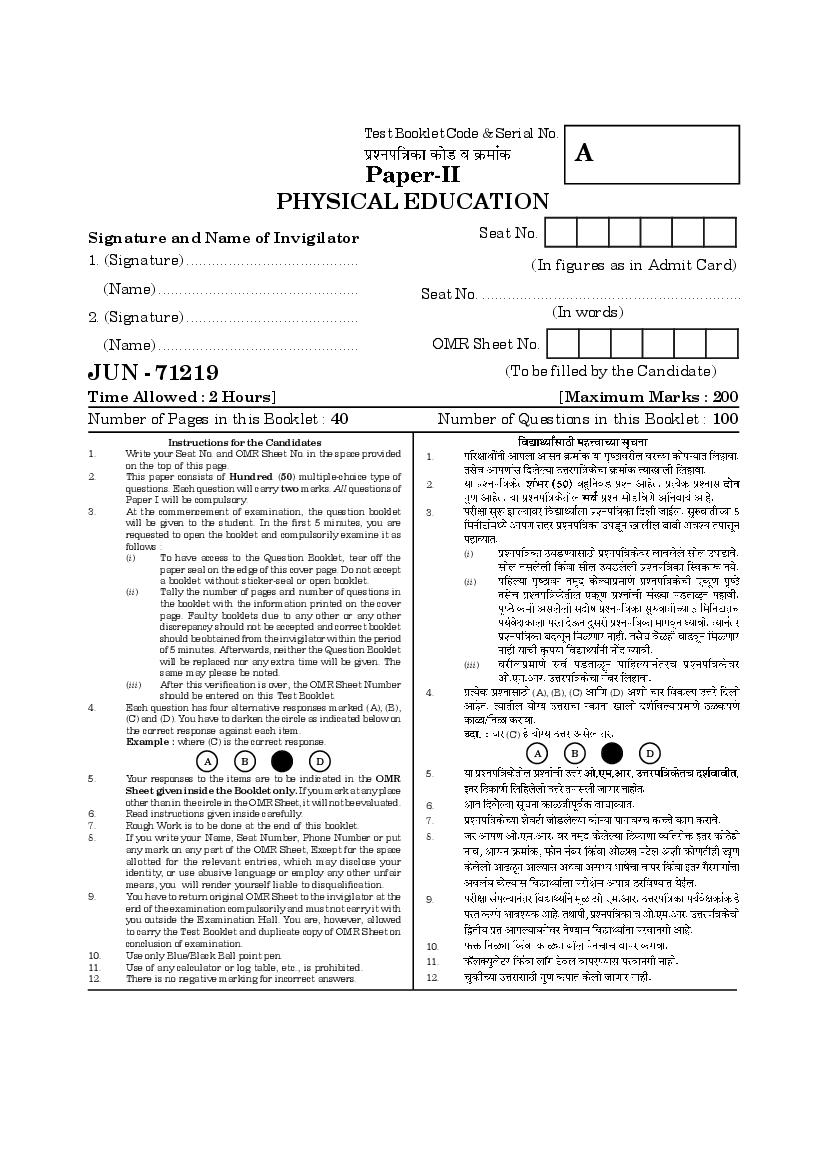
A
PHYSICAL EDUCATION
Signature and Name of Invigilator Seat No.
1. (Signature) ......................................... (In figures as in Admit Card)
(Name) ................................................ Seat No. ..............................................................
2. (Signature) ......................................... (In words)
(Name) ................................................ OMR Sheet No.
JUN - 71219 (To be filled by the Candidate)
Time Allowed : 2 Hours] [Maximum Marks : 200
Number of Pages in this Booklet : 40 Number of Questions in this Booklet : 100
Instructions for the Candidates
1. Write your Seat No. and OMR Sheet No. in the space provided 1.
on the top of this page.
2. This paper consists of Hundred (50) multiple-choice type of
questions. Each question will carry two marks. All questions of 2.
Paper I will be compulsory.
3. At the commencement of examination, the question booklet 3.
will be given to the student. In the first 5 minutes, you are
requested to open the booklet and compulsorily examine it as
follows :
(i) To have access to the Question Booklet, tear off the (i)
paper seal on the edge of this cover page. Do not accept
a booklet without sticker-seal or open booklet. (ii)
(ii) Tally the number of pages and number of questions in
the booklet with the information printed on the cover
page. Faulty booklets due to any other or any other
discrepancy should not be accepted and correct booklet
should be obtained from the invigilator within the period
of 5 minutes. Afterwards, neither the Question Booklet
will be replaced nor any extra time will be given. The (iii)
same may please be noted.
(iii) After this verification is over, the OMR Sheet Number
should be entered on this Test Booklet. 4. (A), (B), (C) (D)
4. Each question has four alternative responses marked (A), (B),
(C) and (D). You have to darken the circle as indicated below on
the correct response against each item. (C)
Example : where (C) is the correct response.
A B D
A B D
5. Your responses to the items are to be indicated in the OMR 5.
Sheet given inside the Booklet only. If you mark at any place
other than in the circle in the OMR Sheet, it will not be evaluated. 6.
6. Read instructions given inside carefully.
7.
7. Rough Work is to be done at the end of this booklet.
8. If you write your Name, Seat Number, Phone Number or put 8.
any mark on any part of the OMR Sheet, Except for the space
allotted for the relevant entries, which may disclose your
identity, or use abusive language or employ any other unfair
means, you will render yourself liable to disqualification.
9. You have to return original OMR Sheet to the invigilator at the 9.
end of the examination compulsorily and must not carry it with
you outside the Examination Hall. You are, however, allowed
to carry the Test Booklet and duplicate copy of OMR Sheet on
conclusion of examination. 10.
10. Use only Blue/Black Ball point pen.
11.
11. Use of any calculator or log table, etc., is prohibited.
12. There is no negative marking for incorrect answers. 12.
Page 2
Page 3
Paper II
II
Time Allowed : 120 Minutes] [Maximum Marks : 200
Note : This Paper contains Hundred (100) multiple choice questions. Each question
carrying Two (2) marks. Attempt All questions.
(100) (2)
1. Wellness is : 1.
(A) Achievement of optimal health (A)
and vitality
(B) Absence of disease
(B)
(C) Maintain healthy body
(C)
(D) Physical fitness
(D)
2. The ratio of length and breadth of
National Flag : 2.
(A) 3 : 2 (A) 3 : 2
(B) 2 : 3 (B) 2 : 3
(C) 3 : 4 (C) 3 : 4
(D) 4 : 3 (D) 4 : 3
3. One of the following is an
3.
inappropriate feedback while
correcting the child :
(A)
(A) Remember to step forward
(B) Practise properly (B)
(C) Look at the incoming object (C)
(D) Turn towards object (D)
3 [P.T.O.
Page 4
received the Jeevan Gourav award
in sports of Maharashtra state :
(A) Shri Uday Deshpande (A)
(B) Shri Ramesh Vipat (B)
(C) Shri Ganpat Mane (C)
(D) Shri Bhishmraj Bam (D)
5. Countries participating in Common- 5.
wealth Games :
(I)
(I) Canada
(II)
(II) India
(III)
(III) Australia
(IV)
(IV) New Zealand
(A) I, III IV
(A) I, III and IV
(B) I, II, III IV
(B) I, II, III and IV
(C) II, III IV
(C) II, III and IV
(D) III IV
(D) III and IV
6.
6. Which of the following is an example
of test protocol when setting up a
fitness test ?
(A) To ensure that the distance is (A)
measured accurately
(B) To shower and change your (B)
clothes after the test
(C) To try and compete with others (C)
to get the best score
(D) To shout out the score after a (D)
flexibility test
4
Page 5
Olympic Games :
(I) China (I)
(II) Japan (II)
(III) Indonesia (III)
(IV) Malaysia
(IV)
(A) I, III, IV
(A) I, III, IV
(B) I and II
(B) I II
(C) I, II, III
(C) I, II, III
(D) I, II, III, IV
(D) I, II, III, IV
8. The environment can affect
8.
participation in physical activities,
which one of the following is an
example of a city environment
having a ‘Negative Effect’ on
participation in physical activities ?
(A) Good transport system (A)
(B) Many indoor sports facilities (B)
(C) Few area of green space (C)
(D) Multi-cultural population (D)
5 [P.T.O.
Page 6
the sports governing bodies of the
country ?
(A)
(A) Clarity of objectives of the
(B)
sports federation
(C)
(B) Financial clarity and strategy
(C) Broad composition and operation (D)
(D) All of the above 10.
10. Sports Psychology is : (A)
(A) Developmental psychology (B)
(B) Experimental psychology
(C)
(C) Clinical psychology
(D)
(D) Applied psychology
11.
11. During concentric contraction the
..................... are pulled towards the
middle of sarcomere.
(A)
(A) I-band
(B)
(B) H-zone
(C) A-band (C)
(D) Z-line (D)
6
Page 7
correct answer from the codes given
below :
Site of Proposed
(1) (I)
Fatigue Mechanism
(1) Neuromuscular (I) Lack of oxygen
junction and inadequate
blood flow (2) (II)
(2) Contractile (II) Local distribu-
mechanism tion caused by
contractile
fatigue signals
(3) Central (III) Decreased
(3) (III)
nervous release of
system acetylcholine
at nerve ending
Codes :
(1) (2) (3)
(1) (2) (3)
(A) (III) (I) (II)
(A) (III) (I) (II)
(B) (I) (II) (III) (B) (I) (II) (III)
(C) (III) (II) (I) (C) (III) (II) (I)
(D) (I) (III) (II) (D) (I) (III) (II)
7 [P.T.O.
Page 8
least how many hours are needed
to restore muscle glycogen level ?
(A) 48
(A) 48
(B) 24
(B) 24
(C) 12
(C) 12
(D) 2
(D) 2
14. Minute ventilation (VE) = ............. ×
Respiratory frequency (f). 14. (VE) = ................. ×
(f).
(A) Inspiratory Reserved Volume
(IRV) (A) (IRV)
(B) Expiratory Reserved Volume (B) (ERV)
(ERV)
(C) (TV)
(C) Tidal Volume (TV)
(D) (VC)
(D) Vital Capacity (VC)
15. (Q)
15. Find out the heart rate of a person
20
whose cardiac output (Q) is 20 litres
0.15
per minute and the stroke volume
is 0.15 liters per beat ?
(A) 133 beats/minute (A) 133
(B) 125 beats/minute (B) 125
(C) 70 beats/minute (C) 70
(D) 180 beats/minute (D) 180
8
Page 9
venous return is provided by
........................ .
(A)
(A) Venous pump
(B)
(B) Arterial pump
(C)
(C) Ventricular pump
(D)
(D) Respiratory pump
17. The basic structural unit of proteins 17.
are ................... .
(A) Amino acids (A)
(B) Lactic acid (B)
(C) Ascorbic acid
(C)
(D) Acetic acid
(D)
18. The random movement of molecules
18.
due to their kinetic energy is
.......................... .
(A)
(A) Systole
(B) Diastole (B)
(C) Diffusion (C)
(D) Osmosis (D)
9 [P.T.O.
Page 10
blood cells, which contains iron and
protein and is capable of combining
with oxygen is ..................... .
(A) Hemoglobin (A)
(B)
(B) Hypotonic
(C)
(C) Hemodilution
(D)
(D) Hemolysis
20.
20. The major cause of coronary heart
disease is .......................... .
(A) Vasoconstriction
(A)
(B) Vasodialation
(B)
(C) Hypertensive
(C)
(D) Atherosclerosis
(D)
21. Coronal plane is also known
21.
as .......................... .
(A) Sagittal plane (A)
(B) Frontal plane (B)
(C) Transverse plane (C)
(D) Horizontal plane (D)
10
Page 11
joint ?
(A)
(A) Shoulder
(B)
(B) Elbow
(C)
(C) Neck
(D)
(D) Hip
23.
23. ...................... levers are known as
force multipliers.
(A)
(A) Second and third class
(B)
(B) Third and first class
(C)
(C) First and second class
(D)
(D) None of the above
24.
24. The product of mass and acceleration
is ......................... .
(A)
(A) Force
(B) Inertia (B)
(C) Velocity (C)
(D) Work (D)
25. Speed is a ...................... quantity. 25.
(A) Scalar (A)
(B) Vector (B)
(C) Both scalar and vector (C)
(D) None of the above (D)
11 [P.T.O.
Page 12
(A) Object speeds up (A)
(B) Object slows down (B)
(C) Object starts and stops (C)
(D) All of the above (D)
27. The centripetal force is directly 27.
proportional to ...................... .
(A) Mass of the object (A)
(B) Radius (B)
(C) Both (A) and (B) (C) (A) (B)
(D) None of the above (D)
28. Upward force exerted on objects 28.
submerged in fluids is called
....................... force.
(A) Drag (A)
(B) Magnus (B)
(C) Couple (C)
(D) Bouyant (D)
29. Angular Acceleration is represented 29.
by symbol ...................... .
(A) Radial (A)
(B) Omega (B)
(C) Alpha (C)
(D) Theta (D)
12
Page 13
is .......................... .
(A)
(A) Work
(B)
(B) Power
(C)
(C) Energy
(D)
(D) Inertia
31. ......................... is a preferred sampling 31.
method for the population with
finite size. (A)
(A) Area sampling (B)
(B) Systematic sampling
(C)
(C) Purposive sampling
(D)
(D) Cluster sampling
32.
32. Which of the following is a
measure of internal consistency of
a measure ? (A)
(A) Cronbach’s alpha (B)
(B) Test retest reliability (C)
(C) Correlation coefficient (D)
(D) t-test
33.
33. H.R.P.F. includes ........................ .
(I) Cardiovascular endurance (I)
(II) Muscular strength and (II)
endurance
(III)
(III) Agility
(IV) Flexibility (IV)
(A) I, II and III (A) I, II III
(B) I, II and IV (B) I, II IV
(C) I, III and IV (C) I, III IV
(D) I, II, III and IV (D) I, II, III IV
13 [P.T.O.
Page 14
is labelled as Assertion (A) and the
other is labelled as Reason (R) :
(A)
Assertion (A) :
Psychological core of personality is
the deepest component which
includes attributes, value, interests,
motives and self worth of an (R)
individual.
Reason (R) :
Psychological core of personality is
dynamic and external and make
adjustment of the environment.
In the context of the above
(A) (R) (A)
statement, which one of the
following is correct ?
(B) (R) (A)
(A) Both are true and (R) is the
correct explanation of (A)
(B) Both are true but (R) is not the (C) (A) (R)
correct explanation of (A)
(C) (A) is true but (R) is false (D) (A) (R)
(D) (A) is false but (R) is true
14
Page 15
considered to be intellectually
disabled.
(A) 120
(A) 120 and above
(B) 90 100
(B) 90 to 100
(C) 76 90
(C) Between 76 to 90
(D) 75
(D) Below 75
36.
36. Pep talk is useful for ..................... .
(A) Motivation
(A)
(B) Emotional arousal
(B)
(C) Best performance
(C)
(D) All of the above
(D)
37. Motivation consists of :
37.
(A) Direction
(A)
(B) Intensity
(B)
(C) Persistence
(C)
(D) All of the above
(D)
38. What skills do students learn in
38.
cooperative games ?
(A) Responsibility and empathy
(A)
(B) How to keep other kids in line
(B)
(C) Ways to get what you want
often (C)
(D) Reaching personal goals (D)
15 [P.T.O.
Page 16
teaching is depended on .......... ?
Select correct code given below :
(a) Physical engaged time spent by (a)
student on activity
(b) General supervision (b)
(c) Allocated time for physical (c)
activity
(d) Well-planned and meaningful (d)
task
Codes :
(A) (a) (b) (c)
(A) (a) (b) (c)
(B) (a) (c) (d)
(B) (a) (c) (d)
(C) (b) (c) (d)
(C) (b) (c) (d)
(D) (a) (b) (d)
(D) (a) (b) (d)
40.
40. Who wrote Military system of
Gymnastics exercise for the use of
arm instructors mannual ?
(A) Archibald Msclarin (A)
(B) Lundovin John (B)
(C) Guthsmuts (C)
(D) Henry Perling (D)
41. The super compensation effect of 41.
training is due to ....................... .
(A) Appropriate load and recovery (A)
(B) Lack of periodization (B)
(C) Competition (C)
(D) Practice (D)
16
Page 17
professional preparation is ................
(A) Self-esteem (A)
(B) Special standard of work
(B)
(C) Belief of people on profession
(C)
(D) Behaviour of professional
(D)
43. Body functions and related energy
expenditure : 43.
List-I List-II -I -II
(1) Digestion of (i) 55 to 75% (1) (i) 55 75%
food (2) (ii) 10 15%
(2) Movement (ii) 10 to 15% (3) (iii) 10 40%
(3) Resting (iii) 10 to 40%
Metabolism
Codes :
(1) (2) (3)
(1) (2) (3)
(A) (iii) (ii) (i)
(A) (iii) (ii) (i)
(B) (ii) (iii) (i)
(B) (ii) (iii) (i)
(C) (ii) (i) (iii)
(C) (ii) (i) (iii)
(D) (i) (ii) (iii) (D) (i) (ii) (iii)
44. Endurance type training modulates 44.
fuel storage and substrate use.
Adaptive response includes :
(A) Increasing intramuscular lipid (A)
use during exercise
(B) Increasing muscle glycogen use (B)
during exercise
(C) Increasing liver glycogen
content (C)
(D) Lowering intramuscular lipid
storage (D)
17 [P.T.O.
Page 18
healing, infection in urine are
symptoms of ...................... .
(A) High BP
(A)
(B) Cancer
(B)
(C) Diabetes
(C)
(D) Heart attack
(D)
46. Match the stages of development
List-I with systematic improvement 46. -I
of teaching skill as List-II and -II
identify correct code given below :
List-I List-II
(a) Stage 1 (1) Learning how to -I -II
do more than one
(a) 1 (1)
thing at a time
(b) Stage 2 (2) Initial discomfort
stage
(b) 2 (2)
(c) Stage 3 (3) Learning how to
use your skills
more appropri- (c) 3 (3)
ately
(d) Stage 4 (4) Learning variety (d) 4 (4)
of techniques
Codes :
(a) (b) (c) (d)
(a) (b) (c) (d)
(A) (2) (3) (1) (4)
(A) (2) (3) (1) (4)
(B) (2) (4) (1) (3) (B) (2) (4) (1) (3)
(C) (3) (4) (1) (2) (C) (3) (4) (1) (2)
(D) (4) (1) (3) (2) (D) (4) (1) (3) (2)
18
Page 19
reasons except :
(A) They are easily digested (A)
(B) They provide energy without (B)
feeling full
(C) They decrease lactic acid (C)
production
(D) They contribute of fluid needs (D)
48. B.M.I. of .................. or more than that
48.
is considered as overweight and
obese.
(A) 25 kg/m2 and 30 kg/m2 2 2
(A) 25 30
(B) 12 kg/m2 and 17 kg/m2 2 2
(B) 12 17
(C) 2.5 kg/m2 and 3.0 kg/m2 2 2
(C) 2.5 3.0
(D) 30 kg/m2 and 25 kg/m2 2 2
(D) 30 25
49. Factor responsible for obesity :
49.
(I) Heredity
(I)
(II) Metabolism
(II)
(III) Lifestyle (III)
(IV) Hormone (IV)
(A) I and II (A) I II
(B) II, III and IV (B) II, III IV
(C) I, II, III and IV (C) I, II, III IV
(D) I, II and IV (D) I, II IV
19 [P.T.O.
Page 20
introduced to revive ..................... .
(A) The sports federations (A)
(B) The sports culture in India at (B)
grass-root level
(C) The sports competition organi- (C)
zation
(D)
(D) The capacity of Indian coaches
51.
51. Balanced diet, Regular exercise and
Positive lifestyle will give the
benefit of ......................... .
(I)
(I) Wellness
(II)
(II) Health
(III)
(III) Being healthy
(IV)
(IV) Well being
(A) I, II, III
(A) I, II, III
(B) II, III, IV
(B) II, III, IV
(C) IV, I, II (C) IV, I, II
(D) I, II, III, IV (D) I, II, III, IV
52. In a statistical table, the row 52.
headings are referred to as :
(A) Source note (A)
(B) Footnote (B)
(C) Stub (C)
(D) Body (D)
20
Page 21
wellness is ....................... .
(i) Diet
(i)
(ii) Exercise
(ii)
(iii) Positive change in lifestyle
(iii)
(A) (i) and (ii)
(B) (i) and (iii) (A) (i) (ii)
(C) (i), (ii) and (iii) (B) (i) (iii)
(D) (ii) and (iii) (C) (i), (ii) (iii)
54. Ancient and Modern Olympic Games (D) (ii) (iii)
started in .......................... .
54.
(A) Greenland
(B) Greece
(A)
(C) Athens
(B)
(D) Rome
55. Of the following, the most important (C)
consideration in selecting a physical (D)
education activity for primary school
class is to ensure that the selected 55.
activity :
(A) Includes strength and
endurance enhancement
(B) Enables all children to (A)
participate and improvement of
(B)
movement skills
(C) Includes both individual and
group component (C)
(D) Has interdisciplinary connections (D)
21 [P.T.O.
Page 22
appropriate practice in establishing
learning environment ?
(A)
(A) Rules vary from day-to-day
(B)
(B) Teacher has systematic plans
(C) Students take responsibility of (C)
their behaviour
(D) Misbehaviours are dealt with (D)
immediately
57.
57. ...................... is not a dimension of
wellness.
(A) Physical (A)
(B) Individual (B)
(C) Intellectual (C)
(D) Environmental
(D)
58. (I) Expiration is the process of air
58. (I)
movement into the lungs.
(II) Expiration at rest is usually a
passive process. (II)
(A) Statement (I) is true and (II) is
false
(A) (I) (II)
(B) Statement (I) is false and (II)
(B) (I) (II)
is true
(C) Statements (I) and (II) are true (C) (I) (II)
(D) Statements (I) and (II) are false (D) (I) (II)
22
Page 23
synthesized by the body.
(II) Lipoproteins are primarily
made up of unsaturated fatty (II)
acid.
(A) Statement (I) is true, statement
(A) (I) (II)
(II) is false
(B) Statement (I) is false, statement (B) (I) (II)
(II) is true
(C) (I) (II)
(C) Statement (I) and (II) are true
(D) Statement (I) and (II) are false (D) (I) (II)
60. (I) Athletes require increased 60. (I)
amount of minerals above the
RDA.
(II) Osteoporosis begins early in life (II)
due mainly to inadequate
calcium intake.
(A) Statement (I) is false and (II)
is true (A) (I) (II)
(B) Statement (I) is true and (II) is
(B) (I) (II)
false
(C) (I) (II)
(C) Statement (I) and (II) are true
(D) Statement (I) and (II) are false (D) (I) (II)
23 [P.T.O.
Page 24
conditioning program through :
(A) Exercise
(A)
(B) Cycles
(B)
(C) Recovery
(C)
(D) Intensity
(D)
62. Match the List A and B and select
62. A B
the correct option :
List-A List-B A B
(1) Intensity (i) Plyometrics (1) (i)
(2) Time (ii) 3-5 days/weeks (2) (ii) 3-5
(3) Frequency (iii) 60-80% of MHR (3) (iii)
(4) Type (iv) 40-45 min 60-80%
(4) (iv) 40-45
Codes :
(1) (2) (3) (4)
(1) (2) (3) (4)
(A) (iv) (iii) (ii) (i)
(A) (iv) (iii) (ii) (i)
(B) (i) (iv) (ii) (iii)
(B) (i) (iv) (ii) (iii)
(C) (iii) (iv) (ii) (i)
(C) (iii) (iv) (ii) (i)
(D) (iii) (iv) (i) (ii)
(D) (iii) (iv) (i) (ii)
63. Calculate THR at 60% intensity for
63. 28 RHR 70
28 years old Kabaddi player whose
bpm 60% 35
RHR is 70 bpm and who wants to THR
perform 35 min continuous running.
(A) 145.2 bpm (A) 145.2
(B) 143.2 bpm (B) 143.2
(C) 144.2 bpm (C) 144.2
(D) 146.2 bpm (D) 146.2
24
Page 25
process.
(A) Sports competition and
(A)
development
(B) Sports participation and (B)
improvement
(C)
(C) Sports equipment distribution
(D)
(D) Sports talent identification and
development 65.
65. To develop strategies and tactics we
need to know the ...................... .
(i) Strength and weaknesses of the
(i)
opposition
(ii)
(ii) Our own strength and
weaknesses (iii)
(iii) Environmental factors
(A) (ii) (iii)
(A) (ii) and (iii)
(B) (i) (ii)
(B) (i) and (ii)
(C) (i) (iii)
(C) (i) and (iii)
(D) (i), (ii) and (iii) (D) (i), (ii) (iii)
25 [P.T.O.
Page 26
the first phase of skill acquisition
is ........................ .
(A)
(A) To achieve mastery over the
technique (B)
(B) To achieve rough coordination
(C)
(C) To achieve fine coordination in
technique (D)
(D) To achieve skill conditioning 67.
67. ‘‘You should exercise the energy
systems, muscles, actions and skills
that are relevant to that sport’’.
................... principal of training does
this define. (A)
(A) Frequency (B)
(B) Progression
(C)
(C) Specificity
(D)
(D) Reversibility
68.
68. Which one of the following best
describes the plyometrics training
method ?
(A)
(A) Involves mainly stretching
(B)
(B) Involves continuous running
(C)
(C) Involves long duration activity
(D) Involves mainly bounding and (D)
hopping
26
Page 27
important factor to be considered
is .......................... .
(i)
(i) Training state
(ii)
(ii) Health
(iii)
(iii) Interest and attitude
(iv)
(iv) Heredity
(A) (i) (iii)
(A) (i) and (iii)
(B) (iii), (ii) and (iv) (B) (iii), (ii) (iv)
(C) (i), (ii) and (iv) (C) (i), (ii) (iv)
(D) (i), (ii), (iii) and (iv) (D) (i), (ii), (iii) (iv)
70. After acquiring mastery over skills, 70.
stress is laid on ........................ .
(A) Development of SRPF (A)
(B) Tactical training (B)
(C) Technical preparation (C)
(D) Training of HRPF components
(D)
71. The interview in which a set of open-
71.
ended questions are asked in a
specific order and exactly as worded
is :
(A) Focus group interview
(A)
(B) Closed quantitative interview
(B)
(C) Formal conversational interview
(D) Standardized open-ended (C)
interview (D)
27 [P.T.O.
Page 28
code :
Column I Column II I II
(1) Alpha ( ) (i) The magni- (1) ( ) (i) II
tude of type II
error
(2) Type I error (ii) Acceptance of (2) I (ii)
the null hypo-
thesis when
null hypoth-
esis is false
(3) Type II error (iii) Level of sig- (3) II (iii)
nificance
(4) ( ) (iv)
(4) Beta ( ) (iv) Rejection of
the null hy-
pothesis when
null hypothe-
sis is true
Codes :
(1) (2) (3) (4)
(1) (2) (3) (4)
(A) (iii) (iv) (ii) (i) (A) (iii) (iv) (ii) (i)
(B) (iii) (ii) (i) (iv)
(B) (iii) (ii) (i) (iv)
(C) (i) (iv) (ii) (iii)
(D) (i) (iii) (iv) (ii) (C) (i) (iv) (ii) (iii)
73. Appropriate sequence of major (D) (i) (iii) (iv) (ii)
sections in the research report would
be : 73.
(A) Introduction, method, results,
discussion, references
(B) Introduction, references, (A)
methods, results, discussion
(B)
(C) Introduction, discussion,
method, results, references (C)
(D) Introduction, results, method,
references, discussion (D)
28
Page 29
the introduction of research report
be written ?
(A)
(A) Present
(B)
(B) Past
(C)
(C) Future
(D) Any of the tenses (D)
75. The defining feature of the historical 75.
research is to :
(A) Generate and develop a theory (A)
(B) Research about people, places
(B)
and event in the past
(C) Describe the culture of a group
(C)
of people
(D) Understand how individuals (D)
experience a phenomenon
76. A design in which all participants 76.
participate in all experimental
treatment conditions :
(A) Pre-test post-test control group
(A)
design
(B)
(B) Post-test only design
(C) Repeated measures design (C)
(D) Factorial design (D)
29 [P.T.O.
Page 30
increased muscle mass and better
muscle memory, which affects
overall exercise performance (DV).’’
In this example, increased muscle
memory is .................... .
(A) Mediating variable (A)
(B) Moderator variable (B)
(C) Extraneous variable (C)
(D) Categorical variable (D)
78. Which of the following is the most
78.
similar ?
(A) Nominal, ratio and interval
(A)
data
(B) Ordinal, nominal and ratio data (B)
(C) Ordinal, interval and ratio data (C)
(D) Nominal, ordinal and ratio data (D)
79. Which test is used to assess the 79.
relationship between two ordinal
variables ?
(A) ‘V’
(A) Cramer’s V
(B)
(B) Phi
(C) Spearman’s rho (C) ‘rho’
(D) Chi-square (D)
30
Page 31
search would be to :
(A) Read introductory textbooks
(A)
(B) Do a literature search online
(B)
(C) Ask teacher to give some articles
(C)
(D) Order inter-library loan
(D)
81. Match the following physical fitness
components with their respective 81.
tests :
List-I List-II
-I -II
(a) Agility (1) Sargent Jump
(a) (1)
rest
(b) (2)
(b) Power (2) Trunk Flexion
(c) Balance (3) Right Boomrang (c) (3)
run (d) (4)
(d) Flexibility (4) Stork stand
(5) 60
(5) 60 yard dash
Codes :
(a) (b) (c) (d)
(a) (b) (c) (d)
(A) (5) (4) (1) (2)
(A) (5) (4) (1) (2)
(B) (3) (4) (2) (1)
(B) (3) (4) (2) (1)
(C) (3) (1) (4) (2) (C) (3) (1) (4) (2)
(D) (3) (5) (2) (4) (D) (3) (5) (2) (4)
31 [P.T.O.
Page 32
choices given below :
(I) To ensure reliability, measure- (I)
ment technique and condition
should be standardized to
reduce measurement error.
(II) Length of the test and hetero- (II)
geneity affect reliability of
instrument.
(A) Both (I) and (II) are correct (A) (I) (II)
(B) (I) is correct and (II) is wrong (B) (I) (II)
(C) (II) is correct and (I) is wrong (C) (II) (I)
(D) Both (I) and (II) are wrong (D) (I) (II)
83. Below are the norms of Grip 83.
strength, Measurement of 23 years 23
women is 47 kg. What is the
47
interpretation of this measure-
ment ?
Men
10-19 20-29 30-39
Age 10-19 20-29 30-39
61 Above Above 54 Above 51
Superior 61 Above Above 54 Above 51
51-61 47-54 43-51
Excellent 51-61 47-54 43-51
Good 47-50 42-46 39-42 47-50 42-46 39-42
Average 41-46 38-41 35-38 41-46 38-41 35-38
Poor 36-40 33-37 30-34 36-40 33-37 30-34
Very Poor Below 36 Below 33 Below 30 Below 36 Below 33 Below 30
Women
Superior 54 Above Above 50 Above 41 54 Above Above 50 Above 41
Excellent 46-54 44-50 35-41 46-54 44-50 35-41
Good 36-45 38-43 29-34 36-45 38-43 29-34
Average 32-35 32-37 25-28 32-35 32-37 25-28
Poor 28-31 27-31 20-24 28-31 27-31 20-24
Very Poor Below 28 Below 27 Below 20 Below 28 Below 27 Below 20
(A) Arm strength is Superior (A)
(B) Arm strength is Very Poor (B)
(C) Arm strength is Excellent (C)
(D) Arm strength is Good (D)
32
Page 33
does NOT include in AAHPERD
Basketball Skill Test ?
(A) Speed spot shooting (A)
(B) Jumping and turning in the air (B)
(C) Defensive movement (C)
(D) Forward pass (D)
85. ‘‘Reliability is the same as : 85.
(A) Consistency (A)
(B) Truthfulness (B)
(C) Representativeness (C)
(D) Usefulness (D)
86. The SCAT questionnaire tests 86. ‘SCAT’
......................... of athletes.
(A) Teaching ability (A)
(B) Self-confidence (B)
(C) Concentration (C)
(D) Anxiety (D)
33 [P.T.O.
Page 34
calculate item difficulty ?
(A) Difficulty Index (A) =
Number correct in upper group
=
Number correct in lower group
(B) Difficulty Index (B) =
Number Answering Wrongly
=
Number Answering Correctly
(C) Difficulty Index (C) =
Number answering correctly
=
Total number of group
(D) Difficulty Index
(D) =
Number answering correctly
=
Total number of questions
88. Which of the following factors NOT
88.
affecting Reliability of Test ?
(A) Method of scoring
(A)
(B) Objective of test
(B)
(C) Administrative procedure
(C)
(D) Length of the test (D)
34
Page 35
in somatotyping ?
(A)
(A) Endomorph — Ectomorph —
Mesomorph (B)
(B) Endomorph — Mesomorph —
(C)
Ectomorph
(C) Ectomorph — Endomorph — (D)
Mesomorph
90.
(D) Mesomorph — Endomorph —
Ectomorph
90. Which of the following is the (A)
subjective method of measuring
(B)
Physical Activity ?
(A) Heart rate telemetry (C)
(B) Pedometry
(D)
(C) Accelerometry
91.
(D) Log book
91. The actual exchange of gases in
lungs takes place in ..................... . (A)
(A) Alveoli
(B)
(B) Trachea
(C)
(C) Pharynx
(D) Primary bronchus (D)
35 [P.T.O.
Page 36
are from :
(A) – 5 to + 5 (A) – 5 to + 5
(B) – 3.5 to + 3.5
(B) – 3.5 to + 3.5
(C) – 3 to + 3
(C) – 3 to + 3
(D) – 5.5 to + 5.5
(D) – 5.5 to + 5.5
93. In a longitudinal study, factors such
as maturation changes, mortality 93.
would be considered threats to
what ?
(A)
(A) Significance
(B)
(B) Internal validity
(C)
(C) Instrumentation
(D) Reliability (D)
94. Match List-I with List-II and select 94. -I -II
the correct answer from the codes
given below : -I -I
List-I List-II
(1) (i)
(1) Cerebral palsy (i) Impairs ability to
communicate
(2) (ii)
(2) Autism (ii) Affects muscle
movement and
coordination
(3) Down Syndrome (iii) Causes develop- (3) (iii)
ment delays
(4) Epilepsy (iv) Disturbs nerve (4) (iv)
cell activity in
brain
Codes :
(1) (2) (3) (4)
(1) (2) (3) (4)
(A) (ii) (i) (iv) (iii) (A) (ii) (i) (iv) (iii)
(B) (ii) (i) (iii) (iv) (B) (ii) (i) (iii) (iv)
(C) (ii) (iii) (iv) (i) (C) (ii) (iii) (iv) (i)
(D) (ii) (iv) (i) (iii) (D) (ii) (iv) (i) (iii)
36
Page 37
fundamental skill ?
(A) Locomotor skill (A)
(B) Sports skill (B)
(C) Manipulative skill (C)
(D) Non-locomotor skill (D)
96. .......................... is not a fat soluble 96.
vitamin.
(A) Vitamin A (A)
(B) Vitamin C (B)
(C) Vitamin D (C)
(D) Vitamin K (D)
97. First aid for seizure includes the 97.
following except :
(A) Time the seizure (A)
(B) Remove sharp objects (B)
(C) Avoid holding the person (C)
(D) Putting something in mouth (D)
98. Handball skills might be useful 98.
while playing basketball is an
example of ...................... .
(A) Negative transfer of learning (A)
(B) Zero transfer of learning (B)
(C) Stable transfer (C)
(D) Positive transfer of learning (D)
37 [P.T.O.
Page 38
the correct answer from the codes
given below :
-I -I
List-I List-II
(1) (i)
(1) Passive muscle (i) Treadmill
contraction exercise
(2) (ii)
(2) Active muscle (ii) Plank hold
contraction exercise
(3) Isokinetic (iii) Pull-ups (3) (iii)
muscle exercise
contraction
Codes : (1) (2) (3)
(1) (2) (3)
(A) (ii) (iii) (i)
(A) (ii) (iii) (i)
(B) (i) (iii) (ii)
(B) (i) (iii) (ii)
(C) (iii) (ii) (i)
(C) (iii) (ii) (i)
(D) (ii) (i) (iii)
(D) (ii) (i) (iii)
100.
100. Apex body related to physical
education teacher education is :
(A) NCTE (A)
(B) SCERT (B)
(C) NCERT (C)
(D) UGC (D)
38
Page 39
39 [P.T.O.
Page 40
40
Document Details
| Board / Org | Maharashtra Exams |
| Exam | MAHA SET |
| Type | Question Paper |
| Pages | 40 |
| Updated | 30 Apr 2026 |