Karnataka SSLC Question Paper 2022 Answer Key Health Care
Finished viewing? Save it for later —
Download Karnataka SSLC Question Paper 2022 Answer Key Health Care (PDF · 15 pages)About Karnataka SSLC Question Paper 2022 Answer Key Health Care
Karnataka SSLC Question Paper 2022 Answer Key Health Care is available here for free download. Published by Karnataka Board for Class 10, this answer key can be viewed online or downloaded as a PDF (15 pages). Candidates preparing for Class 10 can use Karnataka SSLC Question Paper 2022 Answer Key Health Care to understand the exam pattern, the type of questions asked, and the overall difficulty level.
Frequently Asked Questions
How can I download Karnataka SSLC Question Paper 2022 Answer Key Health Care?
Open this page and click the Download button to save Karnataka SSLC Question Paper 2022 Answer Key Health Care as a PDF. It is completely free on AglaSem Docs.
Is Karnataka SSLC Question Paper 2022 Answer Key Health Care free to download?
Yes. Karnataka SSLC Question Paper 2022 Answer Key Health Care can be viewed online and downloaded as a PDF free of cost on AglaSem Docs.
How many pages does Karnataka SSLC Question Paper 2022 Answer Key Health Care have?
Karnataka SSLC Question Paper 2022 Answer Key Health Care contains 15 pages, which you can read online or download together as a single PDF.
Where can I find more Class 10 study material?
You can find more Class 10 question papers, sample papers, syllabus, and answer keys on AglaSem Docs.
Karnataka SSLC Question Paper 2022 Answer Key Health Care – Text
Read the full text of this answer key below — useful to quickly search, copy and reference the content online without downloading the PDF.
📄 View text version (15 pages)
Page 1
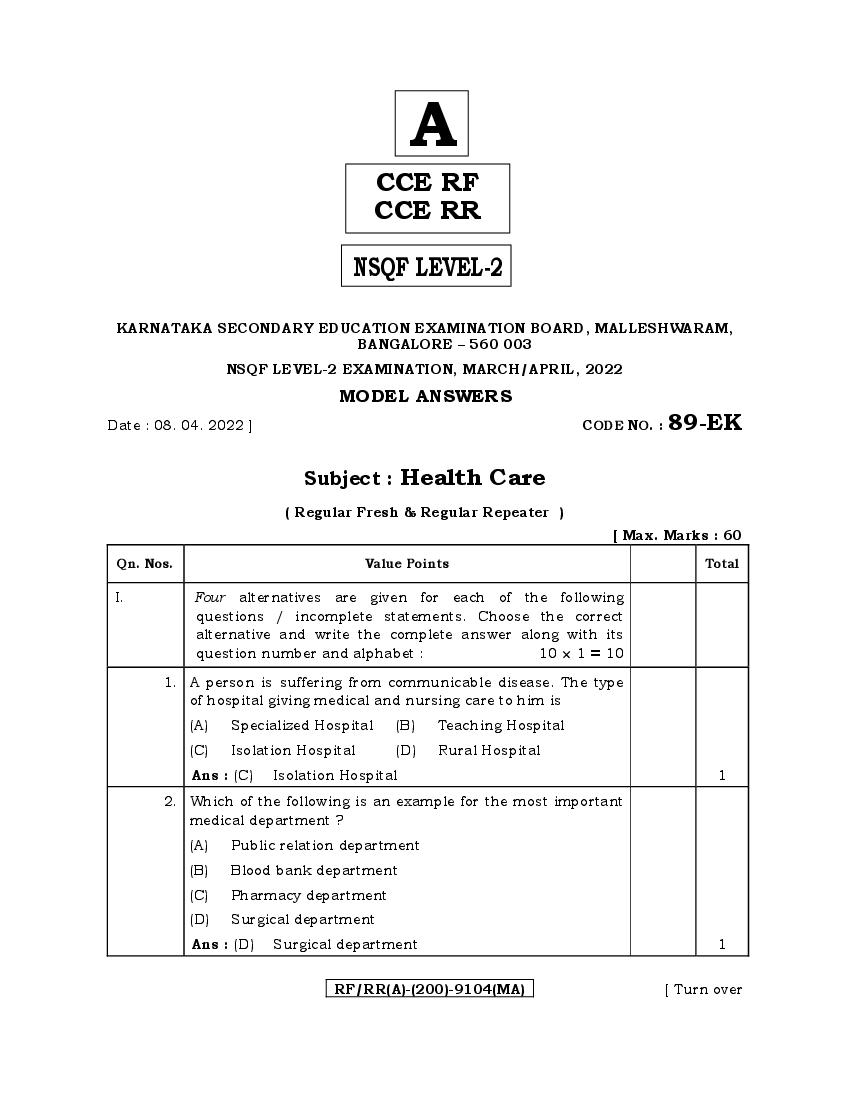
CCE RF
CCE RR
NSQF LEVEL-2
KARNATAKA SECONDARY EDUCATION EXAMINATION BOARD, MALLESHWARAM,
BANGALORE – 560 003
NSQF LEVEL-2 EXAMINATION, MARCH/APRIL, 2022
MODEL ANSWERS
Date : 08. 04. 2022 ] CODE NO. : 89-EK
Subject : Health Care
( Regular Fresh & Regular Repeater )
[ Max. Marks : 60
Qn. Nos. Value Points Total
I. Four alternatives are given for each of the following
questions / incomplete statements. Choose the correct
alternative and write the complete answer along with its
question number and alphabet : 10 × 1 = 10
1. A person is suffering from communicable disease. The type
of hospital giving medical and nursing care to him is
(A) Specialized Hospital (B) Teaching Hospital
(C) Isolation Hospital (D) Rural Hospital
Ans : (C) Isolation Hospital 1
2. Which of the following is an example for the most important
medical department ?
(A) Public relation department
(B) Blood bank department
(C) Pharmacy department
(D) Surgical department
Ans : (D) Surgical department 1
RF/RR(A)-(200)-9104(MA) [ Turn over
Page 2
Qn. Nos. Value Points Total
3. Tests related to micro-organisms and the toxins produced by
them are done in
(A) Parasitological laboratory
(B) Bacteriology laboratory
(C) Haematology laboratory
(D) Clinical biochemistry laboratory
Ans : (B) Bacteriology laboratory 1
4. The chemical agent used in sterilization is
(A) pasteurization (B) radiation
(C) halogens (D) drying
Ans : (C) halogens 1
5. Night blindness disease is caused by the deficiency of
(A) Vitamin A (B) Vitamin B 12
(C) Vitamin C (D) Vitamin D
Ans : (A) Vitamin A 1
6. The orthopedic mechanical device used to immobilize the
bone and protect a part of the body in the case of a fracture
is
(A) Slings (B) Tourniquet bandage
(C) Splints (D) Sterile gloves
Ans : (C) Splints 1
7. The disease caused by Clostridium tetani is
(A) tetanus (B) cystitis
(C) influenza (D) cholera
Ans : (A) tetanus 1
8. The part that separates the chest from the abdomen is
(A) diaphragm (B) liver
(C) stomach (D) pericardium
Ans : (A) diaphragm 1
RF/RR(A)-(200)-9104(MA)
Page 3
Qn. Nos. Value Points Total
9. The chemical used for sanitation of only floors, wall, chair
and table is
(A) Quaternary ammonium compounds
(B) Hydrogen peroxide
(C) Glutaraldehyde
(D) Formaldehyde
Ans : (A) Quaternary ammonium compounds 1
10. The basic unit of the body structure is
(A) tissue (B) cell
(C) organ (D) organ system
Ans : (B) cell 1
II. Fill in the blanks with suitable answer : 4×1=4
11. The number of respirations that take place in a healthy
person, per minute is ....................... .
Ans : 12 to 16 1
12. The telephone number of ambulance is ..................... .
Ans : 108 1
13. An organism which provides shelter to parasite is called
....................... .
Ans : Host 1
14. The instrument used to measure the human heartbeat is
...................... .
Ans : stethoscope 1
RF/RR(A)-(200)-9104(MA) [ Turn over
Page 4
Qn. Nos. Value Points Total
III. The types of tissues are given in Column-A and their
functions are given in Column-B. Match them and write the
answers along with their letters. 4×1=4
15. Match the following :
Column-A Column-B
i) Bone tissue a) Protects the joints and
supports soft tissue
ii) Bone marrow b) Stores the fat
iii) Cartilage tissue c) Protects and supports
internal organs of the
body
iv) Adipose tissue d) Produces and discharges
specialized substances
e) Movement of food
through the digestive
tract
f) Synthesizes the blood
cells
g) Causes movement in
blood vessels
i) c) Protects and supports internal organs of the body 1
ii) f) Synthesizes the blood cells 1
iii) a) Protects the joints and supports soft tissue 1
iv) b) Stores the fat 1
RF/RR(A)-(200)-9104(MA)
Page 5
Qn. Nos. Value Points Total
IV. Answer the following questions : 6×1=6
16. Write any two uses of oxidants.
Formalin is used as surface disinfectant, air surgical
instruments ½
Glutaric dialdehyde is used for disinfecting high
precision instruments, endoscopes ½
3% peroxide is used for disinfecting small trauma
wound.
0·2 % —1 % peroxyacetic acid is used for disinfecting
plastics and glassware
0·1 % potassium permanganate is used for disinfecting
skin. ( Any two )
½+½ 1
17. Iodised salt should be used in our diet. Why ?
Iodine is required for the synthesis of thyroxine from a
thyroid gland. 1
18. What is health emergency ?
A health emergency is a situation in which the health of
a person is in danger because of sudden illness or
accident. ½
Immediate help is required to save life. ½ 1
19. Mention the symptoms of typhoid fever.
Fever and headache, coughing ½
Bleeding from intestines and rose coloured spots on the
skin. ½ 1
RF/RR(A)-(200)-9104(MA) [ Turn over
Page 6
Qn. Nos. Value Points Total
20. What is the role of laundry service in a hospital ?
Washing the dirty lines 1
Repairing the torn linen 1
Replacing the condemned linen. ( Any two ) 2½ 1
21. In the hospitals laboratories must be located in the ground
floor. Why ?
Laboratory services should be easily accessible to the
out-patients. ½
Services may be available day and night. ½ 1
V. Answer the following questions : 6 × 2 = 12
22. List the services provided by out-patient department.
(i) providing the facility of diagnosis or treatment
(ii) ambulatory care
(iii) production of an admission note
(iv) production of a discharge note. (4½) 2
OR
Mention the promotive functions of general duty assistant in
a hospital.
Ans. :
The process of enabling people to increase control over
health related problems and to improve health.
It is not directed against any particular disease but is
intended to strengthen the host.
A variety of approaches such as health education,
environmental modification, nutritional support, life
style and behavioural changes.
The GDA has to educate the client on various aspects of
health education service.
The GDA provides information about health, treatment
or therapy and lifestyle changes. ( Any four ) 4½= 2
RF/RR(A)-(200)-9104(MA)
Page 7
Qn. Nos. Value Points Total
23. Write any four objectives of a care plan.
To provide each patient an individual plan of care so
that the patient can be cured at the earliest.
To determine priorities for a action.
To provide for effective communication among the
nursing staff and professionals from other disciplines.
To encourage patient participation in planning patients'
care and taking decisions about patient health care.
To provide for continuity of care, planning further
actions and goal setting
To assist in documentation of the patients' response
and recovery. ( Any four ) 4 ½ = 2
24. Write the far-reaching consequences due to effects of anger.
Getting a bad reputation
Loss of family/friends
Loss of job
Loss of social privileges
Going to jail. ( Any four ) 4 ½ = 2
25. Write the symptoms of third degree burn.
Lack of pain due to destroyed nerves.
The injured area does not turn white on touch.
No blisters observed
Swelling occurs
Skin develops leathery texture
Discoloration of skin is observed
Scars develop
Crusty surfaces may occur. ( Any four ) 4½= 2
OR
RF/RR(A)-(200)-9104(MA) [ Turn over
Page 8
Qn. Nos. Value Points Total
Mention two types of cuts. How are they caused ?
Ans. :
(i) Minor cuts/Scrapings :
They are caused by sharp tools and equipment like
scissors, razors, saws, knives, pruners, chisels and
blade. 1
(ii) Deep cuts :
They expose the underlying tissues and cause heavy
bleeding. 1 2
26. Mention the symptoms of dog bite.
Symptoms may include :
Skin break
Bruise or puncture, cuts, bleeding, swelling and
redness of the area.
Oozing of fluid
The rabies affected person is scared of water
(hydrophobia). 4½= 2
27. Define the following :
(i) Pathogen
(ii) Infection.
(i) Pathogen :
A pathogen is a micro-organism that has the potential
to cause disease. 1
(ii) Infection :
An infection is the invasion and multiplication of
pathogenic microbes in an individual or population. 1 2
RF/RR(A)-(200)-9104(MA)
Page 9
Qn. Nos. Value Points Total
VI. Answer the following questions : 4 × 3 = 12
28. Name any three types of laboratories that are generally
found in hospitals and mention their functions.
Bacteriology Laboratory : It conducts tests related to
bacteria and the toxins produced by them.
1
Clinical Laboratory : Conducting tests and research in
bio-chemical basis of diseases and clinical trials of new
drugs.
Haematology laboratory : Making haemoglobin
determinations. Coagulation time studies, red and white
cell counts and special blood pathology studies. 1
Parasitology laboratory : It studies the presence of
parasites and the cyst and ovas of the parasites that are
found in the faeces.
1
Blood bank : It has the responsibility for collecting and
processing all blood used in the hospital for
transfusions. ( Any three ) 3
29. Mention any six principles involved in diet therapy.
The diet must be planned in relation to changes in
metabolism, occurring as a result of disease. 1
The diet must be planned according to the food habits of
the client 1
Changes in the diet should be brought gradually and
adequate explanation should be given to the client for
1
the changes made.
In short and acute illness, food should not be forced
because as appetite is very poor and the client may soon
recover the normal appetite.
Whatever the diet prescribed a variety of food should be
selected for the diet.
Small and frequent feeds are preferred to the usual three
meals.
Hot food should be served hot and cold foods should be
served cold. ( Any three ) 3
OR
RF/RR(A)-(200)-9104(MA) [ Turn over
Page 10
Qn. Nos. Value Points Total
Mention any three principles involved in bed making.
Ans. :
Micro-organisms are found everywhere on the skin, on
the article used by the client and in the environment.
The nurse takes care to prevent the transference of
micro-organisms from the source to the new host by
direct contact.
1
A safe and comfortable bed will ensure good sleep and
would thus help to prevent several complications in
bedridden clients. 1
Good body mechanism maintains the body alignment
and prevents fatigue. 1
Systematic ways of functioning saves time, energy and
material. ( Any three ) 3
30. List the materials kept in First Aid kit.
Band-aids of all sizes
4" by 4" gauze pads, for cleaning wounds
Medical tape
Cotton balls
Safety pins
Alcohol pads or isopropyl alcohol for cleaning wounds
Antimicrobial hand wipes
Hydrogen peroxide
Sterile water bottle
Eye flushing solution bottle with an eye cup
Ace bandage for wrapping
Arm sling
Chemical ice pack
Chemical hot pack
Tweezers
Jackknife
Scissors
Clean string
Torch
Sterile gloves
Torch
Nail clippers ( Any six ) 6 ½ = 3
RF/RR(A)-(200)-9104(MA)
Page 11
Qn. Nos. Value Points Total
31. Mention any six qualities of a hospital receptionist.
Knowledge of departments and sections of the hospital
Greeting clients
Arranging meetings
Answering and forwarding phone calls
Sorting and distributing posts
Recording information
Well organised
Efficient
Computer skills
Communication skills
Polite
Discretion
A friendly, sympathetic and reassuring manner
Compassionate ( Any six ) 6 ½ = 3
VII. Answer the following questions : 3 × 4 = 12
32. a) Write any two differences between antiseptics and
disinfectants.
b) Name the oxidants used in the following situations.
(i) Disinfecting skin
(ii) Small trauma wounds.
Antiseptics Disinfectants
Used on skin and Used to kill micro-
mucus membrane to organism on inanimate
kill micro-organisms objects
Not for use of Not for the use on skin
inanimate objects and mucus membrane.
(i) 0·1 % potassium permanganate
(ii) 3 % peroxide 4
OR
RF/RR(A)-(200)-9104(MA) [ Turn over
Page 12
Qn. Nos. Value Points Total
Explain the role of physicians for the prevention and control
of hospital infections.
By providing direct patient care using practices which
minimize infection.
½
By following appropriate practice of hygiene
½
By supporting the infection control committee
½
Supporting the infection control team
½
Protecting their own patients from other infected
patients and from hospital staff who may be infected
½
Complying with the practices approved by the infection
is present or suspected
½
Notifying cases of HAI to the team, as well as the
admission of infected patients ½
Complying with the recommendations of the
Antimicrobial & use committee regarding the use of ½
antibiotics
Advising patients, visitors and staff on techniques to
prevent the transmission of infection.
Instituting appropriate treatment for any infections they
themselves have and taking steps to prevent such
infections being transmitted to other individuals,
specially patients. ( Any eight ) 8½ = 4
RF/RR(A)-(200)-9104(MA)
Page 13
Qn. Nos. Value Points Total
33. Draw the diagram showing the structure of major organs of
the human digestive system and label the following parts.
(i) Pancreas
(ii) Stomach.
Human digestive system
Diagram – 3
Parts – 2 ½ = 1 4
OR
RF/RR(A)-(200)-9104(MA) [ Turn over
Page 14
Qn. Nos. Value Points Total
Draw the diagram of longitudinal section of human eye.
Label the following parts :
(i) Iris
(ii) Optic nerve.
Parts of eye
Diagram – 3
Parts – 2 ½ = 1 4
34. "Computers are very useful in hospital administration."
How ? Explain.
Computers are used in the administrative
Areas for basic tasks that once were done on paper
Staffing and scheduling systems are used to construct
daily
RF/RR(A)-(200)-9104(MA)
Page 15
Qn. Nos. Value Points Total
Weekly or monthly schedules
Many scheduling systems also collect data on
individual employees
Such as the amount of sick time used or vacation hours
accumulated
Staffing and scheduling systems often provide a variety
of reports to the administrative officer
Budgeting and financial tracking are another way in
which computes are used in administration.
8½ = 4
RF/RR(A)-(200)-9104(MA) [ Turn over
Document Details
| Board / Org | Karnataka Board |
| Exam | Class 10 |
| Type | Answer Key |
| Pages | 15 |
| Updated | 22 Jul 2026 |