MAHA SET 2019 Question Paper 2 Political Science
Finished viewing? Save it for later —
Download MAHA SET 2019 Question Paper 2 Political Science (PDF · 40 pages)About MAHA SET 2019 Question Paper 2 Political Science
MAHA SET 2019 Question Paper 2 Political Science is available here for free download. Published by Maharashtra Exams for Maharashtra State Eligibility Test, this question paper can be viewed online or downloaded as a PDF (40 pages). Candidates preparing for Maharashtra State Eligibility Test can use MAHA SET 2019 Question Paper 2 Political Science to understand the exam pattern, the type of questions asked, and the overall difficulty level.
Frequently Asked Questions
How can I download MAHA SET 2019 Question Paper 2 Political Science?
Open this page and click the Download button to save MAHA SET 2019 Question Paper 2 Political Science as a PDF. It is completely free on AglaSem Docs.
Is MAHA SET 2019 Question Paper 2 Political Science free to download?
Yes. MAHA SET 2019 Question Paper 2 Political Science can be viewed online and downloaded as a PDF free of cost on AglaSem Docs.
How many pages does MAHA SET 2019 Question Paper 2 Political Science have?
MAHA SET 2019 Question Paper 2 Political Science contains 40 pages, which you can read online or download together as a single PDF.
Where can I find more Maharashtra State Eligibility Test study material?
You can find more Maharashtra State Eligibility Test question papers, sample papers, syllabus, and answer keys on AglaSem Docs.
MAHA SET 2019 Question Paper 2 Political Science – Text
Read the full text of this question paper below — useful to quickly search, copy and reference the content online without downloading the PDF.
📄 View text version (40 pages)
Page 1
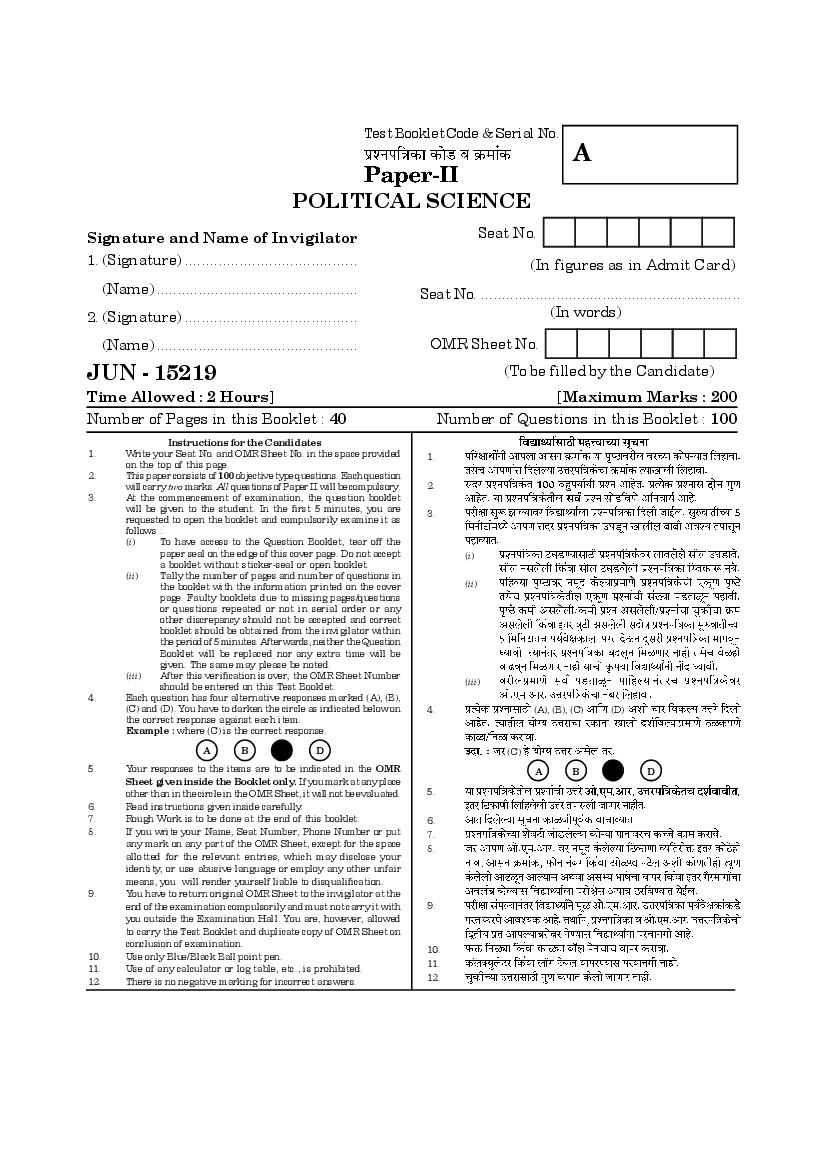
A
POLITICAL SCIENCE
Signature and Name of Invigilator Seat No.
1. (Signature) ......................................... (In figures as in Admit Card)
(Name) ................................................ Seat No. ..............................................................
2. (Signature) ......................................... (In words)
(Name) ................................................ OMR Sheet No.
JUN - 15219 (To be filled by the Candidate)
Time Allowed : 2 Hours] [Maximum Marks : 200
Number of Pages in this Booklet : 40 Number of Questions in this Booklet : 100
Instructions for the Candidates
1. Write your Seat No. and OMR Sheet No. in the space provided 1.
on the top of this page.
2. This paper consists of 100 objective type questions. Each question
will carry two marks. All questions of Paper II will be compulsory. 2.
3. At the commencement of examination, the question booklet
will be given to the student. In the first 5 minutes, you are 3.
requested to open the booklet and compulsorily examine it as
follows :
(i) To have access to the Question Booklet, tear off the
paper seal on the edge of this cover page. Do not accept (i)
a booklet without sticker-seal or open booklet.
(ii) Tally the number of pages and number of questions in
the booklet with the information printed on the cover (ii)
page. Faulty booklets due to missing pages/questions
or questions repeated or not in serial order or any
other discrepancy should not be accepted and correct
booklet should be obtained from the invigilator within
the period of 5 minutes. Afterwards, neither the Question
Booklet will be replaced nor any extra time will be
given. The same may please be noted.
(iii) After this verification is over, the OMR Sheet Number
(iii)
should be entered on this Test Booklet.
4. Each question has four alternative responses marked (A), (B),
(C) and (D). You have to darken the circle as indicated below on 4. (A), (B), (C) (D)
the correct response against each item.
Example : where (C) is the correct response.
A B D (C)
5. Your responses to the items are to be indicated in the OMR A B D
Sheet given inside the Booklet only. If you mark at any place
other than in the circle in the OMR Sheet, it will not be evaluated. 5.
6. Read instructions given inside carefully.
7. Rough Work is to be done at the end of this booklet. 6.
8. If you write your Name, Seat Number, Phone Number or put 7.
any mark on any part of the OMR Sheet, except for the space
8.
allotted for the relevant entries, which may disclose your
identity, or use abusive language or employ any other unfair
means, you will render yourself liable to disqualification.
9. You have to return original OMR Sheet to the invigilator at the
end of the examination compulsorily and must not carry it with 9.
you outside the Examination Hall. You are, however, allowed
to carry the Test Booklet and duplicate copy of OMR Sheet on
conclusion of examination.
10.
10. Use only Blue/Black Ball point pen.
11.
11. Use of any calculator or log table, etc., is prohibited.
12. There is no negative marking for incorrect answers. 12.
Page 2
Page 3
Paper II
II
Time Allowed : 120 Minutes] [Maximum Marks : 200
Note : This Paper contains Hundred (100) multiple choice questions. Each question
carrying Two (2) marks. Attempt All questions.
(100) (2)
1. Which of the following description 1.
does not fit the concept of
‘Multiculturalism’ ?
(A)
(A) Salad Bowl
(B)
(B) Cultural Mosaic
(C)
(C) Melting Pot
(D)
(D) Homogeneous Society
2.
2. Who among the following argued
that ‘Man is working species’ ?
(A)
(A) Babeuf
(B)
(B) Karl Marx
(C)
(C) Hegel
(D) Gramsci (D)
3. Who among the following argued 3.
that ‘Power is repressive’ ?
(A) Gramsci (A)
(B) Karl Marx (B)
(C) Hegel (C)
(D) Foucault (D)
3 [P.T.O.
Page 4
statement that “The History of all
hitherto existing societies is the
history of class struggle” ?
(A) The Civil War in France (A)
(B) On the Jewish Question (B)
(C) Manifesto of Communist Party (C)
(D) Contribution to a Critique of
Political Economy (D)
5. Which variant of liberalism
espouses sympathetic consideration 5.
of cultural differences, group rights
and majority-minority relations as
its core values ?
(A) Multiculturalism
(B) Classical liberalism (A)
(C) Communitarianism (B)
(D) Libertarianism (C)
6. Give the correct answer to the
(D)
statement below :
Post-modernist typically argued 6.
that ........
(A) ‘Universalist’ narratives which
(A)
attempt to explain the world
are invariably false.
(B) The world is socially (B)
constructed in a variety of
ways.
(C)
(C) Differences of viewpoints should
be celebrated not deplored
(D) All of the above (D)
4
Page 5
correct ?
(A) Conservatism — Anti-social
(A)
change
(B)
(B) Conservatism — Anti-authority
(C) Conservatism — Anti-organic (C)
society (D)
(D) Conservatism — Anti-tradition
8. I II
8. Match List I with List II and select
the correct answer from the codes
given below : I
List I (a)
(a) T.H. Marshall (b)
(b) Thomas Paine (c)
(c) James Madison (d)
(d) Samuel Smiles
II
List II
(1)
(1) The Rights of Man
(2)
(2) Advocated the concept of
enterprise, hardwork and self-
reliance
(3) Citizenship and social class (3)
(4) Advanced constitutional (4)
republicanism
Codes :
(a) (b) (c) (d)
(a) (b) (c) (d)
(A) (1) (4) (3) (2)
(A) (1) (4) (3) (2)
(B) (4) (2) (1) (3) (B) (4) (2) (1) (3)
(C) (3) (1) (4) (1) (C) (3) (1) (4) (1)
(D) (2) (4) (3) (1) (D) (2) (4) (3) (1)
5 [P.T.O.
Page 6
codes given below :
(A) :
Assertion (A) :
The economic theory of the
‘Philosophical Radicals’ was directed
from the start, towards the practical
purpose of freeing commerce from
the restrictions.
(R) :
Reason (R) :
The general outline of utilitarian
thinking was announced in
Bentham’s earliest work, ‘The
Fragment of Government’.
Codes :
(A) Both (A) and (R) are true and (A) (A) (R)
(R) is the correct explanation (R) (A)
of (A)
(B) (A) (R)
(B) Both (A) and (R) are true but
(R) is not the correct (R) (A)
explanation of (A)
(C) (A) (R)
(C) (A) is true but (R) is false
(D) (A) (R)
(D) (A) is false but (R) is true
6
Page 7
the correct answer from the codes
given below :
I
List I (Ideologies)
(a) Liberalism (a)
(b) Conservatism (b)
(c) Socialism (c)
(d) Ecologism
(d)
List II (Core Values)
II
(1) Holism, anti-anthropocentrism
(1)
(2) Community, equality, labourism,
cooperation (2)
(3) Tradition, organic society,
(3)
hierarchy, property
(4)
(4) Freedom, justice, reason,
toleration
Codes :
(a) (b) (c) (d)
(a) (b) (c) (d)
(A) (1) (4) (2) (3)
(A) (1) (4) (2) (3)
(B) (3) (2) (4) (1)
(B) (3) (2) (4) (1)
(C) (2) (1) (3) (4)
(C) (2) (1) (3) (4)
(D) (4) (3) (2) (1) (D) (4) (3) (2) (1)
7 [P.T.O.
Page 8
Notebooks’ ?
(A)
(A) Franz Fanon
(B)
(B) Karl Marx
(C)
(C) Antonio Gramsci
(D)
(D) V.I. Lenin
12.
12. Who among the following wrote the
book ‘Wretched of the Earth’ ?
(A)
(A) Karl Marx
(B) Lenin (B)
(C) Franz Fanon (C)
(D) Hannah Arendt (D)
13. The negative theory of liberty was 13.
advocated by :
(A) John Stuart Mill (A)
(B) T.H. Green (B)
(C) Isaih Berlin (C)
(D) Karl Popper
(D)
14. Which one of the following thinkers
14.
stressed the productive dimension of
power ?
(A)
(A) Foucault
(B)
(B) Mill
(C) Marx (C)
(D) Lasswell (D)
8
Page 9
expression ‘forced to be free’ in
connection with the notion of liberty
of the individual ?
(A)
(A) Rousseau
(B)
(B) Locke
(C)
(C) Green
(D)
(D) Hobhouse
16.
16. Who among the following said that
democracy can become ‘tyranny of
the majority’ ?
(A)
(A) J. Rousseau
(B)
(B) De Tocqueville
(C)
(C) J.S. Mill
(D) James Madison (D)
17. Who argued that ‘life, liberty and 17.
property’ are inalienable rights of
men ?
(A) Aristotle (A)
(B) Rousseau (B)
(C) Hobbes (C)
(D) Locke (D)
9 [P.T.O.
Page 10
associated with :
(A) Gramsci (A)
(B) Foucault (B)
(C) Habermas (C)
(D) Lenin
(D)
19. From whom does Marx borrow but
19.
fundamentally modify his dialectic
method ?
(A) Kant (A)
(B) Hegel (B)
(C) Adam Smith (C)
(D) Ludewig Feuerbach (D)
20. Who described freedom as the 20.
‘silence of the laws’ ?
(A) Isaiah Berlin (A)
(B) Thomas Hobbes (B)
(C) Milton Friedman (C)
(D) J.S. Mill
(D)
21. The historic ‘Quit India’ resolution
21.
was passed under Mahatma
Gandhi’s leadership at Gowalia
Tank median in the city of :
(A)
(A) Kolkata
(B) Chennai (B)
(C) Lucknow (C)
(D) Mumbai (D)
10
Page 11
leader with whom M.N. Roy had
a prolonged political debate in
1919-1920 ?
(A)
(A) Karl Marx
(B) V.I. Lenin (B)
(C) Joseph Stalin (C)
(D) Mao Tse Tung (D)
23. Who among the following 23.
personalities established the
organisation ‘Abhinav Bharat’ ?
(A)
(A) B.G. Tilak
(B) M.K. Gandhi (B)
(C) Rabindranath Tagore (C)
(D) V.D. Savarkar (D)
24. Which of the following were the 24.
tenents of Jayprakash Narayan’s
concept of Communitarian
Democracy ?
(a) Decentralised political economy (a)
(b) Competitiveness (b)
(c) Deliberate process of devolution (c)
(d) Harmonization of interest (d)
Choose the answer from the
following codes :
(A) (b), (c), (d)
(A) (b), (c), (d)
(B) (a), (b), (c) (B) (a), (b), (c)
(C) (a), (c), (d) (C) (a), (c), (d)
(D) (a), (b), (d) (D) (a), (b), (d)
11 [P.T.O.
Page 12
separatist movement ?
(A) JKLF (A)
(B) ULFA (B)
(C) PLA
(C)
(D) Naxalism
(D)
26. Who among the following
26.
launched Kalaram Mandir Entry
Satyagraha ?
(A)
(A) Mahatma Gandhi
(B)
(B) Vinoba Bhave
(C)
(C) Dr. B.R. Ambedkar
(D)
(D) J.P. Narayan
27.
27. Which one of the following is the
characteristic of post-behaviourism ?
(A) Quantification (A)
(B) Relevance (B)
(C) Value free (C)
(D) Pure science (D)
12
Page 13
organizations Periyar E.V.
Ramsamy was associated ?
(a) Self-Respect Movement (a)
(b) Justice Party (b)
(c) Dravidar Kazhagam
(c)
(d) Home-rule Movement
(d)
Choose your answer from the
following codes :
Codes :
(A) (a), (c), (d)
(A) (a), (c), (d)
(B) (b), (c), (d)
(B) (b), (c), (d)
(C) (a), (b), (c)
(D) (a), (b), (d) (C) (a), (b), (c)
29. Agganna Sutta is in which text ? (D) (a), (b), (d)
(A) Digha Nikaya
29.
(B) Tripitika
(A)
(C) Vinaya Pitaka
(D) Dhammapada (B)
30. In Buddhist literature what is (C)
‘Sutta’ ?
(D)
(A) Dialogue between Buddha and
Sanjaya 30.
(B) Discourse imparted by the (A)
Buddha to two Brahmins :
Bharadvaja and Vasistha (B)
(C) Dialogue between Sariputta and
Assaji
(C)
(D) Discourse between Anuruddha
and Katyayana (D)
13 [P.T.O.
Page 14
maximum number of colonies ?
(A) Great Britain (A)
(B) France (B)
(C) Portugal
(C)
(D) Holland
(D)
32. Which leader of anti-colonial
32.
struggle served as President of
Zambia from 1964 to 1991 ?
1964 1991
(A) Kenneth Kaunda
(A)
(B) Harry Nkumbula
(B)
(C) Julius Nyerere
(D) Robert Mugabe (C)
33. Who among the following leaders (D)
was not associated with anti-colonial 33.
struggle ?
(A) Mahatma Gandhi (A)
(B) Kenneth Kaunda
(B)
(C) Harry Nkumbula
(C)
(D) Daniel Lisulo
(D)
34. Identify the non-democratic regimes
from the following : 34.
(A) Switzerland (A)
(B) Australia (B)
(C) Cuba (C)
(D) Denmark (D)
14
Page 15
countries transition from democracy
to consolidated democracy can be
witnessed ?
(A)
(A) Kenya
(B)
(B) India
(C)
(C) Uruguway
(D)
(D) Pakistan
36.
36. Choose the incorrect statement :
(A) New social movements focus on (A)
issues related to human rights.
(B) Gay rights movement can be (B)
considered as new social
movement.
(C)
(C) New social movement emerged
in mid 1960 i.e. in a post-
industrial economy.
(D)
(D) Animal rights movement
cannot be called new social
movement as it is not related
to human rights.
37.
37. Which among the following is not
new social movements ?
(A) Women’s movement (A)
(B) Ecology movement (B)
(C) Gay rights movements (C)
(D) Peasant movement (D)
15 [P.T.O.
Page 16
systems has multiparty system ?
(A) USA
(A)
(B) Great Britain
(B)
(C) France
(C)
(D) Australia
(D)
39. Which is not the feature of
Schumpeter’s elite model of 39.
participatory democracy ?
(A) Common people do not have
capacity to make intelligent
(A)
decisions in area of politics.
(B) In democracy the actual power
is in the hands of an elite (B)
minority.
(C) Democracy is competition (C)
between elites and masses.
(D) In democracy the role of citizens
(D)
duty begins and ends with
selecting — via ballot box — the
individual or party.
16
Page 17
the correct answer from the codes
given below :
I
List I
(i)
(i) Patrimonialism
(ii)
(ii) Majoritarianism
(iii) Bureaucratic authoritarianism (iii)
(iv) Military dictatorship (iv)
List II II
(a) Argentina between 1966-1973 (a) 1966-1973
(b) Iraq during 1979 to 2003 (b) 1979 2003
(c) Czar during 12th century (c) 12 1917
to 1917
(d)
(d) Athenian democracy
Codes :
(A) (i–c), (ii–d), (iii–a), (iv–b) (A) (i–c), (ii–d), (iii–a), (iv–b)
(B) (i–b), (ii–c), (iii–a), (iv–d) (B) (i–b), (ii–c), (iii–a), (iv–d)
(C) (i–a), (ii–b), (iii–c), (iv–d) (C) (i–a), (ii–b), (iii–c), (iv–d)
(D) (i–d), (ii–c), (iii–b), (iv–a) (D) (i–d), (ii–c), (iii–b), (iv–a)
41. ................................. Committee was 41.
appointed for advising the
Government about Non-Scheduled
Languages.
(A)
(A) Chandrashekhar Kambar
(B) Bhalachandra Nemade (B)
(C) Sitakant Mahapatra (C)
(D) Ashok Vajpayee (D)
17 [P.T.O.
Page 18
attempt to contain terrorism in
Punjab.
(A)
(A) Rajiv — Longowal
(B)
(B) Indira Gandhi — Bhindranwale
(C) Nehru — Laldenga (C)
(D) Vajpayee — Badal (D)
43. Who led the All Assam Students’ 43.
Movement against migration ?
(A) Prafulla Mahanta
(B) Hiteshwar Saikia (A)
(C) Gopinath Bardoloi (B)
(D) Tarun Gogoi
(C)
44. Frequent use or misuse of Article
........................ has caused rift in (D)
Centre-State Relations. 44.
(A) 352
(B) 360
(C) 356 (A) 352
(D) 32 (B) 360
45. Which of the following is not (C) 356
correct ?
(D) 32
(A) Demolition of Babri Masjid
— 1992 45.
(B) Announcement of LPG Policy (A) — 1992
— 1991
(B) — 1991
(C) RTI Act — 2005
(C) — 2005
(D) Assassination of Indira Gandhi
— 1985 (D) — 1985
18
Page 19
the recommendations of ......................
Commission.
(A)
(A) Fazal Ali
(B)
(B) Dar
(C) Sarkaria (C)
(D) Mandal (D)
47. Which of the following is not a 47.
Dravidian Political Party ?
(A)
(A) Dravida Kazhagam
(B)
(B) Marumalarchi Dravida
Munnetra Kazhagam (C)
(C) Telangana Rashtra Samiti (D)
(D) All India Anna Dravida 48.
Munnetra Kazhagam
48. Which of the following castes is not
mobilised recently for seeking
reservation ? (A)
(A) Jats (B)
(B) Patidars (C)
(C) Marathas (D)
(D) Malis
49.
49. ............................... is the new entrant
in the voting process in India.
(A)
(A) Ballot Paper
(B)
(B) EVMs
(C) VVPATs (C)
(D) Electoral Violence (D)
19 [P.T.O.
Page 20
16th Lok Sabha was :
(A) Kamal Nath (A)
(B) Mallikarjun Kharge (B)
(C) Rahul Gandhi (C)
(D) Gulam Nabi Azad (D)
51. Which of the following is not a Union 51.
Territory ?
(A)
(A) Mizoram
(B)
(B) Lakshadweep
(C)
(C) Andaman & Nicobar Islands
(D)
(D) Daman & Diu
52.
52. Article 1 of the Indian Constitution
describes India as the :
(A)
(A) Territories of the States
(B) Union of State (B)
(C) Indian Federation (C)
(D) Confederation (D)
53. The Joint Session of the Parliament 53.
is chaired by the :
(A) Speaker of Lok Sabha (A)
(B) Vice-President of India (B)
(C) Chairman of the Rajya Sabha (C)
(D) Prime Minister of India (D)
20
Page 21
both the Houses of Parliament
assembled together :
(A) During the emergency session
of the Parliament (A)
(B) Every Session
(B)
(C) First Session after each General
(C)
Election and First Session each
year
(D) Any Session
55. Supremacy of the Constitution (D)
means :
55.
(A) Constitution is above States
(B) Constitution is above (A)
Government
(B)
(C) Constitution is above all
(C)
institutions, organisations and
citizens
(D) Constitution is above the (D)
Parliament
56.
56. Which of the following is the largest
Committee of the Parliament ? (A)
(A) The Estimates Committee
(B)
(B) The Public Accounts Committee
(C)
(C) Committee on Public Sector
Enterprises
(D) The Committee on Petitions (D)
21 [P.T.O.
Page 22
office :
(A)
(A) During the pleasure of the
President (B)
(B) During the pleasure of the (C)
Speaker
(D)
(C) For a fixed term of five years
(D) During the pleasure of Prime 58.
Minister
58. The following word was added
to the Preamble by the 42nd
(A)
Amendment :
(A) Secular (B)
(B) Democratic (C)
(C) Republic (D)
(D) Sovereign
59.
59. According to the Constitution, the
President of India works on the aid
and advice of : (A)
(A) The Vice-President (B)
(B) The Prime Minister and the
(C)
Council of Ministers
(C) The Supreme Court of India (D)
(D) The Attorney General of India 60.
60. Which Article of the Constitution
envisages a Supreme Court ?
(A) 128
(A) 128
(B) 124
(B) 124
(C) 132 (C) 132
(D) 136 (D) 136
22
Page 23
development administration is
that it :
(A)
(A) Emphasizes on regulatory work
(B)
(B) Emphasizes on rule-bound
conduct (C)
(C) Emphasizes on centralization (D)
(D) Emphasizes on participation 62.
62. The New Public Administration
advocated :
(A)
(A) Management science approach
(B)
(B) Efficiency and economy
(C)
(C) Social relevance based
approach (D)
(D) Value neutrality 63.
63. The Minnowbrook Perspective and
Frank Marini are associated with
the emergence of :
(A)
(A) New Public Administration
(B)
(B) Development Administration
(C) Scientific Management (C)
(D) Rational Choice Theory (D)
64. Which one of the following subfields 64.
emphasized on values and ethics ?
(A) Comparative Public Adminis-
(A)
tration
(B)
(B) New Public Management
(C) New Public Administration (C)
(D) Rational Choice Theory (D)
23 [P.T.O.
Page 24
is indicative of ‘integral’ dimension
in the working of an organization ?
(A)
(A) Filing papers
(B)
(B) Planning
(C)
(C) Staffing
(D)
(D) Coordinating
66. Give the correct answer by using the 66.
correct code given below :
Assertion (A) : (A) :
Some scholars have ridiculed
and rejected the principles of
administration as “myths” and
“proverbs”.
(R) :
Reason (R) :
For almost every principle, one can
find an equally plausible and
acceptable contradictory principles.
Codes :
(A) (A) (R)
(A) Both (A) and (R) are true and
(R) (A)
(R) is the correct explanation
of (A)
(B) Both (A) and (R) are true but (B) (A) (R)
(R) is not the correct (R) (A)
explanation of (A)
(C) (A) is true but (R) is false (C) (A) (R)
(D) (A) is false but (R) is true (D) (A) (R)
24
Page 25
cardinal principles of Public
Administration is ensured in New
Public Management by :
(A)
(A) Performing agency’s goods
(B)
(B) Following procedures in totality
(C)
(C) Not obeying orders of superiors
(D)
(D) Preventing misuse of public
68.
money
68. Max Weber identified it as essential
feature of modern bureaucracy :
(A)
(A) Hierarchy
(B)
(B) Flexibility of rules
(C)
(C) Patronage
(D) Personal charisma (D)
69. The principle that “a subordinate 69.
employee should receive orders from
one superior only” is known as :
(A) Span of Control (A)
(B) Unity of Command (B)
(C) Hierarchy (C)
(D) Delegation (D)
25 [P.T.O.
Page 26
(Ideas, Arguments) and select the
correct answer from the codes given
below : I
List I (Theorists) (a)
(a) Vincent Ostrom (b)
(b) David Easton (c)
(c) F.W. Riggs (d)
(d) Mary Parker Follett II
List II (Ideas, Arguments) (1)
(1) Advanced the idea of
‘constructive conflict’ (2)
(2) Presented ‘defracted model’ (3)
(3) Critiqued bureaucratic model
(4) Conceived of public policy as an (4)
output of the political system
Codes :
(a) (b) (c) (d) (a) (b) (c) (d)
(A) (4) (1) (3) (2) (A) (4) (1) (3) (2)
(B) (3) (4) (2) (1) (B) (3) (4) (2) (1)
(C) (1) (3) (4) (2) (C) (1) (3) (4) (2)
(D) (2) (1) (3) (4) (D) (2) (1) (3) (4)
26
Page 27
a characteristic of new local
governance ?
(A)
(A) Organised on formal and legal
pattern
(B) Based on the post-bureaucratic (B)
notion of organisation
(C) Operate through open networks
(C)
(D) Participation of stakeholders in
(D)
decision-making process
72.
72. Functions discharged by the
Panchayat Raj Institutions fall
under :
(A) 9
(A) the 9th schedule
(B) 10
(B) the 10th schedule
(C) 11
(C) the 11th schedule
(D) 12
(D) the 12th schedule
73. Article 243 I of the Indian 73. 243 I
Constitution provides for the
constitution of :
(A)
(A) Panchayat Raj Institutions
(B)
(B) Municipalities
(C)
(C) State Finance Commission
(D) State Election Commission (D)
27 [P.T.O.
Page 28
local governance bodies in India
are :
(a) Financial crunch
(a)
(b) Low level of citizens
participation in local bodies (b)
(c) Privatization of public services
Codes : (c)
(A) (a) and (b)
(B) (b) and (c) (A) (a) (b)
(C) (a), (b) and (c) (B) (b) (c)
(D) (a) and (b)
(C) (a), (b) (c)
75. How many states in India have
(D) (a) (b)
constituted the Lokayukta
institutions ? 75.
(A) 15
(B) 20 (A) 15
(C) 17 (B) 20
(D) 19 (C) 17
76. Lokpal consists of :
(D) 19
(A) 9 members including chair-
person 76.
(B) 8 members including chair-
person (A)
(C) 10 members excluding chair- (B)
person
(C)
(D) 7 members excluding chair-
person (D)
28
Page 29
the feature of good governance ?
(A) Equitable and inclusive (A)
(B) Non-responsive and non- (B)
consensus
(C)
(C) Participatory and accountable
(D)
(D) Transparent
78. I II
78. Match List I with List II and select
the correct answer from the codes
given below :
I
List I
(a)
(a) Good Governance
(b)
(b) Citizen Charter
(c)
(c) Ombudsman
(d) RTE
(d) RTE
II
List II
(1)
(1) People’s defender
(2) Equitable and inclusive (2)
(3) Empowerment of citizens (3)
(4) Article 21A (4) 21A
Codes :
(a) (b) (c) (d) (a) (b) (c) (d)
(A) (2) (3) (1) (4) (A) (2) (3) (1) (4)
(B) (3) (2) (4) (1) (B) (3) (2) (4) (1)
(C) (1) (4) (3) (2) (C) (1) (4) (3) (2)
(D) (4) (1) (2) (3) (D) (4) (1) (2) (3)
29 [P.T.O.
Page 30
is incorporated ?
(A) Article 22 (A) 22
(B) Article 19(2) (B) 19(2)
(C) Article 21(A) (C) 21(A)
(D) Article 23 (D) 23
80. What are the features of MNREGA ? 80. (MNREGA)
(a) A person above the age of 14
years is entitled to apply for
(a)
work.
(b) Any applicant is entitled to
(b)
work within 15 days of his
15
application.
(c) It is limited to 100 days per
(c) 100
household per year.
(d) The applicant will be provided
(d)
if possible within radius of
5 km.
Codes :
(A) (a), (b) and (d) are incorrect and (A) (a), (b) (d)
(c) is correct (c)
(B) (a) is incorrect and (b), (c) and (B) (a) (b), (c) (d)
(d) are correct
(C) (a) and (b) are correct and (c) (C) (a) (b) (c)
and (d) are incorrect (d)
(D) (a), (b) and (d) are correct and (D) (a), (b) (d)
(c) is incorrect (c)
30
Page 31
is not correct ?
(A)
(A) Military capability is a tangible
element of National power.
(B) The quality of leadership can (B)
improve the power of a state.
(C) Demographic indicators are
(C)
important for understanding
the power of a state.
(D) Geography is an element of soft (D)
power of a state.
82. 2015
82. Which of the following statements
is not correct about Paris agreement
on Climate Change 2015 ?
(A) It has determined uniform
(A)
target of emission reduction for
all countries.
(B) It has asked countries to (B)
determine their own emission
reduction targets.
(C) It relies on the principle of
differential treatment of (C)
developed and underdeveloped
countries for emission targets.
(D) It has made a detailed time-
(D)
table for emission reduction for
all countries.
31 [P.T.O.
Page 32
incentive behind the Look East
Policy of India ?
(A)
(A) Weapons purchases
(B)
(B) Quest for energy security
(C)
(C) To build relations to counter
China-Pak axis
(D)
(D) Dominate the Indian Ocean
84.
84. Which of the following regional
trade groups have lowest percentage
of intra-regional trade ?
(A)
(A) SAFTA (South Asian Free
Trade Association)
(B)
(B) NAFTA (North Atlantic Free
Trade Association
(C) EU (European Union) (C)
(D) ASEAN (Association of South- (D)
East Asian Nations)
32
Page 33
the WTO applies specifically to the
developing countries ?
(A) Special and differential (A)
treatment
(B)
(B) Reciprocity and non-
discrimination
(C)
(C) Predictability through
transparency (D)
(D) Equal treatment to locally
produced and foreign goods
86.
86. Which of the following statements
is correct ? (A)
(A) World system theory believes
that anarchic international
system is the root cause of
conflict.
(B)
(B) Structural realism believes that
human nature is the root cause
of conflict.
(C)
(C) Realist theory of International
Relations draws inspiration
from Hobbes’ thought
(D) Constructivism analyses the
(D)
core and periphery in
International Relations.
33 [P.T.O.
Page 34
matched correctly ?
List I I
(a) Balance of power (a)
(b) Deterrence (b)
(c) Collective security (c)
(d) UN peace keeping (d)
List II II
(i) Making alliances (i)
(ii) Nuclear weapons (ii)
(iii) Isolating the aggressor (iii)
(iv) War with the aggressor (iv)
(A) (a–i) (A) (a–i)
(B) (b–ii) (B) (b–ii)
(C) (c–iii) (C) (c–iii)
(D) (d–iv) (D) (d–iv)
88. Which of the following are forced 88.
migrants ?
(A) Mexicans crossing the border to (A)
enter the US (B)
(B) Sri Lankan Tamils living in
camps in Tamil Nadu (C)
(C) Indian workers in Saudi Arabia (D)
(D) Pakistani workers in UAE
34
Page 35
management which emerged in
1990s is known also as :
(A) Managerialism (A)
(B) Market-based public adminis- (B)
tration
(C)
(C) Entrepreneurial government
(D)
(D) All of the above
90.
90. Which of the following pairs is not
matched correctly ?
I
Column I
(a)
(a) Critical Theory
(b)
(b) Realism
(c)
(c) World System Theory
(d)
(d) Social Constructivism
II
Column II
(i)
(i) Regime, Institutions
(ii) Interests, Power (ii)
(iii) Core, Periphery (iii)
(iv) Norms, Values (iv)
(A) (a–i) (A) (a–i)
(B) (b–ii) (B) (b–ii)
(C) (c–iii) (C) (c–iii)
(D) (d–iv) (D) (d–iv)
35 [P.T.O.
Page 36
of India’s ‘Look East’ Policy ?
(A) Nuclear co-operation treaty
with ASEAN countries (A)
(B) Co-operation with ASEAN (B)
countries on South China Sea
disputes
(C) Promoting Democracy in (C)
ASEAN countries
(D)
(D) Free Trade Agreement with
ASEAN countries
92. Among the following regional 92.
groups, which has signed a Free
Trade Agreement with India ?
(A)
(A) European Union
(B) Association of South-East Asian (B)
Nations
(C) Shanghai Co-operation
(C)
Organisation
(D) Gulf Co-operation Council (D)
36
Page 37
an element of India-Russia
co-operation ?
(A) Joint ventures in weapons (A)
production
(B)
(B) Joint ventures in exploration
of natural gas (C)
(C) Joint ventures in sea-bed (D)
exploration
94.
(D) Nuclear partnership
(A)
94. Which of the following statements
is true ? (Indus Commission)
(A) Indus Water Treaty created the
Permanent Indus Commission.
(B)
(B) Indus Water Treaty gave the
control of three ‘eastern’ rivers
(Beas, Ravi, Sutlej) to Pakistan.
(C) Indus Water Treaty appointed
(C)
an international mediator for
resolving water disputes
between India and Pakistan.
(D) Indus Water Treaty appointed (D)
a third party arbitrator to
resolve water disputes between
India and Pakistan.
37 [P.T.O.
Page 38
a principle of India’s Nuclear
Doctrine ?
(A)
(A) Non-proliferation of nuclear
technology (B)
(B) Minimum Credible Deterrence
(C)
(C) No First use of Nuclear
(D)
Weapons
(D) No use of nuclear weapons
against non-nuclear states 96.
96. In which year did India host and
chair the summit of the non-aligned
movement ?
(A) 1983
(A) 1983
(B) 1979 (B) 1979
(C) 1976 (C) 1976
(D) 1986
(D) 1986
97. Which of the following terrorist
97.
groups is not banned by Government
of India ?
(A) Abu Sayyaf Group (A)
(B) Babbar Khalsa International (B)
(C) Communist Party of India
(C)
(Maoist)
(D) Hizb-ul-Mujahideen (D)
38
Page 39
who have come from :
(A) Bangladesh (A)
(B) Myanmar (B)
(C) Bhutan (C)
(D) Nepal (D)
99. Who are regarded as the 99.
‘founding fathers’ of the non-aligned
movement ?
(A)
(A) Nehru, Nasser, Sukarno
(B)
(B) Nehru, Tito, Sukarno
(C)
(C) Nehru, Nasser, Tito
(D)
(D) Nehru, Sukarno, Ho Chi Minh
100. (A) :
100. Assertion (A) :
India-Vietnam friendship dates back
to Cold War period.
(R) :
Reason (R) :
Vietnam has supported India’s bid
for UN Security Council permanent
membership.
Codes :
(A) (A) is true, (R) is not true (A) (A) (R)
(B) (A) is not true, (R) is true (B) (A) (R)
(C) Both (A) and (R) are true, but (C) (A) (R)
(R) is not a cause of (A) (R) (A)
(D) Both (A) and (R) are true and (D) (A) (R)
(R) is a cause of (A) (R) (A)
39 [P.T.O.
Page 40
40
Document Details
| Board / Org | Maharashtra Exams |
| Exam | Maharashtra State Eligibility Test |
| Type | Question Paper |
| Pages | 40 |
| Updated | 30 Apr 2026 |