Karnataka SSLC Question Paper 2022 Answer Key Mathematics
Finished viewing? Save it for later —
Download Karnataka SSLC Question Paper 2022 Answer Key Mathematics (PDF · 27 pages)About Karnataka SSLC Question Paper 2022 Answer Key Mathematics
Karnataka SSLC Question Paper 2022 Answer Key Mathematics is available here for free download. Published by Karnataka Board for Class 10, this answer key can be viewed online or downloaded as a PDF (27 pages). Candidates preparing for Class 10 can use Karnataka SSLC Question Paper 2022 Answer Key Mathematics to understand the exam pattern, the type of questions asked, and the overall difficulty level.
Frequently Asked Questions
How can I download Karnataka SSLC Question Paper 2022 Answer Key Mathematics?
Open this page and click the Download button to save Karnataka SSLC Question Paper 2022 Answer Key Mathematics as a PDF. It is completely free on AglaSem Docs.
Is Karnataka SSLC Question Paper 2022 Answer Key Mathematics free to download?
Yes. Karnataka SSLC Question Paper 2022 Answer Key Mathematics can be viewed online and downloaded as a PDF free of cost on AglaSem Docs.
How many pages does Karnataka SSLC Question Paper 2022 Answer Key Mathematics have?
Karnataka SSLC Question Paper 2022 Answer Key Mathematics contains 27 pages, which you can read online or download together as a single PDF.
Where can I find more Class 10 study material?
You can find more Class 10 question papers, sample papers, syllabus, and answer keys on AglaSem Docs.
Karnataka SSLC Question Paper 2022 Answer Key Mathematics – Text
Read the full text of this answer key below — useful to quickly search, copy and reference the content online without downloading the PDF.
📄 View text version (27 pages)
Page 1
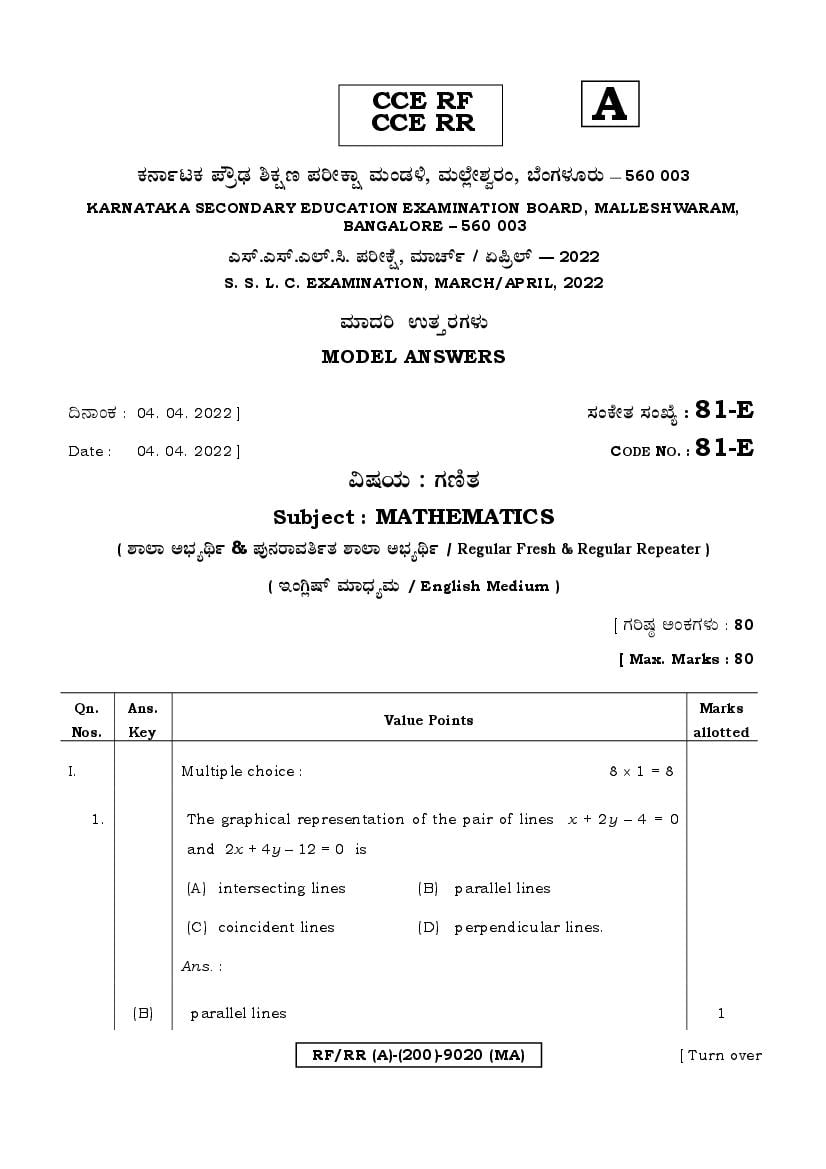
CCE RR A
O⁄´¤%lO⁄ ÆË√v⁄ ÃO⁄–y Æ⁄¬fiO¤– »⁄flMs⁄ÿ, »⁄fl≈Ê«fiÀ⁄ ¡⁄M, ∑ÊMV⁄◊⁄‡¡⁄fl — 560 003
KARNATAKA SECONDARY EDUCATION EXAMINATION BOARD, MALLESHWARAM,
BANGALORE – 560 003
G—È.G—È.G≈È.“. Æ⁄¬fiOÊ⁄–, »⁄·¤^È% / HØ√≈È — 2022
S. S. L. C. EXAMINATION, MARCH/APRIL, 2022
»⁄·¤•⁄¬ D}⁄ °¡⁄V⁄◊⁄fl
MODEL ANSWERS
¶´¤MO⁄ : 04. 04. 2022 ] —⁄MOÊfi}⁄ —⁄MSÊ¿ : 81-E
Date : 04. 04. 2022 ] CODE NO. : 81-E
…Œ⁄æ⁄fl : V⁄{}⁄
Subject : MATHEMATICS
( À¤≈¤ @∫⁄¥¿£% & Æ⁄‚¥´⁄¡¤»⁄~%}⁄ À¤≈¤ @∫⁄¥¿£% / Regular Fresh & Regular Repeater )
( BMW«ŒÈ »⁄·¤®⁄¥¿»⁄fl / English Medium )
[ V⁄¬Œ⁄r @MO⁄V⁄◊⁄fl : 80
[ Max. Marks : 80
Qn. Ans. Marks
Nos. Key allotted
I. Multiple choice : 8×1=8
1. The graphical representation of the pair of lines x + 2y – 4 = 0
and 2x + 4y – 12 = 0 is
(A) intersecting lines (B) parallel lines
(C) coincident lines (D) perpendicular lines.
(B) parallel lines 1
RF/RR (A)-(200)-9020 (MA) [ Turn over
Page 2
Qn. Ans. Marks
Nos. Key allotted
2. The common difference of the Arithmetic progression
8, 5, 2, – 1, ... is
(A) – 3 (B) –2
(C) 3 (D) 8.
(A) –3 1
3. The standard form of 2x 2 = x − 7 is
(A) 2x 2 − x = − 7 (B) 2x 2 + x − 7 = 0
(C) 2x 2 − x + 7 = 0 (D) 2x 2 + x + 7 = 0 .
(C) 2x 2 − x + 7 = 0 1
4. The value of cos ( 90° – 30° ) is
1
(A) – 1 (B)
2
(C) 0 (D) 1.
1
(B)
2 1
5. The distance of the point P ( x, y ) from the origin is
(A) x2 + y2 (B) x2 + y2
(C) x 2 − y 2 (D) x2 − y2 .
(A) x2 + y2 1
RF/RR (A)-(200)-9020 (MA)
Page 3
Qn. Ans. Marks
Nos. Key allotted
6. In a circle, the angle between the tangent and the radius at the
point of contact is
(A) 30° (B) 60°
(C) 90° (D) 180°.
(C) 90° 1
In the given figure, the volume of the frustum of a cone is
7.
(A) π ( r 1 + r 2 ) l (B) π ( r1 − r 2 )l
1 1
(C) π h ( r12 − r2 2 − r 1 r 2 ) (D) π h ( r12 + r2 2 + r 1 r 2 )
3 3
1 2 2
πh ( r1 + r2 + r1 r2 )
(D) 3 1
Surface area of a sphere of radius ‘r’ unit is
8.
(A) π r 2 sq.units (B) 2 π r 2 sq.units
(C) 3 π r 2 sq.units (D) 4 π r 2 sq.units.
2
(D) 4πr sq.units 1
RF/RR (A)-(200)-9020 (MA) [ Turn over
Page 4
Qn. Marks
Nos. allotted
II. Answer the following questions : 8×1=8
( Direct answers from Q. Nos. 9 to 16 full marks should be given )
9. If the pair of linear equations in two variables are inconsistent, then
how many solutions do they have ?
No solution 1
10. In an Arithmetic progression if ‘a’ is the first term and ‘d’ is the
common difference, then write its n th term.
an = a + ( n − 1 ) d 1
11. Write the standard form of quadratic equation.
ax 2 + bx + c = 0 1
sin 18 o
12. Write the value of .
cos 72o
1 1
13. Write the distance of the point ( 4, 3 ) from x-axis.
3 1
14. Find the median of the scores 6, 4, 2, 10 and 7.
6 1
RF/RR (A)-(200)-9020 (MA)
Page 5
Qn. Marks
Nos. allotted
15. Write the statement of “Basic Proportionality” theorem ( Thales
theorem ).
If a line is drawn parallel to one side of a triangle to intersect the other
two sides in distinct points, the other two sides are divided in the
same ratio.
Note : If correct alternate statement is written, give full marks. 1
16. In the given figure, write the formula used to find the curved surface
area of the cone.
Curved surface area of cone = πrl sq units 1
III. Answer the following questions : 8 × 2 = 16
17. Solve the given pair of linear equations by Elimination method :
2x + y = 8
x – y = 1
2x + y = 8 ................ (1 )
Adding x – y = 1 ................ (2) ½
3x = 9
RF/RR (A)-(200)-9020 (MA) [ Turn over
Page 6
Qn. Marks
Nos. allotted
9
x=
3
x=3 ½
Substituting x = 3 in (1)
2(3) + y = 8 ½
6+y=8
y=8–6
2
y=2 ½
18. Find the 30th term of the arithmetic progression 5, 8, 11, ..... by
using formula.
5, 8, 11 .............
Here a = 5, d = 8 – 5 = 3, n = 30 ½
nth term of arithmetic progression
an = a + (n − 1 ) d ½
a 30 = 5 + (30 − 1) 3 ½
= 5 + 29 × 3
= 5 + 87
a 30 = 92 ½
2
19. Find the sum of first 20 terms of the Arithmetic progression
10, 15, 20, .......... by using formula.
OR
Find the sum of first 20 positive integers using formula.
a = 10, d = 15 – 10 = 5, n = 20, S 20 = ?
n
Sn = [ 2a + ( n − 1) d ] ½
2
RF/RR (A)-(200)-9020 (MA)
Page 7
Qn. Marks
Nos. allotted
20
S 20 = [ 2 (10 ) + ( 20 − 1 ) 5 ] ½
2
= 10 [ 20 + 19 × 5 ]
= 10 [ 20 + 95 ]
= 10 × 115 ½
S20 =1150 ½
Note : Any other suitable method is followed to get the correct answer, 2
full marks should be given.
OR
n ( n +1)
Sn = ½
2
n = 20
20 ( 20 + 1 )
S 20 = ½
2
20 × 21
=
2
= 10 × 21 ½
S 20 = 210 ½ 2
20. Find the roots of x 2 + 5x + 2 = 0 by using quadratic formula.
x 2 + 5x + 2 = 0
ax 2 + bx + c = 0
a = 1, b = 5, c = 2
− b ± b 2 − 4ac
x= ½
2a
− 5 ± 5 2 − 4(1 ) (2)
= ½
2 (1)
− 5 ± 25 − 8
= ½
2
− 5 ± 17
= ½
2 2
RF/RR (A)-(200)-9020 (MA) [ Turn over
Page 8
Qn. Marks
Nos. allotted
21. Find the value of the discriminant and hence write the nature of roots
of the quadratic equation x 2 + 4x + 4 = 0.
x 2 + 4x + 4 = 0
ax 2 + bx + c + 0
a = 1, b = 4, c = 4
2
Discriminant = b − 4ac ½
2
= 4 − 4 (1 ) ( 4 ) ½
= 16 – 16
=0 ½
Nature of roots : Two equal real roots. ½ 2
22. Find the distance between the points A ( 2, 6 ) and B ( 5, 10 ) by using
distance formula.
OR
Find the coordinates of the mid-point of the line segment joining the
points P ( 3, 4 ) and Q ( 5, 6 ) by using ‘mid-point’ formula.
A (2, 6 ) B ( 5, 10 )
x1,y1 x 2 , y2
Distance formula d = ( x 2 − x1 )2 + ( y 2 − y1 )2 ½
= ( 5 − 2)2 + ( 10 − 6 )2 ½
= 32 + 42
= 9 + 16
= 25 ½
d = 5 units ½ 2
OR
P (3, 4 ) Q ( 5, 6 )
x1,y1 x 2 , y2
x + x 2 y1 + y 2
Mid-point formula P ( x , y ) = 1 , ½
2 2
RF/RR (A)-(200)-9020 (MA)
Page 9
Qn. Marks
Nos. allotted
3+5 4+6
= ,
½
2 2
8 10
= ,
½
2 2
P ( x , y ) = ( 4, 5 ) ½
2
23. Draw a line segment of length 10 cm and divide it in the ratio 2 : 3 by
geometric construction.
AC : CB = 2 : 3
Drawing line segment (10 cm ) ½
Constructing acute angle at A ½
Marking 5 arcs ½
Constructing A2C || A5B ½
Note : If correct alternate method is followed, give full marks. 2
24. In the given figure find the values of
i) sin θ
ii) tan α.
RF/RR (A)-(200)-9020 (MA) [ Turn over
Page 10
Qn. Marks
Nos. allotted
12
(i) sin θ = 1
13
5
(ii) tan α = 1
12 2
IV. Answer the following questions : 9 × 3 = 27
25. The sum of first 9 terms of an Arithmetic progression is 144 and its
9th term is 28 then find the first term and common difference of the
Arithmetic progression.
n
Sn = [a+l) ½
2
9
S9 = [ a + 28 ]
2
9
144 = [ a + 28 ] ½
2
16
144 × 2
= a + 28
9
32 = a + 28
a = 32 – 28 ½
a=4
an = a + ( n – 1 ) d ½
a9 = 4 + ( 9 – 1 ) d
28 = 4 + 8d ½
24 = 8d
24
d =
8
d= 3 ½ 3
Any other correct alternate, method may be given full marks.
RF/RR (A)-(200)-9020 (MA)
Page 11
Qn. Marks
Nos. allotted
26. The diagonal of a rectangular field is 60 m more than its shorter side.
If the longer side is 30 m more than the shorter side, then find the
sides of the field.
OR
In a right angled triangle, the length of the hypotenuse is 13 cm.
Among the remaining two sides, the length of one side is 7 cm more
than the other side. Find the sides of the triangle.
ABCD → rectangular field
Let AB = x m then BC = ( x + 30 ) m, AC = ( x + 60 ) m
AC 2 = AB 2 + BC 2 ½
( x + 60 )2 = x 2 + ( x + 30 )2 ½
x 2 + 602 + 2 × x × 60 = x 2 + x 2 + 302 + 2 × x × 30
3600 + 120x = x 2 + 900 + 60x
x 2 + 900 + 60x − 3600 −120x = 0
x 2 − 60x − 2700 = 0 ½
x 2 − 90x + 30x − 2700 = 0
x ( x − 90 ) + 30 (x − 90 ) = 0
(x − 90 ) ( x + 30 ) = 0 ½
x – 90 = 0 or x + 30 = 0
x = 90 or x = – 30 ( not considered ) ½
∴ x = 90
AB = x = 90 m
BC = ( x + 30 ) = 90 + 30 = 120 m ½ 3
OR
RF/RR (A)-(200)-9020 (MA) [ Turn over
Page 12
Qn. Marks
Nos. allotted
Let ABC be a right angled triangle.
Let AC = 13 cm, AB = x cm and BC = ( x + 7 ) cm
AC 2 = AB 2 + BC 2 ½
132 = x 2 + ( x + 7)2 ½
2 2
⇒ 169 = x + x + 49 + 14x
2
⇒ 169 = 2x + 49 + 14x
2
⇒ 2x + 49 + 14x − 169 = 0
2
⇒ 2x + 14x − 120 = 0 ½
÷2, x 2 + 7x − 60 = 0
2
⇒ x + 12x − 5x − 60 = 0
⇒ x ( x + 12 ) − 5 ( x + 12 ) = 0
⇒ ( x + 12 ) ( x − 5 ) = 0 ½
x + 12 = 0 or x – 5 = 0
x = – 12 or x = 5
( not considered ) ∴ x = 5 ½
AB = x = 5 cm
BC = ( x + 7 ) = 5 + 7 = 12 cm ½ 3
RF/RR (A)-(200)-9020 (MA)
Page 13
Qn. Marks
Nos. allotted
27. Prove that
( sin A + cosec A ) 2 + ( cos A + sec A ) 2 = 7 + tan 2 A + cot 2 A.
OR
Prove that : sec θ ( 1 – sin θ ) ( sec θ + tan θ ) = 1.
2 2
LHS = ( sin A + cosec A ) + ( cos A + sec A )
2 2 2 2
= sin A + cos ec A + 2 sin A.cosec A + cos A + sec A
+ 2 cos A. sec A 1
1
= sin2 A + cos 2 A + cosec 2 A + 2 sin A . 2
+ sec A
sin A
1
+ 2 cos A . 1
cos A
2 2
= 1 + (1 + cot A ) + 2 + (1 + tan A ) + 2
[ Q cosec2 A =1 + cot2 A
sec2 A = 1 + tan2 A
sin2 A + cos2 A =1 ] ½
2 2
= 7 + tan A + cot A ½
LHS = RHS 3
OR
LHS = sec θ (1 − sin θ ) ( sec θ + tan θ )
1 1 sin θ
= (1 − sin θ ) +
1
cos θ cos θ cos θ
( 1 − sin θ ) ( 1 + sin θ )
= × ½
cos θ cos θ
1 − sin2 θ
= ½
cos 2 θ
cos2 θ
= 2
[ Q 1 − sin2 θ = cos 2 θ ] ½
cos θ
=1 ½
∴ L.H.S. = R.H.S 3
RF/RR (A)-(200)-9020 (MA) [ Turn over
Page 14
Qn. Marks
Nos. allotted
28. Find the coordinates of the point on the line segment joining the points
A ( – 1, 7 ) and B ( 4, – 3 ) which divides AB internally in the ratio
2 : 3.
OR
Find the area of triangle PQR with vertices P ( 0, 4 ), Q ( 3, 0 ) and
R ( 3, 5 ).
A ( – 1, 7 ), B ( 4, – 3 ) 2:3
x1,y1 x 2 , y2 m1 m2
m x + m 2 x1 m1y 2 + m 2y1
P ( x, y ) = 1 2 , 1
m +m m + m
1 2 1 2
2( 4 ) + 3 ( − 1) 2( − 3 ) + 3 ( 7 )
= ,
½
2+3 2+3
8 − 3 − 6 + 21
= ,
½
5 5
5 15
= ,
½
5 5
P ( x , y ) = ( 1, 3 ) ½
3
OR
P ( 0, 4 ), Q ( 3, 0 ) R ( 3, 5 )
x1,y1 x 2 , y2 x3 , y3
1
A= [ x1 ( y 2 − y 3 ) + x 2 ( y 3 − y1 ) + x 3 ( y1 − y 2 ) ] 1
2
1
= [ 0 ( 0 − 5 )+ 3( 5 − 4 )+ 3( 4 − 0 )] ½
2
RF/RR (A)-(200)-9020 (MA)
Page 15
Qn. Marks
Nos. allotted
1
= [ 0 ( − 5 ) + 3 (1 ) + 3 ( 4 ) ] ½
2
1
= [ 0 + 3 + 12 ] ½
2
1 3
= × 15
2
15
A= or 7·5 sq. units ½
2
29. Find the mean for the following grouped data by Direct method :
Class-interval Frequency
10 — 20 2
20 — 30 3
30 — 40 5
40 — 50 7
50 — 60 3
OR
Find the mode for the following grouped data :
Class-interval Frequency
5 — 15 3
15 — 25 4
25 — 35 8
35 — 45 7
45 — 55 3
RF/RR (A)-(200)-9020 (MA) [ Turn over
Page 16
Qn. Marks
Nos. allotted
C-I fi xi f i xi
10-20 2 15 30
20-30 3 25 75
30-40 5 35 175
40-50 7 45 315
50-60 3 55 165
N = 20 ∑ f i x i = 760
Table 2
[ Mid points – 01
finding f i x i - 01 ]
Mean, X =
∑ f i xi OR
∑ FX ½
N N
760
=
20
X = 38 ½ 3
OR
From the frequency distribution table we find that
f 0 = 4, f1 = 8, f 2 = 7, h =10 and l = 25
f1 − f 0
Mode = l + [ ]×h 1
2 f1 − f 0 − f 2
8−4
= 25 + [ ] × 10 ½
2( 8 ) − 4 − 7
4
= 25 + [ ] × 10 ½
16 − 11
4 2
= 25 + × 10 ½
51
= 25 + 8
Mode = 33 ½ 3
RF/RR (A)-(200)-9020 (MA)
Page 17
Qn. Marks
Nos. allotted
30. During a medical check-up
check up of 50 students of a class, their heights were
recorded as follows :
Draw “less than type” ogive for the given data :
Height in cm Number of students
( Cumulative frequency )
Less than 140 5
Less than 145 10
Less than 150 15
Less than 155 25
Less than 160 40
Less than 165 50
RF/RR (A)-(200)-9020 (MA) [ Turn over
Page 18
Qn. Marks
Nos. allotted
Drawing axes and writing scale ½ + ½ =1
Marking points 1
Drawing Ogive 1 3
31. Prove that “the lengths of tangents drawn from an external point to a
circle are equal”.
½
Data : O is the centre of the circle. PQ and PR are tangents drawn from
external point 'P'. ½
To Prove : PQ = PR ½
Construction : Join OP, OQ and OR. ½
Proof : In the figure
∠OQP = ∠ORP = 90° OQ ⊥ PQ
OR ⊥ PR
OQ = OR [ radii of same circle ] ½
OP = OP [ common side ]
∆ OQP ≅ ∆ORP [ RHS ] ½
PQ = PR [ CPCT ]
Note : If the theorem is proved as given in the text-book,
text book, give full
marks. 3
RF/RR (A)-(200)-9020 (MA)
Page 19
Qn. Marks
Nos. allotted
32. Construct two tangents to a circle of radius 3 cm from a point 8 cm
away from its centre.
Drawing a circle C1 of radius 3 cm ½
Drawing OP = 8 cm ½
Constructing perpendicular bisector of OP 1
Drawing C2 circle ½
Joining PA and PB ½ 3
33. The volume of a solid right circular cylinder is 2156 cm 3 . If the height
of the cylinder is 14 cm, then find its curved surface area.
22
[ Take π = ]
7
RF/RR (A)-(200)-9020 (MA) [ Turn over
Page 20
Qn. Marks
Nos. allotted
V = 2156 cm 3
h = 14 cm
r=?
CSA = ?
2
Volume of cylinder = πr h ½
22 2 2
2156 = ×r × 14 ½
71
2156 = 44 r 2
2156
r2 =
44
r 2 = 49
r = 49
r = 7 cm ½
Curved surface area of = 2πrh ½
22
cylinder = 2× × 7 × 14 ½
7
= 2 × 22 × 14
= 616 cm 2 ½ 3
V. Answer the following questions : 4 × 4 = 16
34. Find the solution of the given pair of linear equations by graphical
method :
x + 2y = 6
x+y= 5
RF/RR (A)-(200)-9020 (MA)
Page 21
Qn. Marks
Nos. allotted
x + 2y = 6
x+y=5 For table construction ( 1 + 1 ) 2
Drawing two lines by marking points 1
Marking point of intersection & writing
values of x and y 1
Note : Any other points also may be considered to get straight lines. 4
35. The angle of elevation of the top of a building from the foot of a tower is
30° and the angle of elevation of the top of the tower from the foot of
the building is 60°. Both the tower and building are on the same level
RF/RR (A)-(200)-9020 (MA) [ Turn over
Page 22
Qn. Marks
Nos. allotted
ground. If the height of the tower is 50 m, then find the height of the
building.
OR
As observed from the top of a 75 m high light house from the sea-
level, the angles of depression of two ships are 30° and 45°. If one ship
is exactly behind the other on the same side of the light house, then
find the distance between the two ships.
CD
In ∆BDC, tan 60° = ½
BD
50
3= ½
BD
50
∴ BD = .............. (1) ½
3
AB
In ∆ABD, tan 30° = ½
BD
RF/RR (A)-(200)-9020 (MA)
Page 23
Qn. Marks
Nos. allotted
1 AB
=
3 BD
BD = 3 . AB .............. (2) ½
From (1) and (2)
50
3 . AB = ½
3
50
AB = ½
3. 3
50 2
AB = or 16 m ½
3 3 4
OR
Distance between the two ships is PQ
AB
In ∆ABP, tan 45° = ½
BP
75
1= ½
BP
∴ BP = 75 ½
AB
In ∆ABQ, tan 30° = ½
BQ
1 75
= ½
3 BP + PQ
1 75
= ½
3 75 + PQ
75 + PQ = 75 3
PQ = 75 3 − 75 ½
PQ = 75 ( 3 − 1 ) m ½ 4
36. Construct a triangle with sides 4·5 cm, 6 cm and 8 cm. Then construct
3
another triangle whose sides are of the corresponding sides of the
4
first triangle.
RF/RR (A)-(200)-9020 (MA) [ Turn over
Page 24
Qn. Marks
Nos. allotted
Construction of given triangle 1
Construction of acute angle with division 1
Drawing parallel lines 1
Obtaining required triangle 1 4
In the figure AXB and CYD are the arcs of two concentric circles with
37.
centre O. The length of the arc AXB is 11 cm. If OC = 7 cm and
∠ AOB = 30°, then find the area of the shaded region.
22
[ Take π = ]
7
RF/RR (A)-(200)-9020 (MA)
Page 25
Qn. Marks
Nos. allotted
θ
Length of the arc = × 2πr ½
360°
30° 2211
11 = × 2× ×r ½
360 o126 7
3
11r
11 =
21
11× 21
r=
11
r = 21 cm ½
θ 2
Area of the sector OAXB = A1 = × πr ½
360°
30° 22 2
= × × 21
360 ° 7
11
1 22 3
1
= × × 21 × 21
126 71
2
231
= cm 2 ½
2
θ 2
Area of the sector OCYD = A2 = × πr
360°
30° 22 2
= × ×7
360° 7
1 2211
= × ×7×7
126 7
77
A2 = cm 2 ½
6
Area of the shaded region = A1 − A2
231 77
= −
2 6
693 − 77
= ½
6
616
=
6
RF/RR (A)-(200)-9020 (MA) [ Turn over
Page 26
Qn. Marks
Nos. allotted
308
= cm 2
3
or ½
= 102·66 cm 2
4
OR 102·7 cm 2
VI. Answer the following question : 1×5=5
38. Prove that “the ratio of the areas of two similar triangles is equal to the
square of the ratio of their corresponding sides”.
½
Data : ∆ABC ~ ∆PQR
AB BC AC
∴ = = ½
PQ QR PR
Area of ∆ABC BC 2
To prove : = ½
Area of ∆PQR QR 2
Construction : Draw AM ⊥ BC and PN ⊥ QR ½
1
Area of ∆ABC × BC × AM
Proof : = 2 ½
Area of ∆PQR 1
× QR × PN
2
Area of ∆ABC BC AM
= × ................... (1) ½
Area of ∆PQR QR PN
In ∆ABM and ∆PQN
∠B = ∠Q
RF/RR (A)-(200)-9020 (MA)
Page 27
Qn. Marks
Nos. allotted
∠M = ∠N = 90° [ By construction ]
∆ABM ~ ∆PQN [ AA similarity criterion ] ½
AM AB
= ................... (2) ½
PN PQ
BC AB
But = .............. (3) (data )
QR PQ
From (2) and (3)
AM BC
= .................... (4) ½
PN QR
Substituting (4) in (1)
Area of ∆ABC BC BC
= ×
Area of ∆PQR QR QR
Area of ∆ABC BC 2
= ½ 5
Area of ∆PQR QR 2
Note : Proving the theorem as it is in the textbook give full marks.
RF/RR (A)-(200)-9020 (MA) [ Turn over
Document Details
| Board / Org | Karnataka Board |
| Exam | Class 10 |
| Type | Answer Key |
| Pages | 27 |
| Updated | 22 Jul 2026 |