Karnataka SSLC Question Paper 2022 Answer Key Political Science
Finished viewing? Save it for later —
Download Karnataka SSLC Question Paper 2022 Answer Key Political Science (PDF · 11 pages)About Karnataka SSLC Question Paper 2022 Answer Key Political Science
Karnataka SSLC Question Paper 2022 Answer Key Political Science is available here for free download. Published by Karnataka Board for Class 10, this answer key can be viewed online or downloaded as a PDF (11 pages). Candidates preparing for Class 10 can use Karnataka SSLC Question Paper 2022 Answer Key Political Science to understand the exam pattern, the type of questions asked, and the overall difficulty level.
Frequently Asked Questions
How can I download Karnataka SSLC Question Paper 2022 Answer Key Political Science?
Open this page and click the Download button to save Karnataka SSLC Question Paper 2022 Answer Key Political Science as a PDF. It is completely free on AglaSem Docs.
Is Karnataka SSLC Question Paper 2022 Answer Key Political Science free to download?
Yes. Karnataka SSLC Question Paper 2022 Answer Key Political Science can be viewed online and downloaded as a PDF free of cost on AglaSem Docs.
How many pages does Karnataka SSLC Question Paper 2022 Answer Key Political Science have?
Karnataka SSLC Question Paper 2022 Answer Key Political Science contains 11 pages, which you can read online or download together as a single PDF.
Where can I find more Class 10 study material?
You can find more Class 10 question papers, sample papers, syllabus, and answer keys on AglaSem Docs.
Karnataka SSLC Question Paper 2022 Answer Key Political Science – Text
Read the full text of this answer key below — useful to quickly search, copy and reference the content online without downloading the PDF.
📄 View text version (11 pages)
Page 1
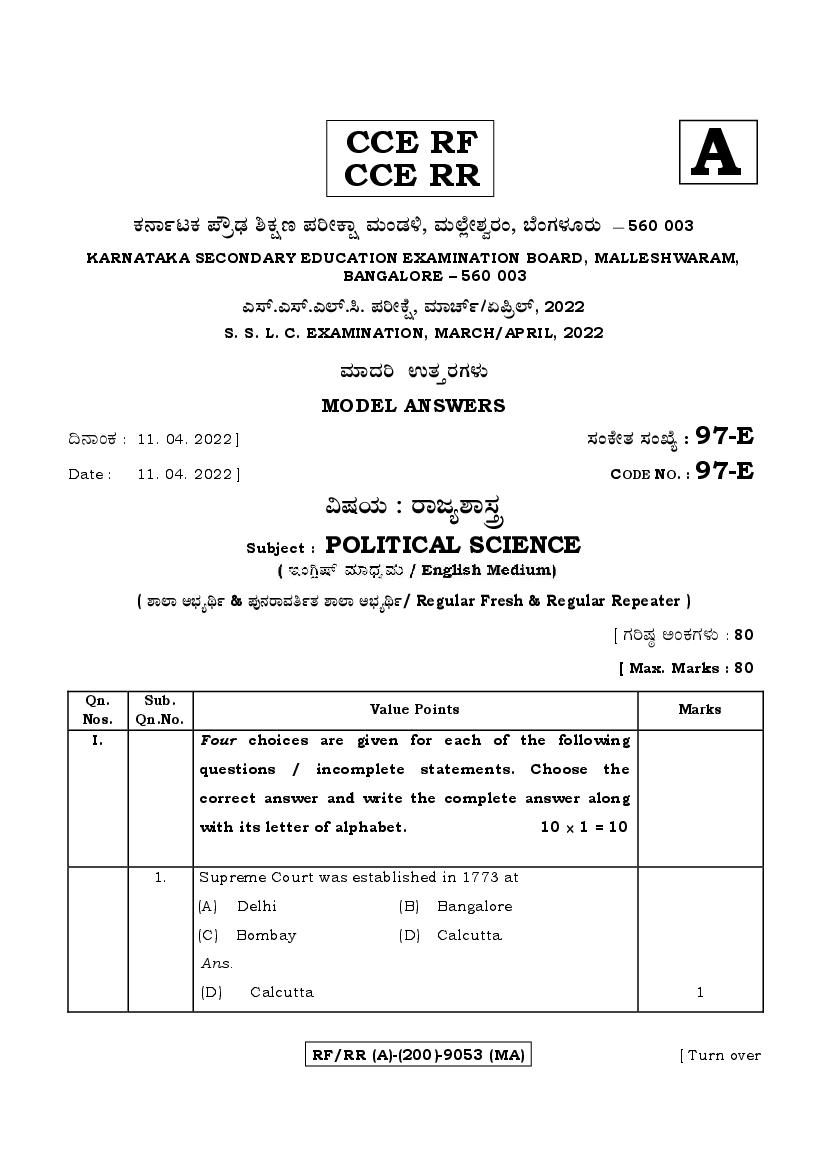
CCE RR A
O⁄´¤%lO⁄ ÆË√v⁄ ÃO⁄–y Æ⁄¬fiO¤– »⁄flMs⁄ÿ, »⁄fl≈Ê«fiÀ⁄ ¡⁄M, ∑ÊMV⁄◊⁄‡¡⁄fl — 560 003
KARNATAKA SECONDARY EDUCATION EXAMINATION BOARD, MALLESHWARAM,
BANGALORE – 560 003
G—È.G—È.G≈È.“. Æ⁄¬fiOÊ⁄–, »⁄·¤^È%/HØ√≈È, 2022
S. S. L. C. EXAMINATION, MARCH/APRIL, 2022
»⁄·¤•⁄¬ D}⁄ °¡⁄V⁄◊⁄fl
MODEL ANSWERS
¶´¤MO⁄ : 11. 04. 2022 ] —⁄MOÊfi}⁄ —⁄MSÊ¿ : 97-E
Date : 11. 04. 2022 ] CODE NO. : 97-E
…Œ⁄æ⁄fl : ¡¤d¿À¤—⁄°
Subject : POLITICAL SCIENCE
( À¤≈¤ @∫⁄¥¿£% & Æ⁄‚¥´⁄¡¤»⁄~%}⁄ À¤≈¤ @∫⁄¥¿£%/ Regular Fresh & Regular Repeater )
[ V⁄¬Œ⁄r @MO⁄V⁄◊⁄fl : 80
[ Max. Marks : 80
Qn. Sub.
Value Points Marks
Nos. Qn.No.
I. Four choices are given for each of the following
questions / incomplete statements. Choose the
correct answer and write the complete answer along
with its letter of alphabet. 10 × 1 = 10
1. Supreme Court was established in 1773 at
(A) Delhi (B) Bangalore
(C) Bombay (D) Calcutta.
(D) Calcutta 1
RF/RR (A)-(200)-9053 (MA) [ Turn over
Page 2
Value Points Marks
2. In 1934, the creation of a constituent assembly was
strongly emphasized by
(A) Motilal Nehru
(B) Mahatma Gandhi
(C) Manavendranath Roy
(D) Dr. B. R. Ambedkar.
(C) Manavendranath Roy 1
3. Our constitution was adopted on
(A) 11th December, 1944
(B) 26th November, 1949
(C) 26th January, 1951
(D) 23rd March, 1956.
(B) 26th November, 1949 1
4. ‘‘Preamble is a yardstick of measuring the worth of the
constitution’’ stated by
(A) Thakur Das Bhargava
(B) D. P. Kethan
(C) B. L. Mittar
(D) K. M. Munshi.
(A) Thakur Das Bhargava
1
5. Article 21A of our constitution is related to
(A) Fundamental duties
(B) free and compulsory education
(C) appointment of the Prime minister
(D) removal of the President.
(B) Free and compulsory education 1
RF/RR (A)-(200)-9053 (MA)
Page 3
Value Points Marks
6. Fundamental duties were included in our constitution in
the year
(A) 1976 (B) 1986
(C) 1996 (D) 2006.
(A) 1976 1
7. ‘‘The Directive Principles of State Policy form the inner
soul of the constitution’’ is stated by
(A) K. C. Wheare (B) H. J. Laski
(C) Granville Austin (D) N. Madhavarao.
(C) Granville Austin 1
8. The cases decided by the District Session Courts are
(A) disputes between states
(B) water disputes
(C) civil cases
(D) criminal cases.
(D) Criminal cases 1
9. The headquarters of Karnataka Public Service
Commission is at
(A) Bengaluru (B) Mangalore
(C) Mysore (D) Belagavi.
(A) Bengaluru
1
10. The headquarters of Joint Public Service Commission of
north-eastern states is at
(A) Imphal (B) Dispur
(C) Kohima (D) Agartala.
(B) Dispur 1
RF/RR (A)-(200)-9053 (MA) [ Turn over
Page 4
Value Points Marks
II. 11. Match list ‘A’ with list ‘B’ and write the answer along
with its letter of alphabet : 5×1=5
A B
a) The Chairman of i) B. N. Rao
Drafting Committee
b) The permanent ii) Jawaharlal Nehru
President of
Constituent
Assembly
c) The Vice-President of iii) Sachchidananda
Constituent Sinha
Assembly
d) The temporary iv) Dr. B. R. Ambedkar
President of
Constituent
Assembly
e) The Constitutional v) Dr. Babu Rajendra
Advisor Prasad
vi) H. C. Mukherjee
vii) Mahatma Gandhi.
A B
a) The Chairman of iv) Dr. B. R. Ambedkar
Drafting Committee
b) The permanent v) Dr. Babu Rajendra
President of Prasad
Constituent
Assembly
c) The Vice-President of vi) H. C. Mukherjee
Constituent
Assembly
d) The temporary iii) Sachchidananda
President of Sinha
Constituent
Assembly
e) The Constitutional i) B. N. Rao
Advisor 5
RF/RR (A)-(200)-9053 (MA)
Page 5
Value Points Marks
III. Answer the following questions in a sentence each :
15 × 1 = 15
12. When was Consumer Court established ?
1986 1
13. Why is Lok Adalat established ?
— to prevent delay
— to compromise
1
14. What is the importance of Article 315 of our
constitution ?
Establishment of Union Public Service Commission
1
15. What is the term of office of the members of State Public
Service Commission ?
6 years / 65 years of age 1
16. Who is the ‘father of Karnataka Panchayat Raj System’ ?
Ramakrishna Hegde 1
17. From which constitution are the Directive Principles of
State Policy borrowed ?
Ireland constitution 1
18. Under which articles are the Directive Principles of State
Policy explained ?
From Articles 36 to 51 1
19. How is the word quo-warranto derived ?
Latin word 1
20. What is the meaning of the word Habeas Corpus ?
to have the body of 1
RF/RR (A)-(200)-9053 (MA) [ Turn over
Page 6
Value Points Marks
21. What did Dr. B. R. Ambedkar call the Article 32 of our
constitution ?
soul and heart of the constitution 1
22. What is Fraternity ?
— living together without discrimination
— spirit of brotherhood. 1
23. What is the opinion of Jawaharlal Nehru on secularism ?
Secularism is not only related to material life but also
spiritual life. 1
24. Although England is a democratic state, it is not a
Republic. Why ?
King / Queen continues to be in office on hereditary. 1
25. Which Act provided separate electoral college for
muslims ?
1909 Act / Morley-Minto reforms. 1
26. Why did K. C. Wheare call our constitution as a balanced
constitution ?
Partly rigid and partly flexible.
1
IV. Answer the following questions in about two to four
sentences each : 14 × 2 = 28
27. Explain the principles of secularism.
— All the religions shall have equal status
— State must be neutral on matters of religion
— Life based on cooperation
— Secularization of social life. 2
RF/RR (A)-(200)-9053 (MA)
Page 7
Value Points Marks
28. Name the philosophical pillars of Indian political system.
— Justice
— Liberty
— Equality
— Fraternity 2
29. What are the features of Fundamental rights ?
— not absolute
— justifiable
— enforceable
— restricted 2
30. Right to Information Act is necessary in democratic
system. Justify.
— combating corruption
— transparency in administration
— enhancing accountability
— rectifying the defects of laws.
2
31. Mention the features of Directive Principles of State
Policy.
— creation of welfare state
— building a society on the basis of liberty, equality etc.
2
32. How is social and economic progress achieved by State
and Central Government ?
— Land reforms
— establishment of Panchayat Raj
— equal pay for equal work
— free and compulsory education. 2
RF/RR (A)-(200)-9053 (MA) [ Turn over
Page 8
Value Points Marks
33. List out Liberal Principles.
— Uniform civil code enforcement
— Separation of judiciary from the executive
— Free and compulsory education
— Promoting peace and harmony
— Preservation of historical monuments. 2
34. Name the revenue courts.
— Tahsildar court
— Assistant Commissioners court
— District Magistrate court
— Commissioner court
— Revenue Board. 2
35. What are the exemptions given to judges of High Court ?
— Judgment given should not be condemned
— Salary and other allowance cannot be reduced. 2
36. Name the Standing Committees of Zilla Panchayat.
— General Committee
— Finance and Planning Committee
— Social Justice Committee
— Education and Health Committee
— Agriculture and Industrial Committee. 2
37. Who are the members of Taluk Panchayat ?
— elected members
— members of Lok Sabha and Rajya Sabha
— members of Legislative Assembly and Council
— 1 of the Panchayat Presidents.
5 2
RF/RR (A)-(200)-9053 (MA)
Page 9
Value Points Marks
38. How is the administration of cantonment areas carried
out ?
— Functions in defence areas
— direct supervision of defence
— high rank military officers. 2
39. How can the members of Union Public Service
Commission be removed ?
— misbehaviour charges are proved
— economically insolvent
— holding an office of profit
— proved to be physically incapaciated. 2
40. What are the qualifications required to become the
member of State Public Service Commission ?
— Served at least 10 years under government
— prestigious persons in different fields. 2
V. Answer the following questions in about three to six
sentences each : 6 × 3 = 18
41. The Government of India Act of 1935 has played an
important role in formation of our constitution. How ?
— Union and provincial autonomy
— Diarchy at centre
— Bicameral legislature
— Central and State list
— Distribution of powers
— Establishment of Reserve Bank of India. 3
RF/RR (A)-(200)-9053 (MA) [ Turn over
Page 10
Value Points Marks
42. Name the fundamental rights given to Indians.
— Equality
— freedom
— against exploitation
— freedom of religion
— cultural and educational rights
— constitutional remedies. 3
43. Differentiate Directive Principles of State Policies and
Fundamental Rights.
Directive Principles Fundamental rights
— positive — negative
— not justiciable — justiciable
— community centred — individual centred
— official ends — means of ends
— strengthening social — developing political
and economic democracy
democracy
3
44. Explain the Preamble of our constitution.
— We, the people of India
— Sovereign country
— Secular and socialist
— Democratic republic
— Social, economic and political justice
— Liberty. 3
RF/RR (A)-(200)-9053 (MA)
Page 11
Value Points Marks
45. Explain the original jurisdiction of the High Court.
— Custodian of fundamental rights
— Transfer of cases
— Direction to subordinate courts
— Directly deal high profile cases
— Contempt of courts
— Company laws. 3
46. Mention the functions of Mahanagar Palike.
— administration of corporation
— preparation of budget
— construction works
— maintenance
— registration
— permission and control
— maintenance of sanitation
— controlling adulteration
— protection of monuments. 3
VI. Answer the question in about eight to ten
sentences / points : 1×4=4
47. What are the functions of Gram Panchayat ?
— Preparing annual plan
— development of agriculture
— encouragement for cottage industries
— eradication of poverty
— controlling pollution
— maintenance of library
— informal education
— developing non-conventional sources
— protection of parks
— providing rural sanitation. 4
RF/RR (A)-(200)-9053 (MA) [ Turn over
Document Details
| Board / Org | Karnataka Board |
| Exam | Class 10 |
| Type | Answer Key |
| Pages | 11 |
| Updated | 22 Jul 2026 |