CBSE Class 12 Biology Question Paper 2020 Set 57-1 Solutions
Finished viewing? Save it for later —
Download CBSE Class 12 Biology Question Paper 2020 Set 57-1 Solutions (PDF · 38 pages)About CBSE Class 12 Biology Question Paper 2020 Set 57-1 Solutions
CBSE Class 12 Biology Question Paper 2020 Set 57-1 Solutions is available here for free download. Published by CBSE for Class 12, this solution can be viewed online or downloaded as a PDF (38 pages). Candidates preparing for Class 12 can use CBSE Class 12 Biology Question Paper 2020 Set 57-1 Solutions to understand the exam pattern, the type of questions asked, and the overall difficulty level.
Frequently Asked Questions
How can I download CBSE Class 12 Biology Question Paper 2020 Set 57-1 Solutions?
Open this page and click the Download button to save CBSE Class 12 Biology Question Paper 2020 Set 57-1 Solutions as a PDF. It is completely free on AglaSem Docs.
Is CBSE Class 12 Biology Question Paper 2020 Set 57-1 Solutions free to download?
Yes. CBSE Class 12 Biology Question Paper 2020 Set 57-1 Solutions can be viewed online and downloaded as a PDF free of cost on AglaSem Docs.
How many pages does CBSE Class 12 Biology Question Paper 2020 Set 57-1 Solutions have?
CBSE Class 12 Biology Question Paper 2020 Set 57-1 Solutions contains 38 pages, which you can read online or download together as a single PDF.
Where can I find more Class 12 study material?
You can find more Class 12 question papers, sample papers, syllabus, and answer keys on AglaSem Docs.
CBSE Class 12 Biology Question Paper 2020 Set 57-1 Solutions – Text
Read the full text of this solution below — useful to quickly search, copy and reference the content online without downloading the PDF.
📄 View text version (38 pages)
Page 1
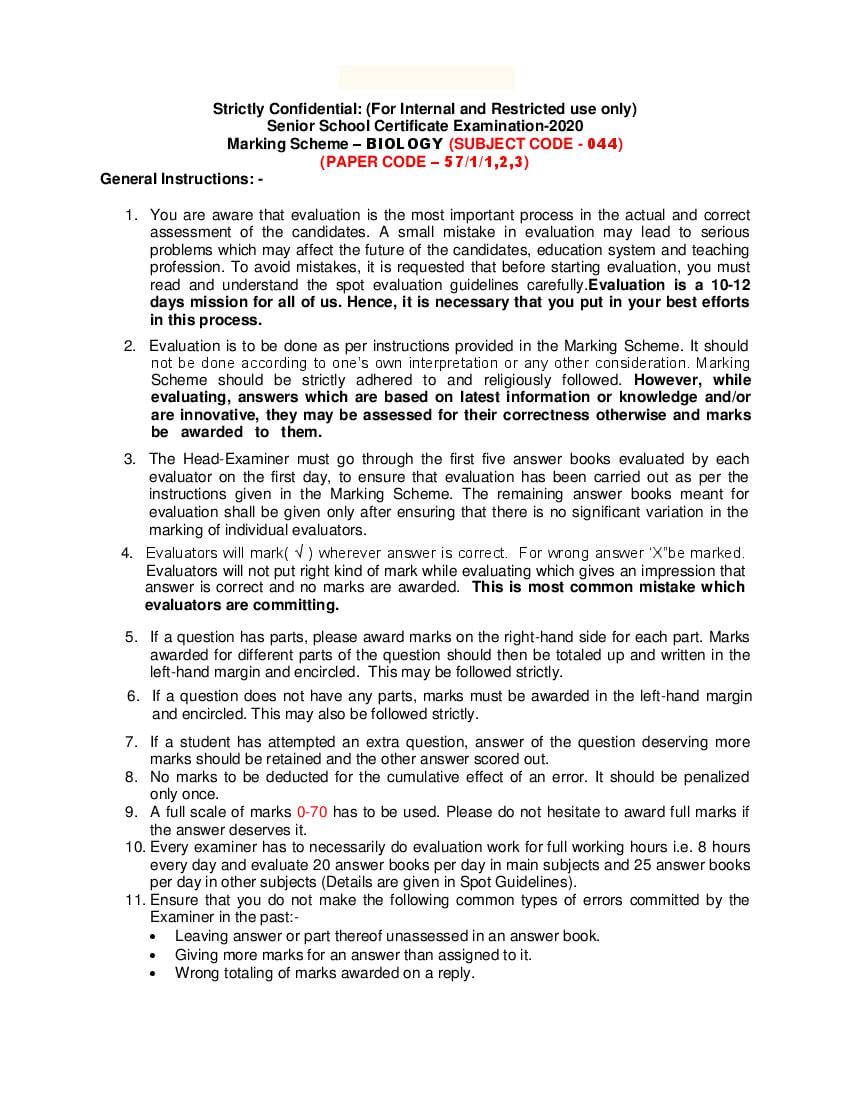
Senior School Certificate Examination-2020
Marking Scheme – BIOLOGY (SUBJECT CODE - 044)
(PAPER CODE – 57/1/1,2,3)
General Instructions: -
1. You are aware that evaluation is the most important process in the actual and correct
assessment of the candidates. A small mistake in evaluation may lead to serious
problems which may affect the future of the candidates, education system and teaching
profession. To avoid mistakes, it is requested that before starting evaluation, you must
read and understand the spot evaluation guidelines carefully.Evaluation is a 10-12
days mission for all of us. Hence, it is necessary that you put in your best efforts
in this process.
2. Evaluation is to be done as per instructions provided in the Marking Scheme. It should
not be done according to one’s own interpretation or any other consideration. Marking
Scheme should be strictly adhered to and religiously followed. However, while
evaluating, answers which are based on latest information or knowledge and/or
are innovative, they may be assessed for their correctness otherwise and marks
be awarded to them.
3. The Head-Examiner must go through the first five answer books evaluated by each
evaluator on the first day, to ensure that evaluation has been carried out as per the
instructions given in the Marking Scheme. The remaining answer books meant for
evaluation shall be given only after ensuring that there is no significant variation in the
marking of individual evaluators.
4. Evaluators will mark( √ ) wherever answer is correct. For wrong answer ‘X”be marked.
Evaluators will not put right kind of mark while evaluating which gives an impression that
answer is correct and no marks are awarded. This is most common mistake which
evaluators are committing.
5. If a question has parts, please award marks on the right-hand side for each part. Marks
awarded for different parts of the question should then be totaled up and written in the
left-hand margin and encircled. This may be followed strictly.
6. If a question does not have any parts, marks must be awarded in the left-hand margin
and encircled. This may also be followed strictly.
7. If a student has attempted an extra question, answer of the question deserving more
marks should be retained and the other answer scored out.
8. No marks to be deducted for the cumulative effect of an error. It should be penalized
only once.
9. A full scale of marks 0-70 has to be used. Please do not hesitate to award full marks if
the answer deserves it.
10. Every examiner has to necessarily do evaluation work for full working hours i.e. 8 hours
every day and evaluate 20 answer books per day in main subjects and 25 answer books
per day in other subjects (Details are given in Spot Guidelines).
11. Ensure that you do not make the following common types of errors committed by the
Examiner in the past:-
Leaving answer or part thereof unassessed in an answer book.
Giving more marks for an answer than assigned to it.
Wrong totaling of marks awarded on a reply.
Page 2
Wrong question wise totaling on the title page.
Wrong totaling of marks of the two columns on the title page.
Wrong grand total.
Marks in words and figures not tallying.
Wrong transfer of marks from the answer book to online award list.
Answers marked as correct, but marks not awarded. (Ensure that the right tick mark
is correctly and clearly indicated. It should merely be a line. Same is with the X for
incorrect answer.)
Half or a part of answer marked correct and the rest as wrong, but no marks
awarded.
12. While evaluating the answer books if the answer is found to be totally incorrect, it should
be marked as cross (X) and awarded zero (0)Marks.
13. Any unassessed portion, non-carrying over of marks to the title page, or totaling error
detected by the candidate shall damage the prestige of all the personnel engaged in the
evaluation work as also of the Board. Hence, in order to uphold the prestige of all
concerned, it is again reiterated that the instructions be followed meticulously and
judiciously.
14. The Examiners should acquaint themselves with the guidelines given in the Guidelines
for spot Evaluation before starting the actual evaluation.
15. Every Examiner shall also ensure that all the answers are evaluated, marks carried over
to the title page, correctly totaled and written in figures and words.
16. The Board permits candidates to obtain photocopy of the Answer Book on request in an
RTI application and also separately as a part of the re-evaluation process on payment of
the processing charges
Page 3
SECTION – A
1. Meselson and Stahl carried out centrifugation in CsCl2 density gradient to separate :
(A) DNA from RNA
(B) DNA from protein
(C) The normal DNA from 15N-DNA
(D) DNA from tRNA
Ans C / The normal DNA from 15N-DNA
[1 Mark]
2. Self-pollination is fully ensured if
(A) the flower is bisexual.
(B) the style is longer than the filament.
(C) the flower is cleistogamous.
(D) the time of pistil and anther maturity is different.
Ans C / Flower is Cleistogamous
OR
Zoospores are the reproductive units to carry asexual reproduction in
(A) Chlamydomonas
(B) Spirogyra
(C) Yeast
(D) Rhizopus
Ans A / Chlamydomonas
[1 Mark]
3. Micropropagation can be achieved by
(A) Self-pollination
(B) Asexual reproduction
(C) Tissue culture
(D) Vegetative propagation
Ans C / Tissue Culture
OR
The microbes commonly used in kitchens are
(A) Lactobacillus and Yeast
3
Page 4
(C) Microspora and E. coli
(D) Rhizopus and Lactobacillus
Ans A / Lactobacillus and Yeast
[1 Mark]
4. The main barrier that prevents the entry of micro-organisms into our body is
(A) Antibodies
(B) Macrophages
(C) Monocytes
(D) Skin
Ans D / Skin
[1 Mark]
5. Nematode specific genes were introduced into the tobacco host plant using a vector
(A) pBR 322
(B) Plasmid
(C) Bacteriophage
(D) Agrobacterium
Ans D / Agrobacterium
[1 Mark]
SECTION – B
6. Given below is one of the strands of a DNA segment :
(a) Write its complementary strand.
(b) Write a possible RNA strand that can be transcribed from the above
DNA molecule formed.
Ans (a) 5'ATGCATGCAT
GCATGC
3' (polarity =½ , nucleotide sequence =½)
(b) 5'AUGCAUGCAU
GCAUGC
3' (polarity =½ , nucleotide sequence =½)
[1 + 1 = 2 Marks]
7. Wings of birds and wings of butterflies contribute to locomotion. Explain the type of
evolution such organs are a result of.
Ans They are not anatomically similar in structure but perform same function , hence these are
analogous structure = ½ + ½
type of evolution is convergent evolution =1
4
Page 5
similar habitat of birds and butterflies has resulted in selection of similar adaptive features
(wings) in different groups of organisms , but towards the same function = ½ + ½
convergent evolution = 1
[2 Marks]
8. It is often observed that the chances of a person suffering from measles in his or her
lifetime are low if he or she has suffered from the disease in their early childhood. Justify
the statement.
Ans Memory cells develop during measles in early childhood , subsequent encounters with the
same pathogen elicits a highly intensified secondary / anamnestic response = 1+1
[2 Marks]
9. List the three hormones produced in women only during pregnancy. What happens to
the levels of estrogen and progesterone during pregnancy ?
Ans
- Human chorionic gonadotropin / hCG ,
- Human placental lactogen / hPL ,
- Relaxin ,
(The level of progesterone & estrogen) increases =½×4
[2 Marks]
10. A student on a field trip suddenly felt breathlessness and started to sneeze very badly.
Name this response and explain what it is due to.
Ans Allergy =1
Allergens ( dust / pollen / mites etc.), due to release of chemicals like histamine/serotonin (
from mast cells)
=½+½
[2 Marks]
11. With the help of a suitable example, explain how cross-breeding is carried out in
developing a new breed in animals.
Ans Mating of superior male of one breed with superior female of another breed. =1
Hisardale , is a new breed of sheep ( developed in punjab) by crossing Bikaneri Ewes and
Marino Rams.
= ½+½
[2 Marks]
12. Name the genus of baculovirus that acts as a biological control agent in
spite of being a pathogen. Justify by giving three reasons that make it an excellent
candidate for the job.
Ans Genus -Nucleopolyhedrovirus, species-specific , Narrow spectrum , No negative impact on
(plants /mammals/ birds /fish ) non-target organisms = ½ ×4 =2
5
Page 6
‘‘Micro-organisms play an important role for the biological treatment of sewage.’’
Justify
Ans Primary effluent passed into aeration tanks, constantly agitated and air is pumped in , allows
growth of useful aerobic microbes into flocs / (masses of bacteria and fungal filaments), these
microbes consume organic matter and reduce Biochemical oxygen demand (BOD) of
effluent. = ½ × 4
[2 Marks]
Section C
13. Draw a schematic transverse section of a mature anther of an angiosperm. Label its
epidermis, middle layers, tapetum, endothecium, sporogenous tissue and the connective.
Ans
=½×6
[3 Marks]
14. Differentiate between wind pollinated and insect pollinated flowers.
Ans
Wind pollinated
Pollen grains are light non sticky /well exposed stamens/ Large feathery stigma / single ovule
in each flower / Small flowers packed in inflorescence
Any three (½ × 3)
Insect pollinated
Pollen grains sticky/ Floral rewards / Fragrant / Nectar rich / Large Flower
Any three (½ × 3)
[3 Marks]
15. Generally it is observed that human males suffer from hemophilia more than human
females, who rarely suffer from it. Explain giving reasons.
Ans This is a sex linked / X chromosomes linked recessive disease ,the heterozygous female /
carrier for hemophilia may transmit the disease to sons (male progeny), The possibility of
hemophilic female/daughter is rare because mother of such a female has to be at least carrier
and the father should be hemophilic. = 1+1+1
[3 Marks]
6
Page 7
F1 progeny of pea plant bearing violet flowers and snapdragon plant bearing red
flowers were selfed to produce their respective F2 progeny.
Compare the phenotypes, the genotypes and the pattern of inheritance of
their respective F2 progeny.
Ans F1 Violet flower of Pea F1 Red flower of snapdragon
Ww Ww / WW WW RR RR
Selfing Selfing Selfing
Case 1 / Case 2
W w W W R R
W WW Ww W WW WW R RR RR
w Ww ww W WW WW R RR RR
Phenotypic ratio 100% WW / Phenotypic ratio
Violet : White all violet flowers Red
3 : 1 100% ½×2
Genotypic Ratio Genotypic Ratio
1:2:1 RR (100%) ½×2
Pattern of inheritance
Pea plant Complete dominance ½
Snapdragon Incomplete dominance ½
[3 Marks]
16. Explain the changes that milk undergoes when suitable starter/inoculum is added to it.
How does the end product formed prove to be beneficial for human health ?
Ans Lactobacillus / lactic acid bacteria (LAB) present in inoculum , grows in milk at a suitable /
optimum temperature, multiplies converting milk to curd, produce acids that coagulate and
partially digest the milk proteins. =½×4
This improves its nutritional quality by increasing Vitamin B12 , LAB check diseases causing
microbes in our stomach = ½ × 2
[3 Marks]
17. Alien species invasion has been a threat to biodiversity. Justify with the help of a
suitable example. List any other three causes responsible for such a loss.
Ans Example of Alien species invasion
Nile Perch , introduced into lake Victoria ( in East Africa) , led to extinction of Cichlid fish
(more than 200 species) in the lake
7
Page 8
Introduction of African cat fish (Clarias gariepinus) , for aquaculture, posing threat to
indigenous catfish
//
Introduction of carrot grass (Parthenium) / Lantana / Water hyacinth (Eicchornia) ,which are
invasive weed , that pose threat to native species
or any other appropriate example. = ½ × 3 = 1½
Causes of biodiversity loss
(i) Habitat loss and fragmentation
(ii) Over exploitation
(iii) Co-extinction
= ½ × 3 = 1½
[3 Marks]
18. Study the table given below and identify a, b, c, d, e and f :
Crops Variety Resistance to disease
a Pusa sadabahar b
c d White rust
e Himgiri f
Ans Crop Variety Resistance to diseases.
a. Chilli - b. Mosaic Virus /Leaf Curl
c Brassica d. Pusa Swarnim/karan Rai
e. Wheat - f. Leaf & stripe rust / hill bunt.
=½ × 6
[3 Marks]
OR
What is plant breeding ? Explain the two steps involved in classical plant breeding.
Plant breeding is the purposeful manipulation of plants species in order to create desired plant
types, that are better suited for cultivation / better yield / disease resistant.
½×2=1
Classical Plant breeding involves crossing or hybridisation of pure lines,followed by artificial
selection to produce plants with desirable traits of higher yield / nutrition / resistance to
diseases. = 1+1
[3 Marks]
19. Explain the three steps carried out in the formation of recombinant DNA using the
enzyme EcoRI.
8
Page 9
=½ =½
=½
=½
=½
=½
//
Eco R1 cuts vector DNA , foreign DNA/ gene of interest , at pallindromic site /
5' GAATTC 3'
3' CTTAAG 5' (between bases G & A only), sticky end (over hanging stretch of bases)
formed at each strand, Joining of sticky ends from DNA fragments by enzyme DNA
Ligase,Recombinant DNA(rDNA) is formed = ½ × 6
[3 Marks]
20. Name any two natural cloning vectors. Give reasons that make them act as cloning
vectors. Write the two characteristics the engineered vectors are made to possess
Ans Plasmids , bacteriophages = ½ + ½
ability to replicate within bacterial cells , high copy number within the
bacterial cells = ½ + ½
Characteristics of engineered Vectors: easy linking of foreign DNA,
Selection of recombinants from non- recombinants /selectable marker = ½ + ½
[3 Marks]
21. Explain the difference between commensalism and mutualism types of interactions,
with the help of a suitable example of each.
Ans Mutualism Commensalism
- both the interacting species are benefitted = 1 - One species is benefitted and other is
9
Page 10
lichen/Mycorrhizae /fig & wasp - Explanation of any one example
or any other suitable example = ½ orchid growing on mango branch /
barnacle on back of whale / cattle
egret & grazing cattle or any other
suitable example = ½
[1 + 1+ ½ + ½ = 3 Marks]
SECTION D
22. Insulin in the human body is secreted by pancreas as prohormone/proinsulin. The
schematic polypetide structure of proinsulin is given below. This proinsulin needs to
undergo processing before it becomes functional in the body. Answer the questions that
follow
(a) State the change the proinsulin undegoes at the time of its processing to become
functional.
(b) Name the technique the American company Eli Lilly used for the commercial
production of human insulin.
(c) How are the two polypeptides of a functional insulin chemically held together ?
Ans (a) ‘C’ Peptide is removed = 1
(b) r-DNA technology / Recombinant DNA Technology = 1
(c) Disulphide bonds = 1
[ 3 Marks]
23 The cytological observations made in a number of insects led to the development of the
concept of genetic/chromosomal basis of sex-determination mechanism. Honey bee is an
interesting example to study the mechanism of sex-determination. Study the schematic
cross between the male and the female honey bees given below and answer the questions
that follow :
10
Page 11
honey bees respectively.
(b) Name the process ‘C’ that leads to the development of male honey bee (drone).
Ans (a) ‘A’ - meiosis
‘B’-Mitosis
(b) ‘C’-Parthenogenesis = 1+1+1
[3 Marks]
24. Study the age pyramids ‘A’, ‘B’ and ‘C’ of the human population given below and
answer the questions that follow :
(a) Identify pyramids ‘B’ and ‘C’.
(b) Write the basis on which the above pyramids are plotted.
Ans (a) B- Stable population = 1
C- Declining population = 1
(b) Age Distribution of male and female of human population = 1
[2 +1 = 3 Marks]
11
Page 12
25. (a) IVF is a very popular method these days that is helping childless couples to bear a
child. Describe the different steps that are carried out in this technique.
(b) Would you consider Gamete Intrafallopian Transfer (GIFT) as an IVF ? Give a
reason in support of your answer.
Ans (a) Ova from the wife /donor (female) and sperms from the husband / donor (male ) , are
collected and induced to form zygote , in simulated conditions in laboratory , the zygote/
early embryos(upto 8 blastomeres) then transferred into the fallopian tube(ZIFT), and
embroyos with more than 8 blastomeres, into the uterus(IUT) to complete its further
development. = ½ × 6
(b) No, GIFT cannot be considered as IVF technique because fertilisation takes place in the
female body / in vivo. =1+1
[3 +2 = 5 Marks]
OR
(a) Draw a sectional view of a human ovary and label primary follicle, tertiary follicle,
Graafian follicle and corpus luteum in it.
(b) Name the gonadotropins and explain their role in oogenesis andthe release of ova.
Ans a. = ½×4
b. LH , FSH = ½ + ½
Both LH and FSH increase during follicular phase and stimulate follicular development ,
secretion of estrogen by the growing follicles, LH surge ( rapid secretion of LH) during mid
cycle / 14th day induces rupture of graffian follicle, and release of ova / secondary oocyte
=½×4=2
[2 + 3 = 5 Marks]
26. Describe the experiment carried out by Hershey and Chase. Write the conclusion they
arrived at.
Ans They grew viruses on a medium containing radioactive phosphorus /P32, and some on
radioactive sulphur / S35, radioactive DNA contained in viruses grown on radioactive
phosphorus , radioactive protein contained in virus grown in radioactive sulphur , Radioactive
phages were allowed to attach to E.coli bacteria , the virus coats were removed from bacteria
12
Page 13
centrifugation , Bacteria infected with viruses containing radioactive DNA were radioactive,
where as bacterial cells infected with virus containing radioactive protein did not show
radioactivity , = ½ × 9
//
=½
=½
=½
=½
=½
=½
=½
=½
=½
=½×9
Conclusion- DNA is therefore the genetic material that is passed from virus to bacteria = ½
[4½ + ½ = 5 Marks]
OR
(a) Describe the observations made on collection of white winged moths and dark winged
moths in England between the years 1850 and 1920. What did these observations lead
to ?
(b) How is the use of herbicides, pesticides and antibiotics by humans for various purposes,
comparable with the observations made on moths in the above question ? What is this
type of phenomenon called ?
Ans a. Before industrialisation tree bark were covered with light coloured lichens , In this
background white winged moth survived but dark coloured moth was picked out by
predators,post industrialisation tree trunks become dark due to industrial smoke and
soot,under this condition the white winged moth did not survive due to predators,while
the dark winged/melanised moth survived, this showed that organism that are better
adapted to survive are selected by Nature/Natural selection. = ½ × 6
b. Excessive use of these chemicals has resulted in the selection of resistant
varieties , in a much lesser time ( scale) . = ½ × 2
These are examples of evolution by anthropogenic action. =1
[3 + 2 = 5 Marks]
13
Page 14
Ans Phosphorus a major constituent of biological membrane / nucleic acids / cellular energy
transfer system , Many animals need it for making shells / bones and teeth , the natural
reservoirs of phosphorous is rock , which contains phosphorous in the form of phosphate
reserves , on weathering minute amount of phosphate dissolve in soil solution , and absorbed
by roots , Herbivores , obtain these elements from plants waste products and dead organism ,
decomposed by phosphate-solubilising bacteria , releasing phosphorus = ½ × 10
//
Marks can also be awarded for the steps given in the proper sequence, with other details
= ½ marks for each given label
[5 Marks]
OR
Describe the DDT biomagnification occurring in an aquatic food chain. State the
negative effects the process has on the organisms at the last trophic level of the food
chain.
Ans Biomagnification refers to increase in concentration of the toxicant at successive trophic
levels , Toxic substance accumulated by an organism cannot be metabolised or excreted and is
passed on to the next higher trophic level = ½ × 2
Biomagnification of DDT in an aquatic food chain
Water Zooplankton small fish Large Fish Fish eating bird. = ½ × 5
0.003 ppb 0.04 ppm 0.5 ppm 2 ppm 25 ppm
High concentration of DDT disturb calcium metabolism in birds,causes thinning of eggshell ,
their premature breaking eventually causing decline in bird population = ½ × 3
[ 5 Marks]
14
Page 15
SECTION – A
1. ‘ ‘Cry’ protein’ coded by gene Cry IAb controls
(A) Cotton bollworm
(B) Corn borer
(C) Tobacco budworm
(D) Mosquito
Ans (B) / Corn borer
[ 1 Mark]
2. Meselson and Stahl carried out centrifugation in CsCl2 density gradient to separate :
(A) DNA from RNA
(B) DNA from protein
(C) The normal DNA from 15N-DNA
(D) DNA from tRNA
Ans C / The normal DNA from 15N-DNA
[1 Mark]
3. Self-pollination is fully ensured if
(A) the flower is bisexual.
(B) the style is longer than the filament.
(C) the flower is cleistogamous.
(D) the time of pistil and anther maturity is different.
Ans C / Flower is Cleistogamous
OR
Zoospores are the reproductive units to carry asexual reproduction in
(A) Chlamydomonas
(B) Spirogyra
(C) Yeast
(D) Rhizopus
Ans A / Chlamydomonas
[1 Mark]
4. Micropropagation can be achieved by
(A) Self-pollination
15
Page 16
(C) Tissue culture
(D) Vegetative propagation
Ans C / Tissue Culture
OR
The microbes commonly used in kitchens are
(A) Lactobacillus and Yeast
(B) Penicillium and Yeast
(C) Microspora and E. coli
(D) Rhizopus and Lactobacillus
Ans A / Lactobacillus and Yeast
[1 Mark]
5. The main barrier that prevents the entry of micro-organisms into our body is
(A) Antibodies
(B) Macrophages
(C) Monocytes
(D) Skin
Ans D / Skin
[1 Mark]
SECTION – B
6. Name the genus of baculovirus that acts as a biological control agent in spite of being a
pathogen. Justify by giving three reasons that make it an excellent candidate for the job.
Ans Genus -Nucleopolyhedrovirus, species-specific , Narrow spectrum , No negative impact on
(plants /mammals/ birds /fish ) non-target organisms = ½ × 4=2
[2 Marks]
OR
‘‘Micro-organisms play an important role for the biological treatment of sewage.’’
Justify
Ans Primary effluent passed into aeration tanks, constantly agitated and air is pumped in , allows
growth of useful aerobic microbes into flocs / (masses of bacteria and fungal filaments), these
microbes consume organic matter and reduce Biochemical oxygen demand (BOD) of
effluent. = ½ × 4
[2 Marks]
7. It is often observed that the chances of a person suffering from measles in his or her
lifetime are low if he or she has suffered from the disease in their early childhood. Justify
the statement.
16
Page 17
same pathogen elicits a highly intensified secondary / anamnestic response. = 1 + 1
[2 Marks]
8. Wings of birds and wings of butterflies contribute to locomotion. Explain the type of
evolution such organs are a result of.
Ans They are not anatomically similar in structure but perform same function , hence these are
analogous structure = ½ + ½
type of evolution is convergent evolution =1
//
similar habitat of birds and butterflies has resulted in selection of similar adaptive features
(wings) in different groups of organisms , but towards the same function = ½ + ½
convergent evolution = 1
[2 Marks]
9. Name and mention the events that occur in the cells when HIV gets into blood after
gaining entry into the human body.
Ans Virus/viral RNA enters into macrophages , where RNA genome of virus replicate to form viral
DNA with the help of reverse transcriptase ,This viral DNA gets incorporated into host cell’s
DNA, and direct infected cells to produce virus particles = ½ × 4
[ 2 Marks]
10. List the four different human male accessory ducts.
Ans rete testis , vasa efferentia , epididymis , vas deferens = ½ × 4
[ 2 Marks]
11. State what is out-crossing type of breeding. Mention on what type of cattle this is
practised.
Ans Practice of mating animals within the same breed, but having no common ancestors on
either side of ( their pedigree) upto 4-6 generations. = ½ + ½
Animals that are below average, in milk production / growth rate in beef cattle. ½ + ½
[ 2 Marks]
12. Given below is one of the strands of a DNA segment :
(a) Write its complementary strand.
(b) Write a possible RNA strand that can be transcribed from the above DNAmolecule
formed.
Ans (a) 5'ATGCATGCAT
GCATGC
3' (polarity =½, nucleotide sequence =½)
17
Page 18
GCAUGC
3' (polarity =½, nucleotide sequence =½)
[1 + 1 = 2 Marks]
Section C
13 Generally it is observed that human males suffer from hemophilia more than human
females, who rarely suffer from it. Explain giving reasons.
Ans This is a sex linked / X chromosomes linked recessive disease ,the heterozygous female /
carrier for hemophilia may transmit the disease to sons (male progeny), The possibility of
hemophilic female/daughter is rare because mother of such a female has to be at least carrier
and the father should be hemophilic.
[3 Marks]
OR
F1 progeny of pea plant bearing violet flowers and snapdragon plant bearing red
flowers were selfed to produce their respective F2 progeny.
Compare the phenotypes, the genotypes and the pattern of inheritance of
their respective F2 progeny.
Ans F1 Violet flower of Pea F1 Red flower of snapdragon
Ww Ww / WW WW RR RR
Selfing Selfing Selfing
Case 1 / Case 2
W w W W R R
W WW Ww W WW WW R RR RR
w Ww ww W WW WW R RR RR
Phenotypic ratio 100% WW / Phenotypic ratio
Violet : White all violet flowers Red
3 : 1 100% ½×2
Genotypic Ratio Genotypic Ratio
1:2:1 RR (100%) ½×2
Pattern of inheritance
Pea plant Complete dominance ½
Snapdragon Incomplete dominance ½
[3 Marks]
14. For a layman, both apple and banana are fruits. But a biology student categorises fruits
as true fruits, false fruits and parthenocarpic fruits. Justify
18
Page 19
False Fruits - Fruits that develops from ovary along with some other floral parts / thalamus.=1
parthenocarpic fruits - Fruits that develop without fertilisation = 1
[ 3 Marks]
15. Draw a schematic transverse section of a mature anther of an angiosperm. Label its
epidermis, middle layers, tapetum, endothecium, sporogenous tissue and the connective.
Ans
=½× 6
[3 Marks]
16. Alien species invasion has been a threat to biodiversity. Justify with the help of a
suitable example. List any other three causes responsible for such a loss.
Ans Example of Alien species invasion
Nile Perch , introduced into lake Victoria ( in East Africa) , led to extinction of Cichlid fish
(more than 200 species) in the lake
//
Introduction of African cat fish (Clarias gariepinus) , for aquaculture, posing threat to
indigenous catfish
//
Introduction of carrot grass (Parthenium) / Lantana / Water hyacinth (Eicchornia) ,which are
invasive weed , that pose threat to native species
or any other appropriate example. = ½ × 3 = 1½
Causes of biodiversity loss
(i) Habitat loss and fragmentation
(ii) Over exploitation
(iii) Co-extinction
= ½ × 3 = 1½
[3 Marks]
17. Explain the changes that milk undergoes when suitable starter/inoculum is added to it.
How does the end product formed prove to be beneficial for human health ?
19
Page 20
optimum temperature, multiplies converting milk to curd, produce acids that coagulate and
partially digest the milk proteins. = ½ × 4
This improves its nutritional quality by increasing Vitamin B12 , LAB check diseases causing
microbes in our stomach = ½ × 2
[3 Marks]
18. Explain the three steps carried out in the formation of recombinant DNA using the
enzyme EcoRI.
Ans
=½ =½
=½
=½
=½
=½
//
Eco R1 cuts vector DNA , foreign DNA/ gene of interest , at pallindromic site /
5' GAATTC 3'
3' CTTAAG 5' (between bases G & A only), sticky end (over hanging stretch of bases)
formed at each strand, Joining of sticky ends from DNA fragments by enzyme DNA
Ligase,Recombinant DNA(rDNA) is formed = ½ × 6
[3 Marks]
19. In an E. coli cloning vector pBR 322, state the role of the following genes : 3
(a) ori gene
(b) Antibiotic resistance gene
(c) rop gene
20
Page 21
this sequence can be made to replicate within the host cell, this sequence control the
copy number of linked DNA = ½ + ½
b) Antibiotic resistance genes - Help in identifying and eliminating non transformant from
transformant / acts as selectable marker /helps in ligation of alien DNA at recognition
site ( present in one of the two antibiotic resistance gene) = 1
c) rop- codes for proteins , involved in the replication of plasmids. = ½ + ½
[ 3 Marks]
20. Study the table given below and identify a, b, c, d, e and f :
Crops Variety Resistance to disease
a Pusa sadabahar b
c d White rust
e Himgiri f
Ans Crop Variety Resistance to diseases.
a. Chilli - b. Mosaic Virus /Leaf Curl
c Brassica d. Pusa Swarnim/karan Rai -
e. Wheat - f. Leaf & stripe rust / hill bunt.
=½×6
[3 Marks]
OR
What is plant breeding ? Explain the two steps involved in classical plant breeding.
Plant breeding is the purposeful manipulation of plants species in order to create desired
plant types, that are better suited for cultivation / better yield / disease resistant. = ½ × 2
Classical Plant breeding involves crossing or hybridisation of pure lines,followed by
artificial selection to produce plants with desirable traits of higher yield / nutrition / resistance
to diseases. = 1 + 1
[3 Marks]
21. Study the population growth curve given below and answer the questions that follow :
21
Page 22
(b) When and why do such curves occur in a population ?
Ans a) ‘A’- Exponential ‘B’ -Logistic =½ + ½
b) ‘A’- Exponential growth - when resources ( food and space) are not limiting / when
resources in the habitat are unlimited , each species has the ability to realise its full
potential to grow in number in absence of checks . = ½ + ½
‘B’ -Logistic growth - When resources become limiting / competition between
individuals for limited resources occurs, the fittest individuals will survive and
reproduce. = ½ + ½
[3 Marks]
22 Study the age pyramids ‘A’, ‘B’ and ‘C’ of the human population given below and
answer the questions that follow :
Ans (a) B- Stable population = 1
C- Declining population = 1
(b) Age Distribution of male and female of human population = 1
[2 + 1 = 3 Marks]
23. Insulin in the human body is secreted by pancreas as prohormone/proinsulin. The
schematic polypetide structure of proinsulin is given below. This proinsulin needs to
undergo processing before it becomes functional in the body. Answer the questions that
follow
22
Page 23
functional.
(b) Name the technique the American company Eli Lilly used for the commercial
production of human insulin.
(c) How are the two polypeptides of a functional insulin chemically held together ?
Ans a ‘C’ Peptide is removed = 1
b r-DNA technology / Recombinant DNA Technology = 1
c Disulphide bonds = 1
[1 + 1 + 1 = 3 Marks]
24. The cytological observations made in a number of insects led to the development of the
concept of genetic/chromosomal basis of sex-determination mechanism. Honey bee is an
interesting example to study the mechanism of sex-determination. Study the schematic
cross between the male and the female honey bees given below and answer the questions
that follow :
23
Page 24
male honey bees respectively.
(b) Name the process ‘C’ that leads to the development of male honey bee (drone).
Ans (a) ‘A’ - meiosis = 1
‘B’-Mitosis = 1
(b) ‘C’-Parthenogenesis = 1
[2 + 1 = 3 Marks]
SECTION – E
25 Describe the model of phosphorus cycle in the terrestrial ecosystem.
Ans Phosphorus a major constituent of biological membrane / nucleic acids / cellular energy
transfer system , Many animals need it for making shells / bones and teeth , the natural
reservoirs of phosphorous is rock , which contains phosphorous in the form of phosphate
reserves , on weathering minute amount of phosphate dissolve in soil solution , and absorbed
by roots , Herbivores , obtain these elements from plants waste products and dead organism ,
decomposed by phosphate-solubilising bacteria , releasing phosphorus = ½ × 10
//
Marks can also be awarded for the steps given in the proper sequence, with other details
= ½ marks for each given label
[5 Marks]
OR
Describe the DDT biomagnification occurring in an aquatic food chain. State the
negative effects the process has on the organisms at the last trophic level of the food
chain.
Ans Biomagnification refers to increase in concentration of the toxicant at successive trophic
levels , Toxic substance accumulated by an organism cannot be metabolised or excreted and is
passed on to the next higher trophic level = ½ × 2
24
Page 25
Water Zooplankton small fish Large Fish Fish eating bird. = ½ × 5
0.003 ppb 0.04 ppm 0.5 ppm 2 ppm 25 ppm
High concentration of DDT disturb calcium metabolism in birds,causes thinning of eggshell ,
their premature breaking eventually causing decline in bird population = ½ × 3
[ 5 Marks]
26. (a) Write the features that a biomolecule must fulfil to be able to act as a genetic
material.
(b) DNA and RNA are both genetic materials. Which one of the two is more stable and
why ?
Ans a) i. It should be able to replicate .
ii. Should be structurally and chemically stable
iii. Provide scope for slow cahnge / mutations required for evolutions
iv. should be able to express itself in the form of ‘Mendelian characters’
=½×4
b) DNA is more stable = 1
It is double stranded, lack OH- group on 2’ carbon / chemically less
reactive, presence of thymine confers stability. (Any two) = 1 × 2
[2 + 3 = 5 Marks]
OR
(a) Explain Hardy-Weinberg Principle on the basis of the algebraicequation p2 + 2pq
+ q2 = 1.
(b) How do gene migration and genetic drift affect this genetic equilibrium ?
Ans (a) In a population of diploid organisms if frequency of allele A= p and frequency of allele
a =q Expected genotype frequency under random mating are = ½
AA = p2 ,
aa = q2 ,
Aa = 2pq = ½ × 3
The gene pool ( total genes and their alleles) in a population remains constant (genetic
equilibrium).= ½
sum total of allelic frequencies is one = ½
(b) When gene migration of a section of population to another place occurs , gene
frequencies change in the original as well as in the new population and disturbs the
equilibrium. = ½ + ½
Genetic drift - changes in gene frequency as in gene migration occuring by chance. =1
[3 + 2 = 5 Marks]
25
Page 26
child. Describe the different steps that are carried out in this technique.
(b) Would you consider Gamete Intrafallopian Transfer (GIFT) as an IVF ? Give a
reason in support of your answer.
Ans a Ova from the wife /donor (female) and sperms from the husband / donor(male ), are
collected and induced to form zygote , in simulated conditions in laboratory , the
zygote / early embryos(upto 8 blastomeres) then transferred into the fallopian
tube(ZIFT) , and embroyos with more than 8 blastomeres, into the uterus(IUT) to
complete its further development. = ½ × 6
b No, GIFT cannot be considered as IVF technique because fertilisation takes place in the
female body / in vivo. = 1 + 1
OR
(a) Draw a sectional view of a human ovary and label primary follicle, tertiary follicle,
Graafian follicle and corpus luteum in it.
(b) Name the gonadotropins and explain their role in oogenesis andthe release of ova.
Ans a. =½×4
b. LH , FSH = ½+½
Both LH & FSH increase during follicular phase and stimulate follicular development ,
secretion of estrogen by the growing follicles, LH surge ( rapid secretion of LH) during mid
cycle / 14th day induces rupture of graffian follicle, and release of ova / secondary
oocyte = ½ × 4
[5 Marks]
26
Page 27
SECTION – A
1. ELISA technique is based on the principle of
(A) DNA replication
(B) Antigen and Antibody interaction
(C) Pathogen and Antigen interaction
(D) Antigen and Protein interaction
Ans (B) /Antigen and Antibody interaction
[1 Mark]
2. Micropropagation can be achieved by
(A) Self-pollination
(B) Asexual reproduction
(C) Tissue culture
(D) Vegetative propagation
Ans C / Tissue Culture
OR
The microbes commonly used in kitchens are
(A) Lactobacillus and Yeast
(B) Penicillium and Yeast
(C) Microspora and E. coli
(D) Rhizopus and Lactobacillus
Ans A / Lactobacillus and Yeast [1 Mark]
3. Meselson and Stahl carried out centrifugation in CsCl2 density gradient to
separate :
(A) DNA from RNA
(B) DNA from protein
(C) The normal DNA from 15N-DNA
(D) DNA from tRNA
Ans C / The normal DNA from 15N-DNA
[1 Mark]
4. Self-pollination is fully ensured if
(A) the flower is bisexual.
(B) the style is longer than the filament.
27
Page 28
(D) the time of pistil and anther maturity is different.
Ans C / Flower is Cleistogamous
OR
Zoospores are the reproductive units to carry asexual reproduction in
(A) Chlamydomonas
(B) Spirogyra
(C) Yeast
(D) Rhizopus
Ans A / Chlamydomonas [1 Mark]
5. The main barrier that prevents the entry of micro-organisms into our body is
(A) Antibodies
(B) Macrophages
(C) Monocytes
(D) Skin
Ans D / Skin
[1 Mark]
SECTION – B
6. Name the genus of baculovirus that acts as a biological control agent in spite of being a
pathogen. Justify by giving three reasons that make it an excellent candidate for the job.
Ans Genus -Nucleopolyhedrovirus, species-specific , Narrow spectrum , No negative impact on
(plants /mammals/ birds /fish ) non-target organisms = ½ × 4
OR
‘‘Micro-organisms play an important role for the biological treatment of sewage.’’
Justify
Ans Primary effluent passed into aeration tanks, constantly agitated and air is pumped in , allows
growth of useful aerobic microbes into flocs / (masses of bacteria and fungal filaments), these
microbes consume organic matter and reduce Biochemical oxygen demand (BOD) of
effluent. = ½ × 4
[2 Marks]
7. It is often observed that the chances of a person suffering from measles in his or her
lifetime are low if he or she has suffered from the disease in their early childhood. Justify
the statement.
Ans Memory cells develop during measles in early childhood, subsequent encounters with the
same pathogen elicits a highly intensified secondary / anamnestic response. = 1+1
[2 Marks]
28
Page 29
evolution such organs are a result of.
Ans They are not anatomically similar in structure but perform same function , hence these are
analogous structure = ½ + ½
type of evolution is convergent evolution =1
//
similar habitat of birds and butterflies has resulted in selection of similar adaptive features
(wings) in different groups of organisms , but towards the same function = ½ + ½
convergent evolution = 1
[2 Marks]
9. How does an amoeba respond to unfavourable conditions, and on arrival of
favourable conditions ?
Ans unfavourable conditions-Amoeba withdraws its pseudopodia, and secrete a three-layered
hard covering or cyst around itself / by encystation ,
Favourable conditon-encysted Amoeba divides by multiple fission , and
produces many minute Amoeba or pseudopodiospores. = ½ × 4
[2 Marks]
10. Where do the following events occur in the life-cycle of Plasmodium ?
(a) Gametocyte development
(b) Sexual reproduction
(c) Asexual reproduction
Ans a. Human host in RBCs/ red blood cells = ½
b. Mosquito host in the gut /Stomach / Intestine = ½
c. Liver cells , red blood cells/RBCs ½ × 2
[½ + ½ +1 = 2 Marks]
11. How is the MOET programme carried out for herd improvement ? Explain
Ans In this method a cow is administered hormone with FSH-like activity, to induce follicular
maturation and super ovulation/ produce 6-8 eggs, Female is either mated with an elite bull or
artificially inseminated, the fertilised eggs at 8-32 cell stage are recovered non-surgically and
transferred to surroagte mothers. = ½ × 4
[2 Marks]
12. Given below is one of the strands of a DNA segment :
(a) Write its complementary strand.
29
Page 30
molecule formed.
Ans (a) 5'ATGCATGCAT
GCATGC
3' (polarity =½, nucleotide sequence =½)
(b) 5'AUGCAUGCAU
GCAUGC
3' (polarity =½, nucleotide sequence =½)
[1 + 1 = 2 Marks]
SECTION C
13. Differentiate between wind pollinated and insect pollinated flowers.
Ans Wind pollinated
Pollen grains are light non sticky/well exposed stamens/ Large feathery stigma/ single ovule
in each flower/ Small flowers packed in inflorescence (Any three) = ½ × 3
Insect pollinated
Pollen grains sticky/ Floral rewards/ Fragrant /Nectar rich/ Large Flower / Foul odour (Any
three) = ½ × 3
[3 Marks]
14. Generally it is observed that human males suffer from hemophilia more than human
females, who rarely suffer from it. Explain giving reasons.
Ans This is a sex linked / X chromosomes linked recessive disease ,the heterozygous female /
carrier for hemophilia may transmit the disease to sons (male progeny), The possibility of
hemophilic female/daughter is rare because mother of such a female has to be at least carrier
and the father should be hemophilic. = 1+1+1
[3 Marks]
OR
F1 progeny of pea plant bearing violet flowers and snapdragon plant bearing red
flowers were selfed to produce their respective F2 progeny.
Compare the phenotypes, the genotypes and the pattern of inheritance of
their respective F2 progeny.
Ans F1 Violet flower of Pea F1 Red flower of snapdragon
Ww Ww / WW WW RR RR
Selfing Selfing Selfing
Case 1 / Case 2
W w W W R R
W WW Ww W WW WW R RR RR
w Ww ww W WW WW R RR RR
30
Page 31
Violet : White all violet flowers Red
3 : 1 100% ½×2
Genotypic Ratio Genotypic Ratio
1:2:1 RR (100%) ½×2
Pattern of inheritance
Pea plant Complete dominance ½
Snapdragon Incomplete dominance ½
[3 Marks]
15. Draw a schematic transverse section of a mature anther of an angiosperm. Label its
epidermis, middle layers, tapetum, endothecium, sporogenous tissue and the connective.
Ans
= ½× 6
[3 Marks]
16. Alien species invasion has been a threat to biodiversity. Justify with the help of a
suitable example. List any other three causes responsible for such a loss.
Ans Example of Alien species invasion
Nile Perch , introduced into lake Victoria ( in East Africa) , led to extinction of Cichlid fish
(more than 200 species) in the lake
//
Introduction of African cat fish (Clarias gariepinus) , for aquaculture, posing threat to
indigenous catfish
//
Introduction of carrot grass (Parthenium) / Lantana / Water hyacinth (Eicchornia) ,which are
invasive weed , that pose threat to native species
or any other appropriate example. = ½ × 3 = 1½
Causes of biodiversity loss
(i) Habitat loss and fragmentation
(ii) Over exploitation
31
Page 32
= ½ × 3 = 1½
[3 Marks]
17. Explain the changes that milk undergoes when suitable starter/inoculum is added to it.
How does the end product formed prove to be beneficial for human health ?
Ans Lactobacillus / lactic acid bacteria (LAB) present in inoculum , grows in milk at a suitable /
optimum temperature, multiplies converting milk to curd, produce acids that coagulate and
partially digest the milk proteins. = ½ × 4
This improves its nutritional quality by increasing Vitamin B12 , LAB check diseases causing
microbes in our stomach = ½ × 2
[3 Marks]
18. Name any two natural cloning vectors. Give reasons that make them act as cloning
vectors. Write the two characteristics the engineered vectors are made to possess
Ans Plasmids , bacteriophages = ½ + ½
ability to replicate within bacterial cells , high copy number within the bacterial cells = ½ +½
Characteristics of engineered Vectors: easy linking of foreign DNA ,
Selection of recombinants from non- recombinants /selectable marker = ½ + ½
[3 Marks]
19. (a) Explain the principle on the basis of which DNA is separated by the
technique of Gel electrophoresis.
(b) How is the separated DNA visualised ?
Ans (a) Since DNA fragments are negatively charged molecules , they can be seperated by
forcing them to move towards the anode, under the electric field through a medium /
matrix /
Agarose , The DNA fragments seperate as per their size smaller fragments move the
farthest. = ½ × 4
(b) They are visualised by staining with ethidium bromide compound, under exposure of
UV light. = ½ × 2
[3 Marks]
20. Study the table given below and identify a, b, c, d, e and f :
Crops Variety Resistance to disease
a Pusa sadabahar b
c d White rust
e Himgiri f
32
Page 33
a. Chilli - b. Mosaic Virus /Leaf Curl
c Brassica d. Pusa Swarnim/karan Rai -
e. Wheat - f. Leaf & stripe rust / hill bunt.
=½×6
[3 Marks]
OR
What is plant breeding ? Explain the two steps involved in classical plant breeding.
Plant breeding is the purposeful manipulation of plants species in order to create desired plant
types, that are better suited for cultivation / better yield / disease resistant.
½ × 2 =1
Classical Plant breeding involves crossing or hybridisation of pure lines , followed by artificial
selection to produce plants with desirable traits of higher yield / nutrition / resistance to
diseases. = 1+1
[3 Marks]
21. What is the natural ageing of a lake called ? How is it caused ? Write the impact of
uncontrolled human activities on it ?
Ans Natural ageing of a lake is called Eutrophication , It is caused due to nutrients such as
nitrogen/ nitrates and phosphorus/phosphates being drained by streams into lakes , Effluent
from insdustries and homes and agriculture wastes have resulted in cultural or Accelerated
Eutrophication. = 1+1+1
[3 Marks]
SECTION D
22. he cytological observations made in a number of insects led to the development of the
concept of genetic/chromosomal basis of sex-determination mechanism. Honey bee is an
interesting example to study the mechanism of sex-determination. Study the schematic
cross between the male and the female honey bees given below and answer the questions
that follow :
33
Page 34
honey bees respectively.
(b) Name the process ‘C’ that leads to the development of male honey bee (drone).
Ans (a) ‘A’ - meiosis
‘B’-Mitosis
(b) ‘C’-Parthenogenesis = 1+1+1
[3 Marks]
23. Study the age pyramids ‘A’, ‘B’ and ‘C’ of the human population given below and
answer the questions that follow :
(a) Identify pyramids ‘B’ and ‘C’.
(b) Write the basis on which the above pyramids are plotted.
Ans (a) B- Stable population = 1
C- Declining population = 1
(b) Age Distribution of male and female of human population = 1
[2 +1 = 3 Marks]
34
Page 35
schematic polypetide structure of proinsulin is given below. This proinsulin needs to
undergo processing before it becomes functional in the body. Answer the questions that
follow
(a) State the change the proinsulin undegoes at the time of its processing to become
functional.
(b) Name the technique the American company Eli Lilly used for the commercial
production of human insulin.
(c) How are the two polypeptides of a functional insulin chemically held together ?
Ans (a) ‘C’ Peptide is removed = 1
(b) r-DNA technology / Recombinant DNA Technology = 1
(c) Disulphide bonds = 1
[ 3 Marks]
SECTION E
25. Describe the model of phosphorus cycle in the terrestrial ecosystem.
Ans Phosphorus a major constituent of biological membrane / nucleic acids / cellular energy
transfer system , Many animals need it for making shells / bones and teeth , the natural
reservoirs of phosphorous is rock , which contains phosphorous in the form of phosphate
reserves , on weathering minute amount of phosphate dissolve in soil solution , and absorbed
by roots , Herbivores , obtain these elements from plants waste products and dead organism ,
decomposed by phosphate-solubilising bacteria , releasing phosphorus = ½ × 10
//
Marks can also be awarded for the steps given in the proper sequence, with other details
35
Page 36
[5 Marks]
OR
Describe the DDT biomagnification occurring in an aquatic food chain. State the
negative effects the process has on the organisms at the last trophic level of the food
chain.
Ans Biomagnification refers to increase in concentration of the toxicant at successive trophic
levels , Toxic substance accumulated by an organism cannot be metabolised or excreted and is
passed on to the next higher trophic level = ½ × 2
Biomagnification of DDT in an aquatic food chain
Water Zooplankton small fish Large Fish Fish eating bird. = ½ × 5
0.003 ppb 0.04 ppm 0.5 ppm 2 ppm 25 ppm
High concentration of DDT disturb calcium metabolism in birds,causes thinning of eggshell ,
their premature breaking eventually causing decline in bird population = ½ × 3
[ 5 Marks]
26. (a) Explain the process of DNA replication in prokaryotes.
(b) Write the phase in cell cycle where DNA replication occurs in a cell. What will
happen if cell division fails to occur after DNA replication in a cell ?
Ans a. Replication of DNA begins at origin of replication site, DNA dependent DNA
polymerase helps in polymerisation of deoxynucleotide, replication occurs within a
small opening- replication fork , Polymerisation take place in 5’ 3’ direction only ,
one strand grows in continous manner while the other DNA strand grows in
discontinuous manner (small stretches) , discontinously synthesised fragments are later
joined by the enzyme DNA ligase. = ½ × 6
36
Page 37
polyploidy / polyploids = 1
[5 Marks]
OR
State the hypothesis proposed by Oparin and Haldane. Describe how S.L.Miller
experimentally supported it.
Ans a. Proposed that first form of life could have come from pre-existing non living organic
molecules, and that formation of life was preceded by Chemical evolution/formation of
diverse organic molecules from inorganic constituents. = 1+1
b. Miller created similar conditions in laboratory as existed on the earth,before the origin
of life, by creating electric discharge, in a closed flask, containing CH4 and H2 and
NH3 , and water vapour at 800oc, observed formation of amino acids = ½ × 6
[5 Marks]
//
Label- Electrodes = ½
Electric / Spark discharge = ½
CH 4
NH 3
H 2 = ½
Boiling water = ½
Water containing organic compound = ½
Condenser = ½
[ 5 Marks]
27. (a) IVF is a very popular method these days that is helping childless couples to bear a
child. Describe the different steps that are carried out in this technique.
(b) Would you consider Gamete Intrafallopian Transfer (GIFT) as an IVF ? Give a
reason in support of your answer.
37
Page 38
collected and induced to form zygote , in simulated conditions in laboratory , the zygote/
early embryos(upto 8 blastomeres) then transferred into the fallopian tube(ZIFT), and
embroyos with more than 8 blastomeres, into the uterus(IUT) to complete its further
development. = ½ × 6
(b) No, GIFT cannot be considered as IVF technique because fertilisation takes place in the
female body / in vivo. =1+1
[3 +2 = 5 Marks]
OR
(a) Draw a sectional view of a human ovary and label primary follicle, tertiary follicle,
Graafian follicle and corpus luteum in it.
(b) Name the gonadotropins and explain their role in oogenesis andthe release of ova.
Ans a. = ½×4
b. LH , FSH = ½ + ½
Both LH and FSH increase during follicular phase and stimulate follicular development ,
secretion of estrogen by the growing follicles, LH surge ( rapid secretion of LH) during mid
cycle / 14th day induces rupture of graffian follicle, and release of ova / secondary oocyte
=½×4=2
[2 + 3 = 5 Marks]
38
Document Details
| Board / Org | CBSE |
| Exam | Class 12 |
| Type | Solution |
| Pages | 38 |
| Updated | 22 Jul 2026 |