CBSE Class 12 Biology Question Paper 2020 Set 57-2 Solutions
Finished viewing? Save it for later —
Download CBSE Class 12 Biology Question Paper 2020 Set 57-2 Solutions (PDF · 38 pages)About CBSE Class 12 Biology Question Paper 2020 Set 57-2 Solutions
CBSE Class 12 Biology Question Paper 2020 Set 57-2 Solutions is available here for free download. Published by CBSE for Class 12, this solution can be viewed online or downloaded as a PDF (38 pages). Candidates preparing for Class 12 can use CBSE Class 12 Biology Question Paper 2020 Set 57-2 Solutions to understand the exam pattern, the type of questions asked, and the overall difficulty level.
Frequently Asked Questions
How can I download CBSE Class 12 Biology Question Paper 2020 Set 57-2 Solutions?
Open this page and click the Download button to save CBSE Class 12 Biology Question Paper 2020 Set 57-2 Solutions as a PDF. It is completely free on AglaSem Docs.
Is CBSE Class 12 Biology Question Paper 2020 Set 57-2 Solutions free to download?
Yes. CBSE Class 12 Biology Question Paper 2020 Set 57-2 Solutions can be viewed online and downloaded as a PDF free of cost on AglaSem Docs.
How many pages does CBSE Class 12 Biology Question Paper 2020 Set 57-2 Solutions have?
CBSE Class 12 Biology Question Paper 2020 Set 57-2 Solutions contains 38 pages, which you can read online or download together as a single PDF.
Where can I find more Class 12 study material?
You can find more Class 12 question papers, sample papers, syllabus, and answer keys on AglaSem Docs.
CBSE Class 12 Biology Question Paper 2020 Set 57-2 Solutions – Text
Read the full text of this solution below — useful to quickly search, copy and reference the content online without downloading the PDF.
📄 View text version (38 pages)
Page 1
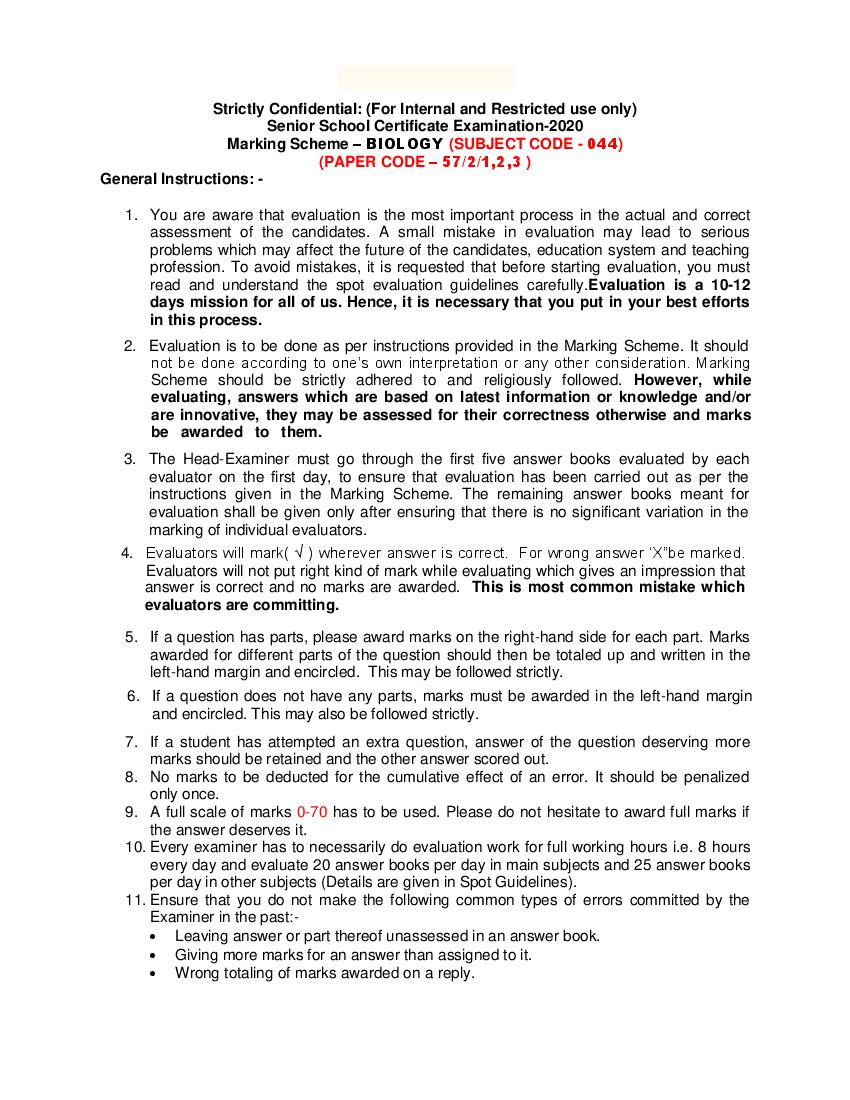
Senior School Certificate Examination-2020
Marking Scheme – BIOLOGY (SUBJECT CODE - 044)
(PAPER CODE – 57/2/1,2,3 )
General Instructions: -
1. You are aware that evaluation is the most important process in the actual and correct
assessment of the candidates. A small mistake in evaluation may lead to serious
problems which may affect the future of the candidates, education system and teaching
profession. To avoid mistakes, it is requested that before starting evaluation, you must
read and understand the spot evaluation guidelines carefully.Evaluation is a 10-12
days mission for all of us. Hence, it is necessary that you put in your best efforts
in this process.
2. Evaluation is to be done as per instructions provided in the Marking Scheme. It should
not be done according to one’s own interpretation or any other consideration. Marking
Scheme should be strictly adhered to and religiously followed. However, while
evaluating, answers which are based on latest information or knowledge and/or
are innovative, they may be assessed for their correctness otherwise and marks
be awarded to them.
3. The Head-Examiner must go through the first five answer books evaluated by each
evaluator on the first day, to ensure that evaluation has been carried out as per the
instructions given in the Marking Scheme. The remaining answer books meant for
evaluation shall be given only after ensuring that there is no significant variation in the
marking of individual evaluators.
4. Evaluators will mark( √ ) wherever answer is correct. For wrong answer ‘X”be marked.
Evaluators will not put right kind of mark while evaluating which gives an impression that
answer is correct and no marks are awarded. This is most common mistake which
evaluators are committing.
5. If a question has parts, please award marks on the right-hand side for each part. Marks
awarded for different parts of the question should then be totaled up and written in the
left-hand margin and encircled. This may be followed strictly.
6. If a question does not have any parts, marks must be awarded in the left-hand margin
and encircled. This may also be followed strictly.
7. If a student has attempted an extra question, answer of the question deserving more
marks should be retained and the other answer scored out.
8. No marks to be deducted for the cumulative effect of an error. It should be penalized
only once.
9. A full scale of marks 0-70 has to be used. Please do not hesitate to award full marks if
the answer deserves it.
10. Every examiner has to necessarily do evaluation work for full working hours i.e. 8 hours
every day and evaluate 20 answer books per day in main subjects and 25 answer books
per day in other subjects (Details are given in Spot Guidelines).
11. Ensure that you do not make the following common types of errors committed by the
Examiner in the past:-
Leaving answer or part thereof unassessed in an answer book.
Giving more marks for an answer than assigned to it.
Wrong totaling of marks awarded on a reply.
Page 2
Wrong question wise totaling on the title page.
Wrong totaling of marks of the two columns on the title page.
Wrong grand total.
Marks in words and figures not tallying.
Wrong transfer of marks from the answer book to online award list.
Answers marked as correct, but marks not awarded. (Ensure that the right tick mark
is correctly and clearly indicated. It should merely be a line. Same is with the X for
incorrect answer.)
Half or a part of answer marked correct and the rest as wrong, but no marks
awarded.
12. While evaluating the answer books if the answer is found to be totally incorrect, it should
be marked as cross (X) and awarded zero (0)Marks.
13. Any unassessed portion, non-carrying over of marks to the title page, or totaling error
detected by the candidate shall damage the prestige of all the personnel engaged in the
evaluation work as also of the Board. Hence, in order to uphold the prestige of all
concerned, it is again reiterated that the instructions be followed meticulously and
judiciously.
14. The Examiners should acquaint themselves with the guidelines given in the Guidelines
for spot Evaluation before starting the actual evaluation.
15. Every Examiner shall also ensure that all the answers are evaluated, marks carried over
to the title page, correctly totaled and written in figures and words.
16. The Board permits candidates to obtain photocopy of the Answer Book on request in an
RTI application and also separately as a part of the re-evaluation process on payment of
the processing charges
Page 3
SECTION A
1. Cleistogamous flowers are self-pollinated because
(A) they are bisexual flowers which do not open at all.
(B) they are bisexual and open flowers.
(C) they are unisexual.
(D) their stigma matures before the anthers dehisce.
Ans. (A) / Bisexual Flower which do not open at all
[1 Mark]
OR
Asexual reproduction by zoospores is observed in
(A) Penicillium
(B) Hydra
(C) Sponge
(D) Chlamydomonas
Ans. (D) / Chlamydomonas
[1 Mark]
2. The theory of evolution supported by the experiment conducted by Louis Pasteur is
(A) Spontaneous generation theory
(B) Life comes only from pre-existing life
(C) Abiogenesis of life
(D) Big bang theory
Ans. (B) / Life comes only from pre-existing life
[1 Mark]
3. The diagnostic test that confirms typhoid in humans is
(A) ELISA
(B) Widal
(C) MRI
(D) Amniocentesis
Ans. (B) / Widal
[1 Mark]
3
Page 4
(A) Tetracyclin
(B) Cyclosporin-A
(C) Statin
(D) Streptomycin
Ans. (B) / Cyclosporin-A
[1 Mark]
OR
‘Blue revolution’ refers to
(A) construction of water dams for conservation of water
(B) production of fish in large quantities
(C) sewage treatment
(D) controlling algal bloom
Ans. (B) / Production of fish in large quantities
[1 Mark]
5. Which one of the following is not the product of transgenic experiments?
(A) Pest-resistant crop variety
(B) High nutritional value in grains
(C) Production of insulin by rDNA technique
(D) Drought-resistant crops
Ans. (No correct answer in the choices-Every one gets one mark)
[1 Mark]
SECTION –B
(Q Nos. 6-12 are of two marks each)
6. Write the ploidy and number of chromosomes in human (a) meiocytes, and (b) gametes.
Ans. (a) (meiocytes) 2n , 46 = ½ + ½
(b) (Gametes) n , 23 = ½ + ½
[2 Marks]
7. What is aneuploidy ? Name a chromosomal disorder in humans caused due to (a) gain of an
autosome, and (b) loss of a sex chromosome in females.
Ans. Failure of segregation of chromatids (during cell division), resulting in gain or loss of a
chromosome (s) = ½ + ½
(a) (Gain of an autosome) - Down’s syndrome = ½
4
Page 5
[2 Marks]
8. State a functional difference between the following codons:
(a) AUG and UAA
(b) Specific and Degenerate
Ans. a. AUG – Start codon / codes for Methionine / Met , UAA- Stop / codon / Nonsense Codon
/ Does not code for any aminoacid / Terminator Codon / Ochre
b. Specific - one codon codes for one amino acid
Degenerate - one amino acid coded by more than one codon = ½ × 4
[2 Marks]
9. (a) Identify any two marsupials from the list given below :
(i) Lemur
(ii) Spotted cuscus
(iii) Flying phalanger
(iv) Bobcat
(v) Tasmanian wolf
(vi) Mole
(b) “Australian marsupials exhibit adaptive radiation.’’ Justify the statement.
Ans. a. ii ) / Spotted cuscus ,
iii) / Flying phalanger
v) / Tasmanian wolf
(Any two) = ½ + ½
b. Australian marsupials each differ from the other evolved from an ancestral stock, all within the
Australian island continent. = ½ + ½
[2 Marks]
10. Name the type of immunity the mother provides the newborn baby. How does it happen?
Ans. Passive immunity = 1
Colostrum has (abundant) antibodies / IgA present = 1
[2 Marks]
11. Name the two primary lymphoid organs. State the importance of T-lymphocytes.
Ans. Thymus , Bone marrow = ½ × 2
Functions : helps B-cells in production of antibodies , mediate CMI , responsible for graft rejection
(any one) = 1
[2 Marks]
12. How are malignant tumors different from benign tumors ? Why are some patients treated
with - interferons ?
5
Page 6
cause little damage / no metastasis ,
malignant tumors proliferate and spread to other body parts / is more harmful / cause serious damage
/ causes metastasis = ½ × 2 = 1
Biological response modifiers / activate immune system to destroy tumor = 1
[2 Marks]
OR
Name the hormone with which a cow is administered using MOET technology. State the
function of this hormone.
Ans. Follicular Stimulating Hormone like / FSH like , to induce follicular maturation / super ovulation/
production of 6-8 eggs = 1 + 1
[2 Marks]
SECTION – C
(Q Nos. 13 - 22 are of three marks each)
13. Draw a longitudinal section of the pistil from a flowering plant, where pollination has
occurred. Label the following:
(a) Stigma showing germinating pollen grains
(b) Style
(c) Pollen tube reaching the micropyle of the ovule
(d) Embryo sac
(e) Components of the egg apparatus
Ans.
/ (a)
/ (b)
/ (c)
/ (d)
½ ×6=3
/ (e)
egg
/ (e) apparatus
6
Page 7
A is an embryonic stage that gets transformed into B, which in turn gets implanted in the
endometrium in human females.
(a) Identify A, B and its parts C and D.
(b) State the fate of C and D in the course of embryonic development in humans.
Ans. a) A - Morula ; B - Blastocyst ; C - Inner cell mass / Stem cells , D - Trophoblast = ½ × 4
b) C. (Inner cell mass) forms embryo / differentiates into germ layers (ectoderm / mesoderm /
endoderm) , D. Trophoblast helps in attachment of embryo / to endometrium / forms chorionic
villi / forms placenta = ½ × 2
[2 + 1 = 3 Marks]
OR
(a) Identify the figure given below and also identify the parts B , C , D and E.
(½ × 6 = 3)
(b) State the function of E.
Ans. a) Mature Dicot Embryo,
B-Suspensor ; C- Radicle ; D-Plumule ; E-Cotyledon ;
b) Storage of food reserves (as in legumes) = ½ × 6
[3 Marks]
Q 15. A normal couple has their first child, who is haemophilic. Work out a cross to show how it
is possible. State the possibility of the normal and the haemophilic children, along with
their sexes, that can be born to them.
7
Page 8
h
XX =½ XY = ½
Carrier Female Normal Male
h
Gametes X X X Y
h
XX XY XX h XY
Normal Daughter Normal Son Carrier Daughter Haemophilic Son = ½ × 4
25% 25% 25% 25%
[3 Marks]
16. Starting from the pioneer species, trace the sequence that follows in an ecological succession
on a bare rock, until climax community is reached in an ecosystem. Name this type of
succession.
Ans. Lichens are the pioneer species on rocks , they secrete acid and dissolve rocks help in soil
formation , pave way to bryophytes that hold small amount of soil , succeeded by higher plants / and
scrub , after several stages a stable climax forest community is formed
Primary Succession / Xerarch (succession) = ½ × 6
[3 Marks]
17. The release of municipal wastewater and industrial waste into our natural water bodies is
causing disastrous effect to the aquatic life. Explain the biological treatment that should
be given to it before releasing into the natural water bodies.
Ans. The primary effluent is passed into large aeration tanks where it is mechanically constantly agitated
and air is pumped into it, this allow growth of useful aerobic microbes into Flocs / masses of
bacteria associated with fungal filaments , these microbes consume major part of organic matter in
the effluent reducing BOD , effluent is passed into settling tanks where Flocs are allowed to sediment
called activated sludge , a small part of this is pumped back into the aeration tank to serve as the
inoculum , the remaining major part of the sludge is pumped into large tanks called anaerobic sludge
digesters where anaerobic bacteria digest the bacteria and the fungi in the sludge. (During this
digestion, bacteria produce a mixture of gases such as methane, hydrogen sulphide and carbon
dioxide.) = ½ × 6
[3 Marks]
18. Mention any two advantages of micropropagation technique. Write how its process is
carried out in the laboratory. Name any two important food plants grown commercially by
this method.
Ans. Used for the production of large number of plants that are genetically identical to the original plant,
recovery of healthy plants from diseased plant. = ½ + ½
Any part of the plant /explant is grown in the test tube under sterile conditions , in specified nutrient
media (sucrose , inorganic salts , vitamins , amino acids , growth hormones - Auxin and cytokinin)
=½+½
8
Page 9
[3 Marks]
19. When Bacillus thuringiensis enters a certain insect’s body, the insect gets killed, but
itself remains unaffected. Explain how it is possible.
Ans. B. thuringiensis forms protein crystals which contain a toxic insecticidal protein, Bt toxin protein
remains as inactive protoxin , once an insect ingests the inactive toxin , it is converted into an active
form of toxin due to alkaline pH of the gut , the activated toxin binds to midgut epithelial cells, and
creates pores that cause swelling and lysis of the cells. = ½ × 6
[3 Marks]
20. (a) Write how parasites have evolved with adaptation to co-exist with their hosts in an
ecosystem.
(b) Parasites are host specific and tend to co-evolve. How would the parasite respond if
the host evolves a certain mechanism to resist or reject the parasite ?
Ans. a) Loss of unnecessary sense organs, presence of adhesive organs / suckers , loss of digestive
system , high reproductive capacity. = ½ × 4
b) (If the host evolves special mechanism for rejecting or resisting a parasit) the parasite has to
evolve a mechanism to counteract and neutralize them. = 1
[3 Marks]
OR
(a) Name an ideal pyramid existing in an ecosystem. Construct it up to its three trophic
levels along with their names.
(b) The sun provides 1,000,000 J of sunlight (solar energy) to an ecosystem. Write the
amount of energy that is available to the first and third trophic levels, respectively.
Ans. a) Pyramid of energy is the ideal pyramid = ½
100 J = ½
SC Carnivores
Herbivores 1000 J = ½
PC
PP Plants 10000 J = ½
1, 000,000 J of sunlight
=½×3
b) (from sun to primary producer 1%)
10,00,000J from sun, (1%) = 10,000 J
10,000 J 1000J 100 J
First trophic level Third trophic level
=½ ½
[½ + 1½ + 1 = 3 Marks]
9
Page 10
(a) Explain any two ways by which carbon is returned to the atmosphere through natural
processes.
(b) List any two human activities that have influenced the carbon cycle in nature.
Ans. (a) Natural process - Respiration by plants and animals , decomposition (bacteria , fungi) = 1+1
(b) Human activities - burning of fossil fuel / burning of forest fuel wood / burning of leaves (any
two) = ½ + ½
[2+1 = 3 Marks]
SECTION D
22.
Study the schematic representation given above and answer the following questions:
(a) Identify A in it.
(b) Identify D in it.
(c) When the population density at time t is N as shown above, write the population
density at time t + 1 in the form of an equation using appropriate symbols.
Ans. a) A = Natality / Immigration - =1
b) D = Emigration / Mortality = 1
c) N (t+1)=Nt+[(B+I)-(D+E)] = 1
[3 Marks]
23. (a) Identify steps A and B in a cycle of Polymerase Chain Reaction given below.
10
Page 11
Ans. a) A= Annealing; B=Extension = 1 + 1
b) Thermostable (DNA Polymerase) / remains active at high temperature = 1
[3 Marks]
24. Study the diagrammatic representation of S.L. Miller’s experiment given below and answer
the questions that follow :
(a) How did S.L. Miller create the conditions which existed before the origin of any life
on Earth ?
(b) Name the organic compound formed and collected at the end of his experiment.
(c) Mention the kind of evolution his experiment supports.
Ans. (a) (Conditions existed before the origin of life -High temperature, volcanic storms, reducing
atmosphere containing CH4, NH3, etc.)
11
Page 12
CH4 , NH3 , H2 , water vapours = ½ × 4
b) amino acids = ½
c) chemical evolution = ½
[3 Marks]
SECTION E
25. (a) Draw the sectional view of a seminiferous tubule of human. Label its any six parts.
(b) Name the pituitary hormones involved in the process of spermatogenesis. State their
functions.
Ans. (a)
(any 6 parts ) = ½ × 6
b) Pituitary hormones: Luteinising hormone (LH) , follicle stimulating hormone (FSH) = ½ + ½
(LH) Acts at the leydig cells and stimulates synthesis and secretion of androgens = ½
(FSH) Acts on sertoli cells and stimulates secretion of some factors which help in the process
of spermiogenesis. = ½
OR
(a) IUDs are said to be effective contraceptives. Name any two commonly used IUDs
and write the mode of their actions.
(b) When is sterilisation advised to married couples ? How is it carried out in a human
male and a female, respectively?
Ans. a) - Lippes Loop , - increases phagocytosis of sperms within the uterus
- CuT / Cu7 / Multiload 375 , - Cu ions suppress sperm motility/ fertilising capacity of
sperms
12
Page 13
hostile to sperms (any two IUDs with their related actions) = ½ × 4
b) Sterilization advised for the male /female partner as terminal method to prevent any more
pregnancies = 1
In male : part of vas deferens is cut and tied (vasectomy) = 1
In female: a small part of the fallopian tube is removed or tied up (tubectomy) = 1
[5 Marks]
26. Explain the expression of lac operon genes in E. coli growing in lactose containing culture
medium.
Ans. In the presence of an inducer , lactose , the repressor is inactivated , by interaction with the inducer,
this allows RNA polymerase access to the promoter , and transcription proceeds , lac mRNA is
transcribed , ß galactosidase , permease , transacetylase is synthesised = ½ × 10
[5 Marks]
OR
Name the types of cells and the process by which hnRNA is formed. Describe the processing
mechanism it undergoes before it becomes functional.
Ans. (hn RNA is formed) in eukaryotic cells , during transcription ,
Primary transcript contains both exon , introns is non-functional , it is subjected to splicing , where
intros are removed, exons are joined in a defined order ,
hn RNA undergoes capping with nucleotide (methyl guanosine triphosphate) being added to the 5’-
end of hn RNA ,
In tailing , adenylate residues (200-300) are added at 3’-end in a template independent
manner. = ½ × 10
[5 Marks]
27. There is a great concern all over the world to conserve biodiversity for maintaining ecological
balance in nature. Explain giving three reasons. Write different ways that have helped in
increasing tiger population in our country.
Ans. Biodiversity should be conserved for the following three reasons:
a) Narrowly utilitarian - = ½
humans derive countless economic benefits from nature-
e.g. food (cereals, pulses, fruits) / firewood / fibre / construction material / industrial products
(tannins, lubricants , dyes , resins , perfumes) / products of medicinal importance.
(any one = ½)
b) Broadly utilitarian - = ½
Play role in many ecological services e.g. production of O2 / pollination / Aesthetic pleasures
=½
c) Ethical - = ½
Every species has an intrinsic value / we have a moral duty to care for their well-being/ pass on
our biological legacy in good order to future generations. = ½
13
Page 14
a) In situ conservation = ½ – protect the natural habitat the forest where the tiger lives / protect
the whole ecosystem to save tigers = ½
b) Ex situ conservation = ½ –threatened tigers are taken out of their natural habitat and placed in
special settings for protection and special care / e.g. zoological park, wildlife
sanctuaries. = ½
[3 + 2 = 5 Marks]
OR
What is integrated organic farming ? How did Ramesh Chandra Dagar, a farmer from
Sonepat, Haryana effectively use this procedure and succeed with zero waste ?
Ans. Integrated organic farming is a cyclical procedure where waste products from one process are
cycled in as nutrients for another process ,
His farm includes bee-keeping , dairy management , water harvesting , composting , agriculture in a
chain of processes , There is no need to use chemical fertilizers , as cattle excreta (dung) is used as
manure / natural fertilizer , Crop waste can be used to create compost, to generate natural gas for
satisfying the energy needs of the farm. = ½ × 10
[5 Marks]
14
Page 15
SECTION A
1. Which one of the following is not the product of transgenic experiments?
(A) Pest-resistant crop variety
(B) High nutritional value in grains
(C) Production of insulin by rDNA technique
(D) Drought-resistant crops
Ans. (No correct answer in the choices-Every one gets one mark)
[1 Mark]
2. The diagnostic test that confirms typhoid in humans is
(A) ELISA
(B) Widal
(C) MRI
(D) Amniocentesis
Ans. (B) / Widal
[1 Mark]
3. The bioactive molecule used as an immunosuppressive agent during organ transplant is
(A) Tetracyclin
(B) Cyclosporin-A
(C) Statin
(D) Streptomycin
Ans. (B) / Cyclosporin-A
[1 Mark]
OR
‘Blue revolution’ refers to
(A) construction of water dams for conservation of water
(B) production of fish in large quantities
(C) sewage treatment
(D) controlling algal bloom
Ans. (B) / Production of fish in large quantities
[1 Mark]
15
Page 16
(A) they are bisexual flowers which do not open at all.
(B) they are bisexual and open flowers.
(C) they are unisexual.
(D) their stigma matures before the anthers dehisce.
Ans. (A) / Bisexual Flower which do not open at all
[1 Mark]
OR
Asexual reproduction by zoospores is observed in
(A) Penicillium
(B) Hydra
(C) Sponge
(D) Chlamydomonas
Ans. (D) / Chlamydomonas
[1 Mark]
5. In Bryophyllum, vegetative propagation occurs by
(A) Stem cuttings
(B) Axillary buds
(C) Root hair
(D) Leaf buds
Ans. (D) / Leaf buds
[1 Mark]
SECTION B
6. Write the cause of Down’s Syndrome in humans. List any three identifying symptoms of
this disorder.
Ans. Cause: presence of an additional copy of the chromosome number 21 /trisomy of
chromosome 21 = ½
Symptoms: short statured small round head/ furrowed tongue partially open mouth/ Palm is broad
with characteristic palm crease /Physical psychomotor and mental development is retarded. (any
three) = ½ × 3
[2 Marks]
7. Write the ploidy and number of chromosomes in human (a) meiocytes, and (b) gametes.
Ans. (a) (meiocytes) 2n , 46 = ½ + ½
(b) (Gametes) n , 23 = ½ + ½
[2 Marks]
16
Page 17
required during the process of translation.
Ans. AUG , Methionine = ½ + ½
Stop codon: UAA/UAG/UGA (any two) = ½ + ½
[2 Marks]
OR
Taking an example of homologous organs in plants, write the types of evolution they are
based on, giving a reason.
Ans. Thorns of Bougainvillea and Tendrils of Cucurbita are homologous organs/ any other appropriate
example = ½
Divergent Evolution = ½
They have same origin/ common ancestry, but perform different functions = ½ + ½
[2 Marks]
9. Name the type of immunity the mother provides the newborn baby. How does it happen?
Ans. Passive immunity = 1
Colostrum has (abundant) antibodies / IgA present = 1
[2 Marks]
10. (a) Identify any two marsupials from the list given below :
(i) Lemur
(ii) Spotted cuscus
(iii) Flying phalanger
(iv) Bobcat
(v) Tasmanian wolf
(vi) Mole
(b) “Australian marsupials exhibit adaptive radiation.’’ Justify the statement.
Ans. a. ii ) / Spotted cuscus ,
iii) / Flying phalanger
v) / Tasmanian wolf
(Any two) = ½ + ½
b. Australian marsupials each differ from the other evolved from an ancestral stock, all within the
Australian island continent. = ½ + ½
[2 Marks]
11. Name the two primary lymphoid organs. State the importance of T-lymphocytes.
Ans. Thymus , Bone marrow = ½ × 2
17
Page 18
(any one) =1
[2 Marks]
12. Name any two water/food borne diseases. Mention any two measures essential for
controlling these diseases.
Ans. Ascariasis , Typhoid , Amoebiasis , Cholera , Jaundice (any two) = ½ + ½
Two measures: standard practice in public catering / consumption of clean drinking water / periodic
cleaning and disinfection of water reservoirs / tank / cesspool (any two) = ½ + ½
[2 Marks]
SECTION C
13. Draw a diagram of a mature anatropous ovule of an angiosperm, indicating the chalazal
end. Label any three parts of the ovule and two parts of the embryo sac.
Ans. chalazal end = ½
Synergids
Embryo Sac
Antipodals
Chalazal Pole
Any three correctly labelled part of ovule = ½ × 3
Any two correctly labelled part of embryo sac = ½ × 2
[½×6 = 3 Marks]
14. Global carbon is fixed in the biosphere through photosynthesis.
(a) Explain any two ways by which carbon is returned to the atmosphere through natural
processes.
(b) List any two human activities that have influenced the carbon cycle in nature.
Ans. (a) Natural process - Respiration by plants and animals , decomposition (bacteria , fungi) = 1+1
(b) Human activities - burning of fossil fuel / burning of forest fuel wood / burning of leaves (any
two) = ½ + ½
[3 Marks]
18
Page 19
following bioactive molecules :
(a) Cyclosporin A
(b) Streptokinase
(c) Statin
Ans. (a) Cyclosporin A - Tricoderma polysporum, is used as an immuno suppressive agent in organ
transplant patients = ½ + ½
(b) Streptokinase - Streptococcus, used as a ‘clot buster’ / for removing clots from the blood
vessels of patients who have undergone myocardial infraction leading to heart attack = ½ + ½
(c) Statin- Monascus purpureus, blood-cholesterol lowering agents. = ½ + ½
[3 Marks]
16. A couple has four children with blood groups A , B , AB and O , respectively. The father of
the children has blood group A and the mother has blood group B. Work out a cross to
show how it is possible.
Father Mother
IAi x IBi ½
Parent
A B
I i I i ½
Gametes
Ans. F1 =½×6
IA IB IA i IBi ii
½ ½ ½ ½
Blood Group AB A B O
[3 Marks]
17. (a) Write how parasites have evolved with adaptation to co-exist with their hosts in an
ecosystem.
(b) Parasites are host specific and tend to co-evolve. How would the parasite respond if
the host evolves a certain mechanism to resist or reject the parasite ?
Ans. a) Loss of unnecessary sense organs, presence of adhesive organs / suckers , loss of digestive
system , high reproductive capacity. = ½ × 4
b) (If the host evolves special mechanism for rejecting or resisting a parasit) the parasite has to
evolve a mechanism to counteract and neutralize them. = 1
[3 Marks]
OR
19
Page 20
levels along with their names.
(b) The sun provides 1,000,000 J of sunlight (solar energy) to an ecosystem. Write the
amount of energy that is available to the first and third trophic levels, respectively.
Ans. a) Pyramid of energy is the ideal pyramid = ½
100 J = ½
SC Carnivores
Herbivores 1000 J = ½
PC
PP Plants 10000 J = ½
1, 000,000 J of sunlight
=½×4
b) (from sun to primary producer 1%)
10,00,000J from sun, (1%) = 10,000 J
10,000 J 1000J 100 J
First trophic level Third trophic level
=½ ½
[2 + 1 = 3 Marks]
18. When Bacillus thuringiensis enters a certain insect’s body, the insect gets killed, but
itself remains unaffected. Explain how it is possible.
Ans. B. thuringiensis forms protein crystals which contain a toxic insecticidal protein, Bt toxin protein
remains as inactive protoxin , once an insect ingests the inactive toxin , it is converted into an active
form of toxin due to alkaline pH of the gut , the activated toxin binds to midgut epithelial cells, and
creates pores that cause swelling and lysis of the cells. = ½ × 6
[3 Marks]
19. Mention any two advantages of micropropagation technique. Write how its process is
carried out in the laboratory. Name any two important food plants grown commercially by
this method.
Ans. Used for the production of large number of plants that are genetically identical to the original plant,
recovery of healthy plants from diseased plant. = ½ + ½
Any part of the plant /explant is grown in the test tube under sterile conditions , in specified nutrient
media (sucrose , inorganic salts , vitamins , amino acids , growth hormones - Auxin and cytokinin)
=½+½
Potato / Banana / sugarcane / tomato / apple (any two) = ½ + ½
[3 Marks]
20. Study the given diagram:
20
Page 21
endometrium in human females.
(a) Identify A, B and its parts C and D.
(b) State the fate of C and D in the course of embryonic development in humans.
Ans. a) A - Morula ; B - Blastocyst ; C - Inner cell mass / Stem cells , D - Trophoblast = ½ × 4
b) C. (Inner cell mass) forms embryo / differentiates into germ layers (ectoderm / mesoderm /
endoderm) , D. Trophoblast helps in attachment of embryo / to endometrium / forms chorionic
villi / forms placenta = ½ × 2
[2 + 1 = 3 Marks]
OR
(a) Identify the figure given below and also identify the parts B , C , D and E.
(6 × ½ = 3)
(b) State the function of E.
Ans. a) Mature Dicot Embryo,
B-Suspensor ; C- Radicle ; D-Plumule ; E-Cotyledon ;
b) Storage of food reserves (as in legumes) = ½ × 6
[3 Marks]
21. The release of municipal wastewater and industrial waste into our natural water bodies is
causing disastrous effect to the aquatic life. Explain the biological treatment that should
be given to it before releasing into the natural water bodies.
Ans. The primary effluent is passed into large aeration tanks where it is mechanically constantly agitated
and air is pumped into it, this allow growth of useful aerobic microbes into Flocs / masses of
bacteria associated with fungal filaments , these microbes consume major part of organic matter in
the effluent reducing BOD , effluent is passed into settling tanks where Flocs are allowed to sediment
called activated sludge , a small part of this is pumped back into the aeration tank to serve as the
21
Page 22
digesters where anaerobic bacteria digest the bacteria and the fungi in the sludge. (During this
digestion, bacteria produce a mixture of gases such as methane, hydrogen sulphide and carbon
dioxide.) = ½ × 6
[3 Marks]
SECTION D
22. Study the diagrammatic representation of S.L. Miller’s experiment given below and answer
the questions that follow :
(a) How did S.L. Miller create the conditions which existed before the origin of any life
on Earth ?
(b) Name the organic compound formed and collected at the end of his experiment.
(c) Mention the kind of evolution his experiment supports.
Ans. (a) (Conditions existed before the origin of life -High temperature, volcanic storms, reducing
atmosphere containing CH4, NH3, etc.)
Conditions were created by electric discharge (high temperature) in a closed flask containing
CH4 , NH3 , H2 , water vapours = ½ × 4
b) amino acids = ½
c) chemical evolution = ½
[2 + ½ + ½ = 3 Marks]
22
Page 23
Study the schematic representation given above and answer the following questions:
(a) Identify A in it.
(b) Identify D in it.
(c) When the population density at time t is N as shown above, write the population
density at time t + 1 in the form of an equation using appropriate symbols.
Ans. a) A = Natality / Immigration
b) D = Emigration / Mortality
c) N (t+1)=Nt+[(B+I)-(D+E)] = 1 × 3
[3 Marks]
Q24 (a) Identify steps A and B in a cycle of Polymerase Chain Reaction given below.
(b) State the specific characteristic feature of the enzyme in carrying step B.
Ans.. a) A= Annealing; B=Extension = 1 + 1
23
Page 24
[3 Marks]
SECTION E
25. There is a great concern all over the world to conserve biodiversity for maintaining ecological
balance in nature. Explain giving three reasons. Write different ways that have helped in
increasing tiger population in our country.
Ans. Biodiversity should be conserved for the following three reasons:
a) Narrowly utilitarian - = ½
humans derive countless economic benefits from nature-
e.g. food (cereals, pulses, fruits) / firewood / fibre / construction material / industrial products
(tannins, lubricants , dyes , resins , perfumes) / products of medicinal importance.
(any one = ½)
b) Broadly utilitarian - = ½
Play role in many ecological services e.g. production of O2 / pollination / Aesthetic pleasures
=½
c) Ethical - = ½
Every species has an intrinsic value / we have a moral duty to care for their well-being/ pass on
our biological legacy in good order to future generations. = ½
The two approaches to save tiger is
a) In situ conservation = ½ – protect the natural habitat the forest where the tiger lives/ protect
the whole ecosystem to save tigers = ½
b) Ex situ conservation = ½ –threatened tigers are taken out of their natural habitat and placed in
special settings for protection and special care/ e.g. zoological park, wildlife
sanctuaries. = ½
[3 + 2 = 5 Marks]
OR
What is integrated organic farming ? How did Ramesh Chandra Dagar, a farmer from
Sonepat, Haryana effectively use this procedure and succeed with zero waste ?
Ans. Integrated organic farming is a cyclical procedure where waste products from one process are
cycled in as nutrients for another process ,
His farm includes bee-keeping , dairy management , water harvesting , composting , agriculture in a
chain of processes , There is no need to use chemical fertilizers , as cattle excreta (dung) is used as
manure / natural fertilizer , Crop waste can be used to create compost, to generate natural gas for
satisfying the energy needs of the farm. = ½ × 10
[5 Marks]
26. (a) Draw the sectional view of a seminiferous tubule of human. Label its any six parts.
(b) Name the pituitary hormones involved in the process of spermatogenesis. State their
functions.
Ans. (a)
24
Page 25
b) Pituitary hormones: Luteinising hormone (LH) , follicle stimulating hormone (FSH) = ½ + ½
(LH) Acts at the leydig cells and stimulates synthesis and secretion of androgens = ½
(FSH) Acts on sertoli cells and stimulates secretion of some factors which help in the process
of spermiogenesis. = ½
OR
(a) IUDs are said to be effective contraceptives. Name any two commonly used IUDs
and write the mode of their actions.
(b) When is sterilisation advised to married couples ? How is it carried out in a human
male and a female, respectively?
Ans. a) - Lippes Loop , - increases phagocytosis of sperms within the uterus
- CuT / Cu7 / Multiload 375 , - Cu ions suppress sperm motility/ fertilising capacity of
sperms
- Progestasert / LNG - 20 , - makes uterus unsuitable for implantation / makes cervix
hostile to sperms (any two IUDs with their related actions) = ½ × 4
b) Sterilization advised for the male /female partner as terminal method to prevent any more
pregnancies = 1
In male: part of vas deferens is cut and tied (vasectomy) = 1
In female: a small part of the fallopian tube is removed or tied up (tubectomy) = 1
[5 Marks]
27. Explain the process of transcription in prokaryotes.
Ans. DNA - dependent RNA polymerase that catalyses the process of transcription ,three steps :
initiation , elongation , and termination ,
Initiation : RNA polymerase binds to promoter , associated with initiation - factor ( ) at 5’ end of
DNA ,
25
Page 26
polymerase help in opening the helix and continuous elongation ,
Termination : Terminator factor ( ) , nascent RNA falls off along with RNA polymerase = ½×10
//
[ 5 Marks]
OR
(a) Write the scientific name of the organism Griffith used in his experiments. State the
conclusions he arrived at.
(b) Name the scientists and describe how they experimentally proved the biochemical
nature of the genetic material which was earlier considered as protein.
Ans. (a) Streptococcus pneumoniae = ½
He concluded that the R strain bacteria has been transformed by the heat-killed S strain bacteria /R
strain to become virulent from non-virulent / he proved the transforming principle of genetic
material = ½
(b) (Oswald) Avery, (Colin) MacLeod , and (Maclyn) McCarty
They purified biochemicals (proteins, DNA, RNA, etc.) from the heat-killed S cells to see which
ones could transform live R cells into S cells ,
They also discovered that protein-digesting enzymes (proteases) and RNA-digesting enzymes
(RNases) did not affect transformation, so the transforming substance was not a protein or RNA ,
Digestion with DNase did inhibit transformation, suggesting that the DNA caused the transformation
=½×8
[1 + 4 = 5 Marks]
26
Page 27
SECTION A
1. Which one of the following is not the product of transgenic experiments?
(A) Pest-resistant crop variety
(B) High nutritional value in grains
(C) Production of insulin by rDNA technique
(D) Drought-resistant crops
Ans. (No correct answer in the choices-Every one gets one mark)
[1 Mark]
2. The diagnostic test that confirms typhoid in humans is
(A) ELISA
(B) Widal
(C) MRI
(D) Amniocentesis
Ans. (B) / Widal
[1 Mark]
3. The bioactive molecule used as an immunosuppressive agent during organ transplant is
(A) Tetracyclin
(B) Cyclosporin-A
(C) Statin
(D) Streptomycin
Ans. (B) / Cyclosporin-A
[1 Mark]
OR
‘Blue revolution’ refers to
(A) construction of water dams for conservation of water
(B) production of fish in large quantities
(C) sewage treatment
(D) controlling algal bloom
Ans. (B) / Production of fish in large quantities
[1 Mark]
27
Page 28
(A) they are bisexual flowers which do not open at all.
(B) they are bisexual and open flowers.
(C) they are unisexual.
(D) their stigma matures before the anthers dehisce.
Ans. (A) / Bisexual Flower which do not open at all
[1 Mark]
OR
Asexual reproduction by zoospores is observed in
(A) Penicillium
(B) Hydra
(C) Sponge
(D) Chlamydomonas
Ans. (D) / Chlamydomonas
[1 Mark]
5. Cucurbits are monoecious plants as
(A) they produce only male flowers on the same plant.
(B) they produce both male and female flowers on the same plant.
(C) they produce bisexual flowers.
(D) they produce only female flowers on the same plant.
Ans. (B) / They produce both male and female flowers on the same plant.
[1 Mark]
SECTION B
6. How are malignant tumors different from benign tumors ? Why are some patients treated
with -interferons ?
Ans. Benign tumors remain confined to their original location/ do not spread to other part of the body /
cause little damage / no metastasis ,
malignant tumors proliferate and spread to other body parts / is more harmful / cause serious damage
/ causes metastasis = ½ × 2 = 1
Biological response modifiers / activate immune system to destroy tumor = 1
[2 Marks]
OR
Name the hormone with which a cow is administered using MOET technology. State the
function of this hormone.
28
Page 29
production of 6-8 eggs = 1 + 1
[2 Marks]
7. Mention the function of the spleen in the human body. Name the two different types of
cells present in it.
Ans. Spleen acts as a filter of the blood , by trapping blood borne (micro) organisms = ½ × 2
Phagocytes/ lymphocytes / erythrocytes (any two) = ½ × 2
[½ × 4 = 2 Marks]
8. State giving one example each, what are the following pattern of inheritance called, where
(a) A single gene controls more than one phenotypic expression.
(b) Two , or more than two genes are involved in controlling a phenotypic character.
Ans. a) Pleiotropic inheritance, shape of pea seed and starch grain size of the pea (large starch grain
size and shape is controlled by same gene) / Sickle cell anemia / Phenylketonuria / any other
correct example = ½ + ½
b) polygenic inheritance, human skin colour controlled by two or more genes /any other correct
example = ½ + ½
[½ × 4 = 2 Marks]
9. Name the type of immunity the mother provides the newborn baby. How does it happen?
Ans. Passive immunity = 1
Colostrum has (abundant) antibodies / IgA present = 1
[2 Marks]
10. Write the ploidy and number of chromosomes in human (a) meiocytes, and (b) gametes.
Ans. (a) (meiocytes) 2n , 46 = ½ + ½
(b) (Gametes) n , 23 = ½ + ½
[2 Marks]
11. Name the scientist who proposed the Central Dogma. Give its schematic representation.
Ans. Francis Crick = ½
DNA RNA Protein
Replication
Transcription Translation
DNA mRNA protein
Central dogma
(DNA, mRNA and protein— to be marked on their correct position) = 3 × ½
[½ × 4 = 2 Marks]
29
Page 30
(i) Lemur
(ii) Spotted cuscus
(iii) Flying phalanger
(iv) Bobcat
(v) Tasmanian wolf
(vi) Mole
(b) “Australian marsupials exhibit adaptive radiation.’’ Justify the statement.
Ans. a. ii ) / Spotted cuscus ,
iii) / Flying phalanger
v) / Tasmanian wolf
(Any two) = ½ + ½
b. Australian marsupials each differ from the other evolved from an ancestral stock, all within the
Australian island continent. = ½ + ½
[2 Marks]
SECTION C
13. Draw a vertical section of maize grain and label its endosperm, plumule, coleoptile,
scutellum, radicle and coleorhiza.
Ans.
(½ × 6 = 3)
[3 Marks]
14. A woman with normal colour vision, whose father was colour blind , married a man with
normal colour vision. Work out a cross to show the probability of children born to them
with respect to colour vision.
Ans. A woman with normal colour vision - whose father was colour blind has to be a carrier for colour
blind gene and her genotype would be —— XXC
30
Page 31
Parents X Xc = ½ x XY =½
c
Gametes X X X Y
c
X X
Children X XX XX
c
c
Y XY XY
25% daughters with normal vision; 25% sons with normal vision ; 25% daughters are carrier ;
25% sons colour blind = ½ × 4
[3 Marks]
15. Global carbon is fixed in the biosphere through photosynthesis.
(a) Explain any two ways by which carbon is returned to the atmosphere through natural
processes.
(b) List any two human activities that have influenced the carbon cycle in nature.
Ans. (a) Natural process - Respiration by plants and animals , decomposition (bacteria , fungi) = 1+1
(b) Human activities - burning of fossil fuel / burning of forest fuel wood / burning of leaves (any
two) = ½ + ½
[3 Marks]
16. (a) Write how parasites have evolved with adaptation to co-exist with their hosts in an
ecosystem.
(b) Parasites are host specific and tend to co-evolve. How would the parasite respond if
the host evolves a certain mechanism to resist or reject the parasite ?
Ans. a) Loss of unnecessary sense organs, presence of adhesive organs / suckers , loss of digestive
system , high reproductive capacity. = ½ × 4
b) (If the host evolves special mechanism for rejecting or resisting a parasit) the parasite has to
evolve a mechanism to counteract and neutralize them. = 1
[3 Marks]
OR
(a) Name an ideal pyramid existing in an ecosystem. Construct it up to its three trophic
levels along with their names.
(b) The sun provides 1,000,000 J of sunlight (solar energy) to an ecosystem. Write the
amount of energy that is available to the first and third trophic levels, respectively.
Ans. a) Pyramid of energy is the ideal pyramid = ½
31
Page 32
SC Carnivores
Herbivores 1000 J = ½
PC
PP Plants 10000 J = ½
1, 000,000 J of sunlight
=½×4
b) (from sun to primary producer 1%)
10,00,000J from sun, (1%) = 10,000 J
10,000 J 1000J 100 J
First trophic level Third trophic level
=½ ½
[2 + 1 = 3 Marks]
17. What is tissue culture ? Explain how, from a virus infected banana plant, virus free healthy
banana plants can be grown by this technique.
Ans. Growing a whole plant from an explant /(any part or the tissue of a plant), in a test tube under sterile
conditions in special nutrient medium = ½ + ½
Meristem of infected banana plant is removed, as meristems are virus free ,
Meristems grown in vitro/through tissue culture, many virus free new banana plant are grown =½×4
[3 Marks]
18. Study the given diagram:
A is an embryonic stage that gets transformed into B, which in turn gets implanted in the
endometrium in human females.
(a) Identify A, B and its parts C and D.
(b) State the fate of C and D in the course of embryonic development in humans.
Ans. a) A - Morula ; B - Blastocyst ; C - Inner cell mass / Stem cells , D - Trophoblast = ½ × 4
b) C. (Inner cell mass) forms embryo / differentiates into germ layers (ectoderm / mesoderm /
endoderm) , D. Trophoblast helps in attachment of embryo / to endometrium / forms chorionic
villi / forms placenta = ½ × 2
[2 + 1 = 3 Marks]
32
Page 33
(a) Identify the figure given below and also identify the parts B , C , D and E.
(b) State the function of E.
Ans. a) Mature Dicot Embryo,
B-Suspensor ; C- Radicle ; D-Plumule ; E-Cotyledon ; = ½ × 5
b) Storage of food reserves (as in legumes) = ½
[3 Marks]
19. Starting from the pioneer species, trace the sequence that follows in an ecological succession
on a bare rock, until climax community is reached in an ecosystem. Name this type of
succession.
Ans. Lichens are the pioneer species on rocks , they secrete acid and dissolve rocks help in soil
formation , pave way to bryophytes that hold small amount of soil , succeeded by higher plants / and
scrub , after several stages a stable climax forest community is formed
Primary Succession / Xerarch (succession) = ½ × 6
[3 Marks]
20. The release of municipal wastewater and industrial waste into our natural water bodies is
causing disastrous effect to the aquatic life. Explain the biological treatment that should
be given to it before releasing into the natural water bodies.
Ans. The primary effluent is passed into large aeration tanks where it is mechanically constantly agitated
and air is pumped into it, this allow growth of useful aerobic microbes into Flocs / masses of
bacteria associated with fungal filaments , these microbes consume major part of organic matter in
the effluent reducing BOD , effluent is passed into settling tanks where Flocs are allowed to sediment
called activated sludge , a small part of this is pumped back into the aeration tank to serve as the
inoculum, The remaining major part of the sludge is pumped into large tanks called anaerobic sludge
digesters where anaerobic bacteria digest the bacteria and the fungi in the sludge. (During this
digestion, bacteria produce a mixture of gases such as methane, hydrogen sulphide and carbon
dioxide.) = ½ × 6
[3 Marks]
21. When Bacillus thuringiensis enters a certain insect’s body, the insect gets killed, but
itself remains unaffected. Explain how it is possible.
33
Page 34
remains as inactive protoxin , once an insect ingests the inactive toxin , it is converted into an active
form of toxin due to alkaline pH of the gut , the activated toxin binds to midgut epithelial cells , and
creates pores that cause swelling and lysis of the cells. = ½ × 6
[3 Marks]
SECTION D
22. (a) Identify steps A and B in a cycle of Polymerase Chain Reaction given below.
(b) State the specific characteristic feature of the enzyme in carrying step B.
Ans. a) A= Annealing ; B=Extension = 1 + 1
b) Thermostable (DNA Polymerase) / remains active at high temperature = 1
[2 + 1 = 3 Marks]
23. Study the diagrammatic representation of S.L. Miller’s experiment given below and answer
the questions that follow :
34
Page 35
on Earth ?
(b) Name the organic compound formed and collected at the end of his experiment.
(c) Mention the kind of evolution his experiment supports.
Ans. (a) (Conditions existed before the origin of life -High temperature, volcanic storms, reducing
atmosphere containing CH4, NH3, etc.)
Conditions were created by electric discharge (high temperature) in a closed flask containing
CH4 , NH3 , H2 , water vapours = ½ × 4
b) amino acids = ½
c) chemical evolution = ½
[3 Marks]
24.
Study the schematic representation given above and answer the following questions:
(a) Identify A in it.
(b) Identify D in it.
(c) When the population density at time t is N as shown above, write the population
density at time t + 1 in the form of an equation using appropriate symbols.
Ans. a) A = Natality / Immigration
b) D = Emigration / Mortality
c) N (t+1)=Nt+[(B+I)-(D+E)] = 1 × 3
[3 Marks]
SECTION E
25. (a) How did Meselson and Stahl reach the conclusion that DNA replication is semi-
conservative while working with E. coli in their experiment?
(b) Explain the contribution of Taylor and his colleagues in DNA replication in flowering
plants.
35
Page 36
generations , 15N was incorporated into newly synthesised DNA, heavy DNA molecule
could be distinguished from the normal DNA by centrifugation in a cesium chloride (CsCl)
density gradient, transferred the cells into a medium with normal 14NH4Cl, took samples at
various definite time intervals/20 minutes, samples were separated independently on CsCl
gradients to measure the densities of DNA, looking at the positions according to their
respective densities of 15N DNA, 14N DNA and hybrid (15N DNA- 14N DNA) in the
centrifuge tubes they reached their conclusion. (½ × 8 = 4)
b) Worked on Vicia faba /faba beans , using radioactive thymidine to prove that DNA in the
chromosomes also replicates semi conservatively = ½ × 2
[4 +1 = 5 Marks]
OR
(a) Write the steps that lead to aminoacylation of tRNA in the cell.
(b) Explain the events that occur in ribosomes during translation in prokaryotes.
Ans. a) amino acids are activated in the presence of ATP ,and linked to their cognate
t-RNA = ½ × 2
b) the ribosome binds to the mRNA at the start codon (AUG) that is recognised only by the
initiator tRNA, the ribosome proceeds to the elongation phase of protein synthesis, during
this stage complexes composed of an amino acid linked to tRNA sequentially bind to the
appropriate codon in mRNA by forming complementary base pairs with the tRNA
anticodon , the ribosome moves from codon to codon along the mRNA, amino acids are
added one by one, translated into Polypeptide sequences represented by mRNA, at the
end-a release factor binds to the stop codon, terminating translation and releasing the complete
polypeptide from the ribosome. = ½ × 8
[1 + 4 = 5 Marks]
26. There is a great concern all over the world to conserve biodiversity for maintaining
ecological balance in nature. Explain giving three reasons. Write different ways that have
helped in increasing tiger population in our country.
Ans. Biodiversity should be conserved for the following three reasons:
a) Narrowly utilitarian - = ½
humans derive countless economic benefits from nature-
e.g. food (cereals, pulses, fruits) / firewood / fibre / construction material / industrial products
(tannins, lubricants , dyes , resins , perfumes) / products of medicinal importance.
(any one = ½)
b) Broadly utilitarian - = ½
Play role in many ecological services e.g. production of O2 / pollination / Aesthetic pleasures
=½
c) Ethical - = ½
Every species has an intrinsic value / we have a moral duty to care for their well-being/ pass on
our biological legacy in good order to future generations. = ½
The two approaches to save tiger is
36
Page 37
the whole ecosystem to save tigers = ½
b) Ex situ conservation = ½ – threatened tigers are taken out of their natural habitat and placed in
special settings for protection and special care/ e.g. zoological park, wildlife
sanctuaries. = ½
[3 + 2 = 5 Marks]
OR
What is integrated organic farming ? How did Ramesh Chandra Dagar, a farmer from
Sonepat, Haryana effectively use this procedure and succeed with zero waste ?
Ans. Integrated organic farming is a cyclical procedure where waste products from one process are
cycled in as nutrients for another process ,
His farm includes bee-keeping , dairy management , water harvesting , composting , agriculture in a
chain of processes , There is no need to use chemical fertilizers , as cattle excreta (dung) is used as
manure / natural fertilizer , Crop waste can be used to create compost, to generate natural gas for
satisfying the energy needs of the farm. = ½ × 10
[5 Marks]
27. (a) Draw the sectional view of a seminiferous tubule of human. Label its any six parts.
(b) Name the pituitary hormones involved in the process of spermatogenesis. State their
functions.
Ans. (a)
(any 6 parts ) = ½ × 6
b) Pituitary hormones: Luteinising hormone (LH) , follicle stimulating hormone (FSH) = ½ + ½
(LH) Acts at the leydig cells and stimulates synthesis and secretion of androgens = ½
(FSH) Acts on sertoli cells and stimulates secretion of some factors which help in the process
of spermiogenesis. = ½
[3 +2 = 5 Marks]
37
Page 38
(a) IUDs are said to be effective contraceptives. Name any two commonly used IUDs
and write the mode of their actions.
(b) When is sterilisation advised to married couples ? How is it carried out in a human
male and a female, respectively?
Ans. a) - Lippes Loop , - increases phagocytosis of sperms within the uterus
- CuT / Cu7 / Multiload 375 , - Cu ions suppress sperm motility/ fertilising capacity of
sperms
- Progestasert / LNG - 20 , - makes uterus unsuitable for implantation / makes cervix
hostile to sperms (any two IUDs with their related actions) = ½ × 4
b) Sterilization advised for the male /female partner as terminal method to prevent any more
pregnancies = 1
In male : part of vas deferens is cut and tied (vasectomy) = 1
In female : a small part of the fallopian tube is removed or tied up (tubectomy) = 1
[2 + 3 = 5 Marks]
38
Document Details
| Board / Org | CBSE |
| Exam | Class 12 |
| Type | Solution |
| Pages | 38 |
| Updated | 22 Jul 2026 |