CBSE Class 12 Biology Question Paper 2020 Set 57-4 Solutions
Finished viewing? Save it for later —
Download CBSE Class 12 Biology Question Paper 2020 Set 57-4 Solutions (PDF · 37 pages)About CBSE Class 12 Biology Question Paper 2020 Set 57-4 Solutions
CBSE Class 12 Biology Question Paper 2020 Set 57-4 Solutions is available here for free download. Published by CBSE for Class 12, this solution can be viewed online or downloaded as a PDF (37 pages). Candidates preparing for Class 12 can use CBSE Class 12 Biology Question Paper 2020 Set 57-4 Solutions to understand the exam pattern, the type of questions asked, and the overall difficulty level.
Frequently Asked Questions
How can I download CBSE Class 12 Biology Question Paper 2020 Set 57-4 Solutions?
Open this page and click the Download button to save CBSE Class 12 Biology Question Paper 2020 Set 57-4 Solutions as a PDF. It is completely free on AglaSem Docs.
Is CBSE Class 12 Biology Question Paper 2020 Set 57-4 Solutions free to download?
Yes. CBSE Class 12 Biology Question Paper 2020 Set 57-4 Solutions can be viewed online and downloaded as a PDF free of cost on AglaSem Docs.
How many pages does CBSE Class 12 Biology Question Paper 2020 Set 57-4 Solutions have?
CBSE Class 12 Biology Question Paper 2020 Set 57-4 Solutions contains 37 pages, which you can read online or download together as a single PDF.
Where can I find more Class 12 study material?
You can find more Class 12 question papers, sample papers, syllabus, and answer keys on AglaSem Docs.
CBSE Class 12 Biology Question Paper 2020 Set 57-4 Solutions – Text
Read the full text of this solution below — useful to quickly search, copy and reference the content online without downloading the PDF.
📄 View text version (37 pages)
Page 1
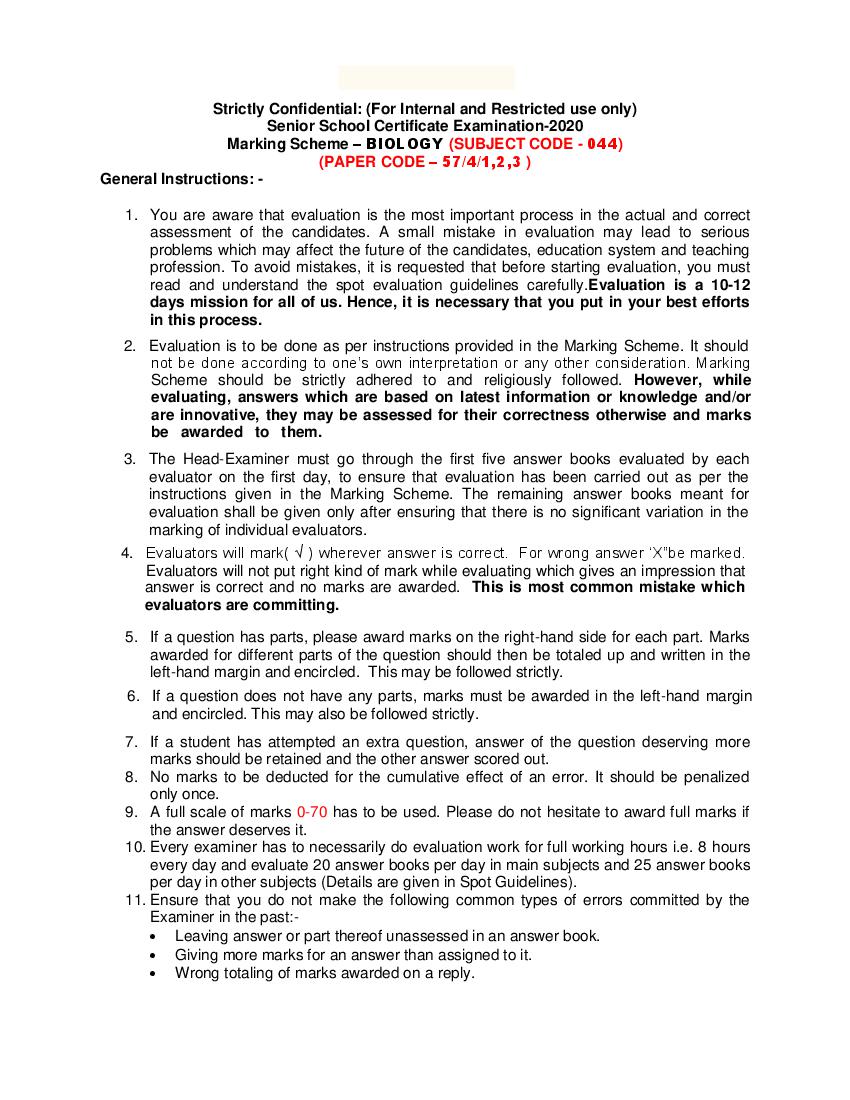
Senior School Certificate Examination-2020
Marking Scheme – BIOLOGY (SUBJECT CODE - 044)
(PAPER CODE – 57/4/1,2,3 )
General Instructions: -
1. You are aware that evaluation is the most important process in the actual and correct
assessment of the candidates. A small mistake in evaluation may lead to serious
problems which may affect the future of the candidates, education system and teaching
profession. To avoid mistakes, it is requested that before starting evaluation, you must
read and understand the spot evaluation guidelines carefully.Evaluation is a 10-12
days mission for all of us. Hence, it is necessary that you put in your best efforts
in this process.
2. Evaluation is to be done as per instructions provided in the Marking Scheme. It should
not be done according to one’s own interpretation or any other consideration. Marking
Scheme should be strictly adhered to and religiously followed. However, while
evaluating, answers which are based on latest information or knowledge and/or
are innovative, they may be assessed for their correctness otherwise and marks
be awarded to them.
3. The Head-Examiner must go through the first five answer books evaluated by each
evaluator on the first day, to ensure that evaluation has been carried out as per the
instructions given in the Marking Scheme. The remaining answer books meant for
evaluation shall be given only after ensuring that there is no significant variation in the
marking of individual evaluators.
4. Evaluators will mark( √ ) wherever answer is correct. For wrong answer ‘X”be marked.
Evaluators will not put right kind of mark while evaluating which gives an impression that
answer is correct and no marks are awarded. This is most common mistake which
evaluators are committing.
5. If a question has parts, please award marks on the right-hand side for each part. Marks
awarded for different parts of the question should then be totaled up and written in the
left-hand margin and encircled. This may be followed strictly.
6. If a question does not have any parts, marks must be awarded in the left-hand margin
and encircled. This may also be followed strictly.
7. If a student has attempted an extra question, answer of the question deserving more
marks should be retained and the other answer scored out.
8. No marks to be deducted for the cumulative effect of an error. It should be penalized
only once.
9. A full scale of marks 0-70 has to be used. Please do not hesitate to award full marks if
the answer deserves it.
10. Every examiner has to necessarily do evaluation work for full working hours i.e. 8 hours
every day and evaluate 20 answer books per day in main subjects and 25 answer books
per day in other subjects (Details are given in Spot Guidelines).
11. Ensure that you do not make the following common types of errors committed by the
Examiner in the past:-
Leaving answer or part thereof unassessed in an answer book.
Giving more marks for an answer than assigned to it.
Wrong totaling of marks awarded on a reply.
Page 2
Wrong question wise totaling on the title page.
Wrong totaling of marks of the two columns on the title page.
Wrong grand total.
Marks in words and figures not tallying.
Wrong transfer of marks from the answer book to online award list.
Answers marked as correct, but marks not awarded. (Ensure that the right tick mark
is correctly and clearly indicated. It should merely be a line. Same is with the X for
incorrect answer.)
Half or a part of answer marked correct and the rest as wrong, but no marks
awarded.
12. While evaluating the answer books if the answer is found to be totally incorrect, it should
be marked as cross (X) and awarded zero (0)Marks.
13. Any unassessed portion, non-carrying over of marks to the title page, or totaling error
detected by the candidate shall damage the prestige of all the personnel engaged in the
evaluation work as also of the Board. Hence, in order to uphold the prestige of all
concerned, it is again reiterated that the instructions be followed meticulously and
judiciously.
14. The Examiners should acquaint themselves with the guidelines given in the Guidelines
for spot Evaluation before starting the actual evaluation.
15. Every Examiner shall also ensure that all the answers are evaluated, marks carried over
to the title page, correctly totaled and written in figures and words.
16. The Board permits candidates to obtain photocopy of the Answer Book on request in an
RTI application and also separately as a part of the re-evaluation process on payment of
the processing charges
Page 3
SECTION – A
(Q. Nos. 1 - 5 are of one mark each)
1. Which one of the following is not found in a female gametophyte of an angiosperm ?
(a) Germ pore (b) Synergids
(c) Filiform apparatus (d) Central cell
Ans. (a) / Germ pore [1 Mark]
2. The autosomal disorder/disease in humans is
(a) Colour blindness (b) Thalassemia
(c) Haemophilia (d) Turner’s Syndrome
Ans. (b) / Thalassemia [1 Mark]
3. Choose the chromosome, in a human, that possesses least number of genes.
(a) 21st Chromosome (b) Autosome
(c) X-Chromosome (d) Y-Chromosome
Ans. (d) / Y-Chromosome [1 Mark]
4. The practice of mating unrelated animals within the same breed, but with no common
ancestor on either side of the pedigree for 4-6 generation is known as
(a) out-breeding (b) out-crossing
(c) cross-breeding (d) in-breeding
Ans. (b) / out crossing
[1 Mark]
OR
Bacteria present in rumen of a cattle digest cellulose to produce
(a) Polysaccharides (b) Sucrose
(c) Ethanol (d) Methane
Ans. (d) / Methane [1 Mark]
57/4 /1, 2, 3 DPSVK/3
Page 4
(a) move away from equator to poles
(b) move towards equator from poles
(c) move along the equator
(d) move from deserts to rain-forests.
Ans. (a) / move away from equator to poles = 1 [1 Mark]
OR
CNG is preferred as a fuel over diesel for public transport because
(i) it is cost effective. (ii) it burns almost completely.
(iii) it can be recycled. (iv) it burns only partially.
Choose the correct combination.
(a) (i) + (ii) (b) (i) + (iii)
(c) (ii) + (iii) (d) (iii) + (iv)
Ans. (a) / (i) + (ii) [1 Mark]
SECTION B
(Q. Nos. 6 - 12 are of two marks each)
6. Mention the advantages of emasculation and bagging in artificial hybridization in plants
bearing unisexual, and bisexual flowers.
Ans. (Unisexual) - No need of emasculation in female flowers / plants , flowers are bagged before
flowers open to prevent pollination by undesirable pollen grain / contaminated with undesirable
pollen = ½ × 2
(Bisexual) - Removal of anthers / emasculation before dehiscence , and bagging to avoid contamina-
tion of stigma from unwanted pollen = ½ × 2 [2 Marks]
7. Two children one with blood group ‘AB’ and other with blood group ‘O’ are born to par-
ents, where the father has blood group ‘A’ and the mother has blood group ‘B’. Work out
a cross to show how is it possible ?
Ans. Father IA i = ½ × IB i Mother = ½
IA i IB i
IAIB ii
Blood group ‘AB’ = ½ Blood group ‘O’ =½ [2 Marks]
57/4 /1, 2, 3 DPSVK/4
Page 5
involved in providing them.
Ans. Humoral immune response , B lymphocytes / B cells = ½ × 2
Cell mediated immunity / cell mediated response , T-lymphocytes / T cells = ½ × 2
[2 Marks]
OR
Name two organisms belonging to two different kingdoms, that are commonly used as
biofertilizers, and how ?
Ans. (i) Mycorrhiza (fungi) , genus Glomus absorbs phosphorus from soil and passes it to the
plant
(ii) Rhizobium (monera) , fixes atmospheric nitrogen and increases soil fertility /
Cyanobacteria (monera) , fixes atmospheric nitrogen and increases soil fertility /
Azospirillum / Azotabacter (monera) , fixes atmospheric nitrogen and increases soil
fertility = ½ × 4
[2 Marks]
9. Write the basis of naming the restriction endonuclease EcoRI.
Ans. The first letter comes from the (genus) Escherichia , and the second two letters from the (species)
coli of prokaryotic cell from which the enzyme is isolated , In EcoRI the letter R is derived from the
name of strain , Roman number indicate the order in which enzyme was isolated (from the strain of
bacteria) = ½ × 4
[2 Marks]
10. What are transgenic animals ? How was the first transgenic cow found to be more useful
than the normal cow, for humans ?
Ans. -Animals having undergone DNA manipulation (to express an extra / foreign gene) = 1
-(Rosie) produced human protein - enriched milk / 2.4 gm protein per litre which contained human
alpha - lactalbumin , and was nutritionally more balanced (product) for human babies than natural
cow milk = ½ × 2
[2 Marks]
11. How do the following organisms pull through the adverse environmental conditions ?
(a) Fungi (b) Zooplankton
(c) Bear (d) Snails
Ans. a. (Fungi) - Thick walled spores
b. (Zooplanktons) - diapause / a stage of suspended development
c. (Bear) - Hibernation during winters
d. (snails) - aestivation to avoid summer / related problem / heat and dessication = ½ × 4
[½ × 4 = 2 Marks]
12. (a) How many primary producers do you think would be needed to support six tertiary
consumers in a grassland ecosystem ?
57/4 /1, 2, 3 DPSVK/5
Page 6
Ans. (a) Since number of tertiary consumers is six hence number of primary producers is many
more in number than tertiary consumers = ½
b)
= 1½
(mark for correct order of trophic levels with decreasing number)
[½ +1½= 2 Marks]
SECTION C
(Q. Nos. 13 - 21 are of three marks each)
13 Explain the role of pituitary and ovarian hormones in the menstrual cycle of humans females.
Ans. (Pituitary hormones) - Gonadotropins / FSH - causes follicular development , secretion of estrogen
(by growing follicles) = ½ + ½
LH - induces rupture of Graafian follicle / ovulation , remaining part of Graafian follicle transform
into corpus luteum which releases progesterone = ½ + ½
(Ovarian hormone) - Estrogen causes growth and maturation of follicle and is necessary for repair
of endometrium =½
Progesterone - necessary for maintenance of the endometrium for implantation = ½
[3 Marks]
14. (a) List the four major causes of increasing population in our country that you would
like to speak on to your fellow students.
(b) Write any two steps that you would stress upon to control the population explosion.
Ans. (a) Rapid decline in death rate , decline in maternal mortality rate , decline in infant mortality rate
(IMR) , increase in number of people in reproductive age , increased health facilities , im-
proved (better)living condition (any four) = ½ × 4
(b) Encourage use of contraceptive methods , statutory raising of marriageable age of females to
18 yrs and that of males to 21 years , incentives should be given to couples for maintaining
small families (any two) = ½ × 2
[2 + 1 = 3 Marks]
57/4 /1, 2, 3 DPSVK/6
Page 7
phosphorus in their experiment.
Ans. They grew viruses / bacteriophages in a medium containing radioactive Sulphur to make protein
coat radioactive , grew bacteriophages in radioactive Phosphorus medium to make their DNA
radioactive ,
They infected E.coli with these radioactive phages separately , bacteria which were infected with
viruses with radioactive protein (radioactive Sulphur) did not show any radioactivity on
centrifugation ,
Bacteria which were infected with viruses with radio active DNA were radioactive ,
They proved that DNA is the genetic material = ½ × 6
[3 Marks]
OR
Describe the experiment where Mathew Meselson and Franklin Stahl used heavy isotope
of Nitrogen.
Ans. They grew E.coli in 15NH4Cl medium for many generations , 15N was incorporated into newly
synthesized / heavy DNA , these cells were transferred into 14NH4Cl / normal medium ,
DNA extracted from culture after one generation / 20 minutes had hybrid / intermediate density ,
DNA extracted after 40 minutes was composed of equal amounts of this hybrid DNA and of ‘light’
DNA , The experiment proved that DNA replicates semi-conservatively = ½ × 6
//
(In lieu of the above explanation the following diagram can be considered)
= ½ × 5=2½
The experiment proved that DNA replicates semi-conservatively = ½
[3 Marks]
16. Analogous organs are a result of convergent evolution whereas homologous organs are a
result of divergent evolution. Justify with the help of suitable example for each.
57/4 /1, 2, 3 DPSVK/7
Page 8
functions such organs are called analogous , are a result of convergent evolution / different structures
evolving for the same functions , (Accept other similar examples like sweet potato and potato / eyes
of octopus and mammals / flippers of Penguin and Dolphins) = ½ × 3
Bones of forelimbs in whales-bats-cheetah-humans have similar pattern / anatomical structure to
perform different functions , (due to different habitat and needs) these structures are said to be
homologous , and show divergent evolution (accept examples of vertebrate hearts / vertebrate brains
/ thorns of Bougainvillea and tendril of Cucurbita) = ½ × 3
[3 Marks]
17. Compare the symptoms of ascariasis, amoebiasis and elephantitis.
Ans. (Ascariasis) - internal bleeding / muscular pain / blockage of intestinal passage / fever / anemia (any
two) = ½ × 2
(Amoebiasis) - Constipation / abdominal pain and cramps / stools with excess mucus and blood
clots (any two) = ½ × 2
(Elephantiasis) - Chronic inflammation of the organs including genital organs / lymphatic vessels of
lower limb / gross deformities (any two) = ½ × 2
[3 Marks]
18. (a) Write the difference between the pro insulin and mature insulin.
(b) How did American company Eli Lilly produce human insulin using rDNA technique ?
Ans. (a) Pro insulin / Pro hormone has peptide chain A and chain B along with peptide chain C in the
middle , = ½
Mature insulin has only peptide chain A and chain B linked together by disulphide bond = ½
(b) Prepared two DNA sequences corresponding to chains A and B of human insulin , and intro-
duced them into plasmids of E.coli to produce insulin chains , A and B were produced sepa-
rately , extracted and combined creating disulphide bonds (to form human insulin) = ½ × 4
[1 + 2 = 3 Marks]
19. Study the table showing the population interaction between species ‘Z’and ‘Y’ respectively.
Assign the appropriate ‘+’/‘–’ signs for ‘A’, ‘B’, ‘D’, ‘E’and respective interactions for ‘C’
and ‘F’.
Species ‘Z’ Species ‘Y’ Name of Interaction
A B Mutualism
- - C
D E Parasitism
+ O F
57/4 /1, 2, 3 DPSVK/8
Page 9
B = + (plus)
C = Competition
D = + (plus) D = - (minus)
E = - (minus) E = + (plus)
F = Commensalism =½×6
[3 Marks]
20. How would you differentiate between gross primary productivity from net primary
productivity, and secondary productivity of an ecosystem.
Ans. (Gross Primary Productivity) - Rate of production of organic matter during photosynthesis =1
(Net Primary Productivity) - Available biomass for consumption to heterotrophs (herbivores and
decomposers) / gross Primary productivity minus respiratory losses / GPP - R = NPP = 1
(Secondary Productivity) - Rate of formation of new organic matter by consumers = 1
[1 + 1 + 1 = 3 Marks]
OR
(a) Explain the concept of endemism.
(b) Name four regions in and around our country that are considered hot-spots.
Ans. (a) Species confined to a particular (geographical) region, and not found anywhere else = ½ × 2
(b) Western Ghats , Himalaya , Indo-Burma , Sri Lanka = ½ × 4
[1 + 2 = 3 Marks]
21. Describe the significance of “Amrita Devi Bishnoi Wildlife Protection Award”. Write her
contribution towards the conservation of forests.
Ans. Bishnoi woman Amrita Devi showed exemplary courage by hugging a tree daring king’s men to cut
her first before cutting the tree (the tree mattered much more to her than her own life) , the tree was
cut down along with Amrita Devi (her three daughters & hundreds of other Bishnois lost their lives
saving trees) for the cause of environment , award is given to individuals / communities showing
extraordinary courage and dedication in protecting wild life = 1 × 3 =3
[3 Marks]
SECTION D
(Q. Nos. 22 - 24 are of three marks each)
22. Hardy-Weinberg Principle is stated in the following algebraic equation : P2 + 2Pq + q2 = 1.
(a) State what do ‘P’ and ‘q’ denote in the equation.
(b) State Hardy-Weinberg principle as indicated in the equation.
(c) What would you interpret if the value of ‘1’ in the equation gets deviated ?
Ans. (a) ‘P’ dominant allele / Frequency of allele ‘A’ ,
‘q’ recessive allele / Frequency of allele ‘a’= ½ × 2 = 1
57/4 /1, 2, 3 DPSVK/9
Page 10
population are stable and is constant from generatioin to generation = 1
(c) Evolutionary changes / Evolution = 1
[1 + 1 + 1 = 3 Marks]
23. Study the picture of biogas plant given below and answer the questions that follow :
(a) Name the components gaining entry from A into the chamber.
(b) Mention the group of bacteria and the condition in which they act on the component
that entered from A in the digester.
(c) Name the components that get collected in gas holder.
Ans.(a) Slurry of dung / dung and water = 1
(b) (Microbial activity of) Methanogens / Methanobacterium , grow anaerobically = ½ × 2
(c) Methane , = ½
CO2 / H2 (any one) = ½
[1 + 1 + 1 = 3 Marks]
24. Observe the diagram shown below of pBR 322. Answer the questions that follow :
(a) What is pBR322 ?
57/4 /1, 2, 3 DPSVK/10
Page 11
(c) State the significance of ‘ampR’ and ‘tetR’.
Ans. (a) E.coli cloning vector /plasmid (accept only if cloning vector / plasmid is mentioned ) = 1
(b) ‘rop’ - codes for proteins involved in the replication of plasmid = 1
(c) Selectable markers which helps in identifying and eliminating non transformants , and permit-
ting the growth of transformants = ½ × 2
[1 × 3 = 3 Marks]
SECTION E
(Q. Nos. 25 - 27 are of five marks each)
25. Trace the development of a 2-celled pollen grain of an angiosperm within an anther. Draw
a labelled diagram to substantiate your answer.
Ans. Each cell of sporogenous tissue develops into a pollen mother cell / microspore mother cell , that
undergoes meiosis forming four cells / microspore tetrad , mature pollen grain contains two cells the
vegetative cell , and the generative cell = ½ × 4 = 2
=½×6=3
[5 Marks]
57/4 /1, 2, 3 DPSVK/11
Page 12
Where does fertilisation occur in the oviduct of a human female ? Explain the embryonic
development from fertilised ovum upto its implantation.
Ans. Ampullary region ( of oviduct )/ ampullary- isthmic junction (of oviduct ) = ½
zygote undergoes mitotic division called cleavage , to form 2-4-8-16 (daughter cells) blastomeres ,
embryo with 8 blastomeres is called morula , continues to divide and transforms into blastocyst ,
blastomeres in the blastocyst are arranged into an outer layer called trophoblast , that gets attached
to endometrium ,the inner cell mass of blastocyst gets differentiated as embryo , the uterine cells
divide rapidly and covers the blastocyst , blastocyst gets embedded in the endometrium of uterus
(called implantation )= ½ × 9 = 4½
[5 Marks]
26. Explain the relationship of ribosomes, t-RNA and m-RNA during the process of translation
in Prokaryotes.
Ans. Amino acids (are activated in the presence of ATP) are linked to their cognate tRNA/ charging of
tRNA / aminoacylation of tRNA , Ribosome is the cellular factory for protein synthesis (which exists
as two subunits ) ,
For initiation / small subunit of ribosome binds to m-RNA at the start codon/AUG , recognised by
initiator t-RNA , large subunit has two sites for subsequent amino acids to bind to each other with a
peptide bond , (ribosome also serves as a catalyst for the formation of peptide bond) ribosome
proceeds to elongation phase where charged tRNAs sequentially bind to the appropriate codon in
mRNA , by forming complementary base pairs with the t-RNA anticodon , Ribosome moves codon
by codon along the m-RNA , aminoacids are added one by one , at the end a release factor binds to
the stop codon / UAA / UAG / UGA terminating translation = ½ × 10 = 5
[5 Marks]
OR
A cross was carried out between two pea plants homozygous dominant for yellow and round
seeds with homozygous recessive for the same trait. The F2 progeny of such a cross showed
phenotypic ratio of 9 : 3 : 3 : 1.
(a) State the different laws of Mendel that could be derived from such a cross.
(b) Write the possible genotypes for the progeny for such a cross having
(i) yellow and wrinkled seeds
(ii) green and round seeds.
Ans. (a) (i) Law of dominance , - In a dissimilar pair of factors of a trait one member dominates
(dominant / yellow) the other (recessive/green) = ½ × 2
(ii) Law of segregation , - Allele pair segregate during gamete formation such that a gamete
receives only one of the two factors and there is no blending of alleles / factors = ½ × 2
57/4 /1, 2, 3 DPSVK/12
Page 13
segregation of one pair of characters is independent of other pair of characters = ½ × 2
(b) (i) Yellow and wrinkled - YYrr , Yyrr = ½ × 2
(ii) Green and round - yyRR , yyRr = ½ × 2
[3 + 2 = 5 Marks]
27. (a) How do normal cells become cancerous ?
(b) Cancer can be treated successfully only if detected at an early stage. How do the
following help in detecting cancer ?
(i) Biopsy (ii) Histopathology (iii) MRI
(c) Name any two methods that can possibly cure cancer.
Ans.(a) Loss of property of contact inhibition by normal cells , leading to uncontrolled
growth = ½ × 2
(b) (i) (Biopsy) - A piece of the suspected tissue is cut into thin section stained and studied ,
=½
(ii) (Histopathology) - a piece of suspected tissue is examined under microscope by a
pathologist = ½
(iii) (MRI) - Uses strong magnetic fields and non-ionising radiations , accurately detect
pathological and physiological changes in the tissues = ½ × 2
(c) Surgery , radiotherapy / radiation therapy , chemotheraphy , immunotherapy , biological
response modifiers such as -interferon (any two) = 1 + 1
[1 + 3 + 2 = 5 Marks]
OR
(a) State what is hidden hunger.
(b) Name the crop breeding phenomenon and state its objective that has helped in
overcoming hidden hunger.
(c) IARI has helped in improving some vegetable crops in this respect. Explain with the
help of two examples.
Ans. (a) Deficiency of micro nutrients proteins and vitamins in diet = ½
(b) Biofortification , = ½
objectives - To improve in protein content and quality , oil content and quality , vitamin content ,
and micronutrient and mineral content = ½ × 4 = 2
(c) Vitamin A enriched - , carrots / spinach / pumpkin //
Vitamin C enriched - , bitter gourd / bathua / mustard / tomato //
Iron and calcium enriched -, spinach / bathua //
Protein enriched- , beans - broad / lablab / french / garden peas //
(any two biofortifications + with their respective examples) = ½ × 4
[½ +2 ½ + 2 = 5 Marks]
57/4 /1, 2, 3 DPSVK/13
Page 14
SECTION – A
(Q. Nos. 1 - 5 are of one mark each)
1. It is observed that, the species diversity decreases as we
(a) move away from equator to poles
(b) move towards equator from poles
(c) move along the equator
(d) move from deserts to rain-forests.
Ans. (a) / move away from equator to poles = 1 [1 Mark]
OR
CNG is preferred as a fuel over diesel for public transport because
(i) it is cost effective. (ii) it burns almost completely.
(iii) it can be recycled. (iv) it burns only partially.
Choose the correct combination.
(a) (i) + (ii) (b) (i) + (iii)
(c) (ii) + (iii) (d) (iii) + (iv)
Ans. (a) / (i) + (ii) [1 Mark]
2. Choose the chromosome, in a human, that possesses least number of genes.
(a) 21st Chromosome (b) Autosome
(c) X-Chromosome (d) Y-Chromosome
Ans. (d) / Y-Chromosome [1 Mark]
3. The practice of mating unrelated animals within the same breed, but with no common
ancestor on either side of the pedigree for 4-6 generation is known as
(a) out-breeding (b) out-crossing
(c) cross-breeding (d) in-breeding
Ans. (b) / out crossing
[1 Mark]
57/4 /1, 2, 3 DPSVK/14
Page 15
Bacteria present in rumen of a cattle digest cellulose to produce
(a) Polysaccharides (b) Sucrose
(c) Ethanol (d) Methane
Ans. (d) / Methane [1 Mark]
4. The autosomal disorder/disease in humans is
(a) Colour blindness (b) Thalassemia
(c) Haemophilia (d) Turner’s Syndrome
Ans. (b) / Thalassemia [1 Mark]
5. Marchantia is a
(a) Monoecious plant (b) Homothallic plant
(c) Dioecious plant (d) Bisexual plant
Ans. (c) / Dioecious plant
[1 Mark]
SECTION – B
(Q. Nos. 6 - 12 are of two marks each)
6. (a) How many primary producers do you think would be needed to support six tertiary
consumers in a grassland ecosystem ?
(b) Draw a grassland pyramid to substantiate your answer.
Ans. (a) Since number of tertiary consumers is six hence number of primary producers is many
more in number than tertiary consumers = ½
b)
= 1½
(mark for correct order of trophic levels with decreasing number)
[½ +1½= 2 Marks]
57/4 /1, 2, 3 DPSVK/15
Page 16
Ans. (standing crop) - mass / biomass of living material present in a trophic level at a particular time = 1
(standing state) - Amount of nutrients such as carbon / nitrogen / phosphorus / calcium (any two) ,
present in the soil at any given time = ½ + ½
[2 Marks]
8. Name any two most common bio-reactors and mention their importance in biotechnology.
Ans. Simple stirred - tank bioreactor , sparged stirred - tank bioreacter = ½ × 2
raw materials are biologically converted into specific products / enzymes using microbial plant animal
or human cells , provides optimal conditions for achieving the desired product on large
scale = ½ × 2
[2 Marks]
9. Describe the process of Pollination in Vallisneria.
Ans. Female flower reaches water surface by long stalk , and male flowers / pollen grains are released on
the surface of water , carried passively by water currents , some eventually reach female flowers and
stigma = ½ × 4
[2 Marks]
10. Two children one with blood group ‘AB’ and other with blood group ‘O’ are born to parents,
where the father has blood group ‘A’ and the mother has blood group ‘B’. Work out a cross
to show how is it possible ?
Ans. Father IA i = ½ × IB i Mother = ½
IA i IB i
IAIB ii
Blood group ‘AB’ = ½ Blood group ‘O’ =½ [2 Marks]
11. Name the types of acquired immune responses, and the special types of lymphocytes
involved in providing them.
Ans. Humoral immune response , B lymphocytes / B cells = ½ × 2
Cell mediated immunity / cell mediated response , T-lymphocytes / T cells = ½ × 2
[2 Marks]
OR
Name two organisms belonging to two different kingdoms, that are commonly used as
biofertilizers, and how ?
Ans. (i) Mycorrhiza (fungi) , genus Glomus absorbs phosphorus from soil and passes it to the
plant
(ii) Rhizobium (monera) , fixes atmospheric nitrogen and increases soil fertility /
57/4 /1, 2, 3 DPSVK/16
Page 17
Azospirillum / Azotabacter (monera) , fixes atmospheric nitrogen and increases soil
fertility = ½ × 4
[2 Marks]
12. Write the basis of naming the restriction endonuclease EcoRI.
Ans. The first letter comes from the (genus) Escherichia , and the second two letters from the (species)
coli of prokaryotic cell from which the enzyme is isolated , In EcoRI the letter R is derived from the
name of strain , Roman number indicate the order in which enzyme was isolated (from the strain of
bacteria) = ½ × 4
[2 Marks]
SECTION – C
(Q. Nos. 13 - 21 are of three marks each)
13. Write two major causes of deforestation. Explain the role of re-forestation in maintaining
ecological balance.
Ans. -Conversion of forests in to agricultural land to feed growing human population , trees are cut for
timber / firewood / cattle rancing , slash and burn agriculture (Jhum cultivation ) (any two) = ½ × 2
- Plant can hold a lot of CO2 as biomass , controls CO2 level and green house effect , maintain
hydrological cycle , prevents soil erosion and desertification in extreme cases , maintain biodiversity
(any four) = ½ × 4
[3 Marks]
14. How would you differentiate between gross primary productivity from net primary
productivity, and secondary productivity of an ecosystem.
Ans. (Gross Primary Productivity) - Rate of production of organic matter during photosynthesis =1
(Net Primary Productivity) - Available biomass for consumption to heterotrophs (herbivores and
decomposers) / gross Primary productivity minus respiratory losses / GPP - R = NPP = 1
(Secondary Productivity) - Rate of formation of new organic matter by consumers = 1
[1 + 1 + 1 = 3 Marks]
OR
(a) Explain the concept of endemism.
(b) Name four regions in and around our country that are considered hot-spots.
Ans. (a) Species confined to a particular (geographical) region, and not found anywhere else = ½ × 2
(b) Western Ghats , Himalaya, Indo-Burma , Sri Lanka = ½ × 4 = 2
[1 + 2 = 3 Marks]
15. Compare the symptoms of ascariasis, amoebiasis and elephantitis.
Ans. (Ascariasis) - internal bleeding / muscular pain / blockage of intestinal passage / fever / anemia (any
two) = ½ × 2
(Amoebiasis) - Constipation / abdominal pain and cramps / stools with excess mucus and blood
clots (any two) = ½ × 2
57/4 /1, 2, 3 DPSVK/17
Page 18
lower limb / gross deformities (any two) = ½ × 2
[3 Marks]
16. (a) Write the difference between the pro insulin and mature insulin.
(b) How did American company Eli Lilly produce human insulin using rDNA technique ?
Ans. (a) Pro insulin / Pro hormone has peptide chain A and chain B along with peptide chain C in the
middle , = ½
Mature insulin has only peptide chain A and chain B linked together by disulphide bond = ½
(b) Prepared two DNA sequences corresponding to chains A and B of human insulin , and
introduced them into plasmids of E.coli to produce insulin chains , A and B were produced
separately , extracted and combined creating disulphide bonds (to form human insulin)
= ½×4
[1 + 2 = 3 Marks]
17. Explain the discovery made by Hershey and Chase using radioactive sulphur and
phosphorus in their experiment.
Ans. They grew viruses / bacteriophages in a medium containing radioactive Sulphur to make protein
coat radioactive , grew bacteriophages in radioactive Phosphorus medium to make their DNA
radioactive ,
They infected E.coli with these radioactive phages separately , bacteria which were infected with
viruses with radioactive protein (radioactive Sulphur) did not show any radioactivity on
centrifugation ,
Bacteria which were infected with viruses with radio active DNA were radioactive ,
They proved that DNA is the genetic material = ½ × 6
[3 Marks]
OR
Describe the experiment where Mathew Meselson and Franklin Stahl used heavy isotope
of Nitrogen.
Ans. They grew E.coli in 15NH4Cl medium for many generations , 15N was incorporated into newly
synthesized / heavy DNA , these cells were transferred into 14NH4Cl / normal medium ,
DNA extracted from culture after one generation / 20 minutes had hybrid / intermediate density ,
DNA extracted after 40 minutes was composed of equal amounts of this hybrid DNA and of ‘light’
DNA , The experiment proved that DNA replicates semi-conservatively = ½ × 6
//
(In lieu of the above explanation the following diagram can be considered)
57/4 /1, 2, 3 DPSVK/18
Page 19
The experiment proved that DNA replicates semi-conservatively = ½
[3 Marks]
18. Explain convergent evolution with the help of two examples, one from plants and the other
from the animals.
Ans. (convergent evolution) - Different structures evolving for same function = 1
(Example from plants) - Sweet potato (root modification) and Potato (stem modification = 1
(Example from animals) - Eye of Octopus and of mammals / flippers of Penguin and Dolphins = 1
[3 Marks]
19. Explain the role of pituitary and ovarian hormones in the menstrual cycle of humans females.
Ans. (Pituitary hormones) - Gonadotropins / FSH - causes follicular development , secretion of estrogen
(by growing follicles) = ½ + ½
LH - induces rupture of Graafian follicle / ovulation , remaining part of Graafian follicle transform
into corpus luteum which releases progesterone = ½ + ½
(Ovarian hormone) - Estrogen causes growth and maturation of follicle and is necessary for repair
of endometrium =½
Progesterone - necessary for maintenance of the endometrium for implantation = ½
[3 Marks]
20. Study the table given below. Identify A, B, C, D, E and F in the table.
Name of the Scientific name of Effect on human
Drug source plant organ/system
Opioids ‘A’ ‘B’
‘C’ Cannabis sativa ‘D’
Cocaine ‘E’ F
57/4 /1, 2, 3 DPSVK/19
Page 20
‘B’ - Depressant / Slows down body function
‘C’ - Cannabinoids / marijuana / hashish / charas / ganja
‘D’ - Cardio vascular system
‘E’ - Erythroxylum coca
‘F’- Hallucinations / Euphoria / stimulate central nervous system / increased energy
[½ × 6= 3 Marks]
21. (a) List the four major causes of increasing population in our country that you would
like to speak on to your fellow students.
(b) Write any two steps that you would stress upon to control the population explosion.
Ans. (a) Rapid decline in death rate , decline in maternal mortality rate , decline in infant mortality rate
(IMR) , increase in number of people in reproductive age , increased health facilities , im-
proved (better)living condition (any four) = ½ × 4
(b) Encourage use of contraceptive methods , statutory raising of marriageable age of females to
18 yrs and that of males to 21 years , incentives should be given to couples for maintaining
small families (any two) = ½ × 2
[2 + 1 = 3 Marks]
SECTION – D
(Q. Nos. 22 - 24 are of three marks each)
22. Study the picture of biogas plant given below and answer the questions that follow :
(a) Name the components gaining entry from A into the chamber.
(b) Mention the group of bacteria and the condition in which they act on the component
that entered from A in the digester.
(c) Name the components that get collected in gas holder.
Ans. (a) Slurry of dung / dung and water = 1
(b) (Microbial activity of) Methanogens / Methanobacterium , grow anaerobically = ½ × 2
57/4 /1, 2, 3 DPSVK/20
Page 21
CO2 / H2 (any one) = ½
[1 + 1 + 1 = 3 Marks]
23. Observe the diagram shown below of pBR 322. Answer the questions that follow :
(a) What is pBR322 ?
(b) Write the role of ‘rop’.
(c) State the significance of ‘ampR’ and ‘tetR’.
Ans. (a) E.coli cloning vector /plasmid (accept only if cloning vector / plasmid is mentioned ) = 1
(b) ‘rop’ - codes for proteins involved in the replication of plasmid = 1
(c) Selectable markers which helps in identifying and eliminating non transformants , and permit-
ting the growth of transformants = ½ × 2
[1 × 3 = 3 Marks]
24. Hardy-Weinberg Principle is stated in the following algebraic equation : P2 + 2Pq + q2 = 1.
(a) State what do ‘P’ and ‘q’ denote in the equation.
(b) State Hardy-Weinberg principle as indicated in the equation.
(c) What would you interpret if the value of ‘1’ in the equation gets deviated ?
Ans. (a) ‘P’ dominant allele / Frequency of allele ‘A’ ,
‘q’ recessive allele / Frequency of allele ‘a’= ½ × 2 = 1
(b) Sum total of all allelic frequencies in a population / gene pool is 1 /allele frequencies in a
population are stable and is constant from generatioin to generation = 1
(c) Evolutionary changes / Evolution = 1
[1 + 1 + 1 = 3 Marks]
SECTION E
(Q. Nos. 25 - 27 are of five marks each)
25. A group of F1 pea plants produce round and yellow seeds. However, when selfed their
offsprings provided a 9 : 3 : 3 : 1 phenotypic ratio for seed shape and colour, with some
57/4 /1, 2, 3 DPSVK/21
Page 22
(a) Explain with the help of a Punnett square their phenotypes, genotypes and respective
given phenotypic ratios of F2-population.
(b) State Mendel’s law that can be deduced only from such a cross.
Ans. (a)
(b) (Law of Independent Assortment states that) when two pairs of traits are combined in a
hybrid segregation of one pair of characters is independent of the other pair of characters
=1
[4 + 1 = 5 Marks]
57/4 /1, 2, 3 DPSVK/22
Page 23
(a) Describe the structure of a ‘transcription Unit’.
(b) Explain the basis of defining the two DNA strands of a structural gene in a
transcription unit.
Ans. (a) The promoter , and terminator flank / present on either side of structural gene , promoter
located towards 5’end / upstream , (it is the presence of a promoter that defines the template
and coding strands) terminator is located towards 3’end / downstream of the coding strand
=½×4=2
//
(In lieu of the above explanation the following diagram can be considered)
=½×4=2
(b) Since two DNA strands have opposite polarity , and DNA dependent RNA-polymerease
catalyses the polymerisation , in only one direction 5’ 3’, the strand with polarity 3’ 5’
act as a template strand , the other strand with polarity 5’ 3’ is (does not code for anything)
during transcription , and is referred to as coding strand (All the reference while defining a
transcription unit is made with coding strand) = ½ × 6 = 3
[2 + 3 = 5 Marks]
26. (a) How do normal cells become cancerous ?
(b) Cancer can be treated successfully only if detected at an early stage. How do the
following help in detecting cancer ?
(i) Biopsy (ii) Histopathology (iii) MRI
(c) Name any two methods that can possibly cure cancer.
Ans. (a) Loss of property of contact inhibition by normal cells , leading to uncontrolled
growth = ½ × 2
(b) (i) (Biopsy) - A piece of the suspected tissue is cut into thin section stained and studied ,
=½
(ii) (Histopathology) - a piece of suspected tissue is examined under microscope by a
pathologist = ½
(iii) (MRI) - Uses strong magnetic fields and non-ionising radiations , accurately detect
pathological and physiological changes in the tissues = ½ × 2
(c) Surgery , radiotherapy / radiation therapy , chemotheraphy , immunotherapy , biological
57/4 /1, 2, 3 DPSVK/23
Page 24
[1 + 3 + 2 = 5 Marks]
OR
(a) State what is hidden hunger.
(b) Name the crop breeding phenomenon and state its objective that has helped in
overcoming hidden hunger.
(c) IARI has helped in improving some vegetable crops in this respect. Explain with the
help of two examples.
Ans. (a) Deficiency of micro nutrients proteins and vitamins in diet = ½
(b) Biofortification , = ½
objectives - To improve in protein content and quality , oil content and quality , vitamin content ,
and micronutrient and mineral content = ½ × 4 = 2
(c) Vitamin A enriched - , carrots / spinach / pumpkin //
Vitamin C enriched - , bitter gourd / bathua / mustard / tomato //
Iron and calcium enriched -, spinach / bathua //
Protein enriched- , beans - broad / lablab / french / garden peas //
(any two biofortifications + with their respective examples) = ½ × 4
[½ +2 ½ + 2 = 5 Marks]
27 Trace the development of a 2-celled pollen grain of an angiosperm within an anther. Draw
a labelled diagram to substantiate your answer.
Ans. Each cell of sporogenous tissue develops into a pollen mother cell / microspore mother cell , that
undergoes meiosis forming four cells / microspore tetrad , mature pollen grain contains two cells the
vegetative cell , and the generative cell = ½ × 4 = 2
57/4 /1, 2, 3 DPSVK/24
Page 25
[5 Marks]
OR
Where does fertilisation occur in the oviduct of a human female ? Explain the embryonic
development from fertilised ovum upto its implantation.
Ans. Ampullary region ( of oviduct )/ ampullary- isthmic junction (of oviduct ) = ½
zygote undergoes mitotic division called cleavage , to form 2-4-8-16 (daughter cells) blastomeres ,
embryo with 8 blastomeres is called morula , continues to divide and transforms into blastocyst ,
blastomeres in the blastocyst are arranged into an outer layer called trophoblast , that gets attached
to endometrium ,the inner cell mass of blastocyst gets differentiated as embryo , the uterine cells
divide rapidly and covers the blastocyst , blastocyst gets embedded in the endometrium of uterus
(called implantation )= ½ × 9 = 4½
[5 Marks]
57/4 /1, 2, 3 DPSVK/25
Page 26
SECTION – A
(Q. Nos. 1 - 5 are of one mark each)
1. The practice of mating unrelated animals within the same breed, but with no common
ancestor on either side of the pedigree for 4-6 generation is known as
(a) out-breeding (b) out-crossing
(c) cross-breeding (d) in-breeding
Ans. (b) / out crossing
[1 Mark]
OR
Bacteria present in rumen of a cattle digest cellulose to produce
(a) Polysaccharides (b) Sucrose
(c) Ethanol (d) Methane
Ans. (d) / Methane [1 Mark]
2. It is observed that, the species diversity decreases as we
(a) move away from equator to poles
(b) move towards equator from poles
(c) move along the equator
(d) move from deserts to rain-forests.
Ans. (a) / move away from equator to poles = 1 [1 Mark]
OR
CNG is preferred as a fuel over diesel for public transport because
(i) it is cost effective. (ii) it burns almost completely.
(iii) it can be recycled. (iv) it burns only partially.
Choose the correct combination.
(a) (i) + (ii) (b) (i) + (iii)
(c) (ii) + (iii) (d) (iii) + (iv)
Ans. (a) / (i) + (ii) [1 Mark]
57/4 /1, 2, 3 DPSVK/26
Page 27
(a) Colour blindness (b) Thalassemia
(c) Haemophilia (d) Turner’s Syndrome
Ans. (b) / Thalassemia [1 Mark]
4. Filiform apparatus in the embryo sac of an angiosperm is present at the micropyler tip of
(a) Central cell (b) Egg cell
(c) Synergids (d) Antipodals
Ans. (c) / Synergids
[1 Mark]
5. Choose the chromosome, in a human, that possesses least number of genes.
(a) 21st Chromosome (b) Autosome
(c) X-Chromosome (d) Y-Chromosome
Ans. (d) / Y-Chromosome [1 Mark]
SECTION – B
(Q. Nos. 6 - 12 are of two marks each)
6. Very small animals like humming birds are rarely found in polar regions. Why ?
Ans. Since small humming birds have large surface area relative to their volume , they tend to lose body
heat very fast , when it is cold outside they have to expend much energy , to generate body
heat = ½ × 4
[2 Marks]
7. (a) How many primary producers do you think would be needed to support six tertiary
consumers in a grassland ecosystem ?
(b) Draw a grassland pyramid to substantiate your answer.
Ans. (a) Since number of tertiary consumers is six hence number of primary producers is many
more in number than tertiary consumers = ½
b)
= 1½
(mark for correct order of trophic levels with decreasing number)
[½ +1½= 2 Marks]
57/4 /1, 2, 3 DPSVK/27
Page 28
Ans. The first letter comes from the (genus) Escherichia , and the second two letters from the (species)
coli of prokaryotic cell from which the enzyme is isolated , In EcoRI the letter R is derived from the
name of strain , Roman number indicate the order in which enzyme was isolated (from the strain of
bacteria) = ½ × 4
[2 Marks]
9. Two children one with blood group ‘AB’ and other with blood group ‘O’ are born to parents,
where the father has blood group ‘A’ and the mother has blood group ‘B’. Work out a cross
to show how is it possible ?
Ans. Father IA i = ½ × IB i Mother = ½
IA i IB i
IAIB ii
Blood group ‘AB’ = ½ Blood group ‘O’ =½ [2 Marks]
10. Name the types of acquired immune responses, and the special types of lymphocytes
involved in providing them.
Ans. Humoral immune response , B lymphocytes / B cells = ½ × 2
Cell mediated immunity / cell mediated response , T-lymphocytes / T cells = ½ × 2
[2 Marks]
OR
Name two organisms belonging to two different kingdoms, that are commonly used as
biofertilizers, and how ?
Ans. (i) Mycorrhiza (fungi) , genus Glomus absorbs phosphorus from soil and passes it to the
plant
(ii) Rhizobium (monera) , fixes atmospheric nitrogen and increases soil fertility /
Cyanobacteria (monera) , fixes atmospheric nitrogen and increases soil fertility /
Azospirillum / Azotabacter (monera) , fixes atmospheric nitrogen and increases soil
fertility = ½ × 4
[2 Marks]
11. (a) Name the structure seen on the surface of black pepper and beet seeds, not seen
on a bean seed. Mention the part of the ovule its is a remnants of.
(b) Name the outer layer of a maize grain, and state where generally does this layer gets
developed in a flowering plant.
Ans. (a) Perisperm , nucellus = ½ × 2
(b) Pericarp , ovary wall (after fertilization) = ½ × 2
[1 + 1 =2 Marks]
57/4 /1, 2, 3 DPSVK/28
Page 29
being used for testing the vaccine safety for a specific human disease. Name the disease.
Ans. (Transgenic animals) - Animals have their DNA manipulated to possess and express an extra (for-
eign) gene = 1
Transgenic mice , polio = ½ × 2
[2 Marks]
SECTION – C
(Q. Nos. 13 - 21 are of three marks each)
13. How would you differentiate between gross primary productivity from net primary
productivity, and secondary productivity of an ecosystem.
Ans. (Gross Primary Productivity) - Rate of production of organic matter during photosynthesis =1
(Net Primary Productivity) - Available biomass for consumption to heterotrophs (herbivores and
decomposers) / gross Primary productivity minus respiratory losses / GPP - R = NPP = 1
(Secondary Productivity) - Rate of formation of new organic matter by consumers = 1
[1 + 1 + 1 = 3 Marks]
OR
(a) Explain the concept of endemism.
(b) Name four regions in and around our country that are considered hot-spots.
Ans. (a) Species confined to a particular (geographical) region, and not found anywhere else = ½ × 2
(b) Western Ghats , Himalaya, Indo-Burma , Sri Lanka = ½ × 4 = 2
[1 + 2 = 3 Marks]
14. It is strongly felt, the way integrated waste water including sewage water, treatment was
carried in the town of Arcata (California) can be effectively used for waste water treatment
in our country. Describe the different steps that were carried to get clean water from waste
water.
Ans. (Ist step) - sedimentation , filtration , and chlorine treatment are given (still on water remains a lot of
dangerous pollutants like heavy metals) = ½ × 3
(Innovative approach)-A series of six connected marshes (over 60 hectares) of marshland ,
appropriate plants-algae /fungi /and bacteria were seeded into this area , which neutralise and absorb
and assimilate the pollutants = ½ × 3
[3 Marks]
15. Explain the role of pituitary and ovarian hormones in the menstrual cycle of humans females.
Ans. (Pituitary hormones) - Gonadotropins / FSH - causes follicular development , secretion of estrogen
(by growing follicles) = ½ + ½
LH - induces rupture of Graafian follicle / ovulation , remaining part of Graafian follicle transform
into corpus luteum which releases progesterone = ½ + ½
57/4 /1, 2, 3 DPSVK/29
Page 30
of endometrium =½
Progesterone - necessary for maintenance of the endometrium for implantation = ½
[3 Marks]
16. (a) Write the specific symptoms of pneumonia and amoebiasis.
(b) Mention their mode of spread in a population.
Ans. (a) (Pneumonia) - chills cough and headache , lips and finger nails may turn gray to bluish in severe
cases , severe problem in respiration (any two) = ½ × 2
(Amoebiasis) - constipation abdominal pain and cramps , stools excess mucus and blood clots
=½×2
(b) (Mode of spreads of Pneumonia) - inhaling droplets released by an infected person / sharing
utensils with infected person = ½
(Mode of spreads of Amoebiasis) - Houseflies transmit the parasite from faeces of infected person
to food and drinking water = ½
[2 + 1 = 3 Marks]
17. Explain the discovery made by Hershey and Chase using radioactive sulphur and
phosphorus in their experiment.
Ans. They grew viruses / bacteriophages in a medium containing radioactive Sulphur to make protein
coat radioactive , grew bacteriophages in radioactive Phosphorus medium to make their DNA
radioactive ,
They infected E.coli with these radioactive phages separately , bacteria which were infected with
viruses with radioactive protein (radioactive Sulphur) did not show any radioactivity on
centrifugation ,
Bacteria which were infected with viruses with radio active DNA were radioactive ,
They proved that DNA is the genetic material = ½ × 6
[3 Marks]
OR
Describe the experiment where Mathew Meselson and Franklin Stahl used heavy isotope
of Nitrogen.
Ans. They grew E.coli in 15NH4Cl medium for many generations , 15N was incorporated into newly
synthesized / heavy DNA , these cells were transferred into 14NH4Cl / normal medium ,
DNA extracted from culture after one generation / 20 minutes had hybrid / intermediate density ,
DNA extracted after 40 minutes was composed of equal amounts of this hybrid DNA and of ‘light’
DNA , The experiment proved that DNA replicates semi-conservatively = ½ × 6
//
(In lieu of the above explanation the following diagram can be considered)
57/4 /1, 2, 3 DPSVK/30
Page 31
The experiment proved that DNA replicates semi-conservatively = ½
[3 Marks]
18. Mention and explain the type of evolution the thorns of Bougainvillea and tendrils of
Cucurbita are a result of. Write a similar example from animal kingdom.
Ans. Divergent evolution = 1
Both organs have common origin / anatomical structure(which is stem) , but developed to perform
different functions / for different needs = ½ × 2
(Example) vertebrate hearts / vertebrate brains / forelimbs of man-cheetah-whale-bat = 1
[3 Marks]
19. (a) List the four major causes of increasing population in our country that you would like
to speak on to your fellow students.
(b) Write any two steps that you would stress upon to control the population explosion.
Ans. (a) Rapid decline in death rate , decline in maternal mortality rate , decline in infant mortality rate
(IMR) , increase in number of people in reproductive age , increased health facilities , im-
proved (better)living condition (any four) = ½ × 4
(b) Encourage use of contraceptive methods , statutory raising of marriageable age of females to
18 yrs and that of males to 21 years , incentives should be given to couples for maintaining
small families (any two) = ½ × 2
[2 + 1 = 3 Marks]
20. (a) Write the difference between the pro insulin and mature insulin.
(b) How did American company Eli Lilly produce human insulin using rDNA technique ?
Ans. (a) Pro insulin / Pro hormone has peptide chain A and chain B along with peptide chain C in the
middle , = ½
Mature insulin has only peptide chain A and chain B linked together by disulphide bond = ½
57/4 /1, 2, 3 DPSVK/31
Page 32
duced them into plasmids of E.coli to produce insulin chains , A and B were produced sepa-
rately , extracted and combined creating disulphide bonds (to form human insulin) = ½ × 4
[1 + 2 = 3 Marks]
21. Study the table showing the population interaction between species ‘Z’and ‘Y’ respectively.
Assign the appropriate ‘+’/‘–’ signs for ‘A’, ‘B’, ‘D’, ‘E’and respective interactions for ‘C’
and ‘F’.
Species ‘Z’ Species ‘Y’ Name of Interaction
A B Mutualism
- - C
D E Parasitism
+ O F
Ans. A = + (plus)
B = + (plus)
C = Competition
D = + (plus) D = - (minus)
E = - (minus) E = + (plus)
F = Commensalism =½×6
[3 Marks]
SECTION – D
(Q. Nos. 22 - 24 are of three marks each)
22. Observe the diagram shown below of pBR 322. Answer the questions that follow :
(a) What is pBR322 ?
(b) Write the role of ‘rop’.
(c) State the significance of ‘ampR’ and ‘tetR’.
Ans. (a) E.coli cloning vector /plasmid (accept only if cloning vector / plasmid is mentioned ) = 1
57/4 /1, 2, 3 DPSVK/32
Page 33
(c) Selectable markers which helps in identifying and eliminating non transformants , and permit-
ting the growth of transformants = ½ × 2
[1 × 3 = 3 Marks]
23. Hardy-Weinberg Principle is stated in the following algebraic equation : P2 + 2Pq + q2 = 1.
(a) State what do ‘P’ and ‘q’ denote in the equation.
(b) State Hardy-Weinberg principle as indicated in the equation.
(c) What would you interpret if the value of ‘1’ in the equation gets deviated ?
Ans. (a) ‘P’ dominant allele / Frequency of allele ‘A’ ,
‘q’ recessive allele / Frequency of allele ‘a’= ½ × 2 = 1
(b) Sum total of all allelic frequencies in a population / gene pool is 1 /allele frequencies in a
population are stable and is constant from generatioin to generation = 1
(c) Evolutionary changes / Evolution = 1
[1 + 1 + 1 = 3 Marks]
24. Study the picture of biogas plant given below and answer the questions that follow :
(a) Name the components gaining entry from A into the chamber.
(b) Mention the group of bacteria and the condition in which they act on the component
that entered from A in the digester.
(c) Name the components that get collected in gas holder.
Ans.(a) Slurry of dung / dung and water = 1
(b) (Microbial activity of) Methanogens / Methanobacterium , grow anaerobically = ½ × 2
(c) Methane , = ½
CO2 / H2 (any one) = ½
[1 + 1 + 1 = 3 Marks]
57/4 /1, 2, 3 DPSVK/33
Page 34
(Q. Nos. 25 - 27 are of five marks each)
25. (a) How do normal cells become cancerous ?
(b) Cancer can be treated successfully only if detected at an early stage. How do the
following help in detecting cancer ?
(i) Biopsy (ii) Histopathology (iii) MRI
(c) Name any two methods that can possibly cure cancer.
Ans. (a) Loss of property of contact inhibition by normal cells , leading to uncontrolled
growth = ½ × 2
(b) (i) (Biopsy) - A piece of the suspected tissue is cut into thin section stained and studied ,
=½
(ii) (Histopathology) - a piece of suspected tissue is examined under microscope by a
pathologist = ½
(iii) (MRI) - Uses strong magnetic fields and non-ionising radiations , accurately detect
pathological and physiological changes in the tissues = ½ × 2
(c) Surgery , radiotherapy / radiation therapy , chemotheraphy , immunotherapy , biological
response modifiers such as -interferon (any two) = 1 + 1
[1 + 3 + 2 = 5 Marks]
OR
(a) State what is hidden hunger.
(b) Name the crop breeding phenomenon and state its objective that has helped in
overcoming hidden hunger.
(c) IARI has helped in improving some vegetable crops in this respect. Explain with the
help of two examples.
Ans. (a) Deficiency of micro nutrients proteins and vitamins in diet = ½
(b) Biofortification , = ½
objectives - To improve in protein content and quality , oil content and quality , vitamin content ,
and micronutrient and mineral content = ½ × 4 = 2
(c) Vitamin A enriched - , carrots / spinach / pumpkin //
Vitamin C enriched - , bitter gourd / bathua / mustard / tomato //
Iron and calcium enriched -, spinach / bathua //
Protein enriched- , beans - broad / lablab / french / garden peas //
(any two biofortifications + with their respective examples) = ½ × 4
[½ +2 ½ + 2 = 5 Marks]
57/4 /1, 2, 3 DPSVK/34
Page 35
a labelled diagram to substantiate your answer.
Ans. Each cell of sporogenous tissue develops into a pollen mother cell / microspore mother cell , that
undergoes meiosis forming four cells / microspore tetrad , mature pollen grain contains two cells the
vegetative cell , and the generative cell = ½ × 4 = 2
=½×6=3
[5 Marks]
OR
Where does fertilisation occur in the oviduct of a human female ? Explain the embryonic
development from fertilised ovum upto its implantation.
Ans. Ampullary region ( of oviduct )/ ampullary- isthmic junction (of oviduct ) = ½
zygote undergoes mitotic division called cleavage , to form 2-4-8-16 (daughter cells) blastomeres ,
embryo with 8 blastomeres is called morula , continues to divide and transforms into blastocyst ,
blastomeres in the blastocyst are arranged into an outer layer called trophoblast , that gets attached
to endometrium ,the inner cell mass of blastocyst gets differentiated as embryo , the uterine cells
57/4 /1, 2, 3 DPSVK/35
Page 36
(called implantation )= ½ × 9 = 4½
[5 Marks]
27. Explain the two complexities that are observed in the process of transcription in eukary-
otes and not in prokaryotes.
Ans. (i) There are three RNA polymerases in the nucleus RNA polymerase I transcribes - rRNAs ,
RNA polymerase II transcribes - heterogenous nuclear RNA/hnRNA , RNA polymerase III
transcribes - tRNA / 5 srRNA / snRNA (small nuclear RNAs)= ½ × 3 = 1½
(ii) Primary transcripts / hnRNA contain both the exons and non functional introns , subj ected to
splicing where introns are removed , exons are joined in a defined order , hnRNA undergoes
processing called capping and tailing , In capping nucleotide methyl guanosine triphosphate is
added to 5’ end of hnRNA , In tailing adenylate residues (200-300) are added at 3’- end in a
template independent manner , this fully processed hnRNA is now called mRNA (and trans-
ported out of the nucleus for translation) = ½/ × 7 = 3½
[5 Marks]
OR
How do certain phenotypes appear in F2 populations when none of the parents originally
exhibited them in a dihybrid cross conducted by G. Mendel in pea plants. Explain.
Prepare Punnett’s square to substantiate your answer.
Ans. Mendel crossed homozygous round and yellow seeds producing pea plant with pea plants produc-
ing wrinkled and green seeds, F1 progeny produced were round and yellow seeds only = ½ × 2
On selfing round and yellow seeded plants of F1 generations he got round green seeds and wrinkled
yellow seed = ½
57/4 /1, 2, 3 DPSVK/36
Page 37
Document Details
| Board / Org | CBSE |
| Exam | Class 12 |
| Type | Solution |
| Pages | 37 |
| Updated | 22 Jul 2026 |