CBSE Class 12 Biology Question Paper 2020 Set 57-B Solutions
Finished viewing? Save it for later —
Download CBSE Class 12 Biology Question Paper 2020 Set 57-B Solutions (PDF · 12 pages)About CBSE Class 12 Biology Question Paper 2020 Set 57-B Solutions
CBSE Class 12 Biology Question Paper 2020 Set 57-B Solutions is available here for free download. Published by CBSE for Class 12, this solution can be viewed online or downloaded as a PDF (12 pages). Candidates preparing for Class 12 can use CBSE Class 12 Biology Question Paper 2020 Set 57-B Solutions to understand the exam pattern, the type of questions asked, and the overall difficulty level.
Frequently Asked Questions
How can I download CBSE Class 12 Biology Question Paper 2020 Set 57-B Solutions?
Open this page and click the Download button to save CBSE Class 12 Biology Question Paper 2020 Set 57-B Solutions as a PDF. It is completely free on AglaSem Docs.
Is CBSE Class 12 Biology Question Paper 2020 Set 57-B Solutions free to download?
Yes. CBSE Class 12 Biology Question Paper 2020 Set 57-B Solutions can be viewed online and downloaded as a PDF free of cost on AglaSem Docs.
How many pages does CBSE Class 12 Biology Question Paper 2020 Set 57-B Solutions have?
CBSE Class 12 Biology Question Paper 2020 Set 57-B Solutions contains 12 pages, which you can read online or download together as a single PDF.
Where can I find more Class 12 study material?
You can find more Class 12 question papers, sample papers, syllabus, and answer keys on AglaSem Docs.
CBSE Class 12 Biology Question Paper 2020 Set 57-B Solutions – Text
Read the full text of this solution below — useful to quickly search, copy and reference the content online without downloading the PDF.
📄 View text version (12 pages)
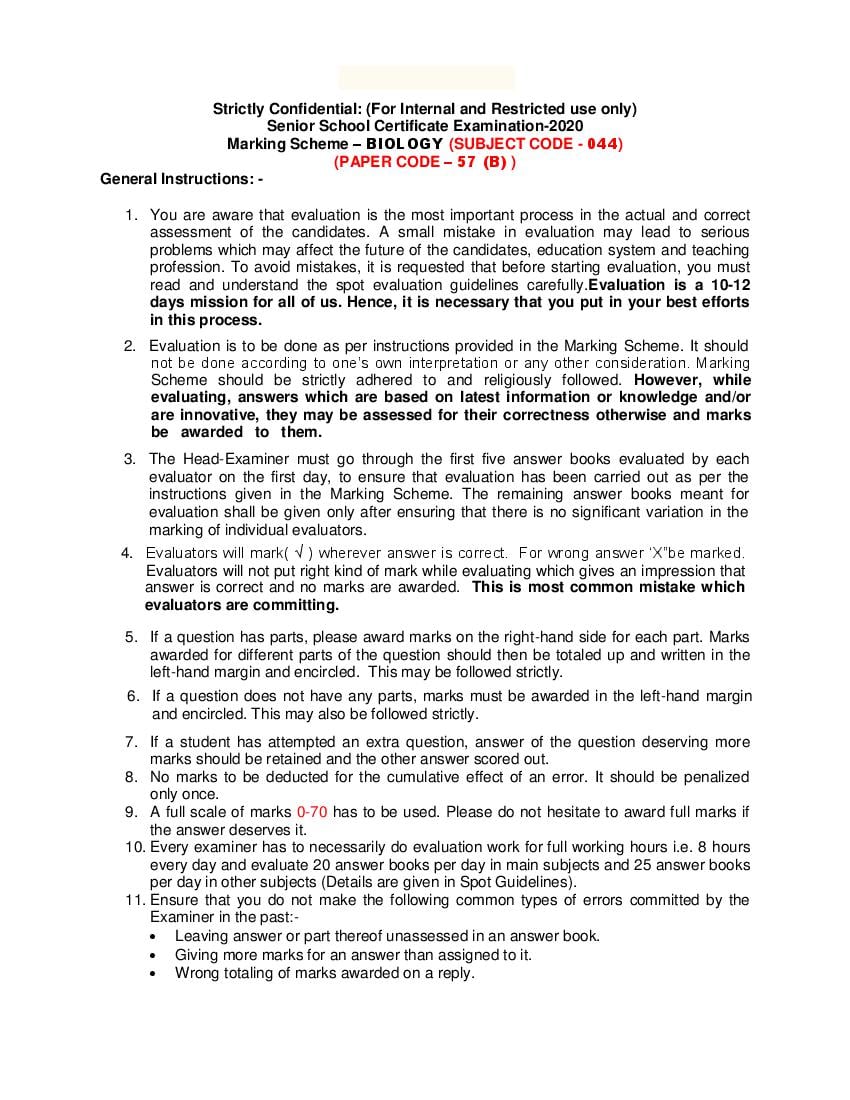
Page 1
Senior School Certificate Examination-2020
Marking Scheme – BIOLOGY (SUBJECT CODE - 044)
(PAPER CODE – 57 (B) )
General Instructions: -
1. You are aware that evaluation is the most important process in the actual and correct
assessment of the candidates. A small mistake in evaluation may lead to serious
problems which may affect the future of the candidates, education system and teaching
profession. To avoid mistakes, it is requested that before starting evaluation, you must
read and understand the spot evaluation guidelines carefully.Evaluation is a 10-12
days mission for all of us. Hence, it is necessary that you put in your best efforts
in this process.
2. Evaluation is to be done as per instructions provided in the Marking Scheme. It should
not be done according to one’s own interpretation or any other consideration. Marking
Scheme should be strictly adhered to and religiously followed. However, while
evaluating, answers which are based on latest information or knowledge and/or
are innovative, they may be assessed for their correctness otherwise and marks
be awarded to them.
3. The Head-Examiner must go through the first five answer books evaluated by each
evaluator on the first day, to ensure that evaluation has been carried out as per the
instructions given in the Marking Scheme. The remaining answer books meant for
evaluation shall be given only after ensuring that there is no significant variation in the
marking of individual evaluators.
4. Evaluators will mark( √ ) wherever answer is correct. For wrong answer ‘X”be marked.
Evaluators will not put right kind of mark while evaluating which gives an impression that
answer is correct and no marks are awarded. This is most common mistake which
evaluators are committing.
5. If a question has parts, please award marks on the right-hand side for each part. Marks
awarded for different parts of the question should then be totaled up and written in the
left-hand margin and encircled. This may be followed strictly.
6. If a question does not have any parts, marks must be awarded in the left-hand margin
and encircled. This may also be followed strictly.
7. If a student has attempted an extra question, answer of the question deserving more
marks should be retained and the other answer scored out.
8. No marks to be deducted for the cumulative effect of an error. It should be penalized
only once.
9. A full scale of marks 0-70 has to be used. Please do not hesitate to award full marks if
the answer deserves it.
10. Every examiner has to necessarily do evaluation work for full working hours i.e. 8 hours
every day and evaluate 20 answer books per day in main subjects and 25 answer books
per day in other subjects (Details are given in Spot Guidelines).
11. Ensure that you do not make the following common types of errors committed by the
Examiner in the past:-
Leaving answer or part thereof unassessed in an answer book.
Giving more marks for an answer than assigned to it.
Wrong totaling of marks awarded on a reply.
Page 2
Wrong question wise totaling on the title page.
Wrong totaling of marks of the two columns on the title page.
Wrong grand total.
Marks in words and figures not tallying.
Wrong transfer of marks from the answer book to online award list.
Answers marked as correct, but marks not awarded. (Ensure that the right tick mark
is correctly and clearly indicated. It should merely be a line. Same is with the X for
incorrect answer.)
Half or a part of answer marked correct and the rest as wrong, but no marks
awarded.
12. While evaluating the answer books if the answer is found to be totally incorrect, it should
be marked as cross (X) and awarded zero (0)Marks.
13. Any unassessed portion, non-carrying over of marks to the title page, or totaling error
detected by the candidate shall damage the prestige of all the personnel engaged in the
evaluation work as also of the Board. Hence, in order to uphold the prestige of all
concerned, it is again reiterated that the instructions be followed meticulously and
judiciously.
14. The Examiners should acquaint themselves with the guidelines given in the Guidelines
for spot Evaluation before starting the actual evaluation.
15. Every Examiner shall also ensure that all the answers are evaluated, marks carried over
to the title page, correctly totaled and written in figures and words.
16. The Board permits candidates to obtain photocopy of the Answer Book on request in an
RTI application and also separately as a part of the re-evaluation process on payment of
the processing charges
Page 3
SECTION – A
1. The organism that reproduces asexually through conidia is
(A) Hydra
(B) Sponge
(C) Penicillium
(D) Amoeba
Ans. (C) / Penicillium
[1 Mark]
2. The scientists who used centrifugation in a cesium chloride density gradient that helped them to
reach the conclusion that the DNA replication is semi-conservative are
(A) Watson and Crick
(B) Meselson and Stahl
(C) Oparin and Haldane
(D) Hershey and Chase
Ans. (B) / Meselson and Stahl
OR
The possible number of genotypes and phenotypes of human blood groups, where gene ‘I’
with three alleles control the blood group is
(A) 7 genotypes and 7 phenotypes
(B) 7 genotypes and 4 phenotypes
(C) 6 genotypes and 4 phenotypes
(D) 4 genotypes and 4 phenotypes
Ans. (C) / 6 genotypes and 4 phenotypes
[1 Mark]
3. The sex chromosomes responsible for sex determination in birds are
(A) XO type
(B) XX type
(C) ZW type
(D) ZZ type
Ans. (C) / ZW type
[1 Mark]
B-2020 - 3
Page 4
(A) Malaria
(B) Dengue
(C) Diphtheria
(D) Pneumonia
Ans. (B) / Dengue
[1 Mark]
5. The construction of the first recombinant DNA was by linking of a gene encoding antibi-
otic resistance with the native plasmid of
(A) Salmonella typhimurium
(B) Agrobacterium tumefaciens
(C) Entamoeba histolytica
(D) Streptococcus pneumoniae
Ans. (A) / Salmonella typhimurium
OR
In DNA recombinant technique, for desired results, the gene of interest is always linked
to
(A) host
(B) parasite
(C) vector
(D) protein
Ans. (C) / vector
[1Mark]
SECTION –B
6. ‘‘Asexually reproducing animals produce clones.’’ Justify the statement with the help of an
example.
Ans. In Amoeba / Paramoecium / protists / monerans = 1
(cell divides mitotically) giving rise to two morphologically , and genetically similar organisms
=½×2
[2 Marks]
OR
Why, in Michelia, is the gynoecium said to be multicarpellary and apocarpous ?
Ans. Multicarpellary - more than one pistil (carpels) = 1
Apocarpous - pistils (carpels) are free / not fused = 1
[2 Marks]
B-2020 - 4
Page 5
Ans. An organism with dominant phenotype / whose genotype is to be determind , is crossed with
the recessive parent = ½ × 2
To determine the genotypic composition / genotype of individual in question / to determine
whether the unknown genotype is homozygous dominant or heterozygous = 1
[1 + 1 = 2 Marks]
8. List the two specific features on which the acquired immune response is based.
Differentiate between primary and secondary immune responses.
Ans. Pathogen specific , characterised by memory = ½ × 2
Primary Immune Response Seconday Immune Response
When the body encounters pathogen subsequent encounter with the
for the first time / of low intensity same pathogen / highly intensified =1
[2 Marks]
9. Expand ELISA. Name the pathogen and the disease for which ELISA is used as a
diagnostic test.
Ans. Enzyme linked immuno - sorbent assay = 1
HIV , AIDS (any other correct disease with pathogen) = ½ × 2
[2 Marks]
10. ‘Mammals can live in Antarctica as well as in the Sahara Desert.’ Explain how they
manage to do this.
Ans. Constant body temperature and osmoregulation / homeostasis / by sweating when temperature
is higher than body temperature , by shivering when the outside temperature is much lower
than the body temperature = ½ × 2
In colder climate the mammals have shorter ears and limbs and aquatic mammals have a thick
layer of fat (blubber) , In Sahara desert production of concentrated urine by internal oxidation
of fat ( in which water is by product) = ½ × 2
[1 + 1 = 2 Marks]
11. ‘‘All organisms are dependent for their food on producers, either directly or indirectly.’’
Do you agree with this statement ? Support your answer with the help of a suitable
example.
Ans. Yes , Plants capture (2 - 10% of PAR ) solar energy which flows through different organisms
of an ecosystem (following 10% law) = ½ + ½
Grass Goat Tiger
/ Producer Primary consumer Secondary consumer
(or any other correct food chain) = 1
[½ + ½+ 1 = 2 Marks]
B-2020 - 5
Page 6
statement with the help of a suitable example.
Ans. (Unintentional / deliberate introduction of alien species in habitat resulted in decline / extinction
of indigenous species ) introduction of Nile perch (into lake victoria in East Africa) led to the
extinction of ecologically unique , hundreds of cichlid fish in the lake
//
(Illegal) introduction of the African Cat fish / Clarias gariepinus ,for aquaculture purposes is
posing a threat to indigenous cat fishes in our river
//
Parthenium / Lantana / water hyacinth, poses a threat to our indigenous species(or any other
correct example) = 1 + 1
[2 Marks]
SECTION – C
13. Where and how does a megaspore develop in an ovule of an angiosperm ? State what is
a monosporic development.
Ans. (In the micropylar region of) nucellus = 1
MMC undergoes meiosis to produce four megaspores , three degenerate , and one functional
megaspore develops into embryo sac / female gametophyte = ½ × 3
Method of embryo sac formation from a single (functional) megaspore is called monosporic
development = ½
[3 Marks]
14. Continued self-pollination in plants results in inbreeding depression. Explain any three
outbreeding devices developed by plants to discourage self-pollination.
Ans. (i) Pollen release and stigma receptivity not synchronised / either the pollen is released
before stigma becomes receptive or vice versa
(ii) Anther and stigma are placed at different positions
(iii) Self incompatibility , prevents self pollen from fertilising the ovules by inhibiting pollen
germination or pollen tube growth on pistil.
(iv) Production of unisexual flower / male and female flower present on different plants
(dioecy)
(Any three) = 1 × 3
[3 Marks]
OR
Where are the following located in the specific regions of a human female’s reproduc-
tive organs ? State the function of each one of them.
(a) Fimbriae
(b) Ampulla
(c) Primary follicle
B-2020 - 6
Page 7
oocyte (after ovulation ) = ½ × 2
(ii) Ampulla - between infundibulum and isthmus , site of fertilisation = ½ × 2
(iii) Primary follicle - Ovary (during embryonic stage ) , to develop matured follicle / graafian
follicle = ½ × 2
[1 × 3 = 3 Marks]
15. Write the scientific name of the bacterium used by Griffith in his experiment. Name the
different strains of bacteria used, and their characteristic features.
Ans. Streptococcus pneumoniae = 1
(i) S strain , have mucus (polysaccharide) coat / virulent / pathogenic = ½ + ½
(ii) R strain , No coat / non - virulent / avirulent / non-pathogenic = ½ + ½
[ 3 Marks]
16. List the different anthropogenic actions, and explain how have they led to evolution.
Ans. Excessive use of herbicides / pesticides / antibiotics , have resulted in the selection of pest
resistant / antibiotic resistant varieties , in much lesser time / time scale of months or years
and not centuries (example from industrial melanism / effect on DDT on mosquito / any other
to be accepted)
[1 + 1 + 1 = 3 Marks]
17. How did Darwin explain ‘adaptive radiation’ ? Support your answer with the help of an
example.
Ans. Darwin observed that there were many varieties of finches in the same island , initially they
had seed eating features , gradually as they migrated to different habitats other features with
altered beak arose , enabling them to become insectivorous and vegetarian finches , This
process of evolution of different species in a given geographical area , starting from a
(geographical) point and radiating to other geographical areas = ½ × 6
[3 Marks]
18. List any six common warning signs of drug and alcohol abuse among the youth.
Ans. Drop in academic performance , unexplained absence from school , lacking in personal hygiene
, withdrawl from family , prolonged isolation , depression , excessive fatigue , excessive
aggression , rebellious behaviour , loss of interest in hobbies , change in sleeping and eating
habits , unexplained fluctuations in weight , loss of appetite , deteriorating relationship with
family and friends
(Any six points) = ½ × 6
[3 Marks]
19. Mention where are the domesticated fowls used for food or for their eggs managed for
commercial purpose. Write any four important components of their farm management.
Ans. Poultry Farm = 1
Selection of disease free and suitable breeds, proper feed and water , proper and safe farm
conditions , hygiene and health care = ½ × 4
[3 Marks]
B-2020 - 7
Page 8
(a) How do normal cells in a human body become cancerous ?
(b) What is metastasis ?
Ans. (a) Cell growth and differentiation is a highly regulated / controlled (property) called con-
t a c t
inhibition , cancer cells lose this property , as a result they continue to divide , form
masses of cells called tumors. = ½ × 4
(b) Cells sloughed / pinched off from malignant tumors , to reach distant sites through blood
and forming new tumor (is called metastasis) = ½ × 2
[2 + 1 = 3 Marks]
20. (a) Name any two naturally occurring cloning vectors.
(b) State the role of ‘Ori’ and ‘Cloning sites’ in a cloning vector.
Ans. (a) Plasmids , bacteriophage = ½ + ½
(b) (i) (‘Ori’) - replication of DNA starts / any piece of DNA when linked to the se-
quence can be made to replicate within host cell , controls the copy number of
the linked
DNA = ½ + ½
(ii) (‘Cloning sites’) - in order to link alien DNA , vectors need recognition sites
where alien DNA is linked to be identified by restriction enzymes = ½ + ½
[1 + 2 = 3 Marks]
21. (a) Name the DNA polymerase used in PCR technique.
Write the scientific name of its source organism. How is this DNA different from the
DNA polymerase ?
(b) Mention the application of PCR technique.
Ans. (a) Taq polymerase = ½
Thermus aquaticus = ½
This is thermostable / remain active during high temperature induced denaturation of
double stranded DNA = 1
(b) Synthesis of multiple copies of gene / DNA of interest (invitro)/ detection of HIV in
(suspected) AIDS patients / detection of mutations / genetic disorders (in suspected cancer
patients) = 1
[2 + 1 = 3 Marks]
SECTION –D
22. Biotechnology has played a very important role in reducing reliance on pesticides by
developing pest-resistant crop varieties. Thus it has helped in increasing crop yields
which has helped the farmers. One such example is of cotton plant being developed.
Answer the questions that follow :
(a) Name the bollworm resistant variety of cotton plant that was developed.
(b) When the bollworm ingests this plant,
B-2020 - 8
Page 9
(ii) how does the gut get affected causing death of the pest ?
Ans. (a) Bt cotton = ½
(b) (i) Protoxin / inactive toxin once ingested is converted into active form of toxin ,
due to alkaline pH of insect’s gut = ½ + ½
(ii) binds to the midgut epithelial cells , create pores , cause swelling and lysis (caus-
ing death of the insect) = ½ × 3
[½ + 2½ = 3 Marks]
23. In nature, no living species, whether of a plant, an animal or microbes, tend to live as a
single individual, but they have a population of their own species.
(a) Why do different species of organisms tend to live in groups that constitute
population ?
(b) How do the following affect the population density ?
(i) Emigration
(ii) Immigration
Ans. (a) Share / compete for similar resources / Interact / potentially interbreed = 1
(b) (i) emigration - decreases population density = 1
(ii) immigration - population density increases = 1
[1 + 2 = 3 Marks]
24. Beekeeping practice is an age-old cottage industry which is relatively easy, inexpensive
and does not require specialisation. It can help in generating regular income for the
farmers from its produce.
(a) Name two popular products obtained from the beekeeping industry.
(b) Write the scientific name of the most common species of bees used in beekeeping
in our country.
(c) Mention any suitable area to be selected for beekeeping practices.
Ans. (a) Honey , Beeswax = ½ × 2
(b) Apis indica = 1
(c) can be practised where there are sufficient bee pastures of wild shrubs / fruit orchards /
cultivated crops /crop field = 1
[1 + 1+ 1= 3 Marks]
SECTION – E
(Q Nos. 25-27 are of five marks each)
25. Describe the events that follow after compatible pollination up to zygote formation only,
in an angiosperm flower.
Ans. Compatible Pollen belonging to same species germinates on stigma , to produce pollen tube
through one of the germ pores , content of pollen grain move into pollen tube , that grow
through the tissue of stigma and style and reaches ovary , generative cells divides to form two
B-2020 - 9
Page 10
of the synergids , releases two male gametes , one of the male gametes fuses with the nucleus
of egg cell called syngamy , resulting in a diploid cell zygote.
[½ × 10 = 5 Marks]
OR
Describe the process of ‘Oogenesis’ in a human female, from early embryonic life till
adult reproductive life
Ans. (Initiated during embryonic development) millions of gamete mother cells / oogonia are formed
in each foetal ovary , these cells undergo meiosis and enter prophase I , called primary oocyte
, forms primary follicle , that get surrounded by more layers of granulosa to form secondary
follicles , secondary follicles develop a fluid filled antrum and transform into tertiary follicle
, primary oocyte undergoes unequal division resulting in a large haploid secondary oocyte and
a tiny polar body , tertiary follicle changes into Grafiaan follicle , Grafiaan follicle rupturs to
release the secondary oocyte / ovum , by the process called ovulation
//
Foetal life - oogonia mitosis and differentiation Primary oocyte , inside the Graafian follicle
=½ =½ =½ =½
Meiosis I
Birth chilhood puberty - Primary oocyte
Completed prior to Ovulation Secondary oocyte + 1st polar body
=½ =½ =½ =½
Adult reproductive life - Secondary oocyte , release during ovulation
=½ =½
[½× 10 = 5 Marks]
26. (a) Carry out a cross between true-bred red-flowered plant and true-bred white-flow-
ered plant in Antirrhinum sp. up to F2 generation. Describe the pattern of inherit-
ances observed in the following :
(i) F1 generation
(ii) F2 generation
(b) How is this pattern of inheritance different from the one described by Mendel in
a monohybrid cross ?
Ans. (a)
B-2020 - 10
Page 11
RR rr
Gametes R r
F1 generation Rr =½
(Pink)
Selfing
R r
R RR Rr
F2 generation =½
r Rr rr
Phenotype ratio Red Pink White
1 : 2 : 1 =½
Genotype ratio RR : Rr : rr
1 : 2 : 1 =½
(Accept explanation with correct ratio)
(b) Incomplete dominance = 1
Rr in F1 generation is not Red but pink , ‘R’ is incompletely dominant over ‘r’ , pheno-
type ratio in monohybrid cross of Mendel is 3 : 1 , phenotype ratio in this heritance is 1
:2:1=½×4
[ 5 Marks]
OR
(a) How is 2.2 metres length of double helix mammalian DNA packed in a small nucleus
of its cell ? Explain.
(b) Differentiate between euchromatin and heterochromatin giving one structural
and one functional difference only.
Ans. (a) Positively charges histone proteins , due to presence of lysine and arginine , form a
histone octamer with eight molecules , the negatively charged DNA wraps around his-
tone octamer to form nucleosome , A nucleosome contain 200 bp of DNA helix , Nu-
cleosome constitute repeating units of structure called chromatin (appears as beads on
strings structure) under electron microscope = ½ × 6
B-2020 - 11
Page 12
Structure loosely packed densly packed =1 + 1
Function Transcriptionally active Inactive
[ 3 + 2 = 5 Marks ]
27. (a) Write the important characteristics of all the ecological communities with respect
to structure and composition. What is a climax community ?
(b) What is an ecological succession ? Differentiate between primary and secondary
succession.
Ans. (a) In an ecological community the change is orderly and sequential , parallel with the changes
in the physical environment = 1
Finally leading to a community that is in near equilibrium with the environment is called
climax community = 1
(b) The gradual and fairly predictable change in the species composition of a given area is
called ecological succession = 1
Primary succession Secondary succession
starts in an area where no Areas that somehow lost all living
living organism ever existed organisms that existed there
as on a bare rock due to burned forests / cuts forests / floods
slow process takes hundred succession is faster
to several thousand years =1+1
[3 + 2 = 5 Marks]
OR
(a) Name the two ‘greenhouse gases’ responsible for the maximum contribution to-
wards global warming.
(b) What would have happened on Earth without the ‘greenhouse effect’ ? How is it
caused ?
(c) Explain the impact of global warming on Earth.
Ans. (a) CO2 , Methane = ½ + ½
(b) The avreage temperature on Earth would have been chilly / -18° C // rather than present
average of 15° C / Impossible for life to exist = 1
Earth’s surface re-emits heat from solar radiations in the form of infrared radiations ,
but part of this does not escape into space due to carbon dioxide and methane , (which
absorb a major fraction of it) = ½ + ½
The molecules of these gases radiate heat energy , and a major part of which again
comes to Earth’s surface thus heating up once again = ½ + ½
(c) Odd climatic changes / EL Nino effect / melting of polar ice caps / Himalayan snow caps
/ submerging of many coastal areas / adversely affects the biodiversity
(any two) = ½ + ½
[1 + 3 + 1= 5 Mark]
B-2020 - 12
Document Details
| Board / Org | CBSE |
| Exam | Class 12 |
| Type | Solution |
| Pages | 12 |
| Updated | 22 Jul 2026 |