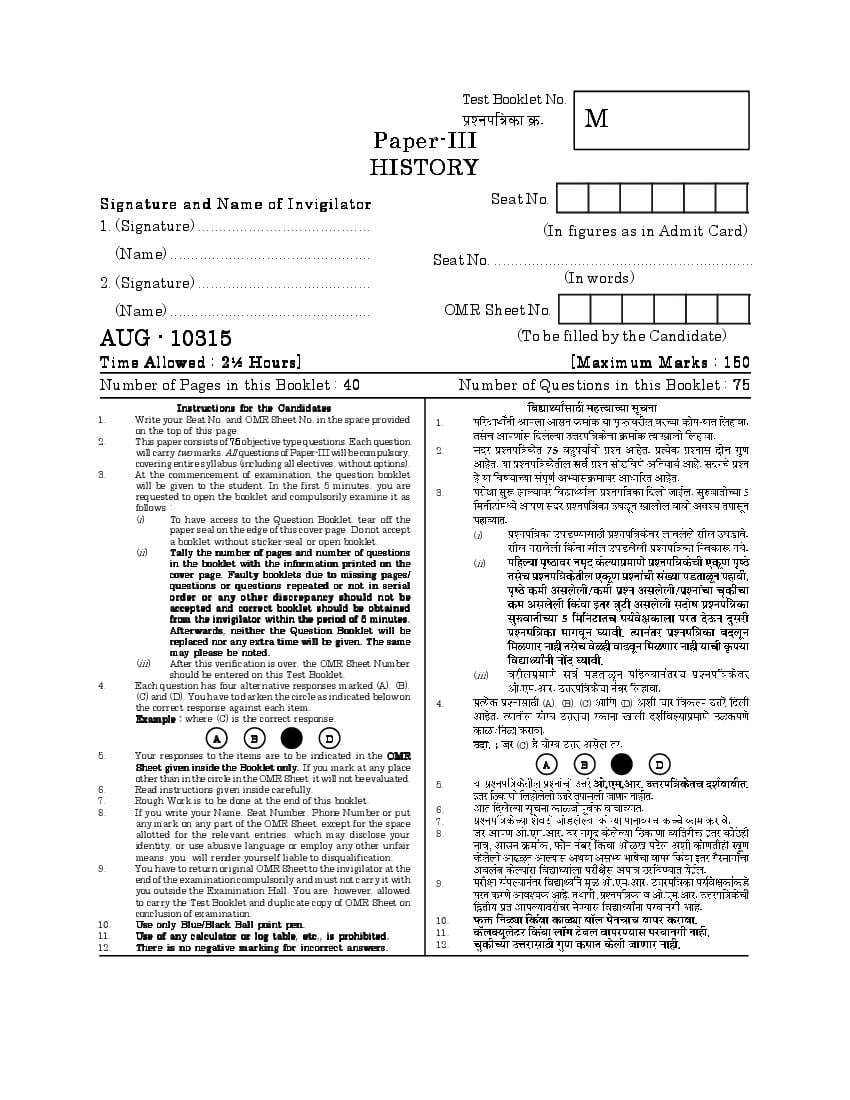
MAHA SET 2015 Question Paper 3 History
Finished viewing? Save it for later —
Download MAHA SET 2015 Question Paper 3 History (PDF · 40 pages)About MAHA SET 2015 Question Paper 3 History
MAHA SET 2015 Question Paper 3 History is available here for free download. Published by Maharashtra Exams for MAHA SET, this question paper can be viewed online or downloaded as a PDF (40 pages). Candidates preparing for MAHA SET can use MAHA SET 2015 Question Paper 3 History to understand the exam pattern, the type of questions asked, and the overall difficulty level.
Frequently Asked Questions
How can I download MAHA SET 2015 Question Paper 3 History?
Open this page and click the Download button to save MAHA SET 2015 Question Paper 3 History as a PDF. It is completely free on AglaSem Docs.
Is MAHA SET 2015 Question Paper 3 History free to download?
Yes. MAHA SET 2015 Question Paper 3 History can be viewed online and downloaded as a PDF free of cost on AglaSem Docs.
How many pages does MAHA SET 2015 Question Paper 3 History have?
MAHA SET 2015 Question Paper 3 History contains 40 pages, which you can read online or download together as a single PDF.
Where can I find more MAHA SET study material?
You can find more MAHA SET question papers, sample papers, syllabus, and answer keys on AglaSem Docs.
MAHA SET 2015 Question Paper 3 History – Text
Read the full text of this question paper below — useful to quickly search, copy and reference the content online without downloading the PDF.
📄 View text version (40 pages)
Page 1
M
HISTORY
Signature and Name of Invigilator Seat No.
1. (Signature) ......................................... (In figures as in Admit Card)
(Name) ................................................ Seat No. ..............................................................
2. (Signature) ......................................... (In words)
(Name) ................................................ OMR Sheet No.
AUG - 10315 (To be filled by the Candidate)
Time Allowed : 2½ Hours] [Maximum Marks : 150
Number of Pages in this Booklet : 40 Number of Questions in this Booklet : 75
Instructions for the Candidates
1. Write your Seat No. and OMR Sheet No. in the space provided 1.
on the top of this page.
2. This paper consists of 75 objective type questions. Each question
will carry two marks. All questions of Paper-III will be compulsory, 2.
covering entire syllabus (including all electives, without options).
3. At the commencement of examination, the question booklet
will be given to the student. In the first 5 minutes, you are
requested to open the booklet and compulsorily examine it as 3.
follows :
(i) To have access to the Question Booklet, tear off the
paper seal on the edge of this cover page. Do not accept
(i)
a booklet without sticker-seal or open booklet.
(ii) Tally the number of pages and number of questions
in the booklet with the information printed on the (ii)
cover page. Faulty booklets due to missing pages/
questions or questions repeated or not in serial
o rder or any other discre pancy should not be
accepted and correct booklet should be obtained
from the invigilator within the period of 5 minutes.
Afterwards, neither the Question Booklet will be
replaced nor any extra time will be given. The same
may please be noted.
(iii) After this verification is over, the OMR Sheet Number
should be entered on this Test Booklet. (iii)
4. Each question has four alternative responses marked (A), (B),
(C) and (D). You have to darken the circle as indicated below on
the correct response against each item. 4. (A), (B), (C) (D)
Example : where (C) is the correct response.
A B D
(C)
5. Your responses to the items are to be indicated in the OMR
Sheet given inside the Booklet only. If you mark at any place A B D
other than in the circle in the OMR Sheet, it will not be evaluated.
5.
6. Read instructions given inside carefully.
7. Rough Work is to be done at the end of this booklet.
8. If you write your Name, Seat Number, Phone Number or put 6.
any mark on any part of the OMR Sheet, except for the space 7.
allotted for the relevant entries, which may disclose your 8.
identity, or use abusive language or employ any other unfair
means, you will render yourself liable to disqualification.
9. You have to return original OMR Sheet to the invigilator at the
end of the examination compulsorily and must not carry it with 9.
you outside the Examination Hall. You are, however, allowed
to carry the Test Booklet and duplicate copy of OMR Sheet on
conclusion of examination.
10. Use only Blue/Black Ball point pen. 10.
11. Use of any calculator or log table, etc., is prohibited. 11.
12. There is no negative marking for incorrect answers. 12.
Page 2
Page 3
Paper III
III
Time Allowed : 2½ Hours] [Maximum Marks : 150
Note : This paper contains Seventy Five (75) multiple choice questions. Each
question carries Two (2) marks. Attempt All questions.
(75) (2)
1. Neolithic age was also called as 1.
Neolithic revolution by :
(A) V. Gordon Childe (A)
(B) H.D. Sankalia (B)
(C) J.F. Fleet (C)
(D) Mortimer Wheeler (D)
2. Which of the following was not one 2.
of the Harappan sites related to the
maritime activities ?
(A)
(A) Soktakoh
(B)
(B) Desalpur
(C)
(C) Lothal
(D) Balakot (D)
3 [P.T.O.
Page 4
been found in the Indus Civilization
sites ?
(A)
(A) Wheat
(B)
(B) Sugarcane
(C)
(C) Barley
(D) Maize (D)
4. Megaliths of South India are 4.
associated with which of the
following ages ?
(A)
(A) Chalcolithic Age
(B) Mesolithic Age (B)
(C) Neolithic age (C)
(D) Iron age (D)
4
Page 5
(Ashmakas) was situated on the
bank of the river :
(A)
(A) Krishna
(B)
(B) Tapi
(C)
(C) Godavari
(D)
(D) Bhima
6.
6. Lord Gautam Buddha delivered first
sermon at .
(A) Gaya (A)
(B) Sarnath (B)
(C) Kushinagar (C)
(D) Shravasti
(D)
5 [P.T.O.
Page 6
7.
inscriptions about land grants ?
(A) Central India, Northern Deccan
(A)
and Andhra
(B) Eastern India, Eastern Bengal
(B)
and Orissa
(C)
(C) Southern India : Tamil Nadu
and Karnataka
(D) Kerala (D)
8. Recently in which place has broken 8.
relief sculpture of King Ashoka been
discovered ?
(A)
(A) Kanaganahalli in Karnataka
(B)
(B) Mahasthan in Uttar Pradesh
(C)
(C) Kumraha in Bihar
(D)
(D) Nittur in Karnataka
6
Page 7
9.
written in ........................ .
(A) Greek and Aramaic
(A)
(B) Greek and Sanskrit (B)
(C) Greek and Persian (C)
(D) Greek and Hebrew (D)
10. Where the evidence of the settlement 10.
of Roman traders in India has been
discovered ?
(A)
(A) Arikamedu
(B)
(B) Tamralipti
(C)
(C) Bhrigukachcha
(D)
(D) Barbaricum
7 [P.T.O.
Page 8
mentioned in the :
(A) Allahabad Pillar Inscription
(A)
(B) Aihole Inscription
(B)
(C) Alapadu Grant
(C)
(D) Hanumankonda Inscription
(D)
12. Who was the author of the
12.
Allahabad Pillar Inscription of
Samudragupta ?
(A)
(A) Kumaravallabha
(B)
(B) Harishena
(C)
(C) Devi Gupta
(D) Hariputhra (D)
8
Page 9
administrative unit under the
Imperial Guptas ?
(A)
(A) Bhukti
(B) Mandala (B)
(C) Rajya
(C)
(D) Sima
(D)
14. Identify the incorrect pair amongst
the following : 14.
(A) Hemcha ndra – P a ri shi sht a -
parvan
(A)
(B) V i s h a k h a d a t t a – M u d r a r a -
(B)
kshash
(C) Ptolemy–The Peloponnesian (C)
war
(D)
(D) Megasthenes–Indica
9 [P.T.O.
Page 10
Century A.D. Medhatithi has
written his commentary on which
famous text ?
(A)
(A) Brahmasutra
(B)
(B) Ashtadhyayi
(C)
(C) Manusmriti
(D)
(D) Nitisara
16.
16. Foreign Notices of South India” was
written by :
(A)
(A) K.M. Panikkar
(B)
(B) K.A. Nilakantha Shastri
(C)
(C) K.K. Pillai
(D)
(D) N. Subramaniam
10
Page 11
Kings and the works authored by
them is correctly matched ?
(A)
(A) Krishnadevaraya–Samaran-
ganasutradharma (B)
(B) M a h e n d r a v a r m a n – M a t t a - (C)
vilasaprahasana
(D)
(C) Bhajadeva–Manasollasa
18.
(D) Somesvara–Amuktamalyada
18. According to Ziauddin Barani,
where were Alauddin Khilji’s market
regulations actually effective ? (A)
(A) From Multan to Allahabad (B)
(B) From Multan to Lahore
(C)
(C) From Lahore to Agra
(D)
(D) From Allahabad to Lakhnauti
11 [P.T.O.
Page 12
brought about the decline of the
Delhi Sultanate because he :
(A) Conducted a large number of
(A)
military campaigns
(B)
(B) Provoked peasant rebellions by
his oppression
(C) Spent too much money on (C)
canals
(D)
(D) Allowed the nobility to become
a hereditary nobility
20.
20. In the Telugu text of Krishnadeva-
raya’s time, the Rayavachakamu,
who was the Narapati ?
(A)
(A) The Vijayanagar King
(B)
(B) The Orissa King
(C)
(C) The Bijapur King
(D)
(D) The Golconda King
12
Page 13
the Sufi Saint Gesudaraz ?
(A) Bidar (A)
(B) Berar (B)
(C) Khuldabad
(C)
(D) Gulbarga
(D)
22. Malik Amber is credited with having
22.
replaced ................... .
(A) The Zabti system with the Ijara
(A)
system
(B)
(B) The Ijara system with the Zabti
system
(C)
(C) Afaqi revenue collectors with
Deccani revenue collectors
(D) Deccani nobility with Afaqi
(D)
nobility
13 [P.T.O.
Page 14
Akbar write a letter in 1591 ?
(A) Burhan Nizam Shah of
(A)
Ahmadnagar
(B)
(B) Chand Bibi of Ahmadnagar
(C)
(C) Raja Ali Khan of Khandesh
(D)
(D) Ibrahim Adil Shah of Bijapur
24. Which is regarded as the largest 24.
naval expedition in the Arabian Sea
in Medieval times ?
(A) The Turkish fleet sent to (A)
besiege Diu in 1534 1534
(B) The Portuguese fleet that (B)
blockaded Chaul in 1515 1515
(C) The Portuguese fleet that (C)
attacked Ormuz in the 1520’s 1520
(D) The Turkish fleet that attacked (D)
Basra in 1512 1512
14
Page 15
who led the Mughal forces into the
Brahmaputra Valley ?
(A)
(A) Asad Khan
(B)
(B) Mir Jumla
(C)
(C) Daud Khan Panni
(D)
(D) Zulfiqar Khan
26. Who was the Amil in Mughal 26.
Administrator ? (A)
(A) The Revenue Assessor
(B)
(B) The person in-charge of
Revenue disputes
(C)
(C) The person in-charge of
collection of Customs Duties
(D)
(D) The Revenue Collector
15 [P.T.O.
Page 16
(A) Grants of land to retired officers (A)
as pension
(B) Grants of land revenue for (B)
educational purposes
(C) Grants of land for cultivation (C)
(D) Cash grants to purchase seeds (D)
and implements
28. Under the Mughals, into how many 28.
categories was land divided ?
(A) Two (A)
(B) Three (B)
(C) Four (C)
(D) Five (D)
16
Page 17
of the Deccan was termed ................
in Mughal times.
(A)
(A) Riyasat
(B)
(B) Risalat
(C)
(C) Ayalat
(D)
(D) Buyutat
30.
30. Where was Mumtaz Mahal buried
until the Taj Mahal was built ?
(A) Aurangabad (A)
(B) Surat (B)
(C) Kandahar (C)
(D) Burhanpur
(D)
17 [P.T.O.
Page 18
31.
system ?
(A)
(A) Assessment after appraisal
(B)
(B) Assessment on the basis of crop
sharing (C)
(C) Arbitrary assessment
(D)
(D) Assessment after measurement
32.
32. An early biography of Chhatrapati
Shivaji Maharaj was written
by : (A)
(A) Dr. Dellon (B)
(B) Dr. John Fryer
(C)
(C) Cosmo de Guarda
(D)
(D) Niccolo Manucci
18
Page 19
a description of the Maratha
Navy ?
(A)
(A) Chitnis Bakhar
(B) Tanjore Bakhar (B)
(C) Chitragupta Bakhar (C)
(D) Sabhasad Bakhar (D)
34. Match the following and choose the 34.
correct answer from the codes given
below :
(a) (i)
(a) Sambhaji (i) Tuzuk-i-Babari
(b) (ii)
(b) Krishnadevaraya (ii) Budhabhushan
(c) (iii)
(c) Someshwara-III (iii) Amuktamal-
yada (d) (iv)
(d) Babar (iv) Manasollasa
Codes : (a) (b) (c) (d)
(a) (b) (c) (d) (A) (ii) (iii) (i) (iv)
(A) (ii) (iii) (i) (iv)
(B) (ii) (iii) (iv) (i)
(B) (ii) (iii) (iv) (i)
(C) (iv) (iii) (ii) (i)
(C) (iv) (iii) (ii) (i)
(D) (iii) (ii) (iv) (i) (D) (iii) (ii) (iv) (i)
19 [P.T.O.
Page 20
and the Marquis of Wellesley in
1802, gave the British effective
control over the Deccan and
Western India :
(A)
(A) The treaty of Bassein (B)
(B) The treaty of Purandar (C)
(C) The treaty of Surat (D)
(D) The treaty of Khandesh
36.
36. The Charter Act of ..................... ended
the East India Company’s monopoly
of trade with India.
(A) 1813
(A) 1813
(B) 1806
(B) 1806
(C) 1833
(C) 1833
(D) 1853
(D) 1853
20
Page 21
led by .................... advocated that
Indian society and religion should
be judged by the dictates of
European rationalism’.
(A)
(A) Radha Kant Deb
(B)
(B) Akshay Kumar Dutt
(C)
(C) Henry Derozio
(D)
(D) William Jones
38. 1820
38. Who enunciated ‘Paramountcy’ as a
(Paramountcy)
concept in 1820, which implied the
duty of British as “Supreme
guardians of general tranquillity,
law and right to maintain the legal
succession” in the princely states ?
(A)
(A) Lord Cornwallis
(B)
(B) Charles Metcalfe
(C)
(C) John Malcolm
(D) Lord Dalhousie (D)
21 [P.T.O.
Page 22
39. 1875
the Arya Samaj (1875)
in :
(A)
(A) Surat
(B)
(B) Amritsar
(C)
(C) Ambala
(D)
(D) Bombay
40.
40. Poona Sarvajanic Sabha was
reorganised form of the :
(A)
(A) Poona Association
(B)
(B) Poona Sabha
(C)
(C) Poona Mandal
(D)
(D) Vichar Munch
22
Page 23
was written by :
(A) Devendranath Tagore (A)
(B) Bankim Chandra Chatterji (B)
(C) Keshav Chandra Sen (C)
(D) Rabindranath Tagore
(D)
42. The transfer of the capital from
42.
Calcutta to Delhi took place in the
year :
(A) 1911
(A) 1911
(B) 1877
(B) 1877
(C) 1930
(C) 1930
(D) 1942
(D) 1942
43.
43. “Al Hilal”, a weekly Urdu
Newspaper, was founded by :
(A)
(A) Syed Ahmed Khan
(B)
(B) Dr. M.A. Ansari
(C)
(C) Khan Abdul Gaffar Khan
(D)
(D) Maulana Abul Kalam Azad
23 [P.T.O.
Page 24
the Congress-League Pact signed in
December, 1916 ?
(A) Faizpur (A)
(B) Amritsar (B)
(C) Bombay (C)
(D) Lucknow (D)
45. O’ Dwyer was killed by : 45.
(A) Madanlal Dhingra (A)
(B) Sardar Udham Singh (B)
(C) Anant Laxman Kanhere (C)
(D) Khudiram Bose
(D)
46. Harish Chandra Bharatendu was a
46.
prolific writer of prose and poetry
who made pioneering contribution
to : (A)
(A) Bengali Literature
(B)
(B) Hindi Literature
(C)
(C) Assamese Literature
(D)
(D) Gujarati Literature
24
Page 25
labelled Assertion (A) and the other (R)
labelled Reason (R) :
(A)
Assertion (A) : A.O. Hume, a
1885
retired British Civil Servant
founded the Indian National
(R)
Congress in 1885.
Reasoning (R) : The first session
of the Congress was presided over
by W.C. Bannerjee.
In the context of the above two
statements which one of the (A) (A) (R)
following is correct ? (R) (A)
(A) Both (A) and (R) are correct and
(R) is the true explanation of (A) (B) (A) (R)
(B) Both (A) and (R) are correct but (R) (A)
(R) is not the true explanation
of (A) (C) (A)
(R)
(C) (A) is correct but (R) is wrong
(D) (A) (R)
(D) Both (A) and (R) are wrong
25 [P.T.O.
Page 26
Gandhi” ?
(A)
(A) Syed Ahmed Khan
(B)
(B) Khan Abdul Gaffar Khan
(C)
(C) Omar Sohani
(D)
(D) Hasrat Mohani
49. 1943
49. .................. handed over command of
the National Army (INA) to
Subhash Chandra Bose in 1943.
(A) Surendra Nath Banerjee (A)
(B) Chittaranjan Das (B)
(C) Rasbehari Bose (C)
(D) Jagdish Chandra Bose
(D)
26
Page 27
government took place on :
(A) 16th August, 1946 (A) 16 1946
(B) 20th August, 1941
(B) 20 1941
(C) 2nd September, 1946
(C) 2 1946
(D) 5th September, 1946
(D) 5 1946
Instructions (Q. Nos. 51 to 54)
Read the following passage carefully
and answer the questions based on
it :
The basic strategic perspective of the
national movement was to wage a
long-drawn out hegemonic struggle,
or, in Gramscian terms, a war of
position. By hegemonic struggle, we
mean a struggle for the minds and
hearts of men and women so that
the nationalist influence would
continuously grow among the people
through different channels and
through the different phases and
stages of the national movement.
27 [P.T.O.
Page 28
phases of extra-legal or law-breaking
mass movements and phases of
functioning within the four walls of
the law. But both phases were
geared to expanding the influence
of the national movement among the
people. The basic strategy of the
national movement was, moreover,
not a strategy of gradual reform. It
was a strategy of active struggle with
the objective of wresting power from
the colonial rulers.
51. Who offered the term ‘war of 51.
position’ ?
(A)
(A) Mahatma Gandhi
(B)
(B) Antonio Gramsci
(C)
(C) Jawaharlal Nehru
(D)
(D) Dr. B.R. Ambedkar
28
Page 29
hegemonic struggle ?
(A) Struggle for social emancipation
(A)
(B) Struggle for wresting power
(B)
from colonial rulers
(C) Struggle of minds and hearts
(C)
leading to growth of nationalist
influence on people
(D) Struggle for equality (D)
53. Which two basic phases alternated 53.
in national movement ?
(A) Extra-legal and law abiding
(A)
(B) War of position and hegemonic
(B)
struggle
(C) Active struggle and gradual
reforms
(C)
(D) Civil Disobedience and Non-
(D)
cooperation
29 [P.T.O.
Page 30
strategy of the national movement ?
(A)
(A) to wags hegemonic struggle
(B)
(B) to carry war of position
(C)
(C) strategy of gradual reforms
(D)
(D) strategy of active struggle to
gain power from colonial rulers
55. Ranajit Guha’s “Prose of Counter- 55.
Insurgency” is regarded as a classic
statement of the ....................... .
(A) Annales school (A)
(B) Marxist school (B)
(C) Subaltern school (C)
(D) Post-modernist school (D)
30
Page 31
Philosophy’ ?
(A) Auguste Comte (A)
(B) Samuel Taylor Coleridge (B)
(C) Edmund Burke (C)
(D) Joseph De Maistive (D)
57. “Language of the Gods in the World 57.
of Men” was written by :
(A) Sheldon Pollock (A)
(B) Romila Thapar (B)
(C) Irfan Habib (C)
(D) Nicholas Dirks (D)
58. The first comprehensive study of 58.
Indian architecture from a colonial
perspective was undertaken
(A)
by ................. .
(A) James Fergusson (B)
(B) James Prinsep
(C)
(C) William Jones
(D)
(D) Colin Mackenzie
31 [P.T.O.
Page 32
correct answer from the codes given
below : (a) (i)
(a) D.D. Kosambi (i) Subaltern School (b) (ii)
(b) Judith Brown (ii) Marxist School (c) (iii)
(c) Gautam Bhadra (iii) Nationalist School (d) (iv)
(d) K.P. Jayaswal (iv) Cambridge School
Codes : (a) (b) (c) (d)
(a) (b) (c) ( d) (A) (i) (ii) (iii) (iv)
(A) (i) (ii) (iii) (iv) (B) (ii) (iv) (i) (iii)
(B) (ii) (iv) (i) (iii) (C) (iii) (ii) (i) (iv)
(C) (iii) (ii) (i) (iv)
(D) (ii) (iv) (iii) (i)
(D) (ii) (iv) (iii) (i)
60.
60. Who argued that caste worked as a
system of extra-economic coercion ?
(A)
(A) James Mill
(B)
(B) James Grant Duff
(C)
(C) R.S. Sharma
(D)
(D) Karl Marx
32
Page 33
was the ideological crux of the
Maratha State ?
(A)
(A) Hindu Dharma
(B)
(B) Maharashtra Dharma
(C)
(C) Jati Dharma
(D)
(D) Modernity
62. Which of the following is not part 62.
of external criticism ?
(A) Establishing the author of a
text
(A)
(B) Establishing the date of a
text (B)
(C) Establishing the space of a
text (C)
(D) Establishing the real meaning
(D)
of a text
33 [P.T.O.
Page 34
were the Marathas defeated in the
Battle of Panipat ?
(A)
(A) Caste Jealousy
(B)
(B) Disunity
(C) Weak leadership of Sadashivrao (C)
Bhau
(D)
(D) Misdeeds of Govind Pant
Bundela and Malharrao Holkar
64.
64. Who among the following historians
depicted the social transition from
lineage to state ?
(A)
(A) D.D. Kosambi
(B)
(B) B.D. Chattopadhyay
(C)
(C) Romila Thapar
(D)
(D) R.S. Sharma
34
Page 35
historian of Maratha history ?
(A) A.R. Kulkarni (A)
(B) Jadunath Sarkar (B)
(C) V.V. Joshi (C)
(D) Sumit Sarkar (D)
66. The author of the “History of the 66.
Peloponesian War” was :
(A) Thucydides (A)
(B) Herodotus (B)
(C) Tacitus (C)
(D) Virgil (D)
67. ‘The Decline and Fall of the Roman 67.
Empire’ was written by :
(A) Edward Gibbon (A)
(B) Oliver Goldsmith (B)
(C) Carl Becker (C)
(D) David Moris (D)
35 [P.T.O.
Page 36
was written by :
(A) Taussaint (A)
(B) Charles Friedman (B)
(C) F.C. Danvers (C)
(D) Alfonso Correa (D)
69. Who wrote the famous treatise “The 69.
Rights of Man” ?
(A)
(A) Thomas Hobbes
(B)
(B) Jeremy Bentham
(C)
(C) Thomas Paine
(D)
(D) John Locke
36
Page 37
New York Stock Exchange crashed
on ......................., the day known as
‘Black Tuesday’.
(A) 19th October, 1929 (A) 19 1929
(B) 29th October, 1929 (B) 29 1929
(C) 9th October, 1929 (C) 9 1929
(D) 10th October, 1929 (D) 10 1929
71. The term ‘Dollar Diplomacy’ is 71.
related to :
(A) Economic Aid (A)
(B) Parliamentary Consultation (B)
(C) International Arbitration (C)
(D) Expensive Agricultural Method (D)
37 [P.T.O.
Page 38
the limitation of naval armaments
after the First World War held at :
(A) Yalta
(A)
(B) Vladivostok
(B)
(C) Nagasaki
(C)
(D) Washington
(D)
73. Sir Joseph Needham is associated
with the study of : 73.
(A) Science and Civilization in
China (A)
(B) Astronomy in Europe
(B)
(C) Botanical Exploration
(C)
(D) Geographical Exploration
(D)
38
Page 39
works is the role of the individual
in shaping the great events of
history found ?
(A)
(A) War and Peace
(B)
(B) Great Expectation
(C)
(C) Crime and Punishment
(D) Tales of Mystery and (D)
Imagination 75.
75. ‘The Prince’ was authored by .......... .
(A)
(A) Niccolo Machiavelli
(B)
(B) Francisco
(C)
(C) Leonardo da-Vinci
(D)
(D) Vicco
39 [P.T.O.
Page 40
40
Document Details
| Board / Org | Maharashtra Exams |
| Exam | MAHA SET |
| Type | Question Paper |
| Pages | 40 |
| Updated | 30 Apr 2026 |