PSEB Syllabus 2020-21 for Class 12 Vocational Stream
Finished viewing? Save it for later —
Download PSEB Syllabus 2020-21 for Class 12 Vocational Stream (PDF · 136 pages)About PSEB Syllabus 2020-21 for Class 12 Vocational Stream
PSEB Syllabus 2020-21 for Class 12 Vocational Stream is available here for free download. Published by Punjab Board for Class 12, this syllabus can be viewed online or downloaded as a PDF (136 pages). Candidates preparing for Class 12 can use PSEB Syllabus 2020-21 for Class 12 Vocational Stream to understand the exam pattern, the type of questions asked, and the overall difficulty level.
Frequently Asked Questions
How can I download PSEB Syllabus 2020-21 for Class 12 Vocational Stream?
Open this page and click the Download button to save PSEB Syllabus 2020-21 for Class 12 Vocational Stream as a PDF. It is completely free on AglaSem Docs.
Is PSEB Syllabus 2020-21 for Class 12 Vocational Stream free to download?
Yes. PSEB Syllabus 2020-21 for Class 12 Vocational Stream can be viewed online and downloaded as a PDF free of cost on AglaSem Docs.
How many pages does PSEB Syllabus 2020-21 for Class 12 Vocational Stream have?
PSEB Syllabus 2020-21 for Class 12 Vocational Stream contains 136 pages, which you can read online or download together as a single PDF.
Where can I find more Class 12 study material?
You can find more Class 12 question papers, sample papers, syllabus, and answer keys on AglaSem Docs.
PSEB Syllabus 2020-21 for Class 12 Vocational Stream – Text
Read the full text of this syllabus below — useful to quickly search, copy and reference the content online without downloading the PDF.
📄 View text version (136 pages)
Page 1
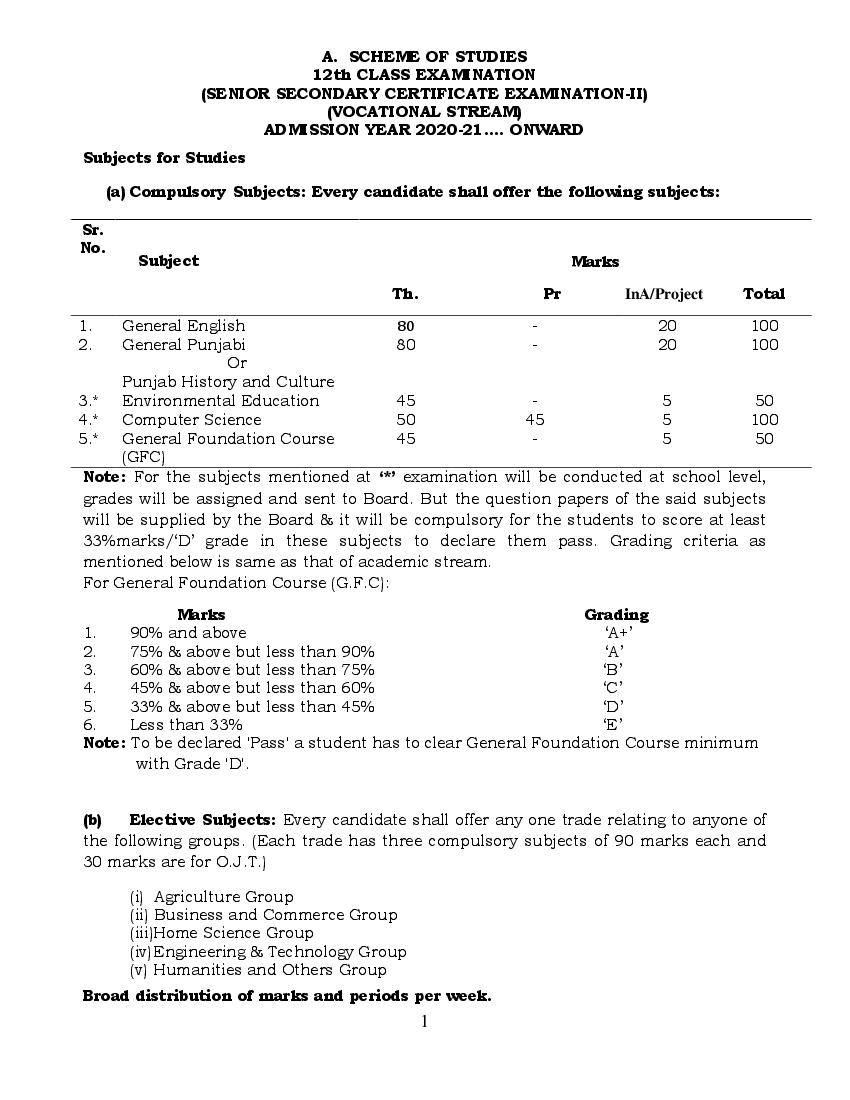
12th CLASS EXAMINATION
(SENIOR SECONDARY CERTIFICATE EXAMINATION-II)
(VOCATIONAL STREAM)
ADMISSION YEAR 2020-21…. ONWARD
Subjects for Studies
(a) Compulsory Subjects: Every candidate shall offer the following subjects:
Sr.
No.
Subject Marks
Th. Pr InA/Project Total
1. General English 80 - 20 100
2. General Punjabi 80 - 20 100
Or
Punjab History and Culture
3.* Environmental Education 45 - 5 50
4.* Computer Science 50 45 5 100
5.* General Foundation Course 45 - 5 50
(GFC)
Note: For the subjects mentioned at ‘*’ examination will be conducted at school level,
grades will be assigned and sent to Board. But the question papers of the said subjects
will be supplied by the Board & it will be compulsory for the students to score at least
33%marks/‘D’ grade in these subjects to declare them pass. Grading criteria as
mentioned below is same as that of academic stream.
For General Foundation Course (G.F.C):
Marks Grading
1. 90% and above ‘A+’
2. 75% & above but less than 90% ‘A’
3. 60% & above but less than 75% ‘B’
4. 45% & above but less than 60% ‘C’
5. 33% & above but less than 45% ‘D’
6. Less than 33% ‘E’
Note: To be declared 'Pass' a student has to clear General Foundation Course minimum
with Grade 'D'.
(b) Elective Subjects: Every candidate shall offer any one trade relating to anyone of
the following groups. (Each trade has three compulsory subjects of 90 marks each and
30 marks are for O.J.T.)
(i) Agriculture Group
(ii) Business and Commerce Group
(iii)Home Science Group
(iv) Engineering & Technology Group
(v) Humanities and Others Group
Broad distribution of marks and periods per week.
1
Page 2
Th. P. InA OJT. Total Th. P. Total OJT.
Elective Subject - I 30 50 10 10 100 2 6 8
Elective Subject - II 30 50 10 10 100 2 6 8 3
Months
Elective Subject - III 30 50 10 10 100 2 6 8
Note: 1. Six period are for Library Studies/Extra Curricular Activities/Optional/
Tutorials/ Assignments.
2. Three months are for On-the-job training (O.J.T) every year based on the
instructions sent by the Board from time to time .
3. Punjab School Education Board Regulations for Senior Secondary
Examination are also applicable to vocational stream with certain exceptions.
4. The Board reserves the right to amend syllabus courses and/or scheme
of studies as and when it considers necessary.
* InA : Internal Assesment
2
Page 3
Time: 3hrs Theory: 45 Marks
InA: 5 Marks
Total: 50 Marks
Structure of Question Paper
In all, Twenty three questions will be set from the prescribed syllabus. The
question paper will comprise of three parts (Part-I, Part-II and Part-III). The questions
will be evenly distributed from the prescribed syllabus.
Part-I will consist of Five objective type questions carrying 1 mark each. All
questions will be compulsory to attempt. The answer of each question should not exceed
more than one sentence.
Part-II will consist of fourteen short answer type questions carrying 3 marks each.
Candidate will attempt any five questions out of these. A question may have two or more
parts. The answer of each question should not be more than one page of the answer
sheet.
Part-III will consist of four questions carrying 5 marks each. Candidate will
attempt any two question out of these. The answer of each question should not be more
than Two pages of the answer sheet.
Syllabus
Industry
Meaning, Kinds of Industry - Manufacturing, Service Industry, Establishing an Industrial Unit -
Procedures, Legal Requirements.
Project Report
Meaning, Need and Elements of Project Report, Registration of the Firm, Choosing Suitable Policy of
Insurance for - Building, Content and Vehicle, Liability Insurance and its Types.
Organizations in India for Industrial Development
Nationalized Banks - State Bank of India, Punjab National Bank etc, Small Industrial Development
Organization, Small Industrial Development Bank of India , Regional Rural Banks, National Small
Industries Corporation, IFCI, State Financial Corporations like Punjab Financial Corporation.
Budget
Meaning, Types, Utility, Meaning and Advantages of Budgetary Control, Marketing Mix, Elements of
Marketing Mix, Concept of SWOT Analysis.
Communication
Meaning, Definition, Importance, Features, Elements, Scope, Principles of Communication, Types and
Media of Communication, Barriers in Communication, New Trends in Communication - Email,
3
Page 4
Conferencing.
Communication Skills
Meaning, Techniques to Develop Good Communication Skill, Various Communication Skills for
Workplace Success, Pronunciation Etiquettes of Communication Skills, Tips on Improving Speaking
Skills.
Personnel Management
Decision Making, Risk Taking Behaviors, Method and Processes of Recruitment, Wages & Incentives,
Appraisal and Training, Employer – Employee Relations.
Interview
Meaning of Resume, Tips to Write a Good Resume, Concept of Interview, Types of Interview -
Traditional, One to One, Job Panel, Group, Telephone and Behavior Interviews, Preparation for the
Interview.
Business Transactions and Ledger
Introduction, Meaning & Definition, Format of Journal, Journal Entries - Simple and Compound with
Narration, Meaning, Utility and Format of Ledger, Meaning and Formats of Cash Book, Trading
Account, Profit & Loss Account and Balance Sheet.
Banking Transactions
Banking Transaction and their Recording, Bank Account - Current, Saving, Recurring Deposit, Fixed
Deposit Account, Pass Book, Pay in Slip, Withdrawal Slip, Statement of Account, Opening and
operating a Bank Account , Types of Cheques.
E-Banking
Meaning, Process, Importance, Kinds of e-banking, Services - Credit Card, Debit Card, Mobile
Banking, Telephone Banking, Electronic Fund Transfer, Electronic Cheque, e-wallet, ATM -
Introduction, Advantages and Precautions.
Income Tax
Meaning, Important Definitions, Components of GST - CGST, SGST, IGST, Format of GST Bill .
C. COMPULSORY SUBJECTS
Note: Compulsory Subjects under Vocational stream & Academic stream at senior
secondary level are the same. Kindly refer to the syllabi & structure of
question paper of these subjects uploaded under Academic Stream.
4
Page 5
General English
Same as Accademic Stream
5
Page 6
Same as Accademic Stream
6
Page 7
Same as Accademic Stream
7
Page 8
Same as Accademic Stream
8
Page 9
Same as Accademic Stream
9
Page 10
FOR ELECTIVE SUBJECTS
(Theory)
For question paper carrying 30 marks (Theory) each (except those specified at *)
NOTE: The length of the answer to a question for all 12th class vocational stream
subjects depends upon the nature of the question. The suggested limit is only a
guideline for the students to answer a question in limited space and limited time. This
practice will help him in competitive tests.
*SUBJECTS HAVING 80 MARKS THEORY ARE:-
GROUP TRADE SUBJECTS
A) Business & Commerce 1. Accountancy and a. Principles of
Auditing Management and
Economics
b. Book Keeping and
Accountancy-(V)
2.Transport Services a. Infrastructure and modes
of Transport-II
b. Transport Management
3.Basic Financial Services a. Accounting for Business-II
b. Introduction to Financial
Market.
4. Insurance
a. Insurance legislation
b. Insurance Salesmanship
5. Informatics a. Management-II
Management
6. Import Export
a. Import management
B) Engineering & Technology Computer Science a. Networking
10
Page 11
Time : 3 hrs Practical: 50 Marks
InA: 10 Marks
Total: 90 Marks
Structure of Question Paper
In all, nineteen questions will be set from the prescribed syllabus. The question
paper will comprise of three parts (Part-I, Part-II and Part-III). The questions will be
evenly distributed from the prescribed syllabus.
Part-I will consist of ten objective type questions carrying 1 mark each. All
questions will be compulsory to attempt. The answer of each question should not exceed
more than one sentence.
Part-II will consist of seven short answer type questions carrying 3 marks each.
Candidate will attempt any five questions out of these. A question may have two or more
parts. The answer of each question should not be more than one page of the answer
sheet.
Part-III will consist of two questions carrying 5 marks each. Candidate will attempt
any one question out of these. The answer of each question should not be more than
Two pages of the answer sheet.
For question paper carrying 80 marks (Theory) each.
Time: 3 hrs Theory: 80 Marks
InA: 10 Marks
Total: 90 Marks
Structure of Question Paper
In all, thirty three questions will be set from the prescribed syllabus. The question
paper will comprise of three parts (Part-I, Part-II and Part-III). The questions will be
evenly distributed from the prescribed syllabus.
Part-I will consist of ten objective type questions carrying 2 mark each. All
questions will be compulsory to attempt. The answer of each question should not exceed
more than one sentence.
Part-II will consist of fifteen short answer type questions carrying 4 marks each.
Candidate will attempt any 9 questions out of these. A question may have two or more
parts. The answer of each question should not be more than one page of the answer
sheet.
Part-III will consist of eight questions carrying 6 marks each. Candidate will
attempt any 4 questions out of these. The answer of each question should not be more
than two pages of the answer sheet.
Or
11
Page 12
precedes the syllabus of particular subject.
E. STRUCTURE OF QUESTION PAPER FOR ELECTIVE SUBJECTS
(Practical)
For Question Paper carrying 50 marks (practical) each (except those specified at*
**SUBJECTS HAVING 80 MARKS PRACTICAL ARE:-
GROUP TRADE SUBJECTS
Engineering & Technology 1. Architecture a. Engineering
Drawing
2. Mechanical a. Engineering
Drawing
Time: 3 hrs Practical: 50 Marks
Distribution of marks will be as follows:
(i) Practical note book/sessional work/visits/project work. 5 Marks
(ii) Viva Voce 5 Marks
(iii) Actual Performance 40 Marks
Major Practical:
In all, three practical will be asked from the prescribed syllabus. Candidate will
be asked to choose any two out of these. The Practical examiner will ask the candidate to
perform any one practical out of the two chosen by him.
25 Marks
Minor Practical:
In all, three practical will be asked from the prescribed syllabus. Candidate will be
asked to choose any two out of these. The Practical examiner will ask the candidate to
perform any one practical out of the two chosen by him.
12
Page 13
For question paper carrying 80 marks (practical) each
(Except those specified at **)
Time: 3 hrs Practical: 80 Marks
Distribution of marks will be as follows:
(i) Practical note book/sessional work/visits/project work. 10 Marks
(ii) Viva Voce 10 Marks
(iii) Actual Performance 60 Marks
Major Practical:
In all, three practical will be asked from the prescribed syllabus. Candidate will be
asked to choose any two out of these. The Practical examiner will ask the candidate to
perform any one practical out of the two chosen by him.
40 Marks
Minor Practical:
In all, three practical will be asked from the prescribed syllabus. Candidate will be
asked to choose any two out of these. The Practical examiner will ask the candidate to
perform any one practical out of the two chosen by him.
20 Marks
Or
In any other case, the structure of question paper Practical precedes the syllabus of
particular subject.
F. GENERAL INSTRUCTIONS TO THE PAPER SETTERS
(Theory)
1. The paper should be strictly from the prescribed syllabus or according to
guidelines given under the structure of question paper.
2. The language should be simple and to the mental level of the students.
3. The standardized form of the technical terminology should be used.
4. The question in the paper should be evenly distributed throughout the syllabus.
13
Page 14
blanks, multiple choice etc.
6. Due weightage should be given to numerical problems wherever required.
7. Marks for every part/sub-part should be shown on the question paper itself.
PRACTICAL
1. The question paper will be set on the spot by the practical examiner himself.
2. The practical examiner will set the question paper on the spot based upon the
instructions & prescribed syllabus. The examiner must send one copy of the
question paper for Board's record. The second copy of the question paper must be
kept by the examiner.
3. A group of students should be examined in given time.
4. Separate question paper should be set for each group.
G. ON-THE-JOB TRAINING
Time: 3 Months M. Marks: 30
INTRODUCTION:
On-the-job training is an essential component of effective Vocational
Education and Training. The Heads of Vocational Schools have to play a vital role
in this regard.
IDENTIFICATION OF TRAINING CENTRE:
The Head of the institution will identify the Training Centres in consultation
with liaison agencies and local community. Any reputed Industrial
Organisation/Workshop/Office/Shop situated in the neighbourhood of the school
can be the training centre.
GROUPING OF STUDENTS:
After the identification of Training Centres the Head of school will group the
students under the guidance of a group incharge, the concerned vocational
master. There should not be more than 10 students in a group.
DURATION:
On-the-job training will be for three Months in all. It will be conducted
after the completion of the annual Syllabus. It can be conducted at more than
one centre depending upon the facilities available at the training centre/s. The
schedule may be framed by the Head of the school in consultation with the
competent authority of the training centre/s.
EVALUATION:
14
Page 15
work, aptitude, gained experience, efficiency etc. of the student and will issue the
training certificate on the Performance Sheet.
PREPARATION OF AWARD LIST:
On the basis of the training, certificate marks will be allotted to the student
by the group incharge. These marks will be listed in the Award List against the
Roll No. of the student issued by the Board. The Award List duly countersigned
by the Head of the institution will be sent to the Board.
Training certificates of the students should not be sent to the Board. These
may issue to each student after the declaration of their result.
CERTIFICATION:
The marks obtained by the student will be reflected in the Detail marks card
issued by the Board. On-the-job training will be counted as a subject and it will
be compulsory to pass this subject to pass the examination as a whole.
H. ELECTIVE SUBJECTS
I. AGRICULTURE GROUP
TRADE : HORTICULTURE
12th VOCATIONAL
PAPER-I LANDSCAPING AND FLORICULTURE
THEORY
Time : 2 hrs Theory : 30 Marks
InA : 10 Marks
Practical : 50 Marks
Total : 90Marks
Importance, Definition, Status and Scope of Floriculture and Landscaping.
History and Types of Gardens.
Principles of Landscaping.
Design and Layout of Gardens for Home, School, College, Public Buildings, Modern
Parks.
Essential and Decorative Components and Features of Gardens-Gate, Lawn, Shrubbery,
Flower Beds, Borders, Paths, Hedges, Edges, Steps, Statues, Fountains, Bird Baths,
Streams, Pools, Waterfalls, Terraces, Rockeries, Pergolas, Arches and Topiary.
Important Ornamental Plant, Trees, Shrubs, Climbers and Pot Plants, Bedding Plants,
15
Page 16
their Planting and Maintenance.
Establishment and Maintenance of Lawns.
Cultivation of the Following Flower Crops with Respect to Soil, Climate, Varieties,
Propagation, Method and Time of Planting Irrigation, Weeding, Pest Control, Time of
Flowering, Harvesting Packing and Marketing: Rose, Chrysanthemum, Gladiolus,
Marigold , Tuberose, Jasmine.
Study of the Flower Arrangements, Flower Shows and Exhibition, Packing and Storage of
Cut Flowers, Study of Cacti and Succulents.
Seed Production of Important Seasonal Flowers.
Marketing of Indoor Plants and Cut Flower.
Gardening Operation Like staking, disbudding and pinching.
Nursery Production - Propagation, Potting, Repotting, Plant Care, Maintenance and Sale
LANDSCAPING AND FLORICULTURE
Time : 3 hrs PRACTICAL Marks : 50
• Planting and maintenance of lawn.
• Identification of landscape trees, shrubs/climbers and ground covers.
• Planting shrubbery, hedges and edges.
• Potting and repotting.
• Garden operations - staking, training, pruning, pinching de-suckering,
disbudding, topiary.
• Landscape plan (i) modern bungalow (ii) public place (iii) park
• Identification of seasonal flowers.
• Preparation of nursery; beds and sowing of seeds of seasonal flowers.
• Propagation of rose, chrysanthemum, and marigold.
• Harvesting, cleaning, grading and packaging of cut flowers.
• Preparation of garlands and bouquets.
16
Page 17
• Visits to flower growers fields, gardens and flower shows and markets.
17
Page 18
12th VOCATIONAL
PAPER-II COMMERCIAL CROPS
THEORY
Time : 2 hrs Theory : 30 Marks
InA : 10 Marks
Practical : 50 Marks
Total : 90Marks
Commercial Crops
Introduction, Present Status and Future Prospects of Plantation, Spice, Medicinal and
Aromatic Crops.
Commercial Cultivation
Commercial Cultivation of the Following with Respect to Soil, Climate, Improved Varieties,
Propagation and Nursery Techniques, Layout and Planting, Cultural Practices, Water
Management, Weed Control, Plant Protection, Harvesting, Processing, Products, Storage
and Marketing of the following -
• Spice Crops - Ginger, Turmeric, Fennel and Coriander.
• Medicinal Crops - Dioscorea, Periwinkle, Sarpagandha,
Ashwagandha, Steroid Bearing Solanum, Isabgol, Senna and
Liquorice, Alovera, Geloe, Tulsi, Stevia.
• Aromatic Crops - Lemon Grass , Citronella, Palmarosa, Vetiver
(Khus), Geranium, Patchaouli, Davana, Mint Species and Rosemary.
Bee Keeping
Importance and Scope, Bee Species and Colony/ Organisation, Social Behavior, Bee Hives
and their Equipments, Apiary Management Practices, Products of Bee Hive, Diseases and
Enemies of Honey Bees, Pesticidal Poising, Economics of Bee Keeping, Marketing of
Honey and Role of Bees in Crop Pollination.
18
Page 19
Types, Production of Summer and Winter Season Mushroom, Environmental
Requirements, Containers, Media and Preparation, Disinfection, Seeding and Pawning,
After Care, Harvesting, Dehydration and Packing.
Vermiculture
Introduction, Role of Earthworms, Organic Wastes, Advantages of Vermiculture, Vermi
Composting, Application of Vermi Composting.
COMMERCIAL CROPS
Time : 3 hrs PRACTICAL Marks : 50
• Processing and curing of ginger and turmeric
• Study of important spice, medicinal and aromatic crops.
• Extraction of essential oils in plants such as Mentha.
• Propagation of geranium and patchouli through cuttings.
• Study of propagation in aromatic grasses.
• Study of species and castes of honey bees.
• Study of bee pasturage.
• Site selection and arrangement of apiary.
• Setting up bee hive.
• Seasonal management of bee colonies.
• Identification and Management of pest and diseases of bees.
• Extraction, processing and marketing of honey.
• Production of hive products other than honey.
• Study of common cultivated mushrooms and their food value.
• Compost preparation for button mushroom.
• Filling of trays/shelves/bags with compost for button mushroom.
• Spawning in button mushroom.
• Casing in button mushroom.
• Cropping and harvesting of button mushroom.
• Substrate preparation for paddy straw mushroom.
• Bed preparation and spawning in paddy straw mushroom.
19
Page 20
• Post harvest management.
• Management of insect-pests and diseases.
• Identification of Important species of earthworms.
• Selection of suitable species.
• Vermi composting materials and feed for earthworms.
• Different schemes for vermi composting.
• Preparation and maintenance of vermi compositing beds.
• Products of cocoons and its survival.
TRADE : HORTICULTURE
12th VOCATIONAL
PAPER-III POST HARVEST TECHOLOGY AND PRESERVATION
THEORY
Time : 2 hrs Theory : 30 Marks
InA : 10 Marks
Practical : 50 Marks
Total : 90Marks
Maturity Index for Fruits and Vegetables.
Methods of Harvesting, Handling, Grading and Transportation.
Harvest life of Fruits and Vegetables.
Methods of Temporary Preservation of Fruits and Vegetables.
Method of Harvesting, Handling, Grading and Transportation.
Different Technique of Removal of Field Heat/Pre Cooling.
Packaging of Fruits and Vegetables for Local and Distant Market.
Canning, Drying and Dehydration of Horticultural Crops.
Cool Chain and Value Addition in Horticulture Crops.
Varieties of Fruits and Vegetables Suitable for Processing.
Preparation of Material for Processing, Technique of Syruping
Exhausting, Sealing, Sterilizing and Cooling.
Technique of Storage Including Cold Storage of Fruits & Vegetables.
Controlled Atmospheric (CA) and Modified Atmospheric (MA) Storage.
Pre and Post Harvest Treatments for Extending Shelf Life of Horticultural Commodities.
Evaluation of Quality of Preserved / Processed Products.
20
Page 21
Time : 3 hrs PRACTICAL Marks : 50
• Determination of maturity standards for fruits and vegetables.
• Procedure of harvesting, handling, grading and transportation of horticultural crops.
• Study of storage life of important fruits and vegetables.
• Preservation of fruits and vegetables at low temperature, chemical additives, salt, sugar etc.
• Study of spoilage of fruits.
• Visit to a processing factory (vegetable and fruits), grading and waxing units (kinnows).
• Preparation and preservation of fruit juices, squashes, cordial syrup, jam, jelly, marmalade and
preserve, chutneys, pickles and sauces.
• Drying and dehydration of important fruits and vegetables.
II. BUSINESS AND COMMERCE GROUP
(i) TRADE : MODERN OFFICE PRACTICES
12th VOCATIONAL
PAPER-I OFFICE MANAGEMENT – II
THEORY
Time : 2 hrs Theory : 30 Marks
InA : 10 Marks
Practical : 50 Marks
Total : 90Marks
Office Machines and Furniture
Objective of Using Office Machines, Advantages, Principles of Selecting Office Machines and Equipment,
Furniture: Importance, Types, Suitability, Factors to be considered while Purchasing New Furniture.
Office Forms and Stationery
Office Forms: Meaning, Advantages, Disadvantages, Designing Forms: Principles, Form Control, Office
Stationery: Principles of Stationery Control.
Office Manuals and Charts
21
Page 22
Concept of Communication
Meaning, Importance, Essential Features, Qualities of Good Communication, Classification: Oral and Written,
Barriers to Communications. Uses of telephone in business.video calling
Mechanical System
CCTV (Close Circuit TV), Bells and Buzzers, Photostat Machine, Printers.
Business letters
Meaning, Importance and Types of Business Letters, Essentials of Letter Writing, Layout of a Business
Letter, Qualities of Good Business Letter.
Job Finding and Job Success
Preparation for Job Finding, Applying and Interviews for Jobs.
Reception work
Qualities of a Receptionist, Location and need of the Reception Office, types of reception counter.
Arrangement of Meetings
Meaning, Importance, Requisites of Valid Meetings, Making Prior Arrangements, Notice, Agenda, Quorum,
Minutes, Proxy, Procedure for Discussion in Meetings, Motions, Resolutions, Interruptions in Debate
Amendments, Formal Motions, Point of Order, Making Prior Arrangements for Meetings.
Report Writing
Meaning, Objectives, Importance, Kinds, Qualities of a Good Report, How to Prepare a Report.
OFFICE MANAGEMENT – II
Time: 3 hrs PRACTICAL Marks : 50
• Visit an office to see types, quality, arrangement and suitability of furniture and submit a report.
• Preparation of a stock register.
• Consulting telephone directory.
• Applying and Preparing for an interview.
• Charge handling over and taking over.
• Keeping record of visitors.
• Railway and air reservation.
• Booking hotel accommodation..
• Making travel arrangements for participants.
• Practice on Stapling/Punching/use of tags on records.
22
Page 23
PAPER-II TYPOGRAPHY – II (ENGLISH)/ (PUNJABI)
THEORY
Time : 2 hrs Theory : 30 Marks
InA : 10 Marks
Practical : 50 Marks
Total : 90Marks
Part-I: Typography
Correspondence
Business: Different styles of letters – indented, semi indented and blocked, Official: Office Memorandum,
office order, DO letter and Office Note.
Manuscript
Proof correction signs, List of standard abbreviations.
Shorthand
Introduction and Importance, Correct Sitting Posture, Qualities of a good Stenographer, Consonants and
Vowels – Meaning, First six consonants, Second Group of Consonants, Next Eight consonants, First,
Second & Third place vowels
Part-II: Computer Applications
Excel
Starting with Excel, understanding worksheets/spreadsheet and workbooks, entering text, entering numbers
and formulas, entering dates and times, Navigating between spreadsheets, Opening a Workbook, Saving a
workbook and printing a Worksheet/Workbook.
Editing Excel
selecting cells, Editing cell contents, Inserting and deleting cells, Inserting and deleting rows and columns,
working with worksheet ranges, Using cut, copy and paste options, clearing data, Spell checking, auto
correct worksheets, finding and replacing data, using autofill, adding comments.
Using Formulas and Functions
Using arithmetic operators, using range names in formulas, using relative and
absolute cell referencing, copying formulas. Using auto sum for efficiency, common functions – sum (),
average (), max(), min(), count(), countif(), counta(), Using paste function.
Formatting Worksheets
23
Page 24
and font, Making format changes, Auto formatting worksheets, modifying styles, additional formatting options
– special alignment, special cell borders, special cell shades, protecting cells, Conditional formatting, tab
colors help separate worksheets.
24
Page 25
Creating custom charts (graphs) - choosing the chart type, selecting data for chart, modifying the chart,
Making a quick, presentable and easily interpretable chart.
Power Point
Understanding presentations and slides, creating a new presentation - the auto content wizard and
presentation design, creating presentations using design templates, Editing and Arranging Presentations:
Using the outline – adding and importing new items, promoting and demoting elements, Using the slide
sorter view, using the notes page view. Saving and printing.
Power Point Advanced Features
Modifying presentations, editing individual slides - putting comments in your Presentations, adding text and
text boxes, moving and rotating text, Adding pictures, Animating your Presentations: Using Power Point's
slide show – timed transitions, transition effects, setting up shows, rehearsing slide show, Voice narration,
using action buttons, introducing animation schemes, customizing animation.
Internet and Security
Finding information from the web using popular Internet search engines like Google, Yahoo, Rediff, e-
Commerce and e-Business.
Opening e-mail accounts using popular sites offering free email services like Yahoo, Google, Rediffmail,
Indiatimes, Hotmail etc., composing a message, formatting text, selecting the e-mail message format, add a
signature, sending and receiving emails with/without attachment, reading email, replying to email, printing an
email, deleting email, forwarding an email, creating folders/labels for archiving emails.
Computer Virus
Computer virus, computer virus versus biological virus. Virus classification - boot sector virus, companion
virus, e-mail virus, logic bomb, macro virus, cross-site scripting virus, Worm and Trojan, Effects of computer
virus, the vulnerability of operating systems to virus, protection from virus and use of popular antivirus
software.
TYPOGRAPHY – II
Time: 3 hrs PRACTICAL Marks : 50
• Key Board Operations – Speed Test of 30 wpm – 10 minutes (300 words/1500 strokes)
• Inculcation of Accuracy in key boarding skills for typing a paragraph by using Typing
Tutor software. Minimum benchmark for accurate typing is the speed of 30 words per
minute.
• Proof Corrections / Correspondence - One manuscript of 200 words containing 10 proof
correction signs.
25
Page 26
• Creating a spreadsheet with at least 5-6 columns and 6-8 rows including main heading,
column headings,
• calculations (max, min, sum, average, or simple arithmetic operations), formatting and
page setting, saving and printing the Spreadsheet.
• Creating a presentation with at least 7-8 slides including Bulleted points, Insertion of
Picture/Clip Arts, Slide Transition Effects and Custom Animations, saving and printing
the presentation.
• Shorthand - Dictation
Same for Punjabi as well as Hindi Medium
12th VOCATIONAL
PAPER-III ACCOUNTING AND E-COMMERCE
Theory : 30 Marks
Time : 2 hrs InA : 10 Marks
Practical : 50 Marks
Total : 90Marks
Introduction to Accounting
Meaning, Definition, Functions, Importance, Accounting Cycle.
Key Accounting Terms
Transaction, Debit, Credit, Accounting Equation, Assets, Liabilities, Capital, Profit, Expenditure, Stock,
Depreciation, Types of Accounts- Personal, Real, Nominal.
Depreciation
Meaning, Need, Features, Causes of Depreciation and Basic Factors affecting Depreciation, Methods: Straight
Line, Written Down Method.
Goods and Services Tax (GST)
Meaning, Characteristics and Objectives.
Introduction to e-commerce
Definition, Applications, History, Elements, Features, Working, Functions, Need of e-commerce, Limitations,
e-commerce Practices vs. Traditional Practices, Scope, Types of e-commerce.
e-commerce in India
Introduction, e-commerce in India, Problems, Opportunities, Legal Issues Involved in e-commerce.
26
Page 27
Introduction, Transaction through Internet, Characteristics, Requirements of e- payment System, Types: e-
cheques, Credit Card and Debit Card, Working of e- cash, e-wallets, Procedure of using an e-wallet,
Benefits, Risk, Use of ATMs, Digital Signatures and Biometric Security System.
e-banking
Meaning, Features, Service Provide by e-banking, Traditional Banking vs. e- banking, Process,, Types,
Merits and demerits, Present Status of e-banking in India, Future Prospects.
e-marketing
Meaning, Features, 4 P's of Marketing, Traditional Marketing vs. e-marketing, Advantages and Disadvantages of
e-marketing.
ACCOUNTING AND E-COMMERCE
Time: 3 hrs PRACTICAL Marks : 50
• Preparation of final accounts.
• Visit a bank to see the services offered by bank to a business firm.
• Drawing cheque, various types of crossings on a cheque.
• Purchasing through internet/online purchases.
• How to transfer money online.
• Purchasing through debit and credit cards.
• View your account statements online.
• Making DD, FD payments etc. through e-banking.
• How to use Amazon, and other apps.
• Visit to nearby ATM and withdraw money through ATMs, making payments through- Credit card,
Smart cards and Debit cards.
(ii) TRADE : BANKING AND FINANCIAL
SERVICES
12th VOCATIONAL
PAPER-I ADVANCES AND FOREIGN EXCHANGE
THEORY
Time : 2 hrs Theory : 30 Marks
InA : 10 Marks
Practical : 50 Marks
Total : 90Marks
27
Page 28
Advance- Cash credit, overdraft
Type of LOANS-
a. Fixed/fluctuating
b. Secured/partly secured/unsecured
c. Commercial/priority sector
Types of borrowers– Individual-Minor, unsound person, married woman, illiterate person, drunken person,
sole proprietorship /Joint accounts –H.U.F, husband- wife/partnership firms/Companies
Loan application - importance, preparation. Security –
Meaning and types
Mode of charges – Meaning, parties, rights and duties, precautions of pledge, mortgage /
meaning and types of assignment, creation of charges, meaning and precautions of hypothecation. Difference
between pledge and mortgage.
Safe deposit lockers/safe custody accounts.meaning and difference Standing
Instructions, investment advice.
Merchant banking services – meaning, functions, service of merchant bank:-consultancy, Shares, bond and
debentures: issue, sale and purchase and underwriting, issue of D-Mat account. Difference between merchant
banking and investment banking.Forfeiting.
Hire Purchase. meaning and features. Leasing
meaning, features and types. Factoring: meaning,
features and types.
Guarantee- meaning, types i.e. performance and financial etc, concept of guarantor, right, liabilities and
precautions of guarantor.
Indemnity-meaning and difference between gurantee and indemnity. Housing
Finance: meaning, features and schemes.
28
Page 29
Automated Teller Machines – Round the clock banking. KYC-meaning and features
Foreign Exchange:
Meaning and importance of foreign Exchange, various types of Non-Resident Account, Purchase and Sales of
Foreign Exchange in different forms i.e. Currency, Travelers cheque, bill etc. Letter of Credit – Concept,
various forms of letter of credit and significance in Foreign Exchange transactions.
29
Page 30
Time: 3 hrs PRACTICAL Marks : 50
1. Can a company issue shares at a premium? If so, state the purpose for which the money received on account of
share premium is utilized.
2. Now a day’s best payments options are plastic cards (Debit and Credit Cards). Do you agree with this
statement. If yes, then prove it and also visit your nearest ATM and write your experience.
3. “Bank is financial institution. It’s Main aim is to provide financial services to customers”, visit your nearest
bank and share your views on it and write in detail the services provided by banks.
4. To prepare a project report about the perception of customers about the financial services availed by them
from their concerned banks.
5. Visit any industrial organization or a Financial Institution and prepare a report on the working and services
provided by them.
6. Fill the forms of any bank like PNB for opening saving account, pay-in-slip, withdrawal slip, money transfer
form, demand draft application form etc, paste the photocopy of the same in your scrap note book.
7. Foreign Exchanges:With the help of all prescribed forms/vouchers/registers/ledgers specimen folio’s
exercise on-
a) Opening and operation of NRE accounts.
b) Opening of a letter of credit.
8. branch undertaking such services.
TRADE : BANKING AND FINANCIAL
SERVICES
12th VOCATIONAL
PAPER-II MANAGERIAL ECONOMICS AND STATISTICS
THEORY
Time : 2 hrs Theory : 30 Marks
InA : 10 Marks
Practical : 50 Marks
Total : 90Marks
Managerial Economics: Meaning, Nature, Scope and Concepts.
Marginal Analysis: Law of Diminishing Marginal Utility, Law of Equi marginal Utility.
30
Page 31
Elasticity of Demand: Meaning, Types and Degrees of Elasticity of Demand, Methods of Measuring Price
Elasticity of Demand, Factors Determining Elasticity of Demand, Importance.
Indifference Curve Analysis: Meaning, Assumptions, Properties, Consumer Equilibrium, Importance. Definition,
Functions, Scope and Limitations of statistics.
Measures of Central Tendency: Types of averages – Arithmetic mean (Simple and Weighted), Median and Mode.
Measures of Dispersion: Range, Quartile deviation, Mean deviation, Standard deviation and Coefficient of
variation.
Simple Correlation : Meaning, Types, Karl Pearsons & Rank Correlation.
Index Numbers: Meaning and importance, Methods of construction of Index Numbers: Weighted and
unweighted; Simple aggregative method, Simple average of price relative method,
Weighted index method: Laspeyres method, Pasches method and Fishers ideal method, Consumer price index.
MANAGERIAL ECONOMICS AND STATISTICS
Time: 3 hrs PRACTICAL Marks : 50
• Make an assignment on diagrams of law of demand, elasticity of demand, indifference curves and
numerical of demand and elasticity of demand.
• Students will make record of various goods having different elasticity of demand and its exceptions.
• Students will make raw data of marks of one subject and calculate mean, median and mode after
formulation of the data collected.
• Students will make data of marks of two different subjects of any class of their school and will
calculate standard deviation and coefficient of standard deviation and correlation between the subjects.
31
Page 32
SERVICES
12th VOCATIONAL
PAPER-III INTRODUCTION TO COMPUTER APPLICATIONS
THEORY
Time : 2 hrs Theory : 30 Marks
InA : 10 Marks
Practical : 50 Marks
Total : 90Marks
Introduction and general Information about computers – history of computer, organization of computer,
memory, batch and serial processing of data, application of computers in business, key board, types of video-
adopter, types of PCs IBMPC system – various sub-system and units and parts.
INTRODUCTION TO E-COMMERCE: Meaning, Features, Functions and Benefits, e-commerce vs Traditional
Practices, Scope and Basic Models, Limitations, Precautions of Secure e-commerce, Proxy Server.
E-COMMERCE IN INDIA: Status, Problems, Opportunities and Future of e-commerce in India.
E-PAYMENT: Transactions through Internet, Requirements of e-payment System, Post-Paid Payment System -
Credit Card Solutions, Cyber Cash, Internet Cheques, Instant Paid Payment System - Debit Card, Pre-Paid System
– Electronic Cash, Digi Cash, Net Cash, Cyber Cash, Smart Cards.
E-MARKETING: Meaning, Features, Concept of e-marketing and 4 P’s of e-marketing. E-TRADING:
Meaning, Features, Functions and Benefits of e-trading.
E-BUSINESS: Meaning, Scope, Features and Difference between e-commerce and e-business. INTRODUCTION TO
INTERNET: Concept of Internet, Use of Internet, Requirements of Internet, Internet Domain, Internet Server,
Establishing Connectivity on the Internet, Types of Internet Providers, Procedure of Opening e-mail Account on
Internet.
E-BANKING: Meaning, Importance, Types , Advantages, Disadvantage, Process, Traditional Vs. e- banking, e-
banking In India.
32
Page 33
payments.
E-MARKETING : Meaning, Features, Concept, 4 P’s of e-marketing, Traditional Marketing Vs e- marketing,
Advantages and Disadvantages , Status of e-marketing In India.
INTRODUCTION TO COMPUTER APPLICATIONS
Time: 3 hrs PRACTICAL Marks : 50
Internet and its Application - log into internet, navigation for seeking information, downloading information
from internet.
Sending and receiving e-mail.
Creating an e-mail account. Creating
a message.
Creating an address book. Attaching a
file with an e-mail. Receiving a
message.
Deleting a message.
Purchasing through the internet and online banking.
Prepare a PPT file of 8 slides on e-banking in MS Office - PowerPoint.
Prepare a note on e-business and e-commerce and show the precautions for secure e-commerce.
33
Page 34
12th VOCATIONAL
PAPER-I ADVANCED MANAGEMENT -II
THEORY
Time : 2 hrs Theory : 30 Marks
InA : 10 Marks
Practical : 50 Marks
Total : 90Marks
Management
Meaning, Management as Science, Management as an Art, Management as Profession, Administration and
Management, Levels, Principles of Management Given by Henry Fayol, Managerial Skills and Rules, Role of
Marketing Manager.
Scientific Management: Meaning, Features, Principles of Scientific Management, Steps to Grow Your
Business with Marketing Strategies, Aims, Objectives and Techniques of Scientific Management.
Business Environment: Meaning, Features, Importance, Components, (i.e. Social, Economic, Political
and Technical Environment), Meaning and Features of New Economic Policy 1991, Meaning of
Liberalization, Privatization and Globalization.
Planning: Meaning, Step, How to Make Plans Effective, Elements of Planning i.e. Objectives, Policies,
Procedures and Budgets, Rules, Methods, Strategies and Programmes.
Organization Structure: Meaning, Developing Organization Structure, Features of a Good
Organization Structure, Role and Forms of Organization Structure.
Staffing: Selection Procedure, Type of Tests, Advantages and Disadvantages, Interview: Meaning,
Types of Interview i.e. Group Interview, Individual Interview, Panel Interview and Telephonic
Interview.
Directing: Meaning of Directing, Leadership: Meaning, Features, Qualities of a Good Leader,
Importance of Leadership Management, Techniques of Effective Leadership, Motivation: Meaning,
Types, Importance, Intrinsic and Extrinsic Techniques of Motivation, Theories of Motivation.
ADVANCED MANAGEMENT –II
Time: 3 hrs PRACTICAL Marks : 50
• Make a project report on hierarchical structure of public or private sector organization.
• Make a file by collecting advertisements regarding recruitment from newspapers, magazines and internet
etc.
• Visit the various websites and prepare project on steps to apply online for test and interview.
• Designing and filling up curriculum vitae for apply a post of marketing manager in an industry.
• Visit to nearest bank/organization and make a report on functions of its manager and other staff.
• Project work: draw organizational flow charts of any five business organizations by showing levels of its
management.
34
Page 35
12th VOCATIONAL
PAPER-II MARKETING MANAGEMENT – II
THEORY
Time : 2 hrs Theory : 30 Marks
InA : 10 Marks
Practical : 50 Marks
Total : 90Marks
Marketing
Meaning, Concept, Functions, Role, Elements of Modern Marketing, Marketing and Selling, Marketing
Management, Management Philosophies.
Financial Management And Financial Institutions
Financial Management: Meaning, Scope, Objectives, Financial Planning: Meaning, Objectives, Functions of a
Financial Manager, Capital Structure: Fixed Capital, Working Capital, Financial Institutions: Meaning, Kinds of
Financial Institutions i.e. Commercial Banks, Insurance Companies and Finance Companies.
Marketing Mix
Meaning, 4 Ps of Marketing Mix (i.e. Product, Place, Price and Promotion), Types of Products, Meaning of
Price Determination, Factors Affecting Price Determination, Meaning of Channels of Distribution, Kinds of
Channels, Meaning of Sales Promotion and Types of Sales Promotion.
International Marketing
Meaning and Benefits of International Marketing.
Financial Markets
Capital Markets, elements of Capital Markets, nature and functions of Capital Markets, Primary and
Secondary markets, unorganized Capital Market, Money Market, constituents of Money Markets, functions of
Money Markets, distinction between Capital and Money Market, Stock exchange, functions of stock
exchange, over the counter exchange of India, objectives of SEBI, functions of SEBI.
MARKETING MANAGEMENT – II
Time: 3 hrs PRACTICAL Marks : 50
• Prepare a report of five financial institutions that provide loan to companies.
• Prepare a project by enlisting the different methods of marketing mix.
• Visit to an organization and report its different methods of marketing.
• List marketing strategies being used for consumer products of any company.
• Project report on different kinds of loans provided by financial institutions.
• Market survey of selected consumer products on the basis of brand name and package.
• Making enquiries from wholesalers and retailers to study and report on the channels of
distribution of selected products.
35
Page 36
12th VOCATIONAL
PAPER-III SALESMANSHIP – II
THEORY
Time : 2 hrs Theory : 30 Marks
InA : 10 Marks
Practical : 50 Marks
Total : 90Marks
SALESMANSHIP
Meaning, Types, Training of Salesman, Wage Payment of Salesman, Salesmanship as Career,
selection Techniques of Salesman.
E-BANKING
Meaning, Features, Difference between of e-banking and Traditional Banking, Types of e-banking,
Advantages and Disadvantages, Process of e- banking, Present Status of e-banking in India.
E-MARKETING
Meaning, Features, Difference between e-marketing and Traditional Marketing, Advantages and
Disadvantages, Present Status of e-marketing in India. 4 P’s of e- marketing
E-ADVERTISING
Meaning, Features, Difference between e-advertising and Traditional Advertising, Advantages and
Disadvantages.
SALES PROMOTION
Meaning, Objectives, Merits, Demerits and Techniques of sales promotion, Role of Media in Sale
Promotion.
RETAIL MANAGEMENT
Retail Management: Meaning, Retailer, Retail vs. Wholesale, Retail Stores.
SALESMANSHIP – II
Time: 3 hrs PRACTICAL Marks : 50
• Prepare a report on best method of selling by your nearest area’s trader.
• Interact with at least five salesmen to know the different techniques of salesmanship used by
them.
• Prepare project work on the role of media in salesmanship.
• Visit your nearest market place and make a report on consumer’s behavior towards online and
offline shopping.
• Make an assignment on the popularity of different brands of consumer product.
• Role playing by each student as salesman with some other student playing the role of customer,
Teacher concerned to assess the performance and external examiner to give his award on the
basis of oral questions.
• Preparation of sales presentation plan by each student on the basis of selected products to be sold
and type of customers to be called upon.
• Ascertaining through interview of outdoor salesman (living or working nearby) the important
steps which they follow in sales presentation and preparation of report thereon.
36
Page 37
12th VOCATIONAL
PAPER-I PRINCIPLES AND PRACTICES OF INSURANCE -II
THEORY
Time : 2 hrs Theory : 30 Marks
InA : 10 Marks
Practical : 50 Marks
Total : 90Marks
Insurance Terminology
Insurance ,Insured, Insurer, Underwriter Premium , Claim, Riders , ULIPS, Surrender
Value, Reinsurance, Under insurance, Over insurance, Double insurance, Nomination,
Assignment, Bonus, Micro insurance, Prospectus, Endorsement, Free Look Period, Risk,
Co-Insurance, warranties.
Motor Insurance
Introduction, Meaning, Origin, Definition of Motor Insurance, Motor Risks - Property,
Personal and Third Party Risk; Classification of Motor Vehicles - Private, Commercial,
Two Wheelers and Miscellaneous, Procedure of Getting Motor Insurance Policy,
Certificate of Insurance, Policy and Covers - Act only Policy, Comprehensive Policy, Third
Party Insurance Policy. Extra Benefits Cover and Additional Benefits Cover Policies.
Risks Covered, Risks not Covered, Motor Insurance Claims - Entitlement of Claims,
Conditions of Indemnity, Settlement of Claims, No Claims Discount - Meaning, Features,
Benefits and Limitations, Motor Accident Claims Tribunal - Who Can File a Complaint,
Documents Required, Court Fee and Features.
CASE STUDY - Third Party Insurance
Insurance of Persons
Introduction, Meaning, Features, Risks Covered, Risks not Covered, Premium and Claim
of Personal Accident, Janta Personal Accident, Gramin Personal Accident Policy,
Accident Policy for School Going Children Group, Personal Accident Air Travel Insurance
Policies, Bhagaya Shree Child Welfare Insurance, Road Safety Insurance, Jandhan
Yojna, Jivan Jyoti Yojna.
37
Page 38
Insurance of Liability and Interest
Meaning of Liability Insurance, Public Liability - Introduction, Scope of Cover , Add on
Cover, Exclusions and Types, Professional Indemnity - Meaning, Scope, Who can Buy
Policy, Additional Covers, Exclusions, Product Liability Insurance - Meaning, Scope,
Need, Add on Covers, How to Get Claim, Fidelity Guarantee Insurance - Introduction,
Conditions, Different Types of Fidelity Guarantee Insurance – Commercial - Individual,
Collective, Position, Excess Floating Policies ,Blanket Policy Package Policy
Meaning of Package Policy, Domestic Multi Risk, Traders Combined, Bankers Blanket,
Jewelers Block, Marine cum Erection, Storage cum Erection Insurance Policy.
Specialized Insurance
Industrial all Risk Insurance, Advance Loss of Profit Cover, Oil & Energy Risk Insurance,
Satellite Insurance.
Health Insurance
Meaning , Need, Exclusion, Benefit of Health Insurance, Types of Health Insurance -
Hospitalization Plans, Daily Cash Benefit Plan, Critical Illness Plans, Senior Citizen
Health Insurance, Family Floater Plan, Difference between Mediclaim and Health
Insurance.
PRINCIPLES AND PRACTICES OF INSURANCE – II
Time : 3 hrs PRACTICAL Marks : 50
• Visit any company/ organization of your locality and note down the risk handling
techniques adopted by the company/organization in case of theft.
• Visit any company/ organization of your locality and note down the risk handling
techniques adopted by the company/ organization in case of fire.
• Visit any company/organization of your locality and note down the activities
undertaken by them in case of loss prevention.
• Visit to 15-20 shopkeepers to enlist the Insurance Policies they have and enquire their
experiences about the Insurance Policies.
• Visit any Company/ Organization nearby you and note down the experiences of
insurance policy holders who have taken claims of insurance.
38
Page 39
• Draw a flow diagram of settlement of motor accident claim as per Motor Accident
Claim Tribunal.
• Fill the different proposal forms for
• Personal Accident Policies: Janta Personal Accident Policy, Health
Insurance Policy.
• Liability Policies: Public liability Policy, Professional Indemnity Policy.
• Package Policies: Domestic Multi - Risk Policy, Bankers Blanket Policy.
• Visit a branch of an insurance company nearby you and note down the various
functions performed by that branch and prepare a report.
TRADE : INSURANCE
12th VOCATIONAL
PAPER-II INSURANCE LEGISLATION - II
THEORY
Time : 2 hrs Theory : 30 Marks
InA : 10 Marks
Practical : 50 Marks
Total : 90Marks
Privatization Of Insurance Industry
Introduction, Historical Background, Arguments against Privatization, Steps Taken by
Government to Privatize the Insurance Sector, Malhotra Committee Recommendations,
Impact of Privatization.
Accounts
Accounts of Insurance Companies, Statutory Books, Subsidiary Books, Final Accounts and
Life Insurance Business Items of Debit Side of Revenue Account of Life Insurance, Items of
Credit Side of Revenue Account of Life Insurance. Explanation of Items Included in
Balance Sheet. Accounts of General Insurance Companies, Debit Side and Credit Side
Items Balance Sheet.
Contract
Meaning, ,Essential of Valid Contract- Offer and Acceptance- Meaning , Features of Valid
Offer And Acceptance, Difference Between Offer And Acceptance, Capacity to Contract,
Lawful Consideration, Certainty of Meaning, Possibility of Performance, Lawful Object,
Lawful Consideration Free Consent, Other Legal Formalities.
39
Page 40
Meaning, Kinds of Insurance Contracts - Indemnity, Life Insurance and Reinsurance,
Difference between Life Insurance Contract and Indemnity Contract, Essentials of Valid
Insurance Contract - Insurable Interest, Utmost Good Faith - Meaning and Essentials,
Principle of Indemnity, Meaning, Features, Merits and Conditions Methods of Indemnity,
Principle of Subrogation - Meaning, Essentials and Features, Principle of Causa Proxima,
Principle of Mitigation of Loss, Principle of Contribution, Co-Insurance, Over Insurance,
Double Insurance, Under Insurance, Warranties in Insurance Contract, Warranties under
Marine Insurance.
Registration of Insurance Company
General Insurance Requirements, Capital Structure Requirements, Procedure of Obtaining
Registration Certificate, Renewal, Suspension, Cancellation of Registration. Complaint
against Insurer
Meaning, Procedure of Filing Complaint against Insurer
IRDA
Introduction, Duties, Objectives, Mission, Composition of Authority and their Tenure
Books Maintained by Insurance Companies
Statutory Books - Register of Agents, Register of Policies, Register of Claims and
Subsidiary Books.
Assignment and Nomination
Assignment- Meaning, Features, Types - Absolute and Conditional, Criteria for Making
Assignment, Situations where Policies can be Assigned and what to Check before
Assigning A Policy, Procedure of Assigning Policy, Nomination - Meaning, Provisions
regarding Nomination, Change and Withdrawal of Nomination, Minor Nominee, Nomination
Versus Assignment, Insurance Documents - Proposal Form, Claim Form, Renewal Forms,
Cover Note, Policy Document.
INSURANCE LEGISLATION – II
Time : 3 hrs PRACTICAL Marks : 50
• Visit any branch of Insurance Company in your locality and prepare a report on various
accounting books maintained by that branch.
• Prepare a chart showing items of Debit Side and Credit Side of Revenue Account of Life
Insurance.
40
Page 41
• Visit any branch of Insurance Company in your locality and fill the forms/ formats of the
statutory books maintained by them.
• Draw a flow chart of essential elements of a valid insurance contract.
• Make a flow chart on procedure of complaint against insurer.
• Make an assignment on insurance companies registered with IRDA.
• Prepare a report on Integrated Grievance Management System of IRDA
41
Page 42
12th VOCATIONAL
PAPER-III INSURANCE SALESMANSHIP -II
THEORY
Time : 2 hrs Theory : 30 Marks
InA : 10 Marks
Practical : 50 Marks
Total : 90Marks
Life Insurance Corporation of India
Introduction, History, Objectives, Functions of LIC, Organizational Setup of LIC -
Committees and Departments, Organizational Structure of LIC, Functions of Head Office,
Zonal Office, Divisional Office and Branch Office, Direct Agent Branch, Ordinary Branch.
General Insurance Corporation
Introduction, History, Organization Structure - Board of Directors and Management
Team, Public Sector General Insurance Companies - The New India Insurance Company
and The United India Insurance Company - Introduction, History, Present Position,
Mission, Objectives and Organizational Structure and Claims.
Distributional Channels
Introduction, Need of Alternative Distribution Channels, Traditional Channels - Agents,
Development Officers, Modern Channels - Bancassurance, Corporate Agents, Internet
Marketing.
Agent
Meaning, Qualification, Selection and Training, Duties, Responsibilities , Functions of
Agent, License of Insurance Agents, Types of Insurance Agents - Captive Agents and
Independent Agents, Advantages and Disadvantages of Captive Agents and Independent
Agents, Commission Structure, Code of Conduct of Insurance Agents, Unfair Practices
Development Officer
Meaning, Qualification, Selection Process, Qualities.
Bancassurance
Meaning, Need, Advantages and Models of Bancassurance - Distribution Alliance Model,
Joint Venture Model, Full Integration Model, Build and Buy Model.
42
Page 43
Procedure of Buying Life Insurance Policy, Procedure of Buying Motor Insurance Policy,
Procedure of Buying Fidelity Guarantee Insurance Policy, Procedure of Buying Fire
Insurance Policy, Procedure of Buying Marine Insurance Policy.
Insuarance Documents
To Enter into a Contract - Proposal Form, Endorsement, Renewal Notice
INSURANCE SALESMANSHIP -II
Time : 3 hrs PRACTICAL Marks : 50
• Visit any branch of National Insurance Company nearby you and draw its organizational
structure.
• Visit any branch of New India Insurance Company nearby you and draw its
organizational structure.
• Visit any branch of United India Insurance Company nearby you and draw its
organizational structure.
• Visit any branch of Birla Sun Life Insurance Company nearby you and draw its
organizational structure.
• Visit any branch of ICICI Prudential Insurance Company nearby you and draw its
organizational structure.
• Visit any branch of Insurance Company (Given in Syllabus) nearby you and fill the
proposal forms of different available policies.
• Visit any branch of Insurance Company (Given in Syllabus) nearby you and fill the claim
forms of different available policies.
• Visit any branch of Insurance Company (Given in Syllabus) nearby you and compare
their policies with respect to premium and claim.
• Visit any Insurance Agent of Insurance Company (Given in Syllabus) nearby you and
note down the promotional strategy adopted by him.
• Visit any branch of Life Insurance Corporation of India nearby you and draw its
organizational structure.
• Visit any branch of insurance company and collect the details regarding
distribution channels adopted by them
• Collect the insurance documents required in buying a policy and make a project report on
43
Page 44
(v)TRADE : TAXATION PRACTICE
12th VOCATIONAL
PAPER-I ELEMENTS OF BOOK - KEEPING -II
THEORY
Time : 2 hrs Theory : 30 Marks
InA : 10 Marks
Practical : 50 Marks
Total : 90Marks
Trial Balance
Meaning, Features, Advantages, Limitations. Preparation of Trial balance.
Bank Reconciliation Statement
Meaning, Features, Objectives and Need, Reason for Difference in Balance of Cash, Book and
Pass Book, Preparation of Bank Reconciliation Statement with Adjusted Cash Book/ Pass Book.
Depreciation
Meaning, Features, Need, Objective and Causes. Method of Recording Depreciation (Straight line
and Diminishing Balance Method Only), Purchase and Sale of Assets including Part of an Asset
(Excluding change in method of charging depreciation).
Financial statements (With adjustment)
Adjustments in Preparation of Financial Statements with respect to Closing Stock, Outstanding
Expenses, Prepaid expenses, Accrued Income, Income Received in Advance, Depreciation, Bad
debts, Provision for doubtful debts, provision for discount on Debtor, Abnormal loss, Good/ Cash
taken for personal use, Interest on Capital and Managers commission, Preparation of Trading and
Profit & Loss Account and Balance Sheet of a Sole Proprietorship with Adjustments.
Accounting for Non Profit organization
Meaning, Features, Specific terms (Subscription, Entrance fees, Donation, Legacy, Endowment
Fund, Government Grant, Life Membership Fees, Honorarium, Specific Fund, Investment and
Consumable goods), Receipt and Payment Account: Meaning, Features and preparation, Income
and Expenditure Account - Meaning, Features and Preparation of Income & Expenditure Account
and Balance Sheet from the given Receipt and Payment Account with additional information.
44
Page 45
Meaning of Partnership, Features, Partnership Deed, Provisions Applicable in the Absence of
Partnership Deed, Fixed and Fluctuating Capital Accounts, Interest on Capital, Interest on Drawing,
Interest on Partner’s Loan, Preparation of Profit and Loss Appropriation Account (Division of Profit
among partners excluding guarantee of profit), Past Adjustments (relating to Interest on Capital,
Interest on Drawing, Salary and Profit sharing ratio only), Change in the Profit Sharing Ratio among
the Existing Partners (Calculation of Sacrificing ratio and Gaining ratio only).
Accounting for partnership II Goodwill
Meaning, Features, Factors determining the Valuation of Goodwill, Types of Goodwill, Preparation
of Goodwill with average Profits Method.
Accounting with Tally
Use of different types of Voucher in Tally, Alteration in information, Preparation of Final account of a
Sole Proprietorship using Tally Software, Generation of Report : Trail Balance, Profit and Loss
Account and Balance sheet.
ELEMENTS OF BOOK - KEEPING – II
Time : 3 hrs PRACTICAL Marks : 50
• Prepare a chart showing head of accounts on debit and credit side of trail balance.
• Visit any firm/ organization nearby you and prepare trail balance from their balance.
• Visit any firm/ organization nearby you and prepare bank reconciliation statement from their
cash book and pass book from a month.
• Visit any firm/ organization and note down the methods of depreciation used by them.
Comment and justify.
• Visit any firm/ organization and prepare a report showing Rate of Depreciation/ useful life of
an asset/ Annual depreciation charged to an asset/ profit or loss on sale of an asset.
• Prepare a detail format of Manufacturing account, Trading and Profit & Loss account and
Balance sheet.
• Visit any firm/ organization in your locality and enlist various books of account and various
accounts maintained by that firm/ organization.
• Visit any not for profit organization in your locality and enlist its various sources of income
and head of expenditure further enlist various accounts and statements prepared by that
organization.
• Prepare a chart showing constituents of partnership deed.
• Visit to an organization in which Accounting is done using Tally Software. Prepare a report
on various Group (other than default group), ledger Account (other than default Ledger
account) and Various Vouchers used. Prepare a Final account of a Sole Proprietor using tally
software take printout of Trading Account, Profit & Loss Account and Balance Sheet.
45
Page 46
12th VOCATIONAL
PAPER-II PRINCIPLES OF MANAGEMENT – II
THEORY
Time : 2 hrs Theory : 30 Marks
InA : 10 Marks
Practical : 50 Marks
Total : 90Marks
Management
Management as Science, as Art, as Profession, Administration and Management, levels of
Management, Managerial Skills and Rules, Branches of Management.
Scientific Management
Meaning, Features, Aims and Objectives of Scientific Management, Principles of Scientific
Management, Techniques of Scientific Management.
Business Environment
Meaning of Business Environment, Features of Business Environment, Importance of Business
Environment, Components of Business Environment, Economic Environment in India, New
Economic Policy, Liberalization, Privatization and Globalization.
Planning
Steps in Planning Process, How to Make Plans Effective, Type of Plans, Objectives, Policies,
Procedures, Methods, Rules Strategies, Programmes and Budgets.
Organization Structure
Meaning, Developing Organization Structure, Role of Organization Structure, Features of a Good
Organization Structure, Forms of Organizational Structure.
Staffing
Selection Procedure, Type of Tests, Advantages and Disadvantages of Test.
Interview
Meaning, types and process.
Wage Payment
Incentive Wage System, Group Incentives and Prerequisites of Good Incentive Plan.
46
Page 47
Motivation - Meaning, Types, Importance, Theories of Motivation, Techniques to Increase
Motivation, Leadership, Nature, Features, Qualities of a Good Leader, Importance of Leadership
Management, Techniques of Effective Leadership.
PRINCIPLES OF MANAGEMENT - II
Time : 3 hrs PRACTICAL Marks : 50
• Prepare Organizational Structure of any Government/ Private Organization.
• Construct Wage Payment structure in Government/ Banking/ Institution/ Private Industry
nearby you.
• Visit Any Company/ Organization in your locality and enlist the leadership styles exhibited by
them in day to day life.
• Visit any local Hotel/ Restaurant/ any industry and enlist the components of Business
environment affecting that Business Concern.
• Prepare a Model Chart on Maslow’s need hierarchy theory of Motivation and verify each step
by surveying at least 15 to 20 people from your locality.
• Enlist the levels of management of any multinational company like Sony, LG, and Samsung
etc. and specify the position and role of executive at each level.
• Enlist the selection procedure adopted by any Multinational Company/ Public Sector
Undertaking Government Organization for various levels. (Lower level, Middle level, Upper
level)
47
Page 48
12th VOCATIONAL
PAPER-III FUNDAMENTALS OF INCOME -TAX – II
THEORY
Time : 2 hrs Theory : 30 Marks
InA : 10 Marks
Practical : 50 Marks
Total : 90Marks
Methods of Taxation
Schedule of Rates of Tax for Individual, HUF and Firm, Computation of Tax Liability of Individual,
H.U.F. and Company.
Double Taxation Relief
Meaning, Provisions Related to Bilateral Relief and unilateral Relief, Objective, advantages and effects
of Double Taxation Relief agreements.
Avoidance of Tax
Meaning and Special provisions Relating to Avoidance of Tax.
Assessment of Agricultural Income
Meaning of Agriculture Income, Conditions, Example of Agricultural Income, Meaning and
Conditions Related to Partial Integration of Tax, Assessment of Tax by Partial Integration of Tax,
Mixed Income.
Assessment of Individuals
Meaning of Individual, profit from Different Organization and Income of Other Person Included in
Gross Total Income of Individuals, Assessment of Individual, Provision Related to Share from AOP
.
Assessment of Hindu Undivided Family
Meaning and Conditions, Residential Status of HUF, Assessment of HUF, Partition of HUF.
Assessment of Firms
Meaning, Features and Assessment of Partnership firm.
Income Tax Authorities and their Powers
Officers Related to Income Tax Authority and Their Appointment, Meaning and Power of CBDT,
Assessment Officer and Income Tax Inspector.
48
Page 49
Provision, Procedure, Types and Income Tax Return Forms.
Tax Deduction at Sources
Meaning, Advantages, Importance, Provision Related to TDS.
Advance payment of Tax
Meaning, Who have to Pay, Provision Related to Advance payment of tax.
Recovery of Tax and Refund
Recovery: Meaning, reasons, Methods of Recovery of Tax.
Refund: Meaning , Cases of Refund of Tax.
Settlement Commission
Meaning, Objective, Powers and Rights of Income tax Settlement Commission. Procedure to Settle
a Dispute by Income Tax Settlement Commission,
Goods and Service Tax
Meaning, Registrations Process, Document Required and Fees, Penalty.
GST Return: Meaning, Condition of Return File, Type of Return - Regular Scheme and Composition
Scheme.
Composition Scheme
Meaning, Conditions, Advantages, Who and How opted, GST Rates Applicable, Filing of Return
and Payment of GST
FUNDAMENTALS OF INCOME - TAX – II
Time : 3 hrs PRACTICAL Marks : 50
• Prepare a chart showing income tax rates applicable on different income groups of Different
assesses of current Financial Year (FY).
• Preparing a chart showing various deductions U/S 80C of income tax of current Year.
• Visit an Income Tax office and prepare a project report on the working of various sections of
Income Tax office.
• Calculate Tax liability of any individual/ H.U.F of your locality who is having both agricultural
and non agricultural Income.
• Prepare a Report regarding calculation of rebate in case of receipt of arrear of salary/ pension
U/S 89 (I) using imaginary figures.
• Prepare a file of various ITR Forms by downloading from Income Tax website -
WWW.incometaxindia.gov.in
49
Page 50
tax provisions on such organization/ firm.
50
Page 51
• Practice e–filling ITR of an individual assesses (without Submitting) on
www.incometaxindia.gov.in. Print relevant pages and paste these pages in practical file.
• Visit an Sale Tax office and prepare a project report on the working of various sections of sale tax
office
(vi)TRADE : IMPORT AND EXPORT MANAGEMENT
12th VOCATIONAL
PAPER-I MANAGEMENT - II
THEORY
Time : 2 hrs Theory : 30 Marks
InA : 10 Marks
Practical : 50 Marks
Total : 90Marks
Management
Meaning, Management as Science, as Art, as Profession, Administration and Management,
Levels of Management, Managerial Skills and Rules, Branches of Management.
Scientific Management
Meaning, Features, Aims, Objectives, Principles, Techniques of Scientific Management.
Business Environment
Meaning, Features, Importance, Components: internal and external, Economic Environment in
India, New Economic Policy, Liberalization, Privatization and Globalization.
Planning
Steps in Planning Process, How to Make Plans Effective, Type of Plans, Meaning of Objectives,
Policies, Procedures, Methods, Strategies, Programs and Budgets.
Organisation Structure
Meaning, Role, Features, Developing Organization Structure, Forms of Organization, Difference
between Formal and Informal Organization, Importance of Good Organizational Structure.
Staffing
Selection Procedure, Type of Tests, Advantages and Disadvantages of Test,
Interview
Meaning, Objectives of Interviews ,Types of Interviews.
Wage Payment
Incentive Wage System, Group Incentives and Prerequisites of Good Incentive Plan.
Directing Motivation
Meaning, Types, Importance, Theories of Motivation, Techniques to Increase Motivation, Leadership
Nature, Features, Qualities of a Good Leader, Importance of Leadership Management, Techniques of
Effective Leadership.
51
Page 52
Time: 3 hrs PRACTICAL Marks : 50
• Draw organizational chart of any five business organizations by showing levels of its
management.
• Draw organizational chart of any five departments of state government.
• Designing and filling up curriculum vitae to apply a post in an company.
• Make a file by collecting advertisement regarding recruitment from news paper
magazine and internet etc.
• How to apply for online test.
• Make a report on panning procedure followed in your school.
• Make a project report on motivational techniques adopted by any two govt. or private sector
industries to motivate their employees.
TRADE : IMPORT AND EXPORT MANAGEMENT
12th VOCATIONAL
PAPER-II TECHNOLOGY AND E-COMMERCE – II
THEORY
Time : 2 hrs Theory : 30 Marks
InA : 10 Marks
Practical : 50 Marks
Total : 90Marks
Internet Technologies
Meaning of Information Technology, Scope and Advantages of Information Technology, Meaning of
Internet, Introduction and History of the Internet, Requirement to Get Connected with Internet, Ways of
Internet Connectivity: Modem, Broadband, DSL, Bluetooth etc. Business Application of the Internet.
Internet Tools
e-mail:Meaning, Advantages, Disadvantages of e-mail, Anatomy of e-mail, Opening e- mail Account,
Reading, Sending, Deleting e-mail Address, Adding Signature, Attaching Files, Opening Attachments,
Managing e-mail Account.
e-commerce
Meaning, Features, Functions, Advantages, Disadvantages, Future, Problems &
Opportunities of e-commerce in India.
anking
Meaning, Advantages, Disadvantages of e-banking ,Difference between Traditional Banking
and e-banking.
Advertisement
Advertisement through Internet, Advantages of Advertisement through Internet, Social Networking Sites
Facebook, Twitter, Orkut, Myspace, etc.
52
Page 53
Time: 3 hrs PRACTICAL Marks : 50
• Opening e-mail account, communications through e-mail (Reading, Sending, Deleting,
Attaching files), managing e-mail account.
• Opening account on Social networking sites (Facebook, Twitter, orkut, etc.) and
interaction thereon.
• Download information through internet and save it into computer memory.
• Messaging through Way2sms, SMS Junction, etc.
• Operating net banking.
• How to publish advertisement through internet.
TRADE : IMPORT AND EXPORT MANAGEMENT
12th VOCATIONAL
PAPER-III IMPORT MANAGEMENT
THEORY
Time : 2 hrs Theory : 30 Marks
InA : 10 Marks
Practical : 50 Marks
Total : 90Marks
Meaning of Indian Import, Types of Foreign Trade, Importance of Foreign Trade, Foreign
Trade Policy 2015-20, Potential Items of Import, Potential Items of Import from USA, UK
and Gulf Countries, Setting up an Appropriate Business Organization, Choosing Suitable
Mode of Operation, Naming the Business.
Select the Product and Making Effective Business Correspondence, Selecting Overseas
Markets, Selecting Buyers, Selecting Channels of Distribution, Negotiating with Buyer.
Processing an Import Order, Entering into Import Contract, Import Pricing and Costing.
Meaning of Indent House, Advantages of Indent House, Obtaining Foreign Currency.
Registration with Regional Authorities of Director General of Foreign Trade, Registration
with Import Promotion Council, Obtaining an Import License and Quota, Obtaining
Permanent Account Number (PAN). Import of Samples, Gifts, Sports Goods and Repaired
Goods etc., Obtaining an Import License.
Import Documentation, Indent, Types of Indent, Bill of Lading, Bill of Entry, Letter of
Credit, Bill of Sight, Dock Challan, Dock Warrant.
IMPORT MANAGEMENT
Time: 3 hrs PRACTICAL Marks : 50
• Preparation of bill of lading.
• Filling of bill of entry.
• Enlist the different items of import by India with showing of import data of each item.
• Procedure to apply for PAN through internet.
53
Page 54
• Visit any financial institution and report about its functioning.
• Prepare a detail list of any five entities engaged in import business in India.
(vii)TRADE : CO-OPERATIVE MANAGEMENT
12th VOCATIONAL
PAPER-I BOOK-KEEPING – II
THEORY
Time : 2 hrs Theory : 30 Marks
InA : 10 Marks
Practical : 50 Marks
Total : 90Marks
Trial Balance
Meaning, Features, Advantages, Limitations, Preparation of Trial Balance with Balance Method
only.
Bank Reconciliation Statement
Meaning, Features, Objectives and Need, Reason for Difference in Balance of Cash Book and Pass
Book, Preparation of Bank Reconciliation Statement with Adjusted Cash Book / Pass Book.
Depreciation
Meaning, Features, Need, Objective and Causes. Method of Recording Depreciation (Straight Line
and Diminishing Balance Method only). Purchase and Sale of Assets Including Part of an Asset.
(Excluding Change in Method of Charging Depreciation) Financial Statements (With Adjustment)
Adjustments in Preparation of Financial Statements with respect to Closing Stock, Outstanding
Expenses, Prepaid Expenses, Accrued Income, Income Received in Advance, Depreciation, Bad
Debts, Provision for Doubtful Debts, Provision for Discount on Debtor, Abnormal Loss, Good/ Cash
Taken for Personal Use, Interest on Capital and Managers Commission.
Preparation of Trading & Profit and Loss Account and Balance Sheet of a Sole Proprietorship With
Adjustments.
Accounting for Non Profit Organization
Meaning, Features, Specific Terms (Subscription, Entrance Fees, Donation, Legacy, Endowment
Fund, Government Grant, Life Membership Fees, Honorarium, Specific Fund, Investment and
Consumable Goods). Receipt and Payment Account: Meaning, Features and Preparation.
54
Page 55
Account and Balance Sheet from the Given Receipt and Payment Account with Additional
Information.
Accounting For Partnership - I
Meaning of Partnership, Features, Partnership Deed, Provisions Applicable in the Absence of
Partnership Deed , Fixed and Fluctuating Capital Accounts, Interest on Capital, Interest on Drawing,
Interest on Partner’s Loan, Preparation of Profit and Loss Appropriation Account (Division of Profit
Among Partners Excluding Guarantee of Profit)
Past Adjustments (Relating to Interest on Capital, Interest on Drawing, Salary and Profit Sharing Ratio
Only).
Change in the Profit Sharing Ratio Among the Existing Partners (Calculation of Sacrificing Ratio
and Gaining Ratio Only)
Accounting For Partnership - II Goodwill
Meaning Features, Factors Determining the Valuation of Goodwill. Types of Goodwill, Preparation of
Goodwill with Average Profits Method.
Accounting with Tally
Use of Different Types of Voucher in Tally, Alteration In Information, Preparation
of Final Account of a Sole Proprietorship Using Tally Software.
Generation of Report: Trail Balance, Profit and Loss Account and Balance Sheet.
BOOK KEEPING – II
Time : 3 hrs PRACTICAL Marks : 50
• Prepare a chart showing head of accounts on debit and credit side of trail balance.
• Visit any firm/ organization nearby you and prepare trail balance from their balance.
• Visit any firm/ organization nearby you and prepare bank reconciliation statement from their
cash book and pass book from a month.
• Visit any firm/ organization and note down the methods of depreciation used by them.
Comment and justify.
• Visit any firm/ organization and prepare a report showing Rate of Depreciation/ useful life of
an asset/ Annual depreciation charged to an asset/ profit or loss on sale of an asset.
• Prepare a detail format of Manufacturing account, Trading and Profit & Loss account and
Balance sheet.
55
Page 56
accounts maintained by that firm/ organization.
• Visit any not for profit organization in your locality and enlist its various sources of income
and head of expenditure further enlist various accounts and statements prepared by that
organization.
• Prepare a chart showing constituents of partnership deed.
• Visit to an organization in which Accounting is done using Tally Software. Prepare a report
on various Groups (other than default group), ledger Account (other than default Ledger
account) and Various Vouchers used. Prepare a Final account of a Sole Proprietor using tally
software take printout of Trading Account, Profit & Loss Account and Balance Sheet.
TRADE : CO-OPERATIVE MANAGEMENT
12th VOCATIONAL
PAPER-II APPLICATION OF MANAGEMENT
THEORY
Time : 2 hrs Theory : 30 Marks
InA : 10 Marks
Practical : 50 Marks
Total : 90Marks
Management
Definition of Management, as Noun, as Process, as Activity, as Group, as Discipline, as Science,
as Art, as Profession, Characteristics of Management, Importance of Management, Administration
and Management, Levels of Management, Fayal’s Major Contribution, Managerial Skills And Rules,
Branches of Management.
Scientific Management
Meaning, Features, Scope, Aims and Objectives of Scientific Management, Principles of Scientific
Management, Techniques of Scientific Management. Benefits of Scientific Management .
Business Environment
Meaning of Business Environment, Features of Business Environment, Importance of Business
Environment, Components of Business Environment, Economic Environment in India, New
Economic Policy, Liberalization, Privatization, Privatization since Industrial Policy 1991,
Globalization.
56
Page 57
Meaning, Nature, Importance, Essentials of a Good Plan, Steps in Planning Process, How to Make
Plans Effective, Type of Plans, Advantages of Planning, Limitations, Objectives, Policies,
Procedures, Methods, Rules, Strategies, Programmes and Budgets. Management by Objectives
(MBO)
Organization
Meaning, Features, Nature, Steps ,Objectives, Principles, Developing Organization Structure, Role
of Organization Structure, Features of a Good Organization Structure, Types or Forms of
Organizational Structure, Importance of Organization, Divisional Structure of Organization
,Delegation.
Staffing
Meaning, Nature, Need, Importance, Process, Recruitment, Selection Procedure, Type of Tests,
Advantages and Disadvantages of Test, Interview. Differences Between Recruitment and
Selection, Training .
Wage Payment
Factors Influencing Wage Rates, Methods of Wage Payments, Incentive Wage System, Group
Incentives and Essentials of a Good Incentive Plan.
Directing
Meaning , Nature, Elements, Importance, Supervision. Meaning of Motivation, Types of Motivation,
Importance of Motivation, Nature of Motivation, Theories of Motivation, Techniques to Increase
Motivation, Maslow's Needs Hierarchy Theory .
Leadership: Nature of Leadership Features of Leadership, Qualities of a Good Leader, Importance
of Leadership Management, Techniques of Effective Leadership. Communication: Meaning,
Elements, Process, Need, Importance, Types, Barriers.
Controlling
Definition, Importance, Relation between Planning and Controlling. Steps in the Process of Control
.
57
Page 58
Time : 3 hrs PRACTICAL Marks : 50
• Prepare organizational structure of any Government/ Private Organization.
• Construct Wage payment structure in Government/ Banking/ Institution/ Private industry
nearby you.
• Visit any Company/ Organization in your locality and enlist the leadership style exhibited by
them in day to day life.
• Visit any local Hotel/Restaurant/any Industry and enlist the components of business
environment affecting that business concern.
• Prepare a Model chart on Maslow's need Hierarchy theory of Motivation and verify each step
by surveying at least 15-20 people from your locality.
• Enlist the Levels of management of any Multinational companies like Sony, LG and Samsung
and specify the position and role of executive at each level.
• Prepare the procedure of Recruitment in any Organization
• Enlist the selection procedure adopted by the multinational companies/Public sector
undertaking/Government organization for various levels (lower level, middle level, upper
level)
• Prepare chart showing Henry Fayal’s principles.
• Visit any Organization and draw a chart showing the Leadership functions.
TRADE: CO-OPERATIVE MANAGEMENT
12th VOCATIONAL
PAPER-III CO-OPERATIVE MANAGEMENT-II
THEORY
Time : 2 hrs Theory : 30 Marks
InA : 10 Marks
Practical : 50 Marks
Total : 90Marks
Co-operative Agricultural Marketing
Introduction, Marketing Services, Operations of Marketing Societies, Co-operative Marketing in
India, Structure and Organization of Co-operative Marketing. Marketing of Agricultural Produce,
58
Page 59
59
Page 60
Agricultural Marketing Co-operatives. Suggestion of All India Rural Credit Review Committee,
Differences between and Profit Making Company.
Co-operative Storage of Agricultural Produce
Introduction, Policy on Co-operative Storage and Warehousing, Role of National Co- operative
Development Corporation, Cold Storage,
Consumer Co-operative Societies
National Co-operative Consumer’s, Federation (NCCF),Organizational Structure of NCCF, State
Consumer Co-operative Federation (SCCF) District Consumer Co-operative Wholesale Stores
(DCCWS), Primary Consumer Co-operative Stores (PCCSS), Objectives of Consumers Co-
operatives, Management of Consumer, Management of Consumer Co- operative, Govt. Support,
Features of Consumer Co-operatives, its Problem, Suggestions for Improvement, Future Prospects
Role of NCDC
Co-operative Housing
Introduction, Advantages of Co-operative Housing, Types of Housing Co-operatives, Organizational
Pattern, Resource, Mobilization, National Co-operative Housing Federation Of India (NCHF) , Co-
operative Housing in Rural Areas. Problems Faced by the Housing Co-operatives, Suggestions.
Dairy Co-operatives
Introduction, National Dairy Development Board, Progress of Dairy Co-operatives under Operation
Flood Programme, Organizational Structure of Diary Co-operatives, Village Co- operative Dairy
Society, District Co-operative Milk Produce, Union, State Co-operative Milk Federation, Problems
Faced by Dairy Co-operatives.
Co-operative Education And Training:
Significance of Co-operative Education and Training, Organization Efforts in India.
Co-operative Training Policy, Co-operative Training Structure, Deficiencies of Co-operative Training
Programmes, Remedial Measures for Improving the Efficiency of Co-operative Training.
60
Page 61
Time : 3 hrs PRACTICAL Marks : 50
• Visit any co-operative agriculture marketing federation nearby you and prepare a chart
showing its structure and aims.
• Visit any co-operative agriculture marketing federation and note down the drawbacks and
problems faced by it.
• Visit any co-operative warehouse/cold store nearby you and note down its policies.
• Visit any co-operative consumer nearby you and note down their problems and suggest for
their improvement.
• Visit any co-operative housing society and note down its organizational pattern and resource
mobilization activities.
• Visit any housing co-operative society and note down their problems and suggest for their
improvement.
• Visit any dairy co-operative nearby you and note down their organizational structure.
• Visit any dairy co-operative nearby you and note down problems faced by them.
• Prepare a project report on source of income of housing co-operative societies.
• Enlist the Management of multipurpose agriculture co-operative societies nearby you.
61
Page 62
(i)TRADE : FOOD PRESERVATION
12thVOCATIONAL
PAPER-I FOOD PROCESSING
THEORY
Time : 2 hrs Theory : 30Marks
InA : 10Marks
Practical : 50 Marks
Total :90Marks
Food Processing
Definition,Types,Technique, Common Terms used in Food Processing.
Unit Operation
Definition,Types of Unit Operation,General Principles of Food Processing, Small and Large Scale
Processing, Sanitation and Hygiene at Food Processing unit.
Processing by Heat
Pasteurization and Sterilization, Preparation of Milk Products- Cheese,Condensed and
Evaporated Milk,Whole and Skim Milk Power and Ice Cream, Curd and Yogurt , Difference
between Curd and Yogurt, Processing of Vegetable and Fruit by Heat.
Canning
Definition,Types of Technique,General Outlines of Canning Unit Operations - Receiving,
Selecting, Weighing, Sorting, Preparing, Blanching, Filling, Exhausting, Seaming, Sterilizing,
Cooling, Packing, Labeling, Warehousing & Dispatching, Processing and Canning of Various
Seasonal Fruits at Domestic and Commercial Level- Apples, Pears, Mangoes, Papaya and
Vegetables Like Beans, Tomatoes, Carrots, Potatoes, and Peas.
Can Spoilage
Spoilage of Canned Fruits and Vegetables, Causes and their Control
By-Products
Utilization of Fruit and Vegetable Waste of Lemon, Orange, Guava, Mangoes, Banana, Grapes,
Tomatoes, Peas and Spinach.
FOOD PROCESSING
Time: 3 hrs PRACTICAL Marks : 50
62
Page 63
• Pasteurization and sterilization of fruit and vegetable juices inbottles.
• Visit to canning/ bottling unit to observe application of seam checking gauge, micrometer,
pressure gauge, vacuum gauge, cut out analysis of canetc.
• Preparation of paneer, cheese, curd,yogurt.
• Preparation of- lassi, flavored milk ,ice-cream, butter, ghee, kalakand and condensed milk.
• Canning of mango, pineapple, citrus fruits, papaya, peas, tomato & spinach/saag.
• Utilization of by products in preparation of lemon peel pickle, orange peel marmalade and
citrus peelcandy.
63
Page 64
12thVOCATIONAL
PAPER-II PLANT MANAGEMENT
THEORY
Time : 2 hrs Theory : 30Marks
InA : 10Marks
Practical : 50 Marks
Total :90Marks
Factory Layout Plan
Plant Layout, Selection of Site, Water Supply, Drainage, Labour, Equipment Forward and
Backward Linkage, Maintenance of Equipment.
Water
Types, Chemical and Bacteriological Qualities of Water, Management of Water, Impact of Hard
Water on Equipment, Food and Containers, Chlorination of Water and its Importance in Food
Processing.
Detergents and Cleaning Agents
Types, Uses and Selection of Cleaning Agents for Food Industry, Working with detergents and
other Cleaning Agents in a Food Processing Unit, Precautions.
Hygiene and Sanitation
Hygienic Standards for Plant and Staff, Disinfection in a Food Processing Unit and Waste Disposal
of Plant.
Pests and Rodents
Detection of Pests and Rodents in a Food Factory, their Effects, Controlling and Elimination of
Pests and Rodents in Food unit.
Book Keeping, Balance Sheet and Profit & Loss Analysis.
Project Report
Introduction, Need, Importance and Components of Project Report.
Documentation
Introduction, Types, Need of documentation in Food Industry, Maintaining Documents and
Inspection of Raw Material in Food Industry, Methods of Documentation, Store Keeping.
64
Page 65
Time: 3 hrs PRACTICAL Marks : 50
• Visit to a food factory and write report on plantlayout.
• Write a project report on setting up of a foodfactory.
• Write a report on sanitary standards of a foodfactory.
• Make a chart of Planning lay out of food processingunit.
• Determination of hardness ofwater.
• Practical training to carryout measures for pestcontrol.
• Cleaning and maintenance ofequipment.
• Procedure and filling-up of required documents - Loan forms, licenses, electric connections,
FPO returns, sales tax returnsetc.
65
Page 66
12thVOCATIONAL
PAPER-III FOOD PACKAGING
THEORY
Time : 2 hrs Theory : 30Marks
InA : 10Marks
Practical : 50 Marks
Total :90Marks
Food Packaging
Introduction, Definition,Importance of Packaging of Food, Modes and Economic Properties,
Advantages and Disadvantages and scope of food Packaging.
PackingMaterials
Origin, Types – Traditional and Modern, Properties,Economical Status and Eco Friendly
Packaging Materials.
Modern Packaging Materials
Introduction, Availability, Utility and Recycling of - O.T.S. Cans, Bottles, P.V.C. L.D.P.E., H.D.P.E.,
Laminators, Retort Pouch, Pet Bottles.Glass.
Paper Packaging
Introduction, Types, Uses, Limitations of - Butter Paper, Wax Paper, Cellophane Paper. Brown
Paper, Plastic Films,Aluminum Foils, Poly Coated Paper and Laminations.
Disposable Packaging
Introduction, Meaning, Uses and Economical Status of Retort Pouch (Boil in Pouch), Tetra
Pack, Flexible Laminate and Poly Pack, Limitations of Different Disposable Packaging Material,
Permeability of Oxygen and Moisture.
Modern Food Packaging
Introduction and Uses of - Edible Packaging,Aerosol Packaging, Skin Packs, Blister Packs.
Crushing Material
Wood Shearing, Paper Shearing, Thermocols, Corrugated Boards- Importance, Criteria for
Selection.
Wooden Packaging
Introduction, History, Uses, Advantages and Disadvantages of Wooden Containers in Food
Processing Industry, their Replacements with Changing Situations.
66
Page 67
Types of Strips, Seals, Veils, Wad and Closures for Local and Export Markets.
67
Page 68
Time: 3 hrs PRACTICAL Marks : 50
• Make a report on packaging of foods in foodindustry.
• Market survey of packing materialsavailability.
• Preparation of a scrap book with samples of different packagingmaterials.
• Suitability of butter paper, wax paper, cellophane and other papers.
• Measurements of closure caps, wad and theiridentifications.
• Exhibition of food products at productioncentres.
• 3D presentation of primary, secondary and tertiary foodpackaging.
(ii)TRADE : GARMENT MAKING
12th VOCATIONAL
PAPER-I DRESS MAKING
THEORY
Time : 2 hrs Theory : 30 Marks
InA : 10 Marks
Practical : 50 Marks
Total : 90Marks
Fashion
Origin - Costumes From Medieval to Modern Period Sultanate Period, Mughal Period, Pre -
British & British Period, Post Independence Period - Modern Period, Fashion - Definition
and Related Terminology - Style, Hi-Style, Classic, Fads, Chic etc, High Fashion, Mass
Fashion, Knock Off, Design, Factors Favouring and Retarding Fashion, Fashion Cycle and its
Stages - Introduction, Rise/ Increase in Popularity, Culmination/ Peak of Popularity, Decline in
Popularity, Obsolescence/ Rejection of Style, Principles of Fashion, Costumes For Males and
68
Page 69
Maharashtra.
Fashion Designer
Role of Fashion and Fashion Designer in The Garment Industry, Nature of Work of Fashion
Designer, Types of Designers in Garment Industry, Industrial Designer, Graphic Designer,
Textile Designer.
Silhouette
Types and Knowledge of Current Silhouettes - A-Line, Ball-Gown, Empire, Sheath, Mermaid,
Tulip, Slim, Pencil.
Special Dress Designs
For Children and Adults with Special Emphasis on - Sleeves - Plain, Puff, Cap, Leg -O- Mutton,
Bishop, Bell, Cowl, Raglan, Dolmon, Petal, Kimono, Drop Shoulder, Cuffs - Band,
Shaped Band, Cuff With Buttons, Elasticated, Draw-String, Cuff With Piping, Collars - Peter
Pan, Sailor, Nehru/ Chinese, Bishop, Rippled, Shawl, Shirt, Convertible, Flat, Coat, Pockets -
Patch, Cross, Kurta, Slit, Flap, Yokes - Rectangular, Round, Triangular, Square, U - Shaped,
Saddle, Pointed, Asymmetrical.
Fitting Method
Fitting Trial, Elements of Fitting, Types of Fitting - Trial Fitting & Final Fitting, Reasons of Wrong
Fitting.
Traditional Embroideries
Phulkari, Kasida, Chickan-Kari, Kantha, Dasuti, Kashmiri, Sindhi, Kutch and Chamba Rumaal.
Try Room
Introduction and Advantages.
Wardrobe Planning
How to Plan a Wardrobe for Different Activities and Life Styles.
DRESS MAKING
Time: 3 hrs PRACTICAL Marks : 50
• Designing, drafting, layout, cutting, stitching, rectification and finishing of – Bu-Shirt,
Salwaar - simple, Patiala, Kalidaar Kurta, Churidaar pyjami, Pant - cut Pyjama, Plazzo,
Ladies’ Shirt, Blouse, Shirt top, Petticoat - four panel & six panel, Nighty, Party wear
Dress (any style).
• Fitting - General fitting problems and their remedial measures.
• Ironing, folding and packing of finished garments/ fabrics according to size and design.
Making gift packs with special emphasis to display the design/ features of the garments/
69
Page 70
• Embroidery file - Samples of different embroideries (as mentioned in the theory) and other
embellishments prevalent.
• Design and stitch one traditional costume of any one state using innovative traditional
embroidery stitches and techniques on the garments designed and stitched.
• Prepare any one article (home furnishing) or garment using any five embroidery stitche
70
Page 71
12th VOCATIONAL
PAPER-II COMMERCIAL CLOTHING
THEORY
Time : 2 hrs Theory : 30 Marks
InA : 10 Marks
Practical : 50 Marks
Total : 90Marks
Measurements
Calculation of Standard Body Measurements from Chest/ Bust and Height
Measurement - Children, Women and Men.
Pattern Grading
Importance and Methods, types of Pattern Grade, Terminology Related to Pattern Grading.
Special Equipments
Knowledge and use of Special Equipments for Button Hole Making, Buttoning, Overlocking,
Embroidery, Pico, Eyelet, Embroidery Stitches and Button Covering, Introduction to Advanced
Electrical Sewing Machines - Double Needle Machine, Fusing Machine, Bartack Machine, Disc
Machine, Cord Machine, Zig Zag Stitch Machine.
Estimation
Estimation of - Fabric, Length of Lay, Raw Material and Accessories according to Design, Sizes,
Order Size and Other Criteria, Points to Be considered while Estimation of Fabric, Raw
Materials and Accessories, Make Estimations for A-Line Frock, Gathered Frock, Blouse, Ladies
Shirt, Salwaar, Churidaar Pyjami, Nighty, Bushirt, Pant, Kalidaar Kurta, Pant - Cut Pyjama.
Commercial (Bulk) Production
Study of Processes and Stages of Commercial (Bulk) Production - Laying, Marking, Cutting,
Fusing, Ticketing, Assembling and Distribution of Components, Stitching,
71
Page 72
Packing.
Finishing and Quality Control
Checking at Various Stages, Purchases of Raw Material and Accessories, Drafting, Cutting,
Stitching, Laundering, Finishing, Packing.
Sale Promotion Techniques
Exhibitions, Displays - Window and Interior, Advertisements, Fashion Shows, Discount Sales,
Sample Portfolio, Free Distribution of Samples, Coupons, Public Relations.
Readymade Garments
Importance, Selection and Evaluation for - Appearance, Workmanship, Fabric, Cost, Merits and
Demerits of Readymade Garments over Tailor Made/ Home Made Garments.
COMMERCIAL CLOTHING
Time: 3 hrs PRACTICAL Marks : 50
• Drafting of men's shirt & trouser.
• Drafting of formal ladies suit.
• Drafting of designed blouse, nighty - gown.
• Drafting of sleeves - puff, ruffle, cap, petal, magyar, flared.
• Drafting of collars - peterpan, cape, baby, Chinese, flat tennis, coat.
• Designing of home textiles products - pillow cover, cushion cover, bag, tray mat, dinning
tale mat, table runner etc.
• Adjustment of pattern according to various body shapes e.g. Full bust, flat bust, steeping
shoulders etc.
• Computerized/ manual grading of pattern one size up and one size below (for children,
women and men).
• Costing of the finished garment: simple and fancy.
• Taking orders from the market for two garments each for men, women or children, and one
from home textile products.
72
Page 73
design, size, order size and other criteria.
• Planning & organization of exhibitions, display, fashion shows, etc.
• Visit to commercial unit to observe stages of commercial production of garments.
• Prepare a pocket file of drafting with actual size garments (any six).
• Designing, drafting, pattern making, lay-out and cost estimation of any one women garment.
TRADE : GARMENT MAKING
12th VOCATIONAL
PAPER-III UNIT MANAGEMENT
THEORY
Time : 2 hrs Theory : 30 Marks
InA : 10 Marks
Practical : 50 Marks
Total : 90Marks
Unit Establishment
Selection of Site for Factory Building/ Shop Personnel Requirement, Equipment Requirements,
Raw Materials Procurement and Complete Budgetary Requirements.
Lay - Out Plans
Efficient and Smooth Working of Units, Effective and Maximum Utilization of Space Available,
Emphasis on Safety Measures: Cleaning and Safety Precautions for Self Protection, Causes
and Prevention of Fire, Safety Precautions for Theft, Safety Precautions in Case of Natural
Calamities e.g. Lightening, Rain, Earthquake etc, First Aid.
Care and Maintenance
Care and Maintenance of Equipment and Machines, Effective Storage of Raw Material, Knowledge
regarding the Working of a Garment Manufacturer/ Export Industry and the
73
Page 74
Records Prevalent in the Garment Industry.
Merchandising
Meaning and Types of Merchandise, Role of a Merchandiser in Garment Industry.
Terminology
Industrial Raw Material, Tools and Equipments, Machinery, Personnel Management, Marketing, Franchise.
Job Prospects in Garment Industry.
Retail Management
Introduction, Importance and Scope
Quality Control
Meaning and benefits of Quality Control
Inspection
Introduction, Need and Role of Inspector in Garment Industry.
UNIT MANAGEMENT
Time: 3 hrs PRACTICAL Marks : 50
• Lay - out plans for factory.
• Lay - out plans for shops - traditional and modern.
• Lay - out plans for interior for the same.
• Using various cleaning agents and techniques for maintenance of various types of equipments in
the unit.
• Different methods of storage for different types of garments.
• Visit to different related industries and reporting regarding lay-out, equipments, safety, storage
and personnel etc.
74
Page 75
advanced sewing machines used in garment industry.
(iii)TRADE :
TEXTILE
DESIGNING 12th
VOCATIONAL
PAPER-I TEXTILE TESTING AND FINISHING
THEORY
Time : 2 Hrs Theory : 30 Marks
InA : 10 Marks
Practical : 50 Marks
Total : 90Marks
Water: Types and Uses in Textile Industry.
Hard Water: Types of Hardness, Methods of Removing of Hardness of Water.
Dis-Advantages of Hard Water on Boiler Stage, Pre Treatment, Dyeing/Printing, after Treatment
(Printing, Finishing) Stages.
Study of Various Kinds of Advanced Finishing Processes used in Textiles - Shearing, Raising, Decatizing,
Sanforization. Mercerisation, Starching, Weightening Finish, Crease, Resistance, Calendaring, Anti-Static
their Importance and Uses.
Study of Various Kinds of Finishing Process used in Textile- Fire Resist and Fire Proof Finish, Mildew
Proof Finish, Moth Proof Finish, Water Proof Finish and Water Resist their Importance and Uses.
Introduction to Dry and Wet Cleaning their Importance and Uses.
Detailed Study of Spray Gun Machine, Vaccum Cleaner and Brushing Machine used for Dry Cleaning and
Washing of Different Textiles.
Detailed Study of Various Types Wet Cleaning Washing Machine(Rope Form,Open Width)
Uses and Importance of Stenter Machine for Drying and Heat-Setting for Polyester.
Cleaning of Carpets, Galicha, Sofa Sets and Wall Hangings.
Quality Inspection of Unevenness and Strength Defects in Finished Goods
Folding and Packing of the Finished Articles.
75
Page 76
Time: 3 hrs PRACTICAL Marks : 50
• Detailed study of textiles fibres (by physical and chemicals methods) to identify the dye applicable to the
given fibre.
• Qualitative and quantitative analysis of different blends-terry-cot, terry-wool, terry- viscose, cots-
wool, cotton, cashmilon.
• Practice of dry cleaning woolen garments.
• Practice of wet cleaning.
• Practice of testing shrinkage of cotton.
• Colour fastness testing with grey scale.(light ,washing, rubbing).
• Practice of cleaning of cusion chairs.
76
Page 77
DESIGNING 12th
VOCATIONAL
PAPER-II TEXTILE DESIGNING AND PRINTING - II
THEORY
Time : 2 Hrs Theory : 30 Marks
InA : 10 Marks
Practical : 50 Marks
Total : 90Marks
Classification of Printing Styles - Direct, Discharge and Resist Styles.
Direct Style-Block and screen Printing.
Discharge Style-Oxidation and Reduction Printing
Resist Style-Batik, Tie and Dye and Chemical Resist Printing.
Introduction to Digital Printing.
Printing of Cotton Fabric using Direct Dyes, Rapid Fast Dyes, Reactive Dyes with Direct Style.
Printing of Synthetic and Blended Fabrics with Pigment Colours, Disperse and Reactive Dyes.
Printing Machinery: Flat Bed, Rotary and Roller Printing Machine, their Operations, Techniques,
Advantages and Disadvantages.
Making of Screens by Direct and Photographic Method and Printing with Screen on Various Textiles.
After Treatment Given to Printed Textile Fabric -Drying, Steaming, Ageing and Washing.
Machine used for after Treatment for Printing Fabric. Stenter M/C, Steamer, Star Ager, Pressure Ager,
Tumble Dryer Washing Machines.
Introduction to Computer Aided Designing.
Introduction to Computer Colour Matching.
77
Page 78
Time: 3 hrs PRACTICAL Marks : 50
• Practice of printing cotton fabric with batik style.
• Practice of chemical resist printing style on cotton fabric.
• Practice of tie and dye techniques for cotton fabric printing.
• Practice of printing direct dyes on cotton fabric with block, screen and spray printing method.
• Practice of printing rapid fast dyes on cotton fabric with block, screen and spray printing method.
• Preparation of screen for printing textile articles and material.
• Practice of printing a blended fabric-blended, terry-cot, cots-wool, with pigment colours with screen
printing using different colours.
• One article to be worked out with a combination of two or more techniques e.g. tie and dye and block-printing;
batik and fabric printing; spray and screen printing.
• Making printing designs with computer techniques/ aides.
• Make any one printed article using Tie and dye/ Block printing/ Spray printing/ Screen printing
78
Page 79
TEXTILE
DESIGNING 12th
VOCATIONAL
PAPER-III TEXTILE DYEING –II
THEORY
Time : 2 Hrs Theory : 30 Marks
InA : 10 Marks
Practical : 50 Marks
Total : 90Marks
Scouring and Bleaching of Acetate Rayon, and Acrylic (Cashmilon), Cotton, Silk, Wool.
Dyeingof Polyester withDisperse Dyes using Conventional Carrier and High Temperature/High
Pressure Method.
Properties and Applications of Basic Dyes on Cashmilon.
Dyeing of Nylon with Acid Dyes and Direct Dyes.
Application of Direct Dyes on Viscose.
Dyeing of Blended Yarn (Poly/Wool, Terrycot) with Disperse Dye, Acid and Reactive Dye in
Double Bath.
Dyeing of Blended Yarn (Poly/Wool, Terrycot) with Disperse Dye, Acid and Reactive Dye in
Single Bath.
Study of Machinery used in Textile Dyeing-Winch Machine, Jigger Machine, Beam Dyeing
Machine, Jet Dyeing Machine, Soft Flow Machines, Cone Dyeing Machine and Cabinet Dyeing
Machine, Continuous Dyeing Range (CDR) Machine.
Types of Hydroextrator used for Fibre, Fabric and Yarn.
Radio-Frequency (R/F) Dryer for Yarn/Fibre.
Reduction Cleaning(R/C) for Polyester.
Introduction to Effluent Treatment Plant (ETP) Unit.
TEXTILE DYEING –II
Time: 3 hrs PRACTICAL Marks : 50
• Practice of scouring and bleaching of acrylic, viscose and terrycot.
• Practice of dyeing of polyester with disperse dyes using carrier method.
• Practice of dyeing cashmilon with basic dyes.
• Practice of dyeing nylon with acid and direct dyes.
• Practice of dyeing terrycot.
• Practice of matching shades with direct dyes.
79
Page 80
80
Page 81
12th VOCATIONAL
PAPER-I FABRIC STRUCTURE AND DESIGNING
THEORY
Time : 2 hrs Theory : 30 Marks
InA : 10 Marks
Practical : 50 Marks
Total : 90Marks
An Introduction to Compound and Complex Weaves-Broken Twill, Mixed Twill, Transposed
Twill, Fancy Twill, Satin and Sateen, Mockleno, Bedford-Cord, Corduroy and Huck-A-Back,
Swivel, Double Cloths, Honey Comb Weave.
Weaving Defects and their Remedies, Defects - Broken ends, Miss Pick,Reed Effect, Double
End, Float ,Crack, Oil Stains,Temple Marks.
Identification of Face and Back of Cloth, Warp and Weft .
Cloth Analysis - Importance, Instructions, Procedure and Introduction.
Introduction to Computer Aided Designing.
Colour - Theory of Colour, Qualities of Colours, Colour Wheel, Colour Schemes,
Psychological Impact of Colours and Factors Affecting Choice of Colours.
Counting Glass – Definition, Introduction, Importance and Uses.
Introduction to Indian Traditional Textile - Phulkari, Kullu Shawls, Chickenkari Work,
Kashmiri Embroidery, Pashmina.
81
Page 82
Time: 3 hrs PRACTICAL Marks : 50
• Preparation of warp, drafting, denting and drawing for plain, twill, mockleno, Bedford- cord
and huck-a-back weaves on the power loom.
• Analysis of cotton, silk and worsted cloth samples with different weaves and patterns.
• Removal of cloth defects on the loom.
• Prepare a scrap file of cloth defects by collecting sample from market/ cloth shops.
• Introduction to computer aided designing.
• Colour - Wheel, tins and tones, combinations and schemes.
• Sketching of floral and geometrical motifs.
• Practice of counting glass for analysis of cloth.
• Visit to Museums, Art galleries, Craft Meals and report writing of the craft appraisal.
• Prepare minimum five design samples of 2/2 twill weave, Satin and Sateen on a frame
of wooden frame 2x2 feet or on Graph Papers.
82
Page 83
12th VOCATIONAL
PAPER-II TEXTILE TESTING AND DYEING
THEORY
Time : 2 hrs Theory : 30 Marks
InA : 10 Marks
Practical : 50 Marks
Total : 90Marks
Importance and Objects of Textile Testing and Quality Control.
Introduction to ISO 9000 (International Standards Organization) and TQM(Total Quality
Management ) Concept.
Define Fibre, Fineness, Fibre Length, Fibre Maturity, Moisture Content in Fibres and Humidity.
Physical Testing for Count of Yarn, Twist of Yarn, Yarn Ply, Types of Yarn, Tensile Strength of
Yarn, Shrinkage of Cloth, Crease Resistance, Strength of Cloth and Abrasion Test.
Chemical Testing for Damage to Cellulose and Animal Fibres, Colour Fastness to Washing,
Sunlight, Rubbing, Bleaching and Crocking.
Quantitative and Qualitative Analysis of Blends - Terricot, Terrywool, Viscos and Cots wool.
Preparation of Material Before Dyeing i.e. Scouring, Boiling, Washing, Bleaching.
Dyeing Process on Cotton, Wool, Silk and Synthetic (Polyster) Fibres using Direct Dyes, Acid
Dyes, Basic Dyes, Reactive Dyes, Vat Dyes, Indigosol Dyes, Mordant Dyes, Azoic Dyes and
Disperse Dyes According to Their Dyeing Suitability.
Dyeing of Silk and Wool By Chrome and Procian Dyes, Dyeing of Polyester by Disperse Dyes.
83
Page 84
Time: 3 hrs PRACTICAL Marks : 50
• Find the yarn count of given piece of cloth by Besseley’s balance and by physical
balance.
• Find the crease resistance angle of a given sample.
• Find the shrinkage percentage of a given sample.
• Find percentage of different fibres from a given sample.
• Preliminary treatment to cotton & woolen cloth or yarn before dyeing.
• Practice of sample dyeing on cotton yarn/ fabric with direct, vat, azoic and reactive dyes.
• Practice of sample dyeing on woolen yarns/ fabric with acid and reactive dyes.
• Practice of sample dyeing on silk and wool with chrome and procian dyes.
• Practice of sample dyeing on polyester with disperse dyes.
• Collect the samples of dyed clothes from market.
84
Page 85
12th VOCATIONAL
PAPER-III POWERLOOM MECHANICS & OPERATIONS
THEORY
Time : 2 hrs Theory : 30 Marks
InA : 10 Marks
Practical : 50 Marks
Total : 90Marks
History of Loom.
Introduction to Parts of Power Loom and their Functioning, Types of Power Looms - Air Jet,
Water Jet, Dornier, Automatic, Shuttle less and Computerized Looms.
Passage of Warp on Power Loom Detail Study with Sketch.
Timing and Working of Power Loom.
Introduction to Different Types of Dobbies - Knowles' Positive Dobby, Negative Dobby,
Single Chain, Double Chain and Hetter Sley.
Introduction to Different Types of Jacquards - Single Cylinder, Single Lift Jacquard,
Double Cylinder, Double Lift Jacquard.
Introduction to Temple, Types of Temples and their uses.
Different Motions of the Power Looms : Primary - Shedding, Pickling & Beating Up, Secondary
- Taking Up and Letting Off, Auxiliary - Warp Stop Motion, Weft Fork Motion, Loose Reed
Motion, Fast Reed Motion.
Checking of Power Looms Before Operation and General Precautions.
Maintenance Steps of Power Loom for Efficient Working.
Making of Lattice and Pegging According to the Design of the Cloth to be Woven on a Dobby
Power Loom.
85
Page 86
Jacquard, Introduction to Piano Cards Cutting Machine.
86
Page 87
Time: 3 hrs PRACTICAL Marks : 50
• Identification of different parts of power loom.
• To prepare lattice as per given design or sample.
• To prepare chain for the jacquard as per given design.
• Draw outline of warp Gaiting up procedure.
• Creation of design using CAM (computer aided manufacturing) - strip pattern and check pattern.
• Draw patterns of NED Graphics.
• Make a file showing different parts of loom.
• Practice of weaving of cloth on plain, dobby and jacquard loom.
• Visit to reputed power loom industry, on the job experience and report writing for the same.
(v)TRADE : KNITTING
12th VOCATIONAL
PAPER-I TEXTILE CALCULATIONS AND GARMENT MAKING
THEORY
Time : 2 hrs Theory : 30 Marks
InA : 10 Marks
Practical : 50 Marks
Total : 90Marks
Definition of Count. Indirect System and Direct System of Yarn
Count, Weight and Length Measure Chart for Different Systems.
Formulas for Production Calculation of Knitting Machines.
Calculation to Find Gauge of Circular Knitting Machine and Flat Knitting Machine.
How to find Courses and Wales per Inch/Stitch Density/Yarn Crimp.
Brief Explanation of Machines used for Sewing Knitted Garments. (Over Lock, Flat
Lock, Sewing Machine Etc.)
Different Types of Garments Made from Knitted Fabrics.
Different Sizes Charts of Garments.
Brief Introduction of Taxes on Knitting Yarn and Hosiery Products.
87
Page 88
How to Calculate the Cost Price of Finished Products.
TEXTILE CALCULATIONS AND GARMENT
MAKING
Time : 3 hrs PRACTICAL Marks : 50
• Adjustment of the knives of the over lock machine.
• Identification and functioning of different parts of over lock machine.
• Adjustment of the needle of over lock machine.
• Adjustment of the loops of the over lock machine.
• Method of calculation cost per piece in knitting industry.
• Drafting of Pull-over, Slipover, Cardigan and undergarments (Vests and Under-wears).
• Cutting and making of V-neck slip-over.
• Cutting and making of pull-over.
• Cutting and making of half-sleeve vest.
• Board pressing of knitted garments.
• Mending, pressing, labeling, folding and packing of finished product.
88
Page 89
12th VOCATIONAL
PAPER-II CIRCULAR KNITTING
THEORY
Time : 2 hrs Theory : 30 Marks
InA : 10 Marks
Practical : 50 Marks
Total : 90Marks
Classification of Circular Weft Knitting Machine.
Different Parts of Circular Knitting Machine and their Fucnions.
Effects of Good Winding in Knitting and Importance of Lubrication in Knitting
Industry.
Different Types of Sinkers and their explanation with Diagram.
Knitting Movements of Latch Needle and it synchronization with other loop forming knitting
element.
Cam Set of Simple Circular Knitting Machine.
Explain Jacquard design in Knitting.
Different Mechanism of Jacquard Designing (Wheel, Drum, Electronics)
Explanation of Pattern Wheel Mechanism with Diagram.
Difference Between Auto Striper and Feeder Striper Circular Knitting Machine.
Introduction of Auto Striper Circular Knitting Machine.
Introduction of Two Track and Four Track Circular Knitting Machines.
Importance and applications of Software for Knitting Graphic Designing.
CIRCULAR KNITTING
Time : 3 hrs PRACTICAL Marks : 50
• Identification of cams from a cam-system of a circular knitting machine.
• Formation of welt on a circular knitting machine.
• Dissembling and assembling of cam set/system.
• Jobbing-on and running on operations.
• Setting of stitch-length for stitch/loop setting.
• Transferring of loop stitch from one needle to another needle.
• Adjustment of centre and timing of dial and cylinder.
• Threading of yarn from bobbin stand/creel to yarn feeder and guide.
• Calculation of the designing area of two/four pattern wheel circular machine.
• Drafting of design on graph paper.
• Filling of bits in pattern wheels according to design.
• Setting of pattern wheels with cylinder and knitting a designed fabric.
89
Page 90
• Create graphic design on computer in ms paint software (bmp file)
TRADE : KNITTING
12th VOCATIONAL
PAPER-III FASHIONED KNITWEAR
THEORY
Time : 2 hrs Theory : 30 Marks
InA : 10 Marks
Practical : 50 Marks
Total : 90Marks
Identification and Functions of Different Parts of Hand Flat Jacquard Knitting
Machine.
Operation of Hand Flat Jacquard Knitting Machine.
Producing a Plain Knitted Fabric (Single Bed) on Hand Flat Jacquard
Knitting Machine.
Producing a 1×1 and 2×2 Rib on Hand Flat Jacquard Knitting Machine.
Explain with Diagram the Loop-Formation of Latch-Needle on Hand Flat
Jacquard Knitting Machine.
Explain with Diagram the Tuck Formation of Latch-Needle on Hand Flat
Jacquard Knitting Machine.
Explain with Diagram the Cam Set of Hand Flat Jacquard Knitting
Machine.
Types of Knitted Fabric Produced on a Hand Flat Jacquard Knitting
Machine.
o Knitting of Fashion Garments
o Narrowing
o Widening
Automation in Knitting Machines.
Importance and application of Software for Knitting Graphic Designing.
Introduction of Different Kind of Computerized Flat Knitting Machines.
o Stoll Computerized Flat Knitting Machine.
o Sheima Computerized Flat Knitting Machine.
o Steiger Computerized Flat Knitting Machine.
o Universal Computerized Flat Knitting Machine Etc.
BMP Design Conversion Into Different Types of Software According to the
Knitting Machine used.
90
Page 91
Page 92
Time : 3 hrs PRACTICAL Marks : 50
• Identification and functions of different parts of Hand Flat Jacquard Knitting
Machine.
• Dissembling and assembling of the parts of Hand Flat Jacquard Knitting
Machine.
• Jobbing-On operation, Running-On operation and winding off operation.
• Starting sequence of the machine.
• Plain Knitting 1x 1 rib and 2 x 2 rib on hand flat machine.
• Adjustment of Stitch-cam for stitch setting.
• Adjustment of Brushes and Yarn Guides.
• Producing (i) Decca-Design (ii) Rack-Design. (iii) Jacquard-Design, (iv) Tuck-Design.
• Knitting-(i) Half cardigan (ribs) (ii) Full cardigan (ribs).
• Knitting-(i) Pull-over (ii) Slip-over.
• Use of machine tools for computerized Flat knitting machines.
• Graphic Designing on computer, create BMP (bitmap image file).
• BMP Design conversion into different types of Software according to the
knitting machine used.
IV ENGINEERING & TECHNOLOGY GROUP
(i)TRADE :
ELECTRICAL
12th
VOCATIONAL
PAPER-I ELEMENTS OF ELECTRICAL TECHNOLOGY
THEORY
Time : 2 hrs Theory : 30 Marks
InA : 10 Marks
Practical : 50 Marks
Total : 90Marks
Transformer
Working Principles, Constructions, Types of Transformer - Step Up and Step Down, Rating
and Applications of Different Types of Transformer, Voltage and Current Transformer,
Autotransformer, Rewinding of Transformers, Introduction to a Welding Transformer, Study of
Star Connection and Delta Connection with Simple Derivation related to above Contents.
92
Page 93
Constructions, Working Principles, Types of Motors - Series, Shunt, Compound and
Applications of Different Types of Motors (Fractional Horse Power), Starting methods and
need of Starters, 3 point Starters for D.C. Motors, Speed Control method and Speed Reverse
Method of D.C. Motor, Common Faults, Their Causes, Testing and Repair (No Derivation).
A.C. Motor (Single Phase)
Constructions, Working Principles,Types of A.C. Motors - Induction Motor (Split Phase and
Repulsion Start), Capacitor Motor, Shaded Pole Motor, Universal Motor, Special
Characteristics, and Applications of Different Types of Fractional Horse Power Motors,
Rotation, Reversal and Speed Control of A.C. Motors, Installation of A.C. Motors, Common
Faults and Causes, Testing and Repairs.
Diodes
Types of Diodes, its symbols, Working and its V-I Characteristics of Diodes, Specifications
and Ratings, Diode as Rectifier its types (Half wave an full wave), Zener diode and L.E.D.
Power
Generation, Transmission and Distribution of Electrical Power, Sources of Electricity, Study of
Hydro, Thermal, Diesel, Nuclear Power Plants, Introduction, Types of Substation, Types of
Poles, Span, Classification of Cables As Per Voltage.
ELEMENTS OF ELECTRICAL TECHNOLOGY
Time: 3 hrs PRACTICAL Marks : 50
• To test and repair a defective cycle dynamo.
• Measurement of resistance of series, shunt field and armature and identification of
terminals by multimeter.
• Measurement of insulation resistance of armature and field.
• Testing, fault finding and repair of a D.C. motor.
• Overhauling of a D.C. motor.
• Dismantling, studying and reassembling of a D.C. motor starters.
• To study D.C. series motor, its running, speed control, reversing rotation, measurement of
current, voltage and speed.
• To study D.C. shunt motor, its running, speed control and reversing rotation and
93
Page 94
• To study D.C. compound motor, its running, speed control and reversing rotation and
measurement of current, voltage and speed.
• To study D.C. universal motor, its running, speed control, and reversing rotation,
measurement of current, voltage and speed.
• Identification of semi conductor diodes.
• Characteristics of diode.
• To observe the input and output wave shape of a half-wave rectifier circuit with and without
filter Using CRO.
• To observe the input and output wave shape of a Full-wave rectifier circuit with and without
filter Using CRO.
• To observe the input and output wave shape of a bridge rectifier circuit with and without
filter Using CRO.
• To Study the connections of - Voltage transformer, Current transformer, Auto-transformer.
• Dismantling, studying and reassembling of an A.C. motor.
• Overhauling of an A.C. Motor.
• Dismantling, studying and reassembling of an A.C. motor starters.
• Testing, fault finding and repairing of an A.C. motor starters.
• Connecting, starting, running and reversing of an induction moto(Split phase/repulsion
Start).
• Connecting, starting, running and reversing of an capacitor motor.
• Connecting, starting, running and reversing of a shaded pole motor.
• Connecting, starting, running and reversing of an A.C. universal motor.
• Study of different types of cables.
94
Page 95
ELECTRICAL
12th
VOCATIONAL
PAPER-II ELECTRICAL DOMESTIC APPLIANCES - II
THEORY
Time : 2 hrs Theory : 30 Marks
InA : 10 Marks
Practical : 50 Marks
Total : 90Marks
ectric Fans
Types of Fans - Ceiling Fan, Pedestal Fan, Fresh - Air Fan, Table Fan, Bracket Fan,
Exhaust Fan, Constructions, Working Principles, Special Characteristics and Applications of
Electric Fans, Common Faults and Causes, Testing and Repairs, Installation of Bracket
Fan and Exhaust Fan.
Electric Mixer
Constructions, Working Principles, Special Characteristics and Applications of Electric
Mixer, Common Faults and Causes, Testing and Repairs, Servicing, Maintenance and
Overhauling of Electric Mixer.
Electric Washing Machines
Constructions, Working Principles, Special Features and Applications of Different Types of
Washing Machines, Common Faults and Causes, Testing and Repairs, Servicing,
Maintenance and Overhauling of Washing Machines.
Hair Dryer
Construction and Working Principles of Hair Dryer, Common Faults and Causes, Testing
and Repair.
Room Cooler
Construction and Working Details of Room Cooler, Common Faults and Causes, Testing
and Repair, Installation of Room Cooler.
Vacuum Cleaner
Construction and Working Principles of Vacuum Cleaner, Common Faults and Causes,
Testing and Repair.
A.C. Voltage Stabilizer (Manual)
Construction, Working Principles of Stabilizer, Common Faults and Causes, Testing and
Repair.
95
Page 96
Construction and Working Principles of Electric Hand Drill, Common Faults and Causes,
Testing and Repair.
96
Page 97
Construction, Working, Common Faults and Causes, Testing and Repair, Specifications of
a Battery Charger.
Fire Alarm
Construction and Working Principles of Fire Alarm, Common Faults and Causes, Testing
and Repair.
ELECTRICAL DOMESTIC APPLIANCES - II
Time: 3 hrs PRACTICAL Marks : 50
• Testing, fault finding, repairing and overhauling electric fans.
• Testing, fault finding, repairing and overhauling electric mixer.
• Testing, fault finding, repairing and overhauling washing machine.
• Testing, fault finding, repairing and overhauling hair dryer.
• Testing, fault finding, repairing and overhauling room cooler.
• Testing, fault finding, repairing and overhauling vacuum cleaner.
• Testing, fault finding, repairing and overhauling voltage stabilizer (manual).
• Testing, fault finding, repairing and overhauling electric hand drill.
• Testing, fault finding, repairing and overhauling fire alarm.
.
97
Page 98
ELECTRICAL
12th
VOCATIONAL
PAPER-III MATERIALS & WORKSHOP PRACTICE - II
THEORY
Time : 2 hrs Theory : 30 Marks
InA : 10 Marks
Practical : 50 Marks
Total : 90Marks
Assembly Shop
Tools, Machines, Equipment and Instruments required for Assembly Shop, their Working and use,
Planning Layout and Setting of an Assembly Shop, Rules and Methods of Sequential Assembly of
Appliances, Safety Precautions and Measures in Assembly Shop, up keeping of Assembly Shop.
Testing Laboratory
Tools and Instruments required for Testing Laboratory, their Working and use, Planning,
Layout and Setting of a Testing Laboratory, Methods of Testing Continuity, Open Circuit,
Short Circuit, Earth Fault In Open Winding and Closed Winding, Methods of Measuring
Resistance, Insulation Resistance, Voltage, Current, Power Consumption, Temperature
and Speed, Safety Precautions and Measures in Testing Laboratory, Up keeping of Testing
Laboratory.
Repairing Shop
Tools, Machines, Equipment and Instruments required for Repairing Shop, their Working
and use, Planning, Layout and Setting of Repairing Shop, Rules and Methods of Repairing,
Servicing and Overhauling Domestic Appliances, Safety Precautions and Measures in
Repairing Shop, Up keeping of Repairing Shop.
Winding Shop
Tools, Machines, Equipment and Instruments required for Winding Shop, their Working and
use, Planning, Layout and Setting of a Winding Shop, Safety Precautions and Measures in
Winding Shop, Up keeping of Winding Shop.
Estimating, Costing and Billing
Elements of Estimation, Quantity and Specifications of required Materials, Knowledge of
Waste and Extra Material Requirement, Performa for Estimation, Elements of
Costing - Market Value of Materials, Labor Cost, Production Cost, Overhead Cost, Profit
and Total Cost, Method of Costing, Costing Performa, Billing Methods and Terms of
Payments.
98
Page 99
Specifications of Various Electrical Accessories and Appliances, Load Calculations of an
Electrical Installation and Preparation of Test Report as per Norms, Tariff, Estimation of a
Bimonthly Electricity Bill.
99
Page 100
Time: 3 hrs PRACTICAL Marks : 50
• Drawing layout of - Assembly shop, Testing laboratory, Repairing shop, Winding shop.
• Practice for making a card-board bobbin/ former.
• Practice for assembly of domestic appliances.
• Rotor winding of motor used in electric mixer.
• Estimating repairing, service and overhauling of domestic appliances, it’s costing and
billing.
• Study of a given project report.
• Preparation of a test report.
• Study of an electricity bill issued by electricity department.
• Estimating electricity bill of a given electrical installation.
• Study of different type of tools used in Assembly shop.
• Study of different types of meter used in testing lab.
(ii)TRADE : ELECTRONICS
12th VOCATIONAL
PAPER-I DIGITAL ELECTRONICS AND COMMUNICATION
THEORY
Time : 2 hrs Theory : 30 Marks
InA : 10 Marks
Practical : 50 Marks
Total : 90Marks
Digital Electronics
100
Page 101
Number System, Logic Gates, OR Gate, AND Gate, NOT Gate, NAND Gate, NOR Gate,
Introduction to IC, Types of IC- Analog & Digital, Advantages, Limitation, Application of IC.
TV Transmission and Pulse Circuits
Basic Concept of TV Transmission system, Block Diagram of TV Transmitter
Camera Scanning, Types of Scanning, Standards and Synchronization, Composite Video
Signal, Photo Electric Effect, Camera Tube, Types of Camera Tubes.
TV Reception
Block Diagram of Monochrome TV Receiver, Block Diagram of Color TV Receiver,
Working Principles of all Stages of Monochrome TV and color TV Receiver- Tuner
Section, Detector, Sound Section, Sync. Section, Deflection circuit, AGC,AFC, EHT,
Picture Tube and Power Supply, Fault Analysis, Test & Alignment of monochrome and
Color TV Receiver, Adjustment Of Centering, Height, Width, Linearity, Pincushion,
Convergence, Color Sensitivity, Deflection circuit, Focus etc.Alignment of Video IF, Tuner,
AGC, AFC.
Transmitting Media
Introduction of Satellite system, Optical Fiber System and RADAR System.Explain Block
Diagram of Satellite system and Optical Fiber System.Advantages of Optical Fiber.
Mobile and Wireless Communication
Basic of Cordless Phone, Introduction to Mobile Communication, Define GSM, CDMA,
Dish Antenna, Yaggi Antenna, Impact of Mobile Phone on-Family, Health and Society,
Precautions while using Mobiles.
DIGITAL ELECTRONICS AND COMMUNICATION
Time : 3 hrs PRACTICAL Marks : 50
• Logic Gate With Truth Tables- OR Gate, AND Gate, NOT Gate, NOR Gate, NAND
Gate.
101
Page 102
• Study of TV Transmitter System.
• Study of Monochrome TV Receiver.
• Voltage Measurement in various stages of Monochrome TV Receiver.
• Alignment of RF, IF, SIF sections of Monochrome TV.
• Testing of Power Supply Section in Monochrome TV Receiver.
• Draw and Explain Composite Video Signal.
• Study of Block diagram of satellite.
• 10.Study of Block Diagram of Optical Fiber System.
• 11.Testing of EHT.
• 12.Assembly, Installation and Testing of Yaggi Antenna.
• 13.Assembly, Installation and Testing of Dish Antenna.
TRADE : ELECTRONICS
12th VOCATIONAL
PAPER-II TEST AND MEASURING INSTRUMENTS
THEORY
Time : 2 hrs Theory : 30 Marks
InA : 10 Marks
Practical : 50 Marks
Total : 90Marks
Testing Instruments
Analog Multimeter, Front Panel of Analog Multimeter, Digital Multimeter, Front Panel of
Digital Multimeter, Measurement of AC/DC Voltage, Current and different values of
Resistance with Multimeter, Testing of - Resistor, Capacitor, Diode, Transistor, SCR and
FET, Energy Meter, Watt Meter.
C.R.O (Cathode Ray Oscilloscope)
102
Page 103
Measurement of Voltage, Current, Frequency using CRO,Lissajous Figure on CRO.
Signal Generator
Signal Generator, Types Of Signal Generator-AF Signal Generator, RF Signal Generator,
Block Diagram, Operation Control, Uses and Applications of- AF/RF Signal Generator,
Block Diagram, Operation Control, Uses and Applications of Pattern Generator, Color
Bar Generator, Sweep Generator, Wobbuloscope.
Transducer
Transducer, Types of Transducer-Passive Transducer, Active Transducer, Working
Principle of Resistance Temperature Detector (R.T.D), Thermocouple, Thirmistor and
LVDT.
Power Supply
Diagram, Working Principle and application of SMPS, Inverter and UPS, Types Of UPS-
ON Line UPS, OFF Line UPS.
Repair and Maintenance
Job Card, Service Card, History Sheet, Stock Keeping, Test Bench, Field Servicing, Job
Scheduling.
TEST AND MEASURING INSTRUMENTS
Time : 3 hrs PRACTICAL Marks : 50
• Study the Front Panel Control of Multimeter.
• Testing of Resistor, Capacitor Using Multimeter.
• Measurement of AC/DC Voltage and Current Using Multimeter.
• Study the Front Panel Control of CRO.
• Measurement of AC/DC Voltage, AC/DC Current, Frequency and Time Period
using CRO.
• Measurement of AC/DC Voltage, AC/DC Current, Frequency and Time Period
using CRO.
103
Page 104
• Study the Lissajous Figure on CRO.
• Demonstration and use of AF/RF Signal Generator.
• 10.Demonstration and use of Pattern Generator.
• 11.Demonstration and use of Wobbuloscope.
• 12.Demonstration of composite video-signal on a CRO.
• 13.Study the RTD and Thermocouple.
• 14.Study the LVDT.
104
Page 105
12th VOCATIONAL
PAPER-III ELECTRONICS DEVICES AND CIRCUITS
THEORY
Time : 2 hrs Theory : 30 Marks
InA : 10 Marks
Practical : 50 Marks
Total : 90Marks
Multistage Amplifier
Multistage Transistor Amplifier, R-C Coupled Amplifier, Transformer Coupled Amplifier, Direct
Coupled Amplifier, Operational Amplifier, Comparison of Different types of Multistage Amplifier.
Power Amplifier
Introduction, Difference between Voltage and Power Amplifier, Classification of Power
Amplifier—Class-A Amplifier, Class-B Amplifier, Class-C Amplifier, Class-AB Amplifier, Push-Pull
Amplifier, Introduction of Heat Sink.
Oscillator
Transistor Oscillator, Types of Transistor Oscillators- Tuned Collector Oscillator, Hartely
Oscillator, Colpitt’s Oscillator, Phase Shift Oscillator, Wein Bridge Oscillator, Crystal Oscillator.
Wave Shaping Circuits
Different types of Wave Shapes, Multi vibrator ,Astable Multi vibrator, Mono stable Multi vibrator,
Bi-Stable Multi vibrator, Differentiating Circuit, Integrating Circuit, Clipping Circuit- Positive
Clipper, Negative Clipper, Biased Clipper, Combination Clipper, Clamping Circuit- Positive
Clamper, Negative Clamper.
Power Electronics
Field Effect Transistor (FET), Silicon Controlled Rectifier ( SCR ), TRIAC, DIAC.
Consumer Electronics
Microphone, Loudspeaker, Microwave Oven, Photo state Machine, LCD, LED.
105
Page 106
Page 107
Time : 3 hrs PRACTICAL Marks : 50
• Study of R-C Coupled Amplifier.
• Study of Transformer Coupled Amplifier.
• Study of Operational Amplifier.
• Study of Hartley Oscillator.
• Study of Colpitt’s Oscillator.
• 6.Study of Wein Bridge Oscillator.
• Study of Crystal Oscillator.
• Study of Differentiating Circuit.
• Study of Integrating Circuit.
• 10.Study of Multi vibrator circuit.
• 11.Study the V-I Characteristics of an SCR.
• 12.Study of Clipping Circuits.
• 13.Study of Clamping Circuits.
• 14.Study of Microphone.
• Study of Speaker.
• Study of Photo state Machine.
(iii)TRADE : ARCHITECTURE
12thVOCATIONAL
PAPER-I ENGINEERING
DRAWING - II
THEORY
Time :2hrs Theory : 30Marks
InA : 10 Marks
Practical : 50 Marks
Total : 90Marks
Pictorial Drawing
Introduction of Projection, Types - Pictorial and Orthographical Projection, Difference between
First Angle Projection and Third Angle Projection, Introduction of Isometric Projection,
Isometric Drawing, and Isometric Scale.
Sections
Introduction Types of Sections - Full Section, Half Section, Offset Section, Broken Section.
107
Page 108
Introduction of Beam, Types of Beam - Simply Supported Beam, Fixed Beam, Overhanging
Beam, Cantilever Beam, Continuous Beam, Factor affecting the Bending Moment of Beam,
Types of load on Beam, Introduction of Single and Double Reinforced Beam, Introduction of
Slab, Types of Slab - One Way and Two Way Slab, Introduction of R.C.C. Column - Square
and Circular, Definition of Long and Short Column, R.C.C. Lintel and R.C.C Chajjha, Form
Work for different R.C.C Work, Requirements for good Form Work, Comparison of Steel
Form Work with Wooden Form Work.
Foundation
Introduction, Objectives, Types - Shallow Foundation, Spread Footing Foundation, Grillage
Foundation, Raft Foundation, Stepped Foundation, Deep Foundation - Pile and Well
Foundation, Cause of Failure, Bearing Capacity of Soil, Safe Bearing Capacity of Soil.
Brick Masonry
Introduction of Bricks, Types of bricks - Burnt Clay Bricks, Hollow Bricks, Fire Bricks, uses
of bricks, Characteristics of good bricks, technical terms - Header, Stretcher, Bat, Closer,
King Closer, Queen Closer, Course, Joints, Lap, Classification of - brick masonry Bond,
English and Flemish, Stecher, Header and Diagonal bond, Basket Weave Bond .
Water Supply and Sewerage System
Introduction of Water Supply Engineering, Layout of Canal System, Classification - Fully in
Cutting, Partly Cutting and Partly in Filling, Fully in Filling, Technical term - Sewer, Sewage,
Sullage, Storm Sewer, Sewerage , Traps and its types, Ventilating Pipe, Waste Pipe, House
Connection, Inspection Chamber, Introduction of Open Drain, Types - Semi circular Drain,
Rectangular, V-Shaped, U- Shaped, Types of Sewer - Circular, Egg-Shaped, Semi circular,
Rectangular.
Commands of Auto CAD (2D) – Introduction, Basic Commands
NGINEERING DRAWING - II
Time:3hrs PRACTICAL Marks :50
• Draw the drawing sheet of Isometric drawing/ projection of Square, Rectangle, Circle,
Triangle, Cube, Cylinder and Cone.
• Draw the drawing sheet of Isometric drawing/ projection of Simple Blocks.
• Draw the drawing sheet of Orthographic drawing/ projection of Simple Blocks.
108
Page 109
• Draw L and cross section of Different size of Double Reinforced Beam.
• Draw cross section of Cantilever Beam.
• Draw plan and cross section of R.C.C Slab.
• Draw plan and cross section of R.C.C Column.
• Draw plan and cross section of R.C.C Lintel.
• Draw important brick masonry bond, English Bond, Flemish Bond, Stretcher Bond,
Header Bond, Diagonal Bond, Basket Weave Bond. (Plan, Elevation , Section)
• Draw section of Spread footing foundation of different foundation sizes.
• Draw section of Raft foundation.
• Draw section of Grillage Foundation.
• Draw section of Stepped Foundation.
• Draw section of pile and well foundation
• Draw cross section of Open Drains-Semi Circular, Rectangular, V-Shaped, U-Shape.
• Draw cross section of Sewers- Circular, Egg-Shaped, Semi circular, Rectangular.
• Draw cross section of different types of Gully and FloorTraps.
• Draw layout of Canal System.
• Draw the cross section of different Canal.
• Layout of Building working out material quantity calculations.
• Draw any 5 Sheets on AutoCAD listed above.
109
Page 110
12thVOCATIONAL
PAPER-II WORKSHOP PRACTICE -
II THEORY
Time :2hrs Theory : 30Marks
InA : 10 Marks
Practical : 50 Marks
Total : 90Marks
Surveying
Introduction of Survey Division of Surveying, Instruments used for Taking Measurements,
Basic Principles of Surveying, Classification of Survey – on the basis of Purpose, Area,
Instrument and Methods.
Chain Survey
Introduction, Instruments - Chain, Metric Chain, Gunter Chain, Revenue Chain, Engineer
Chain, Arrows, Tapes Ranging Rods, Offset Rods, Pegs, Direct and Indirect Methods of
Chaining, Error in Chaining, Chaining on Sloping and Flat Ground, Chain Lines - Base
Line, Check Line, Tie Line, Numerical Related to Chaining, Recording of Field Book.
Leveling
Introduction, Objective, Principles, Level & their Types - Dumpy Level, Tilting Level and Y
Level, Leveling Staff - Telescopic Staff, Folding Staff, Target Staff, Invar Staff, Technical
Terms used in Leveling, Adjustments of the Level, Finding the Difference of Level of
TwoPoints, Level Book, Errors in Leveling and their Prevention - Rise and Fall Method,
Height of Collimation Method.
Plane Table Survey
Introduction, Advantages and Disadvantages, Instrument Used - Drawing Board, Drawing
Sheet, Alidade, Tripod Stand, Spirit Level, Trough Compass, U-Folk, Waterproof Cover,
Setting up and Working of Plane Table, General Instructions for Plane Table Surveying,
Errors in Plane Tabling, Method - Radiation, Re-Section, Inter-Section,Traversing.
Contouring
Contour & Contouring, Characteristics, Contour Intervals, Horizontal Equivalent, Direct and
110
Page 111
Method, Use of Contour Maps.
111
Page 112
Time:3hrs PRACTICAL Marks :50
• Folding and unfolding of chain.
• Adjustment/ Correction of the Length of Chain.
• Ranging a line for measuring the correct length of Survey Line.
• Chaining a line for measuring the Survey Area.
• Setting of Dumpy level to check the level of different points.
• Find the difference in elevation between far points.
• Setting of plane Table to prepare the plan of Survey Area.
• Draw a plan by Radiation method of Plan Table Survey.
• Draw a plan by Traversing method of Plane Table Survey.
• Drawing of contour sheets.
TRADE :
ARCHITECTURE
12thVOCATIONAL
PAPER-III CONSTRUCTION MATERIAL ANDESTIMATION
THEORY
Time :2hrs Theory : 30Marks
InA : 10 Marks
Practical : 50 Marks
Total : 90Marks
Bricks and Tiles
Introduction of Bricks , Ingredients of Good Bricks, Weight and Size of Standard Bricks,
Characteristics of Good Bricks , Manufacturing of - Preparation of Earth, Moulding, Drying Burning of
Bricks, Classification of Bricks, 1st Class, 2nd Class, 3rd Class, Tiles - Introduction of
Tiles, Roofing Tiles, Wall Tiles and FloorTiles, Concrete Blocks & Hollow Blocks.
Cement and Lime
Ingredients, Types – Natural, Artificial - Ordinary Cement, Early Strength Cement, Quick Setting
Cement, Colored Cement and Low Heat Cement, Manufacturing of Cement - Dry and Wet Process,
Flow Chart of Cement Manufacturing, Characteristics of Ordinary Cement, Precautions for Storage
112
Page 113
Filler Material
Introduction of Filler Material, Requirements of Good Filler Material, Sand and its Types - Fine and
Course Sand, Characteristics of Good Sand, Bulking of Sand, Surkhi and its uses, Coarse
Aggregate and uses of Coarse Aggregate.
Timber
Introduction of Important Indian Timber - Kail, Shisham, Deodar, Sal, Teak, Characteristics of Good
Timber, Uses of Timber, Defects in Timber - Knots, Shakes, Twisted Grains, Rind Gall, Unsettled
Grains, Seasoning of Timber - Natural, Water and Kiln Seasoning, Preservation of Timber By -
Tarring, Painting and Polishing.
Building Estimates
Introduction of Estimates Types of Estimate - Approximate, Cubical Content, Plinth Area, Detailed,
Revised, Maintenance Estimate, Standard Method - Centre Line Method, Separate Wall Method of
Taking out Estimate of Quanlity, Labour and Material, Numerical about Estimate of Single Room,
Analysis of Rates For Simple Items of Works, Specifications - Detail and Brief Specifications.
CONSTRUCTION MATERIAL AND ESTIMATE
Time:3hrs PRACTICAL Marks :50
• Water absorption test of bricks of different class bricks
• Crushing strength test of bricks of different class bricks
• Shape and size test of bricks
• Fineness test of Cement to check the grinding of different grades of cement.
• Consistency test of Cement to check the water content for good mixture of cement.
• Soundness test of Cement to check the quantity of Lime in Cement.
• Test of Sand to check the silt content in Sand.
• Test of Sand for bulking of Sand
• Shape and Size test of different types of Aggregate.
• Identification of important IndianTimber.
• Market survey regarding Availability of different materials and their substitutes with approximate
costing.
• Preparation of rough Estimates for single storey building.
113
Page 114
12th VOCATIONAL
PAPER-I FITTING AND WELDING
Time : 2 Hrs Theory : 30 Marks
InA : 10 Marks
Practical : 50 Marks
Total : 90Marks
FITTING
Hand Tools
Hammers, Pliers, Spanners, Torque & Other Wrenches, Punches, Files, Taps and Dies, Screw
Drivers, Hacksaw, Try Squares, Marking Tools, V-Block, Surface Plate, Scriber, Steel Scale,
Marking Gauge etc.
Mechanical Measurements
Linear Measuring Instruments, Calipers, Vernier Caliper, Micrometer, Depth and Height Gauge,
Angular Measuring Instruments, Bevel Protector, Combination Set Gauge, Feeler Gauge, Wire
Gauge, Thread Gauge, Radius Gauge, Dial Gauge.
Limits, Fits and Tolerances
Need for Limit Systems, Types of Fits - Clearance Fits, Transition Fits, Interference Fits,
Elaborating of the above with Examples, Limit Gauges and their Applications, Limits and
Tolerances, Correlation of Allowance with the Type of Fit.
WELDING
Principles and Application
Principles, Applications of Welding, Brazing and Soldering, Classification of Welding.
114
Page 115
Principle of Gas Welding, Gas Welding Equipment, Low Pressure and High Pressure Gas
Welding, Flame - Parts of Flame, Types of Flames and uses, Gas Cutting, Fluxes -
Composition and Application.
Electric Arc Welding
Introduction, Principle of Arc Welding, Arc Welding Equipment, Types of Welding Joints, Edge
Preparation, Types of Electrodes and their Uses, Flux Properties and uses., Arc Welding
Methods using AC and DC supply.
Special Welding Techniques
Electric Resistance Welding- Principle, Description and Working, MIG/MAG welding.
FITTING AND WELDING
Time: 3 Hrs PRACTICAL Marks : 50
• Cutting, chipping, filing and use of measuring instruments.
• Prepare M.S. Rectangular flat with use of file.
• Fitting of male and female pieces.
• Make cube/ rectangular solids from round bar/ stock.
• Drilling, Reaming, Tapping and Spot Facing operations.
• Production of different flames for welding & cutting with Oxy -Acetylene
welding equipment and accessories.
• Make a lap joint by arc welding.
• Make a butt joint by arc welding.
• Make a T Joint by arc welding.
• Make a sheet metal funnel and soldering of joints with a soldering iron.
• Repair of sheet metal stool or bench by gas welding/ arc welding.
• Repair of an article by gas as well as arc welding.
115
Page 116
12th VOCATIONAL
PAPER-II MACHINE TOOL OPERATION
THEORY
Time : 2 Hrs Theory : 30 Marks
InA : 10 Marks
Practical : 50 Marks
Total : 90Marks
Drilling Machine
Classification, Specification and General Description of Drilling Machines, Types of Operations -
Spot Facing, Counter Boring, Counter Sinking, Tapping and Reaming, Types of Drills, Tap and
Reamers.
Milling Machines
Types, Construction and Specifications of Milling Machines, Types of Milling Cutters, Profile -
Job, Tool Holding Devices, Methods of Indexing - Simple, Compound, Differential and Angular
Indexing, Milling Operations - Face Milling, Gang Milling, Spiral Milling, Gear Milling, Cutting
Speed and Feed, Selection of Milling Cutters.
Power Hacksaw Machine
Description, Working of Machine, Selection of Blades for Cutting Different Materials.
Grinding Machines
Types of Grinding Operations - Cylindrical, Internal and External Surface Grinding, Magnetic
and Self Centering Chucks, Types, Shape and Selection of Grinding Wheels, Grinding Wheels
Balancing and Dressing, Use of Universal Tool and Cutter Grinder.
Lubricants
Necessity of Lubrication, Types of Lubricants - Solid, Semi – Solid, Liquid Lubricants, Properties
of a Good Lubricant, Designation of Lubricating Oils according to BIS, Application of Different
Grades of Lubricating Oils With Examples, Coolants and Cutting Fluids.
116
Page 117
Concept of Power Transmission, Types of Drives - Belt and Gear Drives, Types of Belt Drives,
Classification of Gear Trains, Simple and Compound Gear Trains, Velocity Ratio, Calculation of
Driver and Driven Speeds, Gear Ratio, Angular and Peripheral Speed, Power.
Engine
Constructional Features of I.C. Engines and familiarization with Principle Parts, Principles of
Operation and Salient Features of Four Stroke and Two Stroke Engines. Simple Machines
Definition of Terms - Load, Effort, Velocity Ratio (V.R.), Mechanical Advantage (M.A.),
Mechanical Efficiency, Types of Levers, Pulleys, Fixed and Movable Pulleys, Simple Machines -
Simple Wheel and Axle, Simple Screw Jack, Worm and Worm Wheel, Single Purchase Crab,
Industrial Applications of the above Machines.
Machine Shop Layout & Maintenance of Machines
Layout of Machine Shop, Maintenance of Different Types of Machines, General Instructions for
Machine-Shop, Purpose and Importance of Maintenance, Reconditioning and Overhauling of
Machines.
MACHINE TOOL OPERATION
Time: 3 Hrs PRACTICAL Marks : 50
• Drilling countersinking on drilling machine.
• To perform Face milling.
• To perform Form milling.
• Grinding of twist drills.
• Drilling, Boring and Reaming on drilling machine.
• Prepare a sheet metal according to given drawing.
• Familiarization with various machine tools and machines used in maintenance & repair
of tractors.
• Familiarization with different components, gauges & controls of tractors.
• General cleaning, oiling & greasing of tractors.
• Checking & tightening of nuts & bolts, checking of fuel, oil, cooling systems &
battery in engine
• Identification of different parts of an engine.
117
Page 118
TRADE : MECHANICAL
12th VOCATIONAL
PAPER-III MECHANICAL DRAWING - II
THEORY
Time : 2 Hrs Theory : 30 Marks
InA : 10 Marks
Practical : 50 Marks
Total : 90Marks
Projection
Introduction, Types of Projection - First Angle Projection, Third Angle Projection, Difference
between First Angle & Third Angle Projection, Introduction to Isometric Projection, Isometric
View, Simple Diagram.
Section
Types of Section (Detail with Simple Diagram) - Full Section, Half Section, Off Set Section,
Broken section, Uses of Section.
Fasteners
Fastening - Temporary fastener, Permanent Fastener, Rivets -
Introduction, Main Parts, Types - Lap Joint, Butt Joint, Nut and Bolt – Meaning, Use,
Types.
Screw Thread
Introduction, Terms of Screw Thread, Main Parts of Screw Thread (only Definition with Fig.) -
Major Diameter, Minor Diameter, Pitch Diameter, Pitch Line, Crest, Root, Flank or Side, Thread
Angle, Pitch, Lead.
Assembly Drawing
Introduction, Details of Drawing - Assembly Drawing, Making Assembly Drawing, Main Parts of
Assembly Drawing.
Auto Cad
Introduction, Concept, Toolbars in Auto CAD – coordinate system, Snap, Grid, ortho mode
(Absolute, Relative & Polar), Drawing commands – point, line, arc, circle, ellipse, Editing
commands – erase, copy, stretch.
118
Page 119
MECHANICAL DRAWING - II
Time: 3 Hrs PRACTICAL Marks : 50
Isometric Drawings
• Concept of true length and isometric length.
• Conversion of orthographic views into isometric view of simple elements such as V-
block, stepped block, hexagonal, bolt and nut.
• Freehand isometric sketches of simple mechanical elements.
Sectioning
• Concept of sectioning.
• Cutting plane lines.
• Simple example of sectioning - a hollow shaft, pulley and shaft, flange coupling, simple
journal bearing bracket.
Screw Threads
• Introduction to various screw elements - pitch, lead, depth, nominal diameter, core
diameter.
• Threads - Single and multi start, left and right, internal and external threads with suitable
examples.
• Conventional representation of thread portions.
• General thread profiles such as vee, including pipes and coupling, square, knuckle.
Development of Surfaces and Interpenetration of Solids
• Concept of solids - cylinder, prism and pyramid, development of surfaces of these solids.
• Interpenetration of cylinders of equal and different diameters with their axis
intersecting at right angle.
Assembly Drawing
• Concept of assembly and dissembling.
• Assembly drawing of simple elements - pulley and shaft, flange coupling, knuckle joint,
screw & cotter joint.
Rivets and Riveted Joints
• Lap joint, Butt joint - Single riveted, double riveted.
Auto CAD
• Applications of Toolbars in Auto CAD, coordinate system, Snap, Grid, ortho mode
(Absolute, Relative & Polar), Drawing Commands – point,line, arc, circle, ellipse, Editing
commands – erase, copy, stretch.
119
Page 120
(v)TRADE :
COMPUTER SCIENCE
12th VOCATIONAL
PAPER-I DESKTOP PUBLISHING
THEORY
Time : 2 hrs Theory : 30 Marks
InA : 10 Marks
Practical : 50 Marks
Total : 90Marks
DTP
Introduction to DTP
What is Desktop Publishing, Introduction to different DTP Software, Uses of DTP and Print
Documents, Advantages and Disadvantages of DTP over Word Processing, Hardware and Software
Requirements for DTP, Installation of DTP Software and Fonts.
Basics of Pagemaker
Document Planning, Page Layout, Margin, Tabs, Rulers, Header, Footer, Fonts, Styling, Frames,
Master Page Concept, WYSIWYG etc, use of File, Edit, Page, Frame, Font, Graphics and Option
Menu.
Corel Draw
Installation of Corel Draw and Minimum Configuration Requirements, Managing Files, Using the
Drawing Tools, Manipulating the Objects, Moving the Objects, Reshaping Objects, Previewing your
Drawing, Filling and Outfitting the Objects, Shaping Objects, Changing Object Position, Surfing
through Opening Interface for All Tools and Menu, Working with Text, Editing Text, Modifying Special
Effects, Fonts and Choosing Artistic and Paragraph Text, Color, Modeling System, Creating Custom
Colors, Customizing Color Palettes, Using the Corel Clip Board, Working with Objects, Zooming,
Dragging and other Features, Creating Special Effects, Object Perspective, Envelopes, Blending
Objects, Extrusion, Corel Photo Point, Corel Chart, Corel Movie, use of Contour and Lens Effects,
Cropping and Bitmaps.
MS-Power Point
Introduction, Working with Power Point, Creating a New Presentation, Saving and Closing a
Presentation, Opening an Existing Presentation, Inserting and Deleting Text, Moving and Copying
Text, Formatting Text, Changing Text Attribute Styles, Changing Bullet Characteristics, Aligning, Line
Setting, Paragraph Setting, Changing Slide Color Scheme, Using Masters, Slide, Title, Handout,
Notes, Editing Text, Viewing a Presentation in Different View, Adding and Deleting Slide, Selecting
Text, More About Presentation,
120
Page 121
Drawing Objects - Lines, Arcs, Rectangles, Ellipses, Drawing Freeform Shapes, Auto Shape Feature
in Power Point, Rotating Objects, Modifying Colors and Lines, Adding Headers and Footers, Inserting
MS-Excel Worksheet, Printing Presentation Components.
Adobe Photoshop
Installation of Photoshop, Configuration and Requirements, Managing Files, Forms, Line, Space,
Texture, Color, Typography, Layouts etc, Still Life Layouts, Color Layouts, Poster Design, Image
Scanning, Resolution, Size File and Formats of Images, Gray Scale and Color Option, File
Conversion Reducing the Memory Space.
WORD PROCESSING
MS-Word
Starting, Introduction to Tabs and Ribbons, Creating a Document, Opening a Document, Saving a
Document, Navigation of Cursor, Editing Text, Formatting Text, Viewing Documents.
Formatting Document
Line spacing, Paragraph spacing, Setting Tabs, Indenting Text, Aligning text, Adding Headers and
Footers, Numbering Pages, Inserting a Table, Proofing a Document, Spell- Check Utility, Automatic
Spell-Check, Auto Text, Auto Correct, Printing a Document, Mail Merge.
MS-Excel
Starting MS-Excel, Opening a Worksheet, Saving a Worksheet, Spread sheet operations, Entering
Numbers, Text, Dates and Time, Formulas, Editing the Worksheet - Inserting/ Deleting Cells, Rows,
Columns, worksheet), Printing a Worksheet, Formulas and Functions, Cell Referencing, Using Text,
Date and Time in a Formula, Arrays and Named Ranges, Charts, Creating a Chart, Editing a Chart,
Macros - Creating and Running Simple Macros, Creating and Running Menu Macros.
121
Page 122
DESKTOP PUBLISHING
Time: 3 hrs PRACTICAL Marks : 50
PAGEMAKER
• Installation of PageMaker.
• Create style sheets.
• Preparation of one page/ two columns.
• Generate the same page layout of today's Newspaper on your computer screen.
• Generate at least four page brochure of a company with its logo on each page.
• Use of header, footer, foot notes in designing of page layout.
• Designing of corporate logos and image rendering.
CORELDRAW
• Creating an artistic sketch in CorelDraw.
• Linking and integrating the CorelDraw files in Web Pages.
• Make pattern/ draw a logo.
• Design a pamphlet.
POWERPOINT
• Design simple presentation using colors and fonts.
• Design presentation advance features using animation and 3-D features.
PHOTOSHOP
• Saving the pictures in various file formats.
• Practice of different tools on a image in a Photoshop.
• Application of Basic functions on images.
• File conversion and reducing the memory space.
• Pasting photographs and Images using Photoshop.
• Working with Text in Photoshop.
122
Page 123
MS-Word
• Editing and formatting a document.
• Working on Tables in MS Word.
• Page Setup and Printing.
• Shortcut Keys for Microsoft Office.
MS EXCEL
• Format cells, rows, columns, and entire worksheets so they fit and match your data.
• Use formulas and functions for math, accounting, and totaling.
• Create charts and diagrams for your data.
• Working with Excel templates.
• Share and protect your worksheets and workbooks.
PAPER-II OBJECT ORIENTED PROGRAMMING IN C++
THEORY
Time : 2 hrs Theory : 30 Marks
InA : 10 Marks
Practical : 50 Marks
Total : 90Marks
C++ Language Features
Overview, History, How C++ differs from C, Program structure, namespace, identifiers, variables,
constants, enum, operators, typecasting, control structures, IO Streams, cout, cin and cerr object,
Comparison of cout and cin with print() and scan(), Basics of Console Input and Output, Constant Pointers,
Dynamic Memory Allocation.
OOPS
Introduction OOP, Procedural vs Object Oriented Programming, Principles of OOP, Benefits and
applications of OOP
Functions
123
Page 124
Simple functions, Call and Return by reference, Inline functions, Macro Vs. Inline functions, Overloading of
functions, default arguments, friend functions, virtual functions.
Objects and Classes
Basics of object and class in C++, Private and public members, static data and function members,
constructors and their types, destructors, operator overloading, type conversion
Inheritance
Concept of Inheritance, types of inheritance - single, multiple, multilevel, hierarchical, hybrid, protected
members, overriding, virtual base class
Polymorphism
Pointers in C++, Pointes and Objects, this pointer, virtual and pure virtual functions, Implementing
polymorphism
I/O and File Management
Concept of streams, cin and cout objects, C++ stream classes, Unformatted and formatted I/O,
manipulators, File stream, C++ File stream classes, File management functions, File modes, Binary and
random Files
Templates, Exceptions and STL
What is template? function templates and class templates, Introduction to exception, try-catch-throw,
multiple catch, catch all, rethrowing exception, implementing user defined exceptions, Overview and use
of Standard Template Library
OBJECT ORIENTED PROGRAMMING IN C++
Time: 3 hrs PRACTICAL Marks : 50
• Develop an object oriented application to perform all the basic operations like insert, delete, search
on binary tree.
• Develop an object oriented application to compute the Income-tax for the salaried person.
• Develop an object oriented system “Visiting Card Management” which allows user to add, delete
and update and search the visiting card details.
124
Page 125
• Develop an object oriented system “Student Attendance Management” for recording and analyzing
the student attendance.
• Develop a library for performing various Matrix operations.
• Use templates to make them generalized for any data type.
125
Page 126
PAPER-III NETWORKING
THEORY
Time : 2 hrs Theory : 30 Marks
InA : 10 Marks
Practical : 50 Marks
Introduction to Networking
Classification of Networks - LAN, MAN, WAN.
Networking Models
Peer to Peer, Client/ Server, Internet, Intranet & Extranet.
The OSI Model
Layer 1 - Physical, Layer 2 - Data Link, Layer 3 - Network, Layer 4 - Transport, Layer
5 - Session, Layer 6 - Presentation, Layer 7 - Application.
Terminologies and Technologies
Signaling Methods, Multiple Signaling Methods, Data Transmission Methods, Channel Access
Methods, Ethernet, CSMA/CD, CSMA/CA, Token Passing, Addressing Methods.
Network Topologies and Access Methods
Bus Topology, Star Topology, Ring Topology, Mesh Topology.
Protocols
TCP/IP, IPv4, IANA, Classful Network.
Transport Layer Protocols
TCP and UDP
Server Operating Systems
Servers - Microsoft Window Servers, Unix, Linux.
126
Page 127
NETWORKING
Time: 3 hrs PRACTICAL Marks : 50
• Network Hardware - Network Interface Card, Hub, Switch and Routers
• IP Address, IP Address Assignment
• Networking Commands – PING, IPCONFIG, IPCONFIG/all, Netstat, Getmac, Hostname,
Pathping.
• Device Sharing - CD/DVD Sharing, Drive Sharing as C:, D: etc, Printer Sharing, Folder sharing,
Setting permission of shared folder, File Sharing, Accessing Shared CD/DVD, Drives, Printer,
Folder from other computer, Remote Desktop Sharing with mstsc command.
• Analyzing Network requirement for your school or office setups available close to your vicinity, If
a network is already present, understand the purpose of it.
• Identify - Hubs, Switches, Connectors & Cables.
• Comparison - Straight - through & Crossover cables, Different models of wired network cards
available from different vendors, Different models of unmanaged switches available from
different vendors.
• Trouble Shooting Network - Network cable unplugged, Limited or No Network Connectivity, the
Network Path cannot be found, Windows has detected an IP Address conflict, a duplicate name
exists on the network.
127
Page 128
(vi)TRADE : AUTOBILE ENGINEERING
12thVOCATIONAL
PAPER-I WORKSHOP TECHNOLOGY
THEORY
Time : 2 hrs Theory : 30Marks
InA : 10Marks
Practical : 50 Marks
Total :90Marks
Safety Precautions
Use of Lathe, Grinding, Arc Welding & Gas Welding, Equipments to Put off Fire : Fire Extinguisher, Sand
& Water, First Aid Kit & Importance of First Aid.
Lathe
Introduction, Classification and Constructional Features of Centre Lathe, Various types of
Cutting Tools used in lathe and cutting tool materials, Attachments and Accessories of Lathe,
Introduction to CNC (Computer Numerically Control) Lathe Machine, Classification of Lathe :
Speed Lathe, Bench Lathe, Engine or Centre Lathe, Tool Room Lathe, Turret & Capstan Lathe,
Automatic Lathe & Special Purpose Lathe, Purpose of all Type of Lathe Machines in brief,
Labeled Diagram of Centre Lathe.
Main Parts of Lathe
Legs, Bed, Head Stock, Tail Stock, Carriage, Apron, Feed Shaft, Lead Screw, Tray, Chuck &
Tool Post, Purpose of all Parts in brief with Diagram.
Lathe Operations
Sliding, Surfacing, Taper Turning, Plain and Step Turning, Facing, Chamfering, Drilling,
Reaming, Boring, Parting off, Knurling & Threading.
CNC (Computer Numerically Control)
Introduction, Types of CNC in brief.
Welding
Principle of Welding, Classification of Welding Processes, Advantages and Limitations of
Welding, Welding Symbols, Basic Principle of Gas and Arc Welding, Difference Between Gas
and Arc Welding, Arc Welding Transformer Set, Arc and Gas Welding Equipments, Types of
flames in gas welding, Introduction to Electrodes, Flux, Welding Joints, Soldering and Brazing.
GRINDING
Constructional Features of Bench Grinder and its Working.
128
Page 129
Drilling
Principle of Drilling, Classification of drilling machines, various operations performed on drilling machines,
advantages and disadvantages of drilling, Labeled Diagram of Bench Drill, Types of Drilling Machine.
WORKSHOP TECHNOLOGY
Time: 3 hrs PRACTICAL Marks : 50
• Use of tools, equipments in a welding shop.
• Various safety measures used in welding shop.
• Current setting of the transformer according to the thickness of the job and selection of
welding rod accordingly, electric arc welding practice.
• Starting and stopping of flames of gas welding.
• Get the correct character of flames and to form the bead with gas welding.
• Centering of given job on central lathe machine.
• Two exercises each in plain turning, taper turning, thread cutting, drilling, boring,
knurling, chamfering and parting off.
• Form the bead with gas welding.
• Drilling on given job on bench drilling machine.
• Drilling on given job on hand drilling machine.
• Visit to nearby workshops (makereport).
TRADE : AUTOMOBILE ENGINEERING
12thVOCATIONAL
PAPER-II GARAGE PRACTICE AND MANAGEMENT
THEORY
Time : 2 hrs Theory : 30Marks
InA : 10Marks
Practical : 50 Marks
Total :90Marks
Auto Servicing
Study of Vehicle Maintenance, Maintenance Schedule and Repair, General Service Procedure
for Four Wheelers, Servicing of Engine, Clutches Gearbox, Propeller Shaft, Final Drive and
Wheels.
Study of Faults
Engine : Does not Turn Over, Does not Start, Runs but Misses, Locks Power, Over Heats,
129
Page 130
Noisy Operation, Stalls and Back – Fires, Excess Fuel Consumption, Smoky Exhaust, Excess
Oil Consumption, etc, Clutch : Slips while Engaged, Grabs or Chatters, Drags, Noisy, Incorrect
Pedal Play, Gear Box : Noisy, Hard Gear Shifting,
130
Page 131
Slip in Gears, Universal Joint - Worn - Out Cross, Less Bearing Life, Propeller Shaft Defect,
Differential - Continuous Noise Growing while Rounding a Curve, Wheels - Tyre Wear Types,
Tyre Cracks etc, Chassis & Body - Hard & Rough Ride, Vehicle Sway, Sagging Spring,
Distortions in Frame and Body.
Engine Tuning
Tuning Process & Compression Testing,
Steering, Suspension & Brake
Hard Steering, Wheel Wandering, Wheel Pulling, Front Wheel Shimmy, Wheel Tramp, Excess
Steering Play etc, Hard Brake, Paddle goes to Floor, Dragging and Noisy Brake.
Wheel Balancing and Wheel Alignment
Check Wheel Balancing, Check Wheel Alignment, Toe - in, Toe - out, King Pin Inclination, Camber Angle
Adjustment, Brake/ Clutch Adjustment.
Management
Garage Location and Layout, Types, Scope, Selection of Site for Garage, Layout of Building
and Machinery.
Maintenance of Shop, Safety and First Aid Facilities
Safety ensured by Building Aspects, Safety ensured by Machinery and Equipments, Safety
ensured based on the Human Attitude.
Book Keeping
Registers to be Maintained, Method of Accounting Transactions, Profit and Loss Account.
Elements of Costing
Meaning and Importance of Costing, Difference between Estimating and Costing, Direct Labour
Cost, Material Cost, Overhead Cost.
Basic Inventory Control and Store Keeping
Concept of Maximum Stock, Safety Stock, Lead Time, Economic Recorder Quantity, ABC
Analysis, Duties of Store Keeper, Method of Keeping Store, Elements of Shop Act Regarding
Working Hours, Holidays, Definition of Worker.
Insurance of Vehicles
Meaning of Insurance and its necessity, Different types of insurance: Comprehensive and Third
Party Insurance, Duties of Surveyor, Procedure to get accidental claim and compensation,
Cashless Insurance.
Salesmanship
Difference between marketing and selling, Duties of Salesman, Personal Qualities of Salesman,
Advertising and Publicity as per New Motor Vehicle Act.
131
Page 132
Motor Vehicle Rules as per New Motor Vehicle Act
Motor Vehicle Act - main provisions, Salient features of Motor Vehicle Act, Light Duty Vehicle,
Heavy Duty Vehicle, Stage Carriage, Public Carrier, Private Carrier, Invalid Carriage,
Rules
Size of Letters and Background Color of Number Plates of Different types of Vehicles, Location
of Lights and Masking, Minimum Space Required for Passenger, Gang Way, Floor to Ceiling,
Front and Overhang, Safety Aspect in Terms of Condition of Tyre, Brakes, Steering, Exhaust,
Traffic Signs Found Installed on the Road, Signaling by Driver and what it Communicates to
other Road Users, Prescribed Forms for - Driving License, Registration, Permit, Fitness
Certificate, Offences and Penalties of Driving Vehicle Without - Driving License, Registration,
Permit, Fitness Certificate, Euro/ Bharat Pollution Control Norms.
GARAGE PRACTICE AND MANAGEMENT
Time: 3 hrs PRACTICAL Marks : 50
• Servicing of the fuel filter.
• Servicing of fuel injection pump.
• Servicing of fuel injector.
• To exercise air bleeding from fuel supply system.
• Study and sketch the mechanical governor mechanism of a multi cylinder fuel injection
pump.
• Checking & adjusting of ignition timing.
• Dismantle a single cylinder diesel engine, clean components, inspect report on the
condition of parts, suggest remedial measures, repair, reassemble and test.
• Dismantle a multi cylinder diesel engine of a four wheeler, clean components, inspect
report on the condition of parts, suggest remedial measures, repair, reassemble and test.
• Checking of cylinder bore.
• Fitting of bearings, bushes andshells.
• EngineTuning.
132
Page 133
• Obtain all the prescribed forms by Directorate of Transport and fill up detailsfor
(a) Driving license.
(b) Fitness certificate.
(c) Permitetc.
• Study and draw neat sketches of different road signals and signs.
• Inflate tyres with specified pressure and tighten all wheelnuts.
• Prepare a costing and estimate statement for arepair.
• Visit to a nearby auto mobile service station.
• To carry out road test and check exhaust for emission of carbon monoxide.
• Road Testing Procedure.
• Check wheel balancing and Wheel Alignment, toe-in, toe-out, camber angle adjustment,
king Ping inclination.
TRADE : AUTOBILE ENGINEERING
12thVOCATIONAL
PAPER-III AUTOMOBILE SUSPENSION AND CONTROL
THEORY
Time : 2 hrs Theory : 30Marks
InA : 10Marks
Practical : 50 Marks
Total :90Marks
Frames
Function of Frames, Types of Frames for two, three and four Wheelers, Forces Acting on the
Frames, Frames Alignment.
Bodywork
Types of Body and their Repair Procedures, Body Denting, Painting and Polishing, Body
Accessories and Fittings, Trouble Shooting of Frame and its Maintenance.
Suspension System
Function of Suspension System, Desirable Characteristics of Suspension System, Types of
Springs & Shock Absorbers and their Details, Suspension and their types, Independent
Suspension System used on Front Wheels, Trouble Shooting of Suspension System and its
Adjustments.
133
Page 134
Front Axle and Steering
Constructional Features of Front Axle, Front Assembly, Steering Wheel and Column, Steering
Geometry, Camber, Castor, King Pin Inclination, Toe - in, Toe - out on Corners, Trouble
Shooting of Steering and Front Axle Units.
Brake System
Functions of Brakes, Layout of Brake System, Stopping, Stopping Distance, Types of Brakes -
Mechanical, Hydraulic, Disc Brake & Parking Brake, Constructional Details of Mechanical and
Hydraulic Brake System, Brake Drum, Brake Shoe and Lining Material, Simple Master Cylinder
and Wheel Cylinder, Trouble Shooting of Brakes and Adjustments, Bleeding of Brakes.
Wheels and Tyres
Types of Wheel Discs and Rims and their Constructional Features, Tyre Pressure, Spoked
Wheels, Casted Wheels, types of Tyres and their Constructional Features, Tubeless Tyres,
Tyre Specifications, Tyre Rotation, Causes of Tyre Wear, Tyre Retreating, Trouble Shooting of
Tyres and Maintenance.
Electrical System
Lighting Circuits, wiring harness, Layout and its Function, Lamps, Functions of Head Light &
Tail Light, Color Coding of Cables, Connectors, Switches, Wind Screen Wiper, Horn, Gauges
(fuel level and temperature).
AUTOMOBILE SUSPENSION AND CONTROL
Time: 3 hrs PRACTICAL Marks : 50
• Dismantle the front wheel, handle bar assembly of a two wheeler, clean inspect report on
the condition of components, repair, reassemble, adjust and lubricate.
• Dismantle the components of rigid front axle beam of a four wheeler, clean inspect report
on the condition, repair, reassemble and lubricate the parts.
• Dismount the leaf spring suspension of rear axle, dismantle, clean inspect report on the
condition, repair, refit and lubricate.
• Dismount the telescopic shock absorber of front wheel of two wheeler, clean, inspect
report on the condition and repair and refit.
• Dismount the wheel assembly from a two wheeler, dismantle, clean, inspect report on the
condition of wheel, rims, tyre and tube, rectify defects of tube, refit and remount.
134
Page 135
report on the condition of wheel, rims, tyre, tube, rectify defects of tube, refit
and remount.
• Dismantle the disc type brakes, clean inspect and assemble and remount.
• To exercise bleeding of brakes.
• Trouble shooting of lighting system.
• To exercise headlight, beam alignment &focusing.
• Driving practice and road testing.
• Changing of tie end rod.
• Check break oil and refilling.
OR
TRADE : MODERN OFFICE PRACTICES
12th VOCATIONAL
PAPER-III SHORTHAND – II (ENGLISH)/ (PUNJABI)
THEORY
• Time : 2 hrs Theory : 30 Marks
InA : 10 Marks
Practical : 50 Marks
Total : 90Marks
• Prefixes and Suffixes
• Definition, Importance and its Uses.
• Terminations and Special Contractions
• Introduction, Importance and its Uses.
• Circle S and Z
• Define S and Z Circle, Use of Stroke S and Z.
• Large Circle SW, SS or SZ
• Define Circle SW, SS or SZ and their Uses.
• Loop ST & STR
• What is Loop ST & STR, Explain with Examples.
• Hooks
• Use of Initial and Final Hooks, Alternative Signs of Hooked Strokes, Circle and Loop with Initial
• and Final Hooks- 'Shun' and 'Sh' Upward.
• Halving Principle
• Describe its Properties & Examples.
• Doubling Principle
• Definition, Importance and its Uses.
135
Page 136
• Introduction, Good Method/Arrangement of Transcription and its Importance.
• Phraseography
• Definition, Rules and Explain with Examples.
• Evaluation of Paper
• Evaluation Methods and its Properties.
• Functions of a Steno
• SHORTHAND – II (ENGLISH)/ (PUNJABI)
• Time: 3 hrs PRACTICAL Marks : 50
• Weekly a lesson practice using newspaper of minimum 100 words in shorthand.
• Practice shorthand for simple words including grammalogue and phrases.
• Students are to pick up a speed of 80 W.P.M. a passage of 200 words in English will be
• dictated in 2.30 minutes.
• After an interval of two minutes, another passage of 200 words will be dictated in 2.30
• minutes. Students will be required to transcribe both paras within 27 minutes on T/W.
• Make a file of at least 100 pages during the session.
• Same for Punjabi as well as Hindi Medium
136
Document Details
| Board / Org | Punjab Board |
| Exam | Class 12 |
| Type | Syllabus |
| Pages | 136 |
| Updated | 22 Jul 2026 |