CBSE Class 12 Chemistry Question Paper 2020 Set 56-5 Solutions
Finished viewing? Save it for later —
Download CBSE Class 12 Chemistry Question Paper 2020 Set 56-5 Solutions (PDF · 15 pages)About CBSE Class 12 Chemistry Question Paper 2020 Set 56-5 Solutions
CBSE Class 12 Chemistry Question Paper 2020 Set 56-5 Solutions is available here for free download. Published by CBSE for Class 12, this solution can be viewed online or downloaded as a PDF (15 pages). Candidates preparing for Class 12 can use CBSE Class 12 Chemistry Question Paper 2020 Set 56-5 Solutions to understand the exam pattern, the type of questions asked, and the overall difficulty level.
Frequently Asked Questions
How can I download CBSE Class 12 Chemistry Question Paper 2020 Set 56-5 Solutions?
Open this page and click the Download button to save CBSE Class 12 Chemistry Question Paper 2020 Set 56-5 Solutions as a PDF. It is completely free on AglaSem Docs.
Is CBSE Class 12 Chemistry Question Paper 2020 Set 56-5 Solutions free to download?
Yes. CBSE Class 12 Chemistry Question Paper 2020 Set 56-5 Solutions can be viewed online and downloaded as a PDF free of cost on AglaSem Docs.
How many pages does CBSE Class 12 Chemistry Question Paper 2020 Set 56-5 Solutions have?
CBSE Class 12 Chemistry Question Paper 2020 Set 56-5 Solutions contains 15 pages, which you can read online or download together as a single PDF.
Where can I find more Class 12 study material?
You can find more Class 12 question papers, sample papers, syllabus, and answer keys on AglaSem Docs.
CBSE Class 12 Chemistry Question Paper 2020 Set 56-5 Solutions – Text
Read the full text of this solution below — useful to quickly search, copy and reference the content online without downloading the PDF.
📄 View text version (15 pages)
Page 1
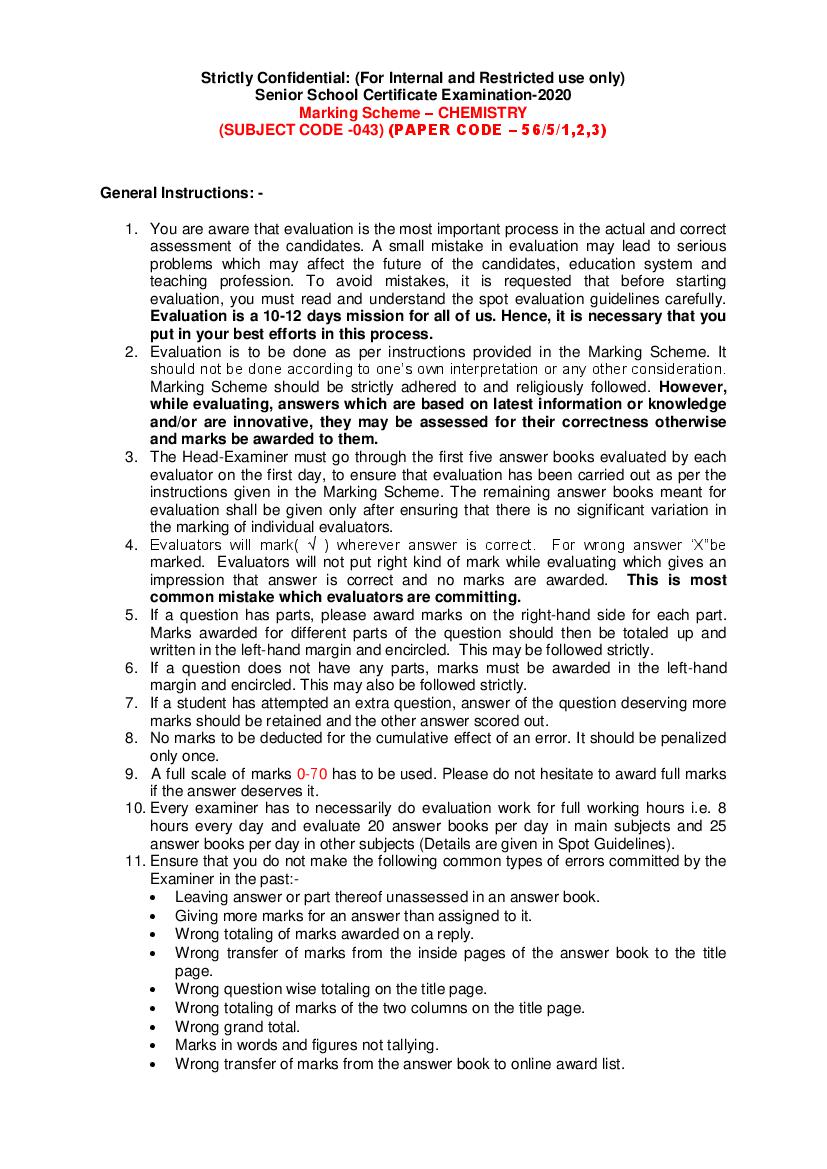
Senior School Certificate Examination-2020
Marking Scheme – CHEMISTRY
(SUBJECT CODE -043) (PAPER CODE – 56/5/1,2,3)
General Instructions: -
1. You are aware that evaluation is the most important process in the actual and correct
assessment of the candidates. A small mistake in evaluation may lead to serious
problems which may affect the future of the candidates, education system and
teaching profession. To avoid mistakes, it is requested that before starting
evaluation, you must read and understand the spot evaluation guidelines carefully.
Evaluation is a 10-12 days mission for all of us. Hence, it is necessary that you
put in your best efforts in this process.
2. Evaluation is to be done as per instructions provided in the Marking Scheme. It
should not be done according to one’s own interpretation or any other consideration.
Marking Scheme should be strictly adhered to and religiously followed. However,
while evaluating, answers which are based on latest information or knowledge
and/or are innovative, they may be assessed for their correctness otherwise
and marks be awarded to them.
3. The Head-Examiner must go through the first five answer books evaluated by each
evaluator on the first day, to ensure that evaluation has been carried out as per the
instructions given in the Marking Scheme. The remaining answer books meant for
evaluation shall be given only after ensuring that there is no significant variation in
the marking of individual evaluators.
4. Evaluators will mark( √ ) wherever answer is correct. For wrong answer ‘X”be
marked. Evaluators will not put right kind of mark while evaluating which gives an
impression that answer is correct and no marks are awarded. This is most
common mistake which evaluators are committing.
5. If a question has parts, please award marks on the right-hand side for each part.
Marks awarded for different parts of the question should then be totaled up and
written in the left-hand margin and encircled. This may be followed strictly.
6. If a question does not have any parts, marks must be awarded in the left-hand
margin and encircled. This may also be followed strictly.
7. If a student has attempted an extra question, answer of the question deserving more
marks should be retained and the other answer scored out.
8. No marks to be deducted for the cumulative effect of an error. It should be penalized
only once.
9. A full scale of marks 0-70 has to be used. Please do not hesitate to award full marks
if the answer deserves it.
10. Every examiner has to necessarily do evaluation work for full working hours i.e. 8
hours every day and evaluate 20 answer books per day in main subjects and 25
answer books per day in other subjects (Details are given in Spot Guidelines).
11. Ensure that you do not make the following common types of errors committed by the
Examiner in the past:-
Leaving answer or part thereof unassessed in an answer book.
Giving more marks for an answer than assigned to it.
Wrong totaling of marks awarded on a reply.
Wrong transfer of marks from the inside pages of the answer book to the title
page.
Wrong question wise totaling on the title page.
Wrong totaling of marks of the two columns on the title page.
Wrong grand total.
Marks in words and figures not tallying.
Wrong transfer of marks from the answer book to online award list.
Page 2
mark is correctly and clearly indicated. It should merely be a line. Same is with
the X for incorrect answer.)
Half or a part of answer marked correct and the rest as wrong, but no marks
awarded.
12. While evaluating the answer books if the answer is found to be totally incorrect, it
should be marked as cross (X) and awarded zero (0)Marks.
13. Any unassessed portion, non-carrying over of marks to the title page, or totaling error
detected by the candidate shall damage the prestige of all the personnel engaged in
the evaluation work as also of the Board. Hence, in order to uphold the prestige of all
concerned, it is again reiterated that the instructions be followed meticulously and
judiciously.
14. The Examiners should acquaint themselves with the guidelines given in the
Guidelines for spot Evaluation before starting the actual evaluation.
15. Every Examiner shall also ensure that all the answers are evaluated, marks carried
over to the title page, correctly totaled and written in figures and words.
16. The Board permits candidates to obtain photocopy of the Answer Book on request in
an RTI application and also separately as a part of the re-evaluation process on
payment of the processing charges.
Marking scheme – 2020
CHEMISTRY (043) / CLASS XII
56/5/1
Q.No Expected Answer / Value Points Marks
SECTION A
1 By gaining one electron they acquire noble gas configuration/ smallest size and high effective 1
nuclear charge in their respective period.
2 Extremely small size/ absence of d orbital/highest electronegativity / low bond dissociation 1
enthalpy of F-F bond.
3 HI>HBr>HCl>HF 1
4 Low bond dissociation enthalpy and high hydration enthalpy. 1
5 X >X’ /X is bigger in size and X’ is smaller. 1
6 Mercury cell 1
7 5F 1
8 k/2.303 1
9 Saccharine/Sucralose / alitame (any other except Aspartame) 1
10 Bakelite 1
11 (c) 1
12 (b) 1
13 (c) 1
14 (a) 1
15 One mark may be awarded to any option 1
16 (D) 1
17 (D) 1
18 (A) 1
Page 3
20 (D) 1
SECTION B
21
For a solution of volatile liquids, the partial vapour pressure of each component of the 1
solution is directly proportional to its mole fraction present in solution.
If we compare the equations for Raoult’s law and Henry’s law, it can be seen that the
partial pressure of the volatile component or gas is directly proportional to its mole 1
fraction in solution.
22 (i) NaCN acts as a leaching agent / it forms complex with gold/ [Ag(CN)2]- 1
4Au + 8CN– + 2H2O + O2 4 [Au(CN2)] – + 4OH– (Balancing may be ignored)
(ii) CO acts as a reducing agent 1
OR
22 It is leached out using acid or bacteria 1
Electrolytic refining 1
23 The accumulation of molecular species at the surface rather than in the bulk of a solid or 1+½
liquid. Example: adsorption of gases on surface of active charcoal (or any other suitable
example) ½
Adsorption of reactants occurs on surface of catalyst and reaction takes place.
OR
23 A state of continuous zig-zag motion of particles. 1
Unbalanced bombardment of the particles by the molecules of the dispersion medium. ½
The Brownian movement has a stirring effect which does not permit the particles to settle. ½
24 (a) Hexacyanidoferrate(III) / Hexacyanoferrate(III) ½
d2sp3 ½
(b) Ligand which can ligate through two different atoms is called ambidentate ligand whereas
di- or polydentate ligand uses its two or more donor atoms to bind a single metal ion. / a 1
chelating ligand forms a more stable complex as compared to an ambidentate ligand. / chelating
ligand forms a cyclic complex while ambidentate ligand forms a non-cyclic complex.
25 Antiseptic is applied on living tissue, to kill or stop growth of microbes while disinfectant is 1
applied on inanimate/ non -living objects
0.2 per cent solution of phenol is an antiseptic while its one percent solution is disinfectant. 1
26.
1
(i)HOCH2CH2OH and / ethylene glycol and phthalic acid / Ethane-1,2-diol and Benzene-1,
2 -dicarboxylic acid
1
(ii)CH2=CHCN / Acrylonitrile / Propene nitrile
27
(i) 1
(ii)
1
Page 4
28 ΔTf = iKf m ½
0.068 = i x 1.86 x 0.01 ½
i = 3.65 or 3.656 ½
α = i-1/n-1 ½
α = 0.883 or 0.885
88.3% or 88.5% (or by any other correct method) 1
29 m=Z I t ½
2 = 63.5 x 2 x t/2x96500
t = 3039.4 s 1
m1/m2 = eq wt 1/eq wt 2 ½
2 / m2 = 63.5/2 / 65/2
m2 = 2.05 g (or by any other correct method) 1
(deduct ½ mark for incorrect or no unit)
30 (i) Amylose is water soluble component of starch while amylopectin is insoluble in water 1
(ii) Globular proteins are spherical in shape while fibrous are linear. 1
(iii) Nucleoside consists of a sugar and a base
1
When nucleoside is linked to phosphate group, it forms a nucleotide
(or any other suitable difference in each case)
31 A: ( CH3 )2 C=CH2 B : ( CH3 )2 CBrCH3 C : ( CH3 )3 C - C(CH3 ) 3 ½ X6
D: ( CH3 )2 CHCH2MgBr E : ( CH3 )2 CHCH3 F: ( CH3 )2 CHCH2OC2H5 =3
32 (i) CH3 CH2CH2OH 1
(ii) (CH3 )2C=CH2 1
(iii)
1
OR
32
1
(i)
(Intermediate compound in above equation may be ignored)
1
1. CH3MgBr
(ii)HCHO CH3CH2OH
2. H2O
(iii) C6H5OH +CH3COCl C6H5OCOCH3 1
(or by any other correct method)
33 (i) Aniline forms salt with AlCl3, the Lewis acid. 1
(ii) Aryl halides do not undergo nucleophilic substitution with the anion formed by 1
phthalimide
(iii) Due to +I effect of alkyl group electron density on N atom increases. 1
34 Lyophobic sol Lyophilic sol
Interaction between dispersed phase Interaction between dispersed phase and
and dispersion medium are weak dispersion medium are strong 1x3=3
irreversible reversible
Can be easily coagulated Can’t be easily coagulated
(or any other suitable difference)
Page 5
34 (i) Lyophilic colloids have a unique property of protecting lyophobic colloids./ Lyophilic 1
colloids form a layer around the lyophobic colloids to protect them from the electrolyte or
coagulation. 1
(ii) Potential difference between the fixed layer and the diffused layer of opposite charges of a
colloid. 1
(iii) Substances used for stabilisation of an emulsion.
SECTION D
35 a) i) Variable or multiple oxidation states / ability to form complexes / they provide large 1
surface area for adsorption.
ii) Similar size/similar properties 1
iii)No unpaired electron/weak interatomic metallic bonding / completely or fully filled d 1
orbitals 1
+ +
b) i) 2Na2CrO4 + 2 H → Na2Cr2O7 + 2 Na + H2O 1
ii) 2MnO2 + 4KOH + O2 → 2K2MnO4 + 2H2O
(Balancing may be ignored in both above reactions)
OR
a) i) Ti has an unpaired electron while there are no unpaired electrons in Sc3+.
3+ 1
35 ii) Stable t2g3 of Cr3+ ion 1
b) 1. Both show variable oxidation states 1
2. Both show f-f transitions 1
3. Electrons of f-orbital in both show poor shielding effect
4. both have common +3 oxidation state
5. both show contraction in atomic radii. (any two suitable differences)
2– + –
c) 3MnO4 + 4H → 2MnO4 + MnO2 + 2H2O 1
36 a) (i) 3-hydroxy-3-phenylpropanal /
1
/ C6H5CH(OH)CH2CHO
(ii) Phenyl hydrazone of benzaldehyde / 1
C6H5CH=N-NHC6H5
(iii)Sodium benzoate and benzyl alcohol /
½+½
and
b) (i) On heating with NaOH and I2 : CH3CH=CHCOCH3 will form yellow ppt of CHI3 while 1
other compound doesn’t .
(ii) On adding NaHCO3 : Benzoic acid produces brisk effervescence while other 1
compound doesn’t.
(or any other suitable chemical test)
OR
36 1
a) (i) CH3CH2CH3
1
(ii) C6H6
1
(iii) CH2=CH-CH2CHO
b) C6H5COCH3 < CH3COCH3 < CH3CHO < HCHO
1
Page 6
1
37 a) k = (2.303 / t) log ([A]o / [A]t) ½
k = (2.303 / 40) log (100 / 75)
1
= 0.007 min-1or 0.0071 min-1or 0.0072 min-1
t = (2.303 / k) log ([A]o / [A]t)
½
t = (2.303 / 0.0071) log (100/20)
t =230 min or 226.7min or 223.7 min. (deduct ½ mark if incorrect or no unit) 1
b) Sum of powers of the concentration of the reactants in the rate law expression. 1
When one of the reactant is present in large excess. 1
OR
37
a) k = 0.693/ t1/2
½
k1= 0.693/ t1/2= 0.693 / 30
k2= 0.693/ t1/2= 0.693 / 10
log k2/k1 = Ea /2.303 R (1/ T1 -1/ T2) 1
log 3 = Ea /2.303 x 8.314 (1/ 300 -1/ 320)
Ea = 2.303 X 8.314 x 0.4771 x ( 300 x 320/20) ½
= 43848.5 J/mol OR 43855 J/mol or 43.8 kJ/mol 1
b) Proper orientation ½
Energy of the colliding particles should be more than threshold energy ½
c) For a complex reaction, order of reaction is applicable while molecularity has no 1
meaning.
Page 7
CHEMISTRY (043)/ CLASS XII
56/5/2
Q.No Expected Answer / Value Points Marks
SECTION A
1 By gaining one electron they acquire noble gas configuration 1
2 Extremely small size/ absence of d orbital/highest electronegativity 1
3 HI>HBr>HCl>HF 1
4 Low bond dissociation enthalpy and high hydration enthalpy 1
5 X >X’ 1
6 Benzylchloride / C6H5CH2Cl 1
7 N,N-dimethylaniline OR N,N-dimethylbenzenamine 1
8 Glycosidic linkage 1
9 Aspartame 1
10 Teflon/PTFE 1
11 (c) 1
12 (c) 1
13 (d) 1
14 (c) 1
15 (d) 1
16 (A) 1
17 (D) 1
18 (C) 1
19 (D) 1
20 (A) 1
SECTION B
21 i) NaCN acts as a leaching agent / it forms complex with gold/ [Ag(CN)2]- 1
4Au + 8CN- + 2H2O + O2 4 [Au(CN2)]- + 4OH- (Balancing may be ignored) 1
ii) CO acts as a reducing agent
OR
21 It is leached out using acid or bacteria 1
Electrolytic refining 1
22 For a solution of volatile liquids, the partial vapour pressure of each component of the 1
solution is directly proportional to its mole fraction present in solution.
If we compare the equations for Raoult’s law and Henry’s law, it can be seen that the 1
partial pressure of the volatile component or gas is directly proportional to its mole
fraction in solution.
23 (i)
1
(ii)
1
Page 8
liquid e.g. adsorption of gases on surface of active charcoal (or any other suitable example)
Adsorption of reactants occurs on surface of catalyst and reaction takes place. ½
OR
24 A state of continuous zig-zag motion of particles. 1
Unbalanced bombardment of the particles by the molecules of the dispersion medium. ½
The Brownian movement has a stirring effect which does not permit the particles to settle. ½
25 (i) Formaldehyde and phenol / HCHO and C6H5OH 1
(ii) Adipic acid and hexamethylenediamine / HOOC (CH2)4 COOH and H2N (CH2)6 NH2 1
26 2 marks to be given for attempting the question. 2
27 Antiseptic is applied on living tissue, to kill or stop growth of microbes while disinfectant is 1
applied on inanimate/ non -living objects
0.2 per cent solution of phenol is an antiseptic while its one percent solution is disinfectant. 1
SECTION C
28 A: ( CH3 )2 C=CH2 B : ( CH3 )2 CBrCH3 C : ( CH3 )3 C - C(CH3 ) 3 ½ X6
D: ( CH3 )2 CHCH2MgBr E : ( CH3 )2 CHCH3 F: ( CH3 )2 CHCH2OC2H5
29 ΔTf = iKf m ½
0.068 = i x 1.86 x 0.01 ½
i = 3.65 or 3.656 ½
AlCl3 Al3+ + 3 Cl-
1 0 0
1-α α 3α
α = i-1/n-1 ½
α = .883 or 0.885
88.3% or 88.5% (or any other suitable/ correct method) 1
30 a) Polysaccharides contain a large number of monosaccharide units joined together by ½
glycosidic linkages./ carbohydrates which give a large number of monosachharides on
hydrolysis.
Example: Starch / Cellulose / Glycogen ½
b) Loss of biological activity of native form of protein when subjected to a change in ½
temperature or pH./During denaturation 2o and 3o structures are destroyed. ½
Example: Coagulation of egg white / Curdling of milk
c) When the polypeptide chains run parallel and are held together by hydrogen and ½
disulphide bonds, then fibre-like structure is formed. ½
Example: Keratin / Myosin
31 m=Z I t ½
2 = 63.5 x 2 x t/2x96500 ½
t = 3039.4 s ½
m1/m2 = eq wt 1/eq wt 2 ½
2 / m2 = 63.5/2 / 65/2 ½
m2 = 2.05 g (or by any other correct method) ½
32
Lyophobic sol Lyophilic sol
Interaction between dispersed phase Interaction between dispersed phase and 1
and dispersion medium are weak dispersion medium are strong
Unstable stable 1
Irreversible reversible 1
Can easily be coagulated Can’t easily be coagulated
(any three from above differences) (or any other suitable difference)
Page 9
32 i) Lyophilic colloids have a unique property of protecting lyophobic colloids./ Lyophilic colloids 1
form a layer around the lyophobic colloids to protect the lyophobic colloid from the electrolyte
in order to prevent coagulation.
ii) Potential difference between the fixed layer and the diffused layer of opposite charges of a 1
colloid.
iii) Substances used for stabilisation of an emulsion. 1
33 i) CH3 CH2CH2OH 1
ii) (CH3 )2C=CH2 1
iii)
1
OR
1
33
(i)
(Intermediate compound in above equation may be ignored)
1. CH3MgBr
(ii)HCHO CH3CH2OH 1
2. H2O
(iii) C6H5OH +CH3COOH H+ C6H5OCOCH3 1
(or any other suitable method)
34 i) Aniline is a Lewis base and anhydrous AlCl3 the catalyst is a Lewis acid which form a salt 1
ii) Aryl halides do not undergo nucleophilic substitution with the anion formed by 1
phthalimide.
iii) Due to +I effect of alkyl group electron density on N atom increases. 1
35 a) k = (2.303 / t) log (Ao / At) ½
k = (2.303 / 40) log (100 / 75)
= 0.007 min-1or 0.0071 min-1or 0.0072 min-1 1
t = (2.303 / k) log (Ao / At)
t = (2.303 / 0.0071) log (100/20) ½
t =230 min or 226.7min or 223.7 min. (deduct ½ mark if incorrect or no unit) 1
b) Sum of powers of the concentration of the reactants in the rate law expression. 1
When one of the reactant is present in large excess. 1
OR
35 a) K1= 0.693/ t1/2= 0.693 / 30 =0.0231 min-1 ½
K2= 0.693/ t1/2= 0.693 / 10 =0.0693 min-1 ½
log K2/K1 = Ea /2.303 R (1/ T1 -1/ T2) 1
Ea = 2.303 R log K2/K1 ( T1T2/T2-T1)
= 2.303 X 8.314 log( 0.0693/0.0231) X ( 300X320/320-300) ½
= 43848.5 J/mol OR 43855 J/mol OR 43.8 kJ/mol ½
b) Proper orientation ½
Energy of the colliding particles should be more than threshold energy ½
c) For a complex reaction, order of reaction is applicable while molecularity has no meaning. 1
36 a) i) Variable or multiple oxidation states / ability to form complexes / they provide large 1
surface area for adsorption.
ii) Similar size/similar properties 1
iii)No unpaired electron/weak metallic bonding/ completely or fully filled d orbitals 1
b) i) 2Na2CrO4 + 2 H+ → Na2Cr2O7 + 2 Na+ + H2O 1
ii) 2MnO2 + 4KOH + O2 → 2K2MnO4 + 2H2O 1
Page 10
OR
36 a) i) Ti3+ has an unpaired electron while there are no unpaired electrons in Sc3+.
ii) Stable t2g3 of Cr3+ ion 1
1
b) 1. Both show variable oxidation states
2. Both show f-f transitions 1
3. Electrons of f-orbital in both show poor shielding effect 1
4. both have common +3 oxidation state
5. both show contraction in atomic radii. (any two suitable differences)
c) 3MnO42– + 4H+ → 2MnO4– + MnO2 + 2H2O
1
37 a) (i) 3-hydroxy-3-phenylpropanal /
1
/ C6H5CH(OH)CH2CHO
(ii) Phenyl hydrazone of benzaldehyde / 1
C6H5CH=N-NHC6H5
(iii)Sodium benzoate and benzyl alcohol /
½+½
and
b) (i) On heating with NaOH and I2 : CH3CH=CHCOCH3 will form yellow ppt of CHI3 while 1
other compound doesn’t .
(ii) On adding NaHCO3 : Benzoic acid produces brisk effervescence while other 1
compound doesn’t.
(or any other suitable chemical test)
OR
1
a) (i) CH3CH2CH3
1
(ii) C6H6
37 1
(iii) CH2=CH-CH2CHO
b) C6H5COCH3 < CH3COCH3 < CH3CHO < HCHO
1
c)
1
Page 11
CHEMISTRY (043)/ CLASS XII
56/5/3
Q.No Expected Answer / Value Points Marks
SECTION A
1 By gaining one electron they acquire noble gas configuration 1
2 Extremely small size/ absence of d orbital/highest electronegativity 1
3 HI>HBr>HCl>HF 1
4 Low bond dissociation enthalpy and high hydration enthalpy 1
5 X >X’ 1
6 (CH3)4C 1
7 (CH3)2NH 1
8 Cis-[Pt(en)2Cl2]2+ 1
9 Zone refining 1
10 Copolymer 1
11 (b) 1
12 (b) 1
13 (c) 1
14 (a) 1
15 (d) 1
16 (D) 1
17 (D) 1
18 (C) 1
19 (A) 1
20 (D) 1
SECTION B
21 (a) Hexacyanidoferrate(III) / Hexacyanoferrate(III) ½
d2sp3 ½
(b) Ligand which can ligate through two different atoms is called ambidentate ligand whereas
di- or polydentate ligand uses its two or more donor atoms to bind a single metal ion. / a 1
chelating ligand forms a more stable complex as compared to an ambidentate ligand. / chelating
ligand forms a cyclic complex while ambidentate ligand forms a non-cyclic complex.
22 (i)
1
(ii)
1
23 i) NaCN acts as a leaching agent / it forms complex with gold/ [Ag(CN)2]- 1
4Au + 8CN- + 2H2O + O2 4 [Au(CN2)]- + 4OH- (Balancing may be ignored)
ii) CO acts as a reducing agent 1
OR
Page 12
Electrolytic refining 1
24 (i) Glycol and terephthalic acid / ½+½
,
(ii) Melamine and formaldehyde/
½+½
,
25 The accumulation of molecular species at the surface rather than in the bulk of a solid or 1+½
liquid. Example: adsorption of gases on surface of active charcoal (or any other suitable
example)
Adsorption of reactants occurs on surface of catalyst and reaction takes place. ½
OR
25 A state of continuous zig-zag motion of particles. 1
Unbalanced bombardment of the particles by the molecules of the dispersion medium. ½
The Brownian movement has a stirring effect which does not permit the particles to settle. ½
26
For a solution of volatile liquids, the partial vapour pressure of each component of the 1
solution is directly proportional to its mole fraction present in solution.
If we compare the equations for Raoult’s law and Henry’s law, it can be seen that the
partial pressure of the volatile component or gas is directly proportional to its mole 1
fraction in solution.
27 (i) A chemical substance which in low concentrations inhibits the growth or ½
destroys microorganisms.
Example: Penicillin/Aminoglycosides/Ofloxacin ½
(ii) Prevent spoilage of food due to microbial growth. ½
Example: table salt/sugar/vegetable oils/sodium benzoate/salts of sorbic acid/salt of ½
propanoic acid.
SECTION C
28 i) CH3 CH2CH2OH 1
ii) (CH3 )2C=CH2 1
iii)
1
OR
28 (i)
1
(Intermediate compound in above equation may be ignored)
1. CH3MgBr
(ii)HCHO 2. H2O CH3CH2OH
1
+
(iii) C6H5OH +CH3COOH H C6H5OCOCH3
(or any other suitable method) 1
29 A: ( CH3 )2 C=CH2 B : ( CH3 )2 CBrCH3 C : ( CH3 )3 C - C(CH3 ) 3 ½ X6
D: ( CH3 )2 CHCH2MgBr E : ( CH3 )2 CHCH3 F: ( CH3 )2 CHCH2OC2H5
Page 13
0.068 = i x 1.86 x 0.01 ½
i = 3.65 or 3.656 ½
AlCl3 Al3+ + 3 Cl-
1 0 0
1-α α 3α
α = i-1/n-1 ½
α = .883 or 0.885
88.3% or 88.5% (or any other suitable/ correct method) 1
31 (i) Deoxyribose sugar , Nitrogenous base and phosphoric acid 1
(ii) Gluconic acid /
1
1
(iii) 2o and 3o structures are destroyed.
32 m=Z I t ½
2 = 63.5 x 2 x t/2x96500 ½
t = 3039.4 s ½
m1/m2 = eq wt 1/eq wt 2 ½
2 / m2 = 63.5/2 / 65/2 ½
m2 = 2.05 g (or any other suitable/ correct method) ½
33
Lyophobic sol Lyophilic sol
Interaction between dispersed phase Interaction between dispersed phase and 1
and dispersion medium are weak dispersion medium are strong
Unstable stable 1
irreversible reversible 1
Can easily be coagulated Can’t easily be coagulated
(any three from above differences) (or any other suitable difference)
OR
33 i) Lyophilic colloids have a unique property of protecting lyophobic colloids./ Lyophilic 1
colloids form a layer around the lyophobic colloids to protect the lyophobic colloid from
the electrolyte in order to prevent coagulation.
ii) Potential difference between the fixed layer and the diffused layer of opposite charges of a 1
colloid.
iii) Substances used for stabilisation of an emulsion. 1
34 i) Aniline is a Lewis base and anhydrous AlCl3 the catalyst is a Lewis acid which form a 1
salt
ii) Aryl halides do not undergo nucleophilic substitution with the anion formed by 1
phthalimide.
iii) Due to +I effect of alkyl group electron density on N increases. 1
SECTION D
35 a) (i) 3-hydroxy-3-phenylpropanal /
1
/ C6H5CH(OH)CH2CHO
Page 14
C6H5CH=N-NHC6H5
(iii)Sodium benzoate and benzyl alcohol /
½+½
and
b) (i) On heating with NaOH and I2 : CH3CH=CHCOCH3 will form yellow ppt of CHI3 1
while other compound doesn’t .
(ii) On adding NaHCO3 : Benzoic acid produces brisk effervescence while other 1
compound doesn’t.
(or any other suitable chemical test)
35 OR
1
a) (i) CH3CH2CH3
1
(ii) C6H6
1
(iii) CH2=CH-CH2CHO
b) C6H5COCH3 < CH3COCH3 < CH3CHO < HCHO
1
c)
1
36 a) k = (2.303 / t) log ([A]o / [A]t) ½
k = (2.303 / 40) log (100 / 75)
= 0.007 min-1or 0.0071 min-1or 0.0072 min-1 1
t = (2.303 / k) log ([A]o / [A]t)
t = (2.303 / 0.0071) log (100/20) ½
t =230 min or 226.7min or 223.7 min. (1/2 mark deducted for incorrect or no unit) 1
b) Sum of powers of the concentration of the reactants in the rate law expression. 1
When one of the reactant is present in large excess. 1
OR
-1
a) K1= 0.693/ t1/2= 0.693 / 30 =0.0231 min ½
36 K2= 0.693/ t1/2= 0.693 / 10 =0.0693 min-1 ½
log K2/K1 = Ea /2.303 R (1/ T1 -1/ T2) 1
Ea = 2.303 R log K2/K1 ( T1T2/T2-T1)
= 2.303 X 8.314 log( 0.0693/0.0231) X ( 300X320/320-300) ½
= 43848.5 J/mol OR 43855 J/mol OR 43.8 kJ/mol ½
b) Proper orientation ½
Energy of the colliding particles should be more than threshold energy ½
c) For a complex reaction, order of reaction is applicable while molecularity has no meaning. 1
37 a) i) Variable or multiple oxidation states / ability to form complexes / they provide large 1
surface area for adsorption.
ii) Similar size/similar properties 1
iii)No unpaired electron/weak metallic bonding/ completely or fully filled d orbitals 1
b) i) 2Na2CrO4 + 2 H+ → Na2Cr2O7 + 2 Na+ + H2O 1
ii) 2MnO2 + 4KOH + O2 → 2K2MnO4 + 2H2O 1
(Balancing may be ignored in both above reactions)
37 OR
a) i) Ti has an unpaired electron while there are no unpaired electrons in Sc3+.
3+
1
ii) Stable t2g3 of Cr3+ ion 1
b) 1. Both show variable oxidation states 1
Page 15
3. Electrons of f-orbital in both show poor shielding effect
4. both have common +3 oxidation state
5. both show contraction in atomic radii. (any two suitable differences)
c) 3MnO42– + 4H+ → 2MnO4– + MnO2 + 2H2O 1
Document Details
| Board / Org | CBSE |
| Exam | Class 12 |
| Type | Solution |
| Pages | 15 |
| Updated | 22 Jul 2026 |