CBSE Class 12 Chemistry Question Paper 2020 Set 56-B Solutions
Finished viewing? Save it for later —
Download CBSE Class 12 Chemistry Question Paper 2020 Set 56-B Solutions (PDF · 6 pages)About CBSE Class 12 Chemistry Question Paper 2020 Set 56-B Solutions
CBSE Class 12 Chemistry Question Paper 2020 Set 56-B Solutions is available here for free download. Published by CBSE for Class 12, this solution can be viewed online or downloaded as a PDF (6 pages). Candidates preparing for Class 12 can use CBSE Class 12 Chemistry Question Paper 2020 Set 56-B Solutions to understand the exam pattern, the type of questions asked, and the overall difficulty level.
Frequently Asked Questions
How can I download CBSE Class 12 Chemistry Question Paper 2020 Set 56-B Solutions?
Open this page and click the Download button to save CBSE Class 12 Chemistry Question Paper 2020 Set 56-B Solutions as a PDF. It is completely free on AglaSem Docs.
Is CBSE Class 12 Chemistry Question Paper 2020 Set 56-B Solutions free to download?
Yes. CBSE Class 12 Chemistry Question Paper 2020 Set 56-B Solutions can be viewed online and downloaded as a PDF free of cost on AglaSem Docs.
How many pages does CBSE Class 12 Chemistry Question Paper 2020 Set 56-B Solutions have?
CBSE Class 12 Chemistry Question Paper 2020 Set 56-B Solutions contains 6 pages, which you can read online or download together as a single PDF.
Where can I find more Class 12 study material?
You can find more Class 12 question papers, sample papers, syllabus, and answer keys on AglaSem Docs.
CBSE Class 12 Chemistry Question Paper 2020 Set 56-B Solutions – Text
Read the full text of this solution below — useful to quickly search, copy and reference the content online without downloading the PDF.
📄 View text version (6 pages)
Page 1
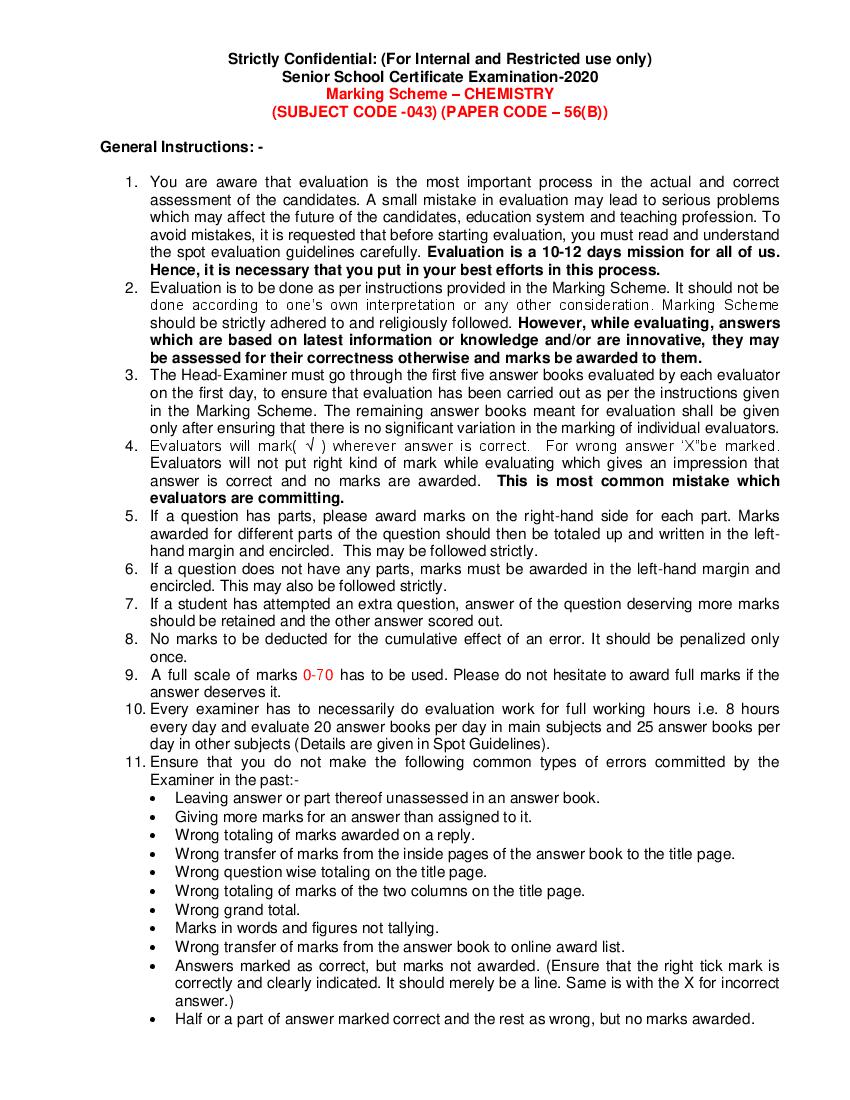
Senior School Certificate Examination-2020
Marking Scheme – CHEMISTRY
(SUBJECT CODE -043) (PAPER CODE – 56(B))
General Instructions: -
1. You are aware that evaluation is the most important process in the actual and correct
assessment of the candidates. A small mistake in evaluation may lead to serious problems
which may affect the future of the candidates, education system and teaching profession. To
avoid mistakes, it is requested that before starting evaluation, you must read and understand
the spot evaluation guidelines carefully. Evaluation is a 10-12 days mission for all of us.
Hence, it is necessary that you put in your best efforts in this process.
2. Evaluation is to be done as per instructions provided in the Marking Scheme. It should not be
done according to one’s own interpretation or any other consideration. Marking Scheme
should be strictly adhered to and religiously followed. However, while evaluating, answers
which are based on latest information or knowledge and/or are innovative, they may
be assessed for their correctness otherwise and marks be awarded to them.
3. The Head-Examiner must go through the first five answer books evaluated by each evaluator
on the first day, to ensure that evaluation has been carried out as per the instructions given
in the Marking Scheme. The remaining answer books meant for evaluation shall be given
only after ensuring that there is no significant variation in the marking of individual evaluators.
4. Evaluators will mark( √ ) wherever answer is correct. For wrong answer ‘X”be marked.
Evaluators will not put right kind of mark while evaluating which gives an impression that
answer is correct and no marks are awarded. This is most common mistake which
evaluators are committing.
5. If a question has parts, please award marks on the right-hand side for each part. Marks
awarded for different parts of the question should then be totaled up and written in the left-
hand margin and encircled. This may be followed strictly.
6. If a question does not have any parts, marks must be awarded in the left-hand margin and
encircled. This may also be followed strictly.
7. If a student has attempted an extra question, answer of the question deserving more marks
should be retained and the other answer scored out.
8. No marks to be deducted for the cumulative effect of an error. It should be penalized only
once.
9. A full scale of marks 0-70 has to be used. Please do not hesitate to award full marks if the
answer deserves it.
10. Every examiner has to necessarily do evaluation work for full working hours i.e. 8 hours
every day and evaluate 20 answer books per day in main subjects and 25 answer books per
day in other subjects (Details are given in Spot Guidelines).
11. Ensure that you do not make the following common types of errors committed by the
Examiner in the past:-
Leaving answer or part thereof unassessed in an answer book.
Giving more marks for an answer than assigned to it.
Wrong totaling of marks awarded on a reply.
Wrong transfer of marks from the inside pages of the answer book to the title page.
Wrong question wise totaling on the title page.
Wrong totaling of marks of the two columns on the title page.
Wrong grand total.
Marks in words and figures not tallying.
Wrong transfer of marks from the answer book to online award list.
Answers marked as correct, but marks not awarded. (Ensure that the right tick mark is
correctly and clearly indicated. It should merely be a line. Same is with the X for incorrect
answer.)
Half or a part of answer marked correct and the rest as wrong, but no marks awarded.
Page 2
marked as cross (X) and awarded zero (0)Marks.
13. Any unassessed portion, non-carrying over of marks to the title page, or totaling error
detected by the candidate shall damage the prestige of all the personnel engaged in the
evaluation work as also of the Board. Hence, in order to uphold the prestige of all concerned,
it is again reiterated that the instructions be followed meticulously and judiciously.
14. The Examiners should acquaint themselves with the guidelines given in the Guidelines for
spot Evaluation before starting the actual evaluation.
15. Every Examiner shall also ensure that all the answers are evaluated, marks carried over to
the title page, correctly totaled and written in figures and words.
16. The Board permits candidates to obtain photocopy of the Answer Book on request in an RTI
application and also separately as a part of the re-evaluation process on payment of the
processing charges.
56(B)
MARKING SCHEME
Sr. SECONDARY SCHOOL EXAMINATION, 2020
Subject: CHEMISTRY (043)
Distribution
Q.No. Expected Answer / Value Points
of Marks
1. The ionization potential / enthalpy of oxygen and xenon are nearly same. 1
2. Xe, lower I.E. of xenon than that of He. ½+½
3. Due to high inter-electronic repulsions. 1
4. 2 Xe F2 + 2 H2O 2 Xe + 4HF + O2 1
5. Used in Fluorescent lamps / Neon Sign boards / Botanical gardens / Green houses 1
(any one)
6. Because the overall reaction does not involve any ion in the solution. 1
7. Zinc has lower reduction potential than copper due to which zinc is oxidized and Cu2+ 1
ions are reduced. / Zn being more reactive than copper, displaces Cu2+ ions from the
solution
8. Pentaamminechloridoplatinum(IV) chloride 1
9. Due to –I effect of halogens. 1
10. 3 (three) 1
11 A 1
12 C 1
13 B 1
14 A 1
15 D 1
16 i 1
17 i 1
Page 3
19 i / ii 1
20 iii 1
21. Due to lowering of vapour pressure of solution. 1
Because it depends on molality / number of solute particles. 1
OR
21. Due to osmosis. / Due to inward movement of water molecules. 1
Yes, osmosis is directly proportional to temperature of solvent. 1
22.
Order Molecularity
i. Sum of powers to which, the The number of reacting species 1
concentration terms are raised in a colliding simultaneously in an
rate law. elementary step.
ii. May also be zero/ fraction/negative It is always a positive whole number. 1
(or any other difference.)
OR
22. (a). Due to decrease in concentration of reactants with time . 1
(b). Due to more surface area. 1
23. (a). It acts as a flux to remove Iron oxide as slag. 1
(b). It acts as a reducing agent. 1
24. (a). Because solute particle size is extremely small. 1
(b). Due to coagulation of blood. 1
25. A= (CH3)2CHCH2Br 4½=2
B=(CH3)2C=CH2
C=(CH3)3CBr
D=(CH3)2CHCH2CH2CH(CH3)2
26. (a). 1
1.111. CH3MgBr 1
(b).CH3CHO (CH3)2CHOH
2. H2O
27.
Homopolymers Co-polymers
Polymers whose repeating structural Polymers whose repeating structural 1
units are derived from only one type of units are derived from two or more
monomer. types of monomers.
Thermoplastic Polymers Thermosetting Polymers
They are linear polymers without cross There is extensive cross linking. 1
linking and branching.
(or any other correct difference.)
28. ½
Tf = i Kf m =
i=3 ½
2 = 3 1.86 1
= 1
Page 4
28. 1
For dilute solutions:
1
=
1
29.
k= ½
½
0.3465
½
t=
½
t=
1
min (deduct half mark if no or incorrect unit)
OR
2
29. Rate = k [A] [B] 1
(i) Rate = k [A] [3B]2 = 9k [A][B]2
So the rate increases by nine times. 1
2 2
(ii) Rate = k [2A] [2B] = 8k [A] [B]
1
So the rate becomes eight times.
30. (a). Both S and H are –ve but H > TS, so G is –ve. 1
(b). Due to the coagulation of colloidal clay particles. 1
(c). In case of high fever the enzyme activity is reduced. 1
31. (a). In test tube (iii), containing sulphur powder. ½+½
(b). In test tube (i), containing cane sugar. ½+½
(c). In test tube (ii), containing copper turnings
½+½
Page 5
1
1
1
33. (i) A CH3CHO , B CH3–CH = N–OH ½+½
(ii) A CH3COOH , B CH3COCl ½+½
(iii) A C6H5COONa , B C6H6 ½+½
34. (a). Tranquilizers 1
(b). Antihistamines / Antacids 1
(c). Highly branched hydrocarbon chains 1
35. E cell = E0cell – ½
1
2.6805 = E0cell –
= E0cell – 0.0295 (–1) ½
= E0cell + 0.0295
E0cell = 2.6805 – 0.0295 = 2.651 V 1
ΔGo = -nFEocell ½
= -2 x 96500 x 2.651 ½
= - 511643 J mol-1 or -511.643 kJmol-1 1
OR
35. (a). Area (A) = r2 = 3.14 (0.5 cm)2 = 0.785 cm2
Length (l) = 50 cm = 0.5 m.
R= or ½
= 87.135 ohm cm. ½
k = ½
½
=
½
Page 6
= 229.6 S cm2 mol–1 ½
(b). (i) Fuel cells are pollution free while thermal plants are major source of 1
pollution / Fuel cells are more efficient.
(ii) Zinc being more reactive will oxidise itself to protect iron. 1
SECTION-D
36. (a). 4 FeCr2O4 + 8 Na2CO3 + 7 O2 8 Na2CrO4 + 2 Fe2O3 + 8 CO2 1
+ +
2Na2CrO4 + 2 H Na2Cr2O7 + 2 Na + H2O 1
(b). (i) Due to comparable energies of 5f, 6d and 7s orbitals. 1
(ii) Due to higher oxidation state of Mn in Mn2O7. 1
(iii) Due to d-d transitions / due to presence of unpaired electrons in d-orbitals. 1
OR
36. (a). 2MnO2 + 4KOH + O2 2K2MnO4 + 2H2O 1
3MnO42– + 4H+ 2MnO4– + MnO2 + 2H2O 1
/ MnO42– MnO4– + e- (during electrolytic oxidation at anode)
(b). (i) Due to almost similar sizes / comparable sizes. 1
(ii) Because 5f electrons in actinoids have more poor shielding effect. 1
(iii) Because Cr3+ has the stable configuration
2+ 5
whereas Mn has stable (3d ) configuration. 1
37. A = C6H5CONH2, 1
B= C6H5N2Cl 1
C= C6H5CN 1
D= C6H5NC 1
E= C6H6 (Or any other answer for option E only) 1
OR
37. (a). (i) Add CHCl3 and KOH (alc.) to both the compounds. 1
Aniline gives foul smelling isocyanides while N-Methylaniline doesn’t.
(ii) Add Ice cold (NaNO2 + HCl) followed by phenol or β-Naphthol to both the 1
compounds.
Aniline forms orange red dye while ethylamine doesn’t.
(Or any other suitable chemical test)
(b). (i) A = C6H5NH2 ,
B=
½+½
½+½
(ii) A = CH3OH , B = CH3Cl ½+½
(iii) A = C2H5NC , B = C2H5NH.CH3
Document Details
| Board / Org | CBSE |
| Exam | Class 12 |
| Type | Solution |
| Pages | 6 |
| Updated | 22 Jul 2026 |