MAHA SET 2019 Question Paper 2 Psychology
Finished viewing? Save it for later —
Download MAHA SET 2019 Question Paper 2 Psychology (PDF · 48 pages)About MAHA SET 2019 Question Paper 2 Psychology
MAHA SET 2019 Question Paper 2 Psychology is available here for free download. Published by Maharashtra Exams for Maharashtra State Eligibility Test, this question paper can be viewed online or downloaded as a PDF (48 pages). Candidates preparing for Maharashtra State Eligibility Test can use MAHA SET 2019 Question Paper 2 Psychology to understand the exam pattern, the type of questions asked, and the overall difficulty level.
Frequently Asked Questions
How can I download MAHA SET 2019 Question Paper 2 Psychology?
Open this page and click the Download button to save MAHA SET 2019 Question Paper 2 Psychology as a PDF. It is completely free on AglaSem Docs.
Is MAHA SET 2019 Question Paper 2 Psychology free to download?
Yes. MAHA SET 2019 Question Paper 2 Psychology can be viewed online and downloaded as a PDF free of cost on AglaSem Docs.
How many pages does MAHA SET 2019 Question Paper 2 Psychology have?
MAHA SET 2019 Question Paper 2 Psychology contains 48 pages, which you can read online or download together as a single PDF.
Where can I find more Maharashtra State Eligibility Test study material?
You can find more Maharashtra State Eligibility Test question papers, sample papers, syllabus, and answer keys on AglaSem Docs.
MAHA SET 2019 Question Paper 2 Psychology – Text
Read the full text of this question paper below — useful to quickly search, copy and reference the content online without downloading the PDF.
📄 View text version (48 pages)
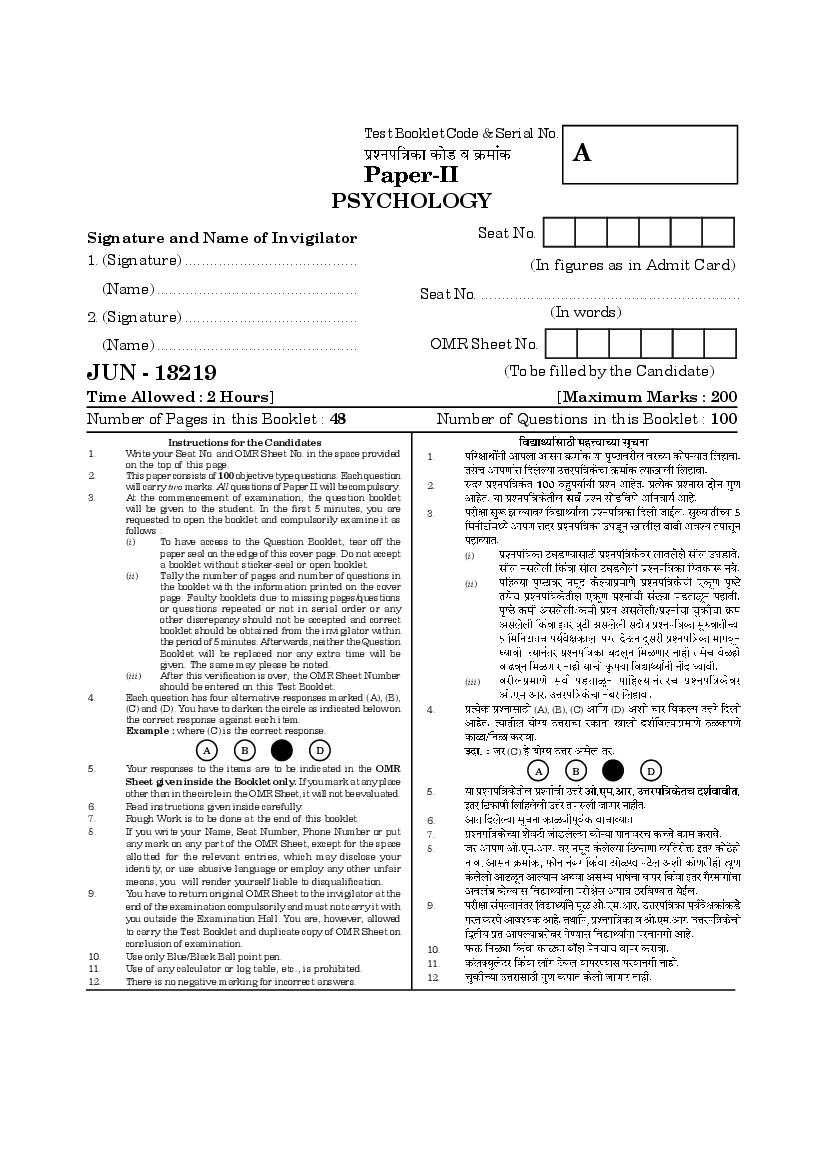
Page 1
A
PSYCHOLOGY
Signature and Name of Invigilator Seat No.
1. (Signature) ......................................... (In figures as in Admit Card)
(Name) ................................................ Seat No. ..............................................................
2. (Signature) ......................................... (In words)
(Name) ................................................ OMR Sheet No.
JUN - 13219 (To be filled by the Candidate)
Time Allowed : 2 Hours] [Maximum Marks : 200
Number of Pages in this Booklet : 48 Number of Questions in this Booklet : 100
Instructions for the Candidates
1. Write your Seat No. and OMR Sheet No. in the space provided 1.
on the top of this page.
2. This paper consists of 100 objective type questions. Each question
will carry two marks. All questions of Paper II will be compulsory. 2.
3. At the commencement of examination, the question booklet
will be given to the student. In the first 5 minutes, you are 3.
requested to open the booklet and compulsorily examine it as
follows :
(i) To have access to the Question Booklet, tear off the
paper seal on the edge of this cover page. Do not accept (i)
a booklet without sticker-seal or open booklet.
(ii) Tally the number of pages and number of questions in
the booklet with the information printed on the cover (ii)
page. Faulty booklets due to missing pages/questions
or questions repeated or not in serial order or any
other discrepancy should not be accepted and correct
booklet should be obtained from the invigilator within
the period of 5 minutes. Afterwards, neither the Question
Booklet will be replaced nor any extra time will be
given. The same may please be noted.
(iii) After this verification is over, the OMR Sheet Number
(iii)
should be entered on this Test Booklet.
4. Each question has four alternative responses marked (A), (B),
(C) and (D). You have to darken the circle as indicated below on 4. (A), (B), (C) (D)
the correct response against each item.
Example : where (C) is the correct response.
A B D (C)
5. Your responses to the items are to be indicated in the OMR A B D
Sheet given inside the Booklet only. If you mark at any place
other than in the circle in the OMR Sheet, it will not be evaluated. 5.
6. Read instructions given inside carefully.
7. Rough Work is to be done at the end of this booklet. 6.
8. If you write your Name, Seat Number, Phone Number or put 7.
any mark on any part of the OMR Sheet, except for the space
8.
allotted for the relevant entries, which may disclose your
identity, or use abusive language or employ any other unfair
means, you will render yourself liable to disqualification.
9. You have to return original OMR Sheet to the invigilator at the
end of the examination compulsorily and must not carry it with 9.
you outside the Examination Hall. You are, however, allowed
to carry the Test Booklet and duplicate copy of OMR Sheet on
conclusion of examination.
10.
10. Use only Blue/Black Ball point pen.
11.
11. Use of any calculator or log table, etc., is prohibited.
12. There is no negative marking for incorrect answers. 12.
Page 2
Page 3
Paper II
II
Time Allowed : 120 Minutes] [Maximum Marks : 200
Note : This paper contains Hundred (100) multiple choice questions. Each question
carrying Two (2) marks. Attempt All questions.
(100) (2)
1. If a researcher is interested in 1.
finding the relationship between
height and running speed of
participants by eliminating the
influence of age, then which method
would be appropriate for data
(A) Rho
analysis ?
(A) Spearman’s Rho (B)
(B) Biserial Correlation
(C)
(C) Multiple Correlation
(D)
(D) Partial Correlation
3 [P.T.O.
Page 4
perceiving a series of still images as
moving when viewed in a rapid
succession.
(A)
(A) Isomorphism
(B)
(B) Phi phenomena
(C)
(C) Apparent motion
(D) Figure ground (D)
3. Which of the following indices are 3. GATB
associated with General Aptitude
Test Battery (GATB) ?
(I)
(I) Cognitive
(II)
(II) Behavioural
(III)
(III) Perceptual
(IV)
(IV) Achievement potential.
Codes :
(A) (I) (II)
(A) (I) and (II)
(B) (II) and (IV) (B) (II) (IV)
(C) (I) and (III) (C) (I) (III)
(D) (I) and (IV) (D) (I) (IV)
4
Page 5
(A) Sensory impulse transmission (A)
(B) Motor impulse transmission (B)
(C) Chemical buffering (C)
(D) Slowing nerve impulses (D)
5. Which effect is found only with 5.
recall and not with recognition
tasks ?
(A)
(A) Mood-dependent memory effect
(B)
(B) State-dependent memory effect
(C)
(C) Spacing effect
(D) Cue overload effect (D)
6. The tests in Torrance Tests for 6.
Creative Thinking can be scored
for :
(A) Fluency, Flexibility, Originality,
(A)
Differentness
(B) Fluency, Flexibility, Originality, (B)
Elaboration
(C)
(C) Articulacy, Flexibility,
Originality, Differentness
(D)
(D) Novelty, Rarity, Differentness,
Domain-specificity
5 [P.T.O.
Page 6
subtests of the Minnesota Tests of
Creative Thinking (MTCT) into
categories. Which of the following
represent the categories ?
(1) Verbal tasks using verbal (1)
stimuli
(2) Verbal tasks using non-verbal (2)
stimuli
(3) Non-verbal tasks (3)
(4) Non-verbal tasks using non- (4)
verbal stimuli
Codes :
(A) (2) and (4) only (A) (2) (4)
(B) (2), (3) and (4) only (B) (2), (3) (4)
(C) (1), (3) and (4) only (C) (1), (3) (4)
(D) (1), (2) and (3) only (D) (1), (2) (3)
8. Psychologist who believed that the 8.
most fundamental human motive is
striving for superiority is :
(A)
(A) Carl Rogers
(B)
(B) Carl Jung
(C)
(C) Karen Horney
(D) Alfred Adler (D)
6
Page 7
the correct answer using codes given
below :
I
List I
(Behaviour)
(P) Unacceptable id impulses are (P)
transformed
(Q)
(Q) Movement from mature
behaviour to immature
behaviour (R)
(R) To restrict undesirable id
impulses from reaching (S)
consciousness
(S) Justification of behaviour
through the use of plausible II
exceses
List II
(1)
(Concepts)
(2)
(1) Regression
(2) Rationalization (3)
(3) Sublimation (4)
(4) Repression
Codes :
(P) (Q) (R) (S)
(P) (Q) (R) (S)
(A) (3) (1) (4) (2)
(A) (3) (1) (4) (2)
(B) (2) (3) (1) (4)
(B) (2) (3) (1) (4)
(C) (4) (2) (3) (1) (C) (4) (2) (3) (1)
(D) (3) (1) (2) (4) (D) (3) (1) (2) (4)
7 [P.T.O.
Page 8
dispositional or personality based
explanations for behaviour observed
in others and under emphasising
situational explanations is called
...............
(A) Action identification (A)
(B) Observer effect (B)
(C) Fundamental attribution error (C)
(D) Self serving bias (D)
11. Teacher in her class teaches : ‘‘A for 11.
Apple’’ and each child says ‘‘A for
Apple; it is an example of ................
(A) Social learning (A)
(B) Social cognition (B)
(C) Social attitude (C)
(D) Socialization (D)
12. Which of the following alternatives 12.
is true for the statements of
‘Assertion’ and ‘Reasoning’ ?
(A) :
Assertion (A) : Psychosomatic
symptoms respond to psychotherapy.
(R) :
Reason (R) : Physical symptoms
in psychosomatic disorders are not
based on organic pathology. (A) (A) (R)
(R) (A)
(A) (A) and (R) are both true and
(R) is the correct explanation
for (A) (B) (A) (R)
(R) (A)
(B) (A) and (R) are both true but
(R) is not the correct (C) (A) (R)
explanation for (A)
(C) (A) is true but (R) is false (D) (A) (R)
(D) (A) is false but (R) is true
8
Page 9
correct way to manage cyber
bullying ?
(A) Inform police (A)
(B) Pay no attention towards the (B)
bullier
(C)
(C) Save evidence as proof
(D) Attack back the bullier (D)
14. The place of worship of Buddhists 14.
is :
(A)
(A) Vihara
(B)
(B) Sangama
(C)
(C) Stupa
(D) Chaitya (D)
15. When did the UN General Assembly 15. 21
announce 21st June as the
International Yoga Day ?
(A) 21 2014
(A) 21st June, 2014
(B) 11 , 2014
(B) 11th Dec., 2014
(C) 12 , 2014
(C) 12th Dec., 2014
(D) 11 , 2014
(D) 11th June, 2014
9 [P.T.O.
Page 10
the following paragraph :
Read the following paragraph and
answer the five questions that
follow :
A researcher wanted to predict
creativity scores (n = 200) using
intelligence (measured by SPM, and
Cattell’s Culture Fair Test – CCFT),
five domains of the big-five variables
(N, E, O, A and C), previous
participation in innovation training (n = 200)
(Participated/not participated). The
multiple regression analysis with
intercept term. The VIF for SPM is
4.2. The model R 2 = .65 and 4.2
Adjusted R2 = .63. Model F statistics R2 = .65 R2 = .63.
was 44.89, P < .001. The significant
F = 44.89, P < .001
b values with SE in bracket are
CCFT = .83 (.07), N = – 0.34 (.08),
Openness = .42 (.06) and conscien- = .83 (.07), = – 0.34 (.08),
tiousness = .23 (.08). Training
= .42 (.06) = .23 (.08).
(participants coded as 1 and non-
1
participants coded as 0) was
insignificant. 0
10
Page 11
(A) Percentage of variance
(A)
explained
(B)
(B) Heteroscedasticity
(C)
(C) Multicollinearity
(D) Residual standard error (D)
17. Research concluded that SPM 17.
cannot predict creativity but CCFT
does. This conclusion ignores :
(A) Linear dependence among
predictors
(A)
(B) Linear dependence of criterion
on predictors (B)
(C) Heteroscedasticity of SPM
(D) Difference between R 2 and (C)
Adjusted R2
(D) R2 R2
18. The regression and residual degrees
18.
of freedom for the entire model
respectively are :
(A) 7 and 199 (A) 7 199
(B) 8 and 199 (B) 8 199
(C) 9 and 198 (C) 9 198
(D) 8 and 191 (D) 8 191
11 [P.T.O.
Page 12
in R for :
(A) Scale of measurement (A)
(B) Increasing regressors (B)
(C) Sample size (C)
(D) Spearman’s R (D)
20. In the above example, previous 20.
participation in innovation training
is a :
(A) Categorical criterion variable (A)
(B) Unsuitable variable in (B)
regression due to categorical
nature
(C)
(C) Dummy variable
(D) Moderator variable (D)
21. The significance of B value 21.
indicates :
(A)
(A) Population beta is non-zero
(B)
(B) Population beta is high
(C) Sample beta is high (C)
(D) Model has high AIC (D)
12
Page 13
by comparing :
(I) Item difficulty level across (I)
different groups with different
backgrounds.
(II)
(II) Average performance of two
groups on overall test.
Codes :
(A) (I)
(A) (I) only
(B) (II)
(B) (II) only
(C) Both (I) and (II) (C) (I) (II)
(D) Neither (I) nor (II) (D) (I) (II)
23. To increase the overall difficulty 23.
level of the test which of the
following items could be added in the
test on the priority basis ?
(A) P = 0.12
(A) An item with P = 0.12
(B) P = 0.45
(B) An item with P = 0.45
(C) P = 0.20
(C) An item with P = 0.20
(D) P = 0.87
(D) An item with P = 0.87
13 [P.T.O.
Page 14
brane opens :
(A) Sodium gates (A)
(B) Potassium gates (B)
(C) Chlorine gates (C)
(D) Calcium gates (D)
25. The Genain quadruplets are known 25.
because :
(A) all became artists (A)
(B) all developed schizophrenia (B)
(C) all were conceived with IVF (C)
(D) all died early (D)
26. Sumit is asked to repeat what his 26.
mother just told him. He says he
‘‘forgot’ but in reality Sumit was not
paying attention to his mother at all.
This is an example of the .............
explanation of forgetting.
(A) Interference (A)
(B) Memory trace (B)
(C) Encoding failure (C)
(D) Repression (D)
14
Page 15
of ................. threshold.
(A) Absolute (A)
(B) Difference (B)
(C) Sensory (C)
(D) Estimate (D)
28. According to componential theory, in
28.
addition to intrinsic task motivation,
which of the following represent
components are essential for
generation of creative responses ?
(A) domain skills, creativity (A)
processes, intrinsic task
motivation and social
environment
(B) domain skills, cognitive (B)
processes and social
environment
(C) domain skills, curiosity (C)
processes, intrinsic motivation
and psychological environment
(D) knowledge, creativity processes, (D)
intrinsic motivation and social
environment
15 [P.T.O.
Page 16
alternative for the ‘‘Assertion and
Reasoning’’ statements ?
(A) :
Assertion (A) : Neither trait nor
type theory can explain total
personality.
Reason (R) : Personality is the (R) :
interactive product of individuality
and environment.
(A) (A) (R)
(A) (A) and (R) are both true and (R) (A)
(R) is the correct explanation
for (A)
(B) (A) (R)
(B) (A) and (R) are both true but
(R) (A)
(R) is not the correct
explanation for (A)
(C) (A) is true but (R) is false (C) (A) (R)
(D) (A) is false but (R) is true (D) (A) (R)
30. According to self-discrepancy theory, 30.
self-regulation is directed by, ‘self-
guides’ which involves comparison
between ............., and ............., and
...................
(A) Ought self, perceived self and
ideal self (A)
(B) Perceived self, social self and (B)
real self
(C) Real self, ideal self and
perceived self (C)
(D) Actual self, ideal self and ought
(D)
self
16
Page 17
typically characterized by .............
(A) Power handed over to followers, (A)
yet leaders take responsibility
for the group’s actions
(B) Leader monitors closely to (B)
enforce rules, give rewards and
punishments
(C) Leader convinces followers to (C)
buy into their ideas
(D) Leader supervises and exerts (D)
complete control
32. The following has not been 32.
researched as a parenting style :
(A) Authoritarian (A)
(B) Permissive (B)
(C) Authoritative (C)
(D) Punitive (D)
33. Chronic stress increase is associated 33.
with :
(A) Hypertension (A)
(B) Type-1 diabetes (B) -1
(C) Type-2 diabetes (C) -2
(D) Coronary Heart Disease (CHD) (D)
17 [P.T.O.
Page 18
because they promote ................ says
functionalists.
(A) Dignity (A)
(B) Social stability (B)
(C) Harmony (C)
(D) Self-enhancement (D)
35. Match List-I with List-II and select 35. -I -II
the correct answer using codes given
below :
I
List I
(P)
(P) Shahada
(Q)
(Q) Salah/Salat
(R)
(R) Zakat
(S)
(S) Siyam/Sawn
II
List II
(1)
(1) Charity
(2)
(2) Prayer
(3)
(3) Fasting
(4)
(4) Faith
Codes :
(P) (Q) (R) (S) (P) (Q) (R) (S)
(A) (3) (1) (4) (2) (A) (3) (1) (4) (2)
(B) (2) (4) (3) (1) (B) (2) (4) (3) (1)
(C) (4) (2) (1) (3) (C) (4) (2) (1) (3)
(D) (1) (3) (2) (4) (D) (1) (3) (2) (4)
18
Page 19
of error variation in the test-retest
reliability study ?
(I)
(I) Temporal stability
(II)
(II) Content of the test
(III)
(III) Individual variation
(IV)
(IV) Test administrator
Codes :
(A) (I)
(A) (I) only
(B) (II)
(B) (II) only
(C) (I) (II)
(C) (I) and (II) only
(D) (III) and (IV) only (D) (III) (IV)
37. Item characteristic curve theory 37.
(ICC) is also known as :
(A) Latent trait theory (A)
(B) Multidimensional trait theory (B)
(C) Test Standardization theory
(C)
(D) Construct validation theory
(D)
19 [P.T.O.
Page 20
respect to sense of hearing :
(1) Pitch and loudness are the
same. (1)
(2) Frequency is measured in (2)
hertz.
(3)
(3) Intensity corresponds to
loudness exactly. (4)
(4) Amplitude is measured in
decibels. (A) (2) (4)
(A) (2) and (4) only (B) (3) (4)
(B) (3) and (4) only
(C) (1), (3) (4)
(C) (1), (3) and (4) only
(D) (1), (2), (3) (4)
(D) (1), (2), (3) and (4)
39. When simple and symmetric forms 39.
are seen more easily than more
complicated and asymmetric forms.
This law is known as ..............
(A)
(A) Law of closure
(B)
(B) Law of common fate
(C) Law of Pragnanz (C)
(D) Law of Similarity (D)
40. ............... theory stated that high 40.
arousal leads to greater selectivity
and is thus beneficial only when
relatively few cues have to be
monitored.
(A) Cue-initiation (A)
(B) Cue-processing (B)
(C) Cue-utilization (C)
(D) Cue-completion (D)
20
Page 21
theories is creativity seen as a
‘precondition to intelligence’ :
(A) Guilford’s theory of Creative (A)
processing
(B) Gardener’s theory of Multiple (B)
intelligence
(C)
(C) Sternberg and Lubart’s
Investment theory (D)
(D) Cox’s theory of Creativity and
Intelligence
42. Which of the following statements 42.
is not true about Goleman’s
intelligence theory ?
(A)
(A) Identifying emotions at a non-
verbal level
(B)
(B) Regulating emotions to
manipulate others
(C) Understanding conveyed (C)
emotions are actions they
generate
(D) Using emotions to guide (D)
cognitive thinking
21 [P.T.O.
Page 22
occurring in any situation as
calculated in relation to any set of
reinforcement is called as :
(A)
(A) Psychological situation
(B)
(B) Reinforcement value
(C) Behaviour potential (C)
(D) Expectancy (D)
44. According to Eysenck, Personality 44.
differences arise mostly from :
(1) Environmental differences (1)
(2) Biological differences (2)
(3) Social and cultural differences (3)
Codes :
(A) (1) only (A) (1)
(B) (1) and (3) only (B) (1) (3)
(C) (2) only (C) (2)
(D) (2) and (3) only (D) (2) (3)
22
Page 23
emotions ?
(1)
(1) Preparing us for action.
(2)
(2) Shaping our future behaviour.
(3)
(3) Helping us interact more
effectively with others.
Codes :
(A) (1) (2)
(A) (1) and (2)
(B) (2) and (3) (B) (2) (3)
(C) (1), (2) and (3) (C) (1), (2) (3)
(D) (1) and (3) (D) (1) (3)
46. ................... is a strategy for making 46.
social judgements based on the
extent to which current stimuti or
events resemble other stimuli.
(A) Prototype (A)
(B) Representativeness Heuristics (B)
(C) Attribution (C)
(D) Availability Heuristics (D)
23 [P.T.O.
Page 24
advertisement shown during movie
breaks on hazards and risk of
smoking and chewing tobacco
is ...........
(A)
(A) Public appeals
(B)
(B) Fear appeals
(C) Public awareness (C)
(D) Social awareness (D)
48. Jerome Bruner gave the concept 48.
of : (A)
(A) Cognitivist theory (B)
(B) Attachment theory (C)
(C) Object relations approach
(D) Universal grammar (D)
49. The following are cluster B 49.
personality disorders :
(1) Schizotypal (1)
(2) Borderline (2)
(3) Histrionic (3)
(4) Antisocial (4)
Codes :
(A) (1) and (2) only (A) (1) (2)
(B) (1), (2) and (3) only (B) (1), (2) (3)
(C) (2), (3) and (4) only (C) (2), (3) (4)
(D) (1), (2), (3) and (4) (D) (1), (2), (3) (4)
24
Page 25
(A)
(A) Negative outcomes arising from
traumatic experiences
(B)
(B) Negative outcomes characterize
from PTSD
(C) Positive outcomes arising from (C)
traumatic experiences
(D) Positive outcomes arising from (D)
character strength
51. According to Islam ‘Shahada’ 51.
means :
(A)
(A) Prayer
(B)
(B) Charity
(C) Faith (C)
(D) Fasting (D)
52. .................. is a perspective which 52.
believes that a great deal of human
life exists as it does due to social and
interpersonal influence.
(A) Social communism (A)
(B) Social attitude (B)
(C) Social constructionism (C)
(D) Social development (D)
25 [P.T.O.
Page 26
tion of subjects achieves which one
of the following ?
(A) Distribution of subjects in all
(A)
the conditions
(B)
(B) Control on unwanted variance
(C) -I
(C) Control Type-I error
(D)
(D) Economy in sample size
54. What is/are true about grade 54.
equivalent norms ?
(I) It is an average performance of (I)
students from a grade.
(II) It is commonly used as norms (II)
for ability tests.
(III) It is commonly used as norms (III)
for achievement tests.
Codes :
(A) (I) only (A) (I)
(B) (II) only (B) (II)
(C) (I) and (II) (C) (I) (II)
(D) (I) and (III) (D) (I) (III)
26
Page 27
most appropriate description of a
psychological test ?
(A) It is a self report measure (A)
(B) It is a measure of conscious
(B)
behaviour
(C) It is a measure of sample of (C)
behaviour
(D)
(D) It is a standardized measure of
a sample of behaviour
56. The vagus nerve does not handle 56.
this function :
(A)
(A) Taste
(B)
(B) Laryngeal control
(C)
(C) Neck sensation
(D) Hearing (D)
57. Mild cognitive impairment is a stage 57.
between :
(A) Borderline IQ and mild MR (A)
(B) Clear and clouded sensorium (B)
(C) Normal aging and dementia (C)
(D) Delirium and dementia (D)
27 [P.T.O.
Page 28
giving substance.
(A) Existential phenomenology (A)
(B) Philosophy (B)
(C) Spirituality (C)
(D) Anthropology (D)
59. Level of significance (alpha) is : 59.
(A) Probability of type I error (A) I
(B) Probability of type II error (B) II
(C) 1-(Probability of type I error) (C) 1-( I )
(D) 1-(Probability of type II error)
(D) 1-( II )
60. The outermost layer of the meninges
60.
is :
(A) Pia mater
(A)
(B) Arachnoid layer
(B)
(C) Skull
(C)
(D) Dura mater
(D)
28
Page 29
the codes given below : I -II
List I I
(Concepts) )
(P) Structuralism (P)
(Q) Functionalism (Q)
(R) Transpersonalism (R)
(S) Co-operative inquiry (S)
List II II
(Theorists) )
(1) John Heron (1)
(2) Wilhem Wundt (2)
(3) William James (3)
(4) Abraham Maslow (4)
Codes :
(P) (Q) (R) (S) (P) (Q) (R) (S)
(A) (2) (3) (4) (1) (A) (2) (3) (4) (1)
(B) (1) (2) (3) (4) (B) (1) (2) (3) (4)
(C) (3) (4) (1) (2) (C) (3) (4) (1) (2)
(D) (4) (1) (2) (3) (D) (4) (1) (2) (3)
29 [P.T.O.
Page 30
for the statements of Assertion and
Reason ?
(A) :
Assertion (A) : Charmaz
constructionist approach to
grounded theory is similar to
discovery model of grounded theory.
(R) :
Reason (R) : Social constructionist
approach believes that concepts are
constructed and ‘why’ questions can
be answered while preserving the
complexity of social life.
Codes :
(A) Both (A) and (R) are true and
(A) (A) (R)
(R) is the correct explanation
of (A) (R) (A)
(B) Both (A) and (R) are true, but (B) (A) (R)
(R) is not the correct
(R) (A)
explanation of (A)
(C) (A) (R)
(C) (A) is true but (R) is false
(D) (A) is false but (R) is true (D) (A) (R)
30
Page 31
interpretation of ..........
(A) Interindividual differences
(A)
(B) Developmental changes within
an individual (B)
(C) Normative scores of personality
(C)
test only
(D) Individual differences in ability
test only (D)
64. To study the unidimensionality of a 64.
test which of the following could be
appropriate ?
(A)
(A) Test-retest reliability
(B)
(B) Alpha reliability
(C) Alternate form reliability (C)
(D) Correlating the test with (D)
another test
65. Sagittal view of the brain means : 65.
(A) The brain bisected into right
(A)
and left
(B)
(B) The brain viewed from behind
(C)
(C) The brain seen from the front
(D) The brain seen from above (D)
31 [P.T.O.
Page 32
executive function can be localized
in the :
(A)
(A) Occipital lobe
(B)
(B) Frontal lobe
(C)
(C) Parietal lobe
(D)
(D) Temporal lobe
67. Match List-I with List-II and select 67. -I -II
the correct answer using the codes
given below :
List-I -I
(Midbrain Structure) )
(P) Superior colliculi (P)
(Q) Inferior colliculi (Q)
(R) Substantia nigra (R)
(S) Ventral tegmentum (S)
List-II
-II
(Function)
)
(1) Guide eye movement and gaze
fixation (1)
(2) Integrates movement.
(2)
(3) Rewarding effect of food, sex,
drugs. (3)
(4) Localize sound direction (4)
Codes :
(P) (Q) (R) (S) (P) (Q) (R) (S)
(A) (2) (3) (4) (1) (A) (2) (3) (4) (1)
(B) (3) (2) (1) (4) (B) (3) (2) (1) (4)
(C) (4) (1) (3) (2) (C) (4) (1) (3) (2)
(D) (1) (4) (2) (3) (D) (1) (4) (2) (3)
32
Page 33
(Column-I) with Theorist (Column-II)
and select the correct answer using
-I
the codes given below :
Column-I )
(Theory) (P)
(P) Filter theory (Q)
(Q) Perceptual load theory (R)
(R) Feature integration theory (S)
(S) Culture and perception theory -II
Column-II )
(Theorist) (1)
(1) Broadbent (2)
(2) Lavie (3)
(3) Treisman and Gelade
(4)
(4) Richard Nisbett
Codes :
(P) (Q) (R) (S)
(P) (Q) (R) (S)
(A) (1) (2) (3) (4)
(A) (1) (2) (3) (4)
(B) (3) (4) (2) (1)
(B) (3) (4) (2) (1)
(C) (4) (3) (1) (2)
(C) (4) (3) (1) (2)
(D) (1) (2) (4) (3)
(D) (1) (2) (4) (3)
69. Signal detection method can be 69.
applied only when the distribution
stimuli is ...............
(A)
(A) Equal
(B)
(B) Unequal
(C) Overlapping (C)
(D) Separate (D)
33 [P.T.O.
Page 34
sequence of the three processing
stages of information processing
model ? (A)
(A) Perception, decision-making
and response selection, response
programming and execution
(B) Decision-making and response (B)
selection, response progra-
mming and execution,
perception
(C) Perception, response (C)
programming and execution,
decision-making and response
selection
(D) Decision-making and response (D)
selection, response progra-
mming and execution, per-
ception
71. ‘‘An idea is creative for a particular 71.
person if that person could not have
had that idea before’’, this account
of creativity falls in line with which
of the following theories :
(A) Guilford’s Deterministic theory
of creativity (A)
(B) Amabile’s Componential theory
of creativity
(B)
(C) Wallace’s Individualistic theory
of creativity (C)
(D) Boden’s impossibility theory of
creativity (D)
34
Page 35
areas is/are related to creativity ?
(I) Angular gyrus (I)
(II) Frontal lobe (II)
(III) Fusiform gyrus. (III)
Codes :
(A) Only (II) (A) (II)
(B) Both (I) and (II) (B) (I) (II)
(C) Both (I) and (III) (C) (I) (III)
(D) All (I), (II) and (III) (D) (I), (II) (III)
73. Choose the correct sequence of 73.
communication process :
(1)
(1) Sender
(2)
(2) Encoding
(3)
(3) Receiver
(4)
(4) Channel
Codes :
(A) (1), (2), (4), (3)
(A) (1), (2), (4), (3)
(B) (1), (3), (4), (2)
(B) (1), (3), (4), (2)
(C) (1), (4), (2), (3) (C) (1), (4), (2), (3)
(D) (1), (2), (3), (4) (D) (1), (2), (3), (4)
35 [P.T.O.
Page 36
the correct answer using the codes
given below :
List I
-I
(Name of disorder or
)
Syndrome)
(P)
(P) Asperger’s disorder
(Q)
(Q) Down’s syndrome
(R)
(R) Fragile X syndrome
(S)
(S) Turner’s syndrome
List II -II
(Description) )
(1) Genetic condition affecting (1)
males causing cognitive
impairment
(2) Trisomy 21 causing MR (2) 21
(3) Chromosomal condition (3)
affecting females
(4)
(4) Difficulty in social interaction
Codes :
(P) (Q) (R) (S)
(P) (Q) (R) (S)
(A) (3) (1) (2) (4) (A) (3) (1) (2) (4)
(B) (2) (3) (4) (1) (B) (2) (3) (4) (1)
(C) (4) (2) (1) (3) (C) (4) (2) (1) (3)
(D) (1) (4) (3) (2) (D) (1) (4) (3) (2)
36
Page 37
in :
(A) DBT (A)
(B) Hypnotherapy (B)
(C) CBT (C)
(D) Vipassana (D)
76. In India which is the most common 76.
means of cyber bullying ...............
(A) Phone call (A)
(B) Computer (B)
(C) E-mails (C)
(D) Hand written notes (D)
77. Who investigated X-ray ? 77.
(A) Wilhelm Roentgen (A)
(B) Merry Annoring (B)
(C) John Baim (C)
(D) William Harney (D)
78. Symptom of an autistic child is 78.
..................
(A)
(A) Hyperactive
(B)
(B) Aggressive
(C)
(C) Lack of eye contact
(D)
(D) Low vision
37 [P.T.O.
Page 38
an option that does not meet the
criterion is eliminated from being
possibility ?
(A) Elimination by probability (A)
(B) Elimination by aspects (B)
(C) Elimination by rationality (C)
(D) Elimination by criteria (D)
80. Which one of the following methods 80.
is the best estimate of Pearson’s
correlation between residential
status (urban and rural) and 20-
attitude towards higher education
measured by a 20-item Likert
scale ?
(A)
(A) Point biserial
(B) Biserial (B)
(C) Tetrachoric (C)
(D) Phi (D)
81. Which among the following subtests 81.
are not the part of WAIS IV ?
(1) Visual puzzles (1)
(2) Figure weights (2)
(3) Picture arrangement (3)
(4) Object assembly (4)
Codes :
(A) Both (1) and (3) only (A) (1) (3)
(B) (2) and (3) only (B) (2) (3)
(C) (3) and (4) only (C) (3) (4)
(D) (1) and (4) only (D) (1) (4)
38
Page 39
measure of ................ behaviour.
(A) Sub-conscious (A)
(B) Unconscious (B)
(C) Self-report of conflict (C)
(D) Problem solving (D)
83. Processing that begins with the 83.
information reviewed by the
receptors is called ...................
(A) Neural processing (A)
(B) Bottom-up processing (B)
(C) Perceptual processing (C)
(D) Top-down processing (D)
84. Which of the following is not an 84.
example of Hull’s drive-reduction
theory of motivation ?
(A)
(A) When motivation arises as a
result of biological needs
(B) When body actively works to (B)
maintain a certain state of
balance
(C) When human behaviour is (C)
motivated only due to
psychological factors
(D)
(D) When human body monitors
and maintains internal states
39 [P.T.O.
Page 40
assumed that specific conditions are
more probable than a single general
one.
(A) Conjunction (A)
(B) Sunk-cost (B)
(C) Gambler’s (C)
(D) Golden mean (D)
86. Each of Freud’s stages of personality 86.
development centre around an
important task that requires
resolution. Failure to do this can
lead to :
(1)
(1) Fixation
(2)
(2) Castration anxiety
(3)
(3) a psychosis
Codes :
(A) (1)
(A) (1) only
(B) (2) and (3) only (B) (2) (3)
(C) (1) and (3) only (C) (1) (3)
(D) (1), (2) and (3) (D) (1), (2) (3)
40
Page 41
is true for the statements of
Assertion and Reasoning ? (A) :
Assertion (A) : Kin selection theory
suggests that key goal of all
organisms is getting our genes into (R) :
next generation.
Reason (R) : Biological altruism
helps in survival of species.
(A) (A) (R)
(A) (A) and (R) are both true but (R) (A)
(R) is the correct reason for (A)
(B) (A) (R)
(B) (A) and (R) both are true but (R) (A)
(R) is not the correct reason
(C) (A) (R)
for (A)
(C) (A) is true but (R) is false
(D) (A) (R)
(D) (A) is false but (R) is true
88. The first pioneering experiment in 88.
the field of social psychology was
conducted on ...............
(A)
(A) Attitude change
(B)
(B) Social facilitation
(C) Social identity (C)
(D) Group behaviour (D)
89. Noam Chomsky gave the concept 89.
of : (A)
(A) Attachment theory
(B)
(B) Object relations approach
(C) Universal grammar (C)
(D) Cognitivist theory
(D)
41 [P.T.O.
Page 42
symptoms of schizophrenia :
(1) Thought broadcast (1)
(2) Thought insertion (2)
(3) Alogia (3)
(4) Anhedonia (4)
Codes :
(A) (1) and (2) only (A) (1) (2)
(B) (3) and (4) only (B) (3) (4)
(C) (1), (3) and (4) only (C) (1), (3) (4)
(D) (2), (3) and (4) only (D) (2), (3) (4)
91. When a HIV patient does not report 91.
in a particular period, this period is
known as ...............
(A) Window period (A)
(B) Door period (B)
(C) Later period (C)
(D) Initial period (D)
92. Which of the following is false if
92.
Wallach and Kogan’s study on
Intelligence and Creativity among
children ?
(A) High creativity-high intelli- (A)
gence children were socially
most ‘‘healthy’’
(B) Low creativity-high intelligence (B)
children were unlikely to
engage in disruptive activities
(C) High creativity-low intelligence
children were unable to (C)
concentrate
(D) Low creativity-low intelligence
(D)
are socially awkward and often
distressed
42
Page 43
your answer using the codes given
below :
List-I -I
(Type of Reasoning)
(P) Modus ponens (P)
(Q) Modus tollens (Q)
(R) Denial of the antecedent
(R)
(S) Affirmation of the consequent
(S)
List II
-II
(Example)
(1) The switch is not turned on;
(1)
therefore the fan is not running.
(2) The switch is turned on;
therefore the fan is running (2)
(3) The fan is running; therefore
the switch is turned on (3)
(4) The fan is not running;
therefore the switch is not (4)
turned on
Codes :
(P) (Q) (R) (S) (P) (Q) (R) (S)
(A) (2) (4) (3) (1) (A) (2) (4) (3) (1)
(B) (2) (4) (1) (3) (B) (2) (4) (1) (3)
(C) (1) (4) (3) (2) (C) (1) (4) (3) (2)
(D) (3) (2) (1) (4) (D) (3) (2) (1) (4)
43 [P.T.O.
Page 44
a physically strong boy could not
retaliate but expressed his anger on
physically weaker boy. This is an
example of :
(A) Projection (A)
(B) Sublimation (B)
(C) Displacement (C)
(D) Regression (D)
95. Match List-I with List-II and select 95. -I -II
the correct answer using codes given
below :
-I
List I
(Techniques)
(P)
(P) Transference
(Q)
(Q) Word Association Test
(R)
(R) Birth order analysis
(S)
(S) Psychohistorical analysis
List II -II
(Psychologists)
(1) Alfred Adler (1)
(2) Erik Erikson (2)
(3) Sigmund Freud (3)
(4) Carl Jung (4)
Codes :
(P) (Q) (R) (S) (P) (Q) (R) (S)
(A) (4) (3) (1) (2) (A) (4) (3) (1) (2)
(B) (3) (4) (1) (2) (B) (3) (4) (1) (2)
(C) (1) (3) (4) (4) (C) (1) (3) (4) (4)
(D) (2) (1) (3) (4) (D) (2) (1) (3) (4)
44
Page 45
the correct answer using codes given -I -II
below :
-I
List I
(Theorists)
(P)
(P) Greenwald et. al
(Q)
(Q) Ajzen & Fishben
(R)
(R) Newcomb & Heider
(S)
(S) Leon Festinger
-II
List II
(Theories)
(1)
(1) Dissonance theory
(2)
(2) Implicit Association Test
(3)
(3) Theory of planned behaviour
(4)
(4) Balance theory
Codes :
(P) (Q) (R) (S)
(P) (Q) (R) (S)
(A) (4) (3) (1) (2)
(A) (4) (3) (1) (2)
(B) (2) (3) (4) (1) (B) (2) (3) (4) (1)
(C) (1) (2) (4) (3) (C) (1) (2) (4) (3)
(D) (3) (1) (2) (4) (D) (3) (1) (2) (4)
45 [P.T.O.
Page 46
married a boy from another
community and had no remorse or
guilt for the same, as the marriage
was unacceptable, which brought
shame to his community. The
appropriate term to explain this
behaviour is ...................
(A)
(A) Hostile aggression
(B)
(B) Instrumental aggression
(C)
(C) Cultural narcissism
(D)
(D) Cultures of honor
98. Make the correct sequence of the 98.
four stages of Piaget’s cognitive
development theory :
(A)
(A) Concrete operations stage;
preoperational stage; sensori-
motor stage; formal operation
stage (B)
(B) Sensorimotor stage; preopera-
tional stage; concrete operation
stage; formal operational stage
(C)
(C) Preoperational stage; concrete
operational stage; sensorimotor
stage; formal operational stage
(D) Sensorimotor stage; formal (D)
operation stage; concrete
operations stage; preoperational
stage
46
Page 47
(1) Frotteurism (1)
(2) Vaginismus (2)
(3) Eclampsia (3)
(4) Erectile dysfunction (4)
Codes :
(A) (2) and (4) only (A) (2) (4)
(B) (1) and (4) only (B) (1) (4)
(C) (1) (2) and (3) only (C) (1) (2) (3)
(D) (1), (2) and (4) only (D) (1), (2) (4)
100. A class of phenomena characterised 100.
by patterns of positive adaptation in
the context of significant adversity
is known as :
(A)
(A) Positive youth development
(B)
(B) External adaptation
(C)
(C) Resilience
(D)
(D) Internal adaptation
47 [P.T.O.
Page 48
48
Document Details
| Board / Org | Maharashtra Exams |
| Exam | Maharashtra State Eligibility Test |
| Type | Question Paper |
| Pages | 48 |
| Updated | 30 Apr 2026 |