IISER AT 2025 Question Paper
Finished viewing? Save it for later —
Download IISER AT 2025 Question Paper (PDF · 61 pages)About IISER AT 2025 Question Paper
IISER AT 2025 Question Paper is available here for free download. Published by Default for IISER Aptitude Test, this question paper can be viewed online or downloaded as a PDF (61 pages). Candidates preparing for IISER Aptitude Test can use IISER AT 2025 Question Paper to understand the exam pattern, the type of questions asked, and the overall difficulty level.
Frequently Asked Questions
How can I download IISER AT 2025 Question Paper?
Open this page and click the Download button to save IISER AT 2025 Question Paper as a PDF. It is completely free on AglaSem Docs.
Is IISER AT 2025 Question Paper free to download?
Yes. IISER AT 2025 Question Paper can be viewed online and downloaded as a PDF free of cost on AglaSem Docs.
How many pages does IISER AT 2025 Question Paper have?
IISER AT 2025 Question Paper contains 61 pages, which you can read online or download together as a single PDF.
Where can I find more IISER Aptitude Test study material?
You can find more IISER Aptitude Test question papers, sample papers, syllabus, and answer keys on AglaSem Docs.
IISER AT 2025 Question Paper – Text
Read the full text of this question paper below — useful to quickly search, copy and reference the content online without downloading the PDF.
📄 View text version (60 pages)
Page 1
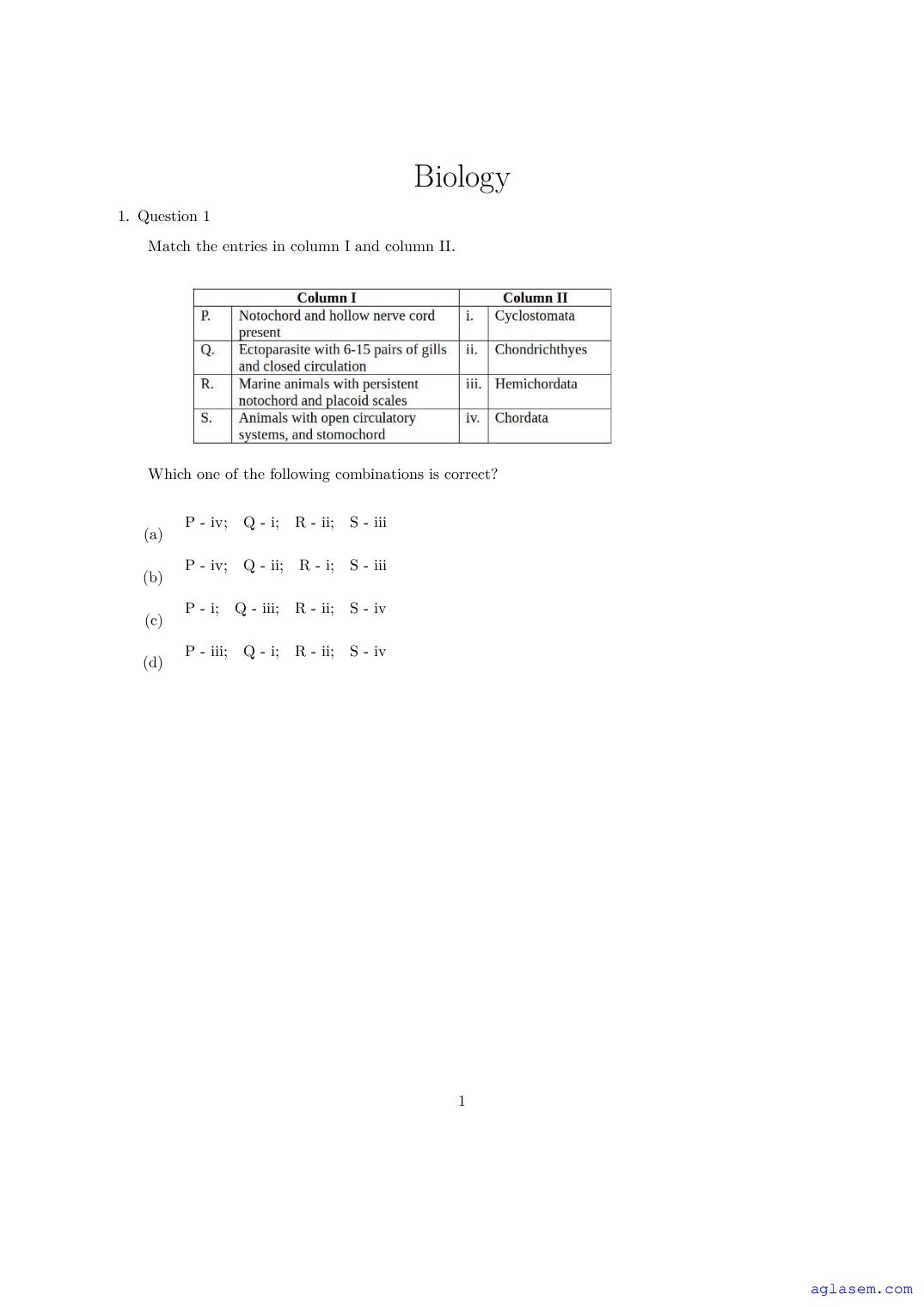
1. Question 1
Match the entries in column I and column II.
Which one of the following combinations is correct?
P - iv; Q - i; R - ii; S - iii
(a)
P - iv; Q - ii; R - i; S - iii
(b)
P - i; Q - iii; R - ii; S - iv
(c)
P - iii; Q - i; R - ii; S - iv
(d)
1
Page 2
Chromosomes are classified as metacentric, sub-metacentric, acrocentric and
telocentric. This classification is based on the position of which one of the
following structures?
Centromere
(a)
Centrosome
(b)
Centriole
(c)
Telomere
(d)
2
Page 3
Which one of the following options describes a triglyceride?
Three fatty acid chains linked to a molecule of glycerol
(a)
Three glycerol molecules linked to a fatty acid chain
(b)
Three saturated fatty acid chains linked to a molecule of cholesterol
(c)
Three glyceride molecules linked to a molecule of phospholipid
(d)
3
Page 4
Which one of the following statements about a plant carotenoid is FALSE?
It is an accessory pigment which absorbs light at 600 - 700 nm.
(a)
It protects chlorophyll a from photo-oxidation.
(b)
It provides precursor for the synthesis of stress hormone in plants.
(c)
It accumulates in chromoplasts during fruit ripening.
(d)
4
Page 5
A cell suspension of actively respiring mitochondria is treated with either
chemical X (experiment 1) or chemical Y (experiment 2), or left untreated
(experiment 3).
Chemical X selectively inhibits electron transport from Complex I to
ubiquinone, while chemical Y selectively inhibits electron transport from
Complex III to cytochrome C.
Which one of the following options represents the correct order of
relative number of ATP synthesised in mitochondria?
Experiment 2 < Experiment 1 < Experiment 3
(a)
Experiment 1 < Experiment 2 < Experiment 3
(b)
Experiment 1 = Experiment 2 = Experiment 3
(c)
Experiment 2 < Experiment 1 = Experiment 3
(d)
5
Page 6
Which one of the following autoregulatory mechanisms is employed by the
kidney when glomerular filtration rate is reduced?
Levels of renin, angiotensin I and II and aldosterone are increased.
(a)
Levels of renin and aldosterone are reduced.
(b)
Levels of renin are increased, while those of angiotensin I and II and
aldosterone are reduced.
(c)
Levels of angiotensin I and II are increased, while that of aldosterone are
reduced.
(d)
6
Page 7
Which one of the following conditions will favour maximum dissociation of
oxygen from the oxyhaemoglobin in the tissues?
higher [H+ ]; higher temperature
(a)
higher [H+ ]; lower temperature
(b)
lower [H+ ]; higher temperature
(c)
lower [H+ ]; lower temperature
(d)
7
Page 8
Which one of the following statements is correct?
Red muscle fibres produce ATP aerobically under normal oxygen conditions.
(a)
Mitochondria are more in white than in red muscle fibres.
(b)
Lactic acid accumulates more in red than in white muscle fibres under similar
conditions.
(c)
All muscle fibres primarily produce ATP anaerobically.
(d)
8
Page 9
Which one of the following organisms produces the female gamete by mitosis
of haploid cells?
Garden pea
(a)
Honey bee
(b)
Fruit fly
(c)
Chicken
(d)
9
Page 10
Which amino acid will be charged on the tRNA with anticodon 5Õ -GUU-3Õ ?
Asparagine (codon AAC)
(a)
Valine (codon GUU)
(b)
Leucine (codon UUG)
(c)
Glutamine (codon CAA)
(d)
10
Page 11
Two double heterozygous plants (PpQq), derived from two different pairs
of true-breeding parents of unknown genotype, produce gametes in the
proportions as given below.
Which one of the following options correctly represents the genotype of the
parents?
R1 = ppQQ ; R2 = PPqq ; R3 = PPQQ ; R4 = ppqq
(a)
R1 = PPQQ ; R2 = ppqq ; R3 = ppQQ ; R4 = PPqq
(b)
R1 = ppQQ ; R2 = PPqq ; R3 = PPqq ; R4 = ppQQ
(c)
R1 = PPQQ ; R2 = ppqq ; R3 = ppqq ; R4 = PPQQ
(d)
11
Page 12
What are retroviruses?
A group of viruses with RNA genome and reverse transcriptase activity
(a)
A group of viruses with DNA genome and no reverse transcriptase activity
(b)
A group of viruses with DNA genome and reverse transcriptase activity
(c)
A group of viruses with RNA genome and no reverse transcriptase activity
(d)
12
Page 13
The given picture was obtained from an agarose gel electrophoresis of a
plasmid after digestion with restriction enzymes either X, Y or both X and
Y.
Which one of the following diagrams correctly represents the position of the
restriction enzyme sites (X, Y) on the 10,000 bp plasmid?
(a)
(b)
13
Page 14
(d)
14
Page 15
Honey bee males are haploid and females are diploid. Which one of the
following statements is INCORRECT about honey bees?
Honey bee males cannot have daughters but can have sons.
(a)
Honey bee males are produced from unfertilized eggs and females are
produced from fertilized eggs.
(b)
A honey bee male does not have a father but has a grandfather.
(c)
Honey bee males form gametes by mitosis and females form gametes by
meiosis.
(d)
15
Page 16
Which one of the following statements is FALSE?
More than 80% of the solar energy incident on earth is captured by plants
and photosynthetic bacteria.
(a)
Only 10% of energy is transferred to each of the higher trophic levels in
grazing food chain.
(b)
All organisms of a trophic level should be included for estimation of energy
content of that trophic level.
(c)
The movement of energy is unidirectional in the ecological pyramid of
energy.
(d)
16
Page 17
1. Question 1
Which one of the following statements best describes the
acidic/basic/amphoteric nature of ZnO and CaO?
ZnO is amphoteric, while CaO is basic.
(a)
ZnO is basic, while CaO is amphoteric.
(b)
Both ZnO and CaO are amphoteric.
(c)
ZnO is acidic, while CaO is basic.
(d)
1
Page 18
Which among the following processes is/are associated with increasing bond
order but no change in diamagnetic/paramagnetic behaviour?
(i) N2 → N2 + + e−
(ii) O2 → O2 + + e−
(iii) O2 + e− → O2 −
(ii) only
(a)
(i) and (ii)
(b)
(ii) and (iii)
(c)
(iii) only
(d)
2
Page 19
What is the value of E ¶ (Fe3+ /Fe0 )?
[The standard reduction potential values are
E ¶ (Fe3+ /Fe2+ ) = 0.77 V, and E ¶ (Fe2+ /Fe0 ) = −0.44 V]
−0.04 V
(a)
0.33 V
(b)
0.11 V
(c)
−0.11 V
(d)
3
Page 20
What are the correct orders of stability for the following compounds?
VF5 > VCl5 ; CuCl2 > CuI2
(a)
VCl5 > VF5 ; CuCl2 > CuI2
(b)
VCl5 > VF5 ; CuI2 > CuCl2
(c)
VF5 > VCl5 ; CuI2 > CuCl2
(d)
4
Page 21
Consider the following reaction scheme:
Which among the following statements is correct?
P shows geometrical isomerism and absorbs light of higher wavelength than
that of Q.
(a)
Both P and Q show geometrical isomerism and P absorbs light of higher
wavelength than that of Q.
(b)
Q shows geometrical isomerism and absorbs light of higher wavelength than
that of P.
(c)
P shows geometrical isomerism and absorbs light of lower wavelength than
that of Q.
(d)
5
Page 22
How many β-hydrogen is/are present in 2-methyl-3-phenyl-pentan-1-al?
4
(a)
1
(b)
3
(c)
2
(d)
6
Page 23
Which of the following reactions do NOT provide an aldehyde as a product?
(a)
(b)
(c)
(d)
7
Page 24
What are the major products formed in the following reaction sequence?
(a)
(b)
(c)
(d)
8
Page 25
What is the major product in the reaction sequence given below?
(a)
(b)
(c)
(d)
9
Page 26
Compound I undergoes hydroboration-oxidation reaction with (BH3 )2
followed by treatment with H2 O2 and aqueous NaOH to produce
another compound II, which upon oxidation with CrO3 gives
2,3-dimethyl-cyclohexanone as the product. What is the structure of I?
(a)
(b)
(c)
(d)
10
Page 27
The work done when one mole of an ideal gas expands at constant
temperature T from volume V to 2V (in two equal steps of volume in a
7
linear fashion) is 12 RT . How much more work would be done by the gas if
it expands in three equal steps?
[R is the universal gas constant]
1
30 RT
(a)
3
8 RT
(b)
3
4 RT
(c)
!1"
-RT ln 15
(d)
11
Page 28
At a particular temperature, the magnitude of the rate constant of a
reaction is 5 × 10⁻⁵ and the unit of the pre-exponential factor of the
Arrhenius equation for this reaction is mol L−1 min−1 . Which of the
following plots is correct for this reaction?
[Note: [R]0 is the initial concentration and t1/2 is the half-life of the reaction]
(a)
(b)
(c)
12
Page 29
13
Page 30
What is the time period of revolution of an electron in the fourth Bohr
orbit of He+ ?
[Bohr radius = 52.9 picometers, mass of an electron = 9.11 × 10⁻³¹ kg,
Planck’s constant = 6.626 × 10⁻³⁴ Js]
2.4 femtoseconds
(a)
4.8 femtoseconds
(b)
24 femtoseconds
(c)
0.24 femtoseconds
(d)
14
Page 31
The dipole moments of three AB3 -type molecules I, II, and III are measured
to be 0.0 D, 0.2 D, and 1.5 D, respectively. Which one of the following
options is correct regarding the identity of I, II, and III?
I: BF3 , II: NF3 , III: NH3
(a)
I: BF3 , II: NH3 , III: NF3
(b)
I: ClF3 , II: NF3 , III: NH3
(c)
I: BCl3 , II: NH3 , III: NF3
(d)
15
Page 32
During the charging and discharging of a lead-acid battery (a Pb anode, a
grid of Pb packed with PbO2 as cathode, and an aqueous solution of H2 SO4
as an electrolyte), which of the following redox reactions does NOT occur?
Pb4+ + 4e− → Pb
(a)
Pb2+ → Pb4+ + 2e−
(b)
Pb → Pb2+ + 2e−
(c)
2Pb2+ → Pb4+ + Pb
(d)
16
Page 33
1. Question 1
How many three digit numbers divisible by 5 are there in which no digits
are repeated?
(a) 136
(b) 128
(c) 144
(d) 162
1
Page 34
Let A be a 3 × 3 matrix with real entries such that
4 −1 cos x
A = −1 5x 25 .
2
x + 1 25 7
For how many values of x, the matrix A is symmetric?
(a) 1
(b) 2
(c) 4
(d) infinitely many
2
Page 35
10 3 42r
ÿ 2
Let n = (−1)r 10 Cr 320 . Which one of the following statements
r=0
3
is TRUE?
(a) n is divisible by 5
(b) n is divisible by 6
(c) n is divisible by 8
(d) n is divisible by 9
3
Page 36
Let f : R → R be the function given by f (x) = cos (tan−1 x). Which one
of the following statements is TRUE?
(a) f is decreasing for x > 0
(b) f is decreasing for x < 0
(c) f is decreasing on R
(d) f is decreasing on the interval (−1, 1)
4
Page 37
Let ; 5 6 <
- 3x − 1 2
A= x ∈ R - − 31 < det ≤ 29 .
−2 5
Which one of the following statements is TRUE?
(a) A = (−2, 2]
(b) A = (−2, 2)
(c) A = [−2, 2)
(d) A = [−2, 2]
5
Page 38
Let z1 , z2 , and z3 be complex numbers satisfying the following conditions
- -
-1 1 1 --
2 = |2z1 | = |z2 − 1| = |z3 + 1| = -- + + .
z1 z2 − 1 z 3 + 1 -
What is the value of |4z1 + z2 + z3 |?
(a) 8
(b) 4
1
(c) 4
1
(d) 8
6
Page 39
Let f : R → R be defined as f (x) = |x3 − 3x|[x], where [x] denotes
the greatest integer less than or equal to x. Which one of the following
statements is TRUE?
(a) Every non-zero integer is a point of discontinuity of f
(b) f is continuous at every real number
(c) Every integer is a point of discontinuity of f
√
(d) f is continuous at every real number except for 0, ± 3
7
Page 40
3 √ 4
2 2 3
Let ¸ be the tangent line to the ellipse x + 16y = 4 at 1, . What is
4
the equation of the line perpendicular to ¸ passing through (2, 0)?
√
(a) y = 4 3(x − 2)
√
(b) y = 2 3(x − 2)
√
(c) y= 3(x − 2)
√
(d) 4 3y = (x − 2)
8
Page 41
Let ˛a and ˛b be two vectors such that |˛a + ˛b| = 15 and
˛a × (3î − 4ĵ + 5k̂) = (3î − 4ĵ + 5k̂) × ˛b.
What is the value of |(˛a + ˛b) · (2î + 3ĵ + k̂)|?
3
(a) √
2
(b)
0
(c)
√
2
(d) 3
9
Page 42
What is the derivative of log(sin2 x) with respect to sin x?
(a) 2 cosec x
(b) sin 2x
(c) 4 cosec x
(d) cot x cosec 2x
10
Page 43
Let Sn denote the sum of the first n terms of a sequence a1 , a2 , a3 , . . .. If
Sn+3 − Sn = 13n + 7 for all n, what is the value of a13 − a10 ?
(a) 13
(b) 137
(c) 46
(d) 12
11
Page 44
Five fair coins are tossed independently. What is the probability that at
least two heads appear?
13
(a)
16
7
(b)
16
5
(c)
16
11
(d)
16
12
Page 45
Let f : R → R be the function defined by
I
x2 − 4x − 5 if x ≥ 1,
f (x) =
2x if x < 1.
Which one of the following statements is TRUE?
(a) f is onto but not one-one
(b) f is one-one but not onto
(c) f is neither one-one nor onto
(d) f is one-one and onto
13
Page 46
Which one of the following is the solution of the differential equation
dy
x2 + 9xy = x4 (for x > 0),
dx
given that y = 0 when x = 1?
1
(a) 12y = x3 −
x9
1
(b) 12y = x9 −
x3
1
(c) 9y = x21 −
x3
1
(d) 9y = x3 −
x21
14
Page 47
⁄π
What is the value of x| cos x| sin x dx?
0
π
(a)
2
π
(b)
4
(c) π
π
(d)
6
15
Page 48
1. Question 1
Consider an elastic collision between two particles A and B of same mass,
moving in the same direction. Particle A is moving at speed vA and particle
B is moving at speed vB . In the figures shown, the solid lines represent
the motion before the collision and the dotted lines represent the motion
after the collision. Which of the following describes the motion of these two
particles most accurately?
(a)
(b)
(c)
(d)
1
Page 49
A block of mass M lies at rest connected to a massless spring of spring
constant k on a frictionless surface. A bullet of mass m hits the block
horizontally with speed v as shown in the figure and is completely stuck
to the block. What is the maximum compression in the spring resulting
from this impact (assuming that at this point the spring is still not fully
compressed)?
Û
m2 v 2
k(M + m)
(a)
Ú
mv 2
k
(b)
Ú
M v2
k
(c)
Û
mM v 2
k(M + m)
(d)
2
Page 50
A cart of mass M is released from A, the highest point of a frictionless
track, as shown in the figure. The cart travels along the track and enters
the semicircular arc DBC of radius R. The heights of the points A and
B are h1 and h2 from the ground, respectively. Which of the following
quantities does not play any role in ensuring that the cart does not leave
the track?
M
(a)
h1
(b)
h2
(c)
R
(d)
3
Page 51
A circular disk of mass M and radius R is rotating clockwise with a uniform
angular velocity ω about an axis passing through the centre, normal to the
disk. At time t = 0, a torque T is applied along the same axis to oppose
the rotation of the disk. What is the angular displacement θ (measured
from t = 0 in the clockwise direction) that the disk attains before it starts
rotating counterclockwise?
ω 2 M R2
θ=
4T
(a)
ω 2 M R2
θ=
8T
(b)
ω 2 M R2
θ=−
4T
(c)
ω 2 M R2
θ=−
8T
(d)
4
Page 52
A metallic cube initially kept at a temperature T is emitting black body
radiation with a power P (energy emitted per unit time). If T is increased by
1 %, the power being radiated increases by 4.5 %. What is the approximate
percentage increase in the volume of the cube in this process?
0.75 %
(a)
0.50 %
(b)
1.56 × 10⁻⁶ %
(c)
6.25 × 10⁻⁶ %
(d)
5
Page 53
Consider two pipes A and B of identical length. A has one end closed and
one end open. B has both ends open. Each tube is immersed in a closed
chamber of ideal gas having volume V . The chamber containing tube A is
at temperature TA and the chamber containing tube B is at temperature
TB . The sound frequencies corresponding to the nA -th harmonic in tube
A and the nB -th harmonic in tube B are the same. What is the relation
between the temperatures TA and TB ?
4n2B
3 4
TA = TB
n2A
(a)
4n2A
3 4
TA = TB
n2B
(b)
n2A
3 4
TA = TB
4n2B
(c)
n2B
3 4
TA = TB
4n2A
(d)
6
Page 54
Consider two
√ waves, which are given by y1 (x, t) = A sin(kx − ωt) and
y2 (x, t) = 3A cos(kx − ωt), where k is the wave number and ω is the
angular frequency. The amplitude of the resultant waveform obtained by
the superposition of the two waves is As and its phase difference with y1 is
φs . What are As and φs ?
π
As = 2A and φs =
3
(a)
π
As = 2A and φs =
6
(b)
A π
As = and φs =
2 3
(c)
A π
As = and φs =
2 6
(d)
7
Page 55
A particle of charge q = 1e and mass m with kinetic energy K enters an
electric field set up by two parallel plates of length l as illustrated in the
figure. The potential difference between the two plates is 1 V and their
separation is d. What is the minimum value of K (in eV) for which the
particle will not hit either of the plates?
[e is the charge of the electron.]
l2
2d2
(a)
d2
2l2
(b)
l2
d2
(c)
d2
l2
(d)
8
Page 56
What is the potential difference between the points P and Q in the circuit
shown below, once the capacitors are fully charged?
P
µF
2
µF
4
2
µF
µF
4
Q
12V
4V
(a)
0V
(b)
8V
(c)
12 V
(d)
9
Page 57
A particle of mass m and charge q moving with a velocity ˛v = v0 (î + ĵ − k̂)
˛ = B0 (î + ĵ + k̂). It executes a helical
is placed in a uniform magnetic field B
trajectory of radius r and pitch p. Which of the following options is correct?
√
2 2mv0 2πmv0
r= and p =
3qB0 3qB0
(a)
mv0 2πmv0
r= and p =
3qB0 3qB0
(b)
√ √
2 2mv0 4 2πmv0
r= and p =
3qB0 3qB0
(c)
√
2πmv0 2 2mv0
r= and p =
3qB0 3qB0
(d)
10
Page 58
A charged particle is moving in a circular orbit with radius r and orbital
angular frequency ω in the presence of a magnetic field. The orbit is
enclosed within a larger circular metallic frame. The frame is concentric
and coplanar with the orbit. The radius of the frame is now gradually
decreased. Assuming that the particle remains within the frame at all times,
what changes to the trajectory of the particle will occur as the frame is being
shrunk?
The radius of the orbit will gradually decrease and the frequency will
gradually increase.
(a)
The radius of the orbit will gradually increase and the frequency will
gradually decrease.
(b)
The radius of the orbit will remain the same but the frequency will gradually
increase.
(c)
Both the radius of the orbit and the frequency will remain unchanged.
(d)
11
Page 59
Consider an equilateral prism of refractive index 1.5 and a parallelepiped
block of refractive index 2.0 arranged as shown in the figure such that their
adjacent faces are parallel. A light ray enters the prism from air at an angle
of incidence such that the ray travels through the prism parallel to its base.
What is the angle of emergence θ?
sin−1 (3/4)
(a)
sin−1 (1/3)
(b)
sin−1 (1/2)
(c)
√
sin−1 ( 3/2)
(d)
12
Page 60
A source produces a light beam of intensity I0 polarized along the
x-direction. The beam is sent along the z-direction. It enters a polaroid P 1
with its polaroid axis aligned along the y-direction so that no light exits the
polaroid. When another polaroid P 2 is placed in between the source and
P 1, the intensity measured after P 1 is 3I0 /16. Which among the following
is a possible value of θ, the angle of the polaroid axis measured from the
x-axis?
Polarisation of
incident light
60
(a)
15
(b)
45
(c)
75
(d)
13
Document Details
| Board / Org | Default |
| Exam | IISER Aptitude Test |
| Type | Question Paper |
| Pages | 61 |
| Updated | 24 Sep 2026 |