MAHA SET 2018 Question Paper 3 Psychology
Finished viewing? Save it for later —
Download MAHA SET 2018 Question Paper 3 Psychology (PDF · 49 pages)About MAHA SET 2018 Question Paper 3 Psychology
MAHA SET 2018 Question Paper 3 Psychology is available here for free download. Published by Maharashtra Exams for MAHA SET, this question paper can be viewed online or downloaded as a PDF (49 pages). Candidates preparing for MAHA SET can use MAHA SET 2018 Question Paper 3 Psychology to understand the exam pattern, the type of questions asked, and the overall difficulty level.
Frequently Asked Questions
How can I download MAHA SET 2018 Question Paper 3 Psychology?
Open this page and click the Download button to save MAHA SET 2018 Question Paper 3 Psychology as a PDF. It is completely free on AglaSem Docs.
Is MAHA SET 2018 Question Paper 3 Psychology free to download?
Yes. MAHA SET 2018 Question Paper 3 Psychology can be viewed online and downloaded as a PDF free of cost on AglaSem Docs.
How many pages does MAHA SET 2018 Question Paper 3 Psychology have?
MAHA SET 2018 Question Paper 3 Psychology contains 49 pages, which you can read online or download together as a single PDF.
Where can I find more MAHA SET study material?
You can find more MAHA SET question papers, sample papers, syllabus, and answer keys on AglaSem Docs.
MAHA SET 2018 Question Paper 3 Psychology – Text
Read the full text of this question paper below — useful to quickly search, copy and reference the content online without downloading the PDF.
📄 View text version (49 pages)
Page 1
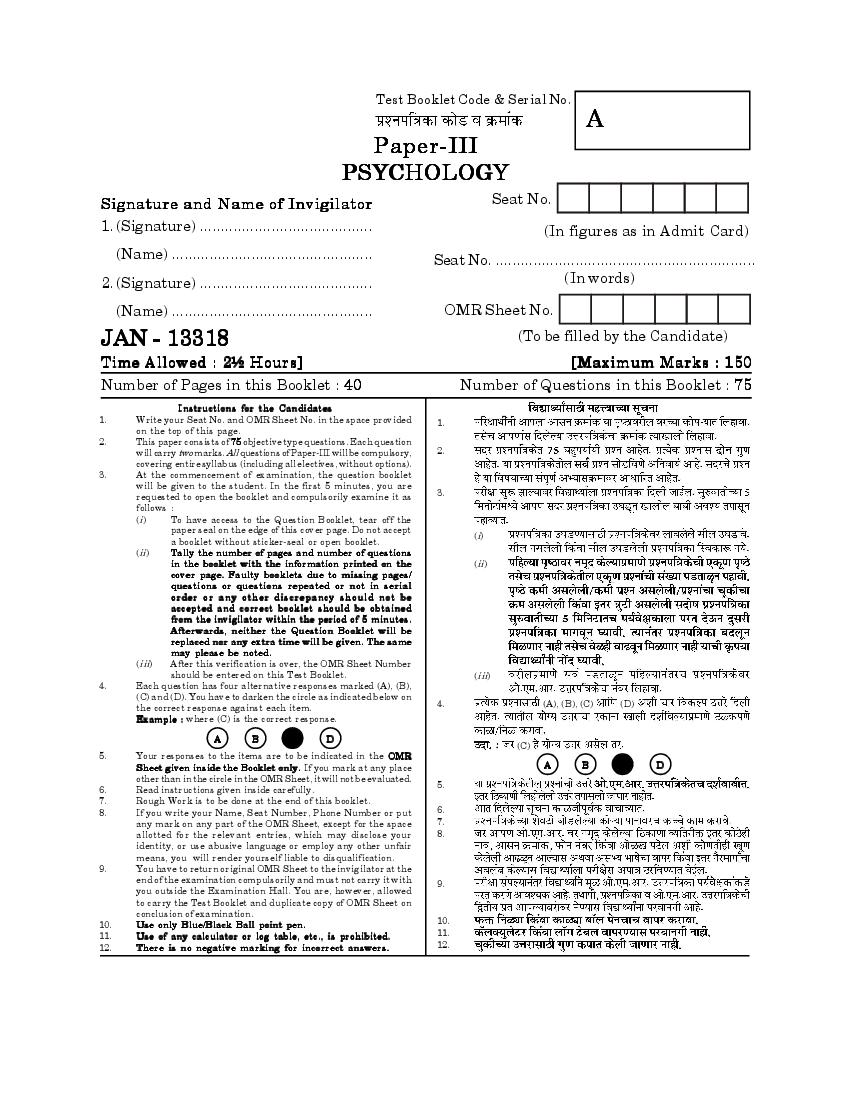
A
Paper-III
PSYCHOLOGY
Signature and Name of Invigilator Seat No.
1. (Signature) ......................................... (In figures as in Admit Card)
(Name) ................................................ Seat No. ..............................................................
2. (Signature) ......................................... (In words)
(Name) ................................................ OMR Sheet No.
JAN - 13318 (To be filled by the Candidate)
Time Allowed : 2½ Hours] [Maximum Marks : 150
Number of Pages in this Booklet : 40 Number of Questions in this Booklet : 75
Instructions for the Candidates
1. Write your Seat No. and OMR Sheet No. in the space provided 1.
on the top of this page.
2. This paper consists of 75 objective type questions. Each question
will carry two marks. All questions of Paper-III will be compulsory, 2.
covering entire syllabus (including all electives, without options).
3. At the commencement of examination, the question booklet
will be given to the student. In the first 5 minutes, you are
requested to open the booklet and compulsorily examine it as 3.
follows :
(i) To have access to the Question Booklet, tear off the
paper seal on the edge of this cover page. Do not accept
(i)
a booklet without sticker-seal or open booklet.
(ii) Tally the number of pages and number of questions
in the booklet with the information printed on the (ii)
cover page. Faulty booklets due to missing pages/
questions or questions repeated or not in serial
o rder or any other discre pancy should not be
accepted and correct booklet should be obtained
from the invigilator within the period of 5 minutes.
Afterwards, neither the Question Booklet will be
replaced nor any extra time will be given. The same
may please be noted.
(iii) After this verification is over, the OMR Sheet Number
should be entered on this Test Booklet. (iii)
4. Each question has four alternative responses marked (A), (B),
(C) and (D). You have to darken the circle as indicated below on
the correct response against each item. 4. (A), (B), (C) (D)
Example : where (C) is the correct response.
A B D
(C)
5. Your responses to the items are to be indicated in the OMR
Sheet given inside the Booklet only. If you mark at any place A B D
other than in the circle in the OMR Sheet, it will not be evaluated.
5.
6. Read instructions given inside carefully.
7. Rough Work is to be done at the end of this booklet.
8. If you write your Name, Seat Number, Phone Number or put 6.
any mark on any part of the OMR Sheet, except for the space 7.
allotted for the relevant entries, which may disclose your 8.
identity, or use abusive language or employ any other unfair
means, you will render yourself liable to disqualification.
9. You have to return original OMR Sheet to the invigilator at the
end of the examination compulsorily and must not carry it with 9.
you outside the Examination Hall. You are, however, allowed
to carry the Test Booklet and duplicate copy of OMR Sheet on
conclusion of examination.
10. Use only Blue/Black Ball point pen. 10.
11. Use of any calculator or log table, etc., is prohibited. 11.
12. There is no negative marking for incorrect answers. 12.
Page 2
Page 3
Paper III
III
Time Allowed : 2½ Hours] [Maximum Marks : 150
Note : This Question Paper contains Seventy Five (75) multiple choice questions.
Each question carries Two (2) marks. Attempt All questions.
(75) (2)
1. Alanon is a group intervention 1.
approach for families of people
with :
(A)
(A) mental retardation
(B)
(B) alcoholism
(C) cancer (C)
(D) alzheimer’s disease (D)
2. Tendency of a person to be less 2.
productive in a group than working
individually is known as :
(A) Group pressure (A)
(B) Group conformity (B)
(C) Social loafing (C)
(D) Social support (D)
3 [P.T.O.
Page 4
(A) “Mainstreams” special children (A)
(B) Accommodates a diverse range (B)
of learners
(C) Integrates special children (C)
(D)
(D) Creates a special division for
special children
4. According to Bronfenbrenner’s 4.
approach to human development,
Macrosystem represents :
(A) broader influences on an (A)
individual
(B)
(B) binds children to parents,
student to teachers etc.
(C) larger cultural influences on an (C)
individual
(D) immediate influences on an
(D)
individual
4
Page 5
use to measure subjective well-being
of an individual is to :
(A) use a questionnaire (A)
(B) use a lie detector (B)
(C) ask a friend (C)
(D) ask a parent (D)
6. Effort to fend off stressful situations 6.
before they occur are called :
(A) Emotion-focused coping
(A)
(B) problem-focused coping
(B)
(C) Self-efficacy (C)
(D) Proactive coping (D)
7. The cultural test bias hypothesis 7.
states :
(A) group differences reflect (A)
artifacts of the test
(B) difference in performance is due (B)
to differences in culture
(C) the bias resides in cultural (C)
aspects like poverty
(D) we need to test the entire (D)
culture to assess bias
5 [P.T.O.
Page 6
personality scale is an example of
a(n) scale :
(A) nominal
(A)
(B) ordinal
(B)
(C) ratio
(C)
(D) interval (D)
9. For an experiment comparing 9.
more than two treatment conditions
you should use analysis of
variance rather than separate t-tests
because :
(A) A test based on variance is
(A)
more sensitive
(B) You are less likely to make a
(B)
mistake in the computation of
ANOVA
(C) II
(C) ANOVA has less risk of
Type II error
(D) I
(D) ANOVA has less risk of a
Type I error
6
Page 7
psychotherapeutic orientations
adopt a basically optimistic view of
life ?
(A) Cognitive-behavioural and (A)
experimental
(B) Cognitive-behavioural and
(B)
psychoanalytic
(C) Experimental and existential
(C)
(D) Existential and psycho-
analytic (D)
11. Which of the following traits are 11.
more associated with creativity ?
(1) Low intelligence and (1)
persistence.
(2)
(2) Moderate to high intelligence
and curiosity.
(3)
(3) Non-conformity and persistence.
Codes :
(A) (1) and (2) (A) (1) (2)
(B) (2) and (3) (B) (2) (3)
(C) (1) and (3) (C) (1) (3)
(D) (1), (2) and (3) (D) (1), (2) (3)
7 [P.T.O.
Page 8
(A) Imaginative thinking (A)
(B) Insightful thinking (B)
(C) Autistic thinking (C)
(D) Convergent thinking (D)
13. In ‘simple heuristics’, rather than 13.
aiming for the best solution to a
problem, people tend to choose the
first alternative that gives an
acceptable solution to the problem.
This is known as :
(A)
(A) a judgement call
(B)
(B) satisficing
(C) choosing among alternatives (C)
(D) solution-focused coping (D)
8
Page 9
was necessary for an operant
behaviour to be acquired.
Observational learning, however,
demonstrates that a behaviour can
also be acquired as a result of :
(A) Punishment (A)
(B) Classical conditioning
(B)
(C) Observing another individual’s
(C)
behaviour and the reinforce-
ment of his behaviour
(D) Instinctive drift (D)
15. Behaviour modification programmes 15.
may be designed to :
(A) increase response strength (A)
(B) reduce response strength (B)
(C) either increase or decrease (C)
response strength
(D) neither increase nor decrease (D)
response strength
9 [P.T.O.
Page 10
encountered in the following model
of psychotherapy : (A)
(A) Mindfulness based approaches
(B) Hypnotherapy (B)
(C) Cognitive behaviour therapy (C)
(D) dialectical behaviour therapy (D)
17. Match List I with List II and select 17. I II
the correct answer using codes
given below :
I
List I
(Theorists)
(P)
(P) Alderfer
(Q)
(Q) Herzberg
(R)
(R) Vroom
(S)
(S) Maslow
II
List II
(Theories)
(1) Hierarchy of needs (1)
(2) Valence (2)
(3) Two-factors (3)
(4) ERG needs (4)
Codes :
(P) (Q) (R) (S) (P) (Q) (R) (S)
(A) (4) (3) (2) (1) (A) (4) (3) (2) (1)
(B) (3) (4) (1) (2) (B) (3) (4) (1) (2)
(C) (1) (2) (3) (4) (C) (1) (2) (3) (4)
(D) (2) (1) (4) (3) (D) (2) (1) (4) (3)
10
Page 11
economic importance of education.
R : Educational attainments have
R :
a significant effect on countries’
economic performance.
(A) A and R are both true and R (A) A R
is the correct explanation for A R A
(B) A and R are both true but R (B) A R
is not the correct explanation
R A
for A
(C) A R
(C) A is true but R is false
(D) A is false but R is true (D) A R
19. In general, when it comes to infants 19.
cognitive development, it appears
that Piaget :
(A) overestimated infants (A)
(B) underestimated infants (B)
(C) was more accurate about (C)
cognitive development
(D) overestimated the role of
culture (D)
20. Reciprocal helping and kin selection 20.
are two main kinds of helping,
according to the :
(A) arousal : cost-reward model (A)
(B) empathy-altruism hypothesis (B)
(C) negative state relief model (C)
(D) evolutionary perspective (D)
11 [P.T.O.
Page 12
21.
of cognitive dissonance if they :
(A) Experience no physiological
around (A)
(B) Engage in attitude-inconsistent
(B)
behaviour
(C) Engage in attitude-consistent (C)
behaviour
(D)
(D) Experience negative un-
foreseeable consequences
22. Ordinal scales : 22.
(A) involve rank (A)
(B) have true zero (B)
(C) have equal intervals (C)
(D) have an arbitrary zero (D)
12
Page 13
X can predict a behaviour with 100% 100%
accuracy, most likely is breaking the
ethical principle of :
(A) competence (A)
(B) integrity (B)
(C) respect of privacy (C)
(D) concern for others’ welfare (D)
24. A repeated measure experiment and 24.
an independent measure experiment
both produce t -statistics with
df = 20. Which experiment used (df = 20)
more subjects ?
(A) They both used n = 21 subjects (A) n = 21
(B) They both used n = 22 subjects (B) n = 22
(C) Independent measures (C)
(D) Repeated measures (D)
13 [P.T.O.
Page 14
to denial of thoughts and feelings
because self-actualization has been
thwarted is found in the :
(A)
(A) Psychodynamic approach
(B)
(B) Existential-humanistic approach
(C) Behavioural approach (C)
(D) Biological-medical approach (D)
26. Guilford’s tests are typically 26.
characterized by :
(A) Highly creative instructions (A)
(B) One correct answer per item (B)
(C) Very brief time periods (C)
(D) Lack of a theoretical framework (D)
14
Page 15
term is called :
(A) A conditional (A)
(B) The antecedent (B)
(C) A connective (C)
(D) The consequent (D)
28. The easier it is for people to 28.
remember on instance in which they
were betrayed by a friend, the more
they except such an event to recur,
this best illustrates the impact of :
(A)
(A) The heuristic principle
(B)
(B) The example principle
(C)
(C) The analogical problem solving
(D) Means-end analysis (D)
15 [P.T.O.
Page 16
that she must wash her hands before
snack-time in order to get a snack.
At home, she has started to wash
her hands before eating. Priyanka’s
behaviour illustrates the process of :
(A)
(A) Stimulus generalization
(B)
(B) Response generalization
(C)
(C) Response discrimination
(D) Stimulus discrimination (D)
30. When a child asks for a candy only 30.
when at the grocery store with their
grandmother and not when with
their mother, the presence of their
grandmother is acting as a :
(A) Discriminating stimulus
(A)
(B) Observational learning
(C) Variable-interval reinforcement (B)
schedule
(C)
(D) Fixed-ratio reinforcement
schedule (D)
16
Page 17
choose the correct answer from the
(1)
options given below :
(1) A pneumoencephalogram is also
(2)
called an air encephalogram
(2) The procedure involves a
lumbar puncture (3)
(3) CSF is withdrawn and replaced
with air, oxygen or helium
(4)
(4) Pneumoencephalograms do not
show the ventricular system
Codes :
(A) (1) (2)
(A) (1) and (2) only
(B) (1), (2) (3)
(B) (1), (2) and (3) only
(C) (1), (3) (4)
(C) (1), (3) and (4) only
(D) (1), (2), (3) and (4) (D) (1), (2), (3) (4)
17 [P.T.O.
Page 18
with :
(A) 21
(A) Trisomy 21
(B)
(B) Cri du chat syndrome
(C) XXY
(C) XXY chromosome combination
(D) XO chromosome aberration (D) XO
33. Religious leaders are more likely
33.
to be :
(A)
(A) Charismatic
(B)
(B) Transformational
(C)
(C) Authoritarian
(D) Task oriented (D)
18
Page 19
the correct answer using codes
given below :
I
List I
(Theorists)
(P)
(P) Freud
(Q)
(Q) McDougall
(R)
(R) Kohlberg
(S)
(S) Mayer
II
List II
(Concepts)
(1)
(1) Curiosity instinct
(2)
(2) Life instinct
(3)
(3) Emotional development
(4) Moral development (4)
Codes :
(P) (Q) (R) (S) (P) (Q) (R) (S)
(A) (3) (4) (1) (2) (A) (3) (4) (1) (2)
(B) (1) (2) (3) (4) (B) (1) (2) (3) (4)
(C) (2) (1) (4) (3) (C) (2) (1) (4) (3)
(D) (4) (3) (2) (1) (D) (4) (3) (2) (1)
19 [P.T.O.
Page 20
meaning of words after only a brief
encounter. This is also known as :
(A) Synaptic explosion (A)
(B) Word unification (B)
(C) Social speech (C)
(D) Fast mapping (D)
36. Which one of the following is 36.
the recent perspectives in Social
Psychology ?
(A)
(A) Social neuroscience
(B)
(B) Behavioural
(C)
(C) Evolutionary
(D) Cross-cultural (D)
20
Page 21
following in the brain :
(A) Myelin distribution (A)
(B) Vascular system (B)
(C) Cell degeneration (C)
(D) Sugar absorption (D)
38. Lumbar punctures can be used to 38.
diagnose :
(1)
(1) Bacterial meningitis
(2)
(2) Viral infections
(3)
(3) Brain abcess and tumor
(4)
(4) Multiple sclerosis
Codes :
(A) (1) (2)
(A) (1) and (2) only
(B) (2) (3)
(B) (2) and (3) only
(C) (2), (3) (4)
(C) (2), (3) and (4)
(D) (1), (2), (3) and (4) (D) (1), (2), (3) (4)
21 [P.T.O.
Page 22
ethical practice(s) observed while
using psychological tests ?
(1) Maintaining the test results
(1)
confidential.
(2)
(2) Obtaining informed consent
from participants.
(3)
(3) Communicating test results to
adults only.
Codes :
(A) (1) only (A) (1)
(B) (2) only (B) (2)
(C) (1) and (2) (C) (1) (2)
(D) (2) and (3) (D) (2) (3)
40. Which one of the following is not a 40.
requirement for the use of Pearson’s
correlation coefficient ?
(A)
(A) Linear relationship
(B)
(B) Random sampling
(C)
(C) Normal distribution
(D) Large sample size (D)
22
Page 23
possess an innate push toward
positive growth and change” is
called :
(A) Self-fulfillment (A)
(B) Need for achievement (B)
(C) Striving for superiority (C)
(D) Unconditional positive regard (D)
42. In regard to the relationship 42.
between Torrance test scores and
intelligence test scores :
(A) there is a pattern of very high
correlation (A)
(B) the relationship is substantial
but only in children
(B)
(C) there is a pattern of low
(C)
correlations
(D)
(D) there is a significant relation-
ship but only in the elderly
23 [P.T.O.
Page 24
(A) A person devaluates importance
(A)
of cognition
(B) Two cognitions have nothing in
common (B)
(C) A cognition contradicts an (C)
initial thought or belief
(D) State of harmony and internal
(D)
consistency arising from
compatibility among a person’s
attitudes, behaviour etc.
44. Which of the following mnemonics 44.
are used for improvement of
memory ?
(1) Imagery (1)
(2) Method of loci (2)
(3) Organization (3)
(4) Closure (4)
Codes :
(A) (1) and (2) (A) (1) (2)
(B) (1) and (3) (B) (1) (3)
(C) (2) and (3) (C) (2) (3)
(D) (3) and (4) (D) (3) (4)
24
Page 25
45.
that is very durable and relatively
hard to extinguish is said to show :
(A) High association with rein-
forcement (A)
(B) Low association with rein-
(B)
forcement
(C)
(C) High resistance to extinction
(D) Low resistance to extinction (D)
46. When noise presentation is 46.
responded to with a “no” (for signal
presence) it is called a :
(A) hit (A)
(B) correct rejection (B)
(C) miss (C)
(D) fabe alarm (D)
25 [P.T.O.
Page 26
(A) Absolute threshold (A)
(B) Difference threshold (B)
(C) Sensory adaptation (C)
(D) Approximate threshold (D)
48. Folie à deux is a type of : 48.
(A) Anxiety disorder
(A)
(B) Depressive disorder
(B)
(C) Delusional disorder
(C)
(D) Sleep disorder (D)
49. Which of the following are the 49.
components of training programme
evaluation ?
(1)
(1) Reaction
(2)
(2) Learning
(3)
(3) Positive attitude
(4)
(4) Result
Codes :
(A) (1) and (2) (A) (1) (2)
(B) (2) and (3) (B) (2) (3)
(C) (1), (2) and (3) (C) (1), (2) (3)
(D) (1), (2) and (4) (D) (1), (2) (4)
26
Page 27
about the dialogic teaching ?
(A) It is collective (A)
(B) It is individualistic (B)
(C) It is reciprocal (C)
(D) It is cumulative (D)
51. According to Kohlberg, moral 51.
development proceeds from a
concern with :
(1)
(1) Rewards and punishment
(2)
(2) Through a focus on social
conventions and rules
(3) Toward a sense of Universal (3)
Moral Principle (4)
(4) The development of super-ego
Select the correct option from the
codes given below :
Codes :
(A) (1), (3) (4)
(A) (1), (3) and (4) only
(B) (2), (3) (4)
(B) (2), (3) and (4) only
(C) (1), (2) (3)
(C) (1), (2) and (3) only
(D) (1), (2) and (4) only (D) (1), (2) (4)
27 [P.T.O.
Page 28
52.
characterized by establishing
independence, developing an
identity and thinking more
abstractly ?
(A)
(A) Middle childhood
(B)
(B) Late childhood
(C) Adolescence (C)
(D) Early adulthood (D)
53. Electromyography is the electrical 53.
analysis of :
(A) Muscles (A)
(B) Bones (B)
(C) Muscles and bones (C)
(D) Blood flow (D)
28
Page 29
variables and Y is the criterion Y
variable, which one of the following
will produce the coefficient of
multiple correlation ?
(A) X1 Y
(A) Correlation of X1 with Y
(B) X1, X2 X3
(B) Correlation of X1, X2 and X3
(C) X 1 , X 2 , X 3 Y
(C) Correlation of X1, X2, X3 and Y
(D) Correlation of X1, X2 and X3 (D) X1, X2 X3 Y
with Y
55. The existential-humanistic approach 55.
typically states that humans have
an inborn drive to :
(A) Maintain equilibrium (A)
(B) Self-actualize (B)
(C) Reduce tension (C)
(D) Increase ego-strength (D)
29 [P.T.O.
Page 30
56.
capacity to motivate behaviour is
referred to as :
(A)
(A) An incentive
(B)
(B) A drive
(C) A homeostatic mechanism (C)
(D) An expectancy (D)
57. Which component of an emotion
57.
refers to the bodily arousal of that
emotion ?
(A)
(A) Cognitive
(B)
(B) Physiological
(C)
(C) Affective
(D) Behavioural (D)
30
Page 31
world is also known as their :
(A) Semantic memory (A)
(B) Implicit memory (B)
(C) Consciousness (C)
(D) Long-term memory (D)
59. Loss of memory for events that a 59.
person experienced prior to some
traumatic injury to the brain is
called :
(A)
(A) Proactive interference
(B)
(B) Retractive interference
(C)
(C) Anterograde amnesia
(D) Retrograde amnesia (D)
31 [P.T.O.
Page 32
will produce points :
(A) Below no bias line
(A)
(B) Near no bias line
(B)
(C) Above no bias line (C)
(D) Far below no bias line (D)
61. Paraphilias are disorders pertaining 61.
to :
(A) Sexual functioning (A)
(B) Sleep (B)
(C) Appetite (C)
(D) Social behaviours (D)
62. Visioning exercise in organization 62.
has the primary objective of :
(A) Improving visual acuity among
employees
(A)
(B) Enhancing leadership effective-
ness (B)
(C) Training employees to enhance (C)
commitment to organization
(D) Bridging the gap between
(D)
individual and organization’s
goals
32
Page 33
about the principle of growth and
development ?
(A)
(A) Development is predictable
(B)
(B) Development is spiral and non-
(C)
linear
(C) It moves from specific to general
(D)
(D) Development is non-spiral and
linear
64. According to Erikson, individuals in 64.
late adulthood engage in looking
back over their lives, evaluating
their experiences, and coming to
terms with decisions. This is also
known as :
(A) ego transcendence Vs . ego
(A)
preoccupied
(B)
(B) acceptance of growing old
(C) generativity Vs. stagnation (C)
(D) ego integrity Vs. despair (D)
33 [P.T.O.
Page 34
that emphasized the role of social
and cultural context in cognition and
language development ?
(A) Lev Vygotsky (A)
(B) Noam Chomsky (B)
(C) Roger Brown (C)
(D) Freud (D)
66. Evoked potentials are also called : 66.
(A) nuclear potentials (A)
(B) seizure potentials (B)
(C) cognitive potentials (C)
(D) event related potentials (D)
34
Page 35
67.
imaging :
(1)
(1) Depends on hydrogen proton
alignment. (2)
(2) Provides superior pictures
(3)
than CT.
(3) Results from a combination of
radio waves and magnetic
(4)
field.
(4) Requires radioactive isotopes.
Codes : (A) (1) (2)
(A) (1) and (2) only
(B) (2) (3)
(B) (2) and (3) only
(C) (1), (2) (3)
(C) (1), (2) and (3) only
(D) (1), (2) (3) (4)
(D) (1), (2) (3) and (4)
35 [P.T.O.
Page 36
68.
on the data in a 3 × 3 factorial
3×3
design (two factors, each having
three levels) involving one
dependent variable. For this
analysis, what would be the total
number of interaction terms ?
(A)
(A) One
(B)
(B) Two
(C)
(C) Six
(D) Nine (D)
69. Popular responses on the Rorschach 69.
are always :
(A) Infrequent (A)
(B) Space responses (B)
(C) F+ responses (C) F+
(D) F– responses (D) F–
36
Page 37
consistent with a drive theory of
motivation ?
(A)
(A) Eating an apple when hungry
(B) Eating dessert after a large (B)
meal
(C) Looking up information in the
(C)
encyclopedia
(D) ‘A’ Grade
(D) Studying hard to earn an ‘A’ on
the test
71. Cannon-Bard theory of emotion 71.
focuses on which determinants of
emotion ?
(A)
(A) Psychological
(B)
(B) Behavioural
(C)
(C) Cognitive
(D) Neural (D)
37 [P.T.O.
Page 38
make our memory distinctive is to
use :
(A) Mental cues (A)
(B) Mental rehearsal (B)
(C) Mental imagery (C)
(D) Mental concentration (D)
73. Which of the following is not a 73.
memory stage included in the
Atkinson-Shiffrin’s model of
memory ?
(A)
(A) Long-term memory
(B)
(B) Short-term memory
(C)
(C) Semantic memory
(D) Sensory memory (D)
38
Page 39
all available possibilities :
(A) the most familiar will be
(A)
perceived
(B) the best, simplest, most stable (B)
will be perceived
(C)
(C) the largest will be perceived
(D)
(D) the smallest will be perceived
75. Researchers have demonstrated 75.
that poor children perceive coins
as :
(A) Smaller than they actually are (A)
(B) Larger than they actually are
(B)
(C) About the same size as they
actually are (C)
(D) Sometimes larger and
(D)
sometimes smaller than they
actually are
39 [P.T.O.
Page 40
40
Page 41
Page 42
Page 43
Page 44
Page 45
Page 46
Page 47
Page 48
48
Page 49
Document Details
| Board / Org | Maharashtra Exams |
| Exam | MAHA SET |
| Type | Question Paper |
| Pages | 49 |
| Updated | 01 May 2026 |