CBSE Class 12 Economics Question Paper 2020 Set 58-1-3 Solutions
Finished viewing? Save it for later —
Download CBSE Class 12 Economics Question Paper 2020 Set 58-1-3 Solutions (PDF · 11 pages)About CBSE Class 12 Economics Question Paper 2020 Set 58-1-3 Solutions
CBSE Class 12 Economics Question Paper 2020 Set 58-1-3 Solutions is available here for free download. Published by CBSE for Class 12, this solution can be viewed online or downloaded as a PDF (11 pages). Candidates preparing for Class 12 can use CBSE Class 12 Economics Question Paper 2020 Set 58-1-3 Solutions to understand the exam pattern, the type of questions asked, and the overall difficulty level.
Frequently Asked Questions
How can I download CBSE Class 12 Economics Question Paper 2020 Set 58-1-3 Solutions?
Open this page and click the Download button to save CBSE Class 12 Economics Question Paper 2020 Set 58-1-3 Solutions as a PDF. It is completely free on AglaSem Docs.
Is CBSE Class 12 Economics Question Paper 2020 Set 58-1-3 Solutions free to download?
Yes. CBSE Class 12 Economics Question Paper 2020 Set 58-1-3 Solutions can be viewed online and downloaded as a PDF free of cost on AglaSem Docs.
How many pages does CBSE Class 12 Economics Question Paper 2020 Set 58-1-3 Solutions have?
CBSE Class 12 Economics Question Paper 2020 Set 58-1-3 Solutions contains 11 pages, which you can read online or download together as a single PDF.
Where can I find more Class 12 study material?
You can find more Class 12 question papers, sample papers, syllabus, and answer keys on AglaSem Docs.
CBSE Class 12 Economics Question Paper 2020 Set 58-1-3 Solutions – Text
Read the full text of this solution below — useful to quickly search, copy and reference the content online without downloading the PDF.
📄 View text version (11 pages)
Page 1
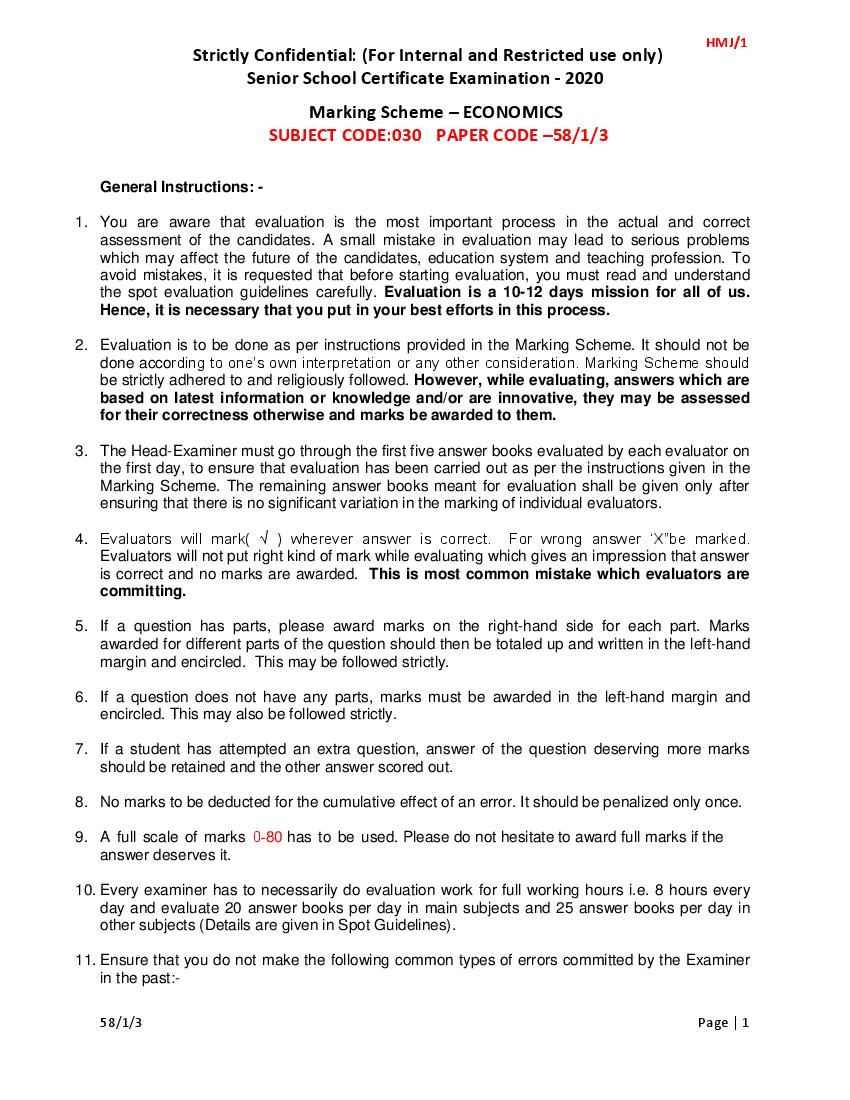
Strictly Confidential: (For Internal and Restricted use only)
Senior School Certificate Examination - 2020
Marking Scheme – ECONOMICS
SUBJECT CODE:030 PAPER CODE –58/1/3
General Instructions: -
1. You are aware that evaluation is the most important process in the actual and correct
assessment of the candidates. A small mistake in evaluation may lead to serious problems
which may affect the future of the candidates, education system and teaching profession. To
avoid mistakes, it is requested that before starting evaluation, you must read and understand
the spot evaluation guidelines carefully. Evaluation is a 10-12 days mission for all of us.
Hence, it is necessary that you put in your best efforts in this process.
2. Evaluation is to be done as per instructions provided in the Marking Scheme. It should not be
done according to one’s own interpretation or any other consideration. Marking Scheme should
be strictly adhered to and religiously followed. However, while evaluating, answers which are
based on latest information or knowledge and/or are innovative, they may be assessed
for their correctness otherwise and marks be awarded to them.
3. The Head-Examiner must go through the first five answer books evaluated by each evaluator on
the first day, to ensure that evaluation has been carried out as per the instructions given in the
Marking Scheme. The remaining answer books meant for evaluation shall be given only after
ensuring that there is no significant variation in the marking of individual evaluators.
4. Evaluators will mark( √ ) wherever answer is correct. For wrong answer ‘X”be marked.
Evaluators will not put right kind of mark while evaluating which gives an impression that answer
is correct and no marks are awarded. This is most common mistake which evaluators are
committing.
5. If a question has parts, please award marks on the right-hand side for each part. Marks
awarded for different parts of the question should then be totaled up and written in the left-hand
margin and encircled. This may be followed strictly.
6. If a question does not have any parts, marks must be awarded in the left-hand margin and
encircled. This may also be followed strictly.
7. If a student has attempted an extra question, answer of the question deserving more marks
should be retained and the other answer scored out.
8. No marks to be deducted for the cumulative effect of an error. It should be penalized only once.
9. A full scale of marks 0-80 has to be used. Please do not hesitate to award full marks if the
answer deserves it.
10. Every examiner has to necessarily do evaluation work for full working hours i.e. 8 hours every
day and evaluate 20 answer books per day in main subjects and 25 answer books per day in
other subjects (Details are given in Spot Guidelines).
11. Ensure that you do not make the following common types of errors committed by the Examiner
in the past:-
58/1/3 Page | 1
Page 2
Giving more marks for an answer than assigned to it.
Wrong totaling of marks awarded on a reply.
Wrong transfer of marks from the inside pages of the answer book to the title page.
Wrong question wise totaling on the title page.
Wrong totaling of marks of the two columns on the title page.
Wrong grand total.
Marks in words and figures not tallying.
Wrong transfer of marks from the answer book to online award list.
Answers marked as correct, but marks not awarded. (Ensure that the right tick mark is correctly
and clearly indicated. It should merely be a line. Same is with the X for incorrect answer.)
Half or a part of answer marked correct and the rest as wrong, but no marks awarded.
12. While evaluating the answer books if the answer is found to be totally incorrect, it should be
marked as cross (X) and awarded zero (0)Marks.
13. Any unassessed portion, non-carrying over of marks to the title page, or totaling error detected
by the candidate shall damage the prestige of all the personnel engaged in the evaluation work
as also of the Board. Hence, in order to uphold the prestige of all concerned, it is again
reiterated that the instructions be followed meticulously and judiciously.
14. The Examiners should acquaint themselves with the guidelines given in the Guidelines for spot
Evaluation before starting the actual evaluation.
15. Every Examiner shall also ensure that all the answers are evaluated, marks carried over to the
title page, correctly totalled and written in figures and words.
The Board permits candidates to obtain photocopy of the Answer Book on request in an RTI
application and also separately as a part of the re-evaluation process on payment of the
processing charges.
58/1/3 Page | 2
Page 3
SECTION- A (MACRO ECONOMICS)
NO.
EXPECTED ANSWER
1 Question: Revenue Deficit can be estimated using the formula _____
(Fill in the blank with the correct formula)
Answer: Revenue Expenditure ─ Revenue Receipts 1
2 Question: State whether the following statement is true or false:
“As per Keynesian theory in an economy, full employment can never exist.”
Answer: False 1
3 Question: According to the theory of Keynesian Economics, the value of average propensity to
consume can never be ______ (Choose the correct alternative)
a. Zero (B) Unity (C) More than one (D) Less than one
Answer:(A) Zero 1
4 Question: State whether the following statement is true or false:
“Expected obsolescence is included in depreciation.”
Answer: True 1
5 Question: Effective demand is defined as ______ (Fill in the blank with the suitable definition)
Answer: that level of output and employment where Aggregate Demand is equal to Aggregate 1
supply.
6 Question: In order to control the money supply in the economy, the Central Bank may
________. (Choose the correct alternative)
(A) Buy securities in the open market
(B) Sell securities in the open market
(C) Reduce cash reserve ratio
(D) Reduce repo rate
1
Answer: One mark to be allotted for any given option (A), (B), (C) or (D).
7 Question: State whether the following statement is true or false:
“Government Budget is an important monetary policy instrument.”
Answer- False 1
OR
Disinvestment is a_______ (capital/revenue) receipt of the government.
(Choose the correct alternative)
Answer: capital 1
8 Question: Two component of money supply are _____ and ______
(Fill in the blanks with the correct answers)
Answer: (i) Currency held with public ½
(ii) Demand deposits with commercial banks. ½
58/1/3 Page | 3
Page 4
Answer: Current Account Deficit refers to a situation when the total value of receipts for
exports of goods and services is lesser than the total value of payments for imports of goods 1
and services.
10 Question: ________ is one of the most important sources of demand for foreign currency.
(Fill in the blank with the correct answer)
1
Answer: Import of goods and services (or any other correct answer to be allotted marks)
11 Question: “Ex- ante Aggregate Demand and Ex- ante Aggregate Supply are always equal.”
Defend or refute the given statement with valid reasons.
Answer: The statement is false. Ex-ante Aggregate Demand is equal to Ex-ante Aggregate
Supply only when the economy is in equilibrium. At under-employment equilibrium level,
when Ex-ante Aggregate Demand falls short of Ex-ante Aggregate Supply, it will lead to 3
accumulation of unplanned inventories. Hence the producer will reduce employment leading
to reduction in output and income till the two forces become equal to each other.
(to be marked as a whole) (Diagram not required)
12 Question: “Final goods include only those goods which are consumed by the households”.
Defend or refute the given statement with valid reason.
Answer: The given statement is refuted as final goods include those goods which are either
consumed by the households or purchased by a producer for investment purposes.
(No marks are to be allotted if reason is not/wrongly given) 3
OR
Question: “Circular flow principle is based on the assumption that one’s expenditure will
become other’s income.” Explain the given statement.
Answer- In a two sector economy households and firms exist to run the economy. Households
render factor services to the firms and earn factor incomes from them. Whereas; firms
produce and sell goods and services to households and earn their income by an equal
magnitude. Thus, in a circular income mode, the axiom that one’s expenditure is other’s 3
income holds true. (to be marked as a whole) (Diagram not mandatory)
13 Question: “India is taking huge leaps in the index of Ease of doing Business; as a result many
MNCs are shifting their production base to India.” In the light of the above statement,
comment upon the flow of foreign exchange and its likely impact on the Indian Economy.
Answer: India, with greater ease of doing business, may attract many more MNC’s to shift
their production base to India, thereby increasing the inflow of foreign exchange (say $) to the
Indian economy. This increase in foreign direct investments (FDI) by MNCs will lead to
increase in the supply of foreign exchange in India leading to a fall in the rate of foreign
exchange, i.e. Indian Rupee (₹) may appreciate. Increase in FDI will result in increase in
production and hence may also generate employment opportunities in the Indian economy. 4
(to be marked as a whole)
58/1/3 Page | 4
Page 5
commercial bank.
Answer: Credit multiplier measures the amount of money that the banks are able to create in
the form of deposits with every initial deposit. The credit creation is inversely related to LRR.
1
Higher the credit multiplier, higher will be the total credit created and vice - versa.
The credit creation by commercial banks is determined by :
1. The amount of the initial deposit.
2. The Legal Reserve Ratio (LRR). ½
Suppose the initial deposits are ₹ 1000 and LRR is 10%, the banks will keep 10% of the ½
deposits i.e. ₹ 100 as reserves and will lend the remaining amount of ₹ 900. Those who
borrow will spend the money for making payments.
It is assumed that the entire ₹ 900 comes back as secondary deposits to the banking system.
Now the banks will again keep 10% of ₹900 i.e. ₹ 90 as reserve and lend out ₹ 810. This 2
process continues till total reserves become equal to initial reserves.
1 1
Total money creation = 𝐼𝑛𝑖𝑡𝑖𝑎𝑙 𝑑𝑒𝑝𝑜𝑠𝑖𝑡 𝐿𝑅𝑅 = 1000(10%) = ₹ 10,000
Hence, the initial deposit of ₹ 1000 has led to the total money supply of ₹ 10,000.
(Explanation in tabular form should also be allotted marks)
OR
Question: “Central bank acts as the banker to the government”. Elaborate the given statement.
Answer: The central bank acts as the banker to the Government, maintain accounts of
government for the purpose of accepting deposits and advancing loans. The central bank
purchases and sells government securities in the open market on behalf of the government. It may 4
also advise the government on policy matters, if solicited. (to be marked as a whole)
15 Question:(a)Distinguish between Capital Expenditure and Revenue Expenditure.
Answer: (a) Capital Expenditure is the expenditure which either creates assets or
reduces liabilities of the Government. 1½
Revenue Expenditure is the expenditure which neither creates assets nor reduces
liabilities of the Government. 1½
Question: b. Define ‘Tax’.
Answer: Tax is a compulsory payment imposed by the government on households
and firms. 1
16 Question: Using a well – labelled diagram, show how Consumption curve can be
derived from Saving curve.
Answer: Steps
1. Draw Saving curve from OS’ on the Y-axis. Take OC equal to OS’ on the Y-
axis. This gives the starting point C of the consumption curve.
2. Draw 45o line from the origin. Draw perpendicular from point B’ 3
intersecting the 45 line at B.
o
3. Join points C and B and extend upwards to obtain the consumption curve
CBC
SUITABLE DIAGRAM WITH VALID EXPLANATION 3
58/1/3 Page | 5
Page 6
Question: (a) If the Saving function is S = (-) 10 + 0.2 Y, how can Consumption
function be derived from the given saving function?
Answer:(a) As we know Y = C + S 1
.˙. C = Y - S
C = Y - (-10 + 0.2 Y) 1½
.˙. C = 10 + 0.8 Y ½
Question: (b)Distinguish between Average Propensity to save and Marginal
Propensity to save
Answer: (b) Average Propensity to Save (APS) is the ratio of total savings and total income in
an economy. 1½
𝑇𝑜𝑡𝑎𝑙 𝑆𝑎𝑣𝑖𝑛𝑔 𝑆
APS =𝑇𝑜𝑡𝑎𝑙 𝐼𝑛𝑐𝑜𝑚𝑒 = 𝑌
1½
Marginal Propensity to Save (MPS) is the ratio of change in total savings and change in total
income in an economy.
𝐶ℎ𝑎𝑛𝑔𝑒 𝑖𝑛 𝑆𝑎𝑣𝑖𝑛𝑔 ∆𝑆
MPS =𝐶ℎ𝑎𝑛𝑔𝑒 𝑖𝑛 𝐼𝑛𝑐𝑜𝑚𝑒 = ∆𝑌
17 Question: (a)Calculate the value of “ Change in Stock” from the following data:
S.NO Items Amount (in
₹Crores)
i. Sales 400
ii Net Value Added at Factor cost (NVAFC) 200
iii Subsidies 10
iv Change in Stock ?
v Depreciation 40
vi Intermediate Consumption 100
Answer: Change in stock = (ii) +(vi)+(v)-(iii)-(i)
= 200+100+40-10-400 2
= (-) ₹70 Crores. 1½
Question: (b). Define Real Gross Domestic Product. ½
Answer: Real Gross Domestic product is the sum total of the money value of all final goods
and services produced in an economy during the year estimated at some given base year’s
prices. 2
OR
Question: (a) Discuss briefly the three components of ‘Income from Property and
Entrepreneurship.’
Answer: (a) Income from property and entrepreneurship (operating surplus) includes:
i. Rent/Royalties 1
ii. Interest 1
iii. Profit (Brief explanation of each pointer) 1
Question: (b) What are ’externalities’? State its types with suitable examples.
Answer: (b) Externalities refer to the benefits/harms caused by a firm/individual to the
society in general, without being penalised. 1
There are two types of externalities :-
58/1/3 Page | 6
Page 7
better roads in a country ½+½
(ii) Negative externalities - Social harms for example pollution caused by stubble
burning in some states of India. (any other suitable definition/example to be allotted marks) ½+½
SECTION- B (INDIAN ECONOMIC DEVELOPMENT)
18 Question: Arrange the following events in chronological order and choose the
correct answer from the given alternatives: 1
(i) Establishment of People’s Republic ofChina
(ii) Creation of Pakistan
(iii) First Five-Year Plan ofIndia
(iv) First Five-Year Plan ofChina
Alternatives :
(A) (i), (iv), (ii), (iii)
(B) (iii), (ii), (i), (iv)
(C) (ii), (i), (iii),(iv)
(D) (iv), (iii), (ii), (i)
Answer: (C) (ii), (i), (iii),(iv) 1
19 Question: The main aim of ‘Great Leap Forward’ was to ensure rapid increase in _______
(primary/secondary/tertiary) sector in China. (Choose the correct alternative)
Answer: secondary 1
20 Question: India is not a member of which of the following regional/global economic
grouping? (Choose the correct alternative)
(A) European Union (C) G-20
(B) BRICS (D) SAARC
Answer – (A) European Union
OR 1
Pakistan introduced its economic reforms in the year ________
(A) 1974 (C) 1978
(B) 1976 (D) 1988
Answer – (D) 1988 1
21 Question: State whether the statement is true or false.
“In the past few decades, primary sector has created maximum jobs in India”
Answer: False 1
22 Question: During India’s first seven five- year plans, the Government of India adopted
______ policy to protect domestic industries. (Fill in the blank with the correct answer)
Answer: Import Substitution (or any other relevant term) 1
23 Question: State the meaning of ‘Golden Revolution’.
Answer: Golden Revolution refers to the period in which there was a tremendous 1
rise in the production of horticultural products like fruits vegetables etc.
58/1/3 Page | 7
Page 8
(Choose the correct alternative)
(A) International Bank for Reconstruction and Development(IBRD)
(B) International Monetary Fund(IMD)
(C) Reserve Bank of India(RBI)
(D) General Agreement on Tariffs and Trade(GATT)
Answer- (D) General Agreement on Tariffs and Trade(GATT) 1
25 Question: State whether the statement is true or false.
“Self- Help Groups (SHGs) are an example of a microcredit organisation.”
Answer: True 1
26 Question: State any one outcome of implementation of Economic Reforms in India in 1991
Answer: Greater inflow of investment. (or any other relevant outcome to be allotted marks) 1
27 Question: Mention any one advantage of Organic farming.
Answer: Safe and Healthy food (or any other valid advantage) 1
28
Question- Compare and analyse the given data of India and China with valid reasons :
Country Annual growth rate of population (2015) Sex ratio (per thousand males)
India 1.2% 929
China 0.5% 941
Source: World Development Indicators, 2015
Answer-
a) The given data shows that China could arrest its annual population growth rate with
the implementation of some stringent measure in late 1970’s like the introduction of
one child norm. This step has been instrumental in controlling the growth of
population in China. India stands virtually more than double to China at its annual 2
population growth rate of 1.2% as compared to China’s annual population growth rate
of 0.5% pa.
b) The social dynamics of both the countries are similar to each other; sex ratio is low and
biased in both the countries due to preference for male child. Whereas, India stands at 1
929 females per 1000 males, China is not far ahead at 941 females per 1000 males.
29
Question: ‘Human Capital Formation gives birth to innovation, invention and technological
improvements.” Do you agree with the given statement? Support your answer with valid arguments.
Answer: The given statement is correct. Human Capital Formation not only increases the productivity
of available human resources but also stimulates innovation and creates ability to adopt new
technologies.
Investment in education creates ability to adopt newer technologies, facilitates invention and
innovation since educated workforce generally adapts to modern technologies and innovation.
(any other valid argument to be allotted marks) (to be marked as whole) 3
OR
58/1/3 Page | 8
Page 9
India.
Answer- Rapid expansion of the banking system had positive effect on rural farm and non
farm output, income and employment. In spite of it, following problems have been faced in
the rural banking such as-
The volume of rural credit in the country is still insufficient in comparison to its
demand and institutional sources have failed to cover the entire rural farmers of the
country. 1½
Less attention has been given on the credit requirements of needy (small and marginal
farmers) and the problem of overdue in agricultural credit continues. 1½
(any other valid argument to be allotted marks)
30 Question: Define any two of the following:
(a) Absorptive capacity of environment
(b) Carrying capacity of environment
(C) Poverty Line (in terms of calorific value).
Answers- (Any two of the following)
(a) Absorptive capacity of the environment- It means the ability of the environment to
absorb degradation without causing environmental damage.
(b) Carrying capacity of environment – It implies that the resources extraction is not
above the rate of regeneration of the resources and wastes generated are within
the assimilating capacity of the environment.
(c) Poverty Line is the cut off point which divides the population of the country as poor
and the non-poor. It can be determined in terms of calorie intake and monthly per 2+2
capita expenditure (MPCE). According to this a minimum intake of 2400 caloriesper
person per day in rural areas and 2100 calories person per day in urban areas is
needed. (any other relevant definitions should be allotted marks)
31 Question- India is often called the ‘Outsourcing Destination’ of the World. Discuss the prime
reasons for this name given to India.
Answer- Reasons for India as outsourcing destination-
(i) Availability of skilled manpower- India has vast skilled manpower which enhances 2
the faith of MNCs.
(ii) Favourable Government policies- MNCs get various types of lucrative offers from 2
the Indian government such as tax holidays, tax concessions etc.
(any other valid argument should be allotted marks)
OR
Question: State the meaning of import substitution Explain how import substitution
can protect the domestic industries.
Answer: Import substitution refers to a policy of replacement or substitution of imports by
domestic production. 1
The domestic industries of India were not in a position to compete against the goods
produced by developed economies. So, the policy of import substitution helped in protecting
58/1/3 Page | 9
Page 10
i. The tariff on imported goods, and
ii. fixation of quotas helped in restricting the level of imports. 1½
As a result, the domestic firms could expand without fear of competition from the foreign 1½
market. (Students may also discuss infant industry argument, to be allotted marks).
32 Question: (a) Name any one prominent economist who estimated India’s National Income
during the Colonial period.
Answer: V.K.R.V.Rao (or other correct name)
1
Question:(b)Discuss any two causes of India’s agricultural stagnation during the Colonial
period.
Answer:(b)Two causes of India’s agricultural stagnation during the Colonial period were :
i. The system of land settlement that was introduced by the colonial government
particularly the zamindari system. 1½
ii. Lack of irrigation facilities. (with valid explanation) 1½
33 Question: a. State the names of six Indian Systems of Medicines (ISM) under AYUSH scheme of
Government of India.
Answer: The six Indian Systems of Medicines (ISM) under AYUSH scheme of Government of ½x6
=3
India includes: Ayurveda, Yoga, Unani, Siddha, Naturopathy and Homeopathy.
Question- (b) Analyse the recent trends in sectoral distribution of workforce in India:
Trends in Employment Pattern (Sector wise), 1983-2012(in %)
Sector 1993-94 1999-2000 2011-2012
Primary 64 60.4 48.9
Secondary 16 15.8 24.3
Services 20 23.8 26.8
Answer- (b) The given data indicates that over the given period, the proportion of workforce
in primary sector has gone down rapidly. Whereas, the employment share of both secondary
sector and the services sector has increased. While the share of secondary sector has gone up
by approximately 9% recently, the corresponding figure for services sector has gone up by
approximately 7%. (to be marked as a whole) 3
34 Question: (a)What is meant by ‘Global Burden of Disease’?
Answer: (a) ‘Global Burden of Disease’ is an indicator used by experts to gauge the number of
people dying prematurely due to a particular disease, as well as, the number of years spent by 2
them in a state of disability owing to the disease.
Question (b) Discuss any two problems faced by power sector in India.
Answer: (b) Major challenges faced by power sector in India are, as follows:
(I) India’s installed capacity to generate electricity is not sufficient. Even the installed capacity
is underutilized because power plants are not running properly. 2
(ii) State Electricity Board which distribute electricity are incurring losses due to obsolete
transmission and distribution system and wrong pricing. (Any other relevant point) 2
58/1/3 Page | 10
Page 11
Question: Critically examine the results of Poverty Alleviation Programmes implemented in
India since independence.
Answer: Poverty Alleviation Programmes are the designated programmes to target
reduction in/removal of poverty in a country. India, which inherited poverty from British rule,
tried her level best to eradicate poverty through various Poverty Alleviation Programmes over
the years. As a result, the percentage of absolute poor in some states has fallen well below
the national average of poverty. However, the problems of malnourishment, hunger and
illiteracy continue to be a common feature in many parts of India, because of the following
reasons:
There has been no radical change in the ownership of assets.
Due to unequal distribution of land and other assets, benefits from such programmes
have been appropriated by the non-poor.
Inadequate resource allocation for these programmes. 6
The Government officials responsible for implementing these programmes were ill
motivated and inadequately trained.
To conclude we may say that poverty alleviation programmes were a great step but could not
achieve desired results due to improper implementation.
(any other relevant answer should be allotted marks)
(to be marked as a whole)
58/1/3 Page | 11
Document Details
| Board / Org | CBSE |
| Exam | Class 12 |
| Type | Solution |
| Pages | 11 |
| Updated | 22 Jul 2026 |