CBSE Class 12 Economics Question Paper 2020 Set 58-2-1 Solutions
Finished viewing? Save it for later —
Download CBSE Class 12 Economics Question Paper 2020 Set 58-2-1 Solutions (PDF · 13 pages)About CBSE Class 12 Economics Question Paper 2020 Set 58-2-1 Solutions
CBSE Class 12 Economics Question Paper 2020 Set 58-2-1 Solutions is available here for free download. Published by CBSE for Class 12, this solution can be viewed online or downloaded as a PDF (13 pages). Candidates preparing for Class 12 can use CBSE Class 12 Economics Question Paper 2020 Set 58-2-1 Solutions to understand the exam pattern, the type of questions asked, and the overall difficulty level.
Frequently Asked Questions
How can I download CBSE Class 12 Economics Question Paper 2020 Set 58-2-1 Solutions?
Open this page and click the Download button to save CBSE Class 12 Economics Question Paper 2020 Set 58-2-1 Solutions as a PDF. It is completely free on AglaSem Docs.
Is CBSE Class 12 Economics Question Paper 2020 Set 58-2-1 Solutions free to download?
Yes. CBSE Class 12 Economics Question Paper 2020 Set 58-2-1 Solutions can be viewed online and downloaded as a PDF free of cost on AglaSem Docs.
How many pages does CBSE Class 12 Economics Question Paper 2020 Set 58-2-1 Solutions have?
CBSE Class 12 Economics Question Paper 2020 Set 58-2-1 Solutions contains 13 pages, which you can read online or download together as a single PDF.
Where can I find more Class 12 study material?
You can find more Class 12 question papers, sample papers, syllabus, and answer keys on AglaSem Docs.
CBSE Class 12 Economics Question Paper 2020 Set 58-2-1 Solutions – Text
Read the full text of this solution below — useful to quickly search, copy and reference the content online without downloading the PDF.
📄 View text version (13 pages)
Page 1
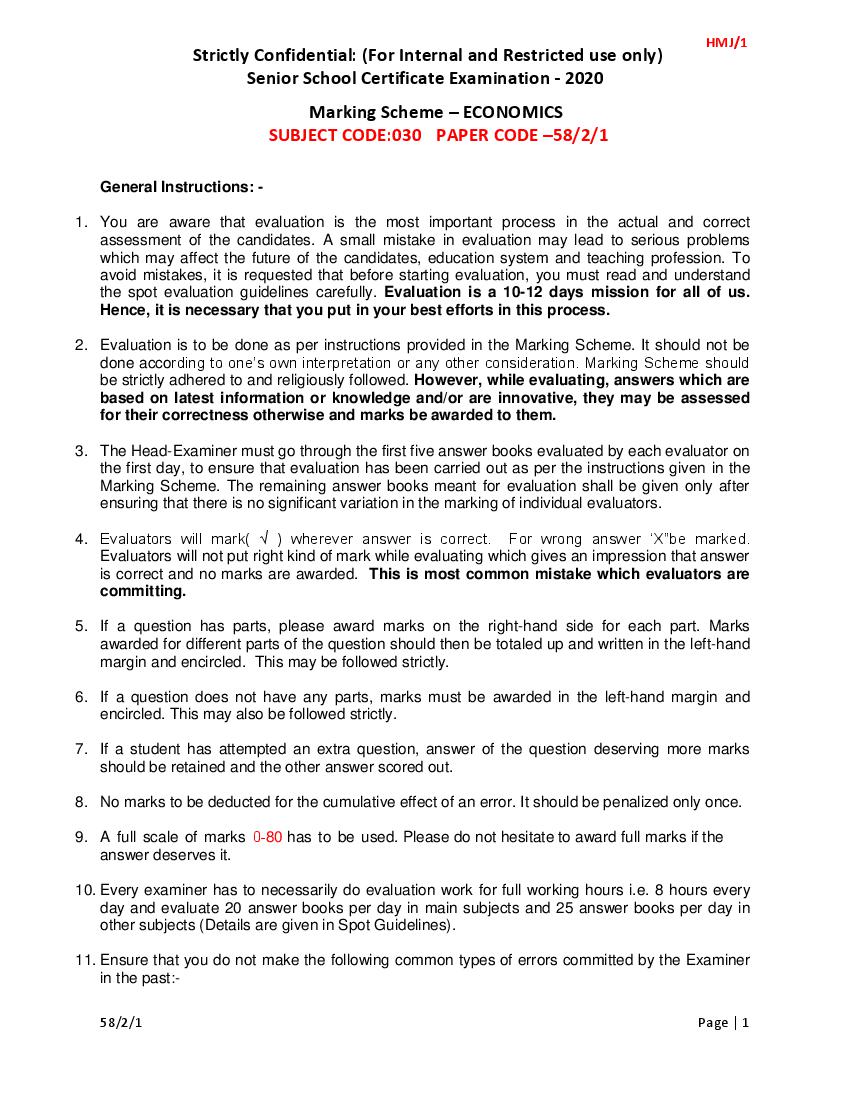
Strictly Confidential: (For Internal and Restricted use only)
Senior School Certificate Examination - 2020
Marking Scheme – ECONOMICS
SUBJECT CODE:030 PAPER CODE –58/2/1
General Instructions: -
1. You are aware that evaluation is the most important process in the actual and correct
assessment of the candidates. A small mistake in evaluation may lead to serious problems
which may affect the future of the candidates, education system and teaching profession. To
avoid mistakes, it is requested that before starting evaluation, you must read and understand
the spot evaluation guidelines carefully. Evaluation is a 10-12 days mission for all of us.
Hence, it is necessary that you put in your best efforts in this process.
2. Evaluation is to be done as per instructions provided in the Marking Scheme. It should not be
done according to one’s own interpretation or any other consideration. Marking Scheme should
be strictly adhered to and religiously followed. However, while evaluating, answers which are
based on latest information or knowledge and/or are innovative, they may be assessed
for their correctness otherwise and marks be awarded to them.
3. The Head-Examiner must go through the first five answer books evaluated by each evaluator on
the first day, to ensure that evaluation has been carried out as per the instructions given in the
Marking Scheme. The remaining answer books meant for evaluation shall be given only after
ensuring that there is no significant variation in the marking of individual evaluators.
4. Evaluators will mark( √ ) wherever answer is correct. For wrong answer ‘X”be marked.
Evaluators will not put right kind of mark while evaluating which gives an impression that answer
is correct and no marks are awarded. This is most common mistake which evaluators are
committing.
5. If a question has parts, please award marks on the right-hand side for each part. Marks
awarded for different parts of the question should then be totaled up and written in the left-hand
margin and encircled. This may be followed strictly.
6. If a question does not have any parts, marks must be awarded in the left-hand margin and
encircled. This may also be followed strictly.
7. If a student has attempted an extra question, answer of the question deserving more marks
should be retained and the other answer scored out.
8. No marks to be deducted for the cumulative effect of an error. It should be penalized only once.
9. A full scale of marks 0-80 has to be used. Please do not hesitate to award full marks if the
answer deserves it.
10. Every examiner has to necessarily do evaluation work for full working hours i.e. 8 hours every
day and evaluate 20 answer books per day in main subjects and 25 answer books per day in
other subjects (Details are given in Spot Guidelines).
11. Ensure that you do not make the following common types of errors committed by the Examiner
in the past:-
58/2/1 Page | 1
Page 2
Giving more marks for an answer than assigned to it.
Wrong totaling of marks awarded on a reply.
Wrong transfer of marks from the inside pages of the answer book to the title page.
Wrong question wise totaling on the title page.
Wrong totaling of marks of the two columns on the title page.
Wrong grand total.
Marks in words and figures not tallying.
Wrong transfer of marks from the answer book to online award list.
Answers marked as correct, but marks not awarded. (Ensure that the right tick mark is correctly
and clearly indicated. It should merely be a line. Same is with the X for incorrect answer.)
Half or a part of answer marked correct and the rest as wrong, but no marks awarded.
12. While evaluating the answer books if the answer is found to be totally incorrect, it should be
marked as cross (X) and awarded zero (0)Marks.
13. Any unassessed portion, non-carrying over of marks to the title page, or totaling error detected
by the candidate shall damage the prestige of all the personnel engaged in the evaluation work
as also of the Board. Hence, in order to uphold the prestige of all concerned, it is again
reiterated that the instructions be followed meticulously and judiciously.
14. The Examiners should acquaint themselves with the guidelines given in the Guidelines for spot
Evaluation before starting the actual evaluation.
15. Every Examiner shall also ensure that all the answers are evaluated, marks carried over to the
title page, correctly totalled and written in figures and words.
The Board permits candidates to obtain photocopy of the Answer Book on request in an RTI
application and also separately as a part of the re-evaluation process on payment of the
processing charges.
58/2/1 Page | 2
Page 3
SECTION- A (MACRO ECONOMICS)
Marks
No. Allocation
EXPECTED ANSWER
Question- If the entire additional income of an economy is consumed, the value of
investment multiplier will be _________. (Choose the correct alternative)
(A) Zero (0)
1 (B) not defined (∞)
(C) one (1)
(D) ten(10)
Answer- (B) not defined (∞) 1
2 Question- A car purchased by a household is a ________. (Choose the correct alternative)
(A) single use capital good (B) single use consumer good
(C) durable consumer good (D) semi-durable consumer good
Answer- (C) durable consumer good
OR
Question- GNP deflator is represented by which of the following formulae? 1
(Choose the correct alternative)
(A) Nominal GNP ×100
Real GNP
(B) Real GNP ×100
Nominal GNP
(C) Real GNP ×100
Change in Rate of Inflation
(D) Change in Rate of Inflation×100
Real GNP
Answer- (A) Nominal GNP × 100
1
Real GNP
3 Question-Name the two components of Aggregate Demand in a closed economy.
Answer- Consumption Expenditure (C) and Investment Expenditure (I) ½+½
4 Question- _______is the agent and adviser to the Government of India.
( Fill in the blank with correct answer )
Answer- Reserve Bank of India (RBI) 1
5 Question- State whether the following statement is true or false:
Page | 3
Page 4
Answer-False
6 Question- Government expenditure incurred on defence items is a type of
______expenditure in the Government Budget. (Fill in the blank with correct answer)
Answer- capital/revenue (Both the answers to be considered correct) 1
7 Question- State whether the following statement is true or false:
“Under a managed floating exchange rate system, the Government directly controls the
exchange rate.”
Answer-False 1
8 Question- ‘Charity from Abroad’ will be recorded on __________(credit/debit)side of the
balance of Payment accounts. (Fill in the blank with correct answer)
Answer- credit 1
9 Question- Give any two examples of non-tax revenue receipts.
Answer- Fees, penalties (any other correct examples to be allotted marks) ½+½
10 Question- Suppose in a hypothetical economy, the income rises from ₹ 500 crores to ₹600
crores. As a result, the consumption expenditure rises from ₹400 crores to ₹500 crores.
Marginal prospensity to consume in such a case would be __________.
(Choose the correct alternative)
(A) 0.8
(B) 0.4
(C) 1.0
(D) 0.6
1
Answer- (C)1.0
11 Question- “Gross Domestic Product (GDP) is not the best indicator of the economic
welfare of a country.”Defend or refute the given statement with valid reasons.
Answer- The given statement can be defended on the following grounds, as GDP may not
take into account:
(i) Non monetary exchanges like services of housewives.
1×3=3
(ii) Externalities (benefits/harms) caused by human activities.
(iii) Distribution of Income (GDP).
(no marks to be allotted if no/wrong reason(s) are given)
Page | 4
Page 5
greater than Aggregate Supply (AS).
Answer- When Aggregate Demand is greater than Aggregate Supply (AD>AS), buyers are
planning to, buy more goods and services than what producers are planning to produce. It
will lead to fall in planned inventories below the desired level. The producers in turn will
produce more, which will raise the income level i.e. AS, till AD becomes equal to AS. 3
(To be marked as a whole)
OR
Question- If in an economy: Change in initial investment (∆I) = ₹ 1,000 crores,
Marginal propensity to save (MPS) = 0.2.
Find the value of the following :
(a) Investment multiplier (K) (b) Change in final income (∆Y)
1
Answer- (a) Investment multiplier (K) = 𝑀𝑃𝑆 ½
1
K= 0.2 ½
K=5 ...........................(i) ½
(b) Investment multiplier (K) = ∆ I
∆Y ½
Substituting K= 5 from .............(i)
∆Y
5 = 1000 ½
∆ Y = ₹ 5000 crores ½
13 Question-What role does credit multiplier play in determining the credit creation capacity
of the banking system? Use a numerical illustration to explain.
Answer- Credit multiplier measures the amount of money that the banks are able to ½
create in the form of deposits with every initial deposit.
The credit creation by commercial banks depends on credit multiplier as it is inversely
related to LRR. Higher the value of credit multiplier, higher will be the total credit created 1½
and vice - versa.
For Example: suppose LRR is 0.5 and initial deposit is Rs. 1,000
1
Credit multiplier = 0.5 = 2
Total credit created = 2 x 1000 = 2,000
Whereas, Suppose the LRR is 0.2 and initial deposit is 1000
1
Credit multiplier = 0.2 = 5
2
Total credit created = 5 x 1,000= 5,000
Thus, with the same initial deposit total credit creation increases with an increase in the
value of credit multiplier. (Any other relevant example)
OR
Page | 5
Page 6
of India.
Answer- Two instruments of credit control are
Repo rate – It is the rate of interest at which central bank lends to commercial
banks for their short term requirements. An increase in repo rate will force 2
commercial banks to increase their lending rates. It will make borrowings costlier
to general public.
Open market operations- It refers to buying and selling of government securities
by the central bank from and to the general public. When central bank sells its
securities, it reduces liquidity (deposits) with commercial banks and adversely 2
affects credit creating power of banks.
(any other instrument/explanation to be allotted marks)
14 Question- “US dollar has recorded a jump of 0.75 paise per dollar (p/$) in the last one
month; this situation might bring smiles and sorrows to different types of traders
(exporters and importers).”Justify the given statement.
Answer- The given condition indicates to the situation of depreciation of home currency
(₹) vis-a-vis foreign currency (US $). This implies that more units of Indian currency (₹) is to 1
be paid to buy one unit of foreign currency (US $).
This may lead to sorrows for importers, as they have to pay higher amount for their 1½
imports.
Also, this may bring smiles for exporters, as they would be getting higher earnings for 1½
their exports. (any other valid explanation to be allotted marks)
15 Question- “The Government Budget of a country cannot have fiscal deficit without the
existence of revenue deficit.” Defend or refute the given statement.
Answer- The given statement can be refuted as the fiscal deficit can exist without revenue
deficit, if:
i) Capital Budget is in deficit (CE > CR) with balanced Revenue Budget (RE = RR). 2
ii) Capital Budget is in deficit (CE > CR) in greater proportion to Surplus Revenue 2
Budget (RE )
16 Question- 16 (a) “Circular flow of income in a two- sector economy is based on the axiom
that one’s expenditure is other’s income.” Support your answer with valid reasons.
Answer- In a two sector economy households and firms exist to run the economy.
Households render factor services to the firms and earn factor incomes from them.
Whereas; firms produce and sell goods and services to households and earn their income 4
by an equal magnitude. Thus, in a circular income mode, the axiom that one’s expenditure
is other’s income holds true. (to be marked as a whole) (Diagram not mandatory)
Question- 16 (b) Distinguish between ‘value of output’ and ‘value added’.
Value of output is the estimated money value of all the goods and services, inclusive of 1
change in stock and production for self consumption. Whereas;
Value added is the excess of value of output over the value of intermediate consumption. 1
OR
Page | 6
Page 7
Real Gross Domestic Product (GDP) for the given years :
Year 2015-16 2016-17
Nominal GDP Rate 8.4% 9%
GDP deflator 140 125
𝑁𝑂𝑀𝐼𝑁𝐴𝐿 𝐺𝐷𝑃
Answer - GDP Deflator = 𝑥 100 2
𝑅𝐸𝐴𝐿 𝐺𝐷𝑃
2014-15 2015-16 2016-17
Nominal GDP = 10,000 (Assume) 10,840 11,815 4
Real GDP = 10,000 (Assume) 7742 (approx) 9452 (approx)
(any other answer provided by student should be allotted marks)
17
Question-In the given figure, what does the gap ‘KT’ represent? State and discuss any two
fiscal measures to correct the situation.
Answer- KT’ represents inflationary gap 1
Two fiscal measures to correct the situation of inflationary gap are –
a) Increase in Taxes - To curb the inflationary gap the government may increase the
taxes. This may reduce the purchasing power in the hands of the public which in 2½
turn may reduce the Aggregate Demand in the economy to bring it equal to the
Aggregate Supply.
b) Reduction in Government Expenditure- To curb the inflationary gap the
government may reduce its non developmental expenditure. This may reduce the 2½
purchasing power in the hands of the people which in turn will reduce the
Aggregate Demand in the economy to bring it equal to the Aggregate Supply.
Page | 7
Page 8
Question - What is meant by deflationary gap? State and discuss any two fiscal measures
to correct the situation of deflationary gap.
Answer- Deflationary gap is that situation when Aggregate Demand is lesser than 1
Aggregate Supply corresponding to full employment level.
Two fiscal measures are to control it are:
a) Decrease in Taxes - To curb the deflationary gap the government may decrease the
2½
taxes. This may increase the purchasing power in the hands of the people which in
turn may increase the Aggregate Demand in the economy to bring it equal to the
Aggregate Supply.
2½
b) Increase in Government Expenditure- To curb the deflationary gap the government
may increase its expenditure. This may increase the purchasing power in the hands
of the people which in turn may increase the Aggregate Demand in the economy
to bring it equal to the Aggregate Supply.
SECTION- B (INDIAN ECONOMIC DEVELOPMENT)
18 Question- In the year _________ the Indian Government made eduction free and
compulsory for all children between 6 – 14 years. (Choose the correct alternative)
(A) 2001 (B) 2009 (C) 2003 (D) 2007
Answer- (B) 2009 1
OR
Question- Which one of the following organisations regulates the health sector in India?
(Choose the correct alternative)
(A) ICMR (B) UGC (C) AICTE (D) RBI
1
Answer-(A) ICMR
19 Question- State whether the following statement is true or false:
“Land ceiling means fixing the minimum limit of land holding for an individual.”
Answer- False. 1
20 Question- Identify and match the correct sequence of alternatives of organisations given in
Column I with the respective functions in column II:
Column I Column II
(i) provides short –term loans to Balance of Payments problem.
(a) WTO
(ii) is a multilateral trade negotiating body.
(b) RBI
(iii) facilitates lending for reconstruction and development.
(c) IMF
Page | 8
Page 9
(d) IBRD
Choose the correct alternative from the following:
(A) a-(ii),b-(i),c-(iii),d-(iv)
(B) a-(ii),b-(iv),c-(iii),d-(i)
(C) a-(ii),b-(iii),c-(iv),d-(i)
(D) a-(ii),b-(iv),c-(i),d-(iii)
Answer- (D) a-(ii),b-(iv),c-(i),d-(iii)
1
21 Question- Mao initiated the ‘Great Leap Forward’ in the year _________.
(A) 1951 (B) 1955 (C) 1958 (D) 1962
Answer-(C) 1958 1
22 Question- Name the apex institution for rural financing in India.
Answer-NABARD 1
23 Question- _________policy was implemented in the first seven five-year plans of India,to
protect domestic industries. (Fill in the blank with correct answer) 1
Answer- Import substitution /inward looking trade.
24 Question- __________ is an example of a commercial source of energy.
(Choose the correct alternative)
(A) Firewood (B) Coal
(C) Agricultural waste (D) Dried dung cakes 1
Answer-( B) Coal
25 Question- State whether the following statement is true or false:
“Proportion of people living below poverty line is more in India as compared to Pakistan.” 1
Answer- True
26 Question- Name any one Maharatna company.
Answer- Indian Oil Corporation Limited or Steel Authority of India Ltd. 1
(or Any other relevant example)
27 Question- Which of the following is not an advantage of organic farming?
(Choose the correct alternative)
(A) Cheap inputs
(B) Attractive returns on investment
(C) Greater possibilities for import
(D) High nutritional value 1
Page | 9
Page 10
28
Question- “Power sector in India has major challenges to face.” Discuss the given
statement with valid reasons.
Answer- Major challenges faced by power sector in India are, as follows:
(I) India’s installed capacity to generate electricity is not sufficient. Even the installed
capacity is underutilized because power plants are not running properly.
(ii) State Electricity Board which distribute electricity are incurring losses due to obsolete
transmission and distribution system and wrong pricing.
1x3=3
(iii) Thermal power plants are facing shortage of raw material and coal supplies.
(Any other relevant point to be allotted marks)
OR
Question- “India has failed to implement the recommendations of Education Commission
of 1964 -66.” Give valid arguments in support of the given statement.
Answer- The given statement is appropriate. Over the years India has not been able to
raise the educational standards to the desired level. Education Commission of 1964-66
had recommended that at least 6 % of GDP should be spent on education so as to make a 3
noticeable rate of growth in educational achievements. However, the current expenditure
level has been quite inadequate. Thus, necessary steps must be taken by the government
in this direction. (To be marked as a whole)
29 Question- “Recently the Government of India has decided to merge MTNL and BSNL on
account of rising losses.” Justify the step taken by the Government of India.
Answer- The decision taken by the Government of India to merge BSNL and MTNL is quite
appropriate. The Government has merged the two loss incurring businesses, with a
motive to:
i) achieve higher economic and functional efficiency. 3
ii) minimise possible losses (any other relevant reason to be allotted marks)
30 Question- Discuss briefly, how institutional reforms (land reforms) have played a
significant role in transforming Indian agriculture.
Answer- After independence the government of India took several institutional/land
reforms to ensure transformation of Indian agriculture, such as:
i) Land ceiling – It ensured reduction of concentration of land ownership in few
2
hands.
ii) Abolition of Zamindari system – It focused on elimination of farmers’ exploitation
and promotion of agricultural growth. 2
Page | 10
Page 11
(any other relevant argument/explanation to be allotted marks)
OR
Question- “Import restrictions were imposed in India with the dual objective to save
foreign exchange reserves and to be self- sufficient.” Justify the given statement with valid
arguments.
Answer- The given statement is appropriate as the policy aimed at:
i) Protecting the domestic industries from foreign competition by substituting
imports with domestic production.
ii) Saving scarce foreign exchange by restricting the volume of imports. 2+2
Thus, in the early post-independence era the dual objectives helped India to move
towards the goal of self-reliance. (any other relevant argument to be allotted marks)
31 Question- Comment upon any two salient features of occupational structure of India on
the eve of Independence.
Answer-The occupational structure of India on the eve of independence had the following
two main features:
i) Predominance of agriculture sector: The agricultural sector accounted for the
largest share of workforce with approximately three-forth of the workforce 2
depending on agriculture, directly or indirectly.
ii) Growing regional variation- Due to rise of manufacturing and services sector in
2
some parts of India (like the then Madras, Bombay and Bengal Presidencies) the
dependency ratio of workforce on agricultural sector declined.
(any other relevant argument to be allotted marks)
32 Question- Compare and analyse the given data of India and China with valid reasons :
Country Annual growth rate of population (2015) Sex ratio (per thousand males)
India 1.2% 929
China 0.5% 941
Source: World Development Indicators, 2015
Answer-
a) The given data shows that China could arrest its annual population growth rate
with the implementation of some stringent measure in late 1970’s like the
introduction of one child norm. This step has been instrumental in controlling the
growth of population in China. India stands virtually more than double to China at 2
its annual population growth rate of 1.2% as compared to China’s annual
population growth rate of 0.5% pa.
b) The social dynamics of both the countries are similar to each other; sex ratio is low
and biased in both the countries due to preference for male child. Whereas, India
Page | 11
Page 12
1000 males.
33 Question- Define the following :
(a) Carrying capacity of environment
Carrying capacity of environment – It implies that the resources extraction is not
above the rate of regeneration of the resources and wastes generated are within the
assimilating capacity of the environment.
(b) Bio- composting
Bio composting - It refers to the process of converting organic waste of various types
into natural manure.
(c) Sustainable Development
Sustainable development - It refers to the development process that meets the needs
of present generation without compromising on the ability of the future generations
to meet their respective needs.
(d) Absorptive capacity of the environment
Absorptive capacity of the environment- It means the ability of the environment to 1½x4=6
absorb degradation without causing environmental damage.
(any other relevant definitions should be allotted marks)
34 Question- (a) Comment upon the informalisation of labour force in India.
Answer- In the recent years India has witnessed an unprecedented growth of informal
sector or unorganised sector. In India almost the entire agricultural sector and a very large
number of industrial and service sector units fall in informal sector. Those employed
under this sector, generally, are not entitled to get regular salary and other social security
benefits.
Thus, Informalisation of labour force refers to a situation where by the proportion of
workforce in the informal sector to total workforce increases. Keeping in view the growth
of this sector and disadvantages attached to it, the Indian government, in recent times, 4
has initiated the modernisation of this sector and provision of social security measures to
the workers in this sector.
Question- (b ) Define the worker- population ratio.
Answer - Worker Population Ratio refers to the ratio of total number of workers to the
2
total population. It is generally expressed in percentage.
𝑇𝑜𝑡𝑎𝑙 𝑛𝑢𝑚𝑏𝑒𝑟 𝑜𝑓 𝑤𝑜𝑟𝑘𝑒𝑟𝑠
Worker population = x 100
𝑇𝑜𝑡𝑎𝑙 𝑝𝑜𝑝𝑢𝑙𝑎𝑡𝑖𝑜𝑛
OR
Page | 12
Page 13
in India since independence.
Answer- Poverty Alleviation Programmes are the designated programmes to target
reduction in/removal of poverty in a country. India, which inherited poverty from British
rule, tried her level best to eradicate poverty through various Poverty Alleviation
Programmes over the years. As a result, the percentage of absolute poor in some states
has fallen well below the national average of poverty. However, the problems of
malnourishment, hunger and illiteracy continue to be a common feature in many parts of
India, because of the following reasons:
There has been no radical change in the ownership of assets.
Due to unequal distribution of land and other assets, benefits from such
programmes have been appropriated by the non-poor.
Inadequate resource allocation for these programmes.
The Government officials responsible for implementing these programmes were ill
6
motivated and inadequately trained.
To conclude we may say that poverty alleviation programmes were a great step but could
not achieve desired results due to improper implementation.
(any other relevant answer should be allotted marks)
(to be marked as a whole)
Page | 13
Document Details
| Board / Org | CBSE |
| Exam | Class 12 |
| Type | Solution |
| Pages | 13 |
| Updated | 22 Jul 2026 |