Class 11 Sample Paper 2022 English Term 2
Finished viewing? Save it for later —
Download Class 11 Sample Paper 2022 English Term 2 (PDF · 6 pages)About Class 11 Sample Paper 2022 English Term 2
Class 11 Sample Paper 2022 English Term 2 is available here for free download. Published by AglaSem for Class 11, this sample paper can be viewed online or downloaded as a PDF (6 pages). Candidates preparing for Class 11 can use Class 11 Sample Paper 2022 English Term 2 to understand the exam pattern, the type of questions asked, and the overall difficulty level.
Frequently Asked Questions
How can I download Class 11 Sample Paper 2022 English Term 2?
Open this page and click the Download button to save Class 11 Sample Paper 2022 English Term 2 as a PDF. It is completely free on AglaSem Docs.
Is Class 11 Sample Paper 2022 English Term 2 free to download?
Yes. Class 11 Sample Paper 2022 English Term 2 can be viewed online and downloaded as a PDF free of cost on AglaSem Docs.
How many pages does Class 11 Sample Paper 2022 English Term 2 have?
Class 11 Sample Paper 2022 English Term 2 contains 6 pages, which you can read online or download together as a single PDF.
Where can I find more Class 11 study material?
You can find more Class 11 question papers, sample papers, syllabus, and answer keys on AglaSem Docs.
Class 11 Sample Paper 2022 English Term 2 – Text
Read the full text of this sample paper below — useful to quickly search, copy and reference the content online without downloading the PDF.
📄 View text version (6 pages)
Page 1
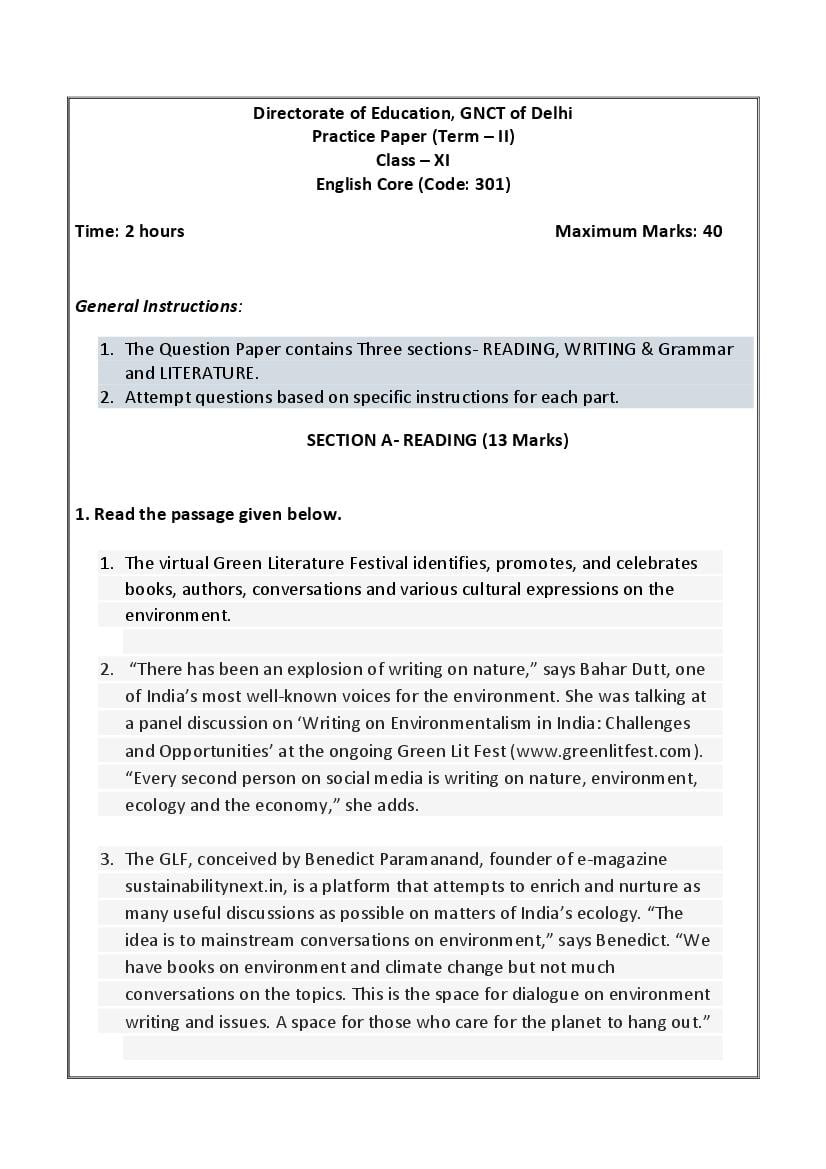
Practice Paper (Term – II)
Class – XI
English Core (Code: 301)
Time: 2 hours Maximum Marks: 40
General Instructions:
1. The Question Paper contains Three sections- READING, WRITING & Grammar
and LITERATURE.
2. Attempt questions based on specific instructions for each part.
SECTION A- READING (13 Marks)
1. Read the passage given below.
1. The virtual Green Literature Festival identifies, promotes, and celebrates
books, authors, conversations and various cultural expressions on the
environment.
2. “There has been an explosion of writing on nature,” says Bahar Dutt, one
of India’s most well-known voices for the environment. She was talking at
a panel discussion on ‘Writing on Environmentalism in India: Challenges
and Opportunities’ at the ongoing Green Lit Fest (www.greenlitfest.com).
“Every second person on social media is writing on nature, environment,
ecology and the economy,” she adds.
3. The GLF, conceived by Benedict Paramanand, founder of e-magazine
sustainabilitynext.in, is a platform that attempts to enrich and nurture as
many useful discussions as possible on matters of India’s ecology. “The
idea is to mainstream conversations on environment,” says Benedict. “We
have books on environment and climate change but not much
conversations on the topics. This is the space for dialogue on environment
writing and issues. A space for those who care for the planet to hang out.”
Page 2
and books, but also children’s literature, poetry, drama and comics,” says
Meghaa Gupta who is also a part of the founding team of GLF. “We are
curating books for children, adults, and green business.” Meghaa is the
author of A Home of Our Own and Unearthed: An Environmental History of
Independent India (Penguin).
5. GLF will host a year-long series of dialogues, discussions, and other artistic
endeavours around the environment, review books for readers of all ages,
release newsletters and hold a three-day fest in December. The highlight of
the fest will be the roll-out of annual honour lists of green literature for
adults, sustainable businesses and children.
6. The panel discussion is the first in a series of green dialogues the festival
plans to have in the coming days. Bahar Dutt spoke of how the Bhopal gas
tragedy proved to be a big trigger event in independent India that gave a
fillip to reporting on environment. “It ties in all the issues, the dichotomy
between economy and the environment, and human versus environment.”
Dutt said the environment beat still has not got the space it deserves.
7. Independent science journalist Disha Shetty spoke of environment from a
public health perspective, on how environmental degradation and climate
change affect public health. “A decade ago, environment and public health
were two different entities. It is not the case any more. The COVID-19
pandemic brought together doctors, environmentalists and journalists.”
8. While drawing the attention on the power of visuals, Dutt also asked how
environmental journalism is changing things on ground. “We are not asking
tough questions any more. Nature writing is picking up, but it has to be
mainstreamed. We are not addressing it enough. People are seeing air
pollution, pandemic, realising the importance of nature, blogging about it,
and learning more on topics such as climate change.”
Source @greenlitfest
Page 3
questions from the nine given below. (1x8= 8)
i. What is the role of The Virtual Green Literature Festival?
ii. Why do you think, Bahar says, “Every second person on social media is
writing on nature, environment, ecology and the economy”?
iii. How does Benedict plan to mainstream conversations on environment?
iv. What kind of people will hang out in GLF?
v. What is the vision of Meghaa Gupta?
vi. Is GLF going to be a single event? How?
vii. What takes an edge in the dichotomy of economy and environment?
viii. How has the COVID-19 pandemic brought together doctors,
environmentalists and journalists.”?
ix. What is the power of visuals?
2. Read the following passage carefully and answer the questions that follow.
1. Imagine a space where you can pour out your troubles, complaints,
grievances and anything that even remotely bothers you... That’s
HappyInc for you. “It’s an online peer counselling service, where
teenagers between 13 and 18 years can express themselves freely to a
team of helpers who will listen, understand what they have to say and
support them, without being judgemental,” explains 17-year-old Kian
Godhwani, a Bengaluru-based Class XII student, who founded HappyInc
along with his friend Nandini Bhattacharya.
2. Nandini explains why they started this initiative. “With exams, figuring
out what they want to do with their life, applying to colleges, working at
internships and so much more, all the while juggling huge personal and
emotional changes in a society that does not understand or even try to
understand what they’re going through. In fact, we also saw many who
are already shouldering the responsibilities of their family while struggling
with their load.”
Page 4
and the stigma surrounding mental health leaves the teens with no choice
but to cope alone. Also, the process of seeking help is often complicated
and distressing since mental health services are either very expensive or
difficult to access. That’s why Kian and Nandini created HappyInc — to
provide a free, confidential, safe, anonymous and accessible space.
4. “Our vision is to change the world one smile at a time. We are now
working to develop our app through which teenagers can not only seek
help from our Helpers system, but also spread hope and happiness
through their stories and hobbies, and make a positive impact even if it
may be a small one. We plan to make the app a hub of all things happy,”
elaborates Kian.
5. HappyInc believes in the power of a good conversation. The process to
connect with a Helper is simple. At the website (happyinc.in), a help
seeker needs to fill in a few details at the Book A Session page and a
Helper is assigned within a few minutes. The sessions are then conducted
over Zoom. The Helpers are teenagers who have undergone an in-house
training programme that was created with the help of professional
counsellors. Help seekers also have the option of chatting with the
Helpers and can remain anonymous if they wish. The services are
completely free.
6. “HappyInc is a place where teens can express themselves, not just with
the Helpers, but also through their HappyBlog, HappyPlaylist, or podcasts.
It’s a place where you don’t need to fit in; where you just need to be. No
matter how dark your tunnel is, you’ll see a speck of light,” adds Nandini.
(a) On the basis of your reading of the above passage, make notes on it using
headings and sub-headings. Use recognisable abbreviations wherever
necessary. Also, suggest a suitable title. 3Marks
(b) Write a summary of the passage in not more than 50 words using the notes.
2 Marks
Page 5
Marks
3 Draft a suitable poster for COVID APPROPRIATE BEHAVIOUR (CAB) 3
on behalf of Health Department. Do not exceed the word limit of 50
words.
4 Attempt ANY ONE from A and B given below. 5
A You are Rajan/Rajni, Head Boy/Girl of your school. Request your
Principal in writing to arrange extra classes in English for the
students of class XI and XII. Give detailed reasons to support your
demand. Do not exceed the word limit of the letter which is 120-
150 words.
OR
B
You are Saba Parvin/ Parveen Kumar, a student of KBC PUBLIC
SCHOOL. Your school is organizing a debate competition on the
topic ‘Online education does more good than harm’. Draft a debate
either in favour or against the topic in 120-150 words.
5 Rearrange the following words or phrases to make meaningful 4
sentences:
1. crowded/ railway platform/ last Sunday/ the/was/
unusually.
2. vendors/ carrying/ were at/ sweet smelling/ flowers/ the/
platform.
3. the train/ how/ they/ we wondered/ would/ get/ on.
4. but/the train/ carefully/ they/ boarded/ very.
Page 6
15
6 Attempt ANY FIVE of the six questions given below, within 40 words 5x2=10
each.
i. How does the rain justify its claim ‘I am the Poem of Earth’? 2
ii. Which awareness according to Nani Palkhivala is growing
worldwide? 2
iii. A term ‘remove’ has been used in the context of the school
mentioned in the story The Browning Version. What does it
mean? 2
iv. What did the poet notice about independent thinking in the
poem Childhood? 2
v. How did music bring comfort to Albert’s life?
vi. What does Mrs Fitzgerald’s advice to Mrs Pearson after she 2
had put back the family members in their proper place 2
signify?
7 Answer ANY ONE of the following in about 120-150 words. 1x5=5
i Andrew’s visit to the Morgan’s gave him pleasure and satisfaction 5
that he had not achieved earlier. Justify.
ii The narrator, in the travelogue ‘Silk Road’, realized that the snow 5
was both dangerous as well as beautiful. Justify.
Document Details
| Board / Org | Aglasem |
| Exam | Class 11 |
| Type | Sample Paper |
| Pages | 6 |
| Updated | 22 Jul 2026 |