MAHA SET 2018 Question Paper 3 Political Science
Finished viewing? Save it for later —
Download MAHA SET 2018 Question Paper 3 Political Science (PDF · 48 pages)About MAHA SET 2018 Question Paper 3 Political Science
MAHA SET 2018 Question Paper 3 Political Science is available here for free download. Published by Maharashtra Exams for Maharashtra State Eligibility Test, this question paper can be viewed online or downloaded as a PDF (48 pages). Candidates preparing for Maharashtra State Eligibility Test can use MAHA SET 2018 Question Paper 3 Political Science to understand the exam pattern, the type of questions asked, and the overall difficulty level.
Frequently Asked Questions
How can I download MAHA SET 2018 Question Paper 3 Political Science?
Open this page and click the Download button to save MAHA SET 2018 Question Paper 3 Political Science as a PDF. It is completely free on AglaSem Docs.
Is MAHA SET 2018 Question Paper 3 Political Science free to download?
Yes. MAHA SET 2018 Question Paper 3 Political Science can be viewed online and downloaded as a PDF free of cost on AglaSem Docs.
How many pages does MAHA SET 2018 Question Paper 3 Political Science have?
MAHA SET 2018 Question Paper 3 Political Science contains 48 pages, which you can read online or download together as a single PDF.
Where can I find more Maharashtra State Eligibility Test study material?
You can find more Maharashtra State Eligibility Test question papers, sample papers, syllabus, and answer keys on AglaSem Docs.
MAHA SET 2018 Question Paper 3 Political Science – Text
Read the full text of this question paper below — useful to quickly search, copy and reference the content online without downloading the PDF.
📄 View text version (48 pages)
Page 1
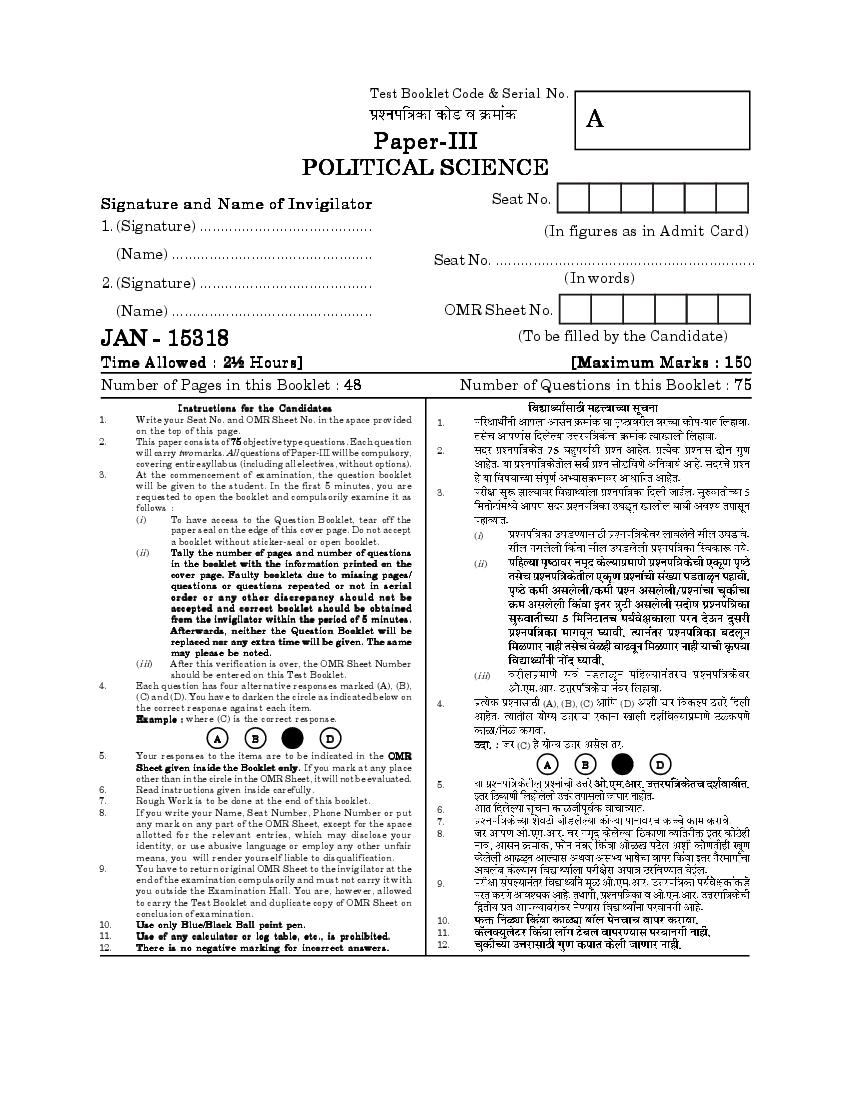
A
Paper-III
POLITICAL SCIENCE
Signature and Name of Invigilator Seat No.
1. (Signature) ......................................... (In figures as in Admit Card)
(Name) ................................................ Seat No. ..............................................................
2. (Signature) ......................................... (In words)
(Name) ................................................ OMR Sheet No.
JAN - 15318 (To be filled by the Candidate)
Time Allowed : 2½ Hours] [Maximum Marks : 150
Number of Pages in this Booklet : 48 Number of Questions in this Booklet : 75
Instructions for the Candidates
1. Write your Seat No. and OMR Sheet No. in the space provided 1.
on the top of this page.
2. This paper consists of 75 objective type questions. Each question
will carry two marks. All questions of Paper-III will be compulsory, 2.
covering entire syllabus (including all electives, without options).
3. At the commencement of examination, the question booklet
will be given to the student. In the first 5 minutes, you are
requested to open the booklet and compulsorily examine it as 3.
follows :
(i) To have access to the Question Booklet, tear off the
paper seal on the edge of this cover page. Do not accept
(i)
a booklet without sticker-seal or open booklet.
(ii) Tally the number of pages and number of questions
in the booklet with the information printed on the (ii)
cover page. Faulty booklets due to missing pages/
questions or questions repeated or not in serial
o rder or any other discre pancy should not be
accepted and correct booklet should be obtained
from the invigilator within the period of 5 minutes.
Afterwards, neither the Question Booklet will be
replaced nor any extra time will be given. The same
may please be noted.
(iii) After this verification is over, the OMR Sheet Number
should be entered on this Test Booklet. (iii)
4. Each question has four alternative responses marked (A), (B),
(C) and (D). You have to darken the circle as indicated below on
the correct response against each item. 4. (A), (B), (C) (D)
Example : where (C) is the correct response.
A B D
(C)
5. Your responses to the items are to be indicated in the OMR
Sheet given inside the Booklet only. If you mark at any place A B D
other than in the circle in the OMR Sheet, it will not be evaluated.
5.
6. Read instructions given inside carefully.
7. Rough Work is to be done at the end of this booklet.
8. If you write your Name, Seat Number, Phone Number or put 6.
any mark on any part of the OMR Sheet, except for the space 7.
allotted for the relevant entries, which may disclose your 8.
identity, or use abusive language or employ any other unfair
means, you will render yourself liable to disqualification.
9. You have to return original OMR Sheet to the invigilator at the
end of the examination compulsorily and must not carry it with 9.
you outside the Examination Hall. You are, however, allowed
to carry the Test Booklet and duplicate copy of OMR Sheet on
conclusion of examination.
10. Use only Blue/Black Ball point pen. 10.
11. Use of any calculator or log table, etc., is prohibited. 11.
12. There is no negative marking for incorrect answers. 12.
Page 2
Page 3
Paper III
III
Time Allowed : 2½ Hours] [Maximum Marks : 150
Note : This paper contains Seventy Five (75) multiple choice questions, each
question carrying Two (2) marks. Attempt All questions.
(75) (2)
1. According to the UNDP’s Human 1.
Development Report of 1994, which
one of the following is incorrectly
stated as an issue falls within the
scope of human security.
(A) Economic security, Food
security
(A)
(B) Health security, Environmental
security (B)
(C) Personal security, Community
(C)
security
(D) Political security, Energy (D)
security
3 [P.T.O.
Page 4
according to the offensive realism
propounded by Mearsheimer ?
(A) Power (A)
(B) Hegemony (B)
(C) Authority (C)
(D) Peace (D)
3. Who was/is the UN Secretary 3.
General took the initiative to
conflict prevention and move the UN
from a culture of reactions to a
culture of prevention ?
(A)
(A) Ban Ki Moon
(B)
(B) Butros Butros Ghali
(C)
(C) Kofi Annan
(D)
(D) Kurt Waldheim
4
Page 5
comprehensive program to combat
corruption in bureaucracy. Which of
the following measures would you
adopt ?
(a) Reform of Indian Penal Code (a)
(b) Modification of the Prevention
(b)
of Corruption Act.
(c)
(c) Improvement in inter-
ministerial coordination (d)
(d) Reduction in protection given
by Art. 311 of the Constitution
:
Codes :
(A) (a) (d)
(A) (a) and (d)
(B) (b) (c)
(B) (b) and (c)
(C) (c) (d)
(C) (c) and (d)
(D) (a), (b) and (d) (D) (a), (b) (d)
5 [P.T.O.
Page 6
5.
labelled as Assertion (A) and the
(A) (R) :
other labelled as Reason (R) :
Assertion (A) : The Prime (A) :
Minister’s Office
maintains liaison
with the
President and
Governors.
(R) :
Reason (R) : The Prime
Minister’s Office
acts as the think
tank of the Prime
Minister.
In the context of the above which
one of the following is correct ?
Codes : :
(A) (A) is true but (R) is false. (A) (A) (R)
(B) Both (A) and (R) are true but
(B) (A) (R)
(R) is not the correct
explanation of (A) (R) (A)
(C) Both (A) and (R) are true and (C) (A) (R)
(R) is the correct explanation of
(R) (A)
(A)
(D) (A) (R)
(D) Both (A) and (R) are false
6
Page 7
Development Administration ?
(A)
(A) Globalization, consumerism,
international trade
(B)
(B) Fundamental Rights,
fundamental duties, secularism
(C)
(C) Economic development, Political
awarness, democracy
(D) Directive principles, socio- (D)
economic justice, welfarism
7. Match List I with List II and select 7.
the correct answer from the codes
I II :
given below :
I
List I
(a)
(a) Political Affairs Committee
(b) Estimates Committee (b)
(c) National Development Council (c)
(d) Inter-state Council (d)
List II II
(1) Administrative reforms (1)
(2) Decisions regarding security (2)
(3) Cooperative federalism (3)
(4) Representation to Chief (4)
Ministers
Codes :
(a) (b) (c) (d)
(a) (b) (c) (d)
(A) (4) (3) (2) (1)
(A) (4) (3) (2) (1)
(B) (3) (1) (4) (2)
(B) (3) (1) (4) (2)
(C) (2) (3) (1) (4) (C) (2) (3) (1) (4)
(D) (2) (1) (4) (3) (D) (2) (1) (4) (3)
7 [P.T.O.
Page 8
statements are linked with
administrative leadership ?
(a)
(a) Influencing people to strive
willingly for mutual objectives.
(b)
(b) Mobilizing people to widen
social base.
(c) Encouraging people for (c)
participation
(d)
(d) Rewarding people for
organizational efficiency.
Codes :
(A) (a) (c) (d)
(A) (a) (c) and (d)
(B) (b) (d)
(B) (b) and (d)
(C) (a), (b) and (d) (C) (a), (b) (d)
(D) (b), (c) and (d) (D) (b), (c) (d)
8
Page 9
(Corporate governance)
(a) It is a government by public
corporations.
(a)
(b) It is a governance protecting
(b)
the interests of the stakeholders.
(c) It is a governance protecting
(c)
ethical and moral values.
(d) International governance.
(d)
Codes : :
(A) (a) and (d) (A) (a) (d)
(B) (b) and (c) (B) (b) (c)
(C) (c) and (d) (C) (c) (d)
(D) (a) and (b) (D) (a) (b)
10. Who of the following advocated the 10.
dependency theory of development
administration ?
(A)
(A) Gunder Frank
(B)
(B) Frank Marini
(C) Chester Barnard (C)
(D) MacGregor (D)
9 [P.T.O.
Page 10
considered while creating a Nagar
Panchayat ?
(A) the degree of urbanization (A)
(B) proportion of employment in
(B)
non-agricultural activities
(C) the degree of people’s (C)
participation
(D)
(D) infrastructure facilities
12. Choose the incorrect statement of the 12.
following :
(A)
(A) The scope of Judicial Review in
Canada was expanded with
Canadian Charter of rights and
freedom in 1982
(B) In India Articles 131-136 of the (B)
Constitution have vested in the
Supreme Court the powers of
Judicial Review
(C)
(C) In US, Judicial Review was
asserted for the first time in
1803 in Marbury Vs. Medison
case
(D) In Switzerland Supreme Court (D)
is empowered to make Judicial
Review of Federal Law
10
Page 11
elected ?
(A)
(A) Directly by people
(B)
(B) Citizens elect the members of
electoral college, these electors
then cast direct votes for the
President
(C) The US Congress elects the (C)
President of America
(D) The Senators elect the (D)
President of America
14. Choose the incorrect statement :
14.
(A) Executive power in Switzerland
(A)
is held by a committee
consisting of 7 members
(B)
(B) Switzerland’s constitution of
1848 provided for a Federal
Council
(C) Each of the ministers in Federal (C)
Council has equal power and is
elected by Parliament
(D) The Swiss Constitution expects (D)
that the executive decisions
should be taken by the President
11 [P.T.O.
Page 12
(A) Indian President can declare (A)
state emergency in a state
through Article 356
(B) Article 356 gives wider powers
(B)
to the central government to
assert its authority over a state
(C) With Article 356 the powers of
the legislature of the state shall (C)
be exercised by or under the
authority of the Parliament
(D) In the Golaknath case the
(D)
Supreme Court discussed at
length the provisions regarding
Article 356
16. In which state the upper house of 16.
the legislature, gets equal
representation from federating
units ?
(A)
(A) India
(B)
(B) USA
(C) UK (C)
(D) None of the above (D)
12
Page 13
member of the Chicago-Michigan
tradition of system theory in
international relations :
(A)
(A) Harold Laski
(B)
(B) Anatoli Raport
(C)
(C) David Singer
(D)
(D) Morton Kaplan
18. Which of the following initiated 18.
the idea of arms control for the first
time ?
(A)
(A) Hague Peace Conference (1899)
(B) Geneva Protocol of 1925 (B)
(C) 14 Points of Woodrow Wilson
(C)
(1919)
(D) Four Powers Declaration of 1945 (D)
13 [P.T.O.
Page 14
labelled as Assertion (A) and the
(A) (R) :
other labelled as Reason (R) :
Assertion (A) : The 17th NAM (A) :
Summit in
Venezuela was
attended by
India’s Vice-
President Hamid (R) :
Ansari.
Reason (R) : In the post-cold
war world NAM
is expected to
focus on core
issues of global
concern.
In the context of the above two
statements, which of the following :
is correct ?
(A) (A) (R)
Codes :
(A) (A) is true, (R) is false (B) (A) (R)
(B) (A) is false, (R) is true (C) (A) (R)
(C) Both (A) and (R) are (R) (A)
individually true, and (R) is the
correct explanation of (A)
(D) (A) (R)
(D) Both (A) and (R) are
individually true, but (R) is not (R) (A)
the correct explanation of (A)
14
Page 15
the UN Security Council is justified
for the following reasons :
(i) India has successfully
(i)
conducted nuclear explosions.
(ii)
(ii) India has never attacked any
country.
(iii)
(iii) Indian economy is growing fast.
(iv) India has achieved greater
diplomatic clout among third (iv)
world countries.
Choose the correct answer from the
following codes :
(A)
(A) All are correct
(B) (i), (ii) (iii)
(B) (i), (ii) and (iii) are correct
(C) (iii) (iv)
(C) (iii) and (iv) are correct
(D) (i), (iii) (iv)
(D) (i), (iii) and (iv) are correct
15 [P.T.O.
Page 16
incorrectly stated ?
(A) Capacity to influence (A)
(B) Embodiment of reason (B)
(C) Based on force (C)
(D) Not backed by law (D)
22. Who among the following has 22.
defined political development as
“increased differentiation and
specialization of political structure
and increased secularisation of
political culture”.
(A) Samuel P. Huntington
(A)
(B) David Easton
(B)
(C) Gabriel A. Almond and G.B.
(C)
Powell
(D) Alfred Diamont (D)
16
Page 17
about India’s Nuclear Policy and
mark the incorrect one :
(A) India considers Nuclear Non-
(A)
Proliferation Treaty (NPT) as
discriminatory treaty
(B) India is in favour of both (B)
vertical and horizontal nuclear
weapon proliferation
(C)
(C) India is for total nuclear
disarmament
(D)
(D) India is against declaring South
Asia as a Nuclear Weapon Free
Zone
17 [P.T.O.
Page 18
the main theme of the 1971 UN
Declaration on Indian Ocean as a
Zone of Peace. Use the codes :
(i) To eliminate the regional and
(i)
extra regional power presence
(ii) To eliminate the great power
(ii)
presence in the context of great
power rivalry
(iii) To make the region a Zone of (iii)
Peace
(iv)
(iv) To declare the region as a
Nuclear Weapon Free Zone.
Codes :
(A) (i), (ii), (iii), (iv)
(A) (i), (ii), (iii), (iv)
(B) (ii), (iii)
(B) (ii), (iii) only
(C) (iii), (iv)
(C) (iii), (iv) only
(D) (i), (ii) and (iii) only (D) (i), (ii) (iii)
18
Page 19
‘security dilemma’ from the
following. Use codes :
(i)
(i) An important paradox inherent
in the state system.
(ii)
(ii) The existence of states is to
provide security of its citizens
by maintaining armed forces. (iii)
(iii) The existence of armed forces
threatens the very security, they
are expected to maintain.
(iv)
(iv) There is no escape from the
international security dilemma
because there is no possibility
forming a world government.
Codes : (A) (i), (ii), (iii) , (iv)
(A) (i), (ii), (iii) are correct and (iv)
is incorrect
(B) (i), (ii), (iii) (iv)
(B) (i), (ii), (iii) and (iv) are correct
(C) (i), (ii) (iii), (iv)
(C) (i), (ii) are correct and (iii), (iv)
are incorrect
(D) (i), (ii), (iv) (iii)
(D) (i), (ii), (iv) are correct and (iii)
is incorrect
19 [P.T.O.
Page 20
(Scholars) and select the correct
codes :
List I (Theory) I
(a) Liberalism (a)
(b) Realism (b)
(c) Critical (c)
(d) Dependency (d)
List II (Scholars) II
(1) Immanuel Kant (1)
(2) Kautilya (2)
(3) Immanuel Wallenstein (3)
(4) Jurgen Habermass (4)
Codes :
(a) (b) (c) (d) (a) (b) (c) (d)
(A) (1) (4) (3) (2) (A) (1) (4) (3) (2)
(B) (4) (3) (2) (1) (B) (4) (3) (2) (1)
(C) (1) (2) (4) (3) (C) (1) (2) (4) (3)
(D) (1) (2) (3) (4) (D) (1) (2) (3) (4)
20
Page 21
celebrated by India as the
‘E-governance year ?
(A)
(A) 2001
(B)
(B) 2002
(C)
(C) 2003
(D)
(D) 2004
28. Who wrote the book entitled 28.
“Development Administration–
Concept and Problems” ?
(A)
(A) Appleby
(B)
(B) L.D. White
(C)
(C) Willobi
(D) Swerdlow (D)
21 [P.T.O.
Page 22
report on ...................... date.
(A) 27th October, 1987 (A)
(B) 26th April, 1966 (B)
(C) 24th November, 1972 (C)
(D) 20th May, 1981 (D)
30. Which Article of the Indian 30.
Constitution describes India as a
‘Union of States’.
(A)
(A) Article 11
(B)
(B) Article 4
(C)
(C) Article 13
(D) Article 1 (D)
22
Page 23
Myanmar ?
(A)
(A) Owang San Su Ki
(B)
(B) Thiyen Sen
(C)
(C) Khin Ki
(D) Ne Win (D)
32. Which is the most important 32.
element of current global politics ?
(A) Technical (A)
(B) Economical (B)
(C) Political (C)
(D) Military (D)
33. According to Huntington which of 33.
the following countries can be
considered as coming under the third
wave of democratization ?
(A)
(A) Japan and Germany
(B)
(B) India and Israel
(C)
(C) Britain, France and USA
(D) Southern and Eastern Europe (D)
23 [P.T.O.
Page 24
correctly matched ?
(a) Samuel Huntington (a)
(b) Mikhail Gorbachev (b)
(c) Henry Kissinger (c)
(1) Clash of civilization (1)
(2) Perestroika and Glasnost (2)
(3) Detente (3)
Codes :
(A) (1) and (2) (A) (1) (2)
(B) (1) and (3) (B) (1) (3)
(C) (2) and (3) (C) (2) (3)
(D) (1), (2) and (3) (D) (1), (2) (3)
35. Who among the following is 35.
the pioneer of the theory of neo-
realism ?
(A)
(A) Kenneth Waltz
(B)
(B) Hans Morgenthau
(C)
(C) Barry Buzan
(D) Raul Prebisch (D)
24
Page 25
economic, political, social and
cultural relations across
international borders is known as
................ . (A)
(A) Political economy
(B)
(B) Economic development
(C)
(C) Globalization
(D)
(D) World economy
37. The farmers organisation, Bharatiya 37.
Kissan Union was established by
............................ .
(A)
(A) Sharad Joshi
(B)
(B) Mahendra Singh Tikait
(C)
(C) Nandunjappa
(D) Raju Shetti (D)
38. When was fundamental duties were 38.
incorporated in the Indian
Constitution ?
(A)
(A) 1948
(B)
(B) 1950
(C) 1976 (C)
(D) 1971 (D)
25 [P.T.O.
Page 26
Constituent Assembly formed ?
(A) Cabinet Mission Plan (A)
(B) Mountbatten Plan (B)
(C) Govt. of India Act, 1935 (C)
(D) Cripps Mission Plan (D)
40. Which one of the following pairs is 40.
not correctly matched ?
(A) Huntington : Differentiation
(A)
(B) Gabriel : Structural
(B)
Almond Differentiation
(C) Huntington : Participation
(D) Gabriel : Centralization (C)
Almond (D)
26
Page 27
correctly matched ?
(A) Civic culture: Parochial and
(A) :
political culture
(B) Civic culture: Subject and
(B) :
super partici-
pant culture
(C) Civic culture: P a r t ici pa t io n (C) :
and political
culture
(D) :
(D) Civic culture: Parochial, Sub-
ject and partici-
pant culture
27 [P.T.O.
Page 28
not correctly matched ?
(A) Vilfredo — The Mind and
(A)
Pareto Society
(B) Gaetano — The Ruling
(B)
Mosca Class
(C)
(C) C. Wright — The Power Elite
Mills
(D) Karl Mann- — Elite and Non- (D)
heim Elite
43. Which one of the following pairs is 43.
correctly matched ?
(A) Steven — Power : Radical
(A)
Lukes View
(B) Michel — Political System
(B)
Foucault
(C) Gramsci — A Theory of
(C)
Justice
(D) Hannah — Political
(D)
Arendt Liberalism
28
Page 29
are correct ?
(a) Between 1950 and 1967, there (a)
was congress dominant at the
centre level.
(b)
(b) After the fourth general election
of 1967, in six states coalition
government was formed.
(c) Between 1950 and 1967, there (c)
was not congress dominant at
the state level.
Select the correct option from the
following codes :
(A) (a) (c)
(A) (a) and (c)
(B) (b) (c)
(B) (b) and (c)
(C) (a) (b)
(C) (a) and (b)
(D) (a), (b) and (c) (D) (a), (b) (c)
29 [P.T.O.
Page 30
are correct ?
(a) The political awareness is (a)
present among the Dalits.
(b)
(b) There are region based political
parties in India
(c)
(c) There are political parties that
are not formed on socio-cultural
basis.
Select the correct option from the
following codes :
(A) (a) (c)
(A) (a) and (c)
(B) (b) (c)
(B) (b) and (c)
(C) (a), (b) and (c) (C) (a), (b) (c)
(D) (a) and (b) (D) (a) (b)
30
Page 31
46.
communist government was
formed ?
(A)
(A) Kerala
(B) Orissa (B)
(C) West Bengal (C)
(D) Tamil Nadu (D)
47. Which of the following statements 47.
are correct ?
(a) Gender is different from sex (a)
(b) Gender is not social construction
(b)
(c) Gender is division of labour
(c)
Select the correct option from the
following codes :
Codes :
(A) (a), (b) and (c) (A) (a), (b) (c)
(B) (a) and (b) (B) (a) (b)
(C) (b) and (c) (C) (b) (c)
(D) (a) (c)
(D) (a) and (c)
31 [P.T.O.
Page 32
the correct answer from the codes II
given below :
I
List I
(a)
(a) Morris-Jones
(b)
(b) Srinivas M.N.
(c) Rajni Kothari (c)
(d) Weiner Myron (ed.) (d)
List II II
(1) The Dominant Caste and Other (1)
Essays
(2)
(2) Government and Politics in
India (3)
(3) State Politics in India (4)
(4) Politics in India
Codes :
(a) (b) (c) (d)
(a) (b) (c) (d)
(A) (2) (1) (4) (3)
(A) (2) (1) (4) (3)
(B) (3) (2) (1) (4)
(B) (3) (2) (1) (4)
(C) (4) (3) (2) (1)
(C) (4) (3) (2) (1)
(D) (1) (2) (3) (4)
(D) (1) (2) (3) (4)
32
Page 33
49.
correctly matched ? (After 1990)
(A) Tow party — Gujarat
(A)
system
(B) One party — Maharashtra (B)
system (C)
(C) One party — Kerala
dominance
(D)
(D) One party — Rajasthan
system
50. Which of the following is/are forms 50.
or system with which the unitary
system is compatible ?
1.
1. Presidential form of
government. 2.
2. Parliamentary form of
3.
government
3. System of judicial review
Choose the correct answer from the
codes given below :
Codes :
(A) 1 2
(A) 1 and 2
(B) 1 3
(B) 1 and 3
(C) 1, 2 and 3 (C) 1, 2 3
(D) only 3 (D) 3
33 [P.T.O.
Page 34
51.
means :
(A) A system of govrnment which
is marked by the existence of a
(A)
group which collectively decides
on the politics of the
government and which is also
collectively responsible to the
parliament
(B) A form of government in which (B)
the cabinet is supreme and is
not accountable to any other
organ of the state
(C) A form of government in which
(C)
all the members of the cabinet
are popularly elected on the
basis of universal audit
franchise
(D) A form of government in which (D)
it is the President, and not the
Prime Minister, who presides
over the cabinet meetings for
the reason that he is directly
elected by the people
34
Page 35
(A) cannot be amended (A)
(B) can be amended only by a new (B)
constituent assembly
(C) can be amended only by two-
(C)
thirds majority of the members
present and voting
(D) can be amended by any
procedure other than ordinary (D)
law making process prescribed
by the constitution
53. Who said that “Authority is 53.
federal” ?
(A) Barker (A)
(B) Duguit (B)
(C) Krabbe (C)
(D) Laski (D)
35 [P.T.O.
Page 36
all the governments ultimately are
oligarchic in nature ?
(A) F.M. Marx (A)
(B) Vilfredo Pareto (B)
(C) Max Weber (C)
(D) Herbert A. Simon (D)
55. Bureaucracy in the modern state is 55.
the form of :
(A) Traditional authority (A)
(B) Rational legal authority (B)
(C) Charismatic authority (C)
(D) Political authority (D)
56. Which of the following imposes 56.
limitations on the supremacy of the
Parliament in India ?
(A)
(A) Parliamentary system
(B)
(B) Federal system and judicial
review
(C)
(C) Socialistic pattern
(D) Fundamental rights (D)
36
Page 37
correctly matched ?
1. Dependency — Samir Amin 1. —
theory
2. Liberal theory — Lucian Pye 2. —
of development
3. Theory of — Karl Marx 3. —
alienation
4. Theory of — John Rawls 4. —
negative
Select the correct answer using the
codes given below :
Codes :
(A) 1, 2, 3 and 4 (A) 1, 2, 3 4
(B) 1 and 2 (B) 1 2
(C) 3 and 4 (C) 3 4
(D) 1, 2 and 3 (D) 1, 2 3
37 [P.T.O.
Page 38
List I I
(a) Sovereign is the main source of (a)
law
(b) Laws are passed by legislature (b)
(c) General will is sovereign (c)
(d) Will, and not force, is the basis (d)
of state
List II II
(1) Hobbes (1)
(2)
(2) Locke
(3)
(3) Rousseau
(4)
(4) T.H. Green
Choose the correct answer from the
codes given below :
(a) (b) (c) (d) (a) (b) (c) (d)
(A) (4) (2) (3) (1) (A) (4) (2) (3) (1)
(B) (1) (2) (3) (4)
(B) (1) (2) (3) (4)
(C) (2) (1) (3) (4)
(C) (2) (1) (3) (4)
(D) (4) (1) (2) (3)
(D) (4) (1) (2) (3)
38
Page 39
struggle between :
(A) labour and bourgeoisie (A)
(B) capitalists and feudalists (B)
(C) middle class and the down- (C)
trodden
(D) aristocracy and commoners (D)
60. Gandhiji believed in the principle of 60.
non-violence. Satyagraha is :
(A) a weapon to oppose violence by
(A)
non-violence
(B) a method of civil disobedience (B)
(C) a method of people’s
(C)
participation
(D) a weapon of violence (D)
39 [P.T.O.
Page 40
61.
form of democracy is government by
the :
(A)
(A) Elite
(B)
(B) War-mongers
(C)
(C) Democrate
(D)
(D) Anarchists
62. Violation of the ‘Rule of Law’ arises 62.
mostly from :
(A) Limited franchise (A)
(B) Delegated legislation (B)
(C) Lack of checks and balances (C)
(D) Unrestrained freedom (D)
40
Page 41
matched ?
Theories of Statements
Nature Regarding Nature
of State of State
(A) Idealist State will wither away (A)
(B) Mechanistic State is an association of (B)
associations
(C) Legal State has a fictitious
(C)
personality
(D) Organic State is the objectification (D)
of spirit
64. Who of the following wrote ‘The 64.
Subjection of Women’ ?
(A) Jeremy Bentham (A)
(B) Karl Marx (B)
(C) James Mill (C)
(D) John Stuart Mill (D)
41 [P.T.O.
Page 42
Satyagraha movement in 1919.
Which of the following was the
correct reason ?
(a) It was a protest against the (a)
British government for its
failure to introduce promised
reforms at the end of the war.
(b) It was a protest against the
massacre at Jallianwala Bagh, (b)
Amritsar.
(c) It was a protest against the
(c)
Rowlatt Act.
(d)
(d) It was a protest against
communal awards.
Codes :
(A) (a) (c)
(A) (a) and (c)
(B) (c)
(B) Only (c)
(C) (c) (d)
(C) (c) and (d)
(D) Only (b) (D) (b)
42
Page 43
Second Round Table Conference at
London (1931) ?
(A) Mahatma Gandhi (A)
(B) Jawahar Lal Nehru (B)
(C) Srinivas Shastri (C)
(D) B.R. Ambedkar (D)
67. The Lahore Session of the Congress 67.
which adopted a resolution of
complete independence for India was
presided over by :
(A)
(A) Subhash Chandra Bose
(B)
(B) Mahatma Gandhi
(C)
(C) Motilal Nehru
(D) Jawaharlal Nehru (D)
68. The basic principle of liberalism 68.
is :
(A)
(A) Individual freedom
(B)
(B) Social justice
(C)
(C) Equality
(D) Nationalism (D)
43 [P.T.O.
Page 44
but sabine finds this utopia ............ .
(A) Generous and a humane one
(A)
(B) Anti-capitalist and prodemocracy (B)
(C) Restrictive and class oriented
(C)
(D) Anti-imperialist and pro-
(D)
authoritarian
70. Which of the following pairs is 70.
correctly matched ?
(A) Rousseau — Civil society (A)
(B) Locke — Original position (B)
(C) Plato — Veil of ignorance (C)
(D) Machiavelli — Hegemony (D)
44
Page 45
the codes given below :
Assertion (A) : Hobbes said
(A) :
“Man is solitary
poor, nasty,
brutish and
short”.
Reason (R) : There can be no (R) :
morality, justice,
industry and
civilisation.
Codes :
(A) (A) is correct but (R) is incorrect (A) (A) (R)
(B) Both (A) and (R) are correct and
(B) (A) (R)
(R) is reason of (A)
(R) (A)
(C) (A) is incorrect but (R) is correct
(C) (A) (R)
(D) Both (A) and (R) are correct but
(R) is not the correct reason of (D) (A) (R)
(A) (R) (A)
45 [P.T.O.
Page 46
constraint in the realization of
liberty” ?
(A)
(A) Rousseau
(B)
(B) Thomas Hobbes
(C) J.S. Mill (C)
(D) T.H. Green (D)
73. Which among the following is an 73.
incorrect statement ?
(A)
(A) Negative liberty is the absence
of obstacles
(B)
(B) Classical liberal state makes a
claim for private property
(C)
(C) Modern liberal state advocates
Laissez-faire economy
(D) Maximum government is main (D)
feature of welfare state
74. Which one of the following pairs is 74.
correctly matched ?
(A) Classical political theory — (A)
Value oriented
(B)
(B) Empirical political theory —
Value oriented
(C)
(C) Empirical political theory —
Anti-positivism
(D)
(D) Classical political theory —
Anti-historicism
46
Page 47
not correctly matched ?
(A) John Rawls theory of justice
(A)
— Each person is to have an
equal right to the most
extensive liberty compatible
with similar liberty to others (B)
(B) Feminist Account of Justice —
The greatest benefit of the least
advantaged
(C)
(C) John Rawls theory of justice —
Attached to offices and positions
open to all under conditions of
fair equality and opportunity
(D)
(D) Amartya Sen Approach —
Justice as a capability based.
47 [P.T.O.
Page 48
48
Document Details
| Board / Org | Maharashtra Exams |
| Exam | Maharashtra State Eligibility Test |
| Type | Question Paper |
| Pages | 48 |
| Updated | 30 Apr 2026 |