Class 11 Sample Paper 2022 Accountancy Term 2
Finished viewing? Save it for later —
Download Class 11 Sample Paper 2022 Accountancy Term 2 (PDF · 4 pages)About Class 11 Sample Paper 2022 Accountancy Term 2
Class 11 Sample Paper 2022 Accountancy Term 2 is available here for free download. Published by AglaSem for Class 11, this sample paper can be viewed online or downloaded as a PDF (4 pages). Candidates preparing for Class 11 can use Class 11 Sample Paper 2022 Accountancy Term 2 to understand the exam pattern, the type of questions asked, and the overall difficulty level.
Frequently Asked Questions
How can I download Class 11 Sample Paper 2022 Accountancy Term 2?
Open this page and click the Download button to save Class 11 Sample Paper 2022 Accountancy Term 2 as a PDF. It is completely free on AglaSem Docs.
Is Class 11 Sample Paper 2022 Accountancy Term 2 free to download?
Yes. Class 11 Sample Paper 2022 Accountancy Term 2 can be viewed online and downloaded as a PDF free of cost on AglaSem Docs.
How many pages does Class 11 Sample Paper 2022 Accountancy Term 2 have?
Class 11 Sample Paper 2022 Accountancy Term 2 contains 4 pages, which you can read online or download together as a single PDF.
Where can I find more Class 11 study material?
You can find more Class 11 question papers, sample papers, syllabus, and answer keys on AglaSem Docs.
Class 11 Sample Paper 2022 Accountancy Term 2 – Text
Read the full text of this sample paper below — useful to quickly search, copy and reference the content online without downloading the PDF.
📄 View text version (4 pages)
Page 1
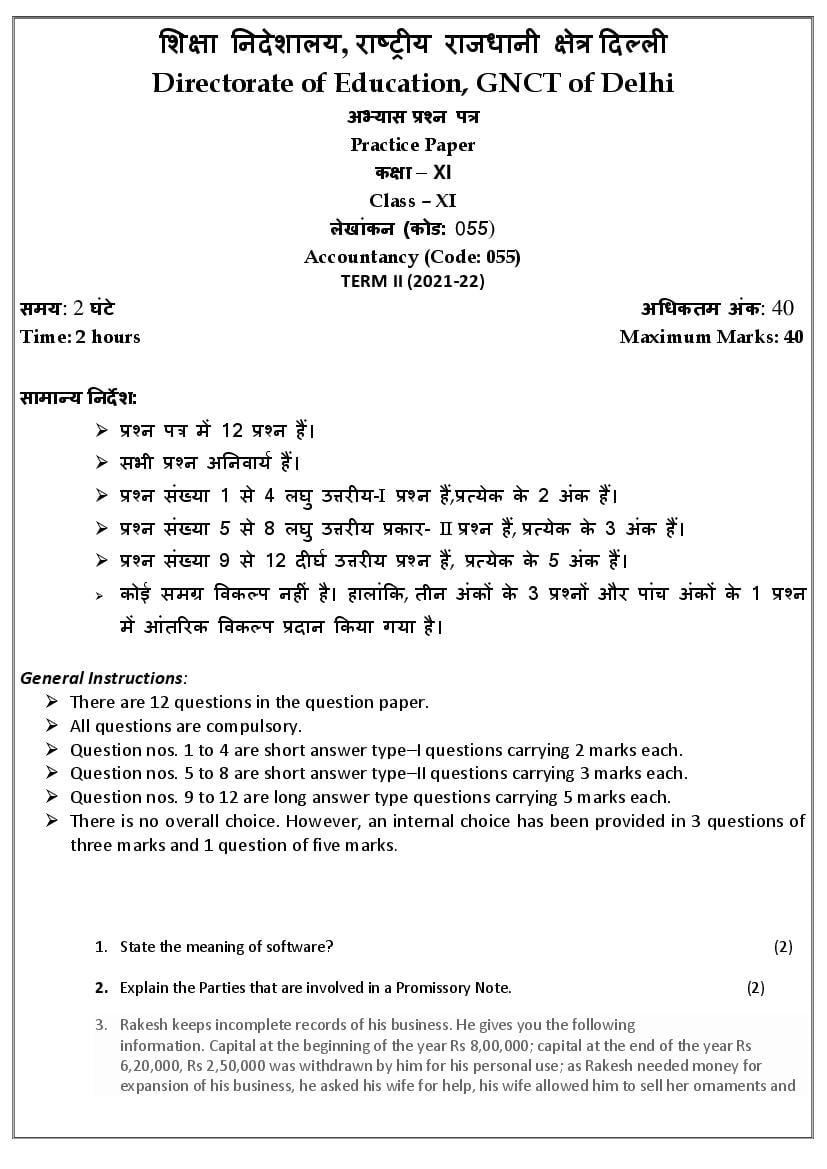
Directorate of Education, GNCT of Delhi
अभ्यास प्रश्ि पत्र
Practice Paper
कक्षा – XI
Class – XI
लेखाांकि (कोड: 055)
Accountancy (Code: 055)
TERM II (2021-22)
समय: 2 घांटे अधधकतम अांक: 40
Time: 2 hours Maximum Marks: 40
सामान्य निदे ि:
प्रश्न पत्र में 12 प्रश्न हैं।
सभी प्रश्न अननवार्य हैं।
प्रश्न संख्र्ा 1 से 4 लघु उत्तरीर्-I प्रश्न हैं,प्रत्र्ेक के 2 अंक हैं।
प्रश्न संख्र्ा 5 से 8 लघु उत्तरीर् प्रकार- II प्रश्न हैं, प्रत्र्ेक के 3 अंक हैं।
प्रश्न संख्र्ा 9 से 12 दीघय उत्तरीर् प्रश्न हैं, प्रत्र्ेक के 5 अंक हैं।
कोई समग्र ववकल्प नहीं है । हालांकक, तीन अंकों के 3 प्रश्नों और पांच अंकों के 1 प्रश्न
में आंतररक ववकल्प प्रदान ककर्ा गर्ा है ।
General Instructions:
There are 12 questions in the question paper.
All questions are compulsory.
Question nos. 1 to 4 are short answer type–I questions carrying 2 marks each.
Question nos. 5 to 8 are short answer type–II questions carrying 3 marks each.
Question nos. 9 to 12 are long answer type questions carrying 5 marks each.
There is no overall choice. However, an internal choice has been provided in 3 questions of
three marks and 1 question of five marks.
1. State the meaning of software? (2)
2. Explain the Parties that are involved in a Promissory Note. (2)
3. Rakesh keeps incomplete records of his business. He gives you the following
information. Capital at the beginning of the year Rs 8,00,000; capital at the end of the year Rs
6,20,000, Rs 2,50,000 was withdrawn by him for his personal use; as Rakesh needed money for
expansion of his business, he asked his wife for help, his wife allowed him to sell her ornaments and
Page 2
year ended. (2)
4. Define Provisions for bad and doubtful debts with adjustment entry. (2)
5. Explain central processing unit, as a component of computer system. (3)
6. List the various advantages of Computerised Accounting Systems. (3)
OR
State the limitations of Computers.
7. State whether the following expenses are capital or revenue in nature: (3)
(i) Expenses on whitewashing and painting of a building purchased to make it ready for use.
(ii) ₹ 10,000 spent on constructing platform for a new machine.
(iii) Repair expenses of ₹ 25,000 incurred for whitewashing of factory building.
OR
From the following information, determine Gross Profit for the year ended 31st March, 2019:
₹ ₹
Opening Stock (1st April, 2018) 25,000 Goods purchased during the year 1,40,000
Freight and Packing 10,000 Closing Stock (31st March, 2019) 30,000
Sales 1,90,000 Packing Expenses on Sales 6,000
8. From the following figures, calculate Operating Profit: (3)
₹ ₹
Net Profit 1,00,000 Rent Received 10,000
Gain on Sale of Machine 15,000 Interest on Loans paid 20,000
Donation received 2,000
OR
Explain Marshalling of Balance Sheets.
9. Rectify the following errors assuming that Suspense Account was opened. (5)
(a) Credit sales to Mohan ₹ 7,000 were recorded in Purchase Book. However, Mohan's Account was correctly
debited.
(b) Credit purchases from Rohan ₹ 9,000 were recorded in Sales Book. However, Rohan's Account was correctly
credited.
(c) Goods returned to Rakesh ₹ 4,000 were recorded in Sale Returns Book. However, Rakesh's Account was
correctly debited.
(d) Goods returned from Mahesh ₹ 1,000 were recorded through Purchase Returns Book. However, Mahesh's
Account was correctly credited.
(e) Goods returned to Naresh ₹ 2,000 were recorded through Purchases Book. However, Naresh's Account was
correctly debited.
10. A sells goods for ₹ 30,000 to B on 1st January, 2017 and on the same day draws a bill on B for three months for
the same amount. B accepts it and returned it to A, who discounts it on 4th February, 2017 with his bank at 18% per
annum. The acceptance is dishonoured on the due date, the noting charges paid by the bank being ₹ 200.
Page 3
(i) Calculate the amount of discount on discounting the bill.
(ii) Pass Journal entry in the books of B for the acceptance of bill.
(iii)Pass Journal entry in the books of B for discounting the bill.
(iv)What is the Maturity date of the bill drawn by A?
(v) Pass journal entry on dishonoured of bill in the books of A
OR
Asha sold goods worth ₹ 19,000 to Nisha on March 2, 2016. ₹ 4,000 were paid by Nisha immediately and for the
balance she accepted a bill of exchange drawn upon her by Asha payable after three months. Asha discounted the
bill immediately with her bank @ 10% p.a. On the due date Nisha dishonoured the bill and the bank paid ₹ 30 as
noting charges.
You are required to answer the following questions:
(i) Calculate the amount of discount on discounting the bill.
(ii) Pass Journal entry in the books of Asha for the Drawn of bill.
(iii)Pass Journal entry in the books of Nisha for discounting the bill.
(iv)What is the Maturity date of the bill drawn by Asha?
(v) Pass journal entry on dishonoured of bill in the books of Nisha.
11. X, a retailer, has not maintained proper books of account but it has been possible to obtain the following
details: (5)
Last Year This Year
Particulars
(₹) (₹)
Trade Creditors ................................................................................ 6,270 5,890
Loan from Naresh ................................................................................ 5,000 5,000
Stock ................................................................................ 12,350 11,980
Cash in Hand ................................................................................ 570 650
Shop Fittings ................................................................................ 7,250 7,800
Trade Debtors ................................................................................ 5,280 4,560
Bank Balance ................................................................................ 3,990 4,130
Calculate the net profit for this year and draft the Statement of Affairs at the end of the year after noting that:
(a) Shop Fittings are to be depreciated by ₹ 780.
(b) X has drawn ₹ 100 per week for his own use.
(c) Included in the Trade Debtors is an irrecoverable balance of ₹ 270.
(d) Interest at 5% p.a. is due on the loan from Naresh but has not been paid for the year.
Page 4
sheet as on March 31, 2017. (5)
Debit Balances Amount Credit Balances Amount
` `
Drawings 6,300 Capital 1,50,000
Cash at bank 13,870 Discount received 2,980
Bills receivable 1,860 Loans 15,000
Loan and Building 42,580 Purchases return 1,450
Furniture 5,130 Sales 2,81,500
Discount allowed 3,960 Reserve for bad debts 4,650
Bank charges 100 Creditors 18,670
Salaries 6,420
Purchases 1,99,080
Stock (opening) 60,220
Sales return 1,870
Carriage 5,170
Rent and Taxes 7,680
General expenses 3,630
Plant and Machinery 31,640
Book debts 82,740
Bad debts 1,250
Insurance 750
4,74,250 4,74,250
Adjustments
1. Closing stock Rs. 70,000
2. Create a reserve for bad and doubtful debts @ 10% on book debts
3. Insurance prepaid Rs. 50
4. Rent outstanding Rs. 150
5. Interest on loan is due @ 6% p.a.
Document Details
| Board / Org | Aglasem |
| Exam | Class 11 |
| Type | Sample Paper |
| Pages | 4 |
| Updated | 22 Jul 2026 |