MAHA SET 2018 Question Paper 2 Sociology
Finished viewing? Save it for later —
Download MAHA SET 2018 Question Paper 2 Sociology (PDF · 24 pages)About MAHA SET 2018 Question Paper 2 Sociology
MAHA SET 2018 Question Paper 2 Sociology is available here for free download. Published by Maharashtra Exams for MAHA SET, this question paper can be viewed online or downloaded as a PDF (24 pages). Candidates preparing for MAHA SET can use MAHA SET 2018 Question Paper 2 Sociology to understand the exam pattern, the type of questions asked, and the overall difficulty level.
Frequently Asked Questions
How can I download MAHA SET 2018 Question Paper 2 Sociology?
Open this page and click the Download button to save MAHA SET 2018 Question Paper 2 Sociology as a PDF. It is completely free on AglaSem Docs.
Is MAHA SET 2018 Question Paper 2 Sociology free to download?
Yes. MAHA SET 2018 Question Paper 2 Sociology can be viewed online and downloaded as a PDF free of cost on AglaSem Docs.
How many pages does MAHA SET 2018 Question Paper 2 Sociology have?
MAHA SET 2018 Question Paper 2 Sociology contains 24 pages, which you can read online or download together as a single PDF.
Where can I find more MAHA SET study material?
You can find more MAHA SET question papers, sample papers, syllabus, and answer keys on AglaSem Docs.
MAHA SET 2018 Question Paper 2 Sociology – Text
Read the full text of this question paper below — useful to quickly search, copy and reference the content online without downloading the PDF.
📄 View text version (24 pages)
Page 1
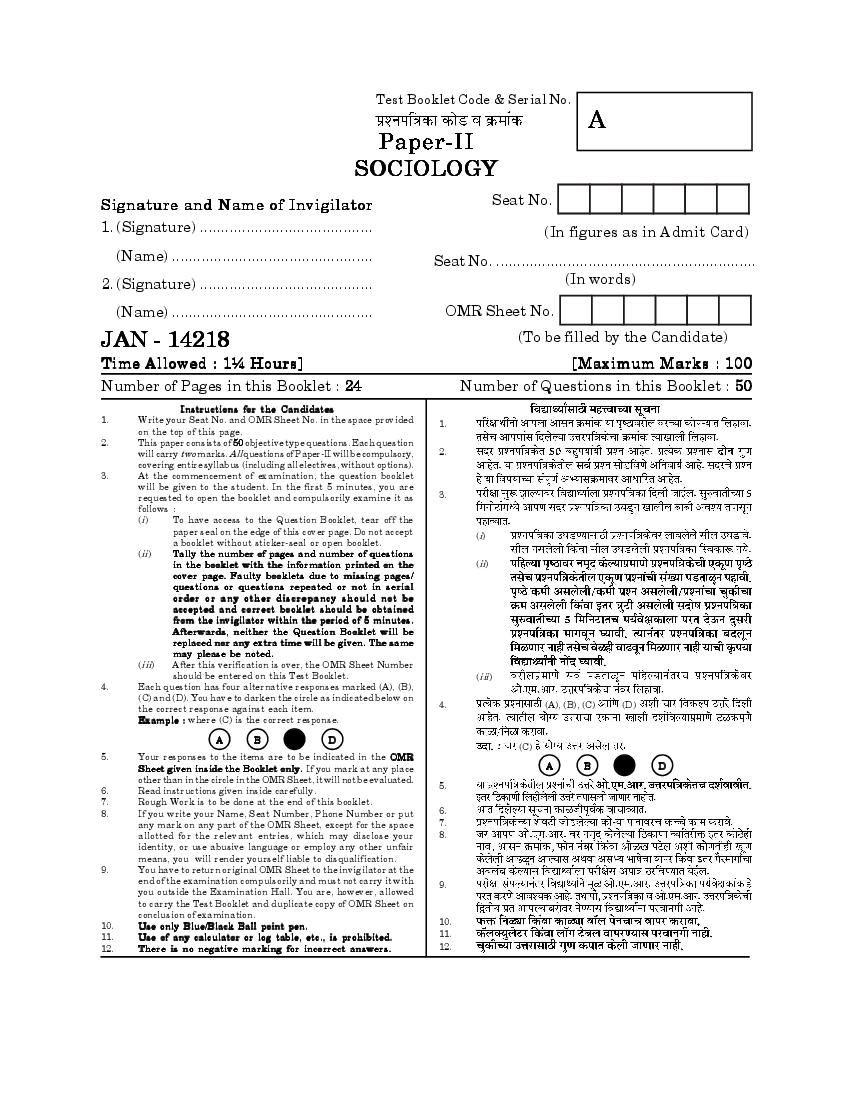
A
SOCIOLOGY
Signature and Name of Invigilator Seat No.
1. (Signature) ......................................... (In figures as in Admit Card)
(Name) ................................................ Seat No. ..............................................................
2. (Signature) ......................................... (In words)
(Name) ................................................ OMR Sheet No.
JAN - 14218 (To be filled by the Candidate)
Time Allowed : 1¼ Hours] [Maximum Marks : 100
Number of Pages in this Booklet : 24 Number of Questions in this Booklet : 50
Instructions for the Candidates
1. Write your Seat No. and OMR Sheet No. in the space provided 1.
on the top of this page.
2. This paper consists of 50 objective type questions. Each question
will carry two marks. All questions of Paper-II will be compulsory, 2.
covering entire syllabus (including all electives, without options).
3. At the commencement of examination, the question booklet
will be given to the student. In the first 5 minutes, you are
requested to open the booklet and compulsorily examine it as 3.
follows :
(i) To have access to the Question Booklet, tear off the
paper seal on the edge of this cover page. Do not accept (i)
a booklet without sticker-seal or open booklet.
(ii) Tally the number of pages and number of questions
in the booklet with the information printed on the (ii)
cover page. Faulty booklets due to missing pages/
questions or questions repeated or not in serial
o rder or any other discre pancy should not be
accepted and correct booklet should be obtained
from the invigilator within the period of 5 minutes.
Afterwards, neither the Question Booklet will be
replaced nor any extra time will be given. The same
may please be noted.
(iii) After this verification is over, the OMR Sheet Number
should be entered on this Test Booklet. (iii)
4. Each question has four alternative responses marked (A), (B),
(C) and (D). You have to darken the circle as indicated below on
the correct response against each item. 4. (A), (B), (C) (D)
Example : where (C) is the correct response.
A B D
(C)
5. Your responses to the items are to be indicated in the OMR
Sheet given inside the Booklet only. If you mark at any place A B D
other than in the circle in the OMR Sheet, it will not be evaluated.
5.
6. Read instructions given inside carefully.
7. Rough Work is to be done at the end of this booklet.
8. If you write your Name, Seat Number, Phone Number or put 6.
any mark on any part of the OMR Sheet, except for the space 7.
allotted for the relevant entries, which may disclose your 8.
identity, or use abusive language or employ any other unfair
means, you will render yourself liable to disqualification.
9. You have to return original OMR Sheet to the invigilator at the
end of the examination compulsorily and must not carry it with 9.
you outside the Examination Hall. You are, however, allowed
to carry the Test Booklet and duplicate copy of OMR Sheet on
conclusion of examination.
10. Use only Blue/Black Ball point pen. 10.
11. Use of any calculator or log table, etc., is prohibited. 11.
12. There is no negative marking for incorrect answers. 12.
Page 2
Page 3
Paper II
II
Time Allowed : 75 Minutes] [Maximum Marks : 100
Note : This paper contains Fifty (50) multiple choice questions, each carrying
Two (2) marks. Attempt All questions.
(50) (2)
1. According to whom every social 1.
system has four functional problems ?
(A) Durkheim (A)
(B) R. Merton (B)
(C) Malinowski (C)
(D) Parsons (D)
2. According to Radcliffe-Brown closely 2.
connected with the concept of social
structure is the conception of :
(A)
(A) Social personality
(B)
(B) Interaction
(C)
(C) Status
(D) Socialization (D)
3 [P.T.O.
Page 4
but substituted Durkheim’s term
‘need’ by ‘necessary condition of
existence’ ?
(A) Malinowski (A)
(B) T. Parsons (B)
(C) Radcliffe-Brown (C)
(D) Nadel (D)
4. “While social structure refers 4.
to arrangements of persons,
or organization refers to the
arrangement of activities.” Who
said it ?
(A)
(A) Radcliffe-Brown
(B)
(B) Levi-Strauss
(C) Malinowski (C)
(D) T. Parsons (D)
5. Conflict theory arose primarily as 5.
a reaction to :
(A) Existentialism (A)
(B) Interactionism (B)
(C) Structural-Functionalism (C)
(D) Formalism (D)
6. Unintended and unrecognised 6.
functions are called :
(A)
(A) Manifest
(B)
(B) Latent
(C)
(C) Rational
(D) Logical (D)
4
Page 5
discussion of social action ?
(A) Subject matter (A)
(B) Knowledge (B)
(C) Interaction (C)
(D) Interpretative understanding (D)
8. Conflict theory is sometimes 8.
discussed as synonymous to which
of the following theory ?
(A) Marxism (A)
(B) Socialism (B)
(C) Critical theory (C)
(D) Capitalism (D)
9. Levi-Strauss has stated three 9.
exchanges. Which are they ?
(I) Exchange of women (I)
(II) Exchange of words (II)
(III) Exchange of commodities (III)
(IV) Exchange of gift (IV)
Select the correct answer from the
codes given below :
Codes :
(A) I, II and III (A) I, II III
(B) I, II and IV (B) I, II IV
(C) II, III and IV (C) II, III IV
(D) I, III and IV (D) I, III IV
5 [P.T.O.
Page 6
stages :
(I) Feudal (I)
(II) Slavery (II)
(III) Capitalistic
(III)
(IV) Primitive
(IV)
Arrange the stages sequentially as
they appeared in Marx’s theory. Use
the codes given below :
Codes :
(A) I, II, III, IV
(A) I, II, III, IV
(B) II, III, IV, I (B) II, III, IV, I
(C) II, III, I, IV (C) II, III, I, IV
(D) IV, II, I, III (D) IV, II, I, III
11. Merton is of the opinion that : 11.
(A) Social institution and
(A)
arrangement are indispensable
to society.
(B) All standardized social or (B)
cultural forms have positive
functions.
(C)
(C) Any part of the social system is
functional for entire system.
(D) The postulates in functionalism (D)
are little more than articles of
faith.
6
Page 7
select the correct answer from
codes given below :
-I -II
List-I List-II
Statements Thinkers
(a) Conflict theory (1) Adam Smith (a) (1)
is a creation of
men of affairs
(b) The conflict of (2) Martindale
self-interest and (b) (2)
social interest
(c) Social and cul- (3) Dahrendorf
(c) (3)
tural evolution
is totally the
result of group
conflict
(d) Group conflict (4) Gumplowicz (d) (4)
is to be seen in
terms of conflict
over the legiti-
macy of autho-
rity relations
Codes :
(a) (b) (c) (d)
(a) (b) (c) (d)
(A) (2) (1) (3) (4)
(A) (2) (1) (3) (4)
(B) (1) (4) (2) (3)
(B) (1) (4) (2) (3)
(C) (2) (1) (4) (3) (C) (2) (1) (4) (3)
(D) (4) (1) (3) (2) (D) (4) (1) (3) (2)
7 [P.T.O.
Page 8
13.
Merton’s concept of ‘functional’
equivalents ?
(A) A political ideology such as
(A)
communism can provide a
functional alternative to
religion.
(B) In democratic state Jat (B)
Panchayat can provide a
functional alternative to
Judicial system. (C)
(C) Test tube baby can provide a
functional alternative to family.
(D) Family can provide a functional (D)
alternative to Education
system.
14. Culture is not : 14.
(A) Learned (A)
(B) Acquired (B)
(C) Shared (C)
(D) Innate (D)
8
Page 9
supported by Ferdinand Tonnies ?
(A) Conflict School (A)
(B) Synthetic School (B)
(C) Formalistic School (C)
(D) Existentialism (D)
16. Who among the following 16.
distinguishes between mechanical
and organic solidarity ?
(A)
(A) Ferdinand Tonnies
(B)
(B) Robert Redfield
(C) Emile Durkheim (C)
(D) William F. Ogburn (D)
17. When a person is required to marry 17.
his deceased wife’s younger sister,
the system is known as :
(A) Kin marriage (A)
(B) Junior Levirate (B)
(C) Junior Sororate (C)
(D) Polygyny (D)
9 [P.T.O.
Page 10
(A) Objective analysis (A)
(B) Subjective viewpoint (B)
(C) Neutrality (C)
(D) Structured Interview (D)
19. Social values can be most effectively 19.
promoted with the help of :
(A) Associations (A)
(B) Pressure groups (B)
(C) Superiors (C)
(D) Socialization (D)
20. Role of researcher according to post- 20.
structuralists is :
(A) Authoritative (A)
(B) Ideal (B)
(C) Equal and Participatory (C)
(D) Equal and Prescriptive (D)
10
Page 11
area and the respondents are
educated, what kind of method of
enquiry you choose ?
(A)
(A) Personal enquiry method
(B)
(B) Correspondence, i.e., mailed
questionnaire method
(C) Direct observation method (C)
(D) Focus interview method (D)
22. What kind of central tendency 22.
measure is applied to nominal scale
data ?
(A)
(A) Mean
(B)
(B) Mode
(C) Median (C)
(D) Harmonic mean (D)
23. Identify the pair of values for range 23.
and arithmetic mean for the scores 4, 5, 6, 7, 8
4, 5, 6, 7, 8 :
(A) 3 and 6 (A) 3 6
(B) 2 and 5 (B) 2 5
(C) 4 and 6 (C) 4 6
(D) 1 and 5 (D) 1 5
11 [P.T.O.
Page 12
scientific method given by Karl
Popper ?
(A)
(A) Replicability
(B)
(B) Hypothesis
(C) Falsifiability (C)
(D) Experimentation (D)
25. Who gave the concept of “following 25.
a rule” with reference to objectivity
in social science ?
(A) Durkheim (A)
(B) Weber (B)
(C) Spencer (C)
(D) Parsons (D)
26. Which sociologist wrote the book 26.
‘The Rules of Sociological Method’ ?
(A) M. Weber
(A)
(B) E. Durkheim
(B)
(C) A. Giddens
(C)
(D) T. Parsons (D)
12
Page 13
according to Bronislaw Malinowski ?
(A) Religion reflects society as a
(A)
whole
(B) Religious ritual is the worship
of society (B)
(C) Religion promotes social
solidarity by dealing with (C)
situations of emotional stress
(D) Religion promotes social
(D)
solidarity through religious
ritual
28. The data, which are collected from 28.
the individual respondents for the
purpose of certain study is known
as :
(A)
(A) Primary
(B)
(B) Secondary
(C)
(C) Tertiary
(D) Biased (D)
13 [P.T.O.
Page 14
human mind was structured in the
same way universally ?
(A) Radcliffe-Brown (A)
(B) Nadel (B)
(C) Levi-Strauss (C)
(D) Karl Marx (D)
30. A social group with some degree of 30.
“We-feeling” is called :
(A) Primary group (A)
(B) Secondary group (B)
(C) Organized group (C)
(D) Minority group (D)
31. Which one of the following is not a 31.
theory of social change ?
(A) Cyclical theory (A)
(B) Linear theory (B)
(C) Wave theory (C)
(D) Cultural Interaction theory (D)
14
Page 15
a science which attempts to
interpretive understanding of
social action ?
(A)
(A) Talcott Parsons
(B)
(B) Emile Durkheim
(C) Max Weber (C)
(D) Pitrim Sorokin (D)
33. One of the following belonged to 33.
Linear Theory of social change :
(A) Emile Durkheim (A)
(B) P.A. Sorokin (B)
(C) Toynbee (C)
(D) Vilfredo Pareto (D)
34. The focus of Sociology is on : 34.
(A) Individualism
(A)
(B) Phenomenon
(B)
(C) Socialism
(C)
(D) Social Action
(D)
15 [P.T.O.
Page 16
propounded by Sir Henry Maine ?
(A) Theory of Monogamy (A)
(B) Matriarchal Theory (B)
(C) Patriarchal Theory (C)
(D) Theory of Polygamy (D)
36. Process of Sanskritisation is a factor 36.
for :
(A) Structural change (A)
(B) Positional change (B)
(C) Revolutionary change (C)
(D) Total transformation (D)
37. Social change brought out by social 37.
legislation is aimed at :
(A) Justice (A)
(B) Authority (B)
(C) Co-operation (C)
(D) Idealism (D)
16
Page 17
that sub-caste is the “real” unit of
the caste system ?
(A)
(A) Yogendra Singh
(B)
(B) M.N. Srinivas
(C) T.N. Madan (C)
(D) J.H. Hutton (D)
39. What is the basis of social 39.
stratification ?
(A)
(A) Superior-Inferior
(B)
(B) Social harmony
(C)
(C) Social understanding
(D) Social problems (D)
40. The pilot sample is usually a small 40.
subset of the :
(A) Target population (A)
(B) Sampled population (B)
(C) Stratified population (C)
(D) Clustered population (D)
17 [P.T.O.
Page 18
is labelled as Assertion (A) and other
is as Reason (R) :
Assertion (A) :
(A)
All societies provide institutionalized
means of reaching culturally defined
goals.
Reason (R) : (R)
In India, the accepted ways of
achieving success are through
education, talent and hardwork.
Select the correct answer from the
(A) (A) (R)
codes given below :
(R) (A)
Codes :
(A) Both (A) and (R) are true
(B) (A) (R)
and (R) is not the correct
(R) (A)
explanation of (A)
(B) Both (A) and (R) are true
and (R) is the correct (C) (A) (R)
explanation of (A)
(C) (A) is false but (R) is true (D) (A) (R)
(D) (A) is true but (R) is false
18
Page 19
is labelled as Assertion (A) and other
is as Reason (R) :
Assertion (A) :
(A)
In modern society the emphasis is
upon achievement.
Reason (R) :
(R)
The caste system provides different
status to different categories of
people.
Select the correct answer from the
codes given below : (A) (A) (R)
Codes : (R) (A)
(A) Both (A) and (R) are true
and (R) is not the correct (B) (A) (R)
explanation of (A) (R) (A)
(B) Both (A) and (R) are true
and (R) is the correct (C) (A) (R)
explanation of (A)
(C) (A) is false but (R) is true
(D) (A) (R)
(D) (A) is true but (R) is false
19 [P.T.O.
Page 20
is labelled as Assertion (A) and other
(A) (R)
is as Reason (R) :
(A)
Assertion (A) :
Social Norms are not formed for all
situations.
Reason (R) : (R)
Social Norms have relevance to
occupation and status, too.
Select the correct answer from the
codes given below :
Codes :
(A) Both (A) and (R) are true
and (R) is not the correct (A) (A) (R) (R)
explanation of (A) (A)
(B) Both (A) and (R) are true
(B) (A) (R) (R)
and (R) is the correct
(A)
explanation of (A)
(C) (A) (R)
(C) (A) is false but (R) is true
(D) (A) is true but (R) is false (D) (A) (R)
20
Page 21
is labelled as Assertion (A) and other
(A) (R)
is as Reason (R) :
(A)
Assertion (A) :
Individual’s status varies from time
to time since childhood.
Reason (R) :
(R)
The dead also have a status in
every society.
Select the correct answer from the
codes given below :
Codes :
(A) Both (A) and (R) are true
(A) (A) (R) (R)
and (R) is not the correct
explanation of (A) (A)
(B) Both (A) and (R) are true (B) (A) (R) (R)
and (R) is the correct
(A)
explanation of (A)
(C) (A) (R)
(C) (A) is true but (R) is false
(D) (A) is false but (R) is true (D) (A) (R)
21 [P.T.O.
Page 22
childhood. This is due to :
(A) Gender Roles (A)
(B) Social Status (B)
(C) Caste System (C)
(D) Tradition (D)
46. A boy is encouraged to play with a 46.
gun to be a soldier when he grows
up. This is called :
(A) Anti-socialization (A)
(B) Re-socialization (B)
(C) Anticipatory socialization (C)
(D) Socialization (D)
47. Which measure of central tendency 47.
is important for using higher
statistics ?
(A)
(A) Mean
(B)
(B) Mode
(C)
(C) Median
(D)
(D) Harmonic mean
22
Page 23
characteristic of the state ?
(A) The political apparatus (A)
(B) Ethnicity (B)
(C) Territory (C)
(D) Law and the use of force (D)
49. Who among the following claims 49.
that ‘a major role of educational
system is the social function of
elimination’ ?
(A)
(A) Pierre Bourdien
(B)
(B) Ivan Illich
(C) Michael Young (C)
(D) Dennis Lawton (D)
50. Casteism we mean : 50.
(A) Bias in favour of one’s own caste (A)
(B) Bias in favour of own caste and
(B)
against other castes
(C) Bias against every caste
(C)
(D) Bias in favour of few castes (D)
23 [P.T.O.
Page 24
24
Document Details
| Board / Org | Maharashtra Exams |
| Exam | MAHA SET |
| Type | Question Paper |
| Pages | 24 |
| Updated | 30 Apr 2026 |