Goa Board Class 10 Sample Paper 2026 Basic Floriculture (E)
Finished viewing? Save it for later —
Download Goa Board Class 10 Sample Paper 2026 Basic Floriculture (E) (PDF · 13 pages)About Goa Board Class 10 Sample Paper 2026 Basic Floriculture (E)
Goa Board Class 10 Sample Paper 2026 Basic Floriculture (E) is available here for free download. Published by Goa Board for Class 10, this sample paper can be viewed online or downloaded as a PDF (13 pages). Candidates preparing for Class 10 can use Goa Board Class 10 Sample Paper 2026 Basic Floriculture (E) to understand the exam pattern, the type of questions asked, and the overall difficulty level.
Frequently Asked Questions
How can I download Goa Board Class 10 Sample Paper 2026 Basic Floriculture (E)?
Open this page and click the Download button to save Goa Board Class 10 Sample Paper 2026 Basic Floriculture (E) as a PDF. It is completely free on AglaSem Docs.
Is Goa Board Class 10 Sample Paper 2026 Basic Floriculture (E) free to download?
Yes. Goa Board Class 10 Sample Paper 2026 Basic Floriculture (E) can be viewed online and downloaded as a PDF free of cost on AglaSem Docs.
How many pages does Goa Board Class 10 Sample Paper 2026 Basic Floriculture (E) have?
Goa Board Class 10 Sample Paper 2026 Basic Floriculture (E) contains 13 pages, which you can read online or download together as a single PDF.
Where can I find more Class 10 study material?
You can find more Class 10 question papers, sample papers, syllabus, and answer keys on AglaSem Docs.
Goa Board Class 10 Sample Paper 2026 Basic Floriculture (E) – Text
Read the full text of this sample paper below — useful to quickly search, copy and reference the content online without downloading the PDF.
📄 View text version (13 pages)
Page 1
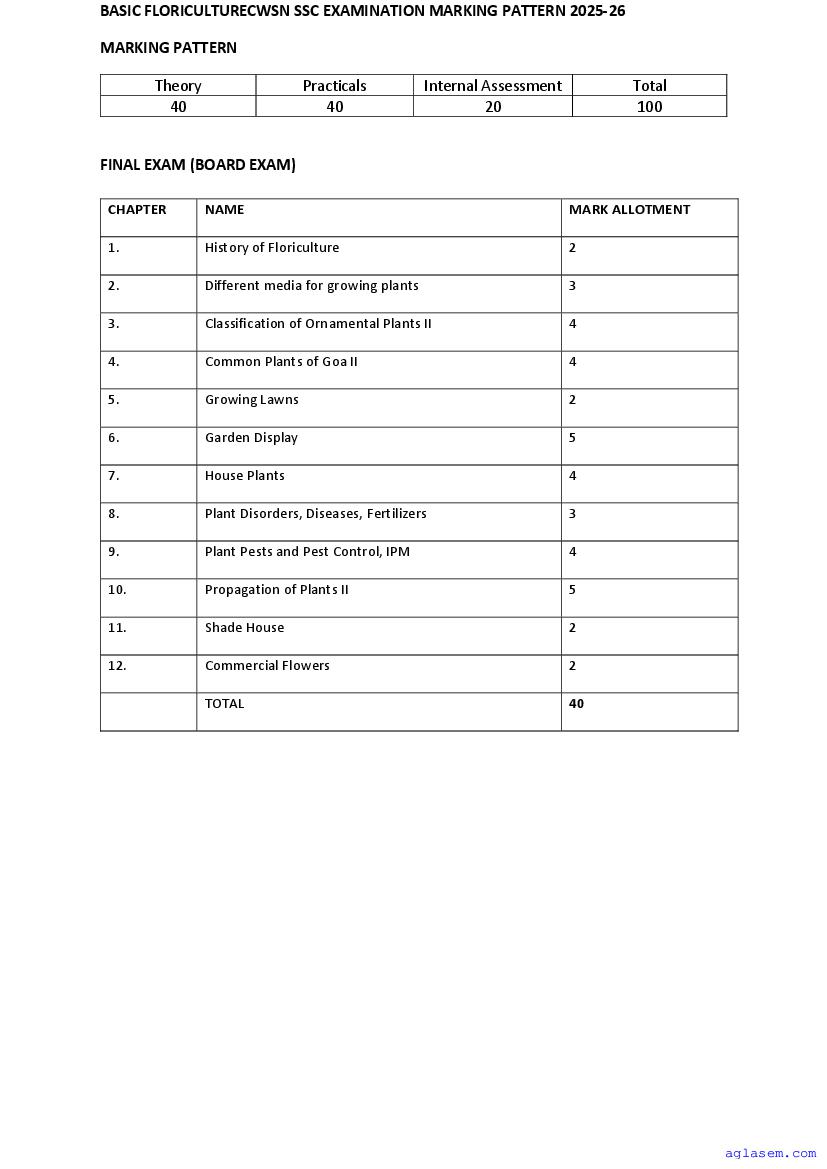
MARKING PATTERN
Theory Practicals Internal Assessment Total
40 40 20 100
FINAL EXAM (BOARD EXAM)
CHAPTER NAME MARK ALLOTMENT
1. History of Floriculture 2
2. Different media for growing plants 3
3. Classification of Ornamental Plants II 4
4. Common Plants of Goa II 4
5. Growing Lawns 2
6. Garden Display 5
7. House Plants 4
8. Plant Disorders, Diseases, Fertilizers 3
9. Plant Pests and Pest Control, IPM 4
10. Propagation of Plants II 5
11. Shade House 2
12. Commercial Flowers 2
TOTAL 40
Page 2
Objective Remembering Understanding Skill Total
No Chapter Name VSA SA VSA SA VSA SA
1 History of 1(1) 1(1) 2(2)
Floriculture
2 Different 1(1) 2(1) 3(2)
media for
growing plants
3 Classification 1(1) 2(2) 1(1) 4(4)
of Ornamental
Plants II
4 Common 1(1) 1(1) 2(2) 4(3)
Plants of Goa
II
5 Growing 1(1) 1(1) 2(2)
Lawns
6 Garden 2(2) 2(1) 1(1) 5(4)
Display
7 House Plants 2(2) 2(1) 4(3)
Plant
8. Disorders, 1(1) 2(1) 3(2)
Diseases,
Fertilizers
9. Plant pests 1(1) 1(1) 2(1 4(3)
and pest
control, IPM
10. Propagation 1(1) 1(1) 3(5) 5(7)
of Plants II
11. Shade house 2(1) 2(1)
12. Commercial 1(1) 1(1) 2(2)
flowers
40
TOTAL
NOTE: Figures outside the bracket indicate marks
Figures inside the bracket indicate the number of question
Page 3
SUBJECT: BASIC FLORICULTURE
(For children with special needs) 2025-26
Subject Code: 2053 Maximum Marks: 40
Duration- 2 hours
INSTRUCTONS:
1. All questions are compulsory
2. Figures to the right indicate marks allotted to each question
3. All answers should be written in the space provided.
________________________________________________________________
Fill in the blanks with the most suitable word from the brackets:
1. An underground plant structure that is made up of layers like an onion
which are modified leaves with a shoot and roots is called
___________________ (1)
• Rhizomes
• Tubers
• Bulbs
• Corms
2. Succulent plants that have raised areas most often with spines are called
_______________________ (1)
• Bonsai
• Cacti
• Foliage plants
• Aquatic plants
3. Anthuriums are propagated through ________________ (1)
• Division of rhizomes
• Division of suckers
• Hardwood cutting
• Soft stem cutting
Page 4
• Hand watering
• Drip irrigation
• Sprinkler
• Flooding
5. A plant media that is obtained from coconut fibre ________________ (1)
• Compost
• Soil
• Cocopeat
• Coconut shell
6. Tool used to trim edges and hedges _______________ (1)
• scissor
• knife
• blade
• shear
7. Fungicide may be sprayed on the plants ____________________ (1)
• every week
• once a year
• every 20-25 days
• everyday
8. Which of the following plants can be propagated from leaf petiole? (1)
____________________
• begonia
• lily
• gladioli
• lotus
9. A plant that may be grown on a sunny balcony is _______________ (1)
• petunia
• maranta
• begonia
• spathiphyllum
Page 5
• sticky trap
• crop rotation
• neem
• turmeric
11. Which of these flowers is cultivated in poly- houses
in Goa _____________ (1)
• Rose
• Hibiscus
• Gerbera
• Crossandra
12. A plant that may be grown indoors is _______________ (1)
• petunia
• maranta
• ixora
• hibiscus
13. Common bushy shrub grown in Goa. _______________ (1)
• Hibiscus
• Helinconia
• Portulaca
• Lily
14. A shade loving plant that can be propagated through leaf, petiole, stem
cutting or division of the tuber _________________ (1)
• petunia
• cactus
• begonia
• croton
Page 6
• Ixora and Hibiscus
• Money Plant and Philodendron
• Honeysuckle and Alamanda
• Marigold and Sunflower
16. A plant that grows well on moss _______________ (1)
• Water Lily
• Honeysuckle
• Croton
• Orchid
17. __________________ are used to kill weeds. (1)
• Pesticides
• Herbicides
• Insecticides
• Neem
18. The technique for propagation of plants whereby tissues from
one plant are inserted into those of another so that the two sets of vascular
tissues may join together is called ____________________ (1)
• division
• grafting
• offset
• Leaf petiole
19. Vase life of gerberas are ___________________ (1)
• 2-3 days
• 4-5 days
• 8-10 days
• 20 -30 days
Page 7
• Potulaca
• Petunia
• Fern
• Sunflower
21. What are Bonsai? (1)
________________________________________________________________
________________________________________________________________
________________________________________________________________
22. Why is Ixora called a perennial plant? (1)
________________________________________________________________
________________________________________________________________
________________________________________________________________
Look at the pictures and answer the questions
23. (a) Name this medium that is used to grow plants (1)
(b) Which important need of the plant does it NOT supply? (1)
Page 8
(a)Name the plant that can be grow as a hedge (1)
(b) Name the garden tool that you will use to trim and shape the hedge (1)
25. Why should lawn not be planted under a tree? (1)
________________________________________________________________
________________________________________________________________
26. How can we treat fungal diseases in plants? (2)
27. What are the advantages of growing plants from cuttings? (1)
________________________________________________________________
________________________________________________________________
Page 9
flower in Column B: (2)
A B
1. Offset (a) Rose
2. Corm (b) Duranta
3. Plant Division (c) Gladioli
4. Hardwood cutting (d) Cactus
(e) Ferns
29. State two advantages of a shade house. (2)
30. Look at the picture and answer the questions: (2)
a) Name this plant
__________________________________
(b) Does it require: _________________________
(i) Full sun
(ii) Full shade
(iii) Partial shade
31. Why are house plants important? (2)
Page 10
PRACTICALS- 2025-26
CONTENTS IN HOME VEGETABLE GARDENING JOURNAL (CWSN)-
Identification: Identification of Plants, Media and Tools
BOARD PRACTICALS (40 Marks)
S.No Name
1. Preparing Potting Mixture(to be taken from Std IX)
2. Pot culture(to be taken from Std IX)including Re-potting
3. Tools(to be taken from Std IX)
4. Making a Coir stick and Planting a climber
5. Some Flowering Plants
6. Some Foliage Plants
7. Flowering climbers
8. Summer Annuals
9. Monsoon Annuals including Perennials that flower in monsoons
10. Winter Annuals
11. Aquatic plants
12. Common Plants of Goa
13. Some Garden Elements
14. House Plants
15. Garden Pests
16. Removing Mealy bugs
17. Preparing organic or chemical nutrient and pesticide/fungicide
solution
18. Shade House Plants
19. Propagation from Hardwood cutting (From Std IX)
20. Propagation from Soft stem cutting (From Std IX)
21. Division of rhizomes :Fern (From Std IX)
22. Division of AnthuriumPlant suckers
23. Division of Sansevieria Plant suckers
24. Planting a Caladium tuber
25. Planting flowering plant seeds
26. Propagation of Begonia from leaf petiole
27. Planting of Corms
Page 11
Procedure
10 05 05 15 05 40
INTERNAL ASSESSMENT SCHEME 2025-26 STD-X
1. A list of activities and assessment criteria for Internal Assessment of 20 marks are listed
under 6 topics.
2. Students may choose anyone from the six.
3. Each activity is allotted 20 marks. Rubrics for the activities is given below.
4. Record of every activity of the student has to be maintained on hard/soft copy for the board
5. Submission of Internal Assessment(IA) should be submitted in November.
I. Field trip to a Plant Nursery.
Instructions: as you walk around the plant nursery, appreciate nature's beauty. Your observations
have to be written, clicked and pasted on a page.
1.Explore the plant nursery: Student has to click pictures of the following below as he/she finds them
and answer the questions:
1. A) Click a picture of a petunia plant.
B) Is it a perennial annual plant?
Yes/No
2. A) Click a picture of a climber plant.
B) Name the climber plant.
3. A) Click a flower with six or more
petals. B) Name the flower.
4. A) Did you find pavings/ tiles in the
nursery?
Yes/ No
5. A) Click a plant that likes shade.
B) Name the plant
6. A) Click a succulent that has spines.
7. List any 3 colours of the ixora plant in the nursery.
8. Find a plant taller than you.
9. Find a plant that lives in water.
10. Find a plant with leaves bigger than your palm.
11. Find a plant with colourful leaves.
Page 12
13. Write what you liked most in the nursery.
14. Name any two plants in the shade house.
15. A) Did you find caterpillars, Beatles, aphids On any plant? Yes/ no
B) State one way To get rid of such pests.
16. A) Name any one plant nutrient you found in the nursery.
B) State one advantage of the nutrient.
Name/ Roll Name of Understanding Data Pictures of Written Total
No the Nursery the topic collection the activity Report
5 5 5 5 20
II. Potting a plant (flowering/foliage)
Instructions: Student has to plant any one flowering or foliage plant in a pot.
The procedure of potting has to be documented with the pictures of the student along with the
plant. The final pot along with the plant should be brought to school.
Name Name of Procedure of Picture of Selection of Care of Total
Roll No the plant potting the activity pot the
according to plant
plant size
5 5 5 5 20
III. Preparation of an Aquatic Plant Bowl.
Instructions: Student has to prepare an aquatic plant bowl with different aquatic plants
and make it decorative with aesthetic material. The final aquatic plant bowl should be
brought to school.
Name/ Roll Name of Procedure in Knowledge of Creativity Maintenance Total
No the aquatic preparation of the topic of the aquatic
plants an aquatic bowl
plant bowl
5 5 5 5 20
Page 13
Instructions: Student has to design/draw a garden, label the elements and colour it on a
chart using maximum garden elements. Example (lawns, hedges, flower bed, hanging
baskets, trees, pavings, etc)
Refer chapter 6 Garden Display. The final garden display (chart) should be brought to
school. Student has to explain the design of the garden.
Name/Roll No Understanding the Procedure (Oral Highlighting/ Creativity/ Total
topic presentation) (labelling) the Neatness
garden
elements
5 5 5 5 20
V. Display of Planters
Instructions: Student has to display five different types of planters using old mugs, vases,
teapots, bottles, etc. Refer Chapter 7 House Plants. The planters can be painted and
decorated. Student should bring the planters to school along with a suitable plant
Name/ Roll No Understanding the Creativity Overall Care of the Total
topic presentation planter
5 5 5 5 20
VI. A Basket of Flowers
Instructions: Student has to arrange for locally available flowers or different foliage
plants and prepare a basket of arranged flowers. The final basket of flowers should be
prepared at school.
Name/Roll No Name of the Presentation Relevance to Creativity Total
different the topic
flowers used
5 5 5 5 20
Document Details
| Board / Org | Goa Board |
| Exam | Class 10 |
| Type | Sample Paper |
| Pages | 13 |
| Updated | 29 Aug 2026 |