MAHA SET 2019 Question Paper 2 Social Work
Finished viewing? Save it for later —
Download MAHA SET 2019 Question Paper 2 Social Work (PDF · 48 pages)About MAHA SET 2019 Question Paper 2 Social Work
MAHA SET 2019 Question Paper 2 Social Work is available here for free download. Published by Maharashtra Exams for MAHA SET, this question paper can be viewed online or downloaded as a PDF (48 pages). Candidates preparing for MAHA SET can use MAHA SET 2019 Question Paper 2 Social Work to understand the exam pattern, the type of questions asked, and the overall difficulty level.
Frequently Asked Questions
How can I download MAHA SET 2019 Question Paper 2 Social Work?
Open this page and click the Download button to save MAHA SET 2019 Question Paper 2 Social Work as a PDF. It is completely free on AglaSem Docs.
Is MAHA SET 2019 Question Paper 2 Social Work free to download?
Yes. MAHA SET 2019 Question Paper 2 Social Work can be viewed online and downloaded as a PDF free of cost on AglaSem Docs.
How many pages does MAHA SET 2019 Question Paper 2 Social Work have?
MAHA SET 2019 Question Paper 2 Social Work contains 48 pages, which you can read online or download together as a single PDF.
Where can I find more MAHA SET study material?
You can find more MAHA SET question papers, sample papers, syllabus, and answer keys on AglaSem Docs.
MAHA SET 2019 Question Paper 2 Social Work – Text
Read the full text of this question paper below — useful to quickly search, copy and reference the content online without downloading the PDF.
📄 View text version (48 pages)
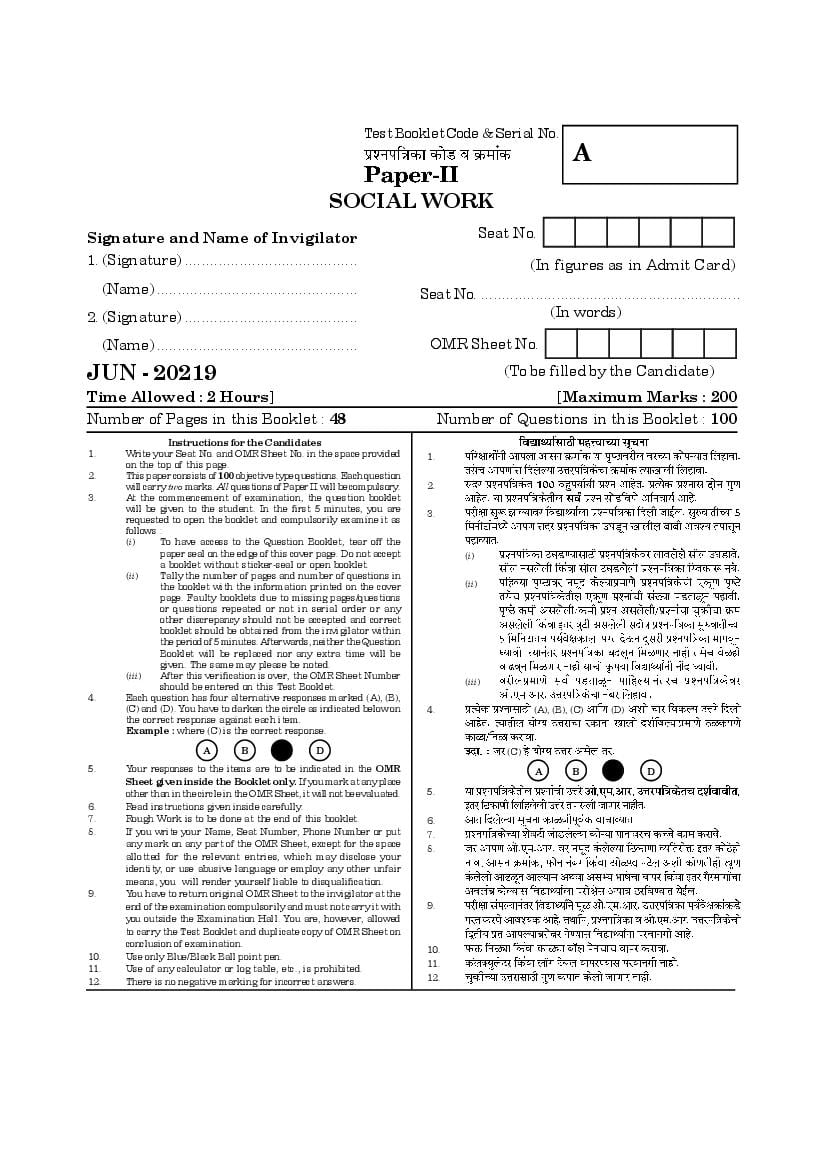
Page 1
A
SOCIAL WORK
Signature and Name of Invigilator Seat No.
1. (Signature) ......................................... (In figures as in Admit Card)
(Name) ................................................ Seat No. ..............................................................
2. (Signature) ......................................... (In words)
(Name) ................................................ OMR Sheet No.
JUN - 20219 (To be filled by the Candidate)
Time Allowed : 2 Hours] [Maximum Marks : 200
Number of Pages in this Booklet : 48 Number of Questions in this Booklet : 100
Instructions for the Candidates
1. Write your Seat No. and OMR Sheet No. in the space provided 1.
on the top of this page.
2. This paper consists of 100 objective type questions. Each question
will carry two marks. All questions of Paper II will be compulsory. 2.
3. At the commencement of examination, the question booklet
will be given to the student. In the first 5 minutes, you are 3.
requested to open the booklet and compulsorily examine it as
follows :
(i) To have access to the Question Booklet, tear off the
paper seal on the edge of this cover page. Do not accept (i)
a booklet without sticker-seal or open booklet.
(ii) Tally the number of pages and number of questions in
the booklet with the information printed on the cover (ii)
page. Faulty booklets due to missing pages/questions
or questions repeated or not in serial order or any
other discrepancy should not be accepted and correct
booklet should be obtained from the invigilator within
the period of 5 minutes. Afterwards, neither the Question
Booklet will be replaced nor any extra time will be
given. The same may please be noted.
(iii) After this verification is over, the OMR Sheet Number
(iii)
should be entered on this Test Booklet.
4. Each question has four alternative responses marked (A), (B),
(C) and (D). You have to darken the circle as indicated below on 4. (A), (B), (C) (D)
the correct response against each item.
Example : where (C) is the correct response.
A B D (C)
5. Your responses to the items are to be indicated in the OMR A B D
Sheet given inside the Booklet only. If you mark at any place
other than in the circle in the OMR Sheet, it will not be evaluated. 5.
6. Read instructions given inside carefully.
7. Rough Work is to be done at the end of this booklet. 6.
8. If you write your Name, Seat Number, Phone Number or put 7.
any mark on any part of the OMR Sheet, except for the space
8.
allotted for the relevant entries, which may disclose your
identity, or use abusive language or employ any other unfair
means, you will render yourself liable to disqualification.
9. You have to return original OMR Sheet to the invigilator at the
end of the examination compulsorily and must not carry it with 9.
you outside the Examination Hall. You are, however, allowed
to carry the Test Booklet and duplicate copy of OMR Sheet on
conclusion of examination.
10.
10. Use only Blue/Black Ball point pen.
11.
11. Use of any calculator or log table, etc., is prohibited.
12. There is no negative marking for incorrect answers. 12.
Page 2
Page 3
Paper II
II
Time Allowed : 120 Minutes] [Maximum Marks : 200
Note : This Paper contains Hundred (100) multiple choice questions. Each question
carrying Two (2) marks. Attempt All questions.
(100) (2)
1. The author of the famous article “Is 1.
Social Work a Profession ?” is :
(A) Octavia Hill (A)
(B) Abraham Flexner (B)
(C) Mary Richmond (C)
(D) Ernest Greenwood (D)
2. Recognition of the right and need 2.
of clients to freedom in making their
own choices and decisions, is termed
as :
(A)
(A) Confidentiality
(B)
(B) Acceptance
(C) Assimilation (C)
(D) Self-determination (D)
3 [P.T.O.
Page 4
another person and understanding
his/her feelings and experiences is :
(A)
(A) Empathy
(B)
(B) Self-experience
(C)
(C) Projection
(D) Sympathy (D)
4. The Nehru Yuva Kendra Sangathan 4.
was set up as an autonomous agency
under ..................... .
(A) Government of India’s Ministry (A)
of Social Justice and
Empowerment.
(B) Government of India’s Ministry (B)
of Social Welfare.
(C)
(C) Government of India’s Ministry
of Youth Affairs and Sports.
(D) Government of India’s Ministry (D)
of Women and Child
Development.
5. Rajiv Gandhi National Institute of 5.
Youth Development is located at :
(A) Thiruvanathapuram, Kerala (A)
(B) Vijayawada, Andhra Pradesh (B)
(C) Sriperumbudur, Tamil Nadu (C)
(D) Shivagiri, Karnataka (D)
4
Page 5
on .................. .
(A) Holistic and Generalist
(A)
(B) Integrated and Holistic
(B)
(C) Assessment, diagnosis and
treatment (C)
(D) Only counselling (D)
7. Ecological Social Work orientation 7.
is ............... .
(A) Environmental
(A)
(B) Ecological Balance
(B)
(C) Ecosystem management
(C)
(D) Integrated, holistic and
generalists (D)
8. Youth are defined as those aged 8.
.................... in the National Youth
Policy (2014).
(A)
(A) 15 to 35 years
(B)
(B) 15 to 29 years
(C)
(C) 15 to 25 years
(D)
(D) 15 to 20 years
5 [P.T.O.
Page 6
fall under the purview of social work
practice :
(i)
(i) Counselling
(ii)
(ii) Home visits
(iii)
(iii) Resource mobilisation
(iv)
(iv) Legal aid
Codes :
(A) (i), (ii), (iii) (iv)
(A) (i), (ii), (iii) and (iv)
(B) (i) (ii)
(B) (i) and (ii)
(C) (i), (ii) and (iii) (C) (i), (ii) (iii)
(D) (ii), (iii) and (iv) (D) (ii), (iii) (iv)
10. A social worker is counselling an 10.
HIV positive male client. Despite
much counselling the client is
unable to use safer-sex practices. The
social worker gets angry with him
and decides to share his HIV positive
status with his wife. Which social
work principles is he/she violating ?
(i) Confidentiality (i)
(ii) Informed consent (ii)
(iii) Autonomy (iii)
(iv) Dignity (iv)
Codes :
(A) (i) and (ii) (A) (i) (ii)
(B) Only (i) (B) (i)
(C) (i), (ii), (iii) (C) (i), (ii), (iii)
(D) (i), (ii), (iii) and (iv) (D) (i), (ii), (iii) (iv)
6
Page 7
...................... .
(A) Lower and upper group (A)
(B) Low and high group (B)
(C) Primary and secondary group (C)
(D) Rich and poor group (D)
12. Praise by social worker for on time 12.
task submission is known as
............................ .
(A)
(A) Positive instigation
(B)
(B) Positive reinforcement
(C)
(C) Negative punishment
(D) Positive morale (D)
13. Society is .................. of social 13.
relationship.
(A)
(A) Complex
(B)
(B) Web
(C)
(C) Website
(D) Community (D)
7 [P.T.O.
Page 8
stratification as a ..................... .
(A) Horizontal division (A)
(B) Vertical division (B)
(C) Upper division (C)
(D) Lower division
(D)
15. Individuals with autism-spectrum 15.
disorders have difficulty in the
following area/s :
(i)
(i) Communication
(ii)
(ii) Social interactions
(iii)
(iii) Cognitive processes
(iv)
(iv) Behavioural processes
Choose the correct answer :
(A) (i), (ii) and (iv) (A) (i), (ii) (iv)
(B) (i), (ii) and (iii) (B) (i), (ii) (iii)
(C) (ii), (iii) and (iv) (C) (ii), (iii) (iv)
(D) (i), (ii), (iii) and (iv) (D) (i), (ii), (iii) (iv)
8
Page 9
16.
involving three stages are ................. .
(A) Freezing, Changing, Refreezing
(B) Unfreezing, Changing, (A)
Refreezing
(B)
(C) Unfreezing, Deep-freezing,
Refreezing (C)
(D) Changing, Refreezing,
(D)
Unfreezing
17. Which one of the following is not a 17.
principle of community
organisation ?
(A)
(A) Principle of specific objectives
(B) Principle of individualisation (B)
(C) Principle of people’s
(C)
participation
(D)
(D) Principle of democratic function
9 [P.T.O.
Page 10
contemporary ideologies for social (II)
change (I) and its implications (II)
on society. Match the following and
choose the codes given below :
I
I
(a) Feminism (a)
(b) Multiculturalism (b)
(c) New social movements (c)
(d) Sustainable and people- (d)
centered development
II
II
(i)
(i) Economic, social and ecological
sustainability for future
generations
(ii)
(ii) Challenge to all dichotomies
that create hierarchies
(iii) Promotion of egalitarian (iii)
multiculturalism
(iv) Democratic repoliticisation of (iv)
the masses, focus on alternative
development
Codes :
(a) (b) (c) (d)
(a) (b) (c) (d)
(A) (iv) (iii) (ii) (i)
(A) (iv) (iii) (ii) (i)
(B) (ii) (iii) (iv) (i)
(B) (ii) (iii) (iv) (i)
(C) (i) (iv) (iii) (ii) (C) (i) (iv) (iii) (ii)
(D) (iii) (ii) (iv) (i) (D) (iii) (ii) (iv) (i)
10
Page 11
Organiser may need to mobilise the
entire community or even people
outside the community to bring
about change.
(R) :
Reason (R) : The process of
mobilising people in the community
towards change is generally termed
‘Community Action’.
Codes :
(A) (A) (R)
(A) (A) is true and (R) is the correct
(R) (A)
explanation of (A)
(B) (A) (R) (R)
(B) (A) is true and (R) is not the
(A)
correct explanation of (R)
(C) (A) (R)
(C) (A) is true but (R) is false
(D) (A) is false but (R) is true (D) (A) (R)
11 [P.T.O.
Page 12
from common mental disorders than
men. However men outnumber (psychosis)
women when it comes to psychosis.
Reason (R) : Hormonal changes in
women, their biology and physiology
(R) :
are the main cause for mental
(hormonal)
disorders in women.
Codes :
(A) Both (A) and (R) are true and
(R) is the correct explanation (A) (A) (R) (R)
of (A) (A)
(B) (A) is true but (R) is false (B) (A) (R)
(C) Both are false (C)
(D) Both are true but (R) is not the (D) (A) (R)
correct explanation of (A) (R) (A)
21. An important purpose of casework
21.
is to :
(A) Get necessary resources for the
(A)
client
(B) Ensure that the client gets the (B)
treatment that she needs
(C) Bring about the desired change (C)
in the person’s life and her
social environment
(D) Write case history (D)
12
Page 13
cautiously takes on a symbolic role
and allows the client to work
through his or her unresolved
conflict.
(R) :
Reason (R) : The client identifies
in the therapist the characteristics
that are reminiscent of the
significant others from whom he or
she is transferring the emotions.
Codes :
(A) (A) (R) (R)
(A) Both (A) and (R) are true and
(R) is the correct explanation (A)
of (A)
(B) (A) (R)
(B) Both (A) and (R) are true but
(R) is not the correct (R) (A)
explanation for (A)
(C) (A) (R)
(C) (A) is true but (R) is false
(D) (A) is false but (R) is true (D) (A) (R)
13 [P.T.O.
Page 14
challenged client and spoke to her
at length about various challenges
and concerns faced by her. This
was a ............................. .
(A)
(A) Structured interview
(B)
(B) Pre interview
(C)
(C) In-depth interview
(D) Long interview (D)
24. Where the client is unable to 24.
understand the nature of the
problem and the causative factors,
the required assistance is called :
(A)
(A) Ventilation
(B)
(B) Exploration
(C)
(C) Clarification
(D)
(D) Confrontation
14
Page 15
social work which ..................... .
(A) Helps individuals to enhance (A)
their social functioning.
(B) Helps growth through conflicts.
(B)
(C) Helps to cope more effectively
(C)
with financial problems of
members.
(D)
(D) Helps members to get trained
in counselling skills.
26. An effective group has ................... . 26.
(A) A democratic group leader (A)
(B) Sub-groups (B)
(C) Limitless freedom for members (C)
(D) Obedient members (D)
27. The duration of the Social Group 27.
Work process should be .................. .
(A)
(A) As long as the group wants.
(B) According to the convenience of (B)
the worker.
(C)
(C) Determined before the process
begins.
(D)
(D) Based on achievement of specific
objectives of group.
15 [P.T.O.
Page 16
which ...................... .
(A) Individuals are helped to (A)
compete with others in the
group.
(B)
(B) Social functioning is enhanced
through purposeful group
experience. (C)
(C) Social functioning is enhanced
through recreation.
(D)
(D) Social functioning of group is
given importance.
29. The philosophy of Social Group 29.
Work is reflected correctly in which
of the following statements ?
I.
I. Primary group experiences
have a lasting influence than
the secondary group experiences.
II.
II. Social Group Work activities
help to adopt the democratic
way of life.
III. Man is a social being and III.
therefore cannot develop is
isolation.
The correct answer is :
(A) I (A) I
(B) I and II (B) I II
(C) I and III (C) I III
(D) I, II and III (D) I, II III
16
Page 17
correct objective of Social Group
Work ?
(A) To facilitate groupism within (A)
the community
(B)
(B) To increase groups in a
community
(C)
(C) To render financial aid and
assistance to group members
(D) To form groups in a planned
manner (D)
31. ‘Save Tree’ movement is known 31.
as ....................... .
(A) Save Jungle movement
(A)
(B) Chipko movement
(B)
(C) Save mango movement
(C)
(D) Save ‘National Sanctuary’
movement (D)
32. Who founded the Arya Samaj ? 32.
(A) Dayanand Saraswati (A)
(B) Vinoba Bhave (B)
(C) Mahatma Phule
(C)
(D) Swami Vivekananda
(D)
17 [P.T.O.
Page 18
is ........................... .
(A)
(A) Leader can be trained
(B)
(B) Leaders are charismatic
(C)
(C) Leaders are heroic personalities
(D) Leader’s are born (D)
34. Which is not a basic character of the 34.
social movement ?
(A) Ideology (A)
(B) Termination (B)
(C) Leadership (C)
(D) Strategies (D)
35. Social Action model aims at 35.
...................... .
(A)
(A) Self help
(B)
(B) Shifting power of relationship
(C)
(C) Problem solving
(D) Collaboration with government (D)
18
Page 19
an analysis of introduction of social
movement in the book, ‘Social
Movement in India’ ?
(A)
(A) M.S.A. Rao
(B)
(B) Ghanshyam Shah
(C)
(C) D.N. Dhanagare
(D) K.K. Singh (D)
37. Which among the following is anti- 37.
reservation movement ?
(A) Resistance movement (A)
(B) Reform movement (B)
(C) Revolutionary movement (C)
(D) Revivalist movement (D)
38. Self-help and community integration 38.
is a ‘goal’ of :
(A) Social Action Model (A)
(B) Social Planning Model (B)
(C) Locality Development Model (C)
(D) People’s Organisation Model (D)
19 [P.T.O.
Page 20
of task-oriented community
organisation has been identified by :
(A) Dunham Arthur (A)
(B) Murry Ross (B)
(C) Jack Rothman (C)
(D) Mc Neil (D)
40. According to Mahatma Gandhi 40.
‘Ahimsa’ (non-violence) was the only
way for :
(A)
(A) Truth
(B)
(B) Satyagraha
(C)
(C) Freedom Attainment
(D) Dandi Yatra (D)
41. Failing to reject a null hypothesis 41.
when it is false is termed as :
(A) Type I error
(A) I
(B) Type II error
(B) II
(C) Sampling error (C)
(D) Non-sampling error (D)
20
Page 21
social work intervention we prefer
to use :
(A)
(A) Descriptive Research Design
(B)
(B) Single Subject Research Design
(C)
(C) Exploratory Research Design
(D) Experimental Research Design (D)
43. Which one of the following is a non- 43.
probability sampling method ?
(A) Simple Random Sampling (A)
(B) Cluster Sampling (B)
(C) Stratified Sampling (C)
(D) Purposive Sampling (D)
44. A hypothesis which predicts the 44.
relationship between two or more
independent variables and two or
more dependent variables is
called : (A)
(A) Statistical Hypothesis
(B)
(B) Complex Hypothesis
(C)
(C) Directional Hypothesis
(D)
(D) Non-directional Hypothesis
21 [P.T.O.
Page 22
by :
(A) Thurstone (A)
(B) Bogardus (B)
(C) Likert (C)
(D)
(D) Wellington
46. Assertion (A) : Quantitative 46. (A) :
researchers prefer probability
sampling method.
(R) :
Reason (R) : So that they can use
non-parametric tests.
Select your answer from the codes
given below :
(A) Both (A) and (R) are true and (A) (A) (R) (R)
(R) is the correct explanation (A)
of (A)
(B) (A) (R)
(B) Both (A) and (R) are true and
(R) is not the correct (R) (A)
explanation of (A)
(C) (A) (R)
(C) (A) is true but (R) is false
(D) (A) (R)
(D) (A) is false but (R) is true
22
Page 23
47. Universe of study consists of
............... .
(A) All the elements covered under (A)
study
(B)
(B) Population
(C)
(C) Sample
(D) Randomization (D)
48. Assertion (A) : Quantitative 48. (A) :
researchers prefer standardised
scales to measure variables.
Reason (R) : Because, it is easily
(R) :
available.
(A) Both (A) and (R) are true and
(R) is the correct explanation (A) (A) (R) (R)
of (A) (A)
(B) Both (A) and (R) are true but (B) (A) (R)
(R) is not the correct
(R) (A)
explanation of (A)
(C) (A) (R)
(C) (A) is true but (R) is not true
(D) (A) (R)
(D) (A) is not true but (R) is true
23 [P.T.O.
Page 24
not a non-parametric test ?
(A) Kolmogorov-Smirnov test (A)
(B) Wilcoxon test (B)
(C) Mann-Whitney (C)
(D) Student’s t-test (D)
50. Assertion (A) : When researcher 50. (A) :
takes information or data on phone
call, it is not considered as data for
survey.
(R) :
Reason (R) : Because it is not
authentic tool of data collection.
(A) Both (A) and (R) are true and
(R) is the correct explanation of
(A) (A) (R) (R)
(A)
(A)
(B) Both (A) and (R) are true but
(B) (A) (R)
(R) is not the correct
(R) (A)
explanation of (A)
(C) (A) is true but (R) is not true (C) (A) (R)
(D) (R) is true but (A) is not true (D) (A) (R)
24
Page 25
provide resources to :
(A) elderly (A)
(B) women (B)
(C) youth (C)
(D) children (D)
52. Which one of the following principles 52.
is not the principle of social welfare
administration ?
(A) The Principle of Professional (A)
Responsibility
(B) The Principle of Agency Purpose (B)
(C) The Principle of Cultural (C)
Setting
(D) The Principle of Individulisation (D)
53. The acronym POSDCORB stands 53. ‘POSDCORB’
for :
(A) Planning, Organising, Staffing,
(A)
Direction, Coordination,
Reporting and Budgeting.
(B) Planning, Organising,
(B)
Supervision, Direction,
Coordination, Reporting and
Budgeting
(C) Planning, Organising, Staffing, (C)
Direction, Cooperation,
Reporting and Budgeting.
(D) Planning, Organising, Staffing, (D)
Direction, Coordination,
Research and Budgeting.
25 [P.T.O.
Page 26
of the Income Tax Act allows an
individual or a company to claim
exemption on their donations to
voluntary organisation from their
taxable income ? (A)
(A) 60 G
(B)
(B) 70 G
(C)
(C) 80 G
(D) 90 G (D)
55. Minimum ............... persons are 55.
required to establish a trust as per
the Indian Trust Act.
(A) two (A)
(B) three (B)
(C) four (C)
(D) five (D)
56. ‘360 degree appraisal’ is tool of 56.
............. .
(A) Management by Objectives
(A)
(B) Performance Management
(B)
System
(C) Competency mapping (C)
(D) OD Intervention (D)
26
Page 27
organisation can be registered
under section 25 of the
............................... .
(A)
(A) Indian Companies Act
(B)
(B) Indian Factories Act
(C)
(C) Trade Unions Act
(D) Indian Association Act (D)
58. Which one of the Five Year Plans 58.
lays emphasis on the role of NGOs
and voluntary organisations in the
conservation of environment ?
(A)
(A) Fourth five-year plan
(B) Fifth five-year plan (B)
(C) Seventh five-year plan (C)
(D) Eighth five-year plan (D)
59. The name of the Ministry of Welfare
59.
was changed to Ministry of Social
Justice and Empowerment in the
year :
(A)
(A) 1998
(B)
(B) 1988
(C) 1978 (C)
(D) 1968 (D)
27 [P.T.O.
Page 28
Women is :
(A) an autonomous body (A)
(B) non-statutory body (B)
(C) semi-statutory body (C)
(D) quasi-statutory body (D)
61. Who was the exponent of the liberal
61.
socialist standpoint on the study of
social policy ?
(A)
(A) B.B. Gilbert
(B) T.H. Marshall (B)
(C) R.M. Titmuss (C)
(D) A.V. Dicey (D)
62. Under the Residual model of social 62.
policy the state took only marginal
responsibility for providing :
(A) Food and shelter to cases of
extreme need arising out of (A)
physical handicap such as old
age or joblessness over an
extended period.
(B) Primary education and public
(B)
health services
(C) All the services such as health,
education and housing (C)
(D) Only higher education and (D)
health services
28
Page 29
technically sound, environmentally
non-degrading and non-hazardous
and socially acceptable use of
natural resources of the country for
promoting the concept of sustainable
agriculture was the strategy of
which policy initiatives ?
(A) National Agricultural Policy of
India, 2000
(B) National Environmental Policy (A)
of India, 2006
(B)
(C) National Forest Policy of India,
2018 (C)
(D) National Policy on Biofuels,
2018 (D)
64. The Human Development Index 64.
does not include which of the
following ?
(A)
(A) Life expectancy
(B)
(B) Expected years of schooling
(C)
(C) Gross National Income
(D) Population Below Poverty Line (D)
29 [P.T.O.
Page 30
needed to find pathways through the
mass of society’s interconnections.
(R) :
Reason (R) : They delineate social
status, define social problems and
trace social trends, which by social
engineering may hopefully be
guided towards social goals
formulated by social planning.
(A) Both (A) and (R) are true and
(R) is the correct explanation (A) (A) (R) (R)
of (A) (A)
(B) Both (A) and (R) are true and (B) (A) (R)
(R) is not the correct (R) (A)
explanation of (A)
(C) (A) (R)
(C) (A) is true but (R) is false
(D) (A) (R)
(D) (A) is false but (R) is true
66. Tejaswini Programme is for 66.
................. . (A)
(A) Girl’s Education
(B)
(B) Sports development for women
(C)
(C) Rural Women’s Empowerment
(D) Rural Women’s Health (D)
30
Page 31
67. The Millennium Development Goals
was adopted by United Nations
General Assembly in the year :
(A) 1998 (A)
(B) 2000 (B)
(C) 2002 (C)
(D) 2004 (D)
68. As per the Human Development 68.
Report (2011) prepared by UNDP,
India ranks ................. in the list of
countries by Human Development
Index.
(A)
(A) 130
(B)
(B) 134
(C)
(C) 136
(D)
(D) 140
31 [P.T.O.
Page 32
69.
(A) Agenda building, adoption,
implementation, formulation
(A)
evaluation of termination
(B) Agenda building, formulation,
adoption, implementation,
(B)
evaluation and termination
(C) Adoption, implementation,
evaluation, formulation and (C)
termination
(D) Formulation, implementation,
(D)
adoption, evaluation and
termination
32
Page 33
70. (A) :
recent Human Development Reports
of UNDP, India has moved from the (UNDP)
category of “Low human
development” to that of “medium”
human development category.
Reason (R) : Because of its high (R) :
population growth rate.
Codes :
(A) Both (A) and (R) are true and (A) (A) (R) (R)
(R) is the correct explanation (A)
of (A)
(B) Both (A) and (R) are true but (B) (A) (R)
(R) is not the correct (R) (A)
explanation of (A)
(C) (A) (R)
(C) (A) is true but (R) is false
(D) (A) is false but (R) is true (D) (A) (R)
71. In case of violation of their rights, 71.
Divyangjan may move an
application to the ................. .
(A) State Commissioner of Social (A)
Welfare.
(B) Chief Commissioner for Persons (B)
with Disabilities in the Centre/
State.
(C) District Social Welfare Officer. (C)
(D) National Commission for (D)
Divyangjan.
33 [P.T.O.
Page 34
deals with :
(A) Uniform State Code (A)
(B) Fundamental Rights (B)
(C) Uniform Civil Code (C)
(D) Right to Survival (D)
73. The National Human Rights 73.
Commission (NHRC) of India was
established on .................... .
(A)
(A) 12th October, 1987
(B) 12th October, 1993 (B)
(C) 12th October, 1997 (C)
(D) 12th October, 1990 (D)
74. Human rights are ................... . 74.
(A) The basic rights and freedom to
(A)
which all humans are entitled
(B) The rights of all humans to
have free and fair elections (B)
(C) The rights of all humans to
settle down in any part of the
world (C)
(D) The rights of all humans to
receive free education without
(D)
restrictions
34
Page 35
of India provide for rights against
exploitation.
(A)
(A) 23 and 24
(B)
(B) 19 and 20
(C)
(C) 31 and 32
(D) 37 and 38 (D)
76. Social justice is defined in .................. 76.
of the Constitution of India.
(A) Article 19 (A)
(B) Article 24 (B)
(C) Article 31 (C)
(D) Not defined in the Constitution (D)
77. The .............. of government receive
77.
their power from the Constitution
and are bound by it.
(A) Executive, parliamentary and
judicial branches (A)
(B) Executive, provincial and
(B)
judicial branches
(C) Executive, bureaucratic and
(C)
judicial branches
(D) Executive, legislative and (D)
judicial branches
35 [P.T.O.
Page 36
Assembly took .................... .
(A) Almost three years to draft the
Constitution
(B) Almost four years to draft the (A)
Constitution
(B)
(C) Almost five years to draft the
Constitution
(C)
(D) Almost six years to draft the
Constitution (D)
79. The Constitution of India was 79.
adopted by .................... .
(A) The Supreme Court of India
(A)
(B) The Constituent Assembly of
India (B)
(C) The Parliament of India
(C)
(D) The Drafting Committee of the
(D)
Constitution
36
Page 37
Social Work Practice” ?
(A)
(A) Use of different methods of
social work simultaneously in
coming up with lasting
(B)
solutions
(B) Use of social work techniques in
a responsible manned for
problem solving (C)
(C) Trying out alternative solutions
to deal with a problem
(D)
(D) To seek the help of inter-
disciplinary experts in research
81. For the first time in the history of
81.
mental health legislation. The
Mental Health Care Act, 2017
emphasises :
(A) Rights of persons with mental (A)
illness
(B) The use of Electro-convulsive
(B)
Therapy (ECTs) to treat mental
illness (ECT)
(C) Common treatment facilities for (C)
patients with and without a
criminal history
(D)
(D) Issuing Adhaar Cards to long-
stay hospital patients
37 [P.T.O.
Page 38
(NCOP) was constituted in the year
of :
(A)
(A) 1997
(B)
(B) 1998
(C)
(C) 1999
(D)
(D) 2000
83. According to................... the term 83.
‘active aging’ refers to the process of
quality of life of aged ?
(A) UNESCO (A)
(B) WHO (B)
(C) UNO
(C)
(D) Help Age India
(D)
38
Page 39
84. Match the following for their
association and choose the correct -I
answer from the codes given below :
(a)
List-I
(a) Protection of Women from
(b)
Domestic Violence Act
(c)
(b) 498 A
(d)
(c) Sexual Harassment of Women
at work place -II
(d) Section 377 (i)
List-II (ii)
(i) Cruelty by husband and in-laws
(iii)
(ii) Vishakha guidelines
(iii) Decriminalising Consensual sex
(iv)
between same-sex adults
(iv) Includes live-in relationships
Codes :
(a) (b) (c) (d)
(a) (b) (c) (d)
(A) (iv) (i) (ii) (iii)
(A) (iv) (i) (ii) (iii)
(B) (i) (iv) (iii) (ii)
(B) (i) (iv) (iii) (ii)
(C) (ii) (iii) (iv) (i) (C) (ii) (iii) (iv) (i)
(D) (iv) (iii) (ii) (i) (D) (iv) (iii) (ii) (i)
39 [P.T.O.
Page 40
(A) Particularly Vulnerable Tribal
Groups (A)
(B) Particularly Voluntary Tribal
Groups (B)
(C) Particularly Vendors Tribal
Groups (C)
(D) Particularly Vigilant Tribal
(D)
Groups
86. Rajiv Gandhi National Fellowship 86.
for ST Students targets to :
(A) Regular full-time research (A)
students in M.Phil. & Ph.D.
courses
(B)
(B) Part-time research students in
M.Phil. & Ph.D. courses
(C)
(C) Research students in M.Phil. &
Ph.D. courses in distance mode
(D) Research students in M.Phil & (D)
Ph.D. courses in abroad
40
Page 41
87. As per The Companies Act CSR
provisions under section 135(1) the
CSR is not applicable for the
companies having ................ .
(A) ` 100
(A) Net worth of ` 100 crore
(B) ` 1000
(B) Turnover of ` 1000 crore
(C) Net profit of ` 5.00 crore (C) ` 5.00
(D) Net worth of ` 500 crore (D) ` 500
88. Arrange the following labour 88.
legislations in chronological order by
their year of enactment (oldest to
latest) :
(i) The Employees State Insurance (i)
Act,
(ii)
(ii) Payment of Bonus Act,
(iii)
(iii) The Payment of Gratuity Act,
(iv)
(iv) The Payment of Wages Act.
Choose your answer from the codes
given below :
(A) (i), (iv), (iii), (ii)
(A) (i), (iv), (iii), (ii)
(B) (iii), (iv), (ii), (i)
(B) (iii), (iv), (ii), (i)
(C) (ii), (i), (iv), (iii)
(C) (ii), (i), (iv), (iii)
(D) (iv), (i), (ii), (iii) (D) (iv), (i), (ii), (iii)
41 [P.T.O.
Page 42
not the responsibility of a medical/
psychiatric social worker.
(A)
(A) Discharge management
(B) Arranging help to the poor (B)
patient
(C)
(C) Counselling
(D) Giving Disability Certification (D)
90. The major shift that has occurred 90.
in last 100 years in the field of
mental health is result of .............. .
(A)
(A) More number of professionals
available (B)
(B) Shift from medical to bio-social
model
(C)
(C) Awareness about mental illness
(D)
(D) Shift from superstitions to
allopathy for treatment
42
Page 43
person to produce/manufacture/
cultivate drugs in India.
(A) Narcotic Drugs and (A)
Psychoactive Compounds Act
(B)
(B) Narcotic Drugs and
Psychotropic Substances Act
(C) Narcotic Drugs and Psychiatric
(C)
Substances Act
(D) Narcotic Drugs and
(D)
Psychoanalytic Substances Act
92. What is the full form of ICDS ? 92.
(A) Integrated Child Development
Scheme (A)
(B) Integrated Child Development
(B)
Sector
(C) Integrated Child Development
(C)
Services
(D) Indian Child Development
(D)
Scheme
43 [P.T.O.
Page 44
by families is a barrier to promotion
of ........................ .
(A) Mental health (A)
(B) Social health (B)
(C) Spiritual health (C)
(D) Physical health (D)
94. Article ................... of Constitution of 94.
India, provides for free and
compulsory education for all children
upto the age of 14 years.
(A)
(A) 79
(B)
(B) 72
(C) 39 (C)
(D) 45 (D)
95. National Institute of Disaster 95.
Management is located at ............ .
(A) Trivandrum (A)
(B) Bhopal (B)
(C) New Delhi (C)
(D) Hyderabad
(D)
44
Page 45
response face challenges that can
include :
(a) Resource limitations, such as
(a)
equipment and supplies
(b)
(b) Remoteness and limited access
to healthcare for higher levels
of care
(c)
(c) Communication issues
(d)
(d) Absence of computer engineers
(A) (a), (b)
(A) (a), (b)
(B) (a), (b) (c)
(B) (a), (b), (c)
(C) (c), (d) (C) (c), (d)
(D) (a), (b), (c), (d) (D) (a), (b), (c), (d)
97. As per the ICDS, how much calories 97.
of food is fixed for nutritional norm
for severely malnourished children.
(A) 900 calories (A)
(B) 1200 calories (B)
(C) 800 calories (C)
(D) 1100 calories (D)
45 [P.T.O.
Page 46
an offender who has :
(A) Only one previous conviction
proved against him (A)
(B) Only two previous convictions
(B)
proved against him
(C)
(C) No previous conviction proved
against him
(D) Any number of previous
(D)
convictions proved against him
99. Emergency preparedness refers 99.
to ............................... .
(A)
(A) Actions performed before an
emergency or disaster
(B) Actions undertaken as soon as
a disaster strikes (B)
(C) Actions taken after an
(C)
emergency to help minimize the
negative effects
(D) Actions taken by the State
(D)
Administration
46
Page 47
contravention in relation to
psychotropic substances under
NDPS Act ?
(A) Rigorous imprisonment for a
(A)
minimum term of 15 years and
maximum term of 20 years and `
minimum fine of one lakh
`
rupees and maximum fine of 2
lakh rupees.
(B) Rigorous imprisonment for a
(B)
minimum term of 10 years and
maximum term of 20 years and
minimum fine of one lakh
` `
rupees and maximum fine of 2
lakh rupees.
(C) Rigorous imprisonment for a
(C)
minimum term of 5 years and
maximum term of 10 years and
minimum fine of one lakh ` `
rupees and maximum fine of 2
lakh rupees.
(D) Rigorous imprisonment for a (D)
minimum term of 5 years and
maximum term of 15 years and `
minimum fine of one lakh `
rupees and maximum fine of 2
lakh rupees.
47 [P.T.O.
Page 48
48
Document Details
| Board / Org | Maharashtra Exams |
| Exam | MAHA SET |
| Type | Question Paper |
| Pages | 48 |
| Updated | 30 Apr 2026 |