MAHA SET 2018 Question Paper 3 Commerce
Finished viewing? Save it for later —
Download MAHA SET 2018 Question Paper 3 Commerce (PDF · 40 pages)About MAHA SET 2018 Question Paper 3 Commerce
MAHA SET 2018 Question Paper 3 Commerce is available here for free download. Published by Maharashtra Exams for MAHA SET, this question paper can be viewed online or downloaded as a PDF (40 pages). Candidates preparing for MAHA SET can use MAHA SET 2018 Question Paper 3 Commerce to understand the exam pattern, the type of questions asked, and the overall difficulty level.
Frequently Asked Questions
How can I download MAHA SET 2018 Question Paper 3 Commerce?
Open this page and click the Download button to save MAHA SET 2018 Question Paper 3 Commerce as a PDF. It is completely free on AglaSem Docs.
Is MAHA SET 2018 Question Paper 3 Commerce free to download?
Yes. MAHA SET 2018 Question Paper 3 Commerce can be viewed online and downloaded as a PDF free of cost on AglaSem Docs.
How many pages does MAHA SET 2018 Question Paper 3 Commerce have?
MAHA SET 2018 Question Paper 3 Commerce contains 40 pages, which you can read online or download together as a single PDF.
Where can I find more MAHA SET study material?
You can find more MAHA SET question papers, sample papers, syllabus, and answer keys on AglaSem Docs.
MAHA SET 2018 Question Paper 3 Commerce – Text
Read the full text of this question paper below — useful to quickly search, copy and reference the content online without downloading the PDF.
📄 View text version (40 pages)
Page 1
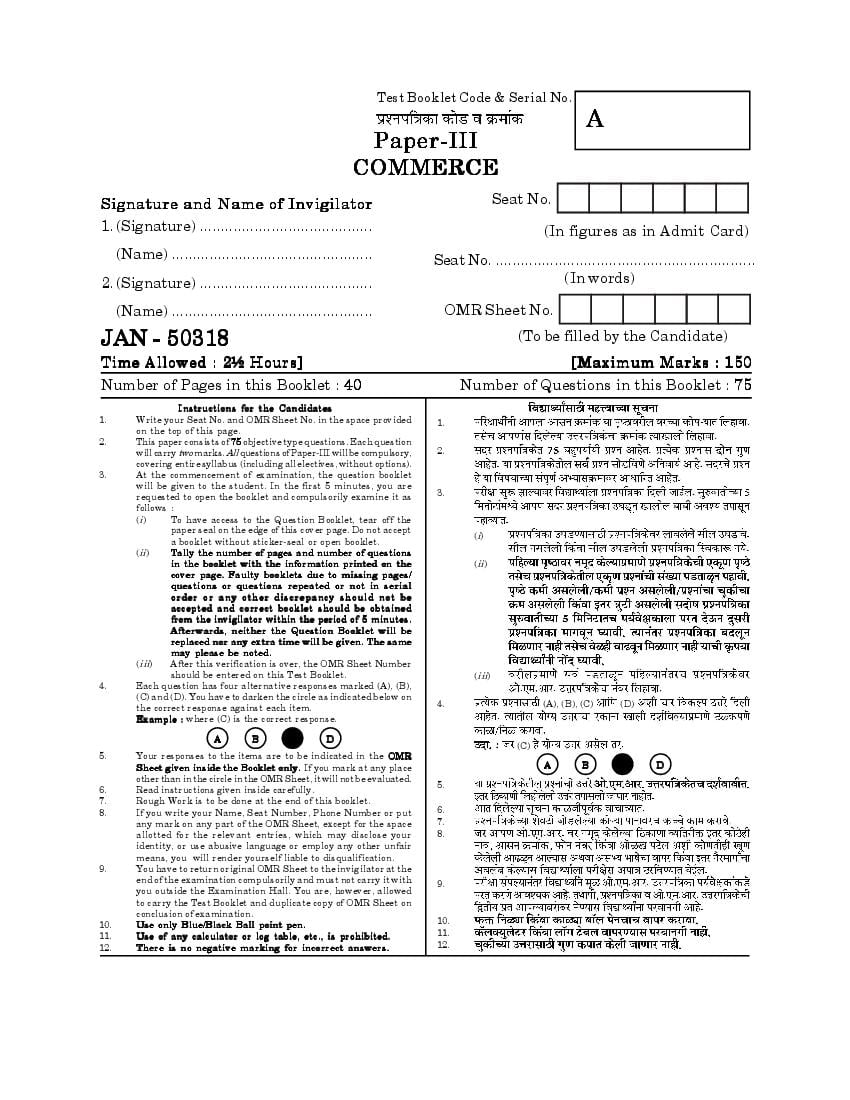
A
COMMERCE
Signature and Name of Invigilator Seat No.
1. (Signature) ......................................... (In figures as in Admit Card)
(Name) ................................................ Seat No. ..............................................................
2. (Signature) ......................................... (In words)
(Name) ................................................ OMR Sheet No.
JAN - 50318 (To be filled by the Candidate)
Time Allowed : 2½ Hours] [Maximum Marks : 150
Number of Pages in this Booklet : 40 Number of Questions in this Booklet : 75
Instructions for the Candidates
1. Write your Seat No. and OMR Sheet No. in the space provided 1.
on the top of this page.
2. This paper consists of 75 objective type questions. Each question
will carry two marks. All questions of Paper-III will be compulsory, 2.
covering entire syllabus (including all electives, without options).
3. At the commencement of examination, the question booklet
will be given to the student. In the first 5 minutes, you are
requested to open the booklet and compulsorily examine it as 3.
follows :
(i) To have access to the Question Booklet, tear off the
paper seal on the edge of this cover page. Do not accept
(i)
a booklet without sticker-seal or open booklet.
(ii) Tally the number of pages and number of questions
in the booklet with the information printed on the (ii)
cover page. Faulty booklets due to missing pages/
questions or questions repeated or not in serial
o rder or any other discre pancy should not be
accepted and correct booklet should be obtained
from the invigilator within the period of 5 minutes.
Afterwards, neither the Question Booklet will be
replaced nor any extra time will be given. The same
may please be noted.
(iii) After this verification is over, the OMR Sheet Number
should be entered on this Test Booklet. (iii)
4. Each question has four alternative responses marked (A), (B),
(C) and (D). You have to darken the circle as indicated below on
the correct response against each item. 4. (A), (B), (C) (D)
Example : where (C) is the correct response.
A B D
(C)
5. Your responses to the items are to be indicated in the OMR
Sheet given inside the Booklet only. If you mark at any place A B D
other than in the circle in the OMR Sheet, it will not be evaluated.
5.
6. Read instructions given inside carefully.
7. Rough Work is to be done at the end of this booklet.
8. If you write your Name, Seat Number, Phone Number or put 6.
any mark on any part of the OMR Sheet, except for the space 7.
allotted for the relevant entries, which may disclose your 8.
identity, or use abusive language or employ any other unfair
means, you will render yourself liable to disqualification.
9. You have to return original OMR Sheet to the invigilator at the
end of the examination compulsorily and must not carry it with 9.
you outside the Examination Hall. You are, however, allowed
to carry the Test Booklet and duplicate copy of OMR Sheet on
conclusion of examination.
10. Use only Blue/Black Ball point pen. 10.
11. Use of any calculator or log table, etc., is prohibited. 11.
12. There is no negative marking for incorrect answers. 12.
Page 2
Page 3
Paper III
III
Time Allowed : 2½ Hours] [Maximum Marks : 150
Note : This paper contains Seventy Five (75) multiple choice questions. Each
question carrying Two (2) marks. Attempt All questions.
(75) (2)
1. A medium enterprise is an 1.
enterprise where investment limit in
plant and machinery is ..............
(A) ` 7.5 crores (A) ` 7.5
(B) ` 5 crores (B) ` 5
(C) ` 10 crores (C) ` 10
(D) ` 20 crores (D) ` 20
2. The scope of MRTP Act, since 1992 2. 1992
has been confined only to the
regulation of :
(A) Consumer monopolies (A)
(B) Restrictive and unfair trade (B)
practices
(C) Restrictive Trade Practices (C)
(D) Monopolistic Trade Practices (D)
3 [P.T.O.
Page 4
be considered as one of the salient
features of major changes
announced in industrial policy on 24
July, 1991 ?
(A) Delicensing with certain
(A)
exception
(B) Liberalisation of Foreign
Investment and technological (B)
participation
(C) Effective promotion of small
industries widely dispersed in (C)
rural areas and small towns
(D) Scraping of MRTP regulation
(D)
pertaining to concentration of
economic power
4. Which one of the following is not 4.
a technique of environmental
analysis ?
(A)
(A) Verbal or written information
(B) Spying (B)
(C) Networking (C)
(D) Forecasting and formal
(D)
studies
4
Page 5
not be considered in a make or buy
decision ?
(A) Potential use of manufacturing
capacity (A)
(B) Variable cost of production (B)
(C) Potential rental income from
(C)
space occupied by production
area
(D)
(D) Uncharged fixed cost
6. A budget that gives a summary of 6.
all the functional budgets and a
projected profit and loss account is
known as ..........
(A)
(A) Master Budget
(B)
(B) Capital Budget
(C)
(C) Flexible Budget
(D) Fixed Budget (D)
5 [P.T.O.
Page 6
responsibility centre ?
(A)
(A) Expense centre
(B)
(B) Profit centre
(C)
(C) Investment centre
(D)
(D) Control centre
8. Which of the following methods of 8.
depreciation is recognised for income
tax purposes ?
(A)
(A) Straight line method
(B)
(B) Annuity method
(C) Written down value method (C)
(D) Revaluation method (D)
6
Page 7
two goods is negative, then they
are :
(A)
(A) Complements
(B)
(B) Substitutes
(C)
(C) Luxuries
(D) Consumer goods (D)
10. Other factors remaining unchanged, 10.
if the income of the buyer increases,
his budget/price line will :
(A)
(A) Shift backwards to the left
(B)
(B) Remains unchanged
(C) Shifts upwards to the right (C)
(D) Becomes vertical (D)
7 [P.T.O.
Page 8
be used to calculate Marginal
Utility (MU) ?
(A) TU/N
(A) TU/N
(B) TU – AU
(B) TU – AU
(C) AU × N
(C) AU × N
(D) TUn – TUn–1 (D) TUn – TUn–1
12. When the marginal cost (MC) of a 12.
firm is rising, it will :
(A)
(A) pull the average cost (AC) up
(B)
(B) push the AC down
(C)
(C) split the AC
(D)
(D) leave the AC unaffected
8
Page 9
means are equal we use ........... test.
(A) t (A) t
(B) F (B) F
(C) Chi square (C) (Chi-square)
(D) Kolmogorov-Smirnov (D)
14. Sampling distribution of a statistic 14.
will be approximately normal when
(Statistic)
the sample size is ............
(A)
(A) Small
(B)
(B) Large
(C)
(C) Sufficiently large
(D) Optimum (D)
9 [P.T.O.
Page 10
to ............ degree angle.
(A) 3.0 (A) 3.0
(B) 4.5 (B) 4.5
(C) 9.0 (C) 9.0
(D) 18.0 (D) 18.0
16. The standard deviation of a 16.
binomial distribution is ............
(A) np (A) np
(B) npq (B) npq
(C) npq (C) npq
(D) np2 q2 (D) np2 q2
10
Page 11
planning.
(A) Policy (A)
(B) Programme (B)
(C) Delegation of authority (C)
(D) Tactic (D)
18. ............. is a step in the process of 18.
controlling.
(A) Decentralisation of Authority (A)
(B) Setting standard
(B)
(C) Determining span of control
(C)
(D) Developing feedback control
(D)
11 [P.T.O.
Page 12
organisational structure.
(A) Committee (A)
(B) Matrix organisation (B)
(C) Informal organisation (C)
(D) Centralisation of authority (D)
20. ............ is a part of the process of 20.
communication.
(A) Strategy formulation (A)
(B) Policy formulation (B)
(C) Decoding (C)
(D) Situation identification (D)
12
Page 13
of sellers, while marketing concept
focuses on the needs of .............
(A) Dealers (A)
(B) Suppliers (B)
(C) Buyers (C)
(D) Distributors (D)
22. A mass communication programme 22.
about a product or an organisation,
for which no payment is made, is
called as ...........
(A) Publicity (A)
(B) Advertising (B)
(C) Salesmanship (C)
(D) Sales Promotional Schemes
(D)
13 [P.T.O.
Page 14
of products and services to a .............
group of buyers.
(A)
(A) Large
(B)
(B) Small
(C)
(C) Substantial
(D) Diversified (D)
24. Initially charging the high price and 24.
then gradually reducing the same
after some time period, is called
as .............
(A)
(A) Skimming Pricing Policy
(B)
(B) Penetration Pricing Policy
(C) Uniform Pricing Policy (C)
(D) Unique Pricing Policy (D)
14
Page 15
A, calculate pay back period.
Cost of project ` 80,000, estimated ` 80,000,
scrap value ` 10,000, estimated cash ` 10,000,
inflow (savings) :
` `
1 year 16,000 1 16,000
2 year 24,000 2 24,000
3 year 24,000 3 24,000
4 year 24,000 4 24,000
5 year 12,000 5 12,000
(A) 3 years, 8 months (A) 3 8
(B) 3 years, 3 months (B) 3 3
(C) 5 years, 8 months (C) 5 8
(D) 5 years, 3 months (D) 5 3
15 [P.T.O.
Page 16
calculate operating leverage :
Sales ` 2,00,000, contribution
` 2,00,000, ` 1,00,000,
` 1,00,000; Fixed cost ` 50,000,
` 50,000,
Earnings before interest and tax
(EBIT) : ` 50,000.
(EBIT) : ` 50,000.
(A) 2
(A) 2
(B) 1
(B) 1
(C) 0.50 (C) 0.50
(D) 0.25 (D) 0.25
27. Which one of the following is not 27.
used to estimate cost of equity
capital ?
(A) External yield criterion (A)
(B) Dividend plus growth model (B)
(C) Equity capitalization approach (C)
(D) Capital Asset Pricing Model (D)
(CAPM)
16
Page 17
significantly influenced by the ...........
(A) Cost concept (A)
(B) Cost consideration (B)
(C) Cost capital (C)
(D) Cost control (D)
29. Working conditions are a part of : 29.
(A) Job environment (A)
(B) Job enlargement (B)
(C) Job evaluation (C)
(D) Job enrichment (D)
30. Provisions relating to health and 30.
safety in industrial organisations are
there in the ...............
(A)
(A) Industrial Disputes Act
(B)
(B) Workmen’s Compensation Act
(C) Factories Act (C)
(D) ESI Act (D)
17 [P.T.O.
Page 18
ment requires understanding of
(n/PWR), (n/AFF)
n /PWR, n /AFF and n /ACH
(n/ACH)
developed by :
(A) Skinner (A)
(B) McClelland (B)
(C) Adams (C)
(D)
(D) Vroom
32. Which of the following is usually 32.
not an approach to on-the-job
training ?
(A)
(A) Coaching
(B)
(B) Job rotation
(C) Planned progression (C)
(D) Sensitivity training (D)
18
Page 19
them as credit, banks act as :
(A) Capital Market (A)
(B) Financial Intermediaries (B)
(C) Forex Dealer (C)
(D) Lender of last resort (D)
34. Which among the following is 34.
incorrect ?
(A)
(A) RBI is the Bank of Issue
(B) RBI acts as Banker to the
(B)
Government
(C)
(C) RBI is Banker’s Bank
(D) RBI is lender to the large (D)
industrial corporations
19 [P.T.O.
Page 20
with :
(A) Central Vigilance Commission (A)
(B) Non-performing Assets (B)
(C) Capital Adequacy Ratio (C)
(D) Foreign Direct Investment (D)
36. Banking Ombudsman means :
36.
(A) A person appointed to recover
(A)
dues
(B) A person to whom customer can (B)
approach for redressal of his
grievances
(C)
(C) A person appointed to settle
disputes between employees and
management
(D)
(D) A person appointed by RBI to
oversee the functioning of
foreign banks
20
Page 21
highest percentage share in Indian
imports ? (A)
(A) Petrol (B)
(B) Gas (C)
(C) Diesel (D) (Petrol, oil and
(D) POL (Petrol, oil and lubricants) lubricants)
38. Special Drawing Rights are : 38. (SDRs)
(A) International Reserve Assets
(A)
(B) Indian Regulatory Authority
(B)
(C) International Regional Assets (C)
(D) Component of FDI (D)
21 [P.T.O.
Page 22
member country upto : (A)
10
(A) 10% of its share in paid up
capital of World Bank (B)
20
(B) 20% of its share in paid up
capital of World Bank
(C)
(C) 30% of its share in paid up 30
capital of World Bank
(D)
(D) 40% of its share in paid up 40
capital of World Bank
40. Balance of trade takes into 40. (BOT)
account :
(A) Only export and import of
services (A)
(B) Export and import of goods and
(B)
services
(C) Export and import of capital
(C)
(D) Export and import of only
merchandise goods (D)
22
Page 23
line is the example of .............
(A) Cost Centre (A)
(B) Revenue Centre (B)
(C) Investment Centre (C)
(D) Profit Centre (D)
42. Accounting Standard-16 is related 42. 16
with ............
(A) Segment reporting (A)
(B) Amalgamation (B)
(C) Borrowing cost (C)
(D) Depreciation accounting (D)
43. Which of the following risk area is 43.
not considered before venture capital
financing ?
(A) Product risk (A)
(B) Market risk (B)
(C) Dividend risk (C)
(D) Technological risk (D)
23 [P.T.O.
Page 24
(A) Vertical combinations (A)
(B) Allied combinations (B)
(C) Horizontal combinations (C)
(D) Mixed combinations (D)
45. When a right to purchase securities 45.
is acquired, it is known as ............
(A) Call option (A)
(B) Put option (B)
(C) Double option (C)
(D) Option (D)
24
Page 25
(A) ADR’s (American Depository
Receipts) (A)
(B) Bonds (B)
(C) Commercial Papers (C)
(D) Gold bonds (D)
47. The first mutual fund scheme in 47.
India was introduced by ..............
(A) Reserve Bank of India (RBI) (A)
(B) State Bank of India (SBI) (B)
(C) Unit Trust of India (UTI) (C)
(D) Government of India (D)
25 [P.T.O.
Page 26
taking the total heterogenous
market for a product and dividing
it into several segments each of
which tends to be ............. in all
significance.
(A)
(A) Different
(B)
(B) Special
(C)
(C) Homogeneous
(D)
(D) Indigeneous
49. In sellers’ market situation, ............... 49.
dominate the decisions and activities
in the market.
(A) Manufacturers and dealers
(A)
(B) Consumers
(B)
(C) Competitors
(C)
(D) Banks and Insurance
Companies (D)
26
Page 27
50.
included in the micro-environmental
factors ?
(A) Customers (A)
(B) Dealers (B)
(C) Competitors
(C)
(D) Other departments in the
(D)
company
51. Out of the following which is not 51.
included as a personal factor
influencing consumers’ buying
behaviour ?
(A)
(A) Occupation
(B)
(B) Lifestyle
(C)
(C) Age
(D) Social group (D)
27 [P.T.O.
Page 28
which ..................
(A)
(A) are packed only in green
coloured paper
(B) include raw materials in green (B)
colour only
(C) try to protect the environment
(C)
(D) are the products harmful to
(D)
environment
53. Day to day buying of fruits and 53.
vegetables by the consumers
indicates an example of ............
buying behaviour.
(A)
(A) Variety seeking
(B) Complex decision-making (B)
(C) Special (C)
(D) Brand Loyal
(D)
28
Page 29
.................. distribution strategy is
preferred.
(A)
(A) Intensive
(B)
(B) Selective
(C)
(C) Exclusive
(D)
(D) Inclusive
55. Which of the following is not the 55.
method of workers’ participation in
management ?
(A)
(A) Co-partnership
(B)
(B) Profit-sharing
(C)
(C) Member on Board of Directors
(D)
(D) Bonus Scheme
29 [P.T.O.
Page 30
produce alone standards receive
higher wages than those who
produce below standards ?
(A) Fayol
(A)
(B) Taylor
(B)
(C) Follet (C)
(D) Halsey-Rowan (D)
57. ............... is constructed/designed to 57.
discover interests, existing skills and
potential for acquiring skills.
(A) Intelligence Test (A)
(B) Proficiency Aptitude Test (B)
(C) Vocational Test (C)
(D) Personality Test (D)
30
Page 31
non-financial incentive ?
(A) Giving additional responsibility (A)
(B) Creating a sense of achievement (B)
(C) Granting recognition (C)
(D) Declaring bonus (D)
59. The blocking of goal-attainment is 59.
referred to as :
(A) Perception (A)
(B) Goal congruence (B)
(C) Frustration (C)
(D) Dissonance (D)
31 [P.T.O.
Page 32
or ideal decision, managers
frequently settle for one that will
adequately serve their purpose. In
Simon’s terms, they :
(A)
(A) Optimise
(B) Maximise (B)
(C) Satisfice (C)
(D) Actualise (D)
61. The following are the basic human 61.
needs mentioned by Maslow :
(i) Physiological needs (i)
(ii) Esteem needs (ii)
(iii) Security needs (iii)
(iv) Self-actualisation needs
(iv) (Self-actualisation)
(v) Affiliation needs
(v)
The ascending order of these as done
by Maslow would be :
(A) (i), (ii), (iii), (v), (iv)
(A) (i), (ii), (iii), (v), (iv)
(B) (i), (iii), (v), (ii), (iv)
(B) (i), (iii), (v), (ii), (iv)
(C) (i), (v), (ii), (iv), (iii)
(C) (i), (v), (ii), (iv), (iii)
(D) (i), (iii), (iv), (v), (ii)
(D) (i), (iii), (iv), (v), (ii)
32
Page 33
its greatest impact on :
(A) Automobile
(A)
(B) Banking and insurance
(B)
(C) Pharmaceuticals (C)
(D) Aviation (D)
63. Which of the following is not agreed 63.
upon by members of WTO ?
(A) Observance of minimum labour
standard
(A)
(B) Protection of Intellectual
(B)
Property Rights
(C)
(C) Dispute Settlement Mechanism
(D) Agricultural Subsidies (D)
33 [P.T.O.
Page 34
established to help and finance
world’s less developed countries ?
(A) IMF (A)
(B) IBRD (B)
(C) IDA (C)
(D) RBI (D)
65. Which of the following is not a major 65.
trading partner of India ?
(A) UAE (A)
(B) China (B)
(C) Germany (C)
(D) Finland (D)
66. Global depository receitps are issued 66. (GDRs)
by :
(A) America (A)
(B) Depository Country (B)
(C) Depository Bank (C)
(D) Investors (D)
34
Page 35
67.
relating to import and exports of
goods, services and factor income is
called as : (A)
(A) Trade Liberalism
(B)
(B) Free Trade
(C)
(C) Current Account Convertibility
(D)
(D) Trade Promotion
68. SAFTA is related to : 68.
(A) UN (A)
(B) EU (B)
(C) SAARC (C)
(D) ASEAN (D)
35 [P.T.O.
Page 36
69.
of foreign University having campus
1961
in India is ............
(A)
(A) Company
(B)
(B) Association of Person
(C) Artificial Judicial Person (C)
(D) Trust (D)
70. Which of the following allowances is
70.
fully exempted under the Income
Tax Act, 1961 ?
(A)
(A) Travelling allowance
(B)
(B) Conveyance allowance
(C)
(C) Hostel allowance
(D) Uniform allowance (D)
36
Page 37
Income Tax Act 1961 in respect of
1961
interest on borrowed capital for
24
repairs of the house property is
restricted to ..............
(A) ` 30,000
(A) ` 30,000 p.a.
(B) ` 1,50,000
(B) ` 1,50,000 p.a.
(C) ` 2,00,000
(C) ` 2,00,000 p.a.
(D) ` 50,000 p.a. (D) ` 50,000
72. Long-term capital gain taxable in 72.
the hands of an individual assessee
at the rate of ...............
(A) 20%
(A) 20%
(B) 15%
(B) 15%
(C) 25% (C) 25%
(D) Relevant slab rates (D)
37 [P.T.O.
Page 38
73.
by a non-corporate assessee having
tax audit is ..............
(A) 30th June of the relevant
Assessment Year
(A) 30
(B) 31st July of the relevant
Assessment Year
(B) 31
(C) 30th Sept. of the relevant
Assessment Year (C) 30
(D) 31st Oct. of the relevant
(D) 31
Assessment Year
74.
74. Suppression of Income is an example
of .............
(A) Tax Planning (A)
(B) Tax Avoidance (B)
(C) Tax Exemption (C)
(D) Tax Deduction (D)
75. Rate of tax deducted at source for 75.
interest on fixed deposits exceeding ` 10,000
` 10,000 for the assessee not
providing Permanent Account
Number is .............
(A) 10% (A) 10%
(B) 20% (B) 20%
(C) 30% (C) 30%
(D) relevant slab rate of tax
(D)
38
Page 39
39 [P.T.O.
Page 40
40
Document Details
| Board / Org | Maharashtra Exams |
| Exam | MAHA SET |
| Type | Question Paper |
| Pages | 40 |
| Updated | 30 Apr 2026 |