NBSE Class 10 Question Paper 2021 for Music
Finished viewing? Save it for later —
Download NBSE Class 10 Question Paper 2021 for Music (PDF · 7 pages)About NBSE Class 10 Question Paper 2021 for Music
NBSE Class 10 Question Paper 2021 for Music is available here for free download. Published by Nagaland Board for Class 10, this question paper can be viewed online or downloaded as a PDF (7 pages). Candidates preparing for Class 10 can use NBSE Class 10 Question Paper 2021 for Music to understand the exam pattern, the type of questions asked, and the overall difficulty level.
Frequently Asked Questions
How can I download NBSE Class 10 Question Paper 2021 for Music?
Open this page and click the Download button to save NBSE Class 10 Question Paper 2021 for Music as a PDF. It is completely free on AglaSem Docs.
Is NBSE Class 10 Question Paper 2021 for Music free to download?
Yes. NBSE Class 10 Question Paper 2021 for Music can be viewed online and downloaded as a PDF free of cost on AglaSem Docs.
How many pages does NBSE Class 10 Question Paper 2021 for Music have?
NBSE Class 10 Question Paper 2021 for Music contains 7 pages, which you can read online or download together as a single PDF.
Where can I find more Class 10 study material?
You can find more Class 10 question papers, sample papers, syllabus, and answer keys on AglaSem Docs.
NBSE Class 10 Question Paper 2021 for Music – Text
Read the full text of this question paper below — useful to quickly search, copy and reference the content online without downloading the PDF.
📄 View text version (7 pages)
Page 1
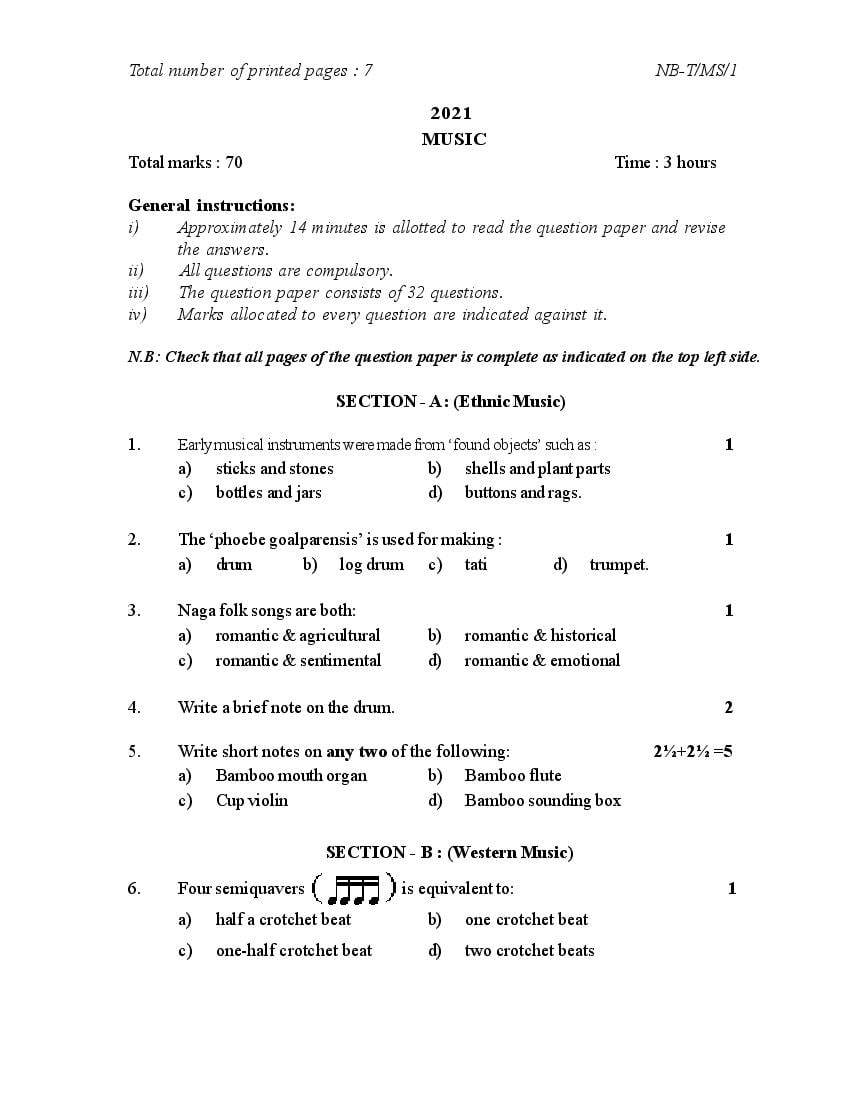
2021
MUSIC
Total marks : 70 Time : 3 hours
General instructions:
i) Approximately 14 minutes is allotted to read the question paper and revise
the answers.
ii) All questions are compulsory.
iii) The question paper consists of 32 questions.
iv) Marks allocated to every question are indicated against it.
N.B: Check that all pages of the question paper is complete as indicated on the top left side.
SECTION - A : (Ethnic Music)
1. Early musical instruments were made from ‘found objects’ such as : 1
a) sticks and stones b) shells and plant parts
c) bottles and jars d) buttons and rags.
2. The ‘phoebe goalparensis’ is used for making : 1
a) drum b) log drum c) tati d) trumpet.
3. Naga folk songs are both: 1
a) romantic & agricultural b) romantic & historical
c) romantic & sentimental d) romantic & emotional
4. Write a brief note on the drum. 2
5. Write short notes on any two of the following: 2½+2½ =5
a) Bamboo mouth organ b) Bamboo flute
c) Cup violin d) Bamboo sounding box
SECTION - B : (Western Music)
6. Four semiquavers is equivalent to: 1
a) half a crotchet beat b) one crotchet beat
c) one-half crotchet beat d) two crotchet beats
Page 2
7. Name the given note : 1
a) B b) F c) C d) E
8. Choose the correct time signature for the given notation: 1
3 3 6 9
a) 4
b) 8
c) 8
d) 8
9. Identify the given interval. 1
a) Major 6th b) Minor 6th c) Major 7th d) Perfect 5th
10. Which minor key has two flats in its key signature? 1
a) G minor b) D minor c) A minor d) E minor
11. Which of the following is not correctly grouped? 1
a) b) c) d)
12. The dominant triad can be labelled with: 1
a) IIII b) V c) 5 d) 5 th
13. Write correctly grouped quaver or semi quaver rests below the
asterisks. ½x4=2
Page 3
14. a) Write the tonic in the last bar to agree with the anacrusis. 1+1=2
b) Write the correct rest in the last bar to agree with the anacrusis.
and second inversion in the key of B major on the bass clef.
15. Write the key signature and the tonic triad in the root, first inversion
4x½=2
16. Write the key of the following music. 1+1=2
a)
b)
17. Write two more repeats of the given bar to make ostinati that move in
similar movement. 2
18. Write the correct time signature. 1+1=2
a)
b)
Page 4
19. Construct the following scales, without key signature, descending,
a) B major
using crotchets in the bass stave. 1+1=2
b) G major
20. Circle the two roots in the following chords. 2
a) b)
21. Write triads on the tonic and dominant degrees of the B minor (harmonic)
scale going down. Use semibreves and label with roman numerals in the
bass stave. Give key signature. 2
22. Identify the following. 2
a)
b)
23. Write some quaver triplets to agree with the time signature
(one bar each) 1+1=2
a)
b)
24. Draw the following intervals up from the given keys as directed. 6x½=3
Perfect Perfect Major Minor Major Major
fifth fourth sixth 2nd 3rd 7th
Page 5
25. Construct broken chords, descending, for the given keys. Finish no
less than 2 leger lines below the stave. Use key signature. 1½+1½=3
3
a) Bm tonic triad in time, using minims on the treble clef.
2
6
b) D major tonic triad in time, using semiquavers triplets on the bass clef.
8
26. Using minims, write out 4 part chords for SATB using chords of the
giving keys. Double the root in each case. Give time signature and key
signature. 1½+1½=3
a) B major b) D minor
27. Label the triads with roman numerals and chord symbols to show the
chord progression. 1½+1½=3
(A minor)
a)
(E minor)
b)
28. Add crotchet or quaver rests in the places marked by an asterisk (*) to
complete the bars. Use brackets wherever necessary. 3x1=3
a)
b)
c)
Page 6
29. Transpose the following tunes as directed. 1½+1½=3
a) Down an octave.
b) Up an octave.
30. Identify the cadences and label them with correct roman numerals and
key names. 1½+1½=3
a)
b)
31. Construct the following scales with minims. Use key signature and
necessary accidentals. 5x1=5
a) D natural minor, descending, bass clef.
b) A melodic minor, ascending, bass clef.
c) B harmonic minor, descending, treble clef.
d) E melodic minor, descending, bass clef.
e) G melodic minor, descending, treble clef.
Page 7
32. Look at the following music and answer the questions that follow. 5x1=5
a) Identify the key the piece is in.
b) Name the type of cadence that ends this piece.
c) What is the interval between the two notes marked (*) in bars 5-6?
d) Is this piece in simple or compound time?
e) What is the total number of counts for the notes in the last bar?
*****************************
Document Details
| Board / Org | Nagaland Board |
| Exam | Class 10 |
| Type | Question Paper |
| Pages | 7 |
| Updated | 22 Jul 2026 |