Goa Board Class 10 Sample Paper 2026 Everyday Mathematics (E)
Finished viewing? Save it for later —
Download Goa Board Class 10 Sample Paper 2026 Everyday Mathematics (E) (PDF · 35 pages)About Goa Board Class 10 Sample Paper 2026 Everyday Mathematics (E)
Goa Board Class 10 Sample Paper 2026 Everyday Mathematics (E) is available here for free download. Published by Goa Board for Class 10, this sample paper can be viewed online or downloaded as a PDF (35 pages). Candidates preparing for Class 10 can use Goa Board Class 10 Sample Paper 2026 Everyday Mathematics (E) to understand the exam pattern, the type of questions asked, and the overall difficulty level.
Frequently Asked Questions
How can I download Goa Board Class 10 Sample Paper 2026 Everyday Mathematics (E)?
Open this page and click the Download button to save Goa Board Class 10 Sample Paper 2026 Everyday Mathematics (E) as a PDF. It is completely free on AglaSem Docs.
Is Goa Board Class 10 Sample Paper 2026 Everyday Mathematics (E) free to download?
Yes. Goa Board Class 10 Sample Paper 2026 Everyday Mathematics (E) can be viewed online and downloaded as a PDF free of cost on AglaSem Docs.
How many pages does Goa Board Class 10 Sample Paper 2026 Everyday Mathematics (E) have?
Goa Board Class 10 Sample Paper 2026 Everyday Mathematics (E) contains 35 pages, which you can read online or download together as a single PDF.
Where can I find more Class 10 study material?
You can find more Class 10 question papers, sample papers, syllabus, and answer keys on AglaSem Docs.
Goa Board Class 10 Sample Paper 2026 Everyday Mathematics (E) – Text
Read the full text of this sample paper below — useful to quickly search, copy and reference the content online without downloading the PDF.
📄 View text version (34 pages)
Page 1
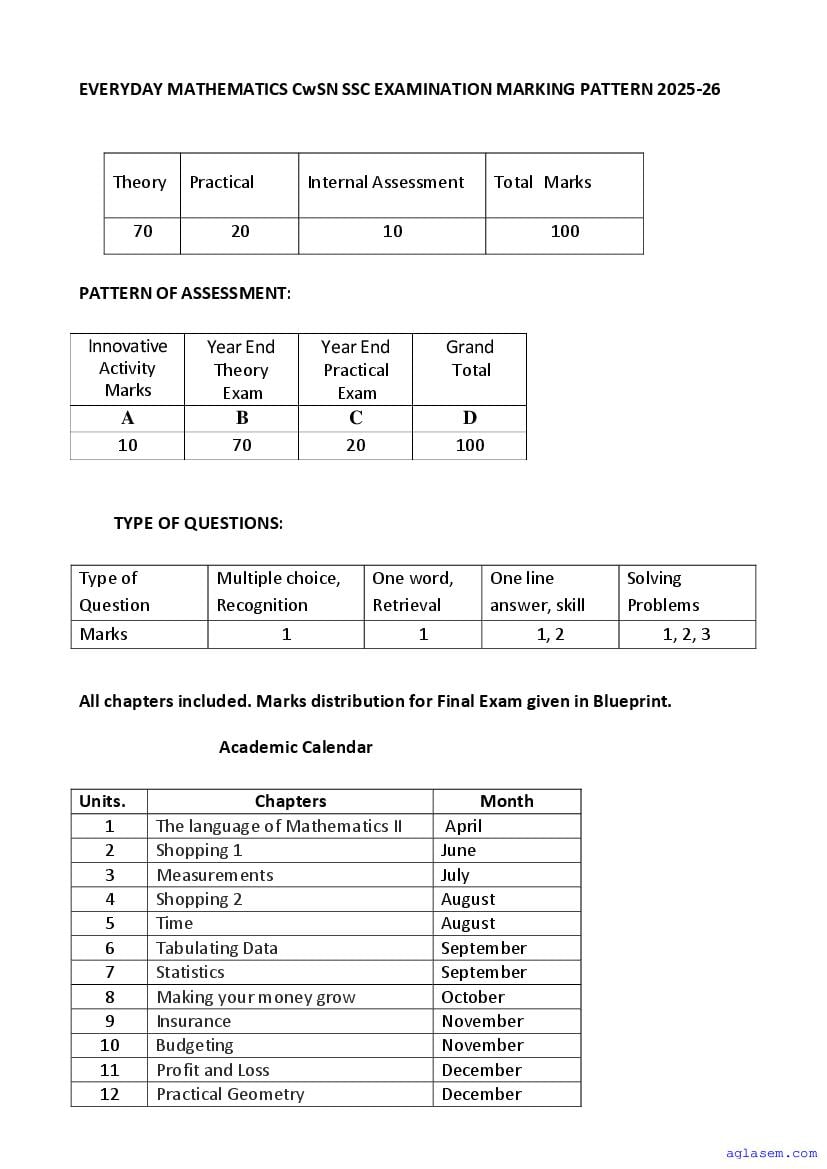
Theory Practical Internal Assessment Total Marks
70 20 10 100
PATTERN OF ASSESSMENT:
Innovative Year End Year End Grand
Activity Theory Practical Total
Marks Exam Exam
A B C D
10 70 20 100
TYPE OF QUESTIONS:
Type of Multiple choice, One word, One line Solving
Question Recognition Retrieval answer, skill Problems
Marks 1 1 1, 2 1, 2, 3
All chapters included. Marks distribution for Final Exam given in Blueprint.
Academic Calendar
Units. Chapters Month
1 The language of Mathematics II April
2 Shopping 1 June
3 Measurements July
4 Shopping 2 August
5 Time August
6 Tabulating Data September
7 Statistics September
8 Making your money grow October
9 Insurance November
10 Budgeting November
11 Profit and Loss December
12 Practical Geometry December
Page 2
awareness of learners. No questions may be included in the theory question paper from this
annexure for this academic year. However, an option is included in the innovative activities
to encourage learners to stay updated.
Everyday Mathematics, Grade 10
Annexure to Chapter 8: Making your money grow
Reforms in Taxation
Q. Why does the government change taxation methods?
Governments often introduce new tax regimes or modify existing ones to achieve
various economic and social objectives.
Q. What is a tax regime of a country or state?
A ‘Tax Regime’ refers to the entire set of rules, laws, and policies that govern how
the taxes are imposed, calculated, and collected.
Q. What are the key aspects of a tax regime?
A tax regime would usually have the following aspects:
Taxable events – types of incomes of a person or business
Tax rates - percentage of income tax slabs, GST rates, corporate tax rates
Tax bases – the type of income or the amount on which the tax rates are
calculated
Deductions and Exemptions – provisions to reduce the amount of tax payable
Page 3
Surcharges and Cesses – additional tax calculated on the basic tax
Rebates – reductions in the final tax amount payable
Q. What is a Progressive Tax Slab structure?
The income tax system is usually progressive. Higher income levels attract higher tax
rates.
Q. What are the tax regimes for personal income tax in India?
The Old Tax Regime
The New Tax Regime
The ‘New Tax Regime’ for individuals was introduced in the year 2020. The previous
method of taxation was then referred to as the ‘Old Tax Regime’.
Q. Why did the Government introduce the New Tax Regime?
It is simple to calculate and easy to follow compared to the Old Tax Regime
To encourage spending, and help economy to grow
To encourage more people to file their income tax returns
To benefit the people who did not invest in tax saving options
To modernise taxation by keeping it transparent and efficient
To provide flexibility and choice of investments to new tax payers
Page 4
Criteria Old Tax Regime New Tax Regime
Type Traditional Global, modern
Intention To encourage savings and long To leave more disposable
term investments for individual income, increase spending,
financial stability improve economy
Promotes Tax saving instruments Choice in investment and
expenditure
Tax structure Complex Simpler
Tax rates Higher Lower
Standard Lower Higher
deduction only for salaried and pensioners
Tax deductions Allows for many types Allows for few types
and exemptions
Tax rebate Lower Higher
Types of tax rate On income, age On income
slabs
Simple for calculation
Beneficial for People investing in many People with less or no tax
different types of tax saving saving instruments
instruments
Option to switch Yes, every year Yes, every year for salaried
to the other individuals.
regime
Only once in a lifetime for
individuals with business /
professional income.
Page 5
The tax payers must ensure the best regime for themselves.
We must carefully calculate our tax liability under both regimes based on specific
income and eligible deductions/investments before making a final decision.
Approach a Chartered Accountant (CA) and seek advice in detail.
Use reliable online tax calculators, with caution.
Q. Why do taxation rules keep changing?
Since the introduction of the New Tax Regime, the tax slabs, rates and other aspects
are being adjusted in both the regimes every year, to suit the country as well as the
tax payer.
Q. Will taxation change again?
Yes. As times change, the needs of the country and the citizens will continue to
evolve. Accordingly, changes and adjustments will be required.
Always remain updated about the latest changes, before filing Income Tax Returns.
Q. What is online tax filing?
Tax filing can be done online on the e-filing portal of the Income Tax Department of
India. Tax could be calculated, and If applicable paid online.
Page 7
Time: - 3 hours Std: - X
Subject: - Everyday Mathematics Marks: - 70
INSTRUCTIONS:
1. All questions are compulsory. Internal options are provided for some questions.
2. Do not write your answers on the Question Paper.
3. Figures to the right indicate full marks.
4. Questions 1 to 35 are MCQs for 1 mark each
5. Questions 36 to 65 are subjective.
6. All questions are to be answered on the answer booklet.
7. Answers should be numbered correctly.
8. All rough work is to be done on the answer booklet.
9. Questions are not to be copied on the answer booklet.
SECTION A
1. The amount in words for 2,13,54,930 is .
A. two crores thirteen lakhs fifty four thousand nine hundred and thirty
B. two crores thirty lakhs fifty four thousand nine hundred and thirteen
C. two crores thirteen lakhs forty five thousand nine hundred and thirty
D. two crore thirty one lakh forty five thousand nine hundred and three
2. Half of ten lakh is .
A. five thousand
B. fifty thousand
C. five lakh
D. ten thousand
7
Page 8
A long shelf life
B. no expiry date
C. no manufacturing date
D. a short shelf life
4. A chips packet has packaging date 15 January 2025. It is labeled ‘Best Before 8
months’.
The Best Before date is .
A. 15 September 2024
B. 15 January 2025
C. 15 April 2025
D. 15 September 2025
5. The date by which a food item does not remain fit for consumption is .
A. manufacturing date
B. best before date
C. expiry date
D. packaging date
6. Tomatoes costs Rs. 70 per kg. So 500 g tomatoes will cost .
A. Rs. 20
B. Rs. 40
8
Page 9
D. Rs. 100
7. To measure the rainfall, the rain gauge should be placed
A. under a tree
B. on the open ground
C. under a roof where water falls and accumulates
D. in house, where water drips
8. For babies it is better to take temperature.
A. oral
B. axillary
C. rectal
D. mouth
9. To buy a shirt, one should measure the
A. circumference of the waist
B. circumference of the hips
C. circumference of the hand
D. circumference of the chest
10. If my jeans size is 32 inches, my jeans size in centimeters will be
A. 80 cm
B. 75 cm
C. 80 m
D. 75 m
9
Page 10
A. weight
B. numbers
C. meters
D. volume
12. In case a discount is offered, a customer will have to pay
A. more than MRP
B. less than MRP
C. same as MRP
D. average
13. Paint is sold in ___________
A. kilograms
B. numbers
C. meters
D. litres
14. The t-shirt worth Rs. 500/- is sold at 10% discount. The customer has to pay
A. Rs. 50/-
B. Rs. 500/-
C. Rs. 550/-
D. Rs. 450/-
10
Page 11
A. 12
B. 24
C. 28
D. 30
16. A minute is made up of ______seconds.
A. 30
B. 50
C. 60
D. 90
17. Tables are made up of _______ .
A. lines and dots
B. rows and columns
C. charts and diagrams
D. images and graphics
18. Data can be represented in various forms such as:
A. equations and formulas
B. paragraphs and essays
C. pie charts, bar graphs and histograms
11
Page 12
19. The ages of Myra’s cousins are 16, 18 and 23. Their mean age is .
A. 16
B. 18
C. 19
D.23
20. A survey is used to _____________.
A. collect data
B. show planning
C. show categories
D. show types of charts
21. The Median for the data set 12, 37, 11, 90, 29 is
A. 11
B. 12
C. 37
D. 29
22. In a school bag, there are 16 pens and 8 notebooks. Their ratio is .
A. 8:4
12
Page 13
C. 1:2
D. 2:8
23. The maturity period for National Saving Certificate is_____years.
A. 5 or 10
B. 10 or 20
C. 3 or 5
D. 20 or 25
24. In India the financial year starts on .
A. 1st January
B. 1st March
C. 1st December
D. 1st April
25. Select and write the odd one out from the following:
A. PPF
B. FD
C. SIP
D. TDS
26. An increase in prices of goods and services is called .
A. inflation
B. taxes
13
Page 14
D. gross income
27. It is compulsory for all the public vehicles to have __________.
A. life insurance
B. third party insurance
C. Fasal Bima Yojna
D. medical insurance
28. The person who helps to buy insurance policy is known as ____________.
A. a trader
B. a customer
C. an agent
D. a manager
29. The budget of the Nation is prepared by the .
A. Prime Minister
B. Chief Minister
C. Finance Minister
D. Home Minister
30. A good budget includes ____________.
A. savings, investment and emergency fund
B. Loan EMI and luxury expenditure
C. under-estimation of expenditure
D. over-estimation of expenditure
14
Page 15
A. Producers.
B. Consumers.
C. Entrepreneurs.
D. Capitalist
32. The angles in an equilateral triangle make a total of .
A. 900
B. 1000
C. 1800
D. 3600
33. Growth charts help us to monitor in children.
A. Nutrition
B. age
C. development.
D. length
34. The road to health chart uses a .
A. histogram.
B. bar graph.
C. line graph.
D. pie chart
35. Raj’s height falls on the 20th percentile on the height age graph. This means
out of 100 children his age _________.
15
Page 16
B. 20 are shorter than Raj
C. 80 are taller than Raj
D. 80 are shorter than Raj
SECTION B
36. Mr. Shinde’s salary is fifty thousand a month. He spends thirty thousand
every month. How much does he save every month? How much will he have
saved in 12 months? Write your answer in figures and words. (2)
37. Rudrak sells apples at a rate of Rs. 350 per dozen. How much will he charge for
5 apples? (1)
38. Answer any one of the following: (2)
Preeti went the shop and bought the following items (price and quantity given)
Sr.No. Item Quantity Unit Price Total price
1 Coffee packet 1 Rs. 60
2 Tea packet 2 Rs. 40
3 Potato chips 3 Rs. 20
Calculate the total bill.
OR
Tina buys the following from the grocery shop:
Chana dal ¼ kg, Kabuli chana ½ kg, Masoor dal ½ kg
Market rates (per kg) : Chana dal Rs. 80, Kabuli chana Rs. 78, Masoor dal Rs.70 Calculate
her bill.
16
Page 17
The syrup is available in 60 ml bottles. Each 5 ml contains 250mg of antibiotic.
Answer questions 39 and 40 based on this data.
39. How many ml will each dose be? (1)
40. How many bottles of syrup should Rajani’s mother buy? (1)
41. What is the odometer reading in the following picture? (1)
42. Answer any one of the following: (1)
In the city of the Panaji rain was recorded for three days of the week from Monday to
Wednesday. Calculate the total rainfall for these three days.
Rainfall : on Monday - 20mm, Tuesday – 30mm and on Wednesday – 25mm
OR
Gauresh set on a trip. When he started his journey the odometer reading was
250546 km. When he finished his trip the odometer reading is 252637 km.
Calculate the total distance Gauresh travelled.
43. Answer any one of the following: (2)
17
Page 18
distance of 275 km. Calculate the mileage of Neelim’s scooter.
OR
The Milk van has to cover a distance of 90 km in 2 hours to reach to the milk plant.
What should be the average speed of thee milk van?
Mrs. Kavlekar buys following kitchen utensils for her house: Plates
4 and glasses 6
The rates per unit are: plate Rs. 125/-, glass Rs. 85/-, Small bowls Rs. 45/-, spoons Rs.
20/-
44. Calculate her total bill. (1)
45. If she is offered 5% discount on the total bill, how much money she will save? (1)
Answer any one set of Questions from 46 to 47 the following: (2)
A 100g toothpaste pack is Rs. 82/- and a 50g pack cost Rs. 45/-.
46. Which pack is cheaper per unit cost?
47. Is there any difference in price per unit weight between the 100g and 50g pack?
OR
Mr. Rajesh buys 9.5m of cloth for decoration purpose. The cost of cloth is Rs. 95/- per
meter. He gives the shopkeeper Rs. 1000/-.
46. What is the total bill?
47. How much money he should get back?
48. In the following clock picture, read the time in hours, minutes and seconds.
Express in figures and words. (1)
18
Page 19
did his journey take? (1)
Observe the amount of rainfall(change) for 3 days in 4 cities given in the
table below and answer the questions.
Date Panaji Mumbai Delhi Bangalore
8th August 2 cm 1 cm 7 cm 8 cm
9th August 3 cm 4 cm 9 cm 6 cm
10th August 5 cm 3 cm 2 cm 9 cm
50.Which city received the maximum rainfall on the 9th of August? (1)
51.What was the total rainfall for 8th to 10th August in Panaji? (1)
Answer any one of the following:
Meena makes snacks to sell at an office canteen. Based on the following data,
answer the questions from 52 to 53:
Sandwich, veg roll, samosa, sandwich, sandwich, batatawada, sandwich, samosa, veg roll,
sandwich, samosa, sandwich, veg roll, batatawada, samosa, sandwich, sandwich, veg roll,
sandwich, samosa, veg roll, sandwich, veg roll, sandwich, samosa, sandwich.
19
Page 20
53.Fill and complete the table correctly. (3)
OR
Movies watched by Gauri and her friends on Sunday are given below. Complete
the table and answer to the questions 52 and 53 in your answer sheet. Prepare a
pie chart. Do not copy the table.
Subject Students that like Degrees
Jumanji 20
Justice League 10
Spiderman 8
Total
54. Calculate the degrees of angles in your answer sheet. (3)
55. Construct the pie chart and label it. (1)
Mrs. Meena has an annual income of Rs. 9 lakhs. She has invested Rs. 1, 00,000 in
EPF and 50,000 in PPF.
Fill in the blanks for her tax statement given below and calculate her tax payable.
Complete the following calculations and answer the questions from 54 to 55.
(Do not copy the table.)
20
Page 21
Less Std Deduction -50,000
Taxable income
Less investment Less
1,00,000 + 50,000
Taxable Income after investment
Tax slab: 5% of 2.5 to 5 lakh
Income tax = 5% of taxable income after investment
56. The taxable income is Rs. (1)
57. The income tax amount to be paid is Rs. (1)
Mr. Naik’s bank balance was Rs 50,000. He invested Rs. 10,000 in Prince Pvt. Ltd.
After 3 months he received Rs 12,500 in his bank.
58. How much profit did Mr. Naik make? (1)
59. What is his bank balance now? (1)
60. Mr. Mishra’s insurance company has declared 5% bonus on sum assured. His
sum assured is Rs. 5,00,000/- what will be his bonus? (1)
Answer the questions from 61to 64 based on following information :
The income and expenditure of Mrs. Naik’s pickle business for a month is given in a
table below. Based on this table, answer the given questions:
21
Page 22
Pickle ingredients 15,500 45,260
Wages 16,000
Electricity bill 1,228
Water bill 825
Miscellaneous 4,500
Total
61. Which is the biggest expense? (1)
62. Calculate the total expenditure. (1)
63. Attempt any one of the following and state the measurement. (2)
Construct MAN with MA= 6.3 cm, AN = 9.3 cm and MN = 5.8 cm. Measure A.
OR
Construct HOP where OP = 8.4 cm, O = 65 and P = 52. Measure HP.
64. A triangle has two angles measuring 50⁰ each. What will be the measure of the
third angle? (1)
65. In the given graph, write the coordinates of point L. (1)
22
Page 23
23
Page 24
Note for teachers:
Practicals of 20 marks = 15 for practical work + 5 for Journal work.
Items required to be kept ready for practicals:
Rate cards, Worksheets, calculator, measuring tape, Kurta/ pants, containers,
water, tray, measuring cups, serving cups, cold drink syrup, spoon, stopwatch,
chalk or coloured tape for marking.
Break up of marks for each term exam:
Three practicals of 5 marks each = 15 marks
The journal work is to be scored out of 5 marks.
Total marks for Practical Exam = 20 marks.
Based on Chapter 2: Shopping 1
Q.1. To check the prepared bill. Find and correct the mistakes: (5 marks)
E.g. Check the following bill based on the given rate card and shopping list:
Rate card Required items and quantities
Chillies Rs. 25 per kg Spinach 4 bundles
Spinach Rs. 10 per bundle Coriander 1 bundle
Coriander Rs. 20 per bundle Garlic 0.2 kg
Garlic Rs. 80 per kg Chillies 0.2 kg
24
Page 25
Item Quantity Rate Amount in Rs.
Spinach 4 bundles Rs. 1 per bundle 4
Coriander 2 bundles Rs. 20 per bundle 40
Garlic 1 kg Rs. 80 per kg 80
Chillies 0.2 kg Rs. 25 per kg 5
Total 129
Q.2. To prepare the bill for given grocery items according to given rate card. (5 marks)
Rate card Required items and quantities
Onions Rs. 22 per kg Onions 1 kg
Potatoes Rs. 25 per kg Potatoes 2 kg
Carrots Rs. 34 per kg Carrots 0.5 kg
Capsicum Rs. 65 per kg Capsicum 0.5 kg
Based on chapter 4: Shopping 2
Q.3. To measure the marked floor area and calculate the tiling cost. (5
marks) (Required : marked area on the floor, measuring tape)
E.g. Measure the length and breadth of the marked floor area and calculate the area.
Calculate the cost of tiling that area if the tiling rate is Rs. 250 per m2.
Based on Chapter 5: Time
Q.4. Read and note the time in figures and words up to the seconds. (5 marks)
25
Page 26
Q.5. Stop the stopwatch at the following times and show the teacher. Write in the hours
: minutes : seconds format. (Material: stopwatch, answer sheet)
(i) 11 seconds
(ii) 1 minute 5 seconds
26
Page 27
(iv) 1 minute 4 seconds
(v) 3 minutes 33 seconds
Based on chapter 6: Tabulating data
Q.6. Based on the table given below, answer the questions: (5 marks)
Pizza Size Small Medium Large
Veg rate Rs 245 295 345
Non-veg rate Rs 300 350 400
(i) What is the rate of the non-veg large pizza?
(ii) What is the rate of the veg medium pizza?
(iii) What is the rate of the non-veg small pizza?
(iv) What will be the cost of 2 small veg pizzas?
(v) What will be the cost of the large veg pizza?
Q.7. Using the following information, tabulate the data in a systematic manner
to prepare a rate card for the laundry. (5 marks)
Laundry charges for clothes : Shirt Rs. 30 for washing and Rs. 80 for dry clean. Trousers
Rs. 60 for washing and Rs. 120 for dry clean. Jacket Rs. 100 for washing and Rs. 200 for
dry clean.
Based on Chapter 7: Statistics
Q.8. Ratio: (Measuring volume of soft drink syrup)
E.g. Prepare soft drink by measuring out syrup and water in the ratio 1:4 (material
required: clean steel pot, cups for measuring and serving, syrup bottle, drinking water
27
Page 28
Note: The actual volume of the resultant cold drink may vary slightly depending on
composition of syrup. Students are to record the actual measurements.
(i) How many cups of syrup? (1/2 mark)
(ii) How many cups of water? (1/2 mark)
(iii) How many total cups of soft drink did it make? (1 mark)
Q.9. Preparing a Bar chart / Histogram:
E.g. Plot a bar chart with rates on the Y axis and vegetables on X axis.
Data: Rates per kg in Rupees – Potato Rs. 23, Capsicum Rs. 70, Broccoli Rs. 95,
Cabbage Rs. 20.
Based on chapter 12: Practical Geometry
Q.10. Plot the weight for the Baby Sweetie in the Health Chart as given below. Join
the points. State whether the Baby Sweetie is on the road to health. ( 5 marks : 4
for plotting 4 points and 1 for joining the points and answer)
Given: Weight of Baby Sweetie in the following months. April
2016 = 3 kg
July 2016 = 5 kg.
July 2017 = 10 kg.
July 2018 = 12 kg.
28
Page 29
Page 30
The Internal Marks for submission to Goa Board are to be scored on Innovative
Activities for academic year 2025-26.
Innovative Activities will be assigned to students by the end of June. The students may select
an activity from the list given below, or appropriate activities may be designed by the
teacher.
Submission of completed work will be expected before Diwali vacation.
20 marks will be converted to 10 for submission as Internal Marks to Goa Board: (20/2 = 10)
The student’s submission may be judged on the following criteria:
The students may select any one activity from the list, or appropriate activities may be
designed by the teacher. The record of every activity of the student must be maintained for
scrutiny.
General Guidelines for Innovative Activities
Innovative activities must be extended classroom activities, with a link of
academics to applications in real life. The focus must be on awareness of
concepts with hands-on experience.
The learner must have an opportunity to choose from among the topics depending on
interest and ability of the learner. Options offered must include a wide variety.
Independent work must be encouraged, while support and guidance from teacher must be
available.
30
Page 31
/ Presentation)
Avoid fancy material, decoration and prefer sustainable materials that
are environment friendly.
The work should be done by the learner, and not ready-made
The student’s submission may be judged with the help of the following rubric:
Grade A B C D E
Max 10 8 6 4 2 Mks
Marks
Criteria Outstanding Very Good Average Satisfactory Can Do
Better
1. Almost all Most Some Incorrect
All correct information informatio information informatio
Accuracy, information is correct n is correct is correct n
Correctness
/ calculation
Mostly
2. confident, Presents
Confident, Confident, presents some of the
Presentation Concise but slow all the information Unsure
informatio
n
3. Mostly
Clear relevant Some
Relevance, and clear Most points Concept
Concept concepts and points are
Relevant concepts are relevant relevant s not
Clarity
points clear
31
Page 32
organized and organized points are points are
Systematic arranged and organized organized Unorganized
Organizatio systematically
n systematic
Student/s They have
worked taken very Completel
5. completely little They Their work y
independen guidance needed was guided supported
Independent significa at each
tly, without from by teacher
work nt step.
any teachers or / parent /
guidance guidance peer
parents .
They took They They
The student some They took followed required
6. showed inspiration inspiration the same guidance
creativity, from from work as to follow
Uniqueness
proactivity. course taught all the
external work steps
work
Total Mks
Calculation for Score out of ten marks = Total Mks / 6
32
Page 33
1. Prepare a list of 10 terms, words, phrases commonly used in word problems. State
the meaning and give an example of a word problem in each case.
2. You are in charge of the snacks for your family picnic of 8 people. Your parents have
given you Rs. 500 for Sandwiches and Soft drinks. Prepare a shopping list of items
to buy, quantities, rates and amounts.
3. Prepare a bill of the following items and calculate the total amount to be paid:
5Pens of Rs. 12 each, 8 magnets of Rs. 30 each, a bottle of glue of Rs. 53, 2 sticker
sheets of Rs. 30 each, 20 foolscap sheets of Rs. 2 each, 20 envelops of Rs. 5 each,
7 files of Rs. 12 each, a box of water colours costing Rs. 85, 2 rolls of tape of Rs. 24
each, 12 chart paper sheets of Rs. 30 each.
4. Consider tiling your bedroom floor. Measure the length and breadth of your
bedroom. Calculate the area. Visit a vendor for flooring tiles and select a
pattern of your choice. Note the length and breadth of a single tile. Using the
rates, find out the total cost of tiles for your bedroom floor.
33
Page 34
tank. Note the volume of the fuel filled the unit rate of the fuel and the
amount paid. Calculate the daily and total distance travelled till the tank is
almost empty. Highlight the reading of the day with the most distance
travelled. Calculate the mileage of the vehicle.
6. Conduct a survey among your classmates to find out their favourite online game.
Use tally marks to collect the data together. Present the data using a pie chart.
State the most popular game.
7. Note the Name, Birth Date, Favorite Food, and Hobby of 10 of your friends
and prepare a table.
8. Conduct a competition among at least 10 of your friends, to see who is the
fastest at putting on their shoes. Decide the rules of the competition. Plan
prizes for the top 3 winners. Use a stopwatch to note the time taken by each
one and record the readings against their names.
34
Page 35
to plan expenses, savings and investments for a year.
10.Visit a bank and collect 3 different bank forms required to make transactions.
List out the purpose of each form.
11. Find out the tax slab for current financial year according to the Old and New
Tax Regimes and prepare a comparative chart.
************
35
Document Details
| Board / Org | Goa Board |
| Exam | Class 10 |
| Type | Sample Paper |
| Pages | 35 |
| Updated | 29 Aug 2026 |