MAHA SET 2015 Question Paper 3 Political Science
Finished viewing? Save it for later —
Download MAHA SET 2015 Question Paper 3 Political Science (PDF · 40 pages)About MAHA SET 2015 Question Paper 3 Political Science
MAHA SET 2015 Question Paper 3 Political Science is available here for free download. Published by Maharashtra Exams for MAHA SET, this question paper can be viewed online or downloaded as a PDF (40 pages). Candidates preparing for MAHA SET can use MAHA SET 2015 Question Paper 3 Political Science to understand the exam pattern, the type of questions asked, and the overall difficulty level.
Frequently Asked Questions
How can I download MAHA SET 2015 Question Paper 3 Political Science?
Open this page and click the Download button to save MAHA SET 2015 Question Paper 3 Political Science as a PDF. It is completely free on AglaSem Docs.
Is MAHA SET 2015 Question Paper 3 Political Science free to download?
Yes. MAHA SET 2015 Question Paper 3 Political Science can be viewed online and downloaded as a PDF free of cost on AglaSem Docs.
How many pages does MAHA SET 2015 Question Paper 3 Political Science have?
MAHA SET 2015 Question Paper 3 Political Science contains 40 pages, which you can read online or download together as a single PDF.
Where can I find more MAHA SET study material?
You can find more MAHA SET question papers, sample papers, syllabus, and answer keys on AglaSem Docs.
MAHA SET 2015 Question Paper 3 Political Science – Text
Read the full text of this question paper below — useful to quickly search, copy and reference the content online without downloading the PDF.
📄 View text version (40 pages)
Page 1
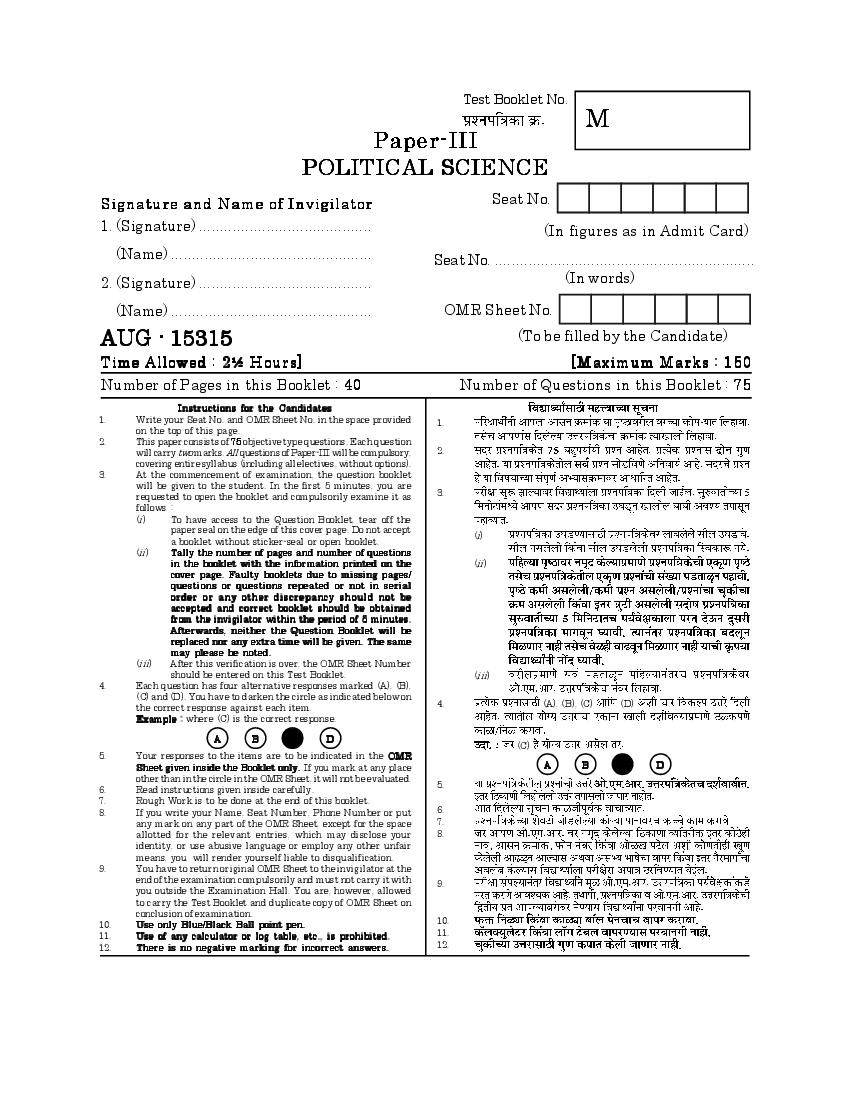
M
POLITICAL SCIENCE
Signature and Name of Invigilator Seat No.
1. (Signature) ......................................... (In figures as in Admit Card)
(Name) ................................................ Seat No. ..............................................................
2. (Signature) ......................................... (In words)
(Name) ................................................ OMR Sheet No.
AUG - 15315 (To be filled by the Candidate)
Time Allowed : 2½ Hours] [Maximum Marks : 150
Number of Pages in this Booklet : 40 Number of Questions in this Booklet : 75
Instructions for the Candidates
1. Write your Seat No. and OMR Sheet No. in the space provided 1.
on the top of this page.
2. This paper consists of 75 objective type questions. Each question
will carry two marks. All questions of Paper-III will be compulsory, 2.
covering entire syllabus (including all electives, without options).
3. At the commencement of examination, the question booklet
will be given to the student. In the first 5 minutes, you are
requested to open the booklet and compulsorily examine it as 3.
follows :
(i) To have access to the Question Booklet, tear off the
paper seal on the edge of this cover page. Do not accept
(i)
a booklet without sticker-seal or open booklet.
(ii) Tally the number of pages and number of questions
in the booklet with the information printed on the (ii)
cover page. Faulty booklets due to missing pages/
questions or questions repeated or not in serial
o rder or any other discre pancy should not be
accepted and correct booklet should be obtained
from the invigilator within the period of 5 minutes.
Afterwards, neither the Question Booklet will be
replaced nor any extra time will be given. The same
may please be noted.
(iii) After this verification is over, the OMR Sheet Number
should be entered on this Test Booklet. (iii)
4. Each question has four alternative responses marked (A), (B),
(C) and (D). You have to darken the circle as indicated below on
the correct response against each item. 4. (A), (B), (C) (D)
Example : where (C) is the correct response.
A B D
(C)
5. Your responses to the items are to be indicated in the OMR
Sheet given inside the Booklet only. If you mark at any place A B D
other than in the circle in the OMR Sheet, it will not be evaluated.
5.
6. Read instructions given inside carefully.
7. Rough Work is to be done at the end of this booklet.
8. If you write your Name, Seat Number, Phone Number or put 6.
any mark on any part of the OMR Sheet, except for the space 7.
allotted for the relevant entries, which may disclose your 8.
identity, or use abusive language or employ any other unfair
means, you will render yourself liable to disqualification.
9. You have to return original OMR Sheet to the invigilator at the
end of the examination compulsorily and must not carry it with 9.
you outside the Examination Hall. You are, however, allowed
to carry the Test Booklet and duplicate copy of OMR Sheet on
conclusion of examination.
10. Use only Blue/Black Ball point pen. 10.
11. Use of any calculator or log table, etc., is prohibited. 11.
12. There is no negative marking for incorrect answers. 12.
Page 2
Page 3
Paper III
III
Time Allowed : 2½ Hours] [Maximum Marks : 150
Note : This Paper contains Seventy Five (75) multiple choice questions, each
question carrying Two (2) marks. Attempt All questions.
(75) (2)
1. Give the correct answer by using the 1.
codes given below :
(1) The behavioural approach
believes in empirical and (1)
predominantly inductive
method
(2) It uses indicators that identify
(2)
regularities and not variables in
human conduct
(3) It separates ethical evaluation
from empirical evaluation
(3)
(A) (1), (2) and (3) are correct
(B) (1) and (3) are correct, (2) is
wrong (A) (1), (2) (3)
(C) (1) and (2) are correct, (3) is (B) (1) (3) , (2)
wrong
(C) (1) (2) , (3)
(D) (1) is correct, (2) and (3) are
wrong (D) (1) , (2) (3)
3 [P.T.O.
Page 4
not correctly matched ?
(A) R. Dahl — Dispersal of power (A) —
in different centres
(B) D. Easton — Authoritative (B) —
allocation of values
(C) Almond and — Conversion process (C) —
Powell
(D) Harold Lasswell — Reverse (D) —
discrimination
3. Which one of the following books did 3.
not encourage revival of political
theory ?
(A) —
(A) Taking Rights — D. Dworkin
Seriously
(B) —
(B) Political Argument — Brian Barry
(C) —
(C) Two concepts of — I. Berlin
Liberty
(D) Democracy, — J. Schumpeter (D) —
Capitalism and
Socialism
4
Page 5
principle of liberalism ?
(A) Minimum Government
(A)
maximum freedom
(B) Minimum freedom maximum (B)
government
(C)
(C) Non-intervention of the state in
economic affairs
(D)
(D) Hindering the hindrances in the
economic development
5. From which book, the following 5.
statement of Marx was chosen ?
‘‘The history of all hitherto existing
societies is the history of class
struggles.’’
(A) The civil war in France (A)
(B) On the Jewish question
(B)
(C) Contribution to a critique of
political economy (C)
(D) Manifesto of the Communist
Party
(D)
5 [P.T.O.
Page 6
statements is not correct ?
Individualism is known for its
adherence to — (A)
(A) Fundamental duties of
individual
(B)
(B) Fundamental rights of
individual
(C)
(C) Fundamental rights and duties
of individual
(D) Social justice (D)
7. Which one of the following is not 7.
propounded by Lenin ?
(A) Theory of imperialism
(A)
(B) Dictatorship of peasantry
(B)
(C) Theory of democratic centralism
(C)
(D) Role of the revolutionary
political (D)
6
Page 7
revolutions was launched by Mao
Tse Tung ?
(A)
(A) Democratic revolution
(B)
(B) Passive revolution
(C) Socialist revolution (C)
(D) Peoples democratic revolution (D)
9. Which is the worst form of 9.
Government according to Plato ?
(A) Democracy (A)
(B) Timocracy (B)
(C) Oligarchy (C)
(D) Tyranny (D)
10. Who said it, ‘‘The state, which is the 10.
highest of all communities, exists for
the sake of good life, and not for the
sake of life only.’’
(A) Plato (A)
(B) Augustine (B)
(C) Aristotle (C)
(D)
(D) Machiavelli
7 [P.T.O.
Page 8
aggrandisement means :
(A) Collecting of limitless wealth by
(A)
rich
(B) The element of good in human (B)
nature (C)
(C) States efforts to increase its
power over other states
(D)
(D) Growing rich at the cost of
state
12. According to Hobbes, felicity 12.
means :
(A) Doing good to other human (A)
beings
(B)
(B) Maximising pleasure and
avoiding pain
(C) A perpetual and restless desire
(C)
of power after power which
ceases only in death
(D) At perpetual war with other
human beings (D)
8
Page 9
codes given below :
(1) The state of nature is a state
(1)
of peace because human beings
are rational creatures capable
of discovering moral truths
(2) The government is instituted
(2)
only as a trustee of the society
and it can act on the principle
of majority
(3) Locke roots sovereignty within
the people and advocates
(3)
popular sovereignty
(A) (1), (2) and (3) are correct
(B) (1) is correct, (2) and (3) are
wrong (A) (1), (2) (3)
(C) (1) is wrong, (2) and (3) are
(B) (1) (2) (3)
correct
(C) (1) (2) (3)
(D) (1) and (2) are correct, (3) is
wrong (D) (1) (2) (3)
9 [P.T.O.
Page 10
civilization was evil and satanical
can be attributed to philosophical
strand of :
(A)
(A) Fabianism
(B)
(B) Romanticism
(C) Philosophical Anarchism (C)
(D) Conservatism (D)
15. Aurobindo’s theory of passive 15.
resistance did not comprise the
following measure :
(A)
(A) to boycott bureaucrats
(B)
(B) to refuse to use foreign made
products (C)
(C) to continue to work in the court
in the interest of society
(D)
(D) to start national schools and
colleges and boycott
government schools
10
Page 11
comparative politics has primarily
been on :
(A) Comparative study of political
thought (A)
(B) Comparative study of foreign (B)
policies
(C)
(C) Comparative study of domestic
politics across the countries
(D) Comparative study of (D)
international organisations
17. Which among the following is not
17.
the capability function of the political
system ?
(A) to regulate and control the (A)
behaviour of the individuals,
groups and institutions
(B) to produce goods and provide (B)
services
(C)
(C) to redistribute the resources
(D) political recruitment (D)
11 [P.T.O.
Page 12
constitutionalism is :
(A) Principles of Marxism-Leninism
(B) Rule of law and Natural law (A)
(C) Principle of democratic (B)
centralism (C)
(D) Doctrine of ‘total state’ (D)
19. In which of the following countries 19.
the Second Chamber is known as
‘Council of States’ ?
(A) U.K. and U.S. (A)
(B) Switzerland and India (B)
(C) France and Canada (C)
(D) Japan and China (D)
20. Which of the following countries
20.
follows the practice of Shadow
Cabinet ?
(A)
(A) U.K.
(B)
(B) U.S.A.
(C) India (C)
(D) Germany (D)
12
Page 13
countries does not have a Federal
Government ?
(A)
(A) Indonesia
(B)
(B) Brazil
(C)
(C) Argentina
(D) Canada (D)
22. In most of the federal states the 22.
Second Chamber represents :
(A)
(A) the interest of the minorities
(B) the interest of constituents units
(B)
of the federation
(C) the interests of the various (C)
occupational groups
(D)
(D) the interests of the people
13 [P.T.O.
Page 14
among the following concepts
explains the role of courts in the
resolution of conflict ?
(A) The concept of separation of
powers (A)
(B) The concept of committed (B)
judiciary
(C)
(C) The concept of ‘triad’
(D) The concept of independent
judiciary (D)
24. The doctrine of separation of power 24.
entails :
(A) Structural division of power (A)
between and among the three
branches of Government
(B)
(B) Territorial division of power
between the centre and
constituent units
(C)
(C) Functional division of power
between the constitutional head
and real head of the state
(D) Division of powers between the
temporal and spiritual (D)
authority
14
Page 15
widely practised in the following pair
of countries :
(A)
(A) Britain, Germany
(B)
(B) Britain, India
(C) USA, France (C)
(D) USA, New Zealand (D)
26. The ‘Spoils System’ is defined as :
26.
(A) The Chief Executive’s right to
(A)
appoint public personnel as a
way of rewarding them
in US
(B) The dysfunction between (B)
Executive and Legislature
in US
(C)
(C) The anger of the people against
the political system in US
(D)
(D) The system where the king
favours a few people in UK
15 [P.T.O.
Page 16
world face armed insurgencies and
military revolts because :
(A) There is political awakening of
(A)
the masses
(B) There is loss of legitimacy of (B)
their authority
(C) Insurgents are supported by the (C)
enemy countries
(D) Security agencies of the
(D)
countries are unefficient and
corrupt
28. Who among the following suggested 28.
that urbanisation, literacy, modern
communication and mass
participation could also be seen
instrument of political decay rather
than of progress ?
(A) Gabriel Almond (A)
(B) Samuel Huntington (B)
(C) J.S. Coleman
(C)
(D) Lucian Pye
(D)
16
Page 17
(A) Authority based on laws, rules
(A)
and regulation
(B) Authority based on economic
power (B)
(C) Authority based on religion,
(C)
customs and norms
(D) Authority based on physical
power (D)
30. Which one of the following thinkers 30.
has not advocated theory of elites ?
(A) Mosca (A)
(B) C. Wright Mills (B)
(C) R. Aron (C)
(D) W. Pareto (D)
31. The Constitution of India 31.
originally comprised of how many
schedules ?
(A) 8
(A) 8
(B) 10
(B) 10
(C) 13
(C) 13
(D) 15
(D) 15
17 [P.T.O.
Page 18
79-123 in Indian Constitution
provide for :
(A) The Union Executive
(A)
(B) The Union Legislature
(B)
(C) The Judiciary
(C)
(D) The States and Union
Territories (D)
33. The matters of civil and criminal law, 33.
transfer of property, contracts,
bankruptcy and civil procedure
belong to which one of the following
Lists in Indian Constitution ?
(A)
(A) State List
(B)
(B) Union List
(C)
(C) Concurrent List
(D) None of the above (D)
18
Page 19
S.R. Bommai case was regarding :
(A) Centre-State relations
(A)
(B) Disqualification of political
party (B)
(C) Inquiring into cases of corruption (C)
(D) Judicial review with reference (D) 356
to Article 356
35. Judicial Activism is equated by the 35.
critics with which one of the
following ?
(A)
(A) Huge Pendancy of cases and
delayed justice
(B)
(B) Determining the status of
legislature competence
(C)
(C) Admitting petitions filed by
concerned citizens on behalf of
the victims of injustice
(D) Tresspassing into realms of (D)
legislation and policy
19 [P.T.O.
Page 20
Assertion (A) : Interest groups
(A) :
compete for
making their
voice heard and
i n t e r e s t s
protected by the
decision-makers
in political
systems.
(R) :
Reason (R) : Interest groups
consistently
support political
parties.
Select the correct option :
Codes :
(A) (A) (R)
(A) (A) is true but (R) is false
(B) Both (A) and (R) are false and (B) (A) (R) (R)
(R) is not the correct
explanation
(C) (A) (R)
(C) Both (A) and (R) are true and
(R)
(R) is correct explanation
(D) (A) is false but (R) is true (D) (A) (R)
37. Which one of the following was not 37.
associated with electoral reforms in
India ?
(A)
(A) Dinesh Goswami Committee
(B)
(B) Inderjit Gupta Committee
(C)
(C) G.V.K. Rao Committee
(D) Tarkunde Committee (D)
20
Page 21
38. (A) (R)
Assertion (A) : The Governor of
the state can (A) :
send back a
recommendation
of the state
cabinet for
reconsideration.
(R) :
Reason (R) : The Governor is
given this power
because he is
expected to draw
the attention of
the state cabinet
upto the point of
reconsideration
only.
Select the correct option : (A) (A) (R) (R)
Codes : (A)
(A) Both (A) and (R) are true and
(B) (A) (R) (R)
(R) is the correct explanation
of (A) (A)
(B) Both (A) and (R) are true but (C) (A) (R)
(R) is not the correct
explanation of (A)
(C) (A) is true but (R) is false (D) (A) (R)
(D) (A) is false but (R) is true
21 [P.T.O.
Page 22
differential mobilization of caste in
Indian politics was conceptualized
by :
(A)
(A) Norman Palmer
(B)
(B) F.G. Bailey
(C)
(C) Rudolph and Rudolph
(D)
(D) Paul R. Brass
40. Who among the following state 40.
leaders made the statement that ‘‘A
new ‘Political Brotherhood’ was
needed to preserve national unity
from ‘The failure of the ruling party
of the centre’’ ?
(A)
(A) Farooq Abdullah
(B) N.T. Rama Rao (B)
(C) Ramkrishna Hegde (C)
(D) Jyoti Basu
(D)
22
Page 23
Chief Election Commissioner T.N.
Seshan enforced stringent Code of
Conduct ?
(A) 1991
(A) 1991
(B) 1996
(B) 1996
(C) 1999
(C) 1999
(D) 2004 (D) 2004
42. The National Development Council 42.
meetings are chaired by :
(A) The Speaker (A)
(B) The Finance Minister (B)
(C) The Prime Minister (C)
(D) The Vice-President (D)
43. In the context of imposing 43.
President’s Rule, which one of the
following Commissions advised that
‘the Governor should report
objectively the facts as he saw them
and not as his ministers and centre
interprete them’ ?
(A) Mandal Commission
(A)
(B) States Reorganization
Commission (B)
(C) Jain Commission (C)
(D) Administrative Reforms (D)
Commission
23 [P.T.O.
Page 24
44.
which group of states mainly belong
to two-party category ?
(A) Bihar, Karnataka, Orissa,
Gujarat
(A)
(B) Himachal Pradesh, M.P.,
(B)
Rajasthan, Gujarat
(C) U.P., Kerala, Tamil Nadu, West
Bengal
(C)
(D) M.P., Haryana, Andhra
Pradesh, Punjab (D)
45. Which one of the following 45.
Committees was not appointed by
the Government ?
(A) Santhanam Committee (A)
(B) Sardar Swaran Singh (B)
Committee
(C)
(C) Rajamannar Committee
(D) Balwantrai Mehta Committee (D)
24
Page 25
the study of Public Administration
has been characterises as :
(A)
(A) Institutional
(B)
(B) Informal
(C)
(C) Comparative
(D)
(D) Behavioural
47.
47. The ‘Civil Service System’ is
synonymous with :
(A) Bureaucracy (A)
(B) Complexity of Administration (B)
(C) Merit system (C)
(D) Spoils system (D)
48. Empowerment of women became one 48.
of the primary objectives of :
(A) Second Five Year Plan (A)
(B) Third Five Year Plan
(B)
(C) Seventh Five Year Plan
(C)
(D) Ninth Five Year Plan
(D)
25 [P.T.O.
Page 26
function of Planning Commission ?
(A) Formulation of Five Year Plans
(A)
(B) Implementation of Five Year
Plans (B)
(C) Working out plan priorities
(C)
(D) Assessment of national
(D)
resources
50. Which of the following statements 50.
is not correct as regards Gram
Sabha ?
(A) It has been an integral part of (A)
the concept of Village
Government
(B) It has been given (B) 73
Constitutional status by the
73rd Amendment
(C)
(C) It is an institution of
representative democracy
(D) It is an institution of direct
(D)
democracy
26
Page 27
organisation gave importance to a
perfect balance between the
organisations goal and workers’
needs :
(A)
(A) Scientific management theory
(B)
(B) Human relation theory
(C) Decision-making theory (C)
(D) Weber’s theory of bureaucracy (D)
52. Formal organisation is : 52.
(A) Humanistic (A)
(B) Mechanistic (B)
(C) Psychological (C)
(D) Devoid of leadership (D)
53. Which of the following writs is issued 53.
by a Superior Court, to a Inferior
Court preventing the latter from
usurping jurisdiction which the law
does not endow it ?
(A) Prohibition (A)
(B) Habeas corpus (B)
(C) Certiorari (C)
(D) Mandamus
(D)
27 [P.T.O.
Page 28
(A) Wider meaning than Govt.
(A)
(B) Is identical with Good
Government (B)
(C) Narrow meaning than Govt. (C)
(D) No relation with Government
(D)
55. Globalisation does not imply :
55.
(A) Import liberalisation
(B) Exchange rate adjustment
(A)
(C) Free flow of foreign direct
(B)
investment
(C)
(D) Increasing control by
Government (D)
56. Which of the following laid down the
56.
foundation for public sector in
India ?
(A) Administrative Reforms
Commission, 1966 (A) 1966
(B) Industrial Policy Resolution,
1948 (B) 1948
(C) Industrial Policy Resolution,
1991 (C) 1991
(D) Second Administrative Reforms
(D)
Commission
28
Page 29
stand for :
(A) Abolishing industrial licensing (A)
(B) Raising the limit of foreign (B)
equity participation
(C) Removal of politician/ (C)
bureaucratic influence
(D) Limiting role of private sector (D)
58. Which of the following statements is 58. 1966
not correct as regards Administrative
Reforms Commission, 1966 ?
(A)
(A) It was a comprehensive report
on administrative reforms after
independence
(B)
(B) The report deals with higher
bureaucracy
(C) The report has covered the (C)
lower administrative class
(D) The report covers District (D)
Administration
29 [P.T.O.
Page 30
service ?
(A)
(A) Indian Police Service
(B) Indian Postal Service
(B)
(C) Indian Defence Accounts
Service (C)
(D) Indian Audit and Accounts
(D)
Service
60. Which of the following is a line 60.
agency ?
(A) Finance Commission (A)
(B) Union Public Service
(B)
Commission
(C)
(C) Department
(D)
(D) Cabinet Secretariat
61. Identify the intangible element of 61.
National Power :
(A) Size of a country (A)
(B) Population (B)
(C) Economic development (C)
(D) National character and morale (D)
30
Page 31
(A) Distribution of Military power
(A)
in such a way that no single
power or bloc can dominate
others
(B) Conflict resolution procedure in
which a third party offers
assistance (B)
(C) A concept which implies that an
act of aggression by any state
(C)
will be met by a collective
response from the rest of the
states
(D) Negotiations between group of
(D)
states to settle their disputes
without resorting to armed
force
63. Which of the following countries was 63.
recently included in SAARC ?
(A) China (A)
(B) Indonesia (B)
(C) Afghanistan (C)
(D) Malaysia (D)
31 [P.T.O.
Page 32
‘‘Military Capability is the most
important indicator of the power of
a state’’ ?
(A)
(A) Constructivists
(B)
(B) Neo-liberals
(C)
(C) Idealists
(D) Realists (D)
65. Which of the following is not a
65.
feature of India’s Non-alignment
Policy ?
(A) A policy of isolation
(A)
(B) Opposition to military
(B)
alliances
(C) Independence of foreign
(C)
policy
(D)
(D) A policy of active cooperation
32
Page 33
assumption of certain key concepts.
Find out which element is not
correct ?
(A)
(A) Strategy
(B)
(B) Morals
(C) Players (C)
(D) Rules (D)
67. Which among the following is not 67.
the feature of the contemporary
world order ?
(A) Shift of the focus of power from (A)
the Atlantic to the Asia-Pacific
region
(B)
(B) Ideological rivalry among major
powers (C)
(C) Proliferation of regional
economic and security groups
(D)
(D) Emergence of new regimes on
trade, environment, nuclear
non-proliferation
33 [P.T.O.
Page 34
the correct answer from the codes
given below :
I
List I
(a)
(a) Military Coup
(b)
(b) Islamist revolution
(c)
(c) People’s uprising for democracy
(d)
(d) Transition from communism
II
List II
(i) 1988
(i) Burma, 1988
(ii) 1989
(ii) East Germany, 1989
(iii) 1978
(iii) Pakistan, 1978
(iv) 1979
(iv) Iran, 1979
Codes :
(A) ( a )—( i ), ( b )—( iv ), ( c )—( ii ),
(A) ( a )—( i ), ( b )—( iv ), ( c )—( ii ),
(d)—(iii)
(d)—(iii)
(B) ( a )—( iii ), ( b )—( iv ), ( c )—( i ),
(B) ( a )—( iii ), ( b )—( iv ), ( c )—( i ),
(d)—(ii) (d)—(ii)
(C) ( a )—( iv ), ( b )—( iii ), ( c )—( ii ), (C) ( a )—( iv ), ( b )—( iii ), ( c )—( ii ),
(d)—(i) (d)—(i)
(D) ( a )—( ii ), ( b )—( iii ), ( c )—( iv ), (D) ( a )—( ii ), ( b )—( iii ), ( c )—( iv ),
(d)—(i) (d)—(i)
34
Page 35
affected by the so-called ‘‘Arab
Spring’’, the Gulf Co-operation
Council intervened on request from
the ruling government ?
(A)
(A) Tunisia
(B)
(B) Bahrain
(C)
(C) Egypt
(D)
(D) Syria
70. India’s role in Afghanistan can be 70.
best described as :
(A) Mediation between the Taliban
and the US
(A)
(B) Intervention on behalf of the
UN (B)
(C) Co-ordination of post-conflict
(C)
reconstruction
(D) Mediation between the (D)
governments of Afghanistan
and Pakistan
35 [P.T.O.
Page 36
71.
what is the real threat that Pakistan
continues to pose to India ?
(A) Threat of a nuclear war
(A)
(B) Fear of aggression in Kashmir
(B)
(C) Pakistan’s friendship with the
US
(C)
(D) Cross-border support to
(D)
terrorism
72. The Partial Test Ban Treaty (PTBT) 72. (PTBT)
bans :
(A) Underground nuclear tests (A)
(B) Under water nuclear tests (B)
(C) Nuclear testing by simulation (C)
(D) Over ground nuclear tests (D)
36
Page 37
carefully and state which of them are
a part of the doctrine of
responsibility to protect :
(i) Sovereignty of a state implies (i)
its primary responsibility to
protect its citizens
(ii)
(ii) If a state fails or is unwilling
to protect its people from a
serious harm, the International
community has the
responsibility to protect such
people
(iii)
(iii) In such case, the principle of
non-intervention yields to
international responsibility to
protect
(iv)
(iv) The responsibility to protect
must be exercised only with the
consent of the concerned state
Select the correct option :
(A) (i), (ii) (iv)
(A) (i), (ii) and (iv)
(B) (i), (ii) (iii)
(B) (i), (ii) and (iii)
(C) (ii), (iii) (iv)
(C) (ii), (iii) and (iv)
(D) (i), (iii) and (iv) (D) (i), (iii) (iv)
37 [P.T.O.
Page 38
is correct ? (A)
(A) India proposed the CTBT and
has signed and satisfied it
(B) India neither proposed nor (B)
signed the CTBT
(C) India was not among the
(C)
proposers of the CTBT but has
signed it
(D) India was among the proposers
(D)
of the CTBT but has not signed
it
75. To whom do you relate the following 75.
perspective on globalisation ?
‘‘Globalisation is driven by a complex
set of forces including the market
and technology and can be regulated
through international institutions.’’
(A) Neo-Marxists (A)
(B) Mercantilists (B)
(C) Idealists (C)
(D) Neo-liberals (D)
38
Page 39
39 [P.T.O.
Page 40
40
Document Details
| Board / Org | Maharashtra Exams |
| Exam | MAHA SET |
| Type | Question Paper |
| Pages | 40 |
| Updated | 30 Apr 2026 |