Goa Board Class 10 Sample Paper 2026 Geography & Economics (E)
Finished viewing? Save it for later —
Download Goa Board Class 10 Sample Paper 2026 Geography & Economics (E) (PDF · 13 pages)About Goa Board Class 10 Sample Paper 2026 Geography & Economics (E)
Goa Board Class 10 Sample Paper 2026 Geography & Economics (E) is available here for free download. Published by Goa Board for Class 10, this sample paper can be viewed online or downloaded as a PDF (13 pages). Candidates preparing for Class 10 can use Goa Board Class 10 Sample Paper 2026 Geography & Economics (E) to understand the exam pattern, the type of questions asked, and the overall difficulty level.
Frequently Asked Questions
How can I download Goa Board Class 10 Sample Paper 2026 Geography & Economics (E)?
Open this page and click the Download button to save Goa Board Class 10 Sample Paper 2026 Geography & Economics (E) as a PDF. It is completely free on AglaSem Docs.
Is Goa Board Class 10 Sample Paper 2026 Geography & Economics (E) free to download?
Yes. Goa Board Class 10 Sample Paper 2026 Geography & Economics (E) can be viewed online and downloaded as a PDF free of cost on AglaSem Docs.
How many pages does Goa Board Class 10 Sample Paper 2026 Geography & Economics (E) have?
Goa Board Class 10 Sample Paper 2026 Geography & Economics (E) contains 13 pages, which you can read online or download together as a single PDF.
Where can I find more Class 10 study material?
You can find more Class 10 question papers, sample papers, syllabus, and answer keys on AglaSem Docs.
Goa Board Class 10 Sample Paper 2026 Geography & Economics (E) – Text
Read the full text of this sample paper below — useful to quickly search, copy and reference the content online without downloading the PDF.
📄 View text version (13 pages)
Page 1
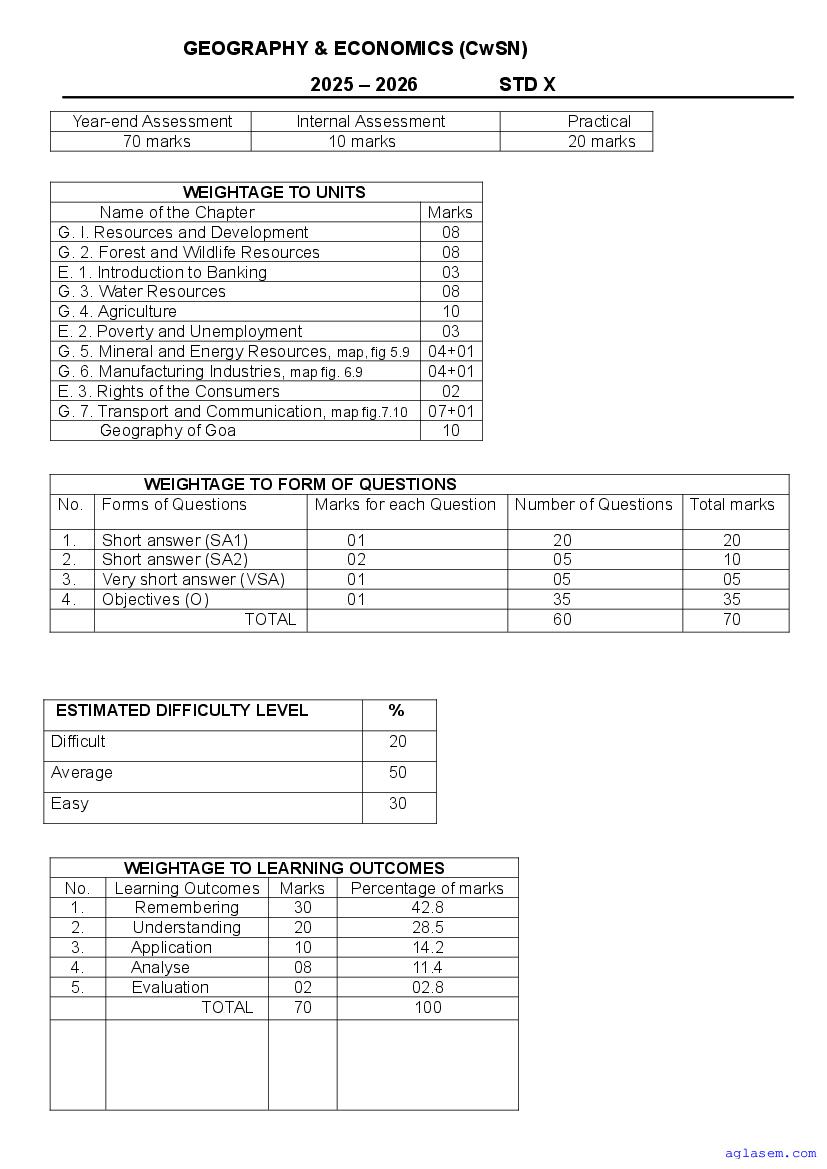
2025 – 2026 STD X
Year-end Assessment Internal Assessment Practical
70 marks 10 marks 20 marks
WEIGHTAGE TO UNITS
Name of the Chapter Marks
G. I. Resources and Development 08
G. 2. Forest and Wildlife Resources 08
E. 1. Introduction to Banking 03
G. 3. Water Resources 08
G. 4. Agriculture 10
E. 2. Poverty and Unemployment 03
G. 5. Mineral and Energy Resources, map, fig 5.9 04+01
G. 6. Manufacturing Industries, map fig. 6.9 04+01
E. 3. Rights of the Consumers 02
G. 7. Transport and Communication, map fig.7.10 07+01
Geography of Goa 10
WEIGHTAGE TO FORM OF QUESTIONS
No. Forms of Questions Marks for each Question Number of Questions Total marks
1. Short answer (SA1) 01 20 20
2. Short answer (SA2) 02 05 10
3. Very short answer (VSA) 01 05 05
4. Objectives (O) 01 35 35
TOTAL 60 70
ESTIMATED DIFFICULTY LEVEL %
Difficult 20
Average 50
Easy 30
WEIGHTAGE TO LEARNING OUTCOMES
No. Learning Outcomes Marks Percentage of marks
1. Remembering 30 42.8
2. Understanding 20 28.5
3. Application 10 14.2
4. Analyse 08 11.4
5. Evaluation 02 02.8
TOTAL 70 100
Page 2
Month Topic Marks Periods Hours
April G.1.Resources and Development, 08 14 9.2
Internal assessment orientation 20 06 4.0
June G. 2. Forest and Wildlife resources 08 14 9.2
July G. 3. Water Resources, 08 14 9.2
E. 1. Introduction to Banking 03 07 4.6
August G. 4. Agriculture 10 18 12.0
September G. 5. Mineral and Energy Resources 05 09 6.0
October E. 2. Poverty and Unemployment 03 08 4.8
November G.6. Manufacturing Industries, 05 09 6.0
E. 3. Rights of the Consumers 02 07 4.6
Geography of Goa 10
December G. 7. Transport and Communication 08 14 9.2
MODEL QUESTION PAPER
INSTRUCTIONS:
1. This paper has 61 questions in all. All questions are compulsory.
2. Marks are indicated against question.
3. Question numbers 48, 49 and 50 are map questions.
4. There is no overall choice.
5. In addition to these separate instructions are given wherever necessary.
Choose the correct alternative for the questions given below:
1. Which one of the following is a biotic resource?
Wind
Oil
Plants
Page 3
2. Which land resource is a base for agriculture?
Mountains
Plains
Plateaus
Fallow lands
3.Which resource is Arunachal Pradesh rich in?
Sunlight
Infrastructure
Vital minerals
Water
4.Which factor contributes to formation of desert soil?
Weathering by snow
Heavy rain
Deposition of silt
Low rainfall
5. What is area not available for cultivation?
Permanent pastures
Khazan lands
Barren lands
Net sown area
6. What are species whose population levels are normal for their survival, known?
Rare species
Endemic species
Extinct species
Normal species
7. In which city has urbanisation resulted in destruction of mangroves?
West Bengal
Mumbai
Madhya Pradesh
Tamil Nadu
8. Which Act helped in conserving our Biodiversity?
Page 4
Forest Protection Act
Kyoto Protocol
Indias forest policy
9. What category of forests are the forests in Madhya Pradesh considered to be?
Reserved
Protected
Unclassified
Unprotected
10. What natural area are the Nilgiris in Tamil Nadu classified as?
Tiger reserve
Wildlife sanctuary
Biosphere reserve
Wildlife Institute of India
11. What colour is planet Earth said to be?
Red
Green
Brown
Blue
12. What resource is the mantra Reduce, Reuse, Recycle and Recharge used for?
Land
Water
Wind
Solar energy
13. What is one merit of a multipurpose river valley project?
Irrigation
Risk earthquakes
Interstate conflicts
Submerge forests
14. What is not a cause of water scarcity?
Pollution
Page 5
Misuse
Conservation
15. Which water harvesting method, served social gatherings and irrigation?
Tankas
Bandharas
Johads
Step wells
16. Which farming method used sticks, hoe and dao?
Primitive subsistence
Plantation
Intensive subsistence
Commercial
17. What is the name of the agricultural season that begins with the rains?
Rabi
Kharif
Zaid
Summer
18. From which crop is gur, khandsari and molasses manufactured?
Maize
Wheat
Sugarcane
Bajra
19. What is the function of the National Reinfed Area Authority with regards to agriculture?
Having special weather bulletins
Enabling drought management
Development of rainfed areas.
Enabling crop insurances.
20. What was the objective of the Land Ceiling Act?
To give landlords more agricultural land.
To own a certain amount of agricultural land.
To remove tenants from agricultural lands.
To make wealthy landlords.
21. Which is the bank account offered to salaried people to operate regularly?
Current account
Fixed deposit account
Savings account
Recurring deposit account
22. What is the type of unemployment when labour is employed for a particular season?
Cyclical
Structural
Educated
Seasonal
23. Which product is a consumer advised to buy from the market?
ISI
Page 6
SII
SIS
24. Which mineral is used in making electrical cables and wires?
Bauxite
Copper
Manganese
Mica
25. Which is an example of non-conventional resource?
Coal
Nuclear power
Hydropower
Solar energy
26. Which is the largest coal producing state in India?
Maharashtra
Chattisgarh
Gujarat
Karnataka
27. Which is the oldest and most famous textile industry of India?
Silk
Jute
Wool
Cotton
28.Which of the following is a private sector industry?
Cochin refineries
Reliance
BHEL
Amul
29. Which means of transport is convenient to carry light articles at short distances?
Airways
Waterways
Roadways
Pipeline
30. Where does the Border Road Organisation build roads?
Page 7
On mountains in the north-east
On National highways
In the villages
31. Which is an important port on the west coast of India?
Mumbai
Vishakapatnam
Paradip
Chennai
32. What is Akashwani?
Is an airline
Is a magazine
Is a postal service
Is a radio station
33. In which state does tourism pose a major problem of waste disposal?
Assam
Madhya Pradesh
Goa
Tamil Nadu.
34. Which of the following industries is has a good scope in Goa?
Silk industry
IT industry
Fisheries
Pearl cultivation
35. Which industry has largely affected the natural landscape?
Forestry
Agriculture
Mining
Hydroelectric generation
Name the following:
36. The multipurpose project on River Damodar. (1)
37. Slash and burn farming in north-east India. (1)
38. Low lying areas in Goa along estuaries. (1)
Explain:
39. The role played by NITI Aayog in developing India. (2)
Page 8
Select the correct answer from the options given below:
41. Which of the following is a beverage crop? (1)
Cotton coffee rubber
Note for the visually impaired candidates.
41. Name a beverage crop grown in south India. (1)
42. Which of the following is used for the extraction of oil? (1)
Pulses Ragi Groundnut
Note for visually impaired candidates
42. Name the oilseed largely produced in Gujarat. (1)
Observe the following pictures and answer the questions that follow below:
43. Mention any two uses of rainwater harvesting. (2)
44. Write any two features of plantation farming. (2)
Read the statement and answer the question below:
Page 9
the bread was spoiled. She then looked at the expiry date of the bread and realised it had expired.
45. What Right did she not pay attention to while buying the bread? (1)
Observe the data on e – rickshaws and petrol run rickshaws in the talukas of Goa given
below, and evaluate the questions given:
Type of Rickshaws Panjim Margao Mapusa
E - Rickshaws 205 238 153
Petrol run Rickshaws 299 267 102
46. Which taluka had a greater number of petrol run rickshaws? (1)
47. What is the difference in the number of e – rickshaws, between Panjim and Mapusa? (1)
On the outline map provided, answer the following questions:
Nuclear power plant
Technology Park
Sea port
Page 10
49.Name the location of the technology park in Kashmir. (1)
50. Name the location of the sea- port in Tamil Nadu. (1)
Note- for visually impaired candidates.
48. Name the location of the nuclear power plant in Maharashtra. (1)
49. Name the location of the technology park in Kashmir. (1)
50. Name the location of the sea – port in Tamil Nadu. (1)
Answer each of the following questions in 20 words:
51. How is alluvial soil formed? (1)
52. What is in-situ method of conservation? (1)
53. What is a mineral? (1)
54. What is the use of the Government s National portal? (1)
Observe the pictures given below, and answer the questions in 20 to 30 words each:
55. Explain how water pollution takes place. (2)
56. Write two features of Internet banking. (2)
57. Distinguish between poverty and unemployment. (2)
Page 11
59. Comment on the uses of the estuaries of Goa. (2)
Give geographical reasons for each of the following:
60. Mangroves in Goa are getting destroyed. (1)
61. Goa can grow winter crops. (1)
________________________________________________________________________________
Learning Outcomes (this vocabulary to be familiarised with students)
Remembering Understanding Applying Analysis Evaluating
Tell, list, Explain, Complete, examine, Analyse, distinguish, Select, choose,
describe, distinguish, classify, choose, examine, compare, justify,
relate, locate, compare, interpret, apply. contrast, determine,
write, state, summarise. investigate, identify, evaluate.
name, identify, explain
recall, define,
match, select.
PRACTICAL EXAM PORTION
Topic Marks
1.Identification of soil conservation methods (pg11) 01
2.Map of Goa (page 109, any 5 select items) 05
3.Map of Goa (talukas, rivers, headquarters) 03
4.Map of India (states, water bodies, neighbouring countries) 03
5.Statistics 02
6.Identifying types of agriculture (any 1) (fig.4.2, 4.3,4.4,4.5,4.6) 02
7.Identifying (any two) state animal, bird, fish, tree, flower (pictures) 02
8.Identifying (any two) types of transport (fig 7.3, 7.4, 7.5, 7.8, 7.12, 7.14, 7.16, 7.18, 02
7.19)
TOTAL 20
Page 12
Internal Assessment
1. Two innovative activities along with rubrics are given below.
2. The student will select any one topic for the activities.
3. Each activity carries a maximum of 20 marks which will be reduced to 10 marks.
Activity 1: Personal and Mass Communication.
Student will visit a Post Office and find out the following.
Students will find details of 5 postal services offered by the Post Office.
Students will record details of the services very neatly.
Criteria Excellent (5) Very Good (4) Good (3) Satisfactory (2)
1.Visit the post Personally, visits Personally, Personally, Doesn’t visit the
office records the post office visits the post visits the post post office but
date of visit. and records all office and office but records services
services records only 4 records only 3 provided.
provided. of the services of the services
provided. provided.
2.Presenting Ensure details Details are Details aren’t Details are not
details are factual factual but not very clear. very clear.
complete
3.Information Gets correct Gets details but Gets details but Not confident
information from is not very not satisfactorily with details of
the post office clear. recorded. the services.
very
enthusiastically.
4.Picture record Puts good Doesn’t have all Doesn’t have Has little or no
relevant pictures. pictures. too many pictures of the
pictures to services
support. provided.
Activity 2: Banking.
Student will visit a bank and find details regarding opening a bank Savings account.
Student will stick withdrawal, deposit and NEFT transfer sheets with their pseudo details.
Students will find information required to carry out cashless transactions.
Students will present the above details neatly recorded and using pictures where required.
Criteria Excellent (5) Very Good (4) Good (3) Satisfactory (2)
1.Visit the bank Personally, visits Personally, Records details Hasn’t visited
and record time the bank and visits the bank in a satisfactory the bank but
and date of visit records details and records manner. recorded visit
sincerely details
2.Sticks the Sticks all the Sticks two Sticks one slip Sticks
required requirements required slips and fills in the photocopies of
documents sheets and fills and fills details required details. the slips and fills
mentioned in details in the details
slips.
3.Speaks to Records neatly Records but not Doesn’t know Ignorant about
banker how to ways of carrying very confident ways of carrying cashless
carry out out cashless in reporting out cashless transactions.
cashless transactions. details. transactions.
transaction
Page 13
presents details but not haphazardly. sake of
neatly. organised. recording.
Document Details
| Board / Org | Goa Board |
| Exam | Class 10 |
| Type | Sample Paper |
| Pages | 13 |
| Updated | 29 Aug 2026 |