Goa Board Class 10 Sample Paper 2026 General Science (E)
Finished viewing? Save it for later —
Download Goa Board Class 10 Sample Paper 2026 General Science (E) (PDF · 27 pages)About Goa Board Class 10 Sample Paper 2026 General Science (E)
Goa Board Class 10 Sample Paper 2026 General Science (E) is available here for free download. Published by Goa Board for Class 10, this sample paper can be viewed online or downloaded as a PDF (27 pages). Candidates preparing for Class 10 can use Goa Board Class 10 Sample Paper 2026 General Science (E) to understand the exam pattern, the type of questions asked, and the overall difficulty level.
Frequently Asked Questions
How can I download Goa Board Class 10 Sample Paper 2026 General Science (E)?
Open this page and click the Download button to save Goa Board Class 10 Sample Paper 2026 General Science (E) as a PDF. It is completely free on AglaSem Docs.
Is Goa Board Class 10 Sample Paper 2026 General Science (E) free to download?
Yes. Goa Board Class 10 Sample Paper 2026 General Science (E) can be viewed online and downloaded as a PDF free of cost on AglaSem Docs.
How many pages does Goa Board Class 10 Sample Paper 2026 General Science (E) have?
Goa Board Class 10 Sample Paper 2026 General Science (E) contains 27 pages, which you can read online or download together as a single PDF.
Where can I find more Class 10 study material?
You can find more Class 10 question papers, sample papers, syllabus, and answer keys on AglaSem Docs.
Goa Board Class 10 Sample Paper 2026 General Science (E) – Text
Read the full text of this sample paper below — useful to quickly search, copy and reference the content online without downloading the PDF.
📄 View text version (26 pages)
Page 1
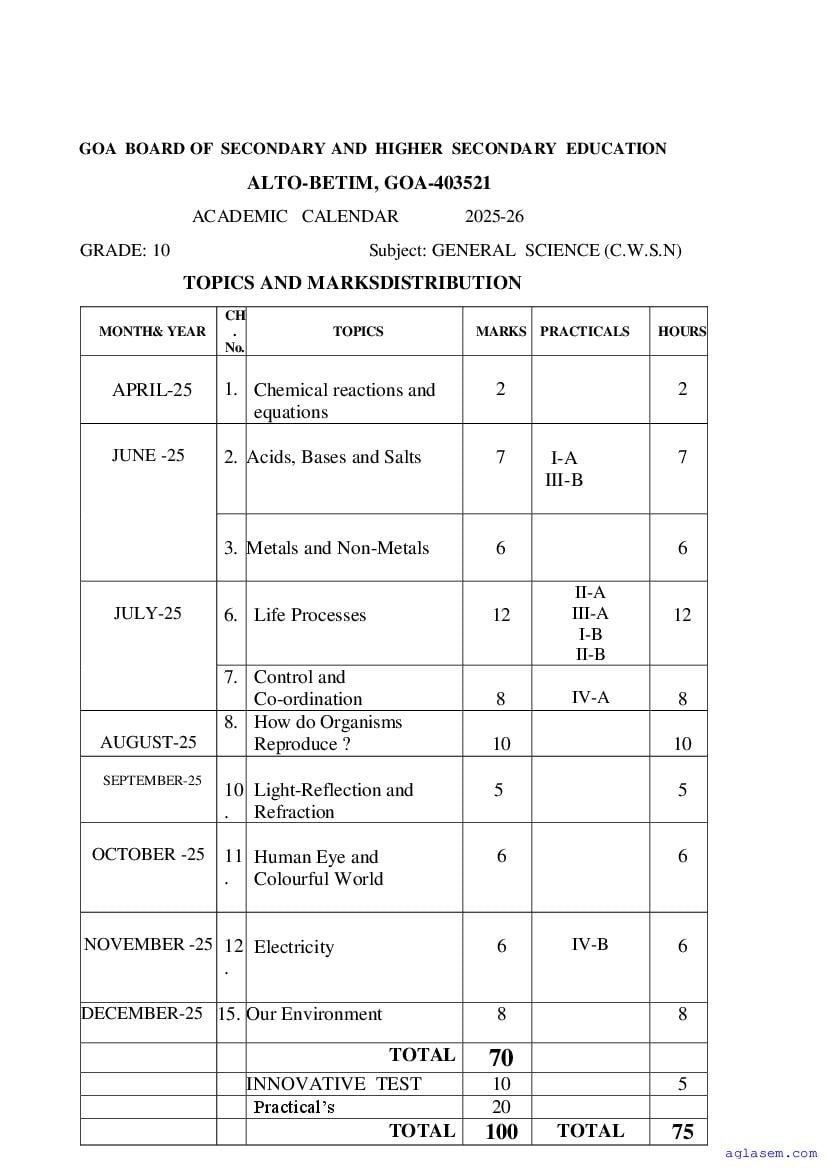
ALTO-BETIM, GOA-403521
ACADEMIC CALENDAR 2025-26
GRADE: 10 Subject: GENERAL SCIENCE (C.W.S.N)
TOPICS AND MARKSDISTRIBUTION
CH
MONTH& YEAR . TOPICS MARKS PRACTICALS HOURS
No.
APRIL-25 1. Chemical reactions and 2 2
equations
JUNE -25 2. Acids, Bases and Salts 7 I-A 7
III-B
3. Metals and Non-Metals 6 6
II-A
JULY-25 6. Life Processes 12 III-A 12
I-B
II-B
7. Control and
Co-ordination 8 IV-A 8
8. How do Organisms
AUGUST-25 Reproduce ? 10 10
SEPTEMBER-25
10 Light-Reflection and 5 5
. Refraction
OCTOBER -25 11 Human Eye and 6 6
. Colourful World
NOVEMBER -25 12 Electricity 6 IV-B 6
.
DECEMBER-25 15. Our Environment 8 8
TOTAL 70
INNOVATIVE TEST 10 5
Practical’s 20
TOTAL 100 TOTAL 75
Page 3
FINAL BOARD EXAM– MODEL PAPER
Grade :10
Subject: General Science (CWSN) TIME:3 Hrs.
Max. Marks: 70
YEAR:2025-26
The weightage or the distribution of marks over different dimensions of the question
paper shall be as follows :
1. Weightage to Learning Outcomes:
Sr. No Learning Outcomes Marks Percentageof
Marks
1. Remembering 28 40%
2. Understanding 21 30%
3. Application 14 20%
4. Creativity 07 10%
Total 70 100
2. Weightage to Content / Subject Units:
Ch. No. Units Marks
1. Chemical Reactions and Equations 2
2. Acids, Bases and Salts 7
3. Metals and Non-metals 6
6. Life Processes 12
7. Control and 8
Co-ordination
8. How do 10
Organisms Reproduce?
10. Light-Reflection 5
and Refraction
11. Human Eye 6
and Colourful world
12. Electricity 6
15. Our Environment 8
Total 70
Page 4
Sr.No. Form of Questions Marks for Numberof Total
each question questions Marks
1. Short Answer Type(SA-II) 1 21 21
2. Short Answer Type(SA-I) 1 14 14
3. Very Short Answer Type(VSA) 1 35 35
Total 70 70
4. The expected time for different types of question would be asfollows:
Sr.No. Form of Questions Approx.time Numberof Approx. time
for each questions (n) for each form
Question in Of Questions
mins (t) in mins(nx t)
1 Short Answer Type(SA-II) 2.50 21 52
2 Short Answer Type(SA-I) 2 14 28
3 Very Short Answer Type(VSA) 2 35 70
Total 150
As the total time is calculated on the basis of the number of questions required to be
answered and the length of their anticipated answers, it would, therefore, be
advisablefor the candidates to budget their time properly by cutting out the
superfluous words and be within the expected time limits.
Page 5
There will be no overall choice. While framing MCQ’s, no alternatives / options are to
be marked by using alphabets. All alternatives / options are to be indicated by using
bullet markings.
3. Weightage to Difficulty level of questions:
Sr. No. Estimateddifficultylevel Percentage
of question
1 Easy 50%
2 Average 50%
A question may vary in difficulty level from individual to individual, as such, the
assessment in respect of each question will be made by the paper setter on the basis of
general anticipation from the group as a whole taking the examination. This provision is
only to make the paper balanced in its weightage, rather than to determine the pattern of
marking at any stage.
4. Number of Main Questions:
It has been decided to introduce serial wise question number and to do away with sub-
question among the questions. Visual questions will have an optional question to
support students with Visual Impairment (With Accommodations ).
Page 6
Subject: GENERAL SCIENCE (CWSN) TIME: 3 Hrs. Marks: 70
Sr. Objective Content Form of the Language Difficultness Difficulty Total
No. area/Major questions of of the level of
/Q. area of questions answers the
No. content questions
1 R Ch.1 VSA(MCQ) Specific Definite Easy 1
2 U Ch.2 VSA(MCQ) Specific Definite Easy 1
3 R Ch.2 VSA(MCQ) Specific Definite Easy 1
4 R Ch.2 VSA(MCQ) Specific Definite Easy 1
5 U Ch.2 VSA(MCQ) Specific Definite Easy 1
6 R Ch.3 VSA(MCQ) Specific Definite Average 1
7 R Ch.3 VSA(MCQ) Specific Definite Easy 1
8 R Ch.3 VSA(MCQ) Specific Definite Average 1
9 R Ch.6 VSA(MCQ) Specific Definite Average 1
10 R Ch.6 VSA(MCQ) Specific Definite Average 1
11 U Ch.6 VSA(MCQ) Specific Definite Easy 1
12 R Ch.6 VSA(MCQ) Specific Definite Easy 1
13 A Ch.6 VSA(MCQ) Specific Definite Easy 1
14 R Ch.6 VSA(MCQ) Specific Definite Average 1
15 A Ch.7 VSA(MCQ) Specific Definite Average 1
16 R Ch.7 VSA(MCQ) Specific Definite Easy 1
17 R Ch.7 VSA(MCQ) Specific Definite Easy 1
18 R Ch.7 VSA(MCQ) Specific Definite Easy 1
19 R Ch.8 VSA(MCQ) Specific Definite Easy 1
20 U Ch.8 VSA(MCQ) Specific Definite Average 1
21 R Ch.8 VSA(MCQ) Specific Definite Easy 1
22 U Ch.8 VSA(MCQ) Specific Definite Average 1
23 U Ch.8 VSA(MCQ) Specific Definite Average 1
24 R Ch.10 VSA(MCQ) Specific Definite Average 1
25 A Ch.10 VSA(MCQ) Specific Definite Average 1
26 A Ch.11 VSA(MCQ) Specific Definite Average 1
27 R Ch.11 VSA(MCQ) Specific Definite Average 1
28 A Ch.11 VSA(MCQ) Specific Definite Average 1
29 R Ch.12 VSA(MCQ) Specific Definite Easy 1
30 U Ch.12 VSA(MCQ) Specific Definite Easy 1
31 U Ch.12 VSA(MCQ) Specific Definite Easy 1
32 A Ch.15 VSA(MCQ) Specific Definite Average 1
Page 7
34 U Ch.15 VSA(MCQ) Specific Definite Average 1
35 R Ch.15 VSA(MCQ) Specific Definite Easy 1 35
36 U Ch.1 SA I Specific Definite Easy 1
37 U Ch.2 SA I Specific Definite Easy 1
38 A Ch.2 SA I Specific Definite Easy 1
39 R Ch.2 SA I Specific Definite Easy 1
40 R Ch.3 SA I Specific Definite Easy 1
41 A Ch.3 SA II Specific Definite Average 1
42 A Ch.3 SA II Specific Definite Average 1
43 C Ch.6 SA II Specific Definite Average 1
44 C Ch.6 SA II Specific Definite Average 1
45 A Ch.6 SA II Specific Definite Average 1
46 U Ch.6 SA II Specific Definite Average 1
47 A Ch.6 SA II Specific Definite Average 1
48 U Ch.6 SA II Specific Definite Average 1
49 C Ch.7 SA II Specific Definite Average 1
50 C Ch.7 SA II Specific Definite Average 1
51 A Ch.7 SA I Specific Definite Easy 1
52 U Ch.7 SA I Specific Definite Easy 1
53 C Ch.8 SA I Specific Definite Easy 1
54 C Ch.8 SA II Specific Definite Average 1
55 C Ch.8 SA I Specific Definite Easy 1
56 U Ch.8 SA II Specific Definite Average 1
57 R Ch.8 SA I Specific Definite Easy 1
58 U Ch.10 SA I Specific Definite Easy 1
59 U Ch.10 SA I Specific Definite Easy 1
60 R Ch.10 SA II Specific Definite Average 1
61 U Ch.11 SA I Specific Definite Easy 1
62 A Ch.11 SA II Specific Definite Average 1
63 U Ch.11 SA I Specific Definite Easy 1
64 U Ch.12 SA I Specific Definite Easy 1
65 R Ch.12 SA II Specific Definite Average 1
66 R Ch.12 SA II Specific Definite Average 1
67 U Ch.15 SA II Specific Definite Average 1
68 R Ch.15 SA II Specific Definite Average 1
69 A Ch.15 SA II Specific Definite Average 1
70 R Ch.15 SA II Specific Definite Easy 1 35
Page 8
BLUE PRINT FINAL SSC EXAMINATION 2025-26
DURATION: 3 Hrs.
SUBJECT: GENERAL SCIENCE (CWSN) MAX.MARKS: 70
REMEMBERING UNDERSTANDING APPLICATIONS CREATIVITY TOTAL TOTAL
CH. CONTENTAREA
NO VSA(MCQ) SAI SA II VSA(MCQ) SAI SA II VSA(MCQ) SAI SA II VSA(MCQ) SAI SA II VSA(MCQ) SAI SA II QUESTION MARKS
1 Chemical Reactions 1 --- --- --- 1 --- --- --- --- --- --- --- 1 1 --- 2 2
and Equations
2 Acids, Bases and 2 1 --- 2 1 ---- --- 1 --- --- --- --- 4 3 --- 7 7
Salts
3 Metals and Non 3 1 --- --- --- --- --- --- 2 --- --- --- 3 1 2 6 6
metals
6 LifeProcesses 4 --- --- 1 --- 2 1 --- 2 ---- --- 2 6 6 12 12
7 Control and 3 --- --- --- 1 --- 1 1 --- --- --- 2 4 2 2 8 8
Co- ordination
8 How do Organisms 2 1 --- 3 --- 1 --- -- --- --- 2 1 5 3 2 10 10
Reproduce?
10 Light- Reflection and 1 1 --- 2 ---- 1 --- --- --- --- --- 2 1 2 5 5
Refraction
11 Human Eye and 1 --- --- ---- 2 --- 2 --- 1 --- --- --- 3 2 1 6 6
colourfulworld
12 Electricity 1 --- 2 2 1 --- --- --- --- --- --- --- 3 1 2 6 6
15 OurEnvironment 2 --- 2 1 --- 1 1 --- 1 --- --- --- 4 4 8 8
Total 28 21 14 7 35 14 21 70 70
Percentage 40% 30% 20% 10% 50% 20% 30%
Page 9
academic year 2025 – 26:
First Mid First Term Innovative Final Board Practical Total
Test Test Exam
Assignment
Project
(Internal
Marks)
Marks20 Marks70 Marks10 Marks70 Marks20 Marks100
Final Board Exam:
Theory 70 Marks + Practical’s 20 Marks + Innovative Test (Internal Marks) 10 Marks
Internal Marks, to be sent to the Goa Board, are solely based on an innovative test. This
may include activity– based assessment, project work, case studies, or paper presentations.
Distribution of practical marks in General Science for SSC examination:
Max. Marks: 20 Marks Duration:1Hour
Long experiment: 10Marks
Short experiment: 5 Marks
Journal: 5 Marks
Page 10
PAPER
FINAL BOARD EXAM
Grade :10
Subject: General Science (CWSN) Time: 3 hours Max Marks:-70
YEAR 2025-26
_______________________________________________________________________
INSTRUCTIONS: Read the following instructions carefully and strictly follow them:
(i) There are 70 questions in the question paper.
(ii) All questions are compulsory.
(iii) Each question carries one mark.
(iv) There is no overall choice in the question paper.
(v) In addition to this, separate instructions are given for each
question wherever necessary.
(vi) The answers are to be entered in the space provided on the
question paper.
(vii) Figures to the right indicate full marks.
(viii) Visual questions will have an optional question to support students
with Visual Impairment (With Accommodations ).
1. Respiration is an ________________ reaction. 1
Endothermic
Exothermic
Combination
Decomposition
2. The gas that turns limewater milky is __________. 1
Oxygen
Nitrogen
Carbon dioxide
Hydrogen
3. A synthetic indicator is ________________. 1
Litmus
Turmeric
Onion
Phenolphthalein
Page 11
Less than 7
Equal to 7
More than 7
Equal to 14
5. The reaction between an acid and a base is called _________. 1
Oxidation reaction
Decomposition reaction
Neutralisation reaction
Displacement reaction
6. The metal used in thermometer is ___________. 1
Iodine
Sulphur
Bromine
Mercury
7. The non-metal that has lustre is _____________. 1
Carbon
Sulphur
Iodine
Bromine
8. The metals that are the best conductors of heat are _________. 1
Silver and copper
Lead and mercury
Magnesium and zinc
Carbon and Sulphur
9. Photosynthesis takes place in the _______________________. 1
Stomata
Flower
leaf
root
10. Exchange of gases takes place in the_______________________. 1
bronchi
alveoli
trachea
nasal cavity
Page 12
value
septum
aorta
artery
12. The organ that stores the urine is called _______________________. 1
kidney
ureter
Urinary bladder
Urethra
13. Cramps in our muscles are due to build up of___________________. 1
Carbonic acid
Acetic acid
Formic acid
Lactic acid
14. Inner lining of the small intestine is made up of finger like projection called 1
________________.
alveoli
cilia
villi
pseudopodia
15. The hormone responsible for the body reaction to fight or flight in animals 1
is ____________________.
Adrenaline
Thyroxine
Insulin
Growth
16. The main thinking part of the brain is ________. 1
Cerebrum
Cerebellum
Medulla
Spinal Chord
17. The action of taking the hand behind when we touch a hot surface is a 1
_________.
Voluntary action
Involuntary action
Reflex action
Control action
Page 13
Diabetes
Goitre
Anemia
Dwarfism
19. The transfer of pollen from the anther to the stigma of a flower is ______. 1
Fertilization
Pollination
Ovulation
Germination
20. The plant that reproduces from leaf is __________. 1
Croton
Dahlia
Bryophyllum
Potato
21. The part of the male reproductive system that provides nutrition for the 1
sperm is ___________.
Penis
Testis
Prostate and seminal vesicles
Urethra
1
22. The special tissue through which the embryo receives nutrition from the
mother’s blood is called ____________.
Placenta
Uterus
Vagina
Urethra
1
23. The number of eggs released from the ovary every month is/are ______.
Two
One
Three
Four
1
24. The reflected rays of light meet and form a real image in a ____.
Plane mirror
Concave mirror
Convex mirror
Shiny surface
Page 14
______.
f= 2R
f= 1/R
f= R/2
f= R
26. The part of the eye that gives the eye its colour is the ______________. 1
iris
Ciliary muscles
Cornea
Retina
27. The splitting of white light into its component colours is ____________. 1
spectrum
reflection
dispersion
refraction
28. The image formed on the retina is _______________. 1
Real and erect
Real and inverted
Virtual and erect
Virtual and inverted
29. The instrument used to measure current is __________. 1
Ammeter
Screw driver tester
Voltmeter
Fuse
30. In an electric bulb electrical energy is converted to ________. 1
Heat only
Mechanical
Heat and Light
Light only
31. An example of a gadget used in a 15 amp circuit is ________. 1
Light bulb
Electric fan
Air conditioner
Televisions
Page 15
Plants and aquatic life
carnivores
Omnivores
Animals
33. An example of a natural ecosystem among the following is ___________. 1
Garden
Aquarium
Crop fields
Forest
34. The formula of ozone is ________. 1
O
O2
O3
O4
35. Fungi and bacteria are ________________ . 1
Producers
Consumers
Decomposers
carnivores
Observe the equation given below:
CaO + H2O Ca ( OH)2
36. Name the reactant / reactants in the above equation . 1
_____________________________________________________
37. What precaution must be taken when diluting an acid? 1
_______________________________________________________
Observe the picture of the solution and answer the following questions.
38. Is the solution an acid or a base? 1
Page 16
38. Why does the smell of onions become less when we apply soap on our 1
hands?
________________________________________________________
39. Name the acid present in curd. 1
___________________________________________________________
Look at the picture and answer the questions :
40. Identify the physical property of metals seen in the picture . 1
OR
40. Name the property by which metals are drawn into thin sheets . 1
41. Electrical wires are made of copper. Give reason . 1
__________________________________________________
42. Name the salt that is used in this fire extinguisher. 1
Look at the picture and label the following parts :
43. Guard cells 1
44. Chloroplast 1
Page 17
43. Write one function of the stomata 1
44. Give one example of parasites in animals . 1
Match the following :
A B C
45. Liver Amylase _______________ 1
46. Pancreas Bile salts _______________ 1
Lipase
47. What is the function of the valves in blood vessels? 1
48. Hypertension is dangerous . Give reason . 1
Look at the picture and label the following parts :
49. Nucleus 1
50. Nerve ending 1
OR
49. Name the receptors in the cell body that receive information . 1
Page 18
51. How is the brain protected? 1
52. Where is testosterone produced ? 1
Look at the picture and label the following parts :
53. Pollen grain 1
54. Pollen tube 1
OR
53. What is the transfer of the pollen grain from the stamen to stigma of the 1
same plant?
54. Which is the female reproductive part of the flower ? 1
Look at the picture and label the following parts :
55. Head 1
Page 19
55. Name the female germ cells in human beings. 1
_____________________________________________________
56. Write one change seen in girls during the teenage time. 1
57. How long does the development of the baby inside the mother take? 1
________________________________________________________
58. Give one point of difference between a real image and a virtual image. 1
59. State the unit of power. 1
________________________________________________________
60. Name the type of mirror used by the dentist. 1
61. What is the farthest distance that the eye can see? 1
________________________________________________________
62. In old age the eye loss it ability to adjust and see near and far objects 1
clearly. What is this defect called?
_______________________________________________________
63. Write one cause of Hypermetropia. 1
__________________________________________________________
Observe the picture and answer the questions :
Page 20
OR
64. What is the unit of measurement of electric potential difference ? 1
Match the following :
A B C
65. Live wire Green _______________
66. Earth wire Blue or Black _______________
Red
67. Name one abiotic component of a ecosystem . 1
68. Name the main source of energy in a food chain. 1
69. Why is the ozone layer important? 1
70. Why does the last trophic level receive less amount of energy? 1
*************************************
Page 21
C.W.S.N
Year 2025-2026
First Mid Test: 20 Marks
First Term Exam: 70 Marks
Preliminary Exam: 70Marks
Final Board Exam
Theory 70 Marks + Practical 20 Marks + Innovative Test (Internal Marks) 10 Marks = 100
Marks.
INTERNAL ASSESSMENT SCHEME YEAR 2025-2026
INNOVATIVE TEST
SUB: GENERAL SCIENCE
MAX MARKS: 20 (To be converted to 10 Marks)
Internal Assessment Guidelines:-
1) Activities and Assessment Criteria:
A Comprehensive list of activities and corresponding assessment criteria, each
carrying a maximum of 20 marks, is provided for internal assessment.
2) Student Choice under Guidance (Individual Activity):
Students are empowered to choose any one activity from the list under the guidance of
their teachers.
3) Maximum Marks Allocation:
Each chosen activity is allotted a maximum of 20 marks, ensuring a standardized
evaluation framework.
4) Record Maintenance:
A meticulous record of each student’s activity must be maintained in both hard and
soft copies, facilitating scrutiny by the Board.
Page 22
In Group activities, every student is required to actively participate in presenting data.
Additionally, each student must maintain a separate report for evaluation.
6) Adaptation by Guide Teachers:
Guide teachers have the flexibility to adapt or modify activities based on subject –
specific requirements, grade levels and the unique interests of students. The emphasis
is on promoting unique interests of students. The emphasis is on promoting creativity,
critical thinking and a hands-on learning approach.
7) Innovative Test for Internal Marks:
Internal marks, to be sent to the Goa Board, are solely based on an innovative test.
This may include activity-based assessments, project work, case studies or paper
presentations.
8) Timeline for Activity Completion:
Each student is expected to complete the assigned activity between July and December,
ensuring a consistent and structured approach to internal assessment.
Page 23
Total Marks: - 20
Choose any one
1. Make a poster showing physical properties of metals.
2. List down 10 edible items and specify the acid present in them. Use pictures and explain
the method used to find acid in the given items.
3. Explain the process of fertilization in Human being.(use pictures and make a chart).
4. Sources of energy (any3) Do a power point presentation.
5. Poster showing 6 trophic level of food chain in an ecosystem and explain it in detail,
(include Human being in the last trophic level).
6. PrepareamodelofHumanDigestivesystem.Dothecorrectlabellingandexplainthe process
of digestion to your teacher.
7. Prepare a model of Human excretory system. Do the correct labeling and explain the
process of excretion to your teacher
8. Prepare a working model of windmill and explain how wind energy is obtained.
9. Make a working model of simple electric circuit and explain it to your tr. show the
current is passed.
10. Make a list of various fuels used in your locality (minimum four). State how these fuel
leads to global warming.
11. Prepare a chart explaining the three R's.(use creativity)
12. Prepare a chart to explain how self-pollination and cross pollination takes place in
flowering plants.
Page 24
Max marks:- 20
1. Relevance of the topic. 2 marks
2. Data collection and analysis. 4 marks
3. Creativity/innovation. 6 marks
4. Presentation of ideas and neatness. 4 marks
5. Oral presentation. 4marks
Note:-
1. Direct print out of the information about the assignment will not be allowed. However
small printed matter highlighting certain points on chart/ poster is allowed.
2. Readymade projects will not be accepted.
3. Only Environment friendly material should be used as far as possible.
4. Fancy material / decoration / colourful paper must be avoided.
5. Submit your work on allotted time.
Page 25
Name of the Students
School Code:
Name of the Activity
Subject teacher:
Name of the School:
Relevance of the Topic
Internal Assessment
2Mks
Data collection and Analysis
4Mks
Creativity / Innovation
6Mks
Presentation of Ideas and
EVALUATION SHEET
4Mks
neatness
Oral Presentation
SUB: General Science (CWSN)
4Mks
Total Marks
20Mks
To be converted to 10
Max Marks: 20
10Mks
Page 26
Grade : 10
List of Experiment under Group ‘A’ (5 marks)
S Experiment No. Name of the Experiment Evaluation Points M
r a
. r
N k
o s
.
1 IA Acidic and Basic Action on litmus paper 1
Solution Action on pH paper and stating pH No. 2
Inference. 2
2 II A Vegetative Identification of specimen. 1
Reproduction in Observation and Inference. 2
Plants
Drawing and labelling any one specimen. 2
3 III A T.S. of Ovary Taking T.S. of ovary. 1
Mountingand focusing. 1
Observation. 1
Drawing and labelling. 2
4 IV A Human Brain Naming any 2 parts. 1
. Writing one function of the identified parts. 2
Drawing and labelling. 2
Page 27
S Experiment No. Name of the Evaluation Points M
r Experiment a
. r
N k
o s
.
1 IB Mounting of Taking mould and testing . 2
Mucor Preparation of slide 1
without air bubble .
Mounting and focusing . 1
Observation . 2
Inference . 2
Drawing and labelling 2
2 II B Pollen Grain Taking pollen grains on a 1
slide.
Preparation of slide. 1
Mounting and focusing . 2
Observation . 2
Inference . 2
Sketching and labelling . 2
3 III B Effect of heat Preparation for tests . 3
on crystals Observations . 2
Re-crystallization. 1
Inference . 2
Diagram . 2
4 IV B To measure current Drawing circuit diagram . 2
. Proper connection . 3
Taking readings on the 2
ammeter.
Writing and converting the 3
values in given units.
Document Details
| Board / Org | Goa Board |
| Exam | Class 10 |
| Type | Sample Paper |
| Pages | 27 |
| Updated | 29 Aug 2026 |