CBSE Class 12 Legal Studies Question Paper 2020 Solutions
Finished viewing? Save it for later —
Download CBSE Class 12 Legal Studies Question Paper 2020 Solutions (PDF · 20 pages)About CBSE Class 12 Legal Studies Question Paper 2020 Solutions
CBSE Class 12 Legal Studies Question Paper 2020 Solutions is available here for free download. Published by CBSE for Class 12, this solution can be viewed online or downloaded as a PDF (20 pages). Candidates preparing for Class 12 can use CBSE Class 12 Legal Studies Question Paper 2020 Solutions to understand the exam pattern, the type of questions asked, and the overall difficulty level.
Frequently Asked Questions
How can I download CBSE Class 12 Legal Studies Question Paper 2020 Solutions?
Open this page and click the Download button to save CBSE Class 12 Legal Studies Question Paper 2020 Solutions as a PDF. It is completely free on AglaSem Docs.
Is CBSE Class 12 Legal Studies Question Paper 2020 Solutions free to download?
Yes. CBSE Class 12 Legal Studies Question Paper 2020 Solutions can be viewed online and downloaded as a PDF free of cost on AglaSem Docs.
How many pages does CBSE Class 12 Legal Studies Question Paper 2020 Solutions have?
CBSE Class 12 Legal Studies Question Paper 2020 Solutions contains 20 pages, which you can read online or download together as a single PDF.
Where can I find more Class 12 study material?
You can find more Class 12 question papers, sample papers, syllabus, and answer keys on AglaSem Docs.
CBSE Class 12 Legal Studies Question Paper 2020 Solutions – Text
Read the full text of this solution below — useful to quickly search, copy and reference the content online without downloading the PDF.
📄 View text version (20 pages)
Page 1
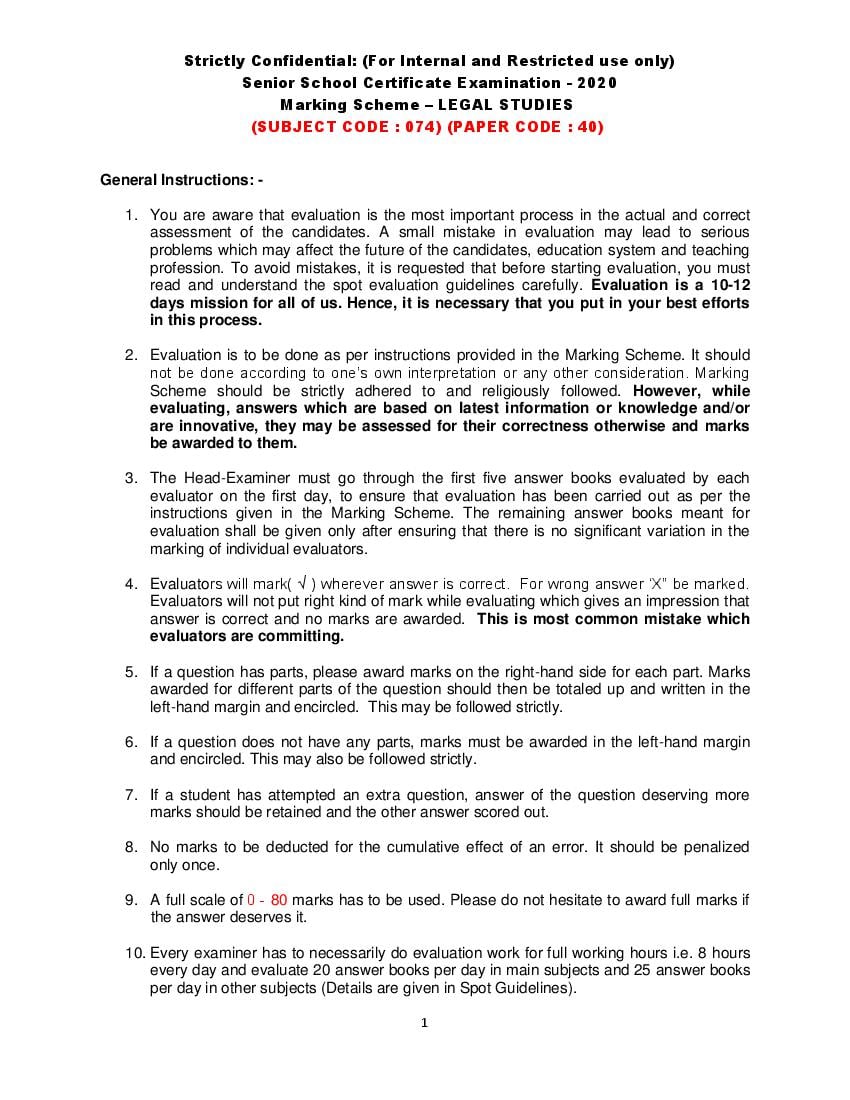
Senior School Certificate Examination - 2020
Marking Scheme – LEGAL STUDIES
(SUBJECT CODE : 074) (PAPER CODE : 40)
General Instructions: -
1. You are aware that evaluation is the most important process in the actual and correct
assessment of the candidates. A small mistake in evaluation may lead to serious
problems which may affect the future of the candidates, education system and teaching
profession. To avoid mistakes, it is requested that before starting evaluation, you must
read and understand the spot evaluation guidelines carefully. Evaluation is a 10-12
days mission for all of us. Hence, it is necessary that you put in your best efforts
in this process.
2. Evaluation is to be done as per instructions provided in the Marking Scheme. It should
not be done according to one’s own interpretation or any other consideration. Marking
Scheme should be strictly adhered to and religiously followed. However, while
evaluating, answers which are based on latest information or knowledge and/or
are innovative, they may be assessed for their correctness otherwise and marks
be awarded to them.
3. The Head-Examiner must go through the first five answer books evaluated by each
evaluator on the first day, to ensure that evaluation has been carried out as per the
instructions given in the Marking Scheme. The remaining answer books meant for
evaluation shall be given only after ensuring that there is no significant variation in the
marking of individual evaluators.
4. Evaluators will mark( √ ) wherever answer is correct. For wrong answer ‘X” be marked.
Evaluators will not put right kind of mark while evaluating which gives an impression that
answer is correct and no marks are awarded. This is most common mistake which
evaluators are committing.
5. If a question has parts, please award marks on the right-hand side for each part. Marks
awarded for different parts of the question should then be totaled up and written in the
left-hand margin and encircled. This may be followed strictly.
6. If a question does not have any parts, marks must be awarded in the left-hand margin
and encircled. This may also be followed strictly.
7. If a student has attempted an extra question, answer of the question deserving more
marks should be retained and the other answer scored out.
8. No marks to be deducted for the cumulative effect of an error. It should be penalized
only once.
9. A full scale of 0 - 80 marks has to be used. Please do not hesitate to award full marks if
the answer deserves it.
10. Every examiner has to necessarily do evaluation work for full working hours i.e. 8 hours
every day and evaluate 20 answer books per day in main subjects and 25 answer books
per day in other subjects (Details are given in Spot Guidelines).
1
Page 2
Examiner in the past: -
• Leaving answer or part thereof unassessed in an answer book.
• Giving more marks for an answer than assigned to it.
• Wrong totaling of marks awarded on a reply.
• Wrong transfer of marks from the inside pages of the answer book to the title page.
• Wrong question wise totaling on the title page.
• Wrong totaling of marks of the two columns on the title page.
• Wrong grand total.
• Marks in words and figures not tallying.
• Wrong transfer of marks from the answer book to online award list.
• Answers marked as correct, but marks not awarded. (Ensure that the right tick mark
is correctly and clearly indicated. It should merely be a line. Same is with the X for
incorrect answer.)
• Half or a part of answer marked correct and the rest as wrong, but no marks
awarded.
12. While evaluating the answer books if the answer is found to be totally incorrect, it should
be marked as cross (X) and awarded zero (0) Marks.
13. Any unassessed portion, non-carrying over of marks to the title page, or totaling error
detected by the candidate shall damage the prestige of all the personnel engaged in the
evaluation work as also of the Board. Hence, in order to uphold the prestige of all
concerned, it is again reiterated that the instructions be followed meticulously and
judiciously.
14. The Examiners should acquaint themselves with the guidelines given in the Guidelines
for spot Evaluation before starting the actual evaluation.
15. Every Examiner shall also ensure that all the answers are evaluated, marks carried over
to the title page, correctly totaled and written in figures and words.
16. The Board permits candidates to obtain photocopy of the Answer Book on request in an
RTI application and separately as a part of the re-evaluation process on payment of the
processing charges.
17. The Marking Scheme carries only suggested value points for an answer. These are only
the guidelines and do not constitute the complete answer. The students can have their
own expression and if the expression is correct, the marks should be awarded
accordingly.
18. Please read the following guidelines carefully and seek clarifications from the Head
Examiner in case of any doubt to reduce subjectivity and bias.
19. Credit should be given to student writing the concept in his own language. Marks should
not be deducted for non-use of bookish language.
2
Page 3
keep in mind that, it is neither exhaustive nor exclusive.
21. The examiners are requested to use their own knowledge and experience wherever
necessary.
22. Marks should be awarded for any CREATIVE answer given by the student
which is logically correct and is related to the concepts taught.
23. Marking should be neither over-strict nor over-liberal. Marks should not be deducted for
spelling errors, wrong proper names, minor inaccuracies, or omission of detail.
24. No marks should be deducted for overshooting word limit.
25. Though break-up of value points is given in a few answers, the examiner may be flexible
in marking the different parts, if the answers reflect understanding of the scope of the
question.
3
Page 4
SUBJECT CODE (074)
SERIES – HMJ/ PAPER CODE NO. 40
S.no. Expected Answers Marks allotted
1. Fill in the blanks:
a) The qualification required for appointment as an Advocate General is similar 1
to that of a ---------------------.
Ans. Judge of High Court 1
b) ----------------------- helps the judge to separate the ‘wheat from the chaff’ and 1
plays a crucial role in the establishment of facts during the court
proceedings.
Ans. Evidence Act/ Evidence Act, 1872 1
(Any of the two answers is to be considered)
Or If the accused is allowed to be withdrawn from prosecution, prior to framing 1
of charges , it is called ---------------------.
Ans. Discharge 1
c) The Lokpal and Lokayukta Act, 2013 provides for the establishment of 1
----------- at every state in order to deal with complaints of corruption against
public functionaries.
Ans. Lokayukta 1
d) Article 21A provides for right to education to all children between the ages 1
of six and fourteen and obligates ----------------- to implement this.
Ans. The State/ State Government 1
(Any of the two answers is to be considered)
Or Article 24 prohibits employment of children below the age of ----------years 1
in factories, mining and other hazardous employment.
Ans. 14/ Fourteen 1
e) -------------------was enacted to expressly provide that no woman would by 1
reason only of her sex, be disqualified from being admitted or enrolled as a
legal practitioner or from practicing as such.
Ans. Legal Practitioners (Women) Act, 1923/ Legal Practitioners (Women) 1
Act /Legal Practitioners Act, 1923
2. Answer in one word /one sentence each.
a) What is the relation between TDSAT(Telecom Dispute Settlement Appellate 1
Tribunal) and TRAI (Telecom Regulatory Authority of India )?
4
Page 5
specialized Government agencies that oversee law and order compliance
OR
TDSAT is a tribunal and TRAI is a regulator 1
OR
Tribunal TDSAT functions alongside the regulator, TRAI (Telecom 1
Regulatory Authority of India) in formulating laws and policy for
resolving telecom disputes in India.
Or How can a judge from lower judiciary be removed from his office? 1
Ans. Judge in the lower judiciary can be removed from his office by the State 1
Government in consultation with the High Court.
b) Who headed the Committee on National Implementation of Legal Aid? 1
Ans. Justice P.N. Bhagwati 1
Or Identify the covenant ratified by India in 1976 that binds India with the 1
international obligation to provide free legal assistance.
Ans. ICCPR/ International Covenant on Civil and Political Rights 1
or
ICESCR/International Covenant of Economic, Social and Cultural
Rights
c) Rohan Abbas, an upcoming criminal lawyer , after taking approval from the 1
Bar Council of India prepared a five piece information that he can put on the
internet to solicit clients . The information included his name, his contact
details and his professional and academic qualifications. Apart from these,
Mention the other two pieces of information that Rohan can give to advertise
his services.
Ans. The other two pieces of information are: 0.5*2=1
a. Enrolment with the Bar/Enrolment number
b. Areas of practice
d) Who is the Patron- in – Chief of the state Legal Services Authority? 1
Ans. Chief Justice of the concerned State High Court 1
e) Arvind is being tried for misappropriation of office funds in a trial before the 1
Sessions Judge. He does not have sufficient means to engage a pleader. What
remedy is available to Arvind?
Ans. Section 304(1) of Cr.P.C. provides that: In a trial before the sessions 1
judge, if the accused has not sufficient means to engage a pleader, the
court should assign a pleader for his defense at the expense of the State
Or
5
Page 6
legal aid/ legal services.
Or State Rawl’s first principle of justice. 1
Ans. Rawl’s first principle of justice states that “Each person should have an 1
equal right to the system of equal basic liberties”.
(If the child has written in his/her own expression full credit will be
given)
3. MCQ’s:
a) Tushar is a Delhi Government employee working as a research analyst at 1
Krishi Anusandhan Kendra (Institute), Delhi. He was given a rent-free
accommodation having five rooms. Tushar sublet two rooms to the students
studying in the institute at a nominal rent. The matter was reported to State
Administrative Tribunal. He was suspended for a month and was asked to
vacate the accommodation. Tushar wants to appeal against the decision of
the State Adminstrative Tribunal. Where should he appeal?
a. Central Administrative Tribunal
b. Division Bench of Supreme Court of India
c. Division Bench of High Court of Delhi
d. No appeal is allowed in Alternate Dispute Resolution mechanisms.
Ans. c. Division Bench of High Court of Delhi 1
Or There was a dispute between Ms. Shreya and Ms. Piyali regarding the title 1
and possession of a plot of land. The parties to the dispute appointed a
neutral third-party Ms. Liam who suggested potential solutions. Identify the
role of Ms. Liam in this situation.
a. Arbitrator
b. Negotiator
c. Mediator
d. Conciliator
Ans. d. Conciliator 1
b) Sudhir, a college student, follows Kirti, his classmate. He sends her 1
unwanted messages and ‘friends request’ on different social media portals.
Although there is no violence or threat of violence, is Sudhir still guilty of
any wrong?
a. Yes, because he is invading Kirti’s privacy
b. Yes, because he is unlawfully harassing Kirti
c. No, because he is not causing any physical harm or injury to Kirti
d. Yes, because he is being negligent towards his duties as a good
student.
Ans. a. Yes, because he is invading Kirti’s privacy 1
Or
b. Yes, because he is unlawfully harassing Kirti
6
Page 7
Or Administrative actions in which no discretion is vested with the authority are 1
called
a. Purely administrative actions
b. Ministerial actions
c. Administrative adjudicatory actions
d. Both a and b
Ans. a. Purely administrative actions / b. Ministerial actions / d. Both (a) and 1
(b)
(Any one the answer is to be taken as the correct answer)
c) The first Indian lady vakil to be enrolled was 1
a. Ms. Hazra
b. Anna Chandy
c. Cornelia Sorabjee
d. Fatima Beevi
Ans. c. Cornelia Sorabjee 1
d) Raveena is working with a reputed law firm. Her area of specialization 1
typically involves practicing in commercial and economic laws and advising
on issues pertaining to a commercial transaction between two or parties. She
also advices on the laws applicable to the transaction, drafts contracts and
other documents and helps clients with the commercial negotiations. Reena
is specialized in.
a. Corporate law
b. Taxation Law
c. Transactional Law
d. Legal Process Outsourcing
Ans. c. Transactional law 1
Or Michael Brown has an undergraduate degree in Anthropology and aspires to 1
become a lawyer in the UK. Which of the following will enable him to do
so?
a. Pupillage
b. Common Professional Examination
c. Bar Vocational Course
d. Legal Practice Course
Ans. b. Common Professional Examination 1
e) A petition was filed in a High Court highlighting the plight of sewage 1
cleaners working for the State Jal Board. It highlighted the problems of
exposure to toxic fumes, suffocation and accidental death, while working. In
this context, which of the following statements is applicable?
a. Fundamental duty has been breached by the State
b. Fundamental Rights cannot be enforced if the violation is not willful
c. Fundamental Rights can be enforced against the State through Public
Interest Litigation
7
Page 8
action
Ans. c. Fundamental Rights can be enforced against the State through Public 1
Interest Litigation
4. State whether the statements are TRUE or FALSE.
a) The Vienna Declaration and Programme of Action led to the creation of the 1
post of the UN High Commissioner for Human rights.
Ans. True 1
b) In the UK, the provisions of an international treaty need to be transformed 1
into local law, passing a domestic legislation with concurrent provisions as
per the international obligations.
Ans. True 1
c) The principles laid out in Part IV(A) of the Indian Constitution are used for 1
interpreting provisions of the Constitution that are vague and ambiguous.
Ans. False 1
Or The freedom of speech and expression granted to the Indian citizens cannot 1
be curtailed on any grounds.
Ans. False 1
d) The State Legal Aid Fund shall be utilized towards the cost of functions of 1
State Authorities, cost of legal services provided by the High Court Legal
Services Committee and Taluk Legal Services Committee.
Ans. True/ False 1
(Both to be awarded as the language is ambiguous)
e) Sona Lal, a Maoist leader convenes a gathering of all comrades in Surguja 1
District to establish an egalitarian society using violent means, if necessary.
The local police on receiving a tip off, constructs barricades around the local
area to ensure that the planned convention cannot take place. This is a
violation of Sona Lal’s fundamental right.
Ans. False 1
SECTION B
5. Analyze the relation between ‘due process of law’ and ‘independence of 2
judiciary’.
Ans. 1. Independence of judiciary means that the judiciary is free from the 2 marks
control of legislature and executive.
2. Due process of law means that the State must respect all the legal
rights that are owed to a person and conform to the norms of
fairness, liberty, etc.
3. Only an independent judiciary can make this concept operational.
Whenever the independence of judiciary has been disturbed, it has
directly impacted upon the due process of governance and rights
granted to average citizens.
4. It is important for rule of law, free and fair society,watchdog of
democracy and protects the fundamental rights of the citizens.
Or Describe the procedure of impeachment as given in Article 124(4) of the 2
8
Page 9
Ans. 1. The inquiry into the grounds for removal i.e. (i) proven 2 marks
misbehaviour or (ii) incapacity is made under the Judges Inquiry
Act, 1986.
2. This inquiry is done by a committee of three members. Based on the
findings, the recommendation to impeach the judge has to be made
by the Chief Justice of India to the President of India.
3. If it is accepted then, the proposal of impeachment must be
introduced in the Parliament for discussion by 100 MPs in Lok
Sabha or 50 MPs in Rajya Sabha.
4. The copy of the proposal is given to the concerned judge before the
proceeding starts in the Parliament of India. The motion of
impeachment has to be passed by the two-third majority members
present and voting must be done separately in each house of the
Parliament
6. Rajbeer, a thief, broke into the apartment of Mr. Sood with the intention of 2
theft. While he was trying to open the locker safe Mr.Sood spotted him and
started shouting. Rajbeer ran out of the apartment. Mr.Sood followed him
and hurled a stone towards Rajbeer which hit him hard in the head and
Rajbeer sustained serious head injury.
Is Mr.Sood criminally liable for this act? Substantiate with proper reasons.
Ans. Yes, Mr Sood is criminally liable for this act because causing injury to 1 marks for
an assailant in self-defense is not a crime, but the moment injury is writing ‘yes’+
caused with intent to take revenge, the act becomes criminal. 1mark for
reason.
Mr Sood had the right to self-defense only till Rajbeer, the thief did not
flee the house and not beyond that/ explains the concept of self-defense.
Or Nirmala and Venkateshwaram, a young couple, scratched their names on the 2
bonnet of Mr. Vishnuvardhan’s car.
Identify the type of civil wrong. Also, what remedy is available to Mr.
Vishnuvardhan?
Ans. Type of civil wrong – Trespass to chattel 1 mark for
Remedy – Damages/ Monetary compensation/compensation identification +
1 mark for
OR remedy
Type of civil wrong – Conversion
Remedy – Forced sale/Damages/ Compensation
7. Mrs. Sfoorti Sinha is an Enlish Lecturer who offered a reward of Rs. 10000 2
to the top scorer in her class. Nisha, a student claimed the reward after
scoring the highest marks. Mrs. Sinha, however, refused to give the reward,
stating that she is not legally bound. Examine the remedy available in this
context.
9
Page 10
intention to create a legal relationship. It was only a moral/social response ‘yes’ /
obligation ‘no’ + 1 mark
OR for reason
No remedy is available to Nisha. based on the
In a similar case of Balfour v Balfour, the husband and wife went on response
leave to England and the wife fell ill in England. The doctors who
treated the wife advised her to take full bed rest and remain in England.
The wife stayed in England. When the leave was over, the husband went
to Ceylon where he was employed and promised to send a sum of £30 to
the wife every month for her stay in England. He sent the amount for
some time and later due to differences and misunderstanding between
them, the husband stopped sending the amount. The wife-initiated
action to recover the arrears due to her. The Court dismissed it on the
ground that the agreement entered was only a moral obligation and the
parties never intended to create any legal relationship
OR
No remedy is available to Nisha as no intention to create a legal
relationship is visible.
In an English case Carlill v. Carbolic Smoke Ball Co., the company was
the manufacturer of a medicine called smoke ball which was used for
the treatment of influenza. An advertisement was put up offering a
reward of £100 to anyone who got influenza again after using the smoke
ball medicine continuously for fifteen days. In the advertisement, it was
also stated that £100 was deposited in a Bank, namely, Alliance Bank for
paying the reward if such situation arose. Seeing the advertisement,
Mrs. Carlill bought the smoke ball medicine and used it as per the
directions provided. Mrs. Carlill got a fresh episode of influenza. Mrs.
Carlill sued the company for the reward of £100. The manufacturing
company stated that: (1) there was no intention to enter into a legal
relationship with anyone through the advertisement, The Court stated
that deposit of £1000 in the Alliance Bank by the smoke ball company
was evidence that the company had real intention to enter into a legal
relationship with anyone who accepted the offer.
(Any 1 of the above)
(Law is opened to interpretation, so this answer will vary from how the
student has interpreted it provided the explanation is as per the text)
8. Why is mediation a better method for resolution of dispute arising from 2
strained relations?
Ans. Mediation is a better method of dispute resolution because mediation: 1 mark each for
• It can handle any number of outstanding gripes or issues, any two points
• it offers a way to discuss (and solve) the problems underlying a
dispute and
• Create truly lasting peace.
10
Page 11
forum to parties to discuss their problems amicably.
• It looks for a common ground of settlement suggested by the parties
themselves.
• No application of laws/procedure/technicality.
• Continuity in relations
• Willingness
• Reduces the burden of the Courts
• Reduces the delay in judgment
(Any 2 points)
9. State the provision of preventive detention laws in India to which safeguard 2
of Article 22 does not apply.
Ans. 1. The safeguards of Article 22 do not apply to a person from an enemy 2 marks
country. Also, they do not apply to persons arrested or detained
under preventive detention laws.
2. Preventive detention laws allow for detaining persons on suspicion
who have not been found guilty of any crime but their release may be
detrimental to society
3. For example, the Maintenance of Internal Security Act of 1971 in
which many political opponents were detained without safeguards
against arrest and detention and other human rights.
(If the student has explained Art. 22 and related it to preventive
detention, full credits to be given)
10. State the regulatory functions of Bar Council of India. 2
Ans. The regulatory functions of Bar Council of India are as follows: 2 marks
• Prescribing standards of professional conduct and etiquette
• Exercising disciplinary jurisdiction over the bar
• It also sets standards for legal education
• Grants recognition to Universities whose degree in law will serve as
qualification for enrolment as an advocate
• To deal with and dispose of any matter which may be referred to it
by a State Bar Council.
• To promote legal education and to lay down standards of legal
education.
• To recognise on a reciprocal basis, the foreign qualifications in law
obtained outside India for the purpose of admission as an advocate
in India.
• To conduct seminars and talks on legal topics by eminent jurists and
publish journals and papers of legal interest
• To manage the funds
11
Page 12
nd
11. Article 39A inserted by 42 Amendment Act makes the provisions of 2
Article 14 of the Indian Constitution more meaningful and progressive.
Evaluate this statement.
Ans. • Article 14 provides to all the right to equality before law and equal 2 marks
protection of the law. It prohibits discrimination on grounds of
religion, race, caste, sex or place of birth. Creation of equal
opportunity for accessing the courts is a dimension of the equality
clause in Article 14 which was further enhanced by creation of
Article 39A.
• Article 39A of the Constitution directed the state to provide free
legal aid by suitable legislation or schemes or in any other way, to
ensure that opportunities to secure justice are not denied to any
citizen by reason of economic or other disabilities.
12. At the concluding session of an international conference in 2019, the 2
following observation was made:
“Mere economic and political arrangements are not enough to ensure growth
and stability in the world. By promoting culture, preserving heritage and
sharing knowledge the world can become a global family where there is
peace and understanding.”
Identify the specialized agency of the UN that can best address this crisis and
state its main functions.
Ans. Specialized agency - United Nations Educational, Scientific and Cultural 1mark for
Organization / UNESCO identification
Functions (Any 2)-
1. Promote coordination between members to ensure growth and
stability in member states. 0.5 marks each
2. Promote culture, preserve the heritage, share knowledge and for any 2 points
understanding that is beneficial for the whole of mankind.
3. Aid sustainable development
4. Foster greater cooperation between nations
SECTION C
13. Susheela is a minor who looks older than her age. Subroto is a major who 4
enters into a contract with Susheela thinking that she is a major too. Later
Subroto found that Susheela is a minor.
a. Is the contract valid? Give reasons.
b. State the exception to the rule regarding capacity to contract by a minor as
stated in the Indian Contract Act,1872.
Ans. (a) The contract is invalid as minor is incompetent to enter into a 2+2 marks
contract / no capacity to contract / is below the age of 18years so cannot
enter into a contract.
(b) The exception to the rule is that if a minor enters into a contract and
12
Page 13
not be held void.
14. Raghav and his two friends, Ravi and Prakash, were arrested by Police on 4
the charges of kidnapping and abduction of a minor girl. A conversation
between Raghav and his friends was overheard by a rag picker while they
were discussing the further course of action in a junk yard. The rag picker
informed the police and the three were arrested.
Ravi, told the Inspector that if taken to Kodaikanal, he would show the spot
where the minor girl was kept.
a. Analyse the nature of evidence presented in the given situation.
b. What is the position of Ravi’s statement in evidence law?
c. If the statement by Ravi was made before a magistrate instead of the
Inspector, would it have the same impact as an evidence? Explain
Ans. (a) The nature of evidences presented in the given situation are extra 1+1+2 marks
judicial confessions. / It’s a hearsay/oral evidence
Extra judicial confessions can be accepted and can be the basis of a
conviction only if it passes the tests of credibility as laid down in the
procedural laws such as corroborated by other evidences.
(b) Ravi’s statement is also considered as extrajudicial confession as it is
made to the inspector during investigation.
(c ) If the statement by Ravi was made before a Magistrate instead of a
Inspector , it would be a judicial confession and may be accepted as
conclusive of the matters confessed if made deliberately and voluntarily.
15. Give any four functions of the National Human Rights Commission. 4
Ans. The functions of National Human Rights Commission (NHRC) are as 1 mark each for
follows 4 functions
1.Inquiry and Investigation -NHRC can conduct inquiry and
investigation into the alleged violation of human rights or abetment
(aiding or supporting) or negligence in the prevention of such
violation by a public servant.
2. Intervening in court proceedings -The Commission may with the
permission of the court intervene in court proceedings concerning
human rights violations.
3. Inspection of jails, etc.- The Commission may also visit any jail or
other governmental institutions, where prisoners are lodged or detained,
to study the living conditions of the inmates and make recommendations
to the government.
13
Page 14
human rights laws either in the Constitution or other statutes and
recommend measures to the government for their effective
implementation. The Commission can also evaluate various factors,
including acts of terrorism, which prevent the enjoyment of human
rights and recommend appropriate remedial measures to the
government. The Commission's role includes studying various
international human rights laws and make recommendations for their
effective implementation at the domestic level (within the State).
Furthermore, the Commission can undertake and promote research in
the field of human rights.
Or Explain the provisions of safeguards in the Indian Constitution, to persons 4
accused of having committed crimes.
Ans. Article 20 provides for safeguards to persons who are accused of having 1 mark each for
committed crimes. the 4 provisions
• Article 20 provides that no person can be convicted for the
commission or omission of an act that does not amount to an offense
by any law in force at the time of such act.
• Article 20 provides that any person who is convicted of a crime
should not receive a penalty greater than what is provided in the
law in force at the time of the act of offence. (Doctrine of
Proportionality)
• It provides for another important right ´no person shall be
prosecuted and punished for the same offence more than once.
(Double Jeopardy)
• It states that no person accused of any offence shall be
compelled to be a witness against himself. This provision
safeguards the accused’s right against self-incrimination. (Right
against self-incrimination)
16. a) Describe the broad features of the NALSA Regulations, 2010. 4
b) State the main objective of the Legal Services Authorities Act, 1987.
Ans. a) Some broad features of the NALSA Regulations 2010 are as follows: 3 marks for
I) Selection of Panel Lawyers features+ 1
The legal services institution is vested with the authority to invite mark for part
applications from legal practitioners with requisite professional (b)
experience to indicate the types of cases as they may be entrusted
The legal practitioner shall have three years or more of experience at
the bar for being considered for empanelment. The personal traits like
competence, integrity, suitability and experience shall be given due
consideration. The Panel has to be reconstituted every three years
14
Page 15
going cases. The panel lawyer may be withdrawn from a case or his
name removed from the panel on account of non- performance of duties
satisfactorily or for actions against the object and purpose of the Act or
Regulations.
II) Payment of Fee
The Regulations specify the rules regarding the payment of fees for
panel lawyers which shall be in accordance with the State regulations
without any delay on receipt of completion of proceedings for them. It
suggests periodic revision of honorarium for the different types of
services provided by panel lawyers in legal aid cases.
III) Senior Advocates
The services of senior advocates may be availed if the Chairman of the
legal services institution forms an opinion to that effect in cases of great
public importance and where serious threats to life and liberty of the
applicant exists.
* If the student has written these three-point full credit to be given even if
they are explained in a paragraph.
b) The main objective of the Legal Services Authorities Act of 1987 is
to provide free and competent legal services to the weaker sections of the
society to ensure that opportunities for securing justice are not denied to
any citizen by reason of economic or other disabilities, and to organize
lok adalats to secure that the operation of the legal system promotes
justice on a basis of equal opportunity.
17. Evaluate the changes effected by the Advocates Act 1961 that revolutionized 4
the legal profession and education in India.
Ans. Profession: 2 marks for
• After the enactment of the Advocates Act ,1961 all the old categories profession + 2
of practitioners (vakils, barristers, pleaders of several grades, and marks for
mukhtars) were abolished and consolidated into a single category education
called "advocates" who enjoy the right to practice in courts
throughout India.
• Advocates have been classified as Senior Advocates and other
Advocates. The designation of an Advocate as a Senior Advocate is
the responsibility of the Supreme Court or High Court based on the
ability, experience and standing in the Bar of the Advocate in
question. The Advocate- on- Record (AOR) is another category of
Advocate in the Supreme Court.
• The Advocates Act also established an All India Bar Council for the
15
Page 16
Education:
• In order to be eligible for enrolment, an Advocate must be: a citizen
of India, at least 21 years of age and
• Must have an LLB degree from an Indian University. The university
is to be recognized by the Bar Council of India.
• The curriculum framework to be decided by the Bar Council of
India.
SECTION D
18. Examine the role of the Supreme Court as an adjudicator and interpreter. 6
Ans. • The Supreme Court of India primarily exercises the role of an 3 marks + 3
adjudicator and interpreter. marks
• Its role as an adjudicator and an interpreter can be understood
through the original and appellate jurisdiction vested with the court.
• Under Article 131 of the constitution, the Supreme Court is granted
original jurisdiction. This power is exercised to adjudicate amongst
disputes between Union and one or more states and between two or
more states. Such disputes must involve some question of law or fact
on which the existence or extent of legal rights can be adjudicated.
• Article 32 of the Constitution further gives an extensive original
jurisdiction to the Supreme Court for the enforcement of
fundamental rights of the citizens, through issuing directions, orders
and writs. This is popularly known as the writ jurisdiction.
• The appellate jurisdiction of the Supreme Court can be invoked by a
certificate granted by the High Court. Appeal to the Supreme Court
may be made against any judgement, decree or final order of a High
Court in both civil and criminal cases. These cases must involve
substantial question of law as to the interpretation of law.
• The Supreme Court is also vested with wide appellate jurisdiction
over all courts and tribunals as provided in Article 136 of the
Constitution. Under its discretion, the court may grant a special
leave to appeal and receive any judgement, decree, determination,
sentence or order in any cause or matter passed by any court or
tribunal in the territory of India.
• Has the power to judicial review
• Public Interest Litigation
19. Anuj and Harish are brothers having a wholesale business of spices working 6
under a Joint Hindu Family business setup. A dispute ensued between the
two for title of the property. Anuj has a litigation in determining the title of
property with Harish. During the period of litigation, Anuj initiates a sale of
the property in favour of Brijesh.
16
Page 17
that can help Harish to stay the transaction.
b. What are the conditions to be satisfied by Harish in order to invoke the
protection under this doctrine?
c. Can the doctrine be invoked if the property is not yet transferred, but only
a contingent agreement for its transfer after the suit has been decided is
made?
Ans. a) Doctrine of Lis Pendens says that when a suit or litigation is pending 2+2+2
on an immovable property, then that immovable property cannot be
transferred.
b) The following are the conditions-
i) A suit or proceeding involving the immovable property should be
pending.
ii) The right to the immovable property must be in question in the
suit or proceeding.
iii) The property in the litigation should be transferred.
iv) The transferred property should affect the rights of the other
person to the transfer.
c) No, the doctrine cannot be invoked. For lis pendence, the property
in question should have been transferred.
(Law is open to interpretation, so if the child has linked the answer with
contingent contract then full credits to be given)
20. The two broad models of legal systems differ in their techniques of 6
adjudication and justice delivery mechanism. Elaborate
Ans. The 2 models of legal systems are Adversarial and Inquisitorial system. 3 marks each
Adversarial system- for the two
1) In an adversarial system, the parties in a legal proceeding develop systems
their own theory of the case and gather evidence to support their
claims.
2) The parties are assisted by their lawyers who take a pro-active role
in delivering justice to the litigants.
3) The lawyers gather evidence and even participate in cross-
examination and scrutiny of evidence presented by the other
disputing party.
4) The role of the judge/decision maker is rather passive as the judge
decides the claims based solely on the evidences and arguments
presented by the parties and their lawyers.
Inquisitorial system-
1) In an inquisitorial system, the judge/decision maker takes a centre
stage in dispensing justice.
2) The role of the judge/decision maker is active as he/she determines
17
Page 18
3) The judge/decision maker also decides the manner in which the
evidence must be presented before the court.
4) For example, the judge may decide for presentation of a specific
form of evidence, i.e. oral (witness statement) or documentary
(correspondence between the parties through letters/mails) or a
combination of both.
5) The judge then evaluates the evidence presented before him/her and
decides upon the legal claims.
6) Therefore, this model of adjudication is also known as the
interventionist/investigative model.
7) Furthermore, in such a system less reliance is placed on cross-
examination and other techniques often used by lawyers to evaluate
evidences of their opposing counsel.
(Advantages and disadvantages for both the systems may also be
considered while assessing the answer)
OR a. Analyze the reasons that paved the way for alternate dispute resolution 6
techniques in the Indian judicial system.
b. “The success of ADR techniques is attributed to the role played by the
instrumentalities in the process of dispute resolution.” Justify explaining the
role of an arbitrator, mediator and conciliator.
Ans. a) The reasons that paved the way for alternate dispute resolution 3 marks+3
techniques in the Indian Judicial system are- marks
1) The ADR methods are speedier, informal and cheaper modes of
dispensing justice.
2) It provides a more convenient forum to the parties who can choose
the time, place and procedure, for conducting the preferred dispute
redressal process.
3) If the dispute is technical in nature, parties have an opportunity to
select the expert who possesses the relevant legal and technical
expertise.
4) The lack of number of courts and judges which creates an
inadequacy within the justice delivery system.
5) The increasing litigation in India due to increasing population,
complexity of laws and obsolete continuation of some pre- existing
legal statutes.
6) The increasing cost of litigation in prosecuting or defending a case,
increasing court fees, lawyer’s fees and incidental expenses.
7) Delay in disposal of cases resulting in huge pendency in all the
courts.
18
Page 19
1) The arbitrator holds power and authority to grant interim
measures, like a judge in the court. or
2) Arbitrators are free to base their decisions on their own conception
of what is fair and just. or
3) Arbitrators are not strictly required to follow the law or the
reasoning of earlier case decisions. Or
4) Gives an award which is binding on both the parties.
Role of Mediator
1) Mediator is a third neutral party who is a facilitator and helps the
parties to reach a mutually agreeable solution.
2) Mediator has an advisory role in that she/he evaluates the strengths
and weaknesses of each side’s argument and makes some
predictions about what would happen should they go to court. or
3) Mediator facilitates the conversation. They further provide a
structure and an agenda for the discussion. or
4) Mediator identifies opportunities for empowerment and recognition
as those opportunities appear in the parties’ own conversations and
responding in ways that provide an opening for parties to choose
what, if anything, to do with them.
Role of Conciliator
1) The role of conciliator goes beyond that of a mediator. A
conciliator may be interventionist in the sense that he/she may
suggest potential solutions to the parties, in order to resolve their
claims and disputes.
21. a. What is ‘Private international law’? How is it different from ‘Public 6
international law’?
b. Why is ‘Private international law’ referred to as ‘Conflict of Laws’?
c. Evaluate the role of any three international bodies which have been
working towards harmonizing private laws of different countries.
Ans. a) 2+1+3
• Private International Law is a set of rules and principles that govern
interstate interactions and transactions of private parties.
• It is different from Public International Law, as the latter is a set of
rules which governs the intercourse between nations through
determining the rights and obligations of the governments of the
nations, while the former comprises of certain rules and regulations
which are established or agreed upon by private citizens from
different nations who enter into transactions and that would govern
them if a dispute were to arise.
19
Page 20
and it is a body constituted of conventions, model laws, domestic
laws of states and secondary legal sources.
c) 3 international bodies are: -
1) The Hague Conference
The Hague Conference, convened by the government of Netherlands,
originates back in 1893, and focuses on developing conventions on a
wide array of aspects of private law.
2) UNCITRAL
The UNCITRAL works towards developing model laws and guides,
related to international trade and commercial laws, including the
UNCITRAL Arbitration Rules.
3) CISG or the Vienna Convention
The CISG, also referred to as the Vienna Convention on sale of goods, is
a multilateral treaty which provides options for avoiding choice of law
issues by providing a framework of accepted substantive rules with
respect to contract disputes. It is considered one of the most influential
documents in private international law, and nowadays is deemed to be
incorporated into any otherwise applicable domestic laws, unless
expressly excluded.
4) ICSID – International Centre on Settlement of Investment Disputes
5) UNDROIT-Unification of Private Laws
6) Geneva Convention
20
Document Details
| Board / Org | CBSE |
| Exam | Class 12 |
| Type | Solution |
| Pages | 20 |
| Updated | 22 Jul 2026 |