MAHA SET 2018 Question Paper 3 Sociology
Finished viewing? Save it for later —
Download MAHA SET 2018 Question Paper 3 Sociology (PDF · 40 pages)About MAHA SET 2018 Question Paper 3 Sociology
MAHA SET 2018 Question Paper 3 Sociology is available here for free download. Published by Maharashtra Exams for MAHA SET, this question paper can be viewed online or downloaded as a PDF (40 pages). Candidates preparing for MAHA SET can use MAHA SET 2018 Question Paper 3 Sociology to understand the exam pattern, the type of questions asked, and the overall difficulty level.
Frequently Asked Questions
How can I download MAHA SET 2018 Question Paper 3 Sociology?
Open this page and click the Download button to save MAHA SET 2018 Question Paper 3 Sociology as a PDF. It is completely free on AglaSem Docs.
Is MAHA SET 2018 Question Paper 3 Sociology free to download?
Yes. MAHA SET 2018 Question Paper 3 Sociology can be viewed online and downloaded as a PDF free of cost on AglaSem Docs.
How many pages does MAHA SET 2018 Question Paper 3 Sociology have?
MAHA SET 2018 Question Paper 3 Sociology contains 40 pages, which you can read online or download together as a single PDF.
Where can I find more MAHA SET study material?
You can find more MAHA SET question papers, sample papers, syllabus, and answer keys on AglaSem Docs.
MAHA SET 2018 Question Paper 3 Sociology – Text
Read the full text of this question paper below — useful to quickly search, copy and reference the content online without downloading the PDF.
📄 View text version (40 pages)
Page 1
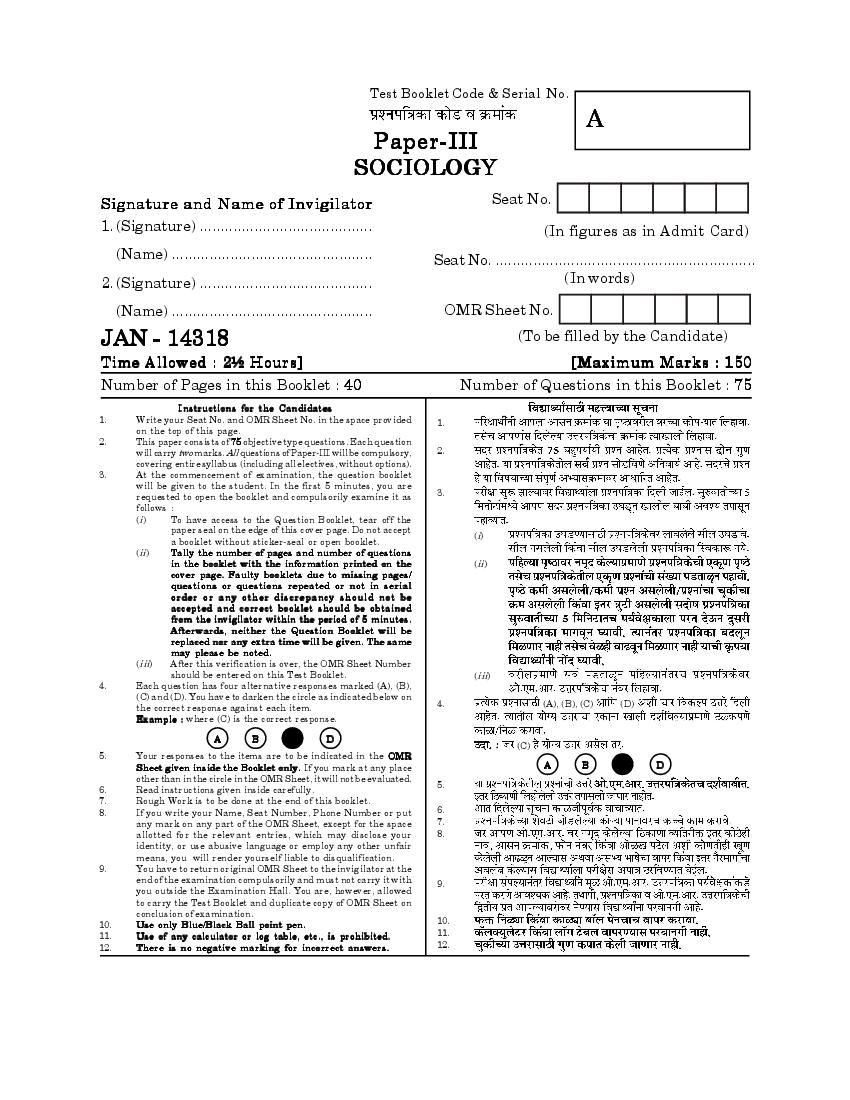
A
Paper-III
SOCIOLOGY
Signature and Name of Invigilator Seat No.
1. (Signature) ......................................... (In figures as in Admit Card)
(Name) ................................................ Seat No. ..............................................................
2. (Signature) ......................................... (In words)
(Name) ................................................ OMR Sheet No.
JAN - 14318 (To be filled by the Candidate)
Time Allowed : 2½ Hours] [Maximum Marks : 150
Number of Pages in this Booklet : 40 Number of Questions in this Booklet : 75
Instructions for the Candidates
1. Write your Seat No. and OMR Sheet No. in the space provided 1.
on the top of this page.
2. This paper consists of 75 objective type questions. Each question
will carry two marks. All questions of Paper-III will be compulsory, 2.
covering entire syllabus (including all electives, without options).
3. At the commencement of examination, the question booklet
will be given to the student. In the first 5 minutes, you are
requested to open the booklet and compulsorily examine it as 3.
follows :
(i) To have access to the Question Booklet, tear off the
paper seal on the edge of this cover page. Do not accept
(i)
a booklet without sticker-seal or open booklet.
(ii) Tally the number of pages and number of questions
in the booklet with the information printed on the (ii)
cover page. Faulty booklets due to missing pages/
questions or questions repeated or not in serial
o rder or any other discre pancy should not be
accepted and correct booklet should be obtained
from the invigilator within the period of 5 minutes.
Afterwards, neither the Question Booklet will be
replaced nor any extra time will be given. The same
may please be noted.
(iii) After this verification is over, the OMR Sheet Number
should be entered on this Test Booklet. (iii)
4. Each question has four alternative responses marked (A), (B),
(C) and (D). You have to darken the circle as indicated below on
the correct response against each item. 4. (A), (B), (C) (D)
Example : where (C) is the correct response.
A B D
(C)
5. Your responses to the items are to be indicated in the OMR
Sheet given inside the Booklet only. If you mark at any place A B D
other than in the circle in the OMR Sheet, it will not be evaluated.
5.
6. Read instructions given inside carefully.
7. Rough Work is to be done at the end of this booklet.
8. If you write your Name, Seat Number, Phone Number or put 6.
any mark on any part of the OMR Sheet, except for the space 7.
allotted for the relevant entries, which may disclose your 8.
identity, or use abusive language or employ any other unfair
means, you will render yourself liable to disqualification.
9. You have to return original OMR Sheet to the invigilator at the
end of the examination compulsorily and must not carry it with 9.
you outside the Examination Hall. You are, however, allowed
to carry the Test Booklet and duplicate copy of OMR Sheet on
conclusion of examination.
10. Use only Blue/Black Ball point pen. 10.
11. Use of any calculator or log table, etc., is prohibited. 11.
12. There is no negative marking for incorrect answers. 12.
Page 2
Page 3
Paper III
III
Time Allowed : 2½ Hours] [Maximum Marks : 150
Note : This paper contains Seventy Five (75) multiple choice questions, each
question carrying Two (2) marks. Attempt All questions.
(75) (2)
1. Match List I with List II and select 1. I II
the correct answer from the codes
given below :
List I I
(a) Foucault, Michel (a)
(b) Giddens, Anthony (b)
(c) Alexander, Jeffrey (c)
(d) Habermas, Jurgan (d)
List II II
(1) The Consequences of Modernity (1)
(2) Discipline and Punish (2)
(3) Knowledge and Human (3)
Interests
(4)
(4) Theoretical Logic in Sociology
Codes :
(a) (b) (c) (d)
(a) (b) (c) (d)
(A) (2) (1) (4) (3) (A) (2) (1) (4) (3)
(B) (4) (3) (2) (1) (B) (4) (3) (2) (1)
(C) (2) (3) (4) (1) (C) (2) (3) (4) (1)
(D) (2) (1) (3) (4) (D) (2) (1) (3) (4)
3 [P.T.O.
Page 4
considers more proper on solution of
the problem of tribals ?
(A)
(A) Revivalism
(B)
(B) Isolation
(C)
(C) Assimilation
(D) Accommodation (D)
3. Match the List I with List II and 3. I II
select the correct answer from the
codes given below :
List I I
(a) Srinivas M.N. (a)
(b) Ghurye G.S. (b)
(c) Desai A.R. (c)
(d) Ambedkar B.R.
(d)
List II
II
(1) Annihilation of Caste
(1)
(2) Peasant Struggles in India
(2)
(3) The Mahadeo Kolis
(3)
(4) Religion and Society Among
(4)
the Coorgs of South India
Codes :
(a) (b) (c) (d) (a) (b) (c) (d)
(A) (4) (3) (2) (1) (A) (4) (3) (2) (1)
(B) (1) (2) (3) (4) (B) (1) (2) (3) (4)
(C) (2) (1) (4) (3) (C) (2) (1) (4) (3)
(D) (2) (3) (4) (1) (D) (2) (3) (4) (1)
4
Page 5
important critera to be a dominant
caste include :
I. Land ownership
I.
II. Strength of number
II.
III. Education
III.
IV. High place in local hierarchy
IV.
Select the correct answer from the
codes given below :
(A) I, II and IV (A) I, II IV
(B) I, III and IV (B) I, III IV
(C) II, III and IV (C) II, III IV
(D) I, II and III
(D) I, II III
5 [P.T.O.
Page 6
key role in the professionalization of
Sociology in India ?
(A) Srinivas M.N. (A)
(B) Ghurye G.S. (B)
(C) Desai A.R. (C)
(D) Mukherjee R.K. (D)
6. The unfavourable alteration of 6.
environment due to human activities
is termed as :
(A)
(A) Ecological Disturbance
(B)
(B) Catastrophe
(C) Ecological Degradation (C)
(D) Pollution (D)
6
Page 7
developed nations consumes 86% of 86%
the world’s goods. This is the ideal
example of .......................... .
(A)
(A) Global poverty
(B)
(B) Global disparities
(C)
(C) Endemic poverty
(D) Dimension of poverty (D)
8. Top five states reporting slums 8.
.......................... .
(A) Andhra Pradesh, Chhattisgarh, (A)
M.P. Odisha, West Bengal
(B) Chhattisgarh, Maharashtra,
(B)
Odisha, Kerala, Assam
(C) Odisha, West Bengal, M.P.,
(C)
Bihar, Jharkhand
(D) Chandigarh, Gujrat,
(D)
Jharkhand, Assam, Kerala
7 [P.T.O.
Page 8
India is ................... .
(A) Anaemia (A)
(B) Vitamin A deficiency (B)
(C) Glaucoma (C)
(D) Cataract (D)
10. Various ethnic groups, caste groups 10.
and religious groups live peacefully.
What is this called ?
(A) Peacefulness (A)
(B) Secularism (B)
(C) Humanitarianism (C)
(D) Pluralism (D)
11. India is not an example of 11.
......................... .
(A)
(A) Cultural pluralism
(B)
(B) Religious pluralism
(C)
(C) Dominance of one group/culture
(D) Linguistic pluralism (D)
8
Page 9
states that India is a ...................... .
(A) Sovereign and secular (A)
(B) Sovereign, socialist, secular, (B)
democratic republic
(C) Secular and democratic (C)
(D) Secular, sovereign and (D)
democratic republic
13. The problem in Indian socio- 13.
political life is ..................... .
(A) Secularization is complete
(A)
(B) Secularism is irrelevant for
India (B)
(C) There is secularism but not
(C)
enough secularization
(D) Government does not support
secularization (D)
9 [P.T.O.
Page 10
started in :
(A)
(A) March 1919
(B)
(B) March 1918
(C)
(C) April 1919
(D) May 1920 (D)
15. Miller studied Jajmani system in : 15.
(A) 1947
(A)
(B) 1952
(B)
(C) 1954
(C)
(D) 1956
(D)
10
Page 11
not correctly matched ?
(A) Giddens — Structuration (A)
(B) Derrida — Deconstruction (B)
(C) Habermas — Neo-Marxism (C)
(D) Alexander — Structuralism (D)
17. Who is the author of ‘Neo- 17.
colonialism in West Africa’ ?
(A) Samir Amin (A)
(B) Gunnar Myrdal (B)
(C) Eric R. Wolf (C)
(D) Andre G. Frank (D)
11 [P.T.O.
Page 12
affecting population growth ?
(A) Ethnicity (A)
(B) Fertility (B)
(C) Mortality (C)
(D) Morbidity (D)
19. Who was of the opinion that 19.
along with industrialisation,
agricultural development is
essential for creation of employment
and productivity ? (A)
(A) Mohandas Gandhi
(B)
(B) Adam Smith
(C)
(C) Gunnar Myrdal
(D) Andre G. Frank (D)
12
Page 13
renamed as ‘Family Welfare’ ?
(A) 1975 (A)
(B) 2011 (B)
(C) 2001 (C)
(D) 1977 (D)
21.
21. Which one of the following is not a
form of Alienation ?
(A) From product (A)
(B) From production process (B)
(C) From self (C)
(D) From manager (D)
13 [P.T.O.
Page 14
List I I
(a) P. Gisbert (a)
(b) Parker, Brown, Child and Smith
(b)
(c) Form and Miller
(c)
(d) Galbraith J.K.
(d)
List II
II
(1) The New Industrial State
(1)
(2) The Sociology of Industry
(2)
(3) Fundamentals of Industrial
Society (3)
(4) Industry, Labour and (4)
Community
Codes :
(a) (b) (c) (d)
(a) (b) (c) (d)
(A) (3) (2) (4) (1)
(A) (3) (2) (4) (1)
(B) (1) (3) (2) (4)
(B) (1) (3) (2) (4)
(C) (4) (1) (2) (3)
(C) (4) (1) (2) (3)
(D) (4) (2) (3) (1) (D) (4) (2) (3) (1)
14
Page 15
carried out in ........................ .
(A) New York (A)
(B) California (B)
(C) Chicago (C)
(D) Washington (D)
24. Under which heading the efforts 24.
were made to rerive the structural-
functional theory ?
(A) Structuralism (A)
(B) Post-structuralism (B)
(C) Structuration (C)
(D) Neo-functionalism (D)
15 [P.T.O.
Page 16
(A) 1988
(A)
(B) 1989
(B)
(C) 1991
(C)
(D) 1992
(D)
26. The Telangana Movement was 26.
started against the ...................... .
(A) Nijam of Hyderabad (A)
(B) Zamindars (B)
(C)
(C) Moneylenders
(D)
(D) Intermediaries
16
Page 17
27.
appointed to look into ..................... .
(A) Industrial growth
(A)
(B) Agricultural crisis
(C) Science and technology (B)
development
(C)
(D) Enterprises in unorganized
(D)
sector
28. Sex ratio in 2011 census of 28.
population of India is :
(A)
(A) 1000 males — 927 females
(B)
(B) 1000 males — 933 females
(C)
(C) 1000 males — 930 females
(D)
(D) 1000 males — 940 females
17 [P.T.O.
Page 18
29. Who is of the opinion that the life
world is a micro world where people
interact and communicate ?
(A)
(A) Garfinkel
(B) Habermas (B)
(C) Alexander (C)
(D) Giddens (D)
30. Which statement is not correct about 30.
sustainable development ?
(A) Conservation of ecology is
(A)
important in development.
(B) Improvement of the quality of
(B)
human life is important in
development
(C) Development should result in (C)
higher per capita income
(D) Development should reduce
(D)
inequalities in access to
resources
18
Page 19
against which component of Marxian
theroy ?
(A) Class conflict (A)
(B) Exploitation (B)
(C) Economic determinism (C)
(D) State (D)
32. Who argues that agency and 32.
structure cannot be separated from
one another ?
(A)
(A) Giddens
(B)
(B) Foucault
(C)
(C) Derrida
(D) Alexander (D)
19 [P.T.O.
Page 20
India ?
(A)
(A) Gond
(B)
(B) Bhills
(C)
(C) Santhals
(D)
(D) Munda
34. The Commission appointed to 34.
examine enterprises in the
unorganised sector is .................. .
(A) Sachhar Commission (A)
(B) Srikrishna Commission (B)
(C) Sengupta Commission (C)
(D) Ambani Commission (D)
20
Page 21
select the correct answer from the
codes given below :
List I (Theories) I
(a) Liberal Feminism (a)
(b) Radical Feminism (b)
(c) Marxist Feminism (c)
(d) Post-modernist Feminism (d)
List II (Arguments) II
(1) Class and Gender both (1)
(2) Equality of sexes (2)
(3) Deconstruction and metaphor (3)
(4) Masculinity and violence (4)
Codes :
(a) (b) (c) (d) (a) (b) (c) (d)
(A) (1) (2) (3) (4) (A) (1) (2) (3) (4)
(B) (4) (1) (2) (3) (B) (4) (1) (2) (3)
(C) (1) (4) (3) (2) (C) (1) (4) (3) (2)
(D) (2) (4) (1) (3) (D) (2) (4) (1) (3)
36. Development perspective defines 36.
women as .......................... .
(A) Partners in development (A)
(B) Beneficiary of welfare schemes (B)
(C) Target population (C)
(D) Objects of charity (D)
21 [P.T.O.
Page 22
select the correct answer from the
codes given below :
List I I
(a) Giddens (a)
(b) Derrida (b)
(c) Althusser (c)
(d) Foucault (d)
List II II
(1) The Constitution of Society (1)
(2) For Marx (2)
(3) Writing and Differences (3)
(4) Madness and Civilization (4)
Codes :
(a) (b) (c) (d) (a) (b) (c) (d)
(A) (2) (1) (3) (4) (A) (2) (1) (3) (4)
(B) (1) (2) (4) (3) (B) (1) (2) (4) (3)
(C) (1) (3) (2) (4) (C) (1) (3) (2) (4)
(D) (4) (2) (3) (1) (D) (4) (2) (3) (1)
22
Page 23
the constitution deals with the
administration and control of
scheduled areas as well as the
scheduled tribes in states other than
Assam, Meghalaya, Tripura
......................... . (A)
(A) 3rd and 4th schedule
(B)
(B) 7th and 8th schedule
(C) 5th Schedule (C)
(D) 10th Schedule (D)
39. Poverty line denotes ................... .
39.
(A) Prevailing standards of what is
(A)
not needed
(B)
(B) Minimum standard of calories
and nutritional intake
(C) Adequate housing (C)
(D) Inadequate money and power (D)
40. ‘Integrated Tribal Development 40.
Project’ was launched in India in the
year ................ .
(A)
(A) 1975 A.D.
(B)
(B) 1980 A.D.
(C)
(C) 1983 A.D.
(D)
(D) 1987 A.D.
23 [P.T.O.
Page 24
proportion of scheduled castes
population as per 2011 census ?
(A) Chhattisgarh (A)
(B) Mizoram (B)
(C) Punjab (C)
(D) Uttar Pradesh (D)
42. According to Weber, Bureaucracy is 42.
......................... .
(A) A response to administrative
(A)
requirements of Industrial
societies
(B) A response to demand for
(B)
efficiency and rational
organization
(C) A response to science and
(C)
technology
(D)
(D) A response to market forces for
augmentation of profits
24
Page 25
select the correct answer from the
codes given below :
List I I
(a) Giddens (a)
(b) Derrida (b)
(c) Habermas (c)
(d) Alexander (d)
List II II
(1) Structuration (1)
(2) Neo-Marxism (2)
(3) Deconstruction (3)
(4) Neo-functionalism (4)
Codes :
(a) (b) (c) (d) (a) (b) (c) (d)
(A) (1) (3) (2) (4) (A) (1) (3) (2) (4)
(B) (3) (2) (1) (4)
(B) (3) (2) (1) (4)
(C) (1) (2) (3) (4)
(C) (1) (2) (3) (4)
(D) (4) (3) (1) (2)
(D) (4) (3) (1) (2)
25 [P.T.O.
Page 26
example of intergenerational conflict
based on gender ?
(A)
(A) Mother forcing daughter to
laugh in a low voice
(B)
(B) Father banning daughter to
attend college
(C)
(C) Senior boss dominating young
colleague
(D) Mother-in-law forcing daughter- (D)
in-law to leave job
45. Domestic violence includes which of 45.
the following :
(i) Physical violence
(i)
(ii) Mental Torture
(ii)
(iii) Sexual Abuse
(iii)
(iv) Social Exclusion
(iv)
Select the correct answer from the
codes given below :
(A) (i) and (ii) (A) (i) (ii)
(B) (i), (ii) and (iii) (B) (i), (ii) (iii)
(C) (i) and (iv) (C) (i) (iv)
(D) (i), (iii) and (iv) (D) (i), (iii) (iv)
26
Page 27
(A) Structure and institution (A)
(B) Macro-Micro (B)
(C) Knowledge and human interests (C)
(D) Culture and agency (D)
47. Displacement is forcible removal of 47.
population for developmental
projects. Which example from the
following list does not indicate
displacement ?
(A)
(A) Highway construction
rehabilitation
(B)
(B) Migration to new township
(C) Rehabilitation due to wildlife (C)
sanctuary
(D)
(D) Rehabilitation due to dam
27 [P.T.O.
Page 28
of India “With a growth rate
averaging 8.7 percent, India has
become one of the fastest growing
economies in the world”.
(A)
(A) 10th plan
(B)
(B) 9th plan
(C) 12th plan (C)
(D) 11th plan (D)
49. Select the pair of percentages for 49.
schedule castes and scheduled tribes
in India in 2011.
(A) 18.2 and 16.2 (A)
(B) 16.2 and 20.2 (B)
(C) 29.2 and 16.2 (C)
(D) 16.2 and 8.2 (D)
28
Page 29
50.
summary of Giddens’ sociological
writing ?
(A)
(A) Structuration
(B)
(B) Structuralism
(C) Deconstruction (C)
(D) Post-modernism (D)
51. Which state has highest number of 51.
slumblocks in India as per 2011
Census ?
(A)
(A) Maharashtra
(B)
(B) Delhi
(C)
(C) Karnataka
(D)
(D) Gujrat
52. (WID)
52. WID approach focuses on :
(A) Gender mainstreaming
(A)
(B) Gender segregation
(B)
(C) Incorporating women in
(C)
development activities
(D) Gender equality (D)
29 [P.T.O.
Page 30
begun in 1946 in the .................... .
(A) Warrangal district of
(A)
Hyderabad state
(B) Bidar district of Hyderabad state (B)
(C) Nalgonda district of Hyderabad
(C)
state
(D)
(D) Dinajpur district of Bengal state
54. Post-modernism is associated with 54.
which society ?
(A) Post-Industrial (A)
(B) Modern (B)
(C) Industrial (C)
(D) Capitalistic (D)
55. Who attributed regional 55.
inequalities in developing countries
to the ‘Spiral of cumulative
causation’ ?
(A)
(A) Gunnar Myrdal
(B)
(B) Samir Amin
(C)
(C) Karl Marx
(D) Amartya Sen (D)
30
Page 31
56.
broadly in three areas of history.
Which are they ?
(I)
(I) Study of psychiatry
(II)
(II) Medicine
(III)
(III) Penology
(IV) Education (IV)
Select the correct answer according
to the codes given below :
(A) (I) (II)
(A) (I) and (II)
(B) (II), (III) (IV)
(B) (II), (III) and (IV)
(C) (I), (II) (III)
(C) (I), (II) and (III)
(D) (I), (III) and (IV) (D) (I), (III) (IV)
31 [P.T.O.
Page 32
.................... .
(A)
(A) There is no absolute way of
defining confirmity and deviant
behaviour
(B)
(B) Law has loopholes
(C) Deviance is absolute
(C)
(D) Deviance is seen as
dysfunctional to society (D)
58. In the current neoliberal 58.
globalization phase, women are
forced to search for jobs. This is
called :
(A) Feminization of poverty (A)
(B) Women as partners in (B)
development
(C)
(C) Mainstreaming gender
(D) Gender equality (D)
32
Page 33
59.
about Neofunctionalism ?
(A) Social institutions have
(A)
universal positive functions
(B) Deviance and social control are
realities within social system (B)
(C) Only a commitment to common
values provides a basis for order
(C)
in society
(D) Order and stability is essential
for the maintenance of the (D)
social system
60. Who wrote the book titled “An Essay 60.
on the Principle of Population” ?
(A) Marx (A)
(B) Doubleday (B)
(C) Malthus (C)
(D) Ricardo (D)
33 [P.T.O.
Page 34
into :
(A)
(A) Little tradition and great
tradition
(B)
(B) Big tradition and small
tradition (C)
(C) Great and short tradition
(D)
(D) Superior and inferior tradition
62. Term ‘Glocalization’ suggests 62.
................ .
(A) Homogeneity between local and (A)
global culture
(B) Major modification of global (B)
products for local markets
(C) Uniformity between local and (C)
global education
(D) Professionalization of education (D)
34
Page 35
investigations to study everyday life
of people ?
(A)
(A) Erving Goffman
(B)
(B) Garfinkel
(C)
(C) Luckmann
(D) J. Alexander (D)
64. The rise of the village is bound up 64.
with the rise of ........................ .
(A) nomadic mode of production (A)
(B) agricultural economy (B)
(C) food gathering economy (C)
(D) barter economy (D)
65. Jajmani system was ....................... . 65.
(A) an economic system (A)
(B) a social system (B)
(C) a political system (C)
(D) a class system (D)
35 [P.T.O.
Page 36
(A) Money economy (A)
(B) Barter system (B)
(C) Political system (C)
(D) Religious system (D)
67. Customs are also called .................. 67.
(A) Culture (A)
(B) Values (B)
(C) Folkways (C)
(D) Mores (D)
68. What is the main objective of 68.
Dormitories in tribal community ?
(A) Sex education (A)
(B)
(B) Entertainment
(C)
(C) Sense of living together
(D)
(D) Sharing of responsibility
36
Page 37
focuses on :
(A) Intersubjective consciousness of
(A)
individual
(B)
(B) Social structure
(C)
(C) Conflicts in society
(D)
(D) Functions of social institutions
70. Eco-Feminism combines insights 70.
from ............ .
(A) Cultural feminism and Marxism
(A)
(B) Cultural feminism and
(B)
Sustainable development
(C)
(C) Postmodernism and feminism
(D)
(D) Ecological perspective and
socialist feminism
37 [P.T.O.
Page 38
promoted ................. .
(A) Corruption (A)
(B) Migration of people (B)
(C) Importance of nation-state (C)
(D) Global friendship (D)
72. Gini index/Gini ratio is related to 72.
...................... .
(A) Inequality and poverty (A)
(B) Development (B)
(C) Progress (C)
(D) Modernization (D)
73. Which one of the following is not 73.
impact of globalization on women ?
(A) Created new areas of women’s
advancement (A)
(B) Lead to new challenges for
(B)
women
(C) Not changed fundamental
(C)
inequality of gender
(D) Visibility in media (D)
38
Page 39
ethnomethodology ?
(A) Garfinkel (A)
(B) Erving Goffman (B)
(C) Alfred Schutz (C)
(D) Peter Berger (D)
75. National Policy on Education 1986 75.
laid stress on :
(A) Giving special attention to Arts
(A)
and Humanities
(B) Giving attention to
management education
(B)
(C) Improving quality of education
(C)
at all stages
(D)
(D) Restructuring the curriculum
39 [P.T.O.
Page 40
40
Document Details
| Board / Org | Maharashtra Exams |
| Exam | MAHA SET |
| Type | Question Paper |
| Pages | 40 |
| Updated | 30 Apr 2026 |