MAHA SET 2015 Question Paper 3 Home Science Paper - Iii
Finished viewing? Save it for later —
Download MAHA SET 2015 Question Paper 3 Home Science Paper - Iii (PDF · 36 pages)About MAHA SET 2015 Question Paper 3 Home Science Paper - Iii
MAHA SET 2015 Question Paper 3 Home Science Paper - Iii is available here for free download. Published by Maharashtra Exams for MAHA SET, this question paper can be viewed online or downloaded as a PDF (36 pages). Candidates preparing for MAHA SET can use MAHA SET 2015 Question Paper 3 Home Science Paper - Iii to understand the exam pattern, the type of questions asked, and the overall difficulty level.
Frequently Asked Questions
How can I download MAHA SET 2015 Question Paper 3 Home Science Paper - Iii?
Open this page and click the Download button to save MAHA SET 2015 Question Paper 3 Home Science Paper - Iii as a PDF. It is completely free on AglaSem Docs.
Is MAHA SET 2015 Question Paper 3 Home Science Paper - Iii free to download?
Yes. MAHA SET 2015 Question Paper 3 Home Science Paper - Iii can be viewed online and downloaded as a PDF free of cost on AglaSem Docs.
How many pages does MAHA SET 2015 Question Paper 3 Home Science Paper - Iii have?
MAHA SET 2015 Question Paper 3 Home Science Paper - Iii contains 36 pages, which you can read online or download together as a single PDF.
Where can I find more MAHA SET study material?
You can find more MAHA SET question papers, sample papers, syllabus, and answer keys on AglaSem Docs.
MAHA SET 2015 Question Paper 3 Home Science Paper - Iii – Text
Read the full text of this question paper below — useful to quickly search, copy and reference the content online without downloading the PDF.
📄 View text version (36 pages)
Page 1
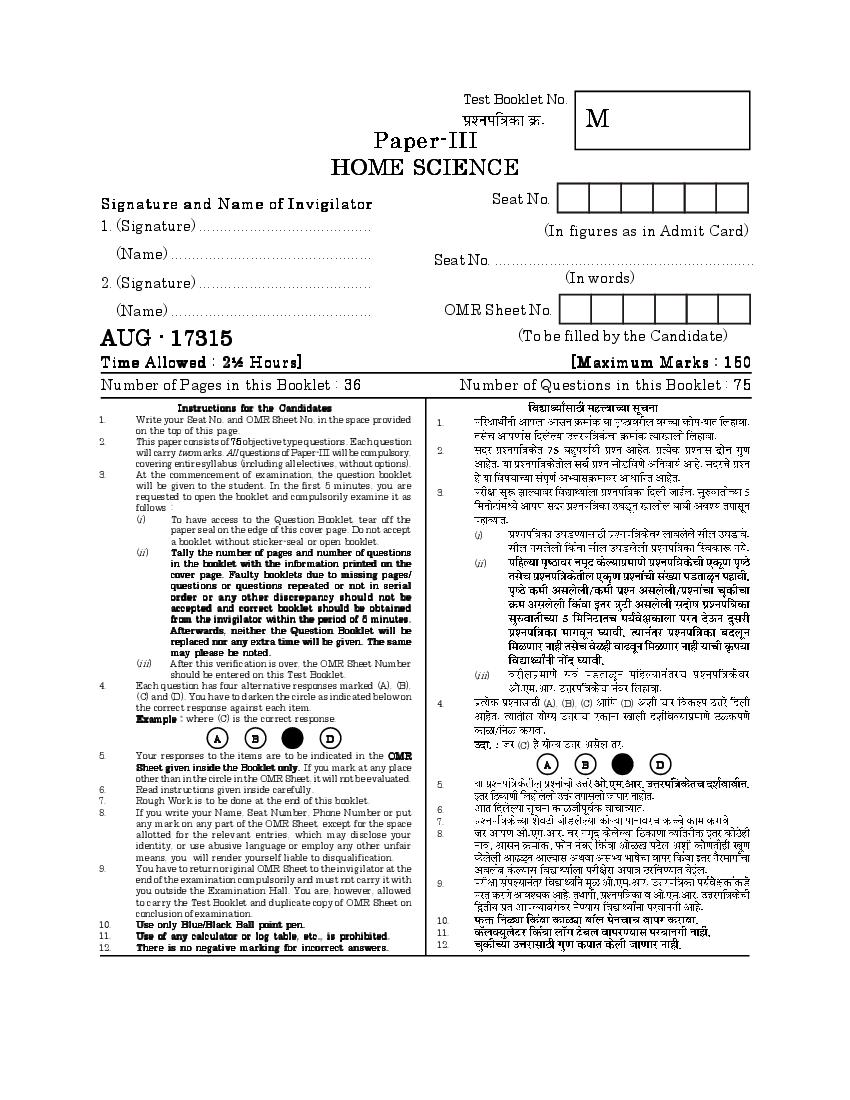
M
HOME SCIENCE
Signature and Name of Invigilator Seat No.
1. (Signature) ......................................... (In figures as in Admit Card)
(Name) ................................................ Seat No. ..............................................................
2. (Signature) ......................................... (In words)
(Name) ................................................ OMR Sheet No.
AUG - 17315 (To be filled by the Candidate)
Time Allowed : 2½ Hours] [Maximum Marks : 150
Number of Pages in this Booklet : 36 Number of Questions in this Booklet : 75
Instructions for the Candidates
1. Write your Seat No. and OMR Sheet No. in the space provided 1.
on the top of this page.
2. This paper consists of 75 objective type questions. Each question
will carry two marks. All questions of Paper-III will be compulsory, 2.
covering entire syllabus (including all electives, without options).
3. At the commencement of examination, the question booklet
will be given to the student. In the first 5 minutes, you are
requested to open the booklet and compulsorily examine it as 3.
follows :
(i) To have access to the Question Booklet, tear off the
paper seal on the edge of this cover page. Do not accept
(i)
a booklet without sticker-seal or open booklet.
(ii) Tally the number of pages and number of questions
in the booklet with the information printed on the (ii)
cover page. Faulty booklets due to missing pages/
questions or questions repeated or not in serial
o rder or any other discre pancy should not be
accepted and correct booklet should be obtained
from the invigilator within the period of 5 minutes.
Afterwards, neither the Question Booklet will be
replaced nor any extra time will be given. The same
may please be noted.
(iii) After this verification is over, the OMR Sheet Number
should be entered on this Test Booklet. (iii)
4. Each question has four alternative responses marked (A), (B),
(C) and (D). You have to darken the circle as indicated below on
the correct response against each item. 4. (A), (B), (C) (D)
Example : where (C) is the correct response.
A B D
(C)
5. Your responses to the items are to be indicated in the OMR
Sheet given inside the Booklet only. If you mark at any place A B D
other than in the circle in the OMR Sheet, it will not be evaluated.
5.
6. Read instructions given inside carefully.
7. Rough Work is to be done at the end of this booklet.
8. If you write your Name, Seat Number, Phone Number or put 6.
any mark on any part of the OMR Sheet, except for the space 7.
allotted for the relevant entries, which may disclose your 8.
identity, or use abusive language or employ any other unfair
means, you will render yourself liable to disqualification.
9. You have to return original OMR Sheet to the invigilator at the
end of the examination compulsorily and must not carry it with 9.
you outside the Examination Hall. You are, however, allowed
to carry the Test Booklet and duplicate copy of OMR Sheet on
conclusion of examination.
10. Use only Blue/Black Ball point pen. 10.
11. Use of any calculator or log table, etc., is prohibited. 11.
12. There is no negative marking for incorrect answers. 12.
Page 2
Page 3
Paper III
III
Time Allowed : 2½ Hours] [Maximum Marks : 150
Note : This Paper contains Seventy Five (75) multiple choice questions, each
question carrying Two (2) marks. Attempt All questions.
(75) (2)
1. MCTs contain ........ 1.
(A) More than C12 (A) 12
(B) Less than C6 (B) 6
(C) C6–C 10 (C) C6–C 10
(D) C6–C 12 (D) C6–C 12
2. Vitamin E supplementation is 2.
suggested in :
(A) Tardive Dyskinesia (A)
(B) Osteoarthritis (B)
(C) Alzeimer’s disease (C)
(D) Ulcerative colitis (D)
3 [P.T.O.
Page 4
fenugreek seeds is :
(A) BCAA (A)
(B) Catechin (B)
(C) Trigonelline (C)
(D) Lignin (D)
4. Lectins are : 4.
(A) Protease inhibitors (A)
(B) Sugar binding protein (B)
(C) Probiotic (C)
(D) Prebiotic (D)
5. Hormone calcitonin : 5.
(A) Decreases calcium absorption (A)
from GIT
(B) Increases calcium reabsorption (B)
(C) Promotes calcium absorption in (C)
small intestine
(D) Prevents calcium mobilization
(D)
from bones
4
Page 5
discoloured because of formation
of :
(A)
(A) Carbon dioxide
(B)
(B) Iron sulfide
(C) Ferrous oxide (C)
(D) Oxygen (D)
7. An enzyme that plays a vital role 7.
in producing angiotensin is :
(A) Rennin (A) (Rennin)
(B) Trypsin (B)
(C) Dipeptidase (C)
(D) Renin (D) (Renin)
8. Retinol is stored in : 8.
(A) Retina (A)
(B) Kidney (B)
(C) Liver (C)
(D) Bones (D)
5 [P.T.O.
Page 6
(A) Tyrosine (A)
(B) Serine (B)
(C) Valine (C)
(D) Tryptophan (D)
10. Meat tenderizing enzyme is : 10.
(A) Papain
(A)
(B) Lycopene
(B)
(C) Ficin
(C)
(D) Pepsin
(D)
11. A pregnant lady requires .............. mg 11.
of calcium daily.
(A) 400—600 (A) 400—600
(B) 600—800 (B) 600—800
(C) 1000 (C) 1000
(D) 1200 (D) 1200
6
Page 7
is :
(A) Oncotic pressure (A)
(B) Osmotic pressure (B)
(C) Colloidal pressure (C)
(D) Portal pressure (D)
13. pH of a protein solution at which the 13. pH
positive and negative charges are
the same is :
(A)
(A) Isoelectric point
(B)
(B) Isometric point
(C)
(C) Electromagnetic point
(D) Electrokinetic point (D)
7 [P.T.O.
Page 8
the demand was seen in the
marketing evolution of :
(A) Production era (A)
(B) Sales era (B)
(C) Management era (C)
(D) Sales and production era (D)
15. Promotion without monetary benefit 15.
is :
(A) Up promotion (A)
(B) Out promotion (B)
(C) Lateral promotion (C)
(D) Dry promotion (D)
8
Page 9
(A) Hostel (A)
(B) Hotel (B)
(C) Coffee shop (C)
(D) Fast-food service (D)
17. SEBI means :
17.
(A) Stock Exchange Board of
(A)
India
(B) Securities Exchange Board of
(B)
India
(C) Share Exchange Board of
India
(C)
(D) State Exchange Board of
(D)
India
9 [P.T.O.
Page 10
(A) Table of special food (A)
(B) Table of the host (B)
(C) Table of menu (C)
(D) Table of special menu (D)
19. The leader who provides freedom 19.
to employees and lets the
organisation run at its own
pace :
(A)
(A) Bureaucratic leader
(B)
(B) Diplomatic leader
(C)
(C) Free rein leader
(D) Instrumental leader (D)
10
Page 11
in :
(A) Malaria (A)
(B) Tuberculosis (B)
(C) Typhoid (C)
(D) Pneumonia (D)
21. A numerical value of a food’s ability 21.
to rise blood sugar is termed
as :
(A)
(A) Glycemic Index
(B)
(B) Glycemic Load
(C)
(C) Glycemic Number
(D)
(D) Glycemic Standard
11 [P.T.O.
Page 12
of renal calculi is :
(A) Nephritis (A)
(B) Nephrosis (B)
(C) Pyelonephritis (C)
(D) Nephrolithiasis (D)
23. Peptic ulcer is caused by : 23.
(A) Acetobacter pylori (A)
(B) Enterobacter pylori (B)
(C) Erwinia bacter pylori (C)
(D) Helicobacter pylori (D)
24. A fibre rich diet is advised for : 24.
(A) Peptic ulcer
(A)
(B) Obesity
(B)
(C) Malabsorption syndrome (C)
(D)
(D) Diarrhoea
12
Page 13
(A) Direct cost (A)
(B) Operating cost (B)
(C) Material cost (C)
(D) Labour cost (D)
26. The method of child study which is 26.
vastly time consuming is ...........
(A) Biographical (A)
(B) Observation (B)
(C) Anecdotal (C)
(D) Experimental (D)
27. The reflex that helps in early social 27.
relationship is :
(A) Rooting reflex (A)
(B) Palmar grasp reflex (B)
(C) Tonic-neck reflex (C)
(D) Stepping reflex (D)
13 [P.T.O.
Page 14
expression of :
(A) Discomfort (A)
(B) Breath (B)
(C) Movement (C)
(D) Anger (D)
29. Demanding, strict and punishment 29.
giving parents are :
(A) Authoritarian (A)
(B) Permissive (B)
(C) Democratic (C)
(D) Diplomatic (D)
30. Sudden infant death syndrome is 30.
more common in :
(A) Breast fed babies (A)
(B) Bottle fed babies (B)
(C) Weaning babies (C)
(D) Premature babies (D)
14
Page 15
when a couple plan to have a
child.
(A)
(A) Adolescence
(B)
(B) Adulthood
(C)
(C) Disciplining
(D)
(D) Parenting
32. PPP refers to : 32.
(A) Physical Programme for
Parents
(A)
(B) Parental Preparation for
(B)
Planning
(C)
(C) Pulse Parental Programme
(D)
(D) Pulse Polio Programme
15 [P.T.O.
Page 16
for the ............of children.
(A) Socialisation (A)
(B) Dissolution (B)
(C) Evolution (C)
(D) Production (D)
34. Which of the following helps in
34.
reducing maternal and infant
mortality by promoting institutional
delivery among the poor pregnant
women ?
(A) Janani Shishu Suraksha (A)
Karyakram
(B)
(B) Janani Suraksha Yojana
(C) Matru Shishu Suraksha
(C)
Yojana
(D)
(D) Family Planning
16
Page 17
(NRHM) which aims at major
qualitative improvements in
standards of public health and ......
(A)
(A) Health care in the rural areas
(B)
(B) Urban health
(C) Education for rural (C)
(D) Food for poor (D)
36. The changes in the structure and 36.
function of the reproductive organs
begin during :
(A)
(A) Puberty
(B)
(B) Late adolescence
(C) (A) (B)
(C) Both (A) and (B)
(D)
(D) Early adulthood
17 [P.T.O.
Page 18
emotional development within social
relationships ?
(A) Piaget and Freud (A)
(B) O’Bryan and Piaget (B)
(C) Freud and Spitz (C)
(D) Spitz and O’Bryan (D)
38. Which of the following is essential 38.
for textile fibre identification ?
(A) Dye bath (A)
(B) Colorimeter (B)
(C) Pick glass (C)
(D) Microscope (D)
18
Page 19
to :
(A) Silk saris (A)
(B) Denim garments (B)
(C) Terry wool jackets (C)
(D) Cotton nightwear (D)
40. Dress forms are used for : 40.
(A) Designing by draping
(B) Displaying garments (A)
(C) Drafting garments (B)
(D) Adaptation by flat pattern (C)
method (D)
41. A French curve is used for : 41.
(A) French seam (A)
(B) Drawing neckline (B)
(C) Raglan sleeve (C)
(D) Finishing edges (D)
19 [P.T.O.
Page 20
control agency in India ?
(A) DIN (A)
(B) WRA (B)
(C) BIS (C)
(D) AATCC (D)
43. The colour fastness to light of a dyed 43.
fabric can be tested by :
(A) Fadometer
(A)
(B) Elemendrof tester
(B)
(C) Crockmeter
(C)
(D) Launderometer
(D)
44. The textile finish that gives lusture
44.
is :
(A)
(A) Gigging
(B)
(B) Napping
(C)
(C) Calendering
(D)
(D) Tebilizing
20
Page 21
shuttleless loom ?
(A)
(A) Rapier loom
(B)
(B) Shantiniketan loom
(C)
(C) Drugget loom
(D) Balarampur loom (D)
46. Sanganer is famous for : 46.
(A) Weaving units
(A)
(B) Phulkari
(B)
(C) Gota embroidery
(C)
(D) Block printed textiles
(D)
47. Which of the following is a
47.
famous Shawl manufactured at
Aurangabad ?
(A)
(A) Doshala
(B)
(B) Panetar
(C)
(C) Himroo
(D)
(D) Jamevar
21 [P.T.O.
Page 22
containing two or more different
generic fiber types in one colour is
known as :
(A)
(A) Union dyeing
(B)
(B) Cross dyeing
(C) Piece dyeing (C)
(D) Stock dyeing (D)
49. Which of the following dyes is not 49.
suitable for cellulosic fibres ?
(A) Disperse dye (A)
(B) Direct dye (B)
(C) Azoic dye (C)
(D) Vat dye (D)
22
Page 23
dyed fabric to create white design
on coloured background is :
(A)
(A) Resist printing
(B)
(B) Discharge printing
(C)
(C) Direct printing
(D) Khadi printing (D)
51. Planning is : 51.
(A) Scrutinizing, reviewing and (A)
forecasting
(B) Scrutinizing, rewarding and
(B)
forecasting
(C)
(C) Scrutinizing, reviewing and
training
(D)
(D) Scrutinizing, rating and
training
23 [P.T.O.
Page 24
in terms of quality of living
is :
(A)
(A) Subsidiary income
(B)
(B) Psychic income
(C)
(C) Real income
(D) Money income (D)
53. The effective reach area 53.
for an individual in work space
is :
(A) 85
(A) 85 cm
(B) 85
(B) 85 mm
(C) 145
(C) 145 mm
(D) 145 cm (D) 145
24
Page 25
freedom is :
(A)
(A) Abstract
(B)
(B) Conventional
(C)
(C) Naturalistic
(D) Geometric (D)
55. The three stems used in Japanese 55.
flower arrangement are denoted
as :
(A) -
(A) Tallest-man, second stem-earth,
third stem-heaven
(B) -
(B) Tallest-heaven, second stem-
earth, third stem-man
(C) -
(C) Tallest-man, second stem-
heaven, third stem-earth
(D) Tallest-heaven, second stem- (D) -
man, third stem-earth
25 [P.T.O.
Page 26
resource of management :
(A) Man (A)
(B) Material (B)
(C) Money (C)
(D) Monitor (D)
57. The effort involved in home making 57.
activities such as bending, leaning,
kneeling and stooping is :
(A) Physical effort (A)
(B) Pedal effort (B)
(C) Muscular effort (C)
(D) Torsal effort (D)
26
Page 27
(A) Pathway chart (A)
(B) Process chart (B)
(C) Flow chart (C)
(D) Pie chart (D)
59. World Consumer Day falls on : 59.
(A) 5th March (A) 5
(B) 10th March (B) 10
(C) 15th March (C) 15
(D) 25th March (D) 25
60. House planning principles of 60.
orientation states that the kitchen
should be placed towards :
(A)
(A) East
(B)
(B) West
(C)
(C) South
(D) North (D)
27 [P.T.O.
Page 28
water purification equipment helps
in :
(A)
(A) Filtering dirt
(B)
(B) Absorbing organic impurities
(C) Inactivating bacteria (C)
(D) Filtering insects (D)
62. Laws of mechanics that apply to 62.
body movement and segment are :
(A) Gravitational force, arm
(A)
position, work height
(B) Gravitational force, momentum,
(B)
arm position
(C) Arm position, moment, work
height (C)
(D) Arm position, work height, (D)
leverage
28
Page 29
(A) Slides, filmstrip, opaque
(A)
projector
(B) Chalk board, Bulletin board (B)
(C) Drama, puppet show, talking
(C)
doll
(D) Tape recorder, telephone (D)
64. Behavioural change in human
64.
being in extension education
includes :
(A)
(A) Change in thinking
(B) Change in attitude (B)
(C) Change in skill
(C)
(D) Change in knowledge, attitude
(D)
and skill
29 [P.T.O.
Page 30
Panchayat Raj system was first
introduced :
(A)
(A) Uttar Pradesh
(B)
(B) Rajasthan
(C)
(C) Haryana
(D) Maharashtra (D)
66. To assess the progress of the 66.
programme is known as :
(A)
(A) Evaluation
(B)
(B) Organization
(C)
(C) Planning
(D) Decision-making (D)
30
Page 31
67.
Development Programme was
started in India ?
(A) Netaji Subhash Chandra (A)
Bose
(B)
(B) Pandit Jawahar Lal Nehru
(C)
(C) Mahatma Gandhi
(D) Sardar Patel (D)
68. Basic principle of Extension 68.
Education is :
(A)
(A) Help to those who help
themselves
(B) Help poorest of the poor (B)
(C) Internal and Spiritual (C)
Education
(D)
(D) Adult Education
31 [P.T.O.
Page 32
by Balwant Rai Mehta in the
year :
(A) 1952
(A) 1952
(B) 1955
(B) 1955
(C) 1957
(C) 1957
(D) 1961 (D) 1961
70. Rural upliftment on mass scale 70.
was started by Mr. F.L. Brayne
who started Gurgaon Project
in the year :
(A) 1918
(A) 1918
(B) 1920
(B) 1920
(C) 1921
(C) 1921
(D) 1922 (D) 1922
32
Page 33
is :
(A) Village (A)
(B) Family (B)
(C) Town (C)
(D) Government (D)
72. A balanced extension programme is
72.
one which considers :
(A) Location specific recommen-
(A)
dation
(B) Needs and desires of people (B)
(C) Broad based programme
(C)
(D) Gives proper consideration to
(D)
the facts, resources and
time
33 [P.T.O.
Page 34
(A) Child education (A)
(B) Women’s education (B)
(C) Adult education (C)
(D) Distance education (D)
74. Tests and scaling are :
74.
(A) Quantitative measurement
technique (A)
(B) Qualitative measurement
(B)
technique
(C) Both qualitative and (C)
quantitative
(D)
(D) None of the above
75. Leadership is the product of : 75.
(A) Position rather than knowledge (A)
(B) Knowledge rather than position (B)
(C) Position alone (C)
(D) Knowledge alone (D)
34
Page 35
35 [P.T.O.
Page 36
36
Document Details
| Board / Org | Maharashtra Exams |
| Exam | MAHA SET |
| Type | Question Paper |
| Pages | 36 |
| Updated | 30 Apr 2026 |