PSEB 12th Model Test Paper 2023 Chemistry
Finished viewing? Save it for later —
Download PSEB 12th Model Test Paper 2023 Chemistry (PDF · 7 pages)About PSEB 12th Model Test Paper 2023 Chemistry
PSEB 12th Model Test Paper 2023 Chemistry is available here for free download. Published by Punjab Board for Class 12, this sample paper can be viewed online or downloaded as a PDF (7 pages). Candidates preparing for Class 12 can use PSEB 12th Model Test Paper 2023 Chemistry to understand the exam pattern, the type of questions asked, and the overall difficulty level.
Frequently Asked Questions
How can I download PSEB 12th Model Test Paper 2023 Chemistry?
Open this page and click the Download button to save PSEB 12th Model Test Paper 2023 Chemistry as a PDF. It is completely free on AglaSem Docs.
Is PSEB 12th Model Test Paper 2023 Chemistry free to download?
Yes. PSEB 12th Model Test Paper 2023 Chemistry can be viewed online and downloaded as a PDF free of cost on AglaSem Docs.
How many pages does PSEB 12th Model Test Paper 2023 Chemistry have?
PSEB 12th Model Test Paper 2023 Chemistry contains 7 pages, which you can read online or download together as a single PDF.
Where can I find more Class 12 study material?
You can find more Class 12 question papers, sample papers, syllabus, and answer keys on AglaSem Docs.
PSEB 12th Model Test Paper 2023 Chemistry – Text
Read the full text of this sample paper below — useful to quickly search, copy and reference the content online without downloading the PDF.
📄 View text version (5 pages)
Page 1
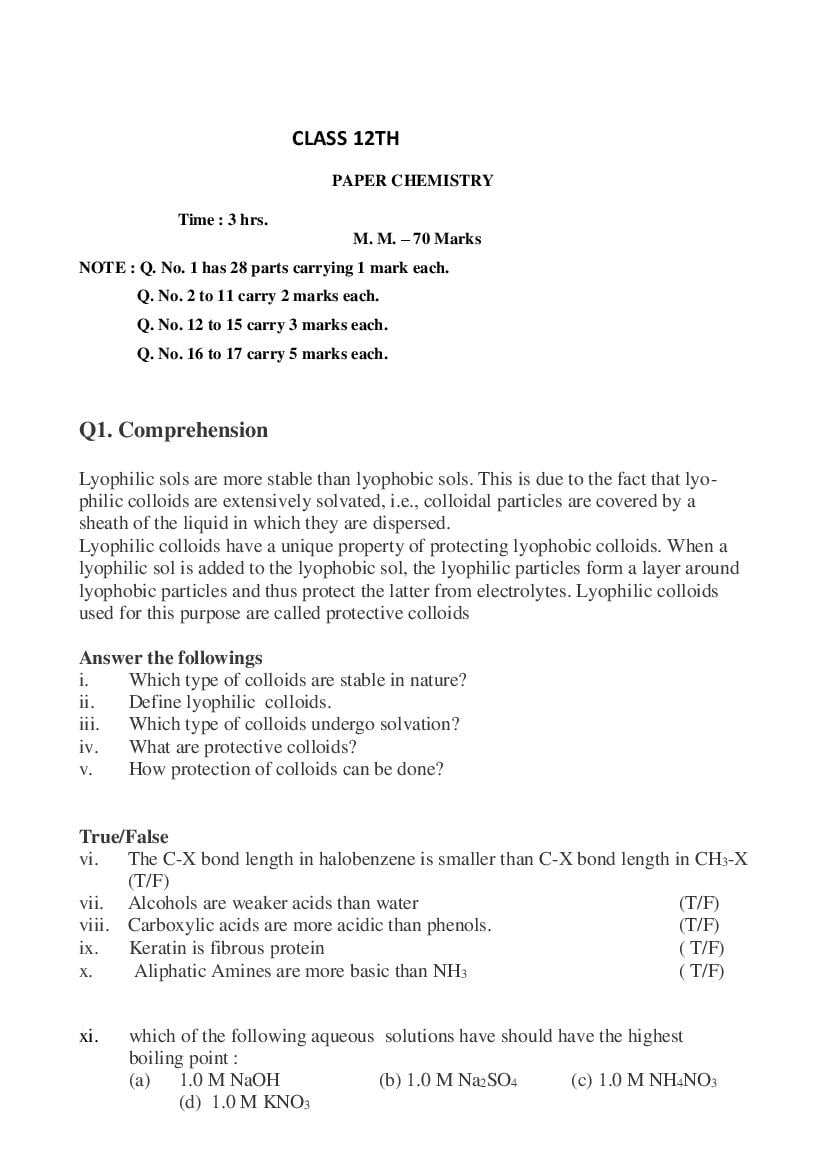
PAPER CHEMISTRY
Time : 3 hrs.
M. M. – 70 Marks
NOTE : Q. No. 1 has 28 parts carrying 1 mark each.
Q. No. 2 to 11 carry 2 marks each.
Q. No. 12 to 15 carry 3 marks each.
Q. No. 16 to 17 carry 5 marks each.
Q1. Comprehension
Lyophilic sols are more stable than lyophobic sols. This is due to the fact that lyo-
philic colloids are extensively solvated, i.e., colloidal particles are covered by a
sheath of the liquid in which they are dispersed.
Lyophilic colloids have a unique property of protecting lyophobic colloids. When a
lyophilic sol is added to the lyophobic sol, the lyophilic particles form a layer around
lyophobic particles and thus protect the latter from electrolytes. Lyophilic colloids
used for this purpose are called protective colloids
Answer the followings
i. Which type of colloids are stable in nature?
ii. Define lyophilic colloids.
iii. Which type of colloids undergo solvation?
iv. What are protective colloids?
v. How protection of colloids can be done?
True/False
vi. The C-X bond length in halobenzene is smaller than C-X bond length in CH3-X
(T/F)
vii. Alcohols are weaker acids than water (T/F)
viii. Carboxylic acids are more acidic than phenols. (T/F)
ix. Keratin is fibrous protein ( T/F)
x. Aliphatic Amines are more basic than NH3 ( T/F)
xi. which of the following aqueous solutions have should have the highest
boiling point :
(a) 1.0 M NaOH (b) 1.0 M Na2SO4 (c) 1.0 M NH4NO3
(d) 1.0 M KNO3
Page 2
(a) Nature of solute particles present in the solution
(b) Nature of solute particles present in the solution
(c) Physical properties of the solute particles
(d) Nature of the solvent particles
xiii. The value of Henry’s constant :
(a) Increases with increase in temp (b) decreases with increase in temp (c)
remains contant (d) first increases the decreases
xiv. 18 g of glucose is dissolved in 1kg of water at what temp will the water boil ,
kb for water is 0.52 K kg mol-1
(a)373.2 K (b) 378.2 K (c) 381.5 K (d)
xv. Which of the followings oxidation state of oxygen is +2
(a) Cl2O (b) O2F2 (c) OF2 (d) N2O
xvi. Ethanol upon heating with conc. H2SO4 at 443 k gives:
(a) Diethyl ether (b) Ethylene
(c) Ethyl hydrogen sulphate (d) none of these
Page 3
(a) +3 (b) +2 (c) +4 (d) -3
xviii. IUPAC name of the complex K3[Fe(CN)6 ] is
(a) potassium hexacyanoferrate (II) (b) potassium hexacyanoferrate (III) (c)
potassium hexacyanoiron (II) (d) tripotassium hexacyanoiron (II)
xix. Which among the followings is disaccharides
(a) Glucose b) cellulose (c) Sucrose (d) starch
xx. Which among the followings is globular protein ?
(a) Albumin (b) Keratin (c) collagen (d) None of the above
xxi. Which among the following is secondary amine:
(a) CH3NH2 (b) ( CH3)3N
(c) CH3NHCH3 (d) CH3CH2NH2
xxii. Alkyl cyanide upon reduction with Na/ethanol gives
(a) Carboxylic acids (b) primary amines
(c) sec- amine (d) tert-amine
xxiii. Which among the followings is most acidic?
(a) Acetic acid (b) Formic acid
(c) Chloroacetic acid (d) Ethanol
xxiv. Which among the followings undergoes cannizzaro’s reaction?
(a) Ethanal (b) Benzaldehyde
(c) Propanal (d) None of above
xxv. When alipahtic aldehydes are treate with fehling solution, following observation
is obtained
(a) White ppt (b) red coluration (c) Orange colouration (d) Brown
coluration
xxvi. In Clemmensen reduction the reducing agent used is
(a) Na / ethanol (b) Zn-Hg /HCl (c) Mg-Hg/H2O (d) LiAlH4
xxvii. One Faraday contains the charge
(a) 95000C (b) 96500 C (c) 94500 C (d) 95600 C
xxviii. XeF2 has linear structure because
(a) Xe is sp3d2 hybridized having 6 bp and 1lp (b) Xe is sp3d2 hybridized having
4 bp and 2 lp (c) Xe is sp3d hybridized having 2 bp and 3 lp
(d) Xe is sp3 hybridized having 3 bp and 1lp
Page 5
Questions
Q2 The vapour pressure of 2.1% of an queous solution pf a non electrolyte at 373 k is
755 mm calculate the molar mass of solute
OR
When 1.80 gm of non volatile compound is dissolved in 25 g of acetone, the solution
boils at 56.86 C while pure acetone boils at 56.38 C under the same atmospheric
pressure calculate the molar mass of the compound .Kb for acetone is 1.72 K kg mol-1
Q3. What is specific conductance of a solution ? How it varies with dilution ?
Q4. A first order reaction is found to have a rate constant k =5.5 X10⁻¹⁴ sec-1 Find
the half life period
OR
A first order reaction is 75% completed in 40 minutes , calculate its half life
period
Q5. Why does NCl5 not exist ?
OR
Oxygen is a gas while sulphur is solid . explain
Q6. Why nitrous acid is oxidant as well as reductant ?
OR
What is the basicity of H3PO4 and why ?
Q7. Why transition metals act as good catalysts?
Q8. Why are Mn2+ compounds more stable than Fe2+ towards oxidation to their +3
state?
Q10. What is meant by unidentate and ambidentate ligands? Give two examples for
each.
OR
[Fe(CN)6]4– and [Fe(H2O)6]2+ are of different colours in dilute solutions. Why?
Q11. Explain the factors affecting rate of a reaction.
Section-C Three Mark Questions
Q12. Calculate the potential of hydrogen electrode in contact with a solution whose
Q13. Compare
pH is 10.and explain the reactivity OR
of different alcohols towards sodium.
Page 7
the time required for the completion of 90% of reaction.
OR
A first order reaction takes 40 min for 30% decomposition.
Calculate half life period.
Q15. Why is dioxygen a gas but sulphur a solid?
Section-D Five Mark Questions
Q16. Explain giving reasons-
(i) Transition metals and many of their compounds show paramagnetic behav
iour. (1)
(ii) The enthalpies of atomisation of the transition metals are high. (2)
(iii) The transition metals generally form coloured compounds. (2)
(i) n-butyl chloride is treated with alcoholic
OR KOH
(ii) bromobenzene is treated with Mg in the presence of dry ether
(iii)
(i) ethyl chloride
Transition is treated
metals with
and their aqueous
many KOH act as good catalyst. (2)
compounds
(iv)
(ii) methyl
Of the dbromide
4
species,isCr
treated
2+ with sodium
is strongly in the
reducing presence
while of dryisether
manganese strongly oxidis
(v) methyl
ing. (2) chloride is treated with KCN ?
(iii) The d1 configuration is very unstable in ions.(1)
Q17. What happens when-
OR
Give
(i) the following reactions-
Sandmeyer’s reaction
(ii) Finkelstein reaction
(iii) Hundsdiecker reaction
(iv) Fittig reaction
(v) Ullmann reaction
Document Details
| Board / Org | Punjab Board |
| Exam | Class 12 |
| Type | Sample Paper |
| Pages | 7 |
| Language | english |
| Updated | 22 Jul 2026 |