MAHA SET 2015 Question Paper 3 Sociology
Finished viewing? Save it for later —
Download MAHA SET 2015 Question Paper 3 Sociology (PDF · 40 pages)About MAHA SET 2015 Question Paper 3 Sociology
MAHA SET 2015 Question Paper 3 Sociology is available here for free download. Published by Maharashtra Exams for Maharashtra State Eligibility Test, this question paper can be viewed online or downloaded as a PDF (40 pages). Candidates preparing for Maharashtra State Eligibility Test can use MAHA SET 2015 Question Paper 3 Sociology to understand the exam pattern, the type of questions asked, and the overall difficulty level.
Frequently Asked Questions
How can I download MAHA SET 2015 Question Paper 3 Sociology?
Open this page and click the Download button to save MAHA SET 2015 Question Paper 3 Sociology as a PDF. It is completely free on AglaSem Docs.
Is MAHA SET 2015 Question Paper 3 Sociology free to download?
Yes. MAHA SET 2015 Question Paper 3 Sociology can be viewed online and downloaded as a PDF free of cost on AglaSem Docs.
How many pages does MAHA SET 2015 Question Paper 3 Sociology have?
MAHA SET 2015 Question Paper 3 Sociology contains 40 pages, which you can read online or download together as a single PDF.
Where can I find more Maharashtra State Eligibility Test study material?
You can find more Maharashtra State Eligibility Test question papers, sample papers, syllabus, and answer keys on AglaSem Docs.
MAHA SET 2015 Question Paper 3 Sociology – Text
Read the full text of this question paper below — useful to quickly search, copy and reference the content online without downloading the PDF.
📄 View text version (40 pages)
Page 1
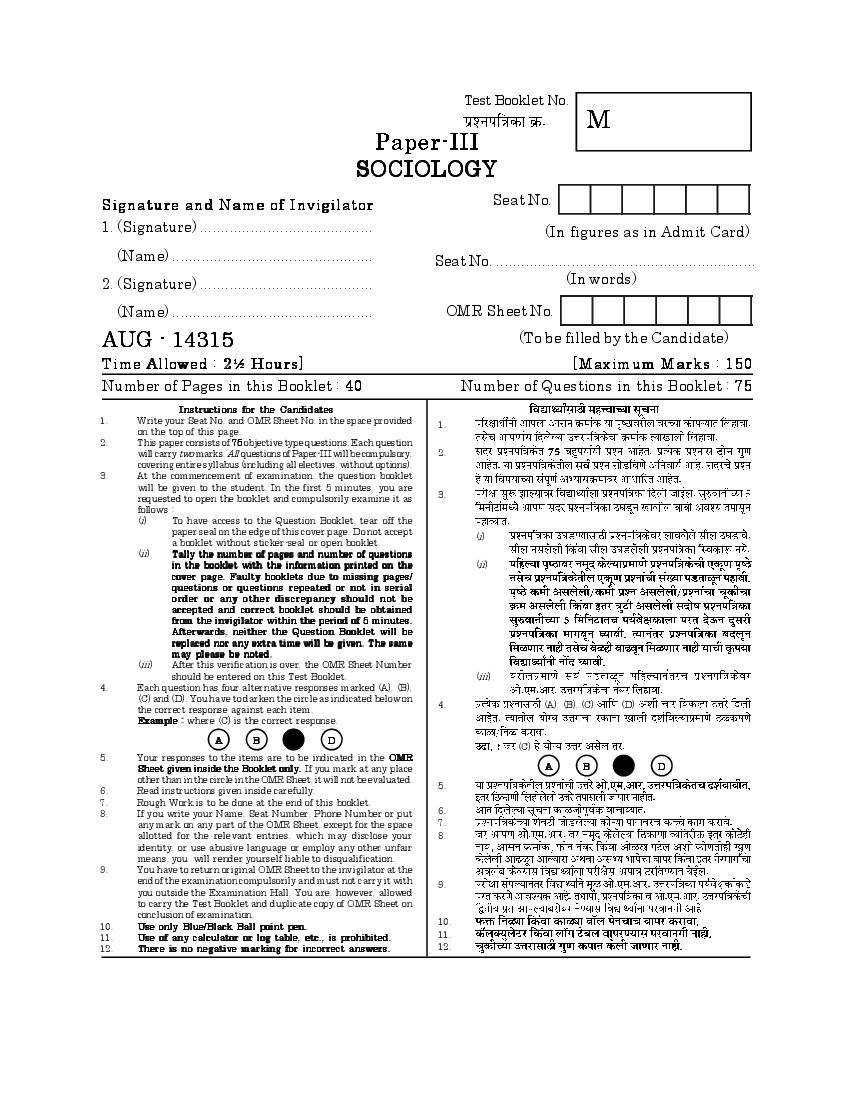
M
SOCIOLOGY
Signature and Name of Invigilator Seat No.
1. (Signature) ......................................... (In figures as in Admit Card)
(Name) ................................................ Seat No. ..............................................................
2. (Signature) ......................................... (In words)
(Name) ................................................ OMR Sheet No.
AUG - 14315 (To be filled by the Candidate)
Time Allowed : 2½ Hours] [Maximum Marks : 150
Number of Pages in this Booklet : 40 Number of Questions in this Booklet : 75
Instructions for the Candidates
1. Write your Seat No. and OMR Sheet No. in the space provided 1.
on the top of this page.
2. This paper consists of 75 objective type questions. Each question
will carry two marks. All questions of Paper-III will be compulsory, 2.
covering entire syllabus (including all electives, without options).
3. At the commencement of examination, the question booklet
will be given to the student. In the first 5 minutes, you are
requested to open the booklet and compulsorily examine it as 3.
follows :
(i) To have access to the Question Booklet, tear off the
paper seal on the edge of this cover page. Do not accept
(i)
a booklet without sticker-seal or open booklet.
(ii) Tally the number of pages and number of questions
in the booklet with the information printed on the (ii)
cover page. Faulty booklets due to missing pages/
questions or questions repeated or not in serial
order or any other discre pancy should not be
accepted and correct booklet should be obtained
from the invigilator within the period of 5 minutes.
Afterwards, neither the Question Booklet will be
replaced nor any extra time will be given. The same
may please be noted.
(iii) After this verification is over, the OMR Sheet Number
should be entered on this Test Booklet. (iii)
4. Each question has four alternative responses marked (A), (B),
(C) and (D). You have to darken the circle as indicated below on
the correct response against each item. 4. (A), (B), (C) (D)
Example : where (C) is the correct response.
A B D
(C)
5. Your responses to the items are to be indicated in the OMR
Sheet given inside the Booklet only. If you mark at any place A B D
other than in the circle in the OMR Sheet, it will not be evaluated.
5.
6. Read instructions given inside carefully.
7. Rough Work is to be done at the end of this booklet.
8. If you write your Name, Seat Number, Phone Number or put 6.
any mark on any part of the OMR Sheet, except for the space 7.
allotted for the relevant entries, which may disclose your 8.
identity, or use abusive language or employ any other unfair
means, you will render yourself liable to disqualification.
9. You have to return original OMR Sheet to the invigilator at the
end of the examination compulsorily and must not carry it with 9.
you outside the Examination Hall. You are, however, allowed
to carry the Test Booklet and duplicate copy of OMR Sheet on
conclusion of examination.
10. Use only Blue/Black Ball point pen. 10.
11. Use of any calculator or log table, etc., is prohibited. 11.
12. There is no negative marking for incorrect answers. 12.
Page 2
Page 3
Paper III
III
Time Allowed : 2½ Hours] [Maximum Marks : 150
Note : This paper contains Seventy Five (75) multiple choice questions, each
carrying Two (2) marks. Attempt All questions.
(75) (2)
1. The book ‘Asylums’ is written by : 1.
(A) Erving Goffman (A)
(B) Alfred Shultz (B)
(C) Peter Berger (C)
(D) J. Alexander (D)
2. According to one scholar, “the 2.
keypoint about ethnomethods is that
they are reflexively accountable”.
Who is this scholar ?
(A) Nicholson (A)
(B) Giddens (B)
(C) Garfinkel (C)
(D) Elias (D)
3 [P.T.O.
Page 4
the correct answer from the codes
given below :
List I I
(Authors)
(a) Alfred Schultz (a)
(b) Habermass (b)
(c) Foucault (c)
(d) Garfinkel (d)
List II II
(Concepts)
(i) Ethnomethodology (i)
(ii) Discourse analysis (ii)
(iii) Typification (iii)
(iv) Critical theory (iv)
(v) Functionalism (v)
Codes :
(a) (b) (c) (d) (a) (b) (c) (d)
(A) (iii) (i) (ii) (iv) (A) (iii) (i) (ii) (iv)
(B) (ii) (iv) (iii) (v) (B) (ii) (iv) (iii) (v)
(C) (iii) (iv) (ii) (i) (C) (iii) (iv) (ii) (i)
(D) (i) (iv) (v) (iii) (D) (i) (iv) (v) (iii)
4
Page 5
society is :
(A) Undistorted communication
(A)
(B) Controlled communication
(B)
(C) Symbolic communication
(C)
(D) Communication of certain
(D)
classes of intellectuals
5. ‘Sociology should be based on a post- 5.
positivistic understanding and the
scientific development should be
understood as much through
theoretical as through empirical
explanations.’ Who suggests this ?
(A)
(A) Althusser
(B)
(B) Colomy
(C) J. Alexander (C)
(D) N. Smelser (D)
5 [P.T.O.
Page 6
is :
(A)
(A) extraordinarily eclectic
(B)
(B) based on teleology
(C)
(C) humanistic in appeal
(D)
(D) anti-Marxist
7. The term ‘biopower’ is associated 7.
with :
(A) Derrida (A)
(B) Habermass (B)
(C) Goffman (C)
(D) Foucault (D)
6
Page 7
selecting correct codes :
List I
I
(Authors)
(a) Foucault
(a)
(b) Giddens
(b)
(c) Derrida
(c)
(d) Althusser
(d)
List II
II
(Concepts)
(i) Duality of structure
(i)
(ii) Relative autonomy (ii)
(iii) Panoptic (iii)
(iv) Discourse analysis (iv)
Codes :
(a) (b) (c) (d) (a) (b) (c) (d)
(A) (iv) (ii) (iii) (i) (A) (iv) (ii) (iii) (i)
(B) (iii) (iv) (i) (ii) (B) (iii) (iv) (i) (ii)
(C) (i) (ii) (iv) (iii) (C) (i) (ii) (iv) (iii)
(D) (iii) (i) (iv) (ii) (D) (iii) (i) (iv) (ii)
7 [P.T.O.
Page 8
which individuals regulate their
own behaviour in case they are being
observed is :
(A)
(A) Panopticism
(B)
(B) Bio-politics
(C)
(C) Episteme
(D) Body fetishism (D)
10. Which one of the authors wrote 10.
about the conflicts that erupted due
to linguistic diversity in India ?
(A)
(A) M. N. Srinivas
(B)
(B) A. R. Desai
(C)
(C) Myron Weiner
(D)
(D) David Hardiman
11.
11. Who was the author of the book—
“Modern Indian Culture” ?
(A) D. P. Mukherji (A)
(B) N. K. Bose (B)
(C) Surajit Sinha (C)
(D) S. C. Dube (D)
8
Page 9
select the correct answer from the
codes given below :
List I
I
(a) Homo Hierarchicus
(a)
(b) Sanskritization
(b)
(c) Modernization of Indian
(c)
Tradition
(d)
(d) Caste, Class and Occupation
II
List II
(i)
(i) G. S. Ghurye
(ii)
(ii) Yogendra Singh
(iii) Louis Dumont (iii)
(iv) M. N. Srinivas (iv)
Codes :
(a) (b) (c) (d) (a) (b) (c) (d)
(A) (i) (ii) (iii) (iv) (A) (i) (ii) (iii) (iv)
(B) (ii) (iii) (iv) (i) (B) (ii) (iii) (iv) (i)
(C) (iii) (iv) (ii) (i) (C) (iii) (iv) (ii) (i)
(D) (iv) (ii) (i) (iii) (D) (iv) (ii) (i) (iii)
9 [P.T.O.
Page 10
to the norms or values held by most
of the members of a group or society
is called :
(A)
(A) Crime
(B)
(B) Corruption
(C)
(C) Delinquency
(D)
(D) Deviance
14. Which one is the recent committee 14.
to look into the regional imbalance
of Maharashtra ?
(A) Dantwala Committee (A)
(B) Dandekar Committee (B)
(C) Kelkar Committee (C)
(D) Chavan Committee (D)
10
Page 11
in which rules and hierarchical
ranking are used to achieve
efficiency is known as :
(A) Authority (A)
(B) Bureaucracy (B)
(C) Capitalism (C)
(D) Rationality (D)
16. Who among the following sociologists 16.
was associated with the term division
of labour ?
(A)
(A) Emile Durkheim
(B)
(B) Karl Marx
(C)
(C) Max Weber
(D) Talcott Parsons (D)
11 [P.T.O.
Page 12
17.
by :
(A) Concentration of productive
process (A)
(B) Application of mechanical
(B)
power
(C) Application of animate sources (C)
of power
(D)
(D) Concentration of wealth
18. Which one is an example of 18.
organization ?
(A)
(A) Schools
(B)
(B) Ethnic groups
(C)
(C) Friendship groups
(D) Classes (D)
12
Page 13
factories and Social Change in
India ?
(A)
(A) B. P. Singh
(B)
(B) R. D. Lambert
(C)
(C) S. D. Punekar
(D)
(D) S. S. Khanka
20. N. M. Lokhande in 1890 succeeded 20.
in forming the first labour
organization in India, namely the :
(A) National Union of Railwaymen (A)
(B) Kamgar Hita Vardhak Sabha (B)
(C) Girni-Kamgar Union (C)
(D) Bombay Mill Hands Association (D)
13 [P.T.O.
Page 14
India—Liberalization, Privatization
and Globalization (LPG) was
introduced ?
(A)
(A) Industrial Policy, 1995
(B)
(B) Industrial Policy, 1980
(C)
(C) Industrial Policy, 1991
(D) Industrial Policy, 1986 (D)
22. A work stoppage in which an 22.
employer prevents employees from
working is known as :
(A)
(A) Strikes
(B)
(B) Gherao
(C)
(C) Picketing
(D) Lockouts (D)
14
Page 15
in management is in the lowest
level ?
(A)
(A) Informative participation
(B)
(B) Consultative participation
(C)
(C) Administrative participation
(D)
(D) Associative participation
24.
24. Which Section of Trade Union Act
of 1926 define Trade Union ?
(A) Section 2(h)
(A) 2(h)
(B) Section 2(k)
(B) 2(k)
(C) Section 2(q) (C) 2(q)
(D) Section 2(l) (D) 2(l)
15 [P.T.O.
Page 16
Industrial Relations ?
(A) Employees (A)
(B) Employer (B)
(C) Government (C)
(D) Collective bargaining (D)
26. MRTP Act, 1969 became effective 26.
from the year :
(A) 1970 (A) 1970
(B) 1971
(B) 1971
(C) 1972
(C) 1972
(D) 1973
(D) 1973
16
Page 17
is associated with which
commission ?
(A)
(A) Brutland Commission
(B)
(B) Sutherland Commission
(C)
(C) Carson Commission
(D)
(D) Fanon Commission
28. In Andre Gunder Frank’s 28.
understanding :
(A)
(A) the periphery exists purely for
feeding the requirements of the
core
(B)
(B) both core and peripheries suffer
due to economic instability
(C) core-periphery relations are (C)
determined through market
fluctuations
(D)
(D) core and periphery look forward
to sustainable development
17 [P.T.O.
Page 18
theory’ rejects the notion of ‘Third
World’ and instead proposes :
(A) a multi-polar world
(A)
(B) a bipolar world
(C) global network of economic (B)
exchange
(C)
(D) Accumulation with social
(D)
justice
30. Gunnar Myrdal’s theory of 30.
‘cumulative causation’ is an
alternative theory of undevelopment,
because : (A)
(A) it gave serious attention to
non-economic or institutional
factors (B)
(B) it focuses upon economic growth (C)
(C) it supports theory of ‘stages of
growth’
(D)
(D) if emphasises on humanitarian
approach
18
Page 19
made the statement that ‘one is not
born but rather becomes a woman’.
(A) Margaret Mead (A)
(B) Betty Friedan (B)
(C) Ann Oakley (C)
(D) Simone de Beauvoir (D)
32. Which group of feminists argued 32.
that women’s liberation can only be
achieved by working to end both
economic and cultural sources of
women’s oppression ?
(A)
(A) Post-modernist feminists
(B) Marxist feminists (B)
(C) Socialist feminists (C)
(D) Cultural feminists
(D)
19 [P.T.O.
Page 20
where men constitute the oppresser
class while, women are the
oppressed category.” This under-
standing belongs to :
(A)
(A) Radical feminist
(B)
(B) Post-structural feminist
(C)
(C) Psychoanalytic feminist
(D)
(D) Socialist feminist
34. Who among the following is 34.
considered as an eco-feminist
thinker ?
(A)
(A) Uma Chakravarti
(B)
(B) Romila Thapar
(C)
(C) Vandana Shiva
(D) Leela Dube (D)
20
Page 21
growth of eco-feminism ?
(A) Deforestation in industrial
(A)
society
(B)
(B) Women’s lives and their
relation with the nature
(C) Pollution and environmental (C)
degradation
(D)
(D) Global warming
36. What are less organized and more 36.
spontaneous reactions to non-
conformity ?
(A)
(A) Formal sanctions
(B)
(B) Informal sanctions
(C)
(C) Legal sanctions
(D) Illegal sanctions (D)
37. Which of the following factors 37.
determines the deviance ?
(A) Personality (A)
(B) Society (B)
(C) Politics (C)
(D) Culture (D)
21 [P.T.O.
Page 22
38.
criminology framed their analysis ?
(A) In terms of the structure of
society (A)
(B) In terms of the deprotection of
(B)
the power of the ruling class
(C) In terms of dysfunction in
society (C)
(D) In terms of deconstruction of
(D)
society
39. Who wrote the Article in Sociological 39.
Bulletin in 1998 on ‘A life-world of
Disenchantment : Modernity,
Ethnicity and Pluralism’ ?
(A) T. K. Ommen (A)
(B) Andre Beteille (B)
(C) Yogendra Singh (C)
(D) D. N. Dhanagare (D)
22
Page 23
authors and choose the correct code
given at the end :
Books
(a) The Household Dimensions of (a)
the Family in India
(b) Science and Society
(b)
(c) The Dynamics of Rural Society
(c)
(d) Social Background of Indian
(d)
Nationalism
Authors
(i)
(i) D. D. Kosambi
(ii)
(ii) A. M. Shah
(iii) A. R. Desai (iii)
(iv) Ramkrishna Mukherji (iv)
Codes :
(a) (b) (c) (d) (a) (b) (c) (d)
(A) (i) (ii) (iii) (iv) (A) (i) (ii) (iii) (iv)
(B) (iv) (iii) (i) (ii) (B) (iv) (iii) (i) (ii)
(C) (ii) (i) (iv) (iii) (C) (ii) (i) (iv) (iii)
(D) (ii) (iii) (iv) (i) (D) (ii) (iii) (iv) (i)
23 [P.T.O.
Page 24
not a part of Daniel Thorner’s
classification of rural classes ?
(A) Landlords (A)
(B) Working peasants (B)
(C) Artisans (C)
(D) Labourers (D)
42. Which of the following objectives 42.
was not recommended by Balwant
Rai Mehta Committee to implement,
Panchayat Raj System in its base
structure ?
(A) To represent the felt needs of (A)
the village community
(B) To give power to the non- (B)
officials for the development of
village communities
(C)
(C) Area development programmes
(D) To give power of implementation (D)
to people
24
Page 25
struggle’ to analyse the phenomenon
of Agrarian Unrest‘’ in India ?
(A) Kathleen Gough (A)
(B) A. R. Desai (B)
(C) Hamza Alavi (C)
(D) D. N. Dhanagare (D)
44. When the Naxalbari peasant 44.
struggle was launched ?
(A) 1921 (A) 1921
(B) 1956 (B) 1956
(C) 1918 (C) 1918
(D) 1967 (D) 1967
25 [P.T.O.
Page 26
of drug usage, who has formulated
differential association theory ?
(A) Merton (A)
(B) Burgess (B)
(C) Sutherland (C)
(D) Akers (D)
46. In which city the ‘slums’ are known 46.
as ‘charies’ ?
(A) Mumbai (A)
(B) Chennai (B)
(C) Delhi (C)
(D) Kanpur (D)
26
Page 27
international voluntary health
organization was established ?
(A) Food and Agricultural
Organization (FAO) (A) (FAO)
(B) Red Cross Society (B)
(C) World Health Organization
(C) (WHO)
(WHO)
(D) (UNICEF)
(D) UNICEF
48. The idea of Primary Health Centre 48.
was spelt out in clear terms by :
(A) Union Health Ministry (A)
(B)
(B) Shrivastava Committee
(C)
(C) Bhore Committee
(D)
(D) Mudaliar Committee
27 [P.T.O.
Page 28
the correct answer from the codes
given below :
List I I
(Village)
(a) Rampura (a)
(b) Shamirpeth (b)
(c) Sripuram (c)
(d) Shivpur (d)
List II
II
(Researchers)
(i) M. N. Srinivas
(i)
(ii) S. C. Dube
(ii)
(iii) Andre Beteille
(iii)
(iv) K. Ishwaran
(iv)
(v) G. S. Ghurye
Codes :
(a) (b) (c) (d)
(a) (b) (c) (d)
(A) (v) (iv) (iii) (ii)
(A) (v) (iv) (iii) (ii)
(B) (i) (ii) (iii) (iv)
(B) (i) (ii) (iii) (iv)
(C) (iii) (ii) (i) (iv)
(C) (iii) (ii) (i) (iv)
(D) (i) (iii) (ii) (iv) (D) (i) (iii) (ii) (iv)
28
Page 29
covered a wider area and was more
modern in nature was undertaken
in India in the year :
(A) 1867 (A) 1867
(B) 1872 (B) 1872
(C) 1881 (C) 1881
(D) 1883 (D) 1883
51. With reference to Internal Migration 51.
who has stated that, “Of all sorts of
luggage, man is the most difficult
to be transported” ?
(A)
(A) Tara Kanitkar
(B)
(B) S. N. Agarawal
(C)
(C) David Ricardo
(D) Adam Smith (D)
29 [P.T.O.
Page 30
marked as ‘year of big divide’ in
India’s population ?
(A) 1951
(A) 1951
(B) 1931
(B) 1931
(C) 1921
(C) 1921
(D) 1911
(D) 1911
53. Who enjoy a longer life expectancy 53.
in almost every country ?
(A) Men (A)
(B) Men in urban area (B)
(C) Women (C)
(D) Women in urban area (D)
54. In which five year plan the stress 54.
was given on extension approach
instead of clinical approach ?
(A) V Five Year Plan (A)
(B) II Five Year Plan (B)
(C) IV Five Year Plan (C)
(D) III Five Year Plan (D)
30
Page 31
are responsible for and benefit, from
the exploitation of women ?
(A) Liberal feminism (A)
(B)
(B) Post-modern feminism
(C)
(C) Socialist feminism
(D)
(D) Radical feminism
56.
56. Studies on learning Sanskrit, as well
as of the higher arts like classical
music, dance, painting, sculpture
under the studied on organization
of specialists were proposed by :
(A)
(A) McKim Marriot
(B)
(B) Surjit Sinha
(C)
(C) D. P. Mukerji
(D) N. K. Bose (D)
31 [P.T.O.
Page 32
Anatomy of a Rururbun
Community’ ?
(A)
(A) M. N. Srinivas
(B)
(B) S. C. Dube
(C)
(C) A. R. Desai
(D) G. S. Ghurye (D)
58. Who is the author of the book “Land 58.
Systems of British India” ?
(A) Baden-Powell (A)
(B) F. G. Balley (B)
(C) O. E. Baker (C)
(D) T. K. Basu (D)
59. Who was of the opinion that ‘poverty 59.
is an evil which could be remedied
by the poor themselves by prudently
delayed marriage’ ?
(A) Thomas Robert Malthus (A)
(B) Niccolo Machiavelli (B)
(C) William Godwin (C)
(D) Kautilya
(D)
32
Page 33
of politics from the hegemony of
religion’.
Who gave this definition ?
(A)
(A) Ian Robertson
(B)
(B) S. Radhakrishnan
(C)
(C) Asghar Ali Engineer
(D)
(D) M. N. Srinivas
61. Who is the author of the book, 61.
‘Population Education for
Developing Countries’ ?
(A)
(A) Salkar K. R.
(B)
(B) Namjoshi G. K.
(C)
(C) Agarwal S. N.
(D) Tiwari R. P. (D)
33 [P.T.O.
Page 34
a basic human rights in 1968 ?
(A) World Health Organization
(A)
(B) United Nations Organization
(B)
(C) National Commission on
(C)
Population
(D)
(D) The United Nations Conference
on Human Rights
63. When the First ‘National Population 63.
Policy’ was formed in India ?
(A) Year 1952 (A) 1952
(B) Year 1975 (B) 1975
(C) Year 2000 (C) 2000
(D) Year 1976 (D) 1976
34
Page 35
sex-indulgent which favours to the
growth of population.’ Who made
this statement ?
(A)
(A) Frank Notestein
(B)
(B) Montesquieu
(C)
(C) Malthus
(D)
(D) Marx
65. The largest part of land were 65.
received by Bhoodan movement in
1953 from :
(A)
(A) Andhra Pradesh
(B)
(B) Bihar
(C)
(C) Madhya Pradesh
(D) Orissa (D)
35 [P.T.O.
Page 36
theory of demographic transition in
an almost mature form in the year :
(A) 1937 (A) 1937
(B) 1945 (B) 1945
(C) 1948 (C) 1948
(D) 1950 (D) 1950
67. Which is a better and significant 67.
measure of health or ill-health in a
community ?
(A)
(A) Maternal mortality
(B)
(B) Morbidity
(C)
(C) Fertility
(D) Mortality (D)
68. When was the National Health 68.
Policy introduced ?
(A) Year 2001 (A) 2001
(B) Year 2005 (B) 2005
(C) Year 2000 (C) 2000
(D) Year 2002 (D) 2002
36
Page 37
‘Health Consumers’ in modern
times ?
(A)
(A) Individuals
(B)
(B) Groups
(C)
(C) Community
(D)
(D) Organizations
70.
70. Who of the following has used the
term ‘Alcoholism’ in the year 1849 ?
(A) Seldon Bacon (A)
(B) Johnson (B)
(C) Magnus Huss (C)
(D) Marshal Clinnard (D)
71. ‘Crime is a violation of conduct, 71.
norms of the normative group.’ Who
has described accordingly ?
(A) Thurston Sellin (A)
(B) Caldwell (B)
(C) Clinard (C)
(D) Hall Jerome (D)
37 [P.T.O.
Page 38
implementation of Panchayat Raj
System in India ?
(A) Community Development
(A)
Projects
(B)
(B) Planning Commission
(C)
(C) National Development Council
(D)
(D) State Governments
73. Which one of the following peasant 73.
movements, was not emerged in
Pre-Independent India ?
(A)
(A) Peasant Revolt in Punjab
(B)
(B) Kheda Peasant Struggle
(C)
(C) Champaran Movement
(D) Telangana Peasant Struggle (D)
38
Page 39
agrarian classes suffers from its own
limitations for it, is not, based on any
specific theoretical assumptions.
Who has commented like this ?
(A) S. C. Dube (A)
(B) A. R. Desai (B)
(C) D. N. Dhanagare (C)
(D) D. R. Gadgil (D)
75. Some of the rural development 75.
activities were production oriented.
However which of the following
activities was not a part, of it ?
(A) Community Development
(A)
Projects
(B) Drought Prone Area Programme (B)
(C) Land Reforms
(C)
(D) Integrated Rural Development
Programmes (D)
39 [P.T.O.
Page 40
40
Document Details
| Board / Org | Maharashtra Exams |
| Exam | Maharashtra State Eligibility Test |
| Type | Question Paper |
| Pages | 40 |
| Updated | 30 Apr 2026 |