MAHA SET 2015 Question Paper 3 Public Administration
Finished viewing? Save it for later —
Download MAHA SET 2015 Question Paper 3 Public Administration (PDF · 40 pages)About MAHA SET 2015 Question Paper 3 Public Administration
MAHA SET 2015 Question Paper 3 Public Administration is available here for free download. Published by Maharashtra Exams for MAHA SET, this question paper can be viewed online or downloaded as a PDF (40 pages). Candidates preparing for MAHA SET can use MAHA SET 2015 Question Paper 3 Public Administration to understand the exam pattern, the type of questions asked, and the overall difficulty level.
Frequently Asked Questions
How can I download MAHA SET 2015 Question Paper 3 Public Administration?
Open this page and click the Download button to save MAHA SET 2015 Question Paper 3 Public Administration as a PDF. It is completely free on AglaSem Docs.
Is MAHA SET 2015 Question Paper 3 Public Administration free to download?
Yes. MAHA SET 2015 Question Paper 3 Public Administration can be viewed online and downloaded as a PDF free of cost on AglaSem Docs.
How many pages does MAHA SET 2015 Question Paper 3 Public Administration have?
MAHA SET 2015 Question Paper 3 Public Administration contains 40 pages, which you can read online or download together as a single PDF.
Where can I find more MAHA SET study material?
You can find more MAHA SET question papers, sample papers, syllabus, and answer keys on AglaSem Docs.
MAHA SET 2015 Question Paper 3 Public Administration – Text
Read the full text of this question paper below — useful to quickly search, copy and reference the content online without downloading the PDF.
📄 View text version (40 pages)
Page 1
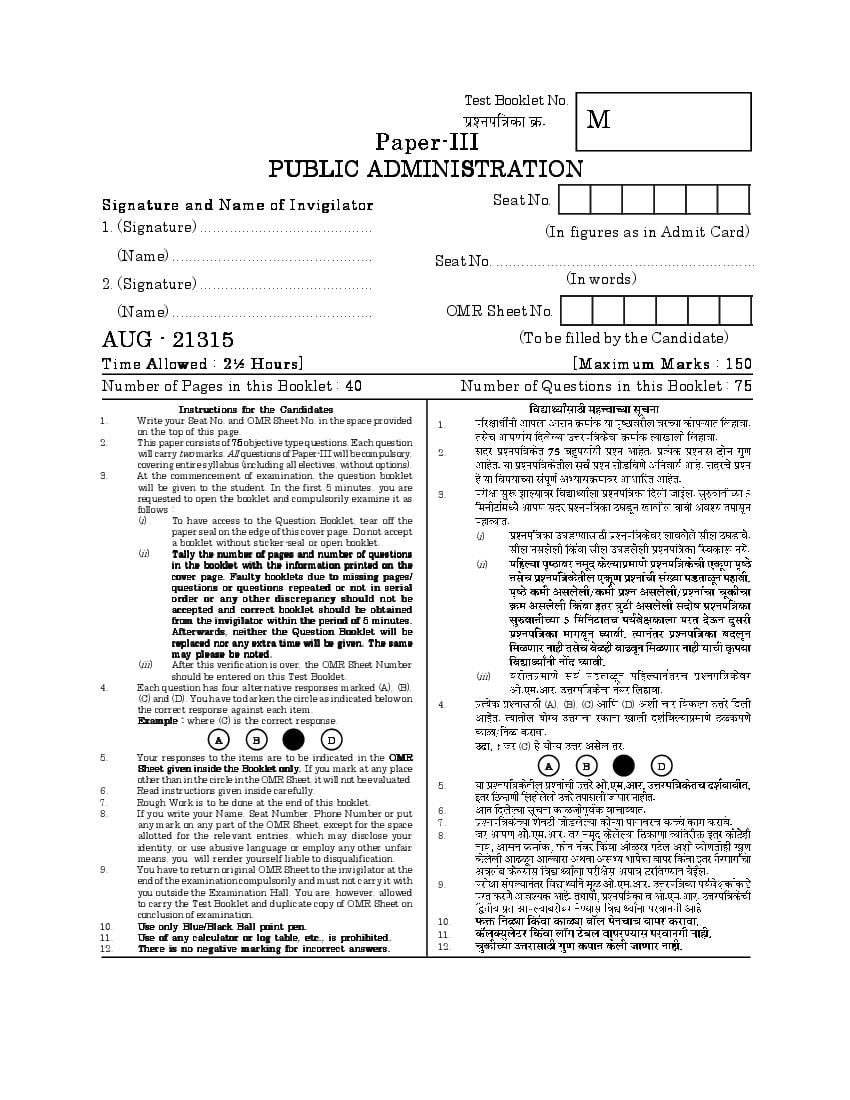
M
PUBLIC ADMINISTRATION
Signature and Name of Invigilator Seat No.
1. (Signature) ......................................... (In figures as in Admit Card)
(Name) ................................................ Seat No. ..............................................................
2. (Signature) ......................................... (In words)
(Name) ................................................ OMR Sheet No.
AUG - 21315 (To be filled by the Candidate)
Time Allowed : 2½ Hours] [Maximum Marks : 150
Number of Pages in this Booklet : 40 Number of Questions in this Booklet : 75
Instructions for the Candidates
1. Write your Seat No. and OMR Sheet No. in the space provided 1.
on the top of this page.
2. This paper consists of 75 objective type questions. Each question
will carry two marks. All questions of Paper-III will be compulsory, 2.
covering entire syllabus (including all electives, without options).
3. At the commencement of examination, the question booklet
will be given to the student. In the first 5 minutes, you are
requested to open the booklet and compulsorily examine it as 3.
follows :
(i) To have access to the Question Booklet, tear off the
paper seal on the edge of this cover page. Do not accept
(i)
a booklet without sticker-seal or open booklet.
(ii) Tally the number of pages and number of questions
in the booklet with the information printed on the (ii)
cover page. Faulty booklets due to missing pages/
questions or questions repeated or not in serial
order or any other discre pancy should not be
accepted and correct booklet should be obtained
from the invigilator within the period of 5 minutes.
Afterwards, neither the Question Booklet will be
replaced nor any extra time will be given. The same
may please be noted.
(iii) After this verification is over, the OMR Sheet Number
should be entered on this Test Booklet. (iii)
4. Each question has four alternative responses marked (A), (B),
(C) and (D). You have to darken the circle as indicated below on
the correct response against each item. 4. (A), (B), (C) (D)
Example : where (C) is the correct response.
A B D
(C)
5. Your responses to the items are to be indicated in the OMR
Sheet given inside the Booklet only. If you mark at any place A B D
other than in the circle in the OMR Sheet, it will not be evaluated.
5.
6. Read instructions given inside carefully.
7. Rough Work is to be done at the end of this booklet.
8. If you write your Name, Seat Number, Phone Number or put 6.
any mark on any part of the OMR Sheet, except for the space 7.
allotted for the relevant entries, which may disclose your 8.
identity, or use abusive language or employ any other unfair
means, you will render yourself liable to disqualification.
9. You have to return original OMR Sheet to the invigilator at the
end of the examination compulsorily and must not carry it with 9.
you outside the Examination Hall. You are, however, allowed
to carry the Test Booklet and duplicate copy of OMR Sheet on
conclusion of examination.
10. Use only Blue/Black Ball point pen. 10.
11. Use of any calculator or log table, etc., is prohibited. 11.
12. There is no negative marking for incorrect answers. 12.
Page 2
Page 3
Paper III
III
Time Allowed : 2½ Hours] [Maximum Marks : 150
Note : This paper contains Seventy Five (75) multiple choice questions. Each
carrying Two (2) marks. Attempt All questions.
(75) (2)
1. The meaning of Administration is : 1.
(A) to serve (A)
(B) implement (B)
(C) programme (C)
(D) plan (D)
2. Identification of common processes 2.
in administration was first done
by :
(A)
(A) Luther Gulick
(B)
(B) Henri Fayol
(C)
(C) C. L. Lyndol
(D)
(D) Gulick-Urwick
3 [P.T.O.
Page 4
branch of the government was
advocated by :
(A)
(A) Woodrow Wilson
(B)
(B) Goodnow
(C)
(C) Pfiffner
(D)
(D) Willoughby
4.
4. The following is not a feature of the
New Public Administration :
(A) Change (A)
(B) Responsibility (B)
(C) Rationality (C)
(D) Behaviourism (D)
4
Page 5
rejects :
(A) Social Equity Attitude (A)
(B) Value Neutrality Approach (B)
(C) Participatory Processes (C)
(D) Responsiveness (D)
6. New Public Management’s basic 6.
premise is that government should
be :
(A)
(A) Paternal
(B)
(B) Open
(C)
(C) Social Agent
(D) Generalist (D)
5 [P.T.O.
Page 6
the following and choose the correct
code : I
List I
(Name of the Author)
(a)
(a) W. Gulick
(b)
(b) H. Fayol
(c) F. Marini (c)
(d) D. Waldo (d)
List II
II
(Title of the Book)
(i) General and Industrial
Administration (i)
(ii) The Minnowbrook Perspective (ii)
(iii) Public Administration in a (iii)
Time of Turbulene
(iv)
(iv) The Papers on the Science of
Administration
Codes : (a) (b) (c) (d)
(a) (b) (c) (d)
(A) (iv) (i) (ii) (iii)
(A) (iv) (i) (ii) (iii)
(B) (i) (ii) (iii) (iv)
(B) (i) (ii) (iii) (iv)
(C) (ii) (iii) (iv) (i) (C) (ii) (iii) (iv) (i)
(D) (iii) (iv) (i) (ii) (D) (iii) (iv) (i) (ii)
6
Page 7
sation was developed by :
(A) Gulick (A)
(B) Fayol (B)
(C) Simon (C)
(D) Elton Mayo (D)
9. Who rejected the principles of 9.
Administration as myths and
proverbs ?
(A)
(A) H. Simon
(B)
(B) W. F. Willoughby
(C)
(C) Barnard
(D) L. D. White (D)
7 [P.T.O.
Page 8
10.
have given more importance to the
structure rather than person in
organisation ? (A)
(A) Luther Gulick
(B)
(B) Elton Mayo
(C)
(C) Barnard
(D)
(D) Follet
11. The concept of line and staff agencies 11.
is borrowed from ............... .
(A) Private Administration (A)
(B) Civil Administration (B)
(C) Military Administration (C)
(D) Industrial Administration (D)
8
Page 9
Administration was introduced
by :
(A)
(A) Albert Waterson
(B)
(B) Joseph La Palambora
(C)
(C) Fred Riggs
(D)
(D) Edward Weidner
13.
13. Who profounded the formal theory
of authority ?
(A) Max Weber (A)
(B) Barnard (B)
(C) H. Simon (C)
(D) Elton Mayo (D)
9 [P.T.O.
Page 10
and responsibility for :
(A) Goal setting (A)
(B) Policy making (B)
(C) Planning (C)
(D) Routine work (D)
15. Simon’s concept of Authority is based 15.
upon :
(A) Zone of acceptance (A)
(B) Zone of indifference (B)
(C) Zone of surveillance (C)
(D) Zone of command (D)
16. The principle of formal organisation 16.
focuses on :
(A) Classical Approach (A)
(B) Bureaucratic Theory (B)
(C) Decision Making Theory (C)
(D) Behavioural Approach (D)
10
Page 11
contributed significantly to the
studies conducted by the
comparative administrative group ?
(1)
(1) Ferrel Heady
(2)
(2) Ralph Braibanti
(3)
(3) Dwight Waldo
(4)
(4) William Willoughby
Select the correct option :
(A) (1), (2) (3)
(A) (1), (2) and (3)
(B) (2), (3) (4)
(B) (2), (3) and (4)
(C) (1) and (4) (C) (1) (4)
(D) (1), (2), (3) and (4) (D) (1), (2), (3) (4)
11 [P.T.O.
Page 12
the types of leadership according to
the concept of Max Weber ?
(A)
(A) Charismatic
(B)
(B) Traditional
(C)
(C) Bureaucratic
(D)
(D) Rational legal
19. Taylor’s concept of functional 19.
foremanship leads to :
(1) Double command (1)
(2) Multiple command (2)
(3) Specialization (3)
(4) Negation of unity of command (4)
Select the correct code :
(A) (2) and (4) (A) (2) (4)
(B) (1), (2) and (4) (B) (1), (2) (4)
(C) (2), (3) and (4) (C) (2), (3) (4)
(D) (1), (3) and (4) (D) (1), (3) (4)
12
Page 13
‘Universalistic’ in Administration ?
(A) Woodrow Wilson (A)
(B) H. A. Simon (B)
(C)
(C) Henry Fayol
(D)
(D) Max Weber
21. Follet terms a function with 21.
authority and corresponding
responsibility as ................. .
(A)
(A) Position
(B)
(B) Authority
(C)
(C) Status
(D) Functional Unity (D)
13 [P.T.O.
Page 14
the chronological order :
(1)
(1) Chester Barnard
(2)
(2) M. P. Follet
(3)
(3) F. W. Riggs
(4)
(4) Willoughby
Choose the correct option :
(A) (2), (4), (3), (1)
(A) (2), (4), (3), (1)
(B) (2), (4), (1), (3)
(B) (2), (4), (1), (3)
(C) (4), (1), (2), (3)
(C) (4), (1), (2), (3)
(D) (4), (2), (1), (3)
(D) (4), (2), (1), (3)
23.
23. Herbert Simon’s concept of
administration is based on :
(A)
(A) Structural-functional approach
(B) Systems approach (B)
(C) Logical positivism (C)
(D) Elite approach (D)
14
Page 15
24.
obedience the communication should
have :
(1)
(1) Force of command
(2) Force of discipline (2)
(3) Consistency with personal
(3)
goals
(4)
(4) Consistency with organizational
goals
Select the correct option :
(A) (1) (2)
(A) (1) and (2)
(B) (1), (2) (4)
(B) (1), (2) and (4)
(C) (2) (3)
(C) (2) and (3)
(D) (3) and (4) (D) (3) (4)
15 [P.T.O.
Page 16
25.
correctly matched ?
(A) Taylor — Functional (A)
foremanship
(B)
(B) Fayol — Gangplank
(C)
(C) Urwick — Unity of command
(D) Gulick — Bases of depart-
(D)
mentalization
26. The greatest resistance to scientific 26.
management came from :
(1) Human Relationists (1)
(2) Workers (2)
(3) Managers (3)
(4) Trade Union (4)
Select the correct answer :
(A) (1) and (2) (A) (1) (2)
(B) (1), (2) and (3) (B) (1), (2) (3)
(C) (1) and (3) (C) (1) (3)
(D) (1), (2), (3) and (4) (D) (1), (2), (3) (4)
16
Page 17
Maslow’s need hierarchy is the first
systematic conceptual model of
human motivation.
Reason (R) : (R)
He explained that human needs
influence human behaviour.
Choose the correct option :
(A) Both (A) and (R) are true and
(A) (A) (R)
(R) is the correct explanation
of (A) (R) (A)
(B) Both (A) and (R) are true, but
(B) (A) (R)
(R) is not the correct explanation
(R) (A)
of (A)
(C) (A) (R)
(C) (A) is true but (R) is false
(D) (A) (R)
(D) (A) is false but (R) is true
17 [P.T.O.
Page 18
to different social structures by
using :
(A)
(A) Ecological Approach
(B)
(B) Structural-Functional Approach
(C)
(C) Equilibrium Approach
(D)
(D) General Systems Theory
29. The present Constitution of the USA 29.
was adopted in the year :
(A) 1786 (A) 1786
(B) 1778 (B) 1778
(C) 1787 (C) 1787
(D) 1789 (D) 1789
30. Governmental systems are “a blend 30.
of formal law, precedents and
tradition” in :
(A) India (A)
(B) U.K. (B)
(C) USA (C)
(D) France (D)
18
Page 19
profounded by :
(A) A. V. Dicey (A)
(B) Lowell (B)
(C) Willoughby (C)
(D) H. Finer (D)
32. The most dominant role is played by 32.
pressure groups in the administrative
system of :
(A) UK (A)
(B) France (B)
(C) USA (C)
(D) Russia (D)
19 [P.T.O.
Page 20
ministers direction in the UK
is :
(A)
(A) Wing
(B)
(B) Branch
(C)
(C) Department
(D)
(D) Division
34. In the UK “The Citizen and the 34.
Administration Redressal of
Grievances” was published by which
report ?
(A)
(A) Whyatt Report
(B)
(B) Atkinson Report
(C) William Report (C)
(D) Northcote Report (D)
20
Page 21
the correct answer by using the codes
given below :
I
List I
(a)
(a) Urwick
(b)
(b) Mayo
(c)
(c) Argyris
(d)
(d) Barnard
II
List II
(i) Synthesised Model Theory (i)
(ii) Administrative Generic Theory (ii)
(iii) Human Relations Theory (iii)
(iv) Organisational Development
(iv)
Theory
Codes :
(a) (b) (c) (d)
(a) (b) (c) (d)
(A) (i) (iii) (ii) (iv)
(A) (i) (iii) (ii) (iv)
(B) (ii) (iii) (iv) (i) (B) (ii) (iii) (iv) (i)
(C) (iv) (ii) (iii) (i) (C) (iv) (ii) (iii) (i)
(D) (i) (iii) (iv) (ii) (D) (i) (iii) (iv) (ii)
21 [P.T.O.
Page 22
of span of control has been due
to ....................... .
(A)
(A) Increasing professionalism
(B)
(B) Big organizations
(C)
(C) Incapable superiors
(D) Bureaucratic culture (D)
37. Which one of the following does not 37.
relate to 4 P’s of Development
Administration ?
(A) Plans and Policies (A)
(B) Programmes (B)
(C) Projects (C)
(D) Political Goals (D)
22
Page 23
38.
revolution stands for :
(A) harmony and co-operation
(B) co-operation, harmony and (A)
restricted output
(B)
(C) restricted output, economy and
co-operation (C)
(D) economy, co-operation and
(D)
restricted output
39. Elton Mayo was involved in the 39.
Hawthorne studies from :
(A) 1924 to 1932 (A) 1924 1932
(B) 1924 to 1934 (B) 1924 1934
(C) 1923 to 1932 (C) 1923 1932
(D) 1927 to 1932 (D) 1927 1932
23 [P.T.O.
Page 24
40.
using the codes given below :
(A)
Assertion (A) :
There is no fixed tenure of the Chief
Secretary. (R)
Reason (R) :
The ARC was not made any specific
recommendation in this regard.
Codes :
(A) Both (A) and (R) are true and
(A) (A) (R)
(R) is the correct explanation
(R), (A)
of (A)
(B) Both (A) and (R) are true but (B) (A) (R)
(R) is not the correct explanation (R), (A)
of (A)
(C) (A) (R)
(C) (A) is true but (R) is false
(D) (A) is false but (R) is true (D) (A) (R)
24
Page 25
for the first time upheld in India
in the year :
(A) 1952
(A) 1952
(B) 1956
(B) 1956
(C) 1957
(C) 1957
(D) 1958
(D) 1958
42. Which functions are performed by 42.
the Secretariat ?
(A)
(A) Policy making
(B)
(B) Exercise of financial control
(C)
(C) Making rules and regulations
(D) Sectoral planning (D)
25 [P.T.O.
Page 26
Officer ?
(A) Secretary (A)
(B) Under secretary (B)
(C) Joint Secretary (C)
(D) Deputy Secretary (D)
44. Planning Commission was set up :
44.
(A) Under the Government of India
Act, 1935
(B) As per the provisions of the (A)
Constitution of India
(B)
(C) By a cabinet resolution
(D) As per the recommendation of (C)
the National Development
(D)
Council
26
Page 27
not related to Cabinet Committee ?
(A) Political Affairs Committee (A)
(B) Economic Affairs Committee (B)
(C) Apointment Committee (C)
(D) Foreign Investment Committee (D)
46. Which of the following suggested to 46.
introduce Aptitude Test in the
competitive examination ?
(A)
(A) Kothari Committee
(B)
(B) Satish Chandra Committee
(C)
(C) Y. K. Alagh Committee
(D) L. M. Singhvi Committee (D)
27 [P.T.O.
Page 28
classification of :
(A) Salaries (A)
(B) Duties (B)
(C) Departments (C)
(D) Personal Status of Incumbents (D)
48. Administration’s role is not : 48.
(A) Principal planner (A)
(B) Promoter (B)
(C) Director of accelerated growth (C)
(D) Entrepreneurial business (D)
49. “Decision making in government is 49.
a plural activity”, is said by :
(A) H. Simon (A)
(B) C. I. Bernard (B)
(C) S. Hudson (C)
(D) H. Koonz (D)
28
Page 29
Reforms Commission (ARC) was :
(A) Shri K. Hanumanthaiah (A)
(B) Gulzarilal Nanda (B)
(C) Morarji Desai (C)
(D) V. T. Krishnamachari (D)
51. Code of conduct of civil servants in 51.
India facilitates :
(A) Public domonstration (A)
(B) Political neutrality (B)
(C) Right to strike (C)
(D) Right to criticise government (D)
52. Which of the following is not a 52.
features of co-ordination ?
(A) It emphasis variety of command
(A)
(B) It is a continuous and dynamic
(B)
process
(C) It is an executive responsibility (C)
(D) It has a common purpose (D)
29 [P.T.O.
Page 30
provides protection to Public
servants against arbitrary dismissal
or removal ?
(A)
(A) Art. 320
(B)
(B) Art. 315
(C)
(C) Art. 314
(D)
(D) Art. 311
54. The joint consultative machinery for 54.
central government employees was
set up in the year :
(A) 1956 (A) 1956
(B) 1960 (B) 1960
(C) 1966 (C) 1966
(D) 1972 (D) 1972
30
Page 31
introduced in India in the year :
(A) 1958 (A) 1958
(B) 1968 (B) 1968
(C) 1978 (C) 1978
(D) 1964 (D) 1964
56. According to ARC, the financial 56.
year should begin on :
(A) 1st November
(A)
(B) 1st July
(B)
(C) 1st September
(C)
(D) 1st January (D)
57. In India the independent audit 57.
emerged in the year :
(A) 1950 (A) 1950
(B) 1947 (B) 1947
(C) 1935 (C) 1935
(D) 1919 (D) 1919
31 [P.T.O.
Page 32
of :
(A) Department of Revenue (A)
(B) Department of Expenditure (B)
(C) Department of Company Affairs (C)
(D) Department of Economic Affairs (D)
59. Audit and Account was separated in 59.
which year ?
(A) 1970-71 (A) 1970-71
(B) 1973-74 (B) 1973-74
(C) 1976-77 (C) 1976-77
(D) 1978-79 (D) 1978-79
60. Who prepares the Appropriation 60.
Accounts ?
(A)
(A) The Finance Committee
(B)
(B) The Public Accounts Committee
(C)
(C) The CAG
(D) Union Cabinet (D)
32
Page 33
(A) Research method (A)
(B) Measurement technique (B)
(C) Tool for data collection (C)
(D) Data analysis technique (D)
62. According to Arthshastra the prime 62.
function of the Council of Ministers
is to :
(A)
(A) Advice the king
(B)
(B) Policy making
(C)
(C) Execute decisions
(D)
(D) Explore resources
63. Who classified the questionnaires 63.
into structural and non-structural ?
(A) P. V. Young (A)
(B) George A. Lundberg (B)
(C) Goode and Hatt (C)
(D) R. K. Merton (D)
33 [P.T.O.
Page 34
controlling one or more variables is
called :
(A) Pure Research (A)
(B) Qualitative Research (B)
(C)
(C) Experimental Research
(D)
(D) Evaluation Research
65. Explanatory research design 65.
involves :
(A) Comparison (A)
(B) Factors of change (B)
(C) Correlationship analysis (C)
(D) Four cell design (D)
34
Page 35
the control of the :
(A) State Government (A)
(B) District Collector (B)
(C) District Treasury Officer (C)
(D) District Accounts Officer (D)
67. Who is the Ex-officio Chairman of
67.
District Rural Development Agency
(DRDA) ?
(A) Sub-divisional Officer (SDO) (A)
(B) Sub-divisional Magistrate
(B)
(SDM)
(C)
(C) District Collector
(D) Chairman, Jilla Parishad (D)
35 [P.T.O.
Page 36
codes given below :
The immediate consequence of
globalisation is making structural
adjustment policies and programmes
in tune with :
(1) General Agreement on Trade (1)
and Tariff (GATT)
(2) World Trade Organisation
(2)
(WTO)
(3)
(3) International Monetary Fund
(IMF) (4)
(4) SAARC
Codes :
(A) (1) (2)
(A) (1) and (2)
(B) (1), (2) (3)
(B) (1), (2) and (3)
(C) (1), (3) (4)
(C) (1), (3) and (4)
(D) (1), (2), (3) and (4) (D) (1), (2), (3) (4)
36
Page 37
targeted at :
(A) Comprehensive social security (A)
(B) Anti-poverty programmes (B)
(C) Better health (C)
(D) Services for the socially under (D)
privileged
70. By 73rd and 74th Constitutional 70.
Amendments, which of the two
schedules were added ?
(A)
(A) 8th and 9th
(B)
(B) 9th and 10th
(C)
(C) 10th and 11th
(D)
(D) 11th and 12th
71. The book “Understanding Public 71.
Policy” was written by :
(A) Etzoni (A)
(B) Dror (B)
(C) H. Simon (C)
(D) Thomas Dey (D)
37 [P.T.O.
Page 38
model (Dror) is :
(A) Qualitative (A)
(B) Sequential (B)
(C) Satisfying (C)
(D)
(D) Quantifiable
73. In order to study and report on 73.
community development
programme, the Planning
Commission appointed a study team
in 1956 under the Chairmanship
of :
(A)
(A) Shri Ashok Mehta
(B)
(B) Shri Balwantrai Mehta
(C)
(C) Shri Jawaharlal Nehru
(D) Shri L. M. Singhvi (D)
38
Page 39
74. (PESA)
PESA Act (Panchayat Extension to
Scheduled Area) ?
(A)
(A) B. D. Sharma Committee
(B) Second ARC (B)
(C) M. M. Punchi Committee
(C)
(D) Dileep Singh Bhunia
(D)
Committee
75. Jan Dhan Yojana is a national 75.
mission to help BPL people in
getting :
(A) Employment
(A)
(B) Education
(B)
(C) Finances for small business
(C)
(D) Access to various financial
schemes (D)
39 [P.T.O.
Page 40
40
Document Details
| Board / Org | Maharashtra Exams |
| Exam | MAHA SET |
| Type | Question Paper |
| Pages | 40 |
| Updated | 30 Apr 2026 |