CBSE Class 12 Sample Paper 2022 for Biotechnology Term 2
Finished viewing? Save it for later —
Download CBSE Class 12 Sample Paper 2022 for Biotechnology Term 2 (PDF · 4 pages)About CBSE Class 12 Sample Paper 2022 for Biotechnology Term 2
CBSE Class 12 Sample Paper 2022 for Biotechnology Term 2 is available here for free download. Published by CBSE for Class 12, this sample paper can be viewed online or downloaded as a PDF (4 pages). Candidates preparing for Class 12 can use CBSE Class 12 Sample Paper 2022 for Biotechnology Term 2 to understand the exam pattern, the type of questions asked, and the overall difficulty level.
Frequently Asked Questions
How can I download CBSE Class 12 Sample Paper 2022 for Biotechnology Term 2?
Open this page and click the Download button to save CBSE Class 12 Sample Paper 2022 for Biotechnology Term 2 as a PDF. It is completely free on AglaSem Docs.
Is CBSE Class 12 Sample Paper 2022 for Biotechnology Term 2 free to download?
Yes. CBSE Class 12 Sample Paper 2022 for Biotechnology Term 2 can be viewed online and downloaded as a PDF free of cost on AglaSem Docs.
How many pages does CBSE Class 12 Sample Paper 2022 for Biotechnology Term 2 have?
CBSE Class 12 Sample Paper 2022 for Biotechnology Term 2 contains 4 pages, which you can read online or download together as a single PDF.
Where can I find more Class 12 study material?
You can find more Class 12 question papers, sample papers, syllabus, and answer keys on AglaSem Docs.
CBSE Class 12 Sample Paper 2022 for Biotechnology Term 2 – Text
Read the full text of this sample paper below — useful to quickly search, copy and reference the content online without downloading the PDF.
📄 View text version (4 pages)
Page 1
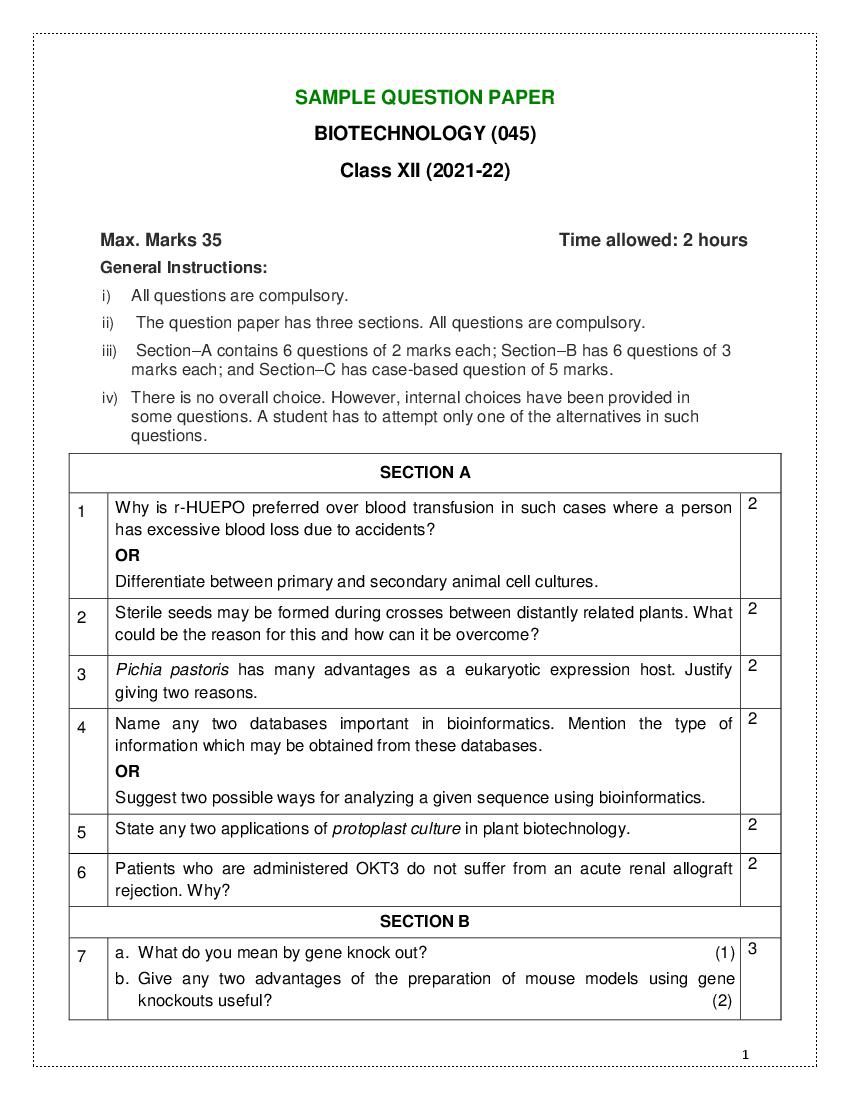
BIOTECHNOLOGY (045)
Class XII (2021-22)
Max. Marks 35 Time allowed: 2 hours
General Instructions:
i) All questions are compulsory.
ii) The question paper has three sections. All questions are compulsory.
iii) Section–A contains 6 questions of 2 marks each; Section–B has 6 questions of 3
marks each; and Section–C has case-based question of 5 marks.
iv) There is no overall choice. However, internal choices have been provided in
some questions. A student has to attempt only one of the alternatives in such
questions.
SECTION A
1 Why is r-HUEPO preferred over blood transfusion in such cases where a person 2
has excessive blood loss due to accidents?
OR
Differentiate between primary and secondary animal cell cultures.
2 Sterile seeds may be formed during crosses between distantly related plants. What 2
could be the reason for this and how can it be overcome?
3 Pichia pastoris has many advantages as a eukaryotic expression host. Justify 2
giving two reasons.
4 Name any two databases important in bioinformatics. Mention the type of 2
information which may be obtained from these databases.
OR
Suggest two possible ways for analyzing a given sequence using bioinformatics.
State any two applications of protoplast culture in plant biotechnology. 2
5
6 Patients who are administered OKT3 do not suffer from an acute renal allograft 2
rejection. Why?
SECTION B
7 a. What do you mean by gene knock out? (1) 3
b. Give any two advantages of the preparation of mouse models using gene
knockouts useful? (2)
1
Page 2
b. State two ways in which artificial seeds are different from embryonic seeds. (2)
Write the steps of BLAST involved in comparison of DNA sequences. 3
9
a. How can microbial cultures be used for the production of different metabolites? 3
10
(1)
b. A recently discovered microbial strain gives us the desired metabolite in
nanomolar concentration. Suggest two ways of improving the production of the
desired metabolite. (2)
11 a. What are edible vaccines? (1) 3
b. How are edible vaccines advantageous over recombinant vaccines produced by
bacterial fermentation? (2)
OR
How can one obtain virus-free sugarcane plants from virus-infected plants? Are
these plants virus-resistant? Give reason for your response.
a. How are the hybridoma cells selected from the culture of B-cells and Myeloma 3
12
cells while fusing them in hybridoma technology? (1)
b. Which monoclonal antibody is used to treat early stages of breast cancer and
how does it work? (2)
SECTION C
Microbial growth kinetics 5
13
Cell growth includes increase in its number. A typical bacterial growth curve is
shown in the figure below-
Diagram 1
Growth kinetics is an autocatalytic reaction which implies that the rate of growth is
directly proportional to the concentration of cell.
2
Page 3
Doubling time which is the time taken by the population to double through one
round of cell division is inversely related to specific growth rate.
a. In the microbial growth curve depicted above (Diagram 1), in which phase is the
microbial cell specific growth rate calculated (from phases AB/BC/CD/DE)?
What is this phase called? (2)
b. Refer to Table 1 and calculate the generation time and specific growth rate
constant of a bacterial population in which the number of bacteria increases
from 104cells /ml to 107 cells /ml during four hours of exponential growth. (3)
OR
Management of Diabetes
Insulin delivery is still the most effective method of pharmacotherapy in cases of
extremely high hyperglycemia. The production process has been divided into
several stages as depicted below in the flow chart:
.
At each stage of insulin production, qualitative and quantitative analyses were
performed to confirm identity and purity of the desired protein. (1X5)
3
Page 4
the production of desired protein, but were unable to get any yield. What could
be the possible reason for this?
b. How is the outcome of the process affected if the number of processing steps
are reduced while obtaining pure protein from the fermentation medium?
c. Which type (recombinant insulin or cattle derived insulin) will be produced in the
above depicted flow chart?
d. Name a metabolite which is produced using clear broth rather than cell mass.
e. How is crude protein different from the desired protein?
***
4
Document Details
| Board / Org | CBSE |
| Exam | Class 12 |
| Type | Sample Paper |
| Pages | 4 |
| Language | english |
| Updated | 30 Apr 2026 |