CBSE Class 12 Question Paper 2025 Solution Accountancy
Finished viewing? Save it for later —
Download CBSE Class 12 Question Paper 2025 Solution Accountancy (PDF · 19 pages)About CBSE Class 12 Question Paper 2025 Solution Accountancy
CBSE Class 12 Question Paper 2025 Solution Accountancy is available here for free download. Published by CBSE for Class 12, this solution can be viewed online or downloaded as a PDF (19 pages). Candidates preparing for Class 12 can use CBSE Class 12 Question Paper 2025 Solution Accountancy to understand the exam pattern, the type of questions asked, and the overall difficulty level.
Frequently Asked Questions
How can I download CBSE Class 12 Question Paper 2025 Solution Accountancy?
Open this page and click the Download button to save CBSE Class 12 Question Paper 2025 Solution Accountancy as a PDF. It is completely free on AglaSem Docs.
Is CBSE Class 12 Question Paper 2025 Solution Accountancy free to download?
Yes. CBSE Class 12 Question Paper 2025 Solution Accountancy can be viewed online and downloaded as a PDF free of cost on AglaSem Docs.
How many pages does CBSE Class 12 Question Paper 2025 Solution Accountancy have?
CBSE Class 12 Question Paper 2025 Solution Accountancy contains 19 pages, which you can read online or download together as a single PDF.
Where can I find more Class 12 study material?
You can find more Class 12 question papers, sample papers, syllabus, and answer keys on AglaSem Docs.
CBSE Class 12 Question Paper 2025 Solution Accountancy – Text
Read the full text of this solution below — useful to quickly search, copy and reference the content online without downloading the PDF.
📄 View text version (19 pages)
Page 1
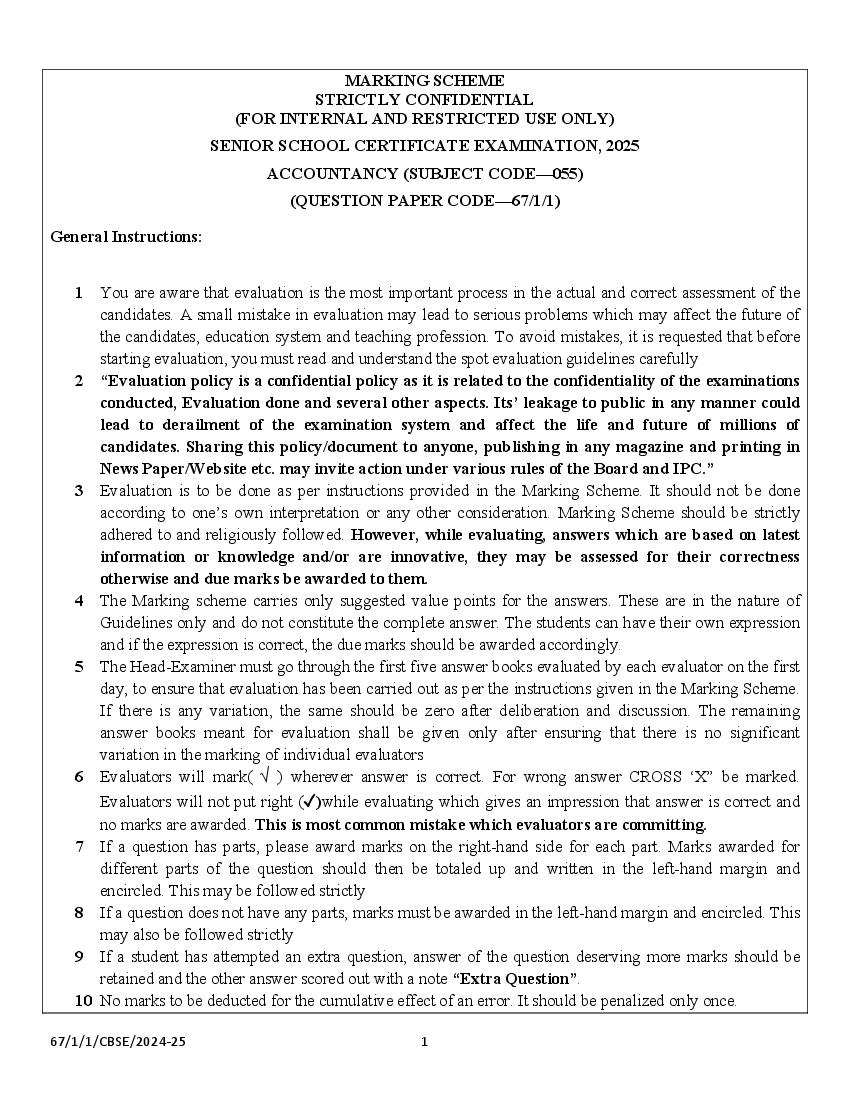
MARKING SCHEME
STRICTLY CONFIDENTIAL
(FOR INTERNAL AND RESTRICTED USE ONLY)
SENIOR SCHOOL CERTIFICATE EXAMINATION, 2025
ACCOUNTANCY (SUBJECT CODE—055)
(QUESTION PAPER CODE—67/1/1)
General Instructions:
1 You are aware that evaluation is the most important process in the actual and correct assessment of the
candidates. A small mistake in evaluation may lead to serious problems which may affect the future of
the candidates, education system and teaching profession. To avoid mistakes, it is requested that before
starting evaluation, you must read and understand the spot evaluation guidelines carefully
2 “Evaluation policy is a confidential policy as it is related to the confidentiality of the examinations
conducted, Evaluation done and several other aspects. Its’ leakage to public in any manner could
lead to derailment of the examination system and affect the life and future of millions of
candidates. Sharing this policy/document to anyone, publishing in any magazine and printing in
News Paper/Website etc. may invite action under various rules of the Board and IPC.”
3 Evaluation is to be done as per instructions provided in the Marking Scheme. It should not be done
according to one’s own interpretation or any other consideration. Marking Scheme should be strictly
adhered to and religiously followed. However, while evaluating, answers which are based on latest
information or knowledge and/or are innovative, they may be assessed for their correctness
otherwise and due marks be awarded to them.
4 The Marking scheme carries only suggested value points for the answers. These are in the nature of
Guidelines only and do not constitute the complete answer. The students can have their own expression
and if the expression is correct, the due marks should be awarded accordingly.
5 The Head-Examiner must go through the first five answer books evaluated by each evaluator on the first
day, to ensure that evaluation has been carried out as per the instructions given in the Marking Scheme.
If there is any variation, the same should be zero after deliberation and discussion. The remaining
answer books meant for evaluation shall be given only after ensuring that there is no significant
variation in the marking of individual evaluators
6 Evaluators will mark( √ ) wherever answer is correct. For wrong answer CROSS ‘X” be marked.
Evaluators will not put right (✓)while evaluating which gives an impression that answer is correct and
no marks are awarded. This is most common mistake which evaluators are committing.
7 If a question has parts, please award marks on the right-hand side for each part. Marks awarded for
different parts of the question should then be totaled up and written in the left-hand margin and
encircled. This may be followed strictly
8 If a question does not have any parts, marks must be awarded in the left-hand margin and encircled. This
may also be followed strictly
9 If a student has attempted an extra question, answer of the question deserving more marks should be
retained and the other answer scored out with a note “Extra Question”.
10 No marks to be deducted for the cumulative effect of an error. It should be penalized only once.
67/1/1/CBSE/2024-25 1
Page 2
marks if the answer deserves it.
12 Every examiner has to necessarily do evaluation work for full working hours i.e., 8 hours every day and
evaluate 20 answer books per day in main subjects and 25 answer books per day in other subjects
(Details are given in Spot Guidelines)
13 Ensure that you do not make the following common types of errors committed by the Examiner in the
past:-
● Leaving answer or part thereof unassessed in an answer book.
● Leaving answer or part thereof unassessed in an answer book.
● Wrong totaling of marks awarded on an answer.
● Wrong transfer of marks from the inside pages of the answer book to the title page.
● Wrong question wise totaling on the title page.
● Wrong totaling of marks of the two columns on the title page.
● Wrong grand total.
● Marks in words and figures not tallying/not same.
● Wrong transfer of marks from the answer book to online award list.
● Answers marked as correct, but marks not awarded. (Ensure that the right tick mark is correctly and
clearly indicated. It should merely be a line. Same is with the X for incorrect answer.)
● Half or a part of answer marked correct and the rest as wrong, but no marks awarded.
14 While evaluating the answer books if the answer is found to be totally incorrect, it should be marked as
cross (X) and awarded zero (0) marks
15 Any un assessed portion, non-carrying over of marks to the title page, or totaling error detected by the
candidate shall damage the prestige of all the personnel engaged in the evaluation work as also of the
Board. Hence, in order to uphold the prestige of all concerned, it is again reiterated that the instructions
be followed meticulously and judiciously.
16 The Examiners should acquaint themselves with the guidelines given in the “Guidelines for spot
Evaluation” before starting the actual evaluation.
17 Every Examiner shall also ensure that all the answers are evaluated, marks carried over to the title page,
correctly totaled and written in figures and words.
18 The candidates are entitled to obtain photocopy of the Answer Book on request on payment of the
prescribed processing fee. All Examiners/Additional Head Examiners/Head Examiners are once again
reminded that they must ensure that evaluation is carried out strictly as per value points for each answer
as given in the Marking Scheme.
..
67/1/1/CBSE/2024-25 2
Page 3
/1 MARKING SCHEME
/1 ACCOUNTANCY (055)
EXPECTED ANSWERS / VALUE POINTS
SECTION A
1 Q. Sara and Tara were partners….
1
Ans. (D) ₹32,000 mark
2 Q. Assertion (A): Each partner carrying….
Ans. (A) Both Assertion (A) and Reason (R) are correct and Reason (R) is the correct explanation of 1
Assertion (A). mark
3 Q. (a) VL Ltd. offered for public subscription…
1
Ans. (D) ₹11,00,000 mark
OR OR
Q. (b) VX Ltd. issued 30,000, 8% Debentures… 1
mark
Ans. (B) ₹1,50,000
4 Q. (a) Kartik, Inder and Lalit were partners….
Ans. (A)
Particulars Dr. Cr.
Amount Amount
(₹) (₹) 1
(A) Lalit’s Capital A/c Dr. 40,000 mark
To Kartik’s Capital A/c 40,000
OR OR
Q. (b) Nidhi, Pranav and Ishu were partners….
Ans. (C)
Particulars Dr. Cr.
Amount Amount
(₹) (₹) 1
(C) Nidhi’s Capital A/c Dr. 2,00,000 mark
Pranav’s Capital A/c Dr. 1,60,000
Ishu’s Capital A/c Dr 40,000
To Profit & Loss A/c 4,00,000
67/1/1/CBSE/2024-25 3
Page 4
1
Ans. (B) ₹4,00,000 mark
6 Q. Money received in advance from the shareholders…
1
Ans. (A) Credited to calls in advance account mark
7 Q. (a) Debentures in respect of which all details….
1
Ans. (C) Registered debentures mark
OR OR
(b) That portion of the called up…..
1
Ans. (A) Paid up capital mark
8 Q. Misha, Sarita and Isha were partners ….
1
Ans. (A) Misha's sacrifice 1/6, Isha's gain 1/6 mark
OR OR
Q. (b) Sia, Tisha and Aryan were partners sharing… 1
mark
Ans. (B) 4:1
9 Q. Anuj and Kartik were partners in a firm…
1
Ans.(C) ₹4,200 mark
10 Q. (a) Vishesh, Manik and Amit were partners…
1
Ans. (D) 27:23 mark
OR OR
Q. (b) Varsha, Aryan and Nimit…….
1
Ans. (B) 8:7 mark
11 Q. When the Partners’ capitals are fixed…
1
Ans. (C) Debit side of Partner’s Current Account. mark
12 Q. 4,000 shares of ₹10 each were forfeited…
1
Ans. (A) ₹8,000 mark
13 Q. On 1st April 2023, Veebee Ltd. issued 20,000, 13% debentures…
1
Ans. (B) ₹2,60,000 mark
67/1/1/CBSE/2024-25 4
Page 5
1
Ans. (C) ₹52,000 mark
15 Q. Ashmit, Veena and Rohan were partners in a firm…
1
Ans.(A) Ashmit ₹3,75,000 and Rohan ₹1,25,000 mark
16 Q. Nita, Vidur and Mita were partners in a firm…
1
Ans. (D) ₹5,00,000 mark
17 Q. Zaina, Yash and Kiran were partners in a firm..
Books of Zaina, Yash and Kiran
Journal
Date Particulars L.F. Dr. Cr.
Amount Amount
(₹) (₹)
2024
July1 Profit and Loss Suspense A/c Dr. 15,000 1½
To Zaina’s Capital A/c 15,000
(Zaina’s share of profit transferred to her capital account)
Calculation of Firm’s profits till Zaina’s death: +
If sale is ₹4,00,000, the profit = ₹1,00,000
If sale is ₹1,50,000, the profit = ₹1,00,000 x ₹1,50,000
₹4,00,000
1½
= ₹37,500
Calculation of Zaina’s share of profit till death = ₹37,500 x 2/5
=
= ₹15,000
3
(If an examinee has shown correct calculation in any other form, full credit is to be given) marks
18 Q. (a) The firm of Amish, Nitish and Misha…
Books of Amish, Nitish and Misha
Journal
Date Particulars L.F. Dr. Cr.
Amount Amount
(₹) (₹)
Amish’s Capital A/c Dr. 30,000
Nitish’s Capital A/c Dr. 30,000 1½
To Misha’s Capital A/c 60,000
(Adjustment of profit for the last three years on account of
change in profit sharing ratio)
67/1/1/CBSE/2024-25 5
Page 6
+
Adjustment Table
Partners Dr. Profits (₹) Cr. Profits (₹) Ner Effect
2:2:1 1:1:1 Dr. (₹) Cr. (₹)
Amish 1,80,000 1,50,000 30,000
Nitish 1,80,000 1,50,000 30,000 1½
Misha 90,000 1,50,000 60,000
4,50,000 4,50,000 60,000 60,000 =
3
(If an examinee has shown the correct working in any other form, full credit should be given) marks
OR OR
Q. (b) Vidhi, Manas and Ansh were partners sharing…
Books of Vidhi, Manas and Ansh
Journal
Date Particulars L.F. Dr. Cr.
Amount Amount
(₹) (₹)
2024 Profit & Loss Appropriation A/c Dr. 2,00,000
Mar.31 To Vidhi’s Capital A/c 40,000
To Manas’s Capital A/c 60,000 1½
To Ansh’s Capital A/c 1,00,000
(Profit distributed among the partners in their profit sharing +
ratio)
” Vidhi’s Capital A/c Dr. 10,000 1½
Manas’s Capital A/c Dr. 10,000 =
To Ansh’s Capital A/c 20,000
(Deficiency for Ansh borne by Vidhi and Manas equally) 3 marks
Alternate Answer: Alternate
Answer:
Books of Vidhi, Manas and Ansh
Journal
Date Particulars L.F. Dr. Cr.
Amount Amount
(₹) (₹)
2024 Profit & Loss Appropriation A/c Dr. 2,00,000
3 marks
Mar.31 To Vidhi’s Capital A/c 30,000
To Manas’s Capital A/c 50,000
To Ansh’s Capital A/c 1,20,000
(Profit distributed among the partners in their profit sharing
ratio with guaranteed amount to Ansh)
.
19 Q. (a) Delight Ltd. purchased assets worth…
Books of Delight Ltd.
Journal
Date Particulars L.F. Dr. Cr.
67/1/1/CBSE/2024-25 6
Page 7
(₹) (₹)
Assets A/c Dr. 4,00,000
Goodwill A/c Dr. 30,000 1½
To Liabilities A/c 70,000
To Marvel Ltd. 3,60,000
(Assets and liabilities of Marvel Ltd. taken over) +
Marvel Ltd. Dr. 3,60,000
To 11% Debentures A/c 3,00,000 1½
To Securities Premium A/c 60,000 =
(Issue of 3,000 debentures at a premium of 20%) 3
Marks
OR OR
Q. (b) Prime Ltd. took over assets of ₹6,00,000…
Books of Prime Ltd.
Journal
Date Particulars L.F. Dr. Cr.
Amount Amount
(₹) (₹)
Assets A/c Dr. 6,00,000
To Liabilities A/c 1,00,000 1½
To Rabi Ltd. 3,60,000
To Capital Reserve A/c 1,40,000
(Assets and liabilities of Rabi Ltd. taken over)
+
Rabi Ltd. Dr. 3,60,000
Discount on issue of debentures A/c Dr. 40,000 1½
To 10% Debentures A/c 4,00,000 =
(Issue of 4,000 debentures at a discount of 10%) 3
Marks
.
20 Q. The capital of the firm of Rajat and Karan is…
Ans. Goodwill= Super profit x Number of years’ purchase
Normal profit= Normal Rate of return/100 x Capital Employed
= 12/100 x₹15,00,000
= ₹1,80,000………..…………………………………………. 1/2
Average profit= (₹2,40,000+ ₹2,80,000+ ₹3,20,000)/3
= ₹2,80,000
Average profit less partners’ salary= ₹2,80,000- ₹50,000 3
= ₹2,30,000………………………………………………..1 Marks
Average Super profit/ Super profit = Average profit - Normal profit
=₹2,30,000- ₹1,80,000
=₹50,000………………………………….……1/2
Goodwill= Super profit x Number of years’ purchase
= ₹50,000 x 2
= ₹1,00,000…………………………………………………………………1
67/1/1/CBSE/2024-25 7
Page 8
Alternate answer: Answer
Interest on capital employed = 12/100 x₹15,00,000= ₹1,80,000
Partners salary= ₹20,000 +₹30,000 = ₹50,000
Normal Profit= Interest on capital employed + Partners’ salary= ₹1,80,000 +₹50,000= ₹2,30,000…. 1
Average profit= (₹2,40,000+ ₹2,80,000+ ₹3,20,000)/3 3 marks
= ₹2,80,000……………………………………………..………………… 1/2
Average Super profit= Average profit - Normal profit
=₹2,80,000- ₹2,30,000
=₹50,000…………………………………………………..…………………1/2
Goodwill= Super profit x Number of years purchase
= ₹50,000 x 2
= ₹1,00,000………………………………………………………………………1
21 Q. Pass necessary journal entries………..
(i)
Books of Kiero Ltd.
Journal
Date Particulars L.F. Dr. Cr.
Amount Amount
(₹) (₹)
Bank A/c Dr. 80,00,000
To Debenture Application and Allotment A/c 80,00,000
(Debenture application money received)
Debenture Application and Allotment A/c Dr. 80,00,000
Loss on Issue of Debentures A/c Dr. 8,00,000 (1 x 2)
To 9% Debentures A/c 80,00,000
To Premium on Redemption of Debentures A/c 8,00,000
(Debenture application money transferred to debentures and
premium on redemption of debentures account)
(ii)
Books of Naro Ltd. +
Journal
Date Particulars L.F. Dr. Cr.
Amount Amount
(₹) (₹)
Bank A/c Dr. 52,50,000
To Debenture Application and Allotment A/c 52,50,000
(Debenture application money received)
Debenture Application and Allotment A/c Dr. 52,50,000
Loss on Issue of Debentures A/c Dr. 5,00,000 (1 x 2)
To 10% Debentures A/c 50,00,000 =
To Securities Premium A/c 2,50,000 4
To Premium on Redemption of Debentures A/c 5,00,000 marks
(Debenture application money transferred to debentures and
premium on redemption of debentures account)
67/1/1/CBSE/2024-25 8
Page 9
22 Q. Raja, Bharat and Vedika were partners in…
Books of Raja, Bharat and Vedika
Dr. Vedika’s Capital A/c Cr.
Particulars Amount Particulars Amount
(₹) (₹)
To Drawings A/c 12,000 By Balance b/d 90,000
To Vedika’s Executors A/c 1,09,400 By General Reserve A/c. 10,000
½x8
By Interest on Capital A/c 2,400
=
By P& L Suspense A/c 3,000
4
By Raja’s Capital A/c 8,000 marks
By Bharat’s Capital A/c. 8,000
1,21,400 1,21,400
23 Q. PL Ltd. was registered with …..
(i) (C) Nil
(ii) (D) 80,000 1x6
(iii) (A) ₹16,000 =
(iv) (B) ₹9,00,000 6
marks
(v) (C) Subscribed capital
(vi) (B) ₹8,16,000
24 Q. Pass the necessary journal entries…
Books of Vibha and Ajit
Journal
Date Particulars L.F. Dr. Cr.
Amount Amount
(₹) (₹)
(i) Realisation A/c Dr. 9,000
To Cash A/c 9,000
(Creditors accepted cash and furniture in full settlement of
their claim)
(ii) Ajit Capital A/c Dr. 7,200
Cash/ Bank A/c Dr. 18,000
To Realisation A/c 25,200
(40% of the stock was taken over by Ajit and the remaining
stock sold for ₹18,000)
67/1/1/CBSE/2024-25 9
Page 10
To Vibha’s Capital A/c 16,000
(Vibha was allowed a remuneration to look after dissolution
work)
(iv) Ajit Loan A/c Dr. 45,000 1x6
To Cash/ Bank A/c 42,000
To Realisation A/c 3,000 =
(Ajit’s loan was settled)
(v) Vibha’s Capital A/c Dr. 23,000 6
To Realisation A/c 23,000 marks
(Unrecorded machinery taken over by Vibha)
(vi) Vibha’s Capital A/c Dr. 10,000
Ajit’s Capital A/c Dr. 10,000
To Profit and Loss A/c 20,000
(Debit balance of Profit and Loss account debited to the
partners’ capital accounts)
25 Q. (a) Altima Ltd. invited applications for issuing…
Books of Altima Ltd.
Journal
Date Particulars L.F. Dr. Cr.
Amount Amount
(₹) (₹)
Bank A/c Dr. 16,80,000
To Equity Share Application and Allotment A/c 16,80,000
(Application money received on 2,40,000 shares @₹7 per share,
including premium ₹1)
Equity Share Application and Allotment A/c Dr. 16,80,000
To Equity Share Capital A/c 12,00,000
To Securities Premium A/c 2,00,000
To Bank A/c 2,80,000
(Transfer of application money to share capital and excess
application money refunded)
Equity Share First and Final call A/c Dr. 14,00,000
To Equity Share Capital A/c 8,00,000 1x6
To Securities Premium A/c 6,00,000
(Amount due on share first and final call) =
Bank A/c Dr. 13,72,000
To Equity Share First and Final call A/c 13,72,000 6
(Amount received on share first and final call) marks
or
Bank A/c Dr. 13,72,000
Call in arrears A/c Dr. 28,000
To Equity Share First and Final Call A/c 14,00,000
(Amount received on share first and final call)
Equity Share Capital A/c Dr. 40,000
Securities Premium A/c Dr. 12,000
To Share Forfeiture A/c 24,000
To Equity Share First and Final Call/ Calls in Arrears A/c 28,000
(4000 shares forfeited for non-payment of first and final call
money)
67/1/1/CBSE/2024-25 10
Page 11
Share Forfeiture A/c Dr. 24,000
To Equity Share capital A/c 40,000
(Reissue of 4,000 shares at ₹4 per share fully paid)
OR OR
Q. (b) Pass necessary journal entries for forfeiture and reissue…
(i)
Books of Macil Ltd.
Journal
Date Particulars L.F. Dr. Cr.
Amount Amount
(₹) (₹)
Share Capital A/c Dr. 2,40,000
Securities Premium A/c Dr. 30,000
To Share Forfeiture A/c 60,000
To Share Allotment A/c 90,000
To Share First Call A/c 1,20,000
(3000 shares forfeited for non-payment of allotment and first call
money)
or
Share Capital A/c Dr. 2,40,000
Securities Premium A/c Dr. 30,000 (1 x 3)
To Share Forfeiture A/c 60,000
To Calls in Arrears A/c 2,10,000
(3000 shares forfeited for non-payment of allotment and first call
money)
Bank A/c Dr. 1,80,000
To Share Capital A/c 1,60,000
To Securities Premium A/c 20,000
(Reissue of 2,000 shares @₹90 per share ₹80 paid up)
Share Forfeiture A/c Dr. 40,000
To Capital Reserve A/c 40,000
(Balance in share forfeiture account transferred to capital reserve)
(ii) +
Books of Avian Ltd.
Journal
Date Particulars L.F. Dr. Cr.
Amount Amount
(₹) (₹)
Share Capital A/c Dr. 90,000
To Share Forfeiture A/c 50,000
To Share First Call/ Calls in Arrears A/c 40,000
(10,000 shares forfeited for non-payment of first call money) (1 x 3)
Bank A/c Dr. 36,000
Share Forfeiture A/c Dr. 4,000 =
To Share Capital A/c 40,000
(Reissue of 4,000 shares @₹9 per share fully paid up) 6
marks
Share Forfeiture A/c Dr. 16,000
To Capital Reserve A/c 16,000
(Balance in share forfeiture account transferred to capital reserve)
.
67/1/1/CBSE/2024-25 11
Page 12
Books of Aryan and Adya
Dr. Revaluation A/c Cr.
Particulars Amount Particulars Amount
(₹) (₹)
To Provision for doubtful debts 3,500 By Machinery A/c 60,000 (½ x 4)
To Profit transferred to: By Creditors A/c 3,500
Aryan’s Capital A/c 45,000 +
Adya’s capital A/c. 15,000 60,000
63,500 63,500
Dr. Partners’ Capital Accounts Cr.
Particulars Aryan Adya Dev Particulars Aryan Adya Dev
(₹) (₹) (₹) (₹) (₹) (₹)
To Profit & Loss A/c 15,000 5,000 By balance b/d ½ 3,20,000 2,40,000
½
To balance c/d ½ 3,95,000 2,65,000 1,65,000 By Cash A/c 1 1,65,000
By Premium for
goodwill A/c ½ 30,000 10,000
4
By Workmen
Compensation 15,000 5,000
Reserve ½
By Revaluation A/c ½ 45,000 15,000 =
6
4,10,000 2,70,000 1,65,000 4,10,000 2,70,000 1,65,000 Marks
OR OR
Q. (b) Ashish, Vinit and Reema were partners sharing…
Books of Ashish, Vinit and Reema
Journal
Date Particulars L.F. Dr. Cr.
Amount Amount
(₹) (₹)
2024
Mar.31 Patents A/c Dr. 20,000
To Revaluation A/c 20,000
(Patents were found undervalued by 20%)
Revaluation A/c Dr. 10,000
To Stock A/c 10,000
(Value of stock reduced) 1x6
Revaluation A/c Dr. 10,000
To Ashish’s Capital A/c 4,000 =
To Vinit’s Capital A/c 4,000
To Reema’s Capital A/c 2,000 6 marks
(Profit on revaluation credited to partners’ capital accounts)
67/1/1/CBSE/2024-25 12
Page 13
To Ashish’s Capital A/c 20,000
To Vinit’s Capital A/c 20,000
To Reema’s Capital A/c 10,000
(General Reserve credited to partners’ capital accounts)
Ashish’s Capital A/c Dr. 12,000
Reema’s Capital A/c Dr. 12,000
To Vinit’s Capital A/c 24,000
(Vinit’s share of goodwill adjusted in the capital accounts of
Ashish and Reema in the gaining ratio)
Vinit’s Capital A/c Dr. 2,48,000
To Cash A/c 20,000
To Vinit’s Loan A/c 2,28,000
(Vinit was paid ₹20,000 on retirement, and the balance
transferred to his loan account)
.
PART B
OPTION 1
(Analysis of Financial Statements)
27 Q. (a) The tool of analysis of ………
1
Ans. (A) Comparative statements mark
OR OR
1
Q. (b) Ratios that are calculated for measuring the efficiency… mark
Ans. (C) Turnover ratios
28 Q. The Debt Equity Ratio of Manak Enterprises…
1
Ans. (C) Issue of debentures ₹6,00,000 mark
29 Q. (a) Which of the following are operating activities…
1
Ans. (B) (i) and (iii) mark
OR OR
Q. (b) Which of the following statements is incorrect? 1
mark
Ans. (C) Receipt from interest and dividend will result in cash inflow from financing activities
30 Q. Statement 1:
Investing activities are the acquisition and disposal…
1
Ans. (A) Both the Statements are true. mark
67/1/1/CBSE/2024-25 13
Page 14
Item Major head Sub-head
(i) Computer software Non-Current Assets Property, Plant and Equipment and Intangible
Assets – Intangible Assets ½x6
(ii) Outstanding salary Current Liabilities Other Current Liabilities =
3 marks
(iii) Work in progress Current Assets Inventories
32 Q. From the following information of CN Ltd….
Common Size Statement of Profit and Loss of CN Ltd.
for the years ended 31st March, 2023 and 31st March, 2024
Absolute Amounts Percentage of
Revenue from operations
Particulars 2022-23 2023-24 2022-23 2023-24
(₹) (₹) (%) (%)
Revenue from Operations 20,00,000 40,00,000 100 100 ½
Less Expenses:
Purchase of stock in trade 4,00,000 8,00,000 20 20 ½
Other expenses 2,00,000 4,00,000 10 10 ½
3
Total expenses 6,00,000 12,00,000 30 30 marks
Profit before tax 14,00,000 28,00,000 70 70 ½
Less Tax @50% 7,00,000 14,00,000 35 35 ½
Profit after tax 7,00,000 14,00,000 35 35 ½
.
33 Q. (a) Calculate opening and closing Trade Payables….
Trade payables turnover ratio= Net Credit purchases/ Average Trade Payables………………….1
Total purchases = Cash purchases+ Credit purchases
ð ₹15,00,000= ¼ Credit purchases + Credit purchases
ð ₹15,00,000= 5/4 Credit Purchases
ð Credit Purchases ₹15,00,000 x 4/5
ð Credit purchases= ₹12,00,000…………………………………………………….……….1
67/1/1/CBSE/2024-25 14
Page 15
ð 4 =₹12,00,000/ Average Trade Payables 4
ð Average Trade Payables= ₹3,00,000 Marks
Average Trade Payables= (Opening Trade Payables + Closing Trade Payables)/2
ð ₹3,00,000 = (Opening Trade Payables + 2 Opening Trade Payables)/2
ð Opening Trade Payables= ₹3,00,000 x 2/3
ð Opening Trade Payables= ₹2,00,000…………………………………………………….1
Closing Trade Payables= 2 x Opening Trade Payables
ð Closing Trade Payables= 2 x ₹2,00,000
ð Closing Trade Payables=
₹4,00,000…………………………………………………………………………………1
OR OR
Q. (b) From the following information……….
Return on Investment= Profit before interest and tax/ Capital Employed x 100………………1
Profit before Interest and Tax= Net profit after tax + Tax + Interest on Debentures
ð Profit before Interest and Tax= ₹3,00,000 + ₹1,00,000+ ₹80,000
ð Profit before Interest and tax= ₹4,80,000………………………………………………1
Capital employed= Shareholders Funds+ Debentures 4 marks
ð Capital employed= ₹ 16,00,000 + ₹ 8,00,000
ð Capital employed= ₹ 24,00,000………………………………………………………..1
or
Capital employed= Non-Current assets + Current Assets - Current Liabilities
ð Capital employed = ₹21,00,000 + ₹5,00,000 - ₹2,00,000
ð Capital employed= ₹24,00,000
Return on investment= (₹4,80,000/ ₹24,00,000) x 100
ð Return on investment= 20%...........................................................................................1
34 Q. (a) From the following information…
Calculation of Cash Flows from Investing Activities
for the year ended 31st March 2024
Particulars (₹) (₹)
Purchase of Machinery (1,30,000)
Sale of Machinery 33,000 (1 x 3)
Net Cash used in Investing Activities (97,000)
+
Dr. Machinery A/c Cr.
Particulars Amount Particulars Amount
(₹) (₹)
To Balance b/d 3,00,000 By Bank/Cash A/c 33,000
To Statement of Profit & Loss- 3,000 By Accumulated Depreciation A/c 20,000
Profit on sale
To Bank/ Cash A/c………………….……. 1,30,000 By Balance c/d 3,80,000 1
(Balancing figure)
4,33,000 4,33,000
67/1/1/CBSE/2024-25 15
Page 16
Dr. Accumulated Depreciation A/c Cr.
Particulars Amount Particulars Amount
(₹) (₹) -
To Machinery A/c 20,000 By Balance b/d 45,000
To Balance c/d 62,000 By Depreciation A/c 37,000
82,000 82,000
(b) From the following information…
Calculation of Cash Flows from Financing Activities
+
for the year ended 31st March 2024
Particulars (₹) (₹)
Issue of Equity Shares (including premium of ₹40,000) 4,40,000
Redemption of 11% Debentures (1,00,000) (½ x 4)
Interest paid on debentures (40,000) =
Net Cash flows from Financing Activities 3,00,000 6
. marks
PART B
OPTION II
(Computerised Accounting)
27 Q. (a) Which of the following……..
1
Ans. (B) Unprogrammed and un-specific reports cannot be generated mark
OR OR
Q. (b) The need for codification……
1
Ans. (D) the encryption of data mark
28 Q. To see all the available………
1 mark
Ans. (A) More
29 Q. (a) To safeguard assets………
1
Ans. (C) keep internal checks and controls mark
OR OR
Q. (b) Which of the following…….. 1
mark
Ans. (B) Sundry creditors
30 Q. Which of the following is an adjustment………
1 mark
Ans. (D) Journal voucher
31 Q. What is meant by ‘Data’…….
(a) Data: Data item or data element is the smallest name unit of data in the information system. These are
processed through an accounting software to generate different sets of information in the form of
67/1/1/CBSE/2024-25 16
Page 17
(b) Information: The information may be viewed as data at one level and when it is processed keeping in =
view the requirements of decision maker. It becomes the information at another level.
3 marks
(c) Transaction: Transaction consists of four data elements such as name of account, accounting code,
date of transaction and amount. The transaction is a record of inflow and outflow of resources.
32 Q. List six features of an ………
(Any six)
(1) It can perform basic accounting functions.
(2) It can manage stores.
(3) Do the job costing
(4) Manage Payroll ½x6
(5) Get many Management Information System reports which are useful for day to day functions.
(6) File tax returns like prepare Balance Sheet, Profit and loss Statement, VAT forms, TDS returns, =
Service tax returns, etc.
(7) Manage budget and scenarios. 3 marks
(8) Calculate interest on pending amount.
(9) Manage data over different locations and synchronize it with m other features.
33 Q. (a) Each and every data……..
(1) Labels: (Text) are descriptive data such as names, months and usually include alphabetic characters.
Excel aligns text to the left side of the cell.
(2) Values: (Numbers) are generally raw numbers or dates.
§ Whole Value: If the data is a whole value such as 34 or 5763, Excel aligns the data to the right side of 1x4
the cell.
=
§ Value with a decimal: If the data is a decimal value, Excel aligns the data to the right side of the cell
including the decimal point, with exception of a trailing 0. If we enter 3.75 then 3.75 displays; such as 4 marks
3.70 will display as 3.7. We can change the display appearance column width and alignment of data.
(3) Formulas are instructions for Excel to perform calculations.
(4) Date: This format is dependent to country specific format.
OR OR
Q. (b) What is meant by ………
Ans. Data Validation is a feature to define restriction on type of data entered into a cell. It is invaluable
because it is necessary that data must be accurate and consistent. 1
Error Alert Tab Enables:
(a) To display the error alert after invalid data is entered in the box.
67/1/1/CBSE/2024-25 17
Page 18
(c) In style drop-down menu select information, warning or stop as per the severity and accuracy
requirement for data where
(1 x 3)
(i) Information displays a message but will prevent entry of invalid data.
=
(ii) Warning: displays a warning message but will not prevent entry of invalid data.
4 marks
(iii) Stop: will prevent invalid entry of data.
34 Q. “Different chart elements can be…….
Ans. Following are the options available:
(a) Change shape style
(b) Shape outline
(c) Text format
Changing the shape style
On the Format tab, in the shape styles group, do one of the following:
§ To see all available shape styles click the more button.
§ To apply a pre-defined shape style, in the shape style box. Click the style that the user wants.
§ To apply a different shape fill click shape fill and then do one of the following.
6 marks
§ To use different fill colour under Theme colours or standard colours left click and select the colour.
§ To remove the colour from the selected chart elements click No Fill.
§ To select a colour which is neither available in theme colour nor in standard colours click More Fill
Colours and then specify the colour. Custom fill colours are added under Recent colours, can also be
used.
§ To fill a shape with picture, click Picture. In the Insert Picture dialog box, click the picture to use and
then click Insert.
§ To use gradient effect for the selected fill colour, click Gradient and then under Variation click the
gradient style to be used.
§ To use texture, click Texture and then click the texture to use.
67/1/1/CBSE/2024-25 18
Page 19
Document Details
| Board / Org | CBSE |
| Exam | Class 12 |
| Type | Solution |
| Pages | 19 |
| Updated | 24 Sep 2026 |