CBSE Class 12 Question Paper 2025 Solution Applied Mathematics
Finished viewing? Save it for later —
Download CBSE Class 12 Question Paper 2025 Solution Applied Mathematics (PDF · 18 pages)About CBSE Class 12 Question Paper 2025 Solution Applied Mathematics
CBSE Class 12 Question Paper 2025 Solution Applied Mathematics is available here for free download. Published by CBSE for Class 12, this solution can be viewed online or downloaded as a PDF (18 pages). Candidates preparing for Class 12 can use CBSE Class 12 Question Paper 2025 Solution Applied Mathematics to understand the exam pattern, the type of questions asked, and the overall difficulty level.
Frequently Asked Questions
How can I download CBSE Class 12 Question Paper 2025 Solution Applied Mathematics?
Open this page and click the Download button to save CBSE Class 12 Question Paper 2025 Solution Applied Mathematics as a PDF. It is completely free on AglaSem Docs.
Is CBSE Class 12 Question Paper 2025 Solution Applied Mathematics free to download?
Yes. CBSE Class 12 Question Paper 2025 Solution Applied Mathematics can be viewed online and downloaded as a PDF free of cost on AglaSem Docs.
How many pages does CBSE Class 12 Question Paper 2025 Solution Applied Mathematics have?
CBSE Class 12 Question Paper 2025 Solution Applied Mathematics contains 18 pages, which you can read online or download together as a single PDF.
Where can I find more Class 12 study material?
You can find more Class 12 question papers, sample papers, syllabus, and answer keys on AglaSem Docs.
CBSE Class 12 Question Paper 2025 Solution Applied Mathematics – Text
Read the full text of this solution below — useful to quickly search, copy and reference the content online without downloading the PDF.
📄 View text version (18 pages)
Page 1
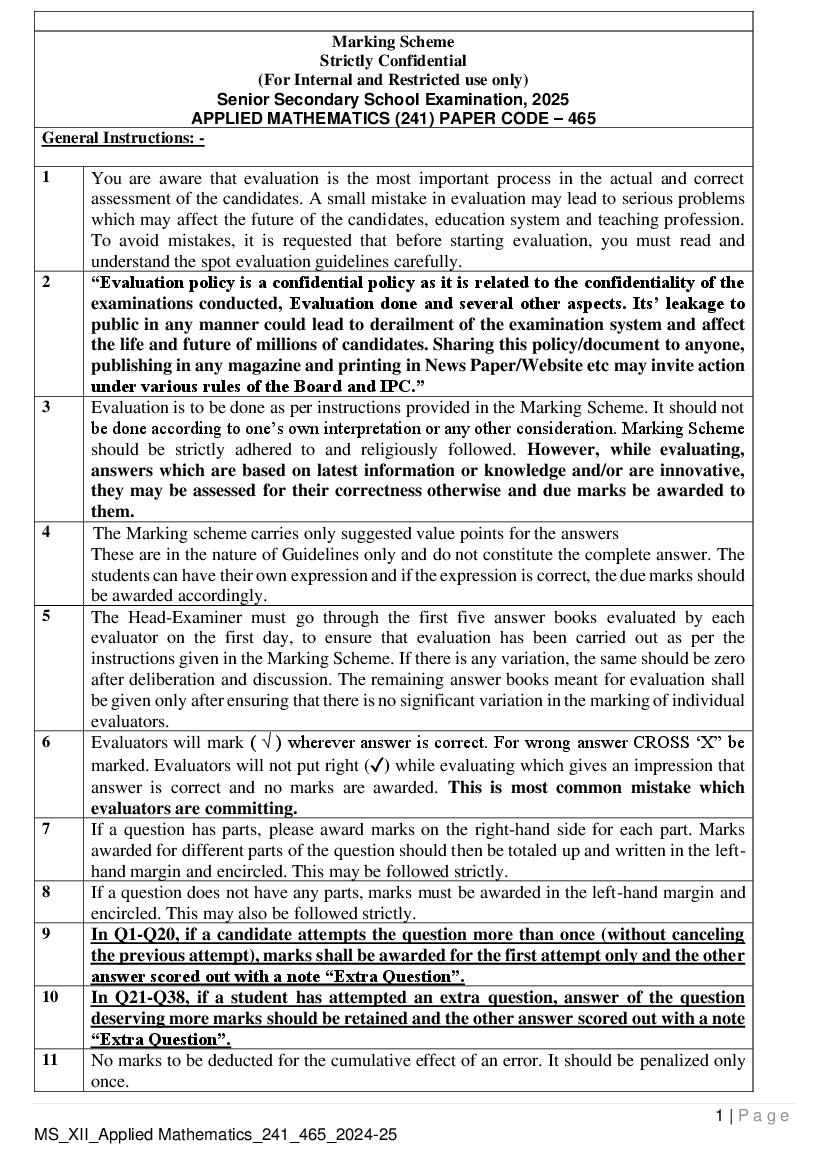
Strictly Confidential
(For Internal and Restricted use only)
Senior Secondary School Examination, 2025
APPLIED MATHEMATICS (241) PAPER CODE – 465
General Instructions: -
1 You are aware that evaluation is the most important process in the actual and correct
assessment of the candidates. A small mistake in evaluation may lead to serious problems
which may affect the future of the candidates, education system and teaching profession.
To avoid mistakes, it is requested that before starting evaluation, you must read and
understand the spot evaluation guidelines carefully.
2 “Evaluation policy is a confidential policy as it is related to the confidentiality of the
examinations conducted, Evaluation done and several other aspects. Its’ leakage to
public in any manner could lead to derailment of the examination system and affect
the life and future of millions of candidates. Sharing this policy/document to anyone,
publishing in any magazine and printing in News Paper/Website etc may invite action
under various rules of the Board and IPC.”
3 Evaluation is to be done as per instructions provided in the Marking Scheme. It should not
be done according to one’s own interpretation or any other consideration. Marking Scheme
should be strictly adhered to and religiously followed. However, while evaluating,
answers which are based on latest information or knowledge and/or are innovative,
they may be assessed for their correctness otherwise and due marks be awarded to
them.
4 The Marking scheme carries only suggested value points for the answers
These are in the nature of Guidelines only and do not constitute the complete answer. The
students can have their own expression and if the expression is correct, the due marks should
be awarded accordingly.
5 The Head-Examiner must go through the first five answer books evaluated by each
evaluator on the first day, to ensure that evaluation has been carried out as per the
instructions given in the Marking Scheme. If there is any variation, the same should be zero
after deliberation and discussion. The remaining answer books meant for evaluation shall
be given only after ensuring that there is no significant variation in the marking of individual
evaluators.
6 Evaluators will mark ( √ ) wherever answer is correct. For wrong answer CROSS ‘X” be
marked. Evaluators will not put right (✓) while evaluating which gives an impression that
answer is correct and no marks are awarded. This is most common mistake which
evaluators are committing.
7 If a question has parts, please award marks on the right-hand side for each part. Marks
awarded for different parts of the question should then be totaled up and written in the left-
hand margin and encircled. This may be followed strictly.
8 If a question does not have any parts, marks must be awarded in the left-hand margin and
encircled. This may also be followed strictly.
9 In Q1-Q20, if a candidate attempts the question more than once (without canceling
the previous attempt), marks shall be awarded for the first attempt only and the other
answer scored out with a note “Extra Question”.
10 In Q21-Q38, if a student has attempted an extra question, answer of the question
deserving more marks should be retained and the other answer scored out with a note
“Extra Question”.
11 No marks to be deducted for the cumulative effect of an error. It should be penalized only
once.
1|Page
Page 2
Question Paper) has to be used. Please do not hesitate to award full marks if the answer
deserves it.
13 ● Every examiner has to necessarily do evaluation work for full working hours i.e., 8
hours every day and evaluate 20 answer books per day in main subjects and 25 answer
books per day in other subjects (Details are given in Spot Guidelines). This is in view
of the reduced syllabus and number of questions in question paper.
14 Ensure that you do not make the following common types of errors committed by the
Examiner in the past: -
● Leaving answer or part thereof unassessed in an answer book.
● Giving more marks for an answer than assigned to it.
● Wrong totaling of marks awarded on an answer.
● Wrong transfer of marks from the inside pages of the answer book to the title page.
● Wrong question wise totaling on the title page.
● Wrong totaling of marks of the two columns on the title page.
● Wrong grand total.
● Marks in words and figures not tallying/not same.
● Wrong transfer of marks from the answer book to online award list.
● Answers marked as correct, but marks not awarded. (Ensure that the right tick mark is
correctly and clearly indicated. It should merely be a line. Same is with the X for
incorrect answer.)
Half or a part of answer marked correct and the rest as wrong, but no marks awarded.
15 While evaluating the answer books if the answer is found to be totally incorrect, it should
be marked as cross (X) and awarded zero (0) Marks.
16 Any un assessed portion, non-carrying over of marks to the title page, or totaling error
detected by the candidate shall damage the prestige of all the personnel engaged in the
evaluation work as also of the Board. Hence, in order to uphold the prestige of all concerned,
it is again reiterated that the instructions be followed meticulously and judiciously.
17 The Examiners should acquaint themselves with the guidelines given in the “Guidelines
for spot Evaluation” before starting the actual evaluation.
18 Every Examiner shall also ensure that all the answers are evaluated, marks carried over to
the title page, correctly totaled and written in figures and words.
19 The candidates are entitled to obtain photocopy of the Answer Book on request on payment
of the prescribed processing fee. All Examiners/Additional Head Examiners/Head
Examiners are once again reminded that they must ensure that evaluation is carried out
strictly as per value points for each answer as given in the Marking Scheme.
2|Page
Page 3
APPLIED MATHEMATICS (Subject Code–241)
(PAPER CODE: 465)
Section A
Q. No. EXPECTED OUTCOMES/VALUE POINTS Marks
SECTION A
Questions no. 1 to 18 are multiple choice questions (MCQs) and questions number 19
and 20 are Assertion-Reason based questions of 1 mark each.
1.
Sol. (B) 4 1
2.
Sol. (D) a − c > b + c 1
3.
Sol. (D) skew symmetric matrix 1
4.
Sol. 1/6 1/6 1
(C) [ ]
−1/3 2/3
5.
Sol. (D) ± 3 1
3|Page
Page 4
Sol. (A) 4 1
7.
Sol. dP 1
(B) dt = (α − β)P
8.
Sol. 𝟏 1
(C) 𝟑
9.
Sol. (A) 0 1
10.
Sol. (C) seasonal variations 1
11.
Sol. (B) 140 1
4|Page
Page 5
Sol. (A) ₹ 2,000 1
13.
Sol. (D) ₹ 14 1
14.
Sol. (B) 100 1
15.
Sol. 𝟏 1
(B)
𝟓
16.
Sol. 𝑥̅ −𝑦̅ 1
(B) 𝑡 = 1 1
𝑠√ +
𝑛1 𝑛2
5|Page
Page 6
Sol. (B) 4.04 % 1
18.
Sol. (A) 49.53 % 1
19.
Sol. (A) Both Assertion (A) and Reason (R) are true and Reason (R) is the correct 1
explanation of the Assertion (A).
20.
Sol. (A) Both Assertion (A) and Reason (R) are true and Reason (R) is the correct 1
explanation of the Assertion (A).
6|Page
Page 7
This section comprises very short answer (VSA) type questions of 2 marks each.
21(a).
Sol. Let the price per kg of mixture be ₹ 𝐱
𝟑𝟓−𝐱 𝟑 1
∴ 𝐱−𝟐𝟓 = 𝟐
⟹ 70 − 2x = 3x − 75
1
Solving, we get x = 29
∴ Price per kg of the mixture is ₹ 29
OR
21(b).
Sol. Let the required time taken be 𝑛 minutes
1 1 1 1
∴ 𝑛 = 60 + 90
1 3+2 5 1
⟹ 𝑛 = 180 = 180 = 36
3
∴ 𝑛 = 36 minutes or 5 hours 1
22.
Sol. Let the speed of the boat be 𝑥 km/h
∴ Speed of the boat upstream = (𝑥 − 1) km/h ½
and speed of the boat downstream = (𝑥 + 1) km/h
3.5 3.5 12 6
∴ 𝑥−1 + 𝑥+1 = 1 + 60 = 5 ½
⟹ 3.5 (2𝑥)5 = 6 (𝑥 2 − 1)
⟹ 6𝑥 2 − 35𝑥 − 6 = 0 ½
Solving, we get 𝑥 = 6 km/h ½
(rejecting the -ve value)
7|Page
Page 8
Sol.
Let the winning post be x metres away from the starting point.
x x−40
∴ = 1
3/2 1
x 3
⟹ 2 = 2 × 40 = 60 ⟹ x = 120 metres 1
24.
Sol. 1 1 −5 2 0 1
BA = [−5 1 −5] [3 4 5]
1 −2 4 0 2 3
Obtaining at least 4 correct entries 1
5 −6 −9
= [−7 −6 −15] 1
−4 0 3
25 (a).
Sol. 1 1 ½
Here, 𝑛 = 6, 𝑝 = 2 , 𝑞 = 2
P (at least 4 heads in 6 throws) = 𝑃(𝑋 ≥ 4)
1 4 1 2 1 5 1 1 1 6 1 0
= 6𝐶4 ( ) ( ) + 6𝐶5 ( ) ( ) + 6𝐶6 ( ) ( )
2 2 2 2 2 2 1
1 6 22 11
= 22 (2) = 64 𝑜𝑟 32 ½
OR
25 (b).
Sol. 𝑋−𝜇 15−9 1
(i) 𝑍 = = =2
𝜎 3
𝑋−9
(ii) 4 = ⟹ 𝑋 = 21
3
1
8|Page
Page 9
This section comprises short answer (SA) type questions of 3 marks each.
26.
Sol. 72 = 49 ≡ −1(𝑚𝑜𝑑 10)
7295 = (72 )147 × 7 1
Now, (72 )147 ≡ (−1)147 (𝑚𝑜𝑑 10) ≡ −1(𝑚𝑜𝑑 10) 1
⟹ 7295 = (72 )147 × 7 ≡ −7(𝑚𝑜𝑑 10) ≡ 3(𝑚𝑜𝑑 10) ½
∴ Units digit is 3. ½
27.
Sol. Numbers on the dice are 1, 2, 3, 4, 5, 6
∴ X can take the values 1, 2, 3, 4, 5 ½
X 1 2 3 4 5
P(X) 5 4 3 2 1 1
15 15 15 15 15
X P(X) 5 8 9 8 5
1
15 15 15 15 15
35 7 ½
𝐸 (𝑋) = ∑ 𝑋 𝑃(𝑋) = 15 = 3
28 (a).
4 8
Sol. Mean = 𝑛𝑝 = , variance = 𝑛𝑝𝑞 = ½
3 9
8 3 2
⟹𝑞 = 9×4= 3 ½
2 1
∴ 𝑝 =1−3 =3 ½
1 4
𝑛×3 = 3 ⟹ 𝑛 = 4 ½
1 1 2 3 1 8 ½
𝑃(𝑥 = 1) = 4𝐶1 (3) (3) = 4 × 3 × 27
32
= 81 ½
OR
9|Page
Page 10
Sol. Given, 𝑝 = 0.007, 𝑛 = 400 ½
∴ 𝜆 = 𝑛𝑝 = 400 × 0.007 = 2.8 1
(2.8)2 𝑒 −2.8 1
Now, 𝑃(X = 2) = 2!
7.84
= × 0.0608 = 0.2383 ½
2
29 (a).
Sol. Let 𝑥 kg of nitrogen and 𝑦 kg of phosphoric acid is used for minimum cost.
∴ the objective function is
Minimize 𝑍 = 6𝑥 + 5𝑦 ½
Subject to the constraints 10% × 𝑥 + 5% × 𝑦 ≥ 14 or 2𝑥 + 𝑦 ≥ 280 1
and 6% × 𝑥 + 10% × 𝑦 ≥ 14 or 3𝑥 + 5𝑦 ≥ 700 1
𝑥, 𝑦 ≥ 0 ½
Note: * Marks should be awarded for the formation of equations 2𝑥 + 𝑦 = 280 and
3𝑥 + 5𝑦 = 700 instead of inequations in Hindi medium only.
OR
29 (b).
10 | P a g e
Page 11
1½ for
correct
graph
Corner Points Value of Z 1 for
O (0,0) 0 correct
A (0, 17) 510 table
B (2,14) 520
C (9, 0) 450
∴ Maximum Z = 520 at B (2, 14) ½
30.
Sol. 𝑥̅ = 0.742, 𝜇 = 0.7
𝑛 = 10, 𝑠 = 0.04 ½
𝐻0 : Null hypothesis : If there is no significant difference between 𝑥̅ and 𝜇
𝐻1 : Alternate hypothesis : If there is a significant difference between 𝑥̅ and 𝜇
𝑥̅ −𝜇 0.742−0.7 1½
𝑡= 𝑠 = 0.04 = 3.15
√𝑛−1 √9
Df = 9 and 𝑡9 (0.05) = 2.262
Since |𝑡| = 3.15 > 2.262 ½
∴ Null hypothesis is rejected
11 | P a g e
Page 12
𝑥̅ −𝜇
Note:* 𝑡 = 𝑠 should also be accepted.
√𝑛
31.
Sol. 𝑃 = ₹ 5, 00, 000
𝑃𝑅𝑇
Interest =
100
500000×7.5×5
= = ₹ 1,87, 500 1
100
𝑛 = 5 years = 60 months ½
𝑃+𝐼
∴ EMI =
𝑛
500000+187500
= 1
60
= ₹ 11,458.33 ½
SECTION D
This section comprises of Long Answer (LA) type questions of 5 marks each.
32 (a).
Sol. |𝐴| = 2(−4 + 4) + 3(−6 + 4) + 5(3 − 2) = −1 ≠ 0 ½
∴ 𝐴−1 exists
2 −3 5 x 11
Now, [3 2 −4] [y] = [−5]
1
1 1 −2 z −3
or AX = B ⟹ X = A−1 B
0 −1 2
adj(A) = [2 −9 23] 1½
1 −5 13
0 −1 2 0 1 −2
1 1
A−1 = |A| adj(A) = −1 [2 −9 23] = [− 2 9 −23] ½
1 −5 13 −1 5 −13
x 0 1 −2 11 1
∴ [y] = [− 2 9 −23] [−5] = [2] 1
z −1 5 −13 −3 3
So, x = 1, y = 2, z = 3 ½
12 | P a g e
Page 13
32 (b).
Sol. (b + c)2 a2 a2
LHS = ∆= | b2 (c + a)2 b2 |
c2 c2 (a + b)2
Applying, C1 → C1 − C3
C2 → C2 − C3
(b + c)2 − a2 0 a2
∆= | 0 (c + a)2 − b2 b2 |
c − (a + b)2
2
c 2 − (a + b)2 (a + b)2 1+1
b+c−a 0 a2
= (a + b + c) 2|
0 c+a−b b2 | 1
c − a − b c − a − b (a + b)2
Applying, R1 → R 3 − R1 − R 2
b+c−a 0 a2
2|
= 2(a + b + c) 0 c+a−b b2 |
−b −a ab
Expanding, we get ∆ = 2abc(a + b + c)3 2
33.
Sol. p = 4 − 5𝑥 + 𝑥 2
p0 = 18, we have 18 = 4 − 5𝑥 + 𝑥 2
or 𝑥 2 − 5𝑥 − 14 = 0
⟹ (𝑥 − 7)(𝑥 + 2) = 0
∴ 𝑥 = 7, 𝑥 = −2 is rejected 1½
p0 𝑥0 = 18 × 7 = 126 ½
7
PS = p0 𝑥0 − ∫0 (𝑥 2 − 5𝑥 + 4) 𝑑𝑥 1
7
𝑥3 5𝑥 2
= 126 − [ 3 − 2 + 4𝑥] 1
0
119
= 126 −
6
637
= 6 or 106.17 approx. 1
13 | P a g e
Page 14
Sol.
Year Index 4 yearly 4 yearly Centered Centered
Number moving moving Total moving 4 yearly
total Average average moving
2001 2450 total – 1
2002 1470 mark
7870 1967.5
2003 2150 3625 1812.5 4 yearly
moving
6630 1657.5
average
2004 1800 3435 1717.5
– 1½
7110 1777.5
marks
2005 1210 3592.5 1796.25
7260 1815
centered
2006 1950 3805 1902.5
total - 1
7960 1990
mark
2007 2300 4297.5 2148.75
9230 2307.5
centered
2008 2500 4797.5 2398.75 moving
9960 2490 average
2009 2480 - 1½
2010 2680 marks
OR
34(b).
Sol.
14 | P a g e
Page 15
𝑋=
0.5
(𝑥𝑖 ) Number
𝑥𝑖 − 2013.5
(𝑌) =
0.5
2011 210 −5 25 −1050 234.17
+ (−5)1.64
= 225.97
2012 225 −3 9 −675 229.25
2013 275 −1 1 −275 232.53
2014 220 1 1 220 235.81
2015 240 3 9 720 239.09 2½ for
2016 235 5 25 1175 242.37 the
correct
𝑛=6 1405 ∑𝑋 = 0 ∑ 𝑋 2 = 70 ∑ 𝑋𝑌 = 115
table
∑𝑌 1405
𝑎= 𝑛 = = 234.17 (approx.) 1
6
∑ 𝑋𝑌 115
𝑏 = ∑ 𝑋2 = 70 = 1.64 (approx.) 1
Required line is 𝑌 = 𝑎 + 𝑏𝑥 = 234.17 + 1.64 𝑥 ½
35.
Sol. Amount needed after 12 years = ₹ 1,00,000 − ₹ 5,000 = ₹ 95,000 1
The payments into sinking fund consist of 12 annual payments at the rate of 5% per
year.
(1+𝑖)𝑛 −1
𝐴 = 𝑅[ ]
𝑖
(1.05)12 −1 2
95000 = 𝑅 [ ]
0.05
95000×0.05 4750 2
⟹𝑅= = ₹ 5968.84 (or = ₹ 5937.50 using approximations)
0.7958 0.8
15 | P a g e
Page 16
This section comprises of 3 case-study based questions of 4 marks each.
36.
Sol. (i) 𝑉 = 𝑥 (36 − 2𝑥)2 1
𝑑𝑉
(ii) = (36 − 2𝑥)2 + 2𝑥(36 − 2𝑥)(−2)
𝑑𝑥
= (36 − 2𝑥 )(36 − 2𝑥 − 4𝑥)
= (36 − 2𝑥 )(36 − 6𝑥 )
= 12 (18 − 𝑥)(6 − 𝑥) 1
𝑑𝑉
(iii) = 0 ⟹ 𝑥 = 18 or 𝑥 = 6 1
𝑑𝑥
Rejecting 𝑥 = 18, we have 𝑥 = 6
𝑑2 𝑉
and 𝑑𝑥 2 = 12(18 − 𝑥 )(−1) + 12 (−1)(6 − 𝑥 )
𝑑2 𝑉 ½
⟹ 𝑑𝑥 2 < 0 at 𝑥 = 6
∴ volume is maximum for 𝑥 = 6 ½
OR
𝑑𝑉
(iii) = 0 ⟹ 𝑥 = 18 or 𝑥 = 6 1
𝑑𝑥
Rejecting 𝑥 = 18, we have 𝑥 = 6
𝑑2 𝑉
and 𝑑𝑥 2 = 12(18 − 𝑥 )(−1) + 12 (−1)(6 − 𝑥 )
𝑑2 𝑉
⟹ 𝑑𝑥 2 < 0 at 𝑥 = 6
∴ Max V = 6 (36 − 12)2 = 6 (24)2 = 3456 𝑐𝑚3 1
16 | P a g e
Page 17
Sol. (i) P to C = 9 − (𝑥 + 𝑦) 1
(ii) Q to A = (4 − 𝑥)
½
Q to B = (4 − 𝑦)
Q to C = 6 − [9 − 𝑥 − 𝑦] = (𝑥 + 𝑦 − 3) ½
(iii) 𝑍 = 160 𝑥 + 100 𝑦 + 150 (9 − 𝑥 − 𝑦) + 100 (4 − 𝑥 ) + 120(4 − 𝑦) +
100(𝑥 + 𝑦 − 3) 1
= 10𝑥 − 70𝑦 + 1930 1
OR
17 | P a g e
Page 18
𝑥+𝑦≥3 ½
𝑥 ≤ 4, 𝑦 ≤ 4 1
𝑥, 𝑦 ≥ 0
38.
Sol. 𝑃𝑖 𝑃 𝑖 (1+𝑖)𝑛 1
(i) 𝐸 = 1−(1+𝑖)−𝑛 or (1+𝑖)𝑛−1
12
(ii) 𝑃 = ₹ 7, 00, 0000, 𝑖 = = 0.01, 𝑛 = 12 × 30 = 360 months 1
1200
7,00,000×0.01
(iii) 𝐸 = ₹ 1−(1.01)−360 1
7000 7000
= 0.97218332 = ₹ 7200.29 (or = ₹ 7216.49 using approximations) 1
0.97
OR
7,00,000×0.01
(iii) 𝐸 = ₹ 1−(1.01)−240 1
7000 7000
= 0.90819416 = ₹ 7707.60 (or = ₹ 7692.31 using approximations) 1
0.91
18 | P a g e
Document Details
| Board / Org | CBSE |
| Exam | Class 12 |
| Type | Solution |
| Pages | 18 |
| Updated | 24 Sep 2026 |