CBSE Class 12 Question Paper 2025 Solution Agriculture
Finished viewing? Save it for later —
Download CBSE Class 12 Question Paper 2025 Solution Agriculture (PDF · 13 pages)About CBSE Class 12 Question Paper 2025 Solution Agriculture
CBSE Class 12 Question Paper 2025 Solution Agriculture is available here for free download. Published by CBSE for Class 12, this solution can be viewed online or downloaded as a PDF (13 pages). Candidates preparing for Class 12 can use CBSE Class 12 Question Paper 2025 Solution Agriculture to understand the exam pattern, the type of questions asked, and the overall difficulty level.
Frequently Asked Questions
How can I download CBSE Class 12 Question Paper 2025 Solution Agriculture?
Open this page and click the Download button to save CBSE Class 12 Question Paper 2025 Solution Agriculture as a PDF. It is completely free on AglaSem Docs.
Is CBSE Class 12 Question Paper 2025 Solution Agriculture free to download?
Yes. CBSE Class 12 Question Paper 2025 Solution Agriculture can be viewed online and downloaded as a PDF free of cost on AglaSem Docs.
How many pages does CBSE Class 12 Question Paper 2025 Solution Agriculture have?
CBSE Class 12 Question Paper 2025 Solution Agriculture contains 13 pages, which you can read online or download together as a single PDF.
Where can I find more Class 12 study material?
You can find more Class 12 question papers, sample papers, syllabus, and answer keys on AglaSem Docs.
CBSE Class 12 Question Paper 2025 Solution Agriculture – Text
Read the full text of this solution below — useful to quickly search, copy and reference the content online without downloading the PDF.
📄 View text version (13 pages)
Page 1
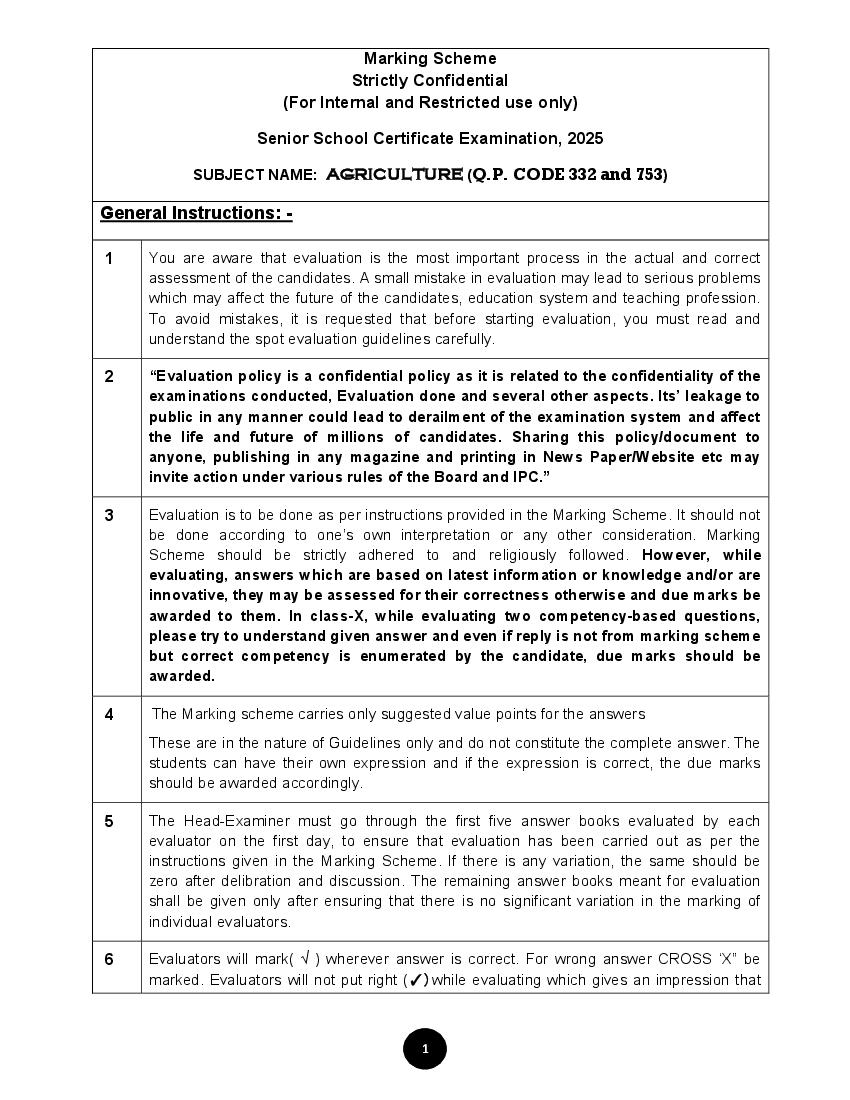
Strictly Confidential
(For Internal and Restricted use only)
Senior School Certificate Examination, 2025
SUBJECT NAME: AGRICULTURE (Q.P. CODE 332 and 753)
General Instructions: -
1 You are aware that evaluation is the most important process in the actual and correct
assessment of the candidates. A small mistake in evaluation may lead to serious problems
which may affect the future of the candidates, education system and teaching profession.
To avoid mistakes, it is requested that before starting evaluation, you must read and
understand the spot evaluation guidelines carefully.
2 “Evaluation policy is a confidential policy as it is related to the confidentiality of the
examinations conducted, Evaluation done and several other aspects. Its’ leakage to
public in any manner could lead to derailment of the examination system and affect
the life and future of millions of candidates. Sharing this policy/document to
anyone, publishing in any magazine and printing in News Paper/Website etc may
invite action under various rules of the Board and IPC.”
3 Evaluation is to be done as per instructions provided in the Marking Scheme. It should not
be done according to one’s own interpretation or any other consideration. Marking
Scheme should be strictly adhered to and religiously followed. However, while
evaluating, answers which are based on latest information or knowledge and/or are
innovative, they may be assessed for their correctness otherwise and due marks be
awarded to them. In class-X, while evaluating two competency-based questions,
please try to understand given answer and even if reply is not from marking scheme
but correct competency is enumerated by the candidate, due marks should be
awarded.
4 The Marking scheme carries only suggested value points for the answers
These are in the nature of Guidelines only and do not constitute the complete answer. The
students can have their own expression and if the expression is correct, the due marks
should be awarded accordingly.
5 The Head-Examiner must go through the first five answer books evaluated by each
evaluator on the first day, to ensure that evaluation has been carried out as per the
instructions given in the Marking Scheme. If there is any variation, the same should be
zero after delibration and discussion. The remaining answer books meant for evaluation
shall be given only after ensuring that there is no significant variation in the marking of
individual evaluators.
6 Evaluators will mark( √ ) wherever answer is correct. For wrong answer CROSS ‘X” be
marked. Evaluators will not put right (✓)while evaluating which gives an impression that
1
Page 2
evaluators are committing.
7 If a question has parts, please award marks on the right-hand side for each part. Marks
awarded for different parts of the question should then be totaled up and written in the left-
hand margin and encircled. This may be followed strictly.
8 If a question does not have any parts, marks must be awarded in the left-hand margin and
encircled. This may also be followed strictly.
9 If a student has attempted an extra question, answer of the question deserving more
marks should be retained and the other answer scored out with a note “Extra Question”.
10 No marks to be deducted for the cumulative effect of an error. It should be penalized only
once.
11 A full scale of marks 60 marks as given in Question Paper has to be used. Please do not
hesitate to award full marks if the answer deserves it.
12 Every examiner has to necessarily do evaluation work for full working hours i.e., 8 hours
every day and evaluate 20 answer books per day in main subjects and 25 answer books
per day in other subjects (Details are given in Spot Guidelines).This is in view of the
reduced syllabus and number of questions in question paper.
Ensure that you do not make the following common types of errors committed by the
13 Examiner in the past:-
● Leaving answer or part thereof unassessed in an answer book.
● Giving more marks for an answer than assigned to it.
● Wrong totaling of marks awarded on an answer.
● Wrong transfer of marks from the inside pages of the answer book to the title page.
● Wrong question wise totaling on the title page.
● Wrong totaling of marks of the two columns on the title page.
● Wrong grand total.
● Marks in words and figures not tallying/not same.
● Wrong transfer of marks from the answer book to online award list.
● Answers marked as correct, but marks not awarded. (Ensure that the right tick mark
is correctly and clearly indicated. It should merely be a line. Same is with the X for
incorrect answer.)
● Half or a part of answer marked correct and the rest as wrong, but no marks awarded.
14 While evaluating the answer books if the answer is found to be totally incorrect, it should
be marked as cross (X) and awarded zero (0)Marks.
15 Any unassessed portion, non-carrying over of marks to the title page, or totaling error detected
by the candidate shall damage the prestige of all the personnel engaged in the evaluation
work as also of the Board. Hence, in order to uphold the prestige of all concerned, it is again
reiterated that the instructions be followed meticulously and judiciously.
2
Page 3
Spot Evaluation” before starting the actual evaluation.
17 Every Examiner shall also ensure that all the answers are evaluated, marks carried over to the
title page, correctly totaled and written in figures and words.
18 The candidates are entitled to obtain photocopy of the Answer Book on request on payment of
the prescribed processing fee. All Examiners/Additional Head Examiners/Head Examiners are
once again reminded that they must ensure that evaluation is carried out strictly as per value
points for each answer as given in the Marking Scheme.
3
Page 4
Series: YWXZ4 Q P Code: 332
Q P Code: 753
Senior Secondary School Certificate Examination-2025
Marking Scheme – AGRICULTURE (808)
Max. Time: 3 Hours Max. Marks: 60
SECTION - A
OBJECTIVE TYPE QUESTIONS
Q1 Answer any 4 out of the given 6 questions on Employability skills (4x 1 = 4 marks)
i. (c) Ctrl + v 1
ii. (c) Organic farmers 1
iii. (b) Perseverance 1
iv. (d) Narcissistic personality disorder 1
v. (c)First letter in the names of all months is in small letter 1
vi. (a) 2 1
Q. 2 Answer any 5 out of the given 7 questions (5x 1 = 5 marks)
i. Banana 1
ii. 45 % 1
iii. Vitamin A 1
iv. (Any one) 1
Cashew nut, Almond, Walnut
4
Page 5
vi. Any flowering or foliage tree 1
vii. Use of low temperature is not a permanent method because some micro organisms can 1
also grow at low temperature
Q. 3 Answer any 6 out of the given 7 questions (6x 1 = 6 marks)
i Arnon and Stout 1
ii Apis dorsata 1
iii Lawn is an area where grass is grown as a green carpet for a landscape and is the basic 1
feature of any garden
iv Rose garden of Ludhiana 1
v Pre cooling 1
vi Urea 1
vii Nicholas Appert 1
Q.4 Answer any 5 out of the given 6 questions (5x 1 = 5 marks)
i Autoclave firstly used by Shriver 1
ii Biopesticides may be derived from animals (e.g. nematodes), plants (Chrysanthemum, 1
Azadirachta) and micro-organisms (e.g. Bacillus thuringiensis, Trichoderma,
nucleopolyhedrosis virus) (Any one)
iii Evaluating the fertility and nutrition content of the soil to offer an index of nutrient 1
availability in soil. Determining any salinity, acidity, and alkalinity problems.
iv 17 1
v Sericulture or silk production is the breeding and management of silk worms for the 1
commercial production of silk.
vi Asepsis: It means preventing the entry of micro organisms by maintaining of general 1
cleanliness while picking, grading, packing and transporting of fruits and vegetables,
increase their keeping quality and the product prepared from them will be of superior
quality.
5
Page 6
1
i Organic farming is a method of crop and livestock production that involves much more
than choosing not to use pesticides, weedicide, fertilizers, genetically modified
organisms, antibiotics and growth hormones.
1
ii Fruit jam
2 + ½ =1
iii Plant nutrients whose deficiency is first seen in young growing parts of plant (Any two)
[a] Fe-Iron
[b] Cu- Copper
[c] Cl- Chlorine
[d] S- Sulfur
[e] Mn- Manganese
1
iv In most of the preserved products two Class II chemical preservatives are used viz.
Sodium benzoate, Potassium metabisulhite (KMS)
1
v Rhizobium
1
vi Any One
1. Sucrose
2. Lactose
3. Maltose
Q.6 Answer any 5 out of the given 6 questions (1x 5 = 5 marks)
i Problems in sampling due to soil variation across a field/sampling in problematic soil 1
ii 10t/yr 1
iii Feb-March month 1
iv Ghaziabad, UP 1
v ≤2% 1
vi 0.25% P205 1
6
Page 7
(SUBJECTIVE TYPE QUESTIONS)
Answer any 3 out of the given 5 questions on Employability skills (3 x 2 = 6 marks)
Answer each question in 20-30 words
Q. 7 By managing stress effectively and maintaining a positive attitude, one can overcome 2
any challenge and achieve heights in career. Managing stress effectively helps one
maintain a healthy work–life balance.
Q. 8 The five stages of active listening are as follows. 2
1. Receiving: It involves listening attentively.
2. Understanding: It is an informed agreement about something or someone.
3. Remembering: It refers to the retrieval or recall of some information from the past.
4. Evaluating: It is about judging the value, quantity, importance and amount of
something or someone.
5. Responding: It is about saying or doing something as a response to something that
has been said or done.
Q. 9 Any one method can be used to add a new slide in any presentation. 2x1=2
Step1: Click on Slide. For each step
1 mark
Step2: Select New Slide from the drop-down
OR
Step1: You can also press Ctrl + M on the keyboard.
Step2: This will add a blank New Slide to the presentation.
Q. 10 Green jobs in eco tourism sector 2
Eco-tourism is intended to provide an experience to visitors to understand the
importance of conserving resources, reducing waste, enhancing the natural
environment and reducing pollution. This helps improve public image as the visitors
feel good about being in an environment friendly place. Green jobs in eco-tourism
include eco-tour guides and eco-tourism operators.
Q. 11 Qualities of successful entrepreneur (Any two) 2x1=2
1. Taking initiative
2. Willingness to take risks
3. Ability to learn from experience
4. Motivated
5. Self-confidence
6. Hard working
7. Decision making ability
7
Page 8
The main disadvantages of application of fertilizers through broadcasting are (Any 2x1=2
Q. 12
two)
1. Nutrients cannot be fully utilized by plant roots as they move laterally over
long distances.
2. The weed growth is stimulated all over the field.
3. Nutrients are fixed in the soil as they come in contact with a large mass of soil.
4. Large amount of fertilizer used as compared to other methods.
Various methods to judge the endpoint during Jelly preparation (Any two) 2x1=2
Q. 13
i. Drop test:- A drop of the concentrated mass is poured into a glass containing
water. Settling down of the drop without disintegration denotes the end-point
ii. Temperature:- 105.50C
iii. TSS:- 65 %
iv. Weight Test:- If total weight of jam is 1.5 times more than sugar weight, jam
is prepared.
Advantages of sprinkler irrigation. (Any two) 2x1=2
Q. 14
i. In the method, approximately 80 percent of the water is consumed by plants,
whereas in conventional method only 30 percent of the water is used.
ii. In this method save 30-50% water.
iii. Saving in fertilizer
iv. Suitable for any topography
v. No soil erosion
vi. Better seed germination, free aeration of root zone.
vii. Uniform application of water.
viii.
2
Q. 15 Degreening in fruits :
⚊ Is the process of decomposing the green pigments by applying ethylene or
other metabolic inducers to give fruits its colour preferred by consumers.
⚊ Followed in citrus fruits, banana, and mango.
8
Page 9
Q. 16
a) Organic food is more expensive because farmers do not get as much out of
their land as conventional farmers do.
b) Production costs are higher because farmers need more workers.
c) Marketing and distribution is not efficient because organic food is produced
in smaller amounts.
d) Production as productivity is low.
e) Problem with authenticity of organic produce
Answer any 2 out of the given 3 questions in 30-50 words each (2 x 3 = 6 marks)
Q. 17 Soil fertility evaluation can be performed using various methods : 3
1. Soil testing : Soil testing involves analyzing soil samples for various soil
nutrients, including macronutrients and micronutrients. Soil testing can be
done using various techniques, such as chemical extraction, biological assays,
and spectroscopy.
2. Plant tissue analysis : Plant tissue analysis involves analyzing plant tissues for
nutrient concentrations, which can help identify nutrient deficiencies or
excesses.
3. Visual observation : Visual observation involves assessing plant growth and
development, leaf color, and other indicators of plant health to identify
potential nutrient deficiencies or excesses.
Q. 18 6x ½ =3
Various reasons for preserving the food
[a] To increase the shelf life of the food for increasing the supply.
[b] To make the seasonal fruits available throughout the year.
[c] To add the variety to the diet.
[d] To save time by reducing preparation, time and energy.
[e] To stabilize the prices of the food in the market.
[f] To improve the health of the population/ nutritional quality.
[g] Income of the farmers is increased.
9
Page 10
1. Atta : Is a wheat flour, suitable fo r making chappatis
2. Special bakers flour : They are two types:-
[A] Strong flour : Used for bread, rolls, and pasty
[B] Light flour (Bakers flour) : Used for making light bread
3. Biscuit flour : special bread of flour, used for mechanical biscuit planes.
4. Salt-raising flour : Is a soft flour fortified with chemical creative additive
similar to baking powder, used for cake making
Answer any 3 out of the given 5 questions in 50 -80 words each (3 x 2 = 12 marks)
Q. 20 Description/Explanation o
on the following heading 4
10
Page 11
[a] To work as when as possible in a closed system to draw upon local
resources.
[b] To maintain long-term fertility of soils
[c] To avoid all forms of pollution result from agricultural technologies
[d] To produce food products with high nutritional quality and sufficient
quantity.
[e] To reduce the use of fossil energy to a minimum
[f] To give livestock conditions of life that confirm to their physiological need
[g] To make agricultural. producers to earn life through their work and develop
their potential
Q. 22 Bio pesticide is a formulation made from naturally occurring substances that controls 1+3=4
pests by nontoxic mechanisms and in eco-friendly manner. Bio pesticides are
generally less toxic to the user and are non-target organisms, making them desirable
and sustainable tools for disease management.
Classification of biopesticide with example
1. Microbial pesticides : Composed of microscopic living organisms (viruses,
bacteria, fungi, protozoa, or nematodes) or toxin produced by these
organisms. Example Bacillus thuringiensis (Bt), Agrobacterium radiobacter
Pseudomonas fluorescens (Phenazine), Trichoderma, Metarhizium anisopliae,
Beauveria bassiana Nomuraea riley, Baculoviruses(Bvs)
2. Plant-incorporated-protectants (PIPs) : Cry genes
3. Biochemical pesticides : Semiochemicals (chemical signals) include
pheromones, ecdysteroids and the juvenile hormones
4. Botanical pesticides : Several plant based insecticides as nicotinoids, natural
pyrethrins, rotenoids, neem products etc
5. Biotic agents (parasitoids and predators) : Lady beetles, rove beetles, many
ground beetles, lacewings, true bugs such as Podisus and Orius, syrphid fly
larvae, mantids, spiders, and mites such as Phytoseiulus and Amblyseius.
11
Page 12
Cucumber
Washing
Peeling
Cutting into 5 cm pieces
Mixing with salt
Filling in jar
Standing for 6-8 hours
Draining off water
Adding spices and vinegar
Keeping in sun for a week
Storage
(In a cool place, away from sunlight)
12
Page 13
radiation is referred as radiation, also known as radurization, and cold sterilization as
it works without raising temperature of the produce.
Irradiation Dose
Commodity
Minimum Maximum Purpose
Onion 0·03 0·09
Potatoes 0·05 0·15 Sprout
Garlic 0·03 0·15 Inhibition
Shallots 0·03 0·15
—END—
13
Document Details
| Board / Org | CBSE |
| Exam | Class 12 |
| Type | Solution |
| Pages | 13 |
| Updated | 24 Sep 2026 |