CBSE Class 12 English Core Question Paper 2018 Set 1
Finished viewing? Save it for later —
Download CBSE Class 12 English Core Question Paper 2018 Set 1 (PDF · 16 pages)About CBSE Class 12 English Core Question Paper 2018 Set 1
CBSE Class 12 English Core Question Paper 2018 Set 1 is available here for free download. Published by CBSE for Class 12, this question paper can be viewed online or downloaded as a PDF (16 pages). Candidates preparing for Class 12 can use CBSE Class 12 English Core Question Paper 2018 Set 1 to understand the exam pattern, the type of questions asked, and the overall difficulty level.
Frequently Asked Questions
How can I download CBSE Class 12 English Core Question Paper 2018 Set 1?
Open this page and click the Download button to save CBSE Class 12 English Core Question Paper 2018 Set 1 as a PDF. It is completely free on AglaSem Docs.
Is CBSE Class 12 English Core Question Paper 2018 Set 1 free to download?
Yes. CBSE Class 12 English Core Question Paper 2018 Set 1 can be viewed online and downloaded as a PDF free of cost on AglaSem Docs.
How many pages does CBSE Class 12 English Core Question Paper 2018 Set 1 have?
CBSE Class 12 English Core Question Paper 2018 Set 1 contains 16 pages, which you can read online or download together as a single PDF.
Where can I find more Class 12 study material?
You can find more Class 12 question papers, sample papers, syllabus, and answer keys on AglaSem Docs.
CBSE Class 12 English Core Question Paper 2018 Set 1 – Text
Read the full text of this question paper below — useful to quickly search, copy and reference the content online without downloading the PDF.
📄 View text version (16 pages)
Page 1
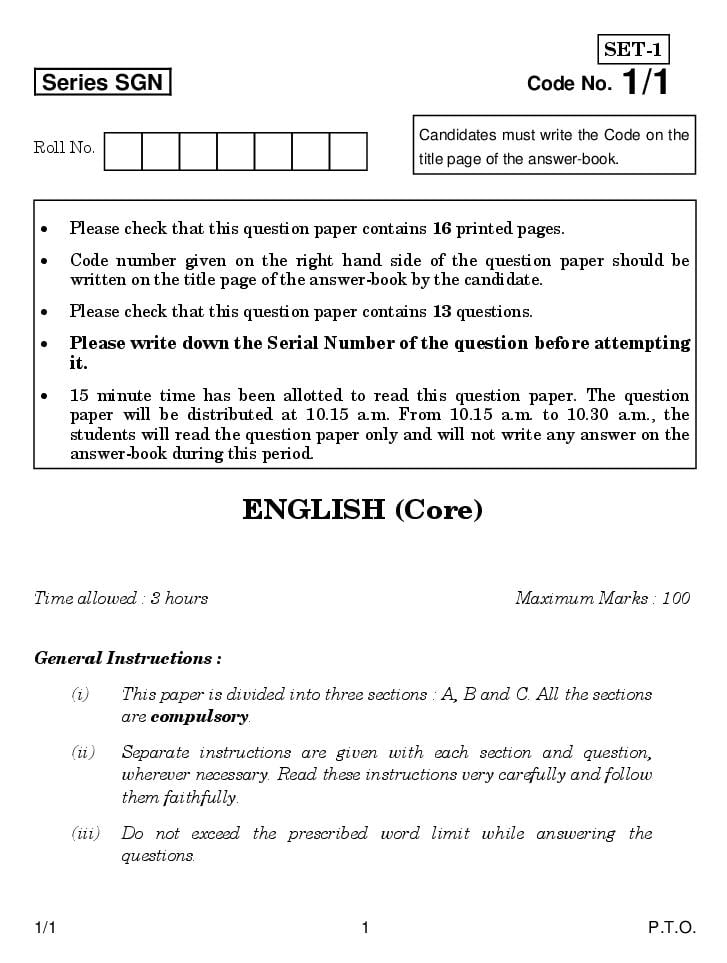
Series SGN Code No. 1/1
Candidates must write the Code on the
Roll No.
title page of the answer-book.
Please check that this question paper contains 16 printed pages.
Code number given on the right hand side of the question paper should be
written on the title page of the answer-book by the candidate.
Please check that this question paper contains 13 questions.
Please write down the Serial Number of the question before attempting
it.
15 minute time has been allotted to read this question paper. The question
paper will be distributed at 10.15 a.m. From 10.15 a.m. to 10.30 a.m., the
students will read the question paper only and will not write any answer on the
answer-book during this period.
ENGLISH (Core)
Time allowed : 3 hours Maximum Marks : 100
General Instructions :
(i) This paper is divided into three sections : A, B and C. All the sections
are compulsory.
(ii) Separate instructions are given with each section and question,
wherever necessary. Read these instructions very carefully and follow
them faithfully.
(iii) Do not exceed the prescribed word limit while answering the
questions.
1/1 1 P.T.O.
Page 2
1. Read the passage given below : 12
1 When you grow up in a place where it rains five months a year, wise
elders help you to get acquainted with the rain early. They teach you
that it is ignorant to think that it is the same rain falling every day.
Oh no, the rain is always doing different things at different times.
There is rain that is gentle, and there is also rain that falls too hard
and damages the crops. Hence, the prayer for the sweet rain that helps
the crops to grow.
2 The monsoon in the Naga hills goes by the native name, khuthotei
(which means the rice-growing season). It lasts from May to early or
mid-October. The local residents firmly believe that Durga Puja in
October announces the end of rain. After that, one might expect a
couple of short winter showers, and the spring showers in March and
April. Finally, comes the ‘‘big rain’’ in May; proper rainstorms
accompanied by heart-stopping lightning and ear-splitting thunder. I
have stood out in storms looking at lightning arc across dark skies, a
light-and-sound show that can go on for hours.
3 This is the season when people use the word sezuo or süzu to refer to
the week-long rains, when clothes don’t dry and smell of mould, when
fungus forms on the floor and when you can’t see the moon or the stars
because of the rainclouds. But you learn not to complain. Rain, after
all, is the farmer’s friend and brings food to the table. Rituals and
festivals centre around the agricultural rhythm of life, which is the
occupation of about 70 percent of the population.
1/1 2
Page 3
grandfather say, ‘‘It’s very windy this year. We’ll get good rain.’’ If the
windy season was short and weak, he worried there might not be
enough rain for the crops. I learned the interconnectedness of the
seasons from childhood, and marvelled at how the wind could bring
rain. Another evening, many rainy seasons ago, my paternal aunt
observed the new moon and worried, ‘‘Its legs are in the air, we’re in
for some heavy rain.’’ She was right. That week, a storm cut off power
lines and brought down trees and bamboos.
5 Eskimos boast of having a hundred names for snow. Norwegians in the
north can describe all kinds of snow by an equal amount of names :
pudder, powder snow, wet snow, slaps, extra wet snow, tight snowfall,
dry snow, and at least 95 more categories of snow. Likewise, in India
we have names and names for rain. Some are common, some are
passing into history.
6 The rains are also called after flowering plants and people believe that
the blossoming of those plants draws out rain. Once the monsoons set
in, field work is carried out in earnest and the work of uprooting and
transplanting paddy in flooded terrace fields is done. The months of
hard labour are June, July and August. In August, as the phrogü plant
begins to bloom, a rain will fall. This August rain, also called phrogü, is
a sign that the time for cultivation is over. If any new grain seeds are
sown, they may not sprout; even if they do sprout, they are not likely to
bear grain. The rain acts as a kind of farmer’s almanac.
7 The urban population of school-goers and office-goers naturally dislikes
the monsoon and its accompanying problems of landslides, muddy
streets and periodic infections. For non-farmers, the month of
1/1 3 P.T.O.
Page 4
awareness persists that the monsoons will last out till October. One
needs to have the heart of a farmer to remain grateful for the watery
days, and be able to observe — from what seems to the inexperienced
as a continuous downpour — the many kinds of rain. Some of the
commonly known rain-weeks are named after the plants that
alternately bloom in August and September. The native belief is that
the flowers draw out the rain.
8 Each rain period has a job to fulfil : October rain helps garlic bulbs to
form, while kümünyo rain helps the rice bear grain. Without it, the
ears of rice cannot form properly. End October is the most beautiful
month in the Naga hills, as the fields turn gold and wild sunflowers
bloom over the slopes, all heralding the harvest. Prayers go up for
protecting the fields from storms, and the rains to retreat because the
grain needs to stand in the sun and ripen. The cycle nears completion a
few weeks before the harvest, and the rain does retreat so thoroughly
from the reaped furrows that the earth quickly turns hard. The months
of rain become a distant memory until it starts all over again.
On the basis of your understanding of the above passage, complete the
statements given below with the help of options that follow : 1 4=4
(a) The rains are called after flowering plants because
(i) heavy rains kill plants.
(ii) flowers grow in the rainy season.
(iii) it is believed that the plants bring the rain.
(iv) flowers grow all the year round.
1/1 4
Page 5
(i) it tells them when to sow and when to harvest.
(ii) it tells them the birthdays of their children.
(iii) each month has a time for plantation.
(iv) different kinds of rain tell different things.
(c) People who live in cities don’t like rain because
(i) it brings mud and sickness with it.
(ii) they are not bothered about the farmers.
(iii) they don’t like the plants that grow during the rain.
(iv) going shopping becomes difficult.
(d) People pray asking the rain to retreat because
(i) the fungus and mould need to dry.
(ii) children don’t get a chance to play.
(iii) the crops need the sun and heat to ripen.
(iv) they like to pray.
Answer the following questions briefly : 1 6=6
(e) Why do the elders want you to understand the rains in the Naga hills ?
(f) What does Durga Puja mean to the farmers of the Naga hills ?
(g) What kind of rain is called sezuo ?
(h) What is the occupation of more than half the population of the Naga
hills ?
1/1 5 P.T.O.
Page 6
(j) When does rain become a memory in the minds of the people of the
Naga hills ?
(k) Find words from the passage which mean the same as the
following : 1 2=2
(i) flowering (para 6)
(ii) nonstop (para 7)
2. Read the passage given below : 10
1 Every morning Ravi gives his brain an extra boost. We’re not talking
about drinking strong cups of coffee or playing one of those
mind-training video games advertised all over Facebook. ‘‘I jump
onto my stationary bike and cycle for 45 minutes to work,’’ says
Ravi. ‘‘When I get to my desk, my brain is at peak activity for a few
hours.’’ After his mental focus comes to a halt later in the day, he
starts it with another short spell of cycling to be able to run errands.
2 Ride, work, ride, repeat. It’s a scientifically proven system that
describes some unexpected benefits of cycling. In a recent study in
the Journal of Clinical and Diagnostic Research, scientists found
that people scored higher on tests of memory, reasoning, and
planning after 30 minutes of spinning on a stationary bike than they
did before they rode the bike. They also completed the tests faster
after pedalling.
1/1 6
Page 7
exercising your muscles, create rich capillary beds not only in leg
and hip muscles, but also in your brain. More blood vessels in your
brain and muscles mean more oxygen and nutrients to help them
work. When you pedal, you also force more nerve cells to fire. The
result : you double or triple the production of these cells — literally
building your brain. You also release neurotransmitters (the
messengers between your brain cells) so all those cells, new and old,
can communicate with each other for better, faster functioning.
That’s a pretty profound benefit to cyclists.
4 This kind of growth is especially important with each passing
birthday, because as we age, our brains shrink and those
connections weaken. Exercise restores and protects the brain cells.
Neuroscientists say, ‘‘Adults who exercise display sharper memory
skills, higher concentration levels, more fluid thinking, and greater
problem-solving ability than those who are sedentary.’’
5 Cycling also elevates your mood, relieves anxiety, increases stress
resistance, and even banishes the blues. ‘‘Exercise works in the
same way as psychotherapy and antidepressants in the treatment of
depression, maybe better,’’ says Dr. Manjari. A recent study
analyzing 26 years of research finds that even some exercise — as
little as 20 to 30 minutes a day — can prevent depression over the
long term.
1/1 7 P.T.O.
Page 8
especially when you’re just getting started or getting back into
riding. When you first begin to exert yourself, your body releases a
particular hormone to raise your heart rate, blood pressure, and
blood glucose levels, says Meher Ahluwalia, PhD, a professor of
integrative physiology. As you get fitter, it takes a longer, harder
ride to trigger that same response.
On the basis of your understanding of the passage, complete the
statements given below with the help of the options that follow : 1 2=2
(a) Ravi gets his brain to work at peak level by
(i) drinking three cups of coffee.
(ii) playing games that need brain activity.
(iii) cycling on a stationary bike.
(iv) taking tablets to pump up his brain.
(b) When nerve cells work during exercise then
(i) the body experiences stress.
(ii) the bran is strengthened by multiplying them.
(iii) you start to lose your temper.
(iv) your stationary cycle starts to beep.
Answer the following questions briefly : 1 6=6
(c) How does exercise help the brain ?
(d) Why does Ravi do a circuit of ‘ride, work, ride’ ?
1/1 8
Page 9
(f) What benefits other than greater brain activity does one get from
cycling ?
(g) Why is exercise so important for adults ?
(h) How is exercise itself a stress ?
(i) Find words from the passage which mean the same as the
following : 1 2=2
(i) manure (para 3)
(ii) inactive (para 4)
3. Read the passage given below : 8
Keeping cities clean is essential for keeping their residents healthy. Our
health depends not just on personal hygiene and nutrition, but critically
also on how clean we keep our cities and their surroundings.
The spread of dengue and chikungunya are intimately linked to the
deteriorating state of public health conditions in our cities.
The good news is that waste management to keep cities clean is now
getting attention through the Swachh Bharat Mission. However, much of
the attention begins and stops with the brooms and the dustbins,
extending at most to the collection and transportation of the mixed waste
to some distant or not so distant place, preferably out of sight.
1/1 9 P.T.O.
Page 10
waste, and safe disposal of the residuals in scientific landfills, has received
much less attention in municipal solid waste management than is expected
from a health point of view.
One of the problems is that instead of focusing on waste management for
health, we have got sidetracked into ‘‘waste for energy’’. If only we were to
begin by not mixing the biodegradable component of solid waste (close to
60 percent of the total) in our cities with the dry waste, and instead use
this stream of waste for composting and producing a gas called methane.
City compost from biodegradable waste provides an alternative to
farmyard manure (like cow-dung). It provides an opportunity to
simultaneously clean up our cities and help improve agricultural
productivity and quality of the soil. Organic manure or compost plays a
very important role as a supplement to chemical fertilisers in enriching the
nutrient-deficient soils. City compost can be the new player in the field.
Benefits of compost on the farm are well-known. The water holding
capacity of the soil which uses compost helps with drought-proofing, and
the requirement of less water per crop is a welcome feature for a
water-stressed future. By making the soil porous, use of compost also
makes roots stronger and resistant to pests and decay. Farmers using
compost, therefore, need less quantity of pesticides. There is also evidence
to suggest that horticulture crops grown with compost have better flavour,
size, colour and shelf-life.
City compost has the additional advantage of being weed-free unlike
farmyard manure which brings with it the seeds of undigested grasses and
requires a substantial additional labour cost for weeding as the crops grow.
City compost is also rich in organic carbon, and our soils are short in this.
1/1 10
Page 11
composted before making it available to the farmers for applying to the
soil, cities would be cleaned up and the fields around them would be much
more productive.
Quite apart from cleaning up the cities of biodegradable waste, this would
be a major and sustainable contribution to improving the health of our soil
without further damage by excessive chemical inputs. What a marvellous
change from waste to health!
The good news is that some states are regularly laying plastic roads.
Plastic roads will not only withstand future monsoon damage but will also
solve a city’s problem of disposing of non-recyclable plastic. It is clear that
if the mountains of waste from our cities were to be recycled into road
construction material, it would tackle the problem of managing waste
while freeing up scarce land.
(a) On the basis of your understanding of the above passage, make
notes on it using headings and sub-headings. Use recognisable
abbreviations wherever necessary (minimum four) and a format you
consider suitable. Also supply an appropriate title to it. 5
(b) Write a summary of the passage in about 80 words. 3
1/1 11 P.T.O.
Page 12
4. You are Faiz/Falak Mazumdar living at 39, Udampur Colony, Shimla.
You decide to hold a dinner party to congratulate your grandparents on
their golden wedding anniversary. Draft a formal invitation in not more
than 50 words to all family members to attend a grand dinner at home. 4
OR
You are Harish/Harshita of 12, Seva Nagar, Pune. You want to sell your
flat as you are shifting to another city for work. Draft a suitable
advertisement in not more than 50 words to be published in The Pune
Times under the classified columns.
5. You are Neeraj/Neeraja Shekhar, Principal, Vasant Public School, Pune.
Your school has just started a music department. Write a letter to the
Manager of Melody House, Pune, wholesale suppliers of musical
instruments, placing an order for musical instruments for the school. Ask
for a discount on the catalogue prices. (120 – 150 words) 6
OR
Bal Vidya Public School, Bhilai, urgently requires a post-graduate teacher
to teach political science for which they have placed an advertisement in
The Bhilai Express. You are Sanjay/Sanjana Sharma from 21, Vasant
Marg, Bhilai. Draft a letter including a CV, applying for the advertised
post. (120 – 150 words)
1/1 12
Page 13
monsoon season laid bare the hollowness of the claims of the civic
authorities of their preparedness. The poor had to bear the brunt of the
problem while no one was ever held accountable. Write an article in
150 – 200 words on the common man’s woes during the monsoons and the
need for accountability of the officials concerned. You are Sumit/Smita
Verma. 10
OR
You are Ali/Alia, Head girl / Head boy of your school. You are deeply
disturbed by the rising cases of aggressive behaviour of students in your
school. You decide to speak during the morning assembly about it. Write a
speech on ‘Indiscipline in Schools’. (150 – 200 words)
7. ‘‘Academic excellence is the only requirement for a successful career.’’
Write a debate either for or against the motion. (120 – 150 words) 10
OR
MMD School, Nashik, recently organised a science symposium on the
topic : ‘Effect of pollution on quality of life’. You are Amit/Amita Raazdan,
editor of the school magazine. Write a report on the event for your school
magazine. (120 – 150 words)
1/1 13 P.T.O.
Page 14
8. Read the extract given below and answer the questions that follow : 1 4=4
... and clear rills
That for themselves a cooling covert make
‘Gainst the hot season; the mid forest brake,
Rich with the sprinkling of fair musk-rose blooms;
...............
(a) Identify the poem and the poet.
(b) What is the role of the clear rills ?
(c) How has the mid forest brake become rich ?
(d) Name the figure of speech in ‘cooling covert’.
OR
...... On their slag heap, these children
Wear skins peeped through by bones and spectacles of steel
With mended glass, like bottle bits on stones.
(a) Name the poem and the poet.
(b) Explain : ‘slag heap’.
(c) What future awaits these children ?
(d) Name the figure of speech used in the third line.
1/1 14
Page 15
(a) What does the poet’s smile in the poem, ‘My Mother at Sixty-six’
show ?
(b) ‘‘Listening to them, I see two distinct worlds ... .’’ In the context of
Mukesh, the bangle maker’s son, which two worlds is Anees Jung
referring to ?
(c) Though the sharecroppers of Champaran received only one-fourth of
the compensation, how can the Champaran struggle still be termed
a huge success and victory ?
(d) Which article in McLeery’s suitcase played perhaps the most
significant role in Evans’ escape and how ?
(e) Why does Derry’s mother not want him to go back to visit Mr. Lamb ?
(f) What considerations influenced the Tiger King to get married ?
10. Answer the following question in 120 – 150 words : 6
In one’s approach to life one should be practical and not live in a world of
dreams. How is Jansie’s attitude different from that of Sophie ?
OR
Fear is something that we must learn to overcome if we want to succeed in
life. How did Douglas get over his fear of water ?
1/1 15 P.T.O.
Page 16
At the end of the storytelling session, why does Jack consider himself
‘caught in an ugly middle position’ ?
OR
It may take a long time for oppression to be resisted, but the seeds of
rebellion are sowed early in life. How did Zitkala-Sa face oppression as a
child and how did she overcome it ?
12. Answer the following question in 120 – 150 words : 6
How does the perception and attitude of the villagers of Raveloe towards
Silas Marner change from the beginning to the end of the novel ?
OR
How do you perceive Dr. Kemp based on his interaction with Griffin ? (The
Invisible Man)
13. Answer the following question in 120 – 150 words : 6
How is Godfrey Cass different from his younger brother, Dunstan ?
OR
‘‘Misdirected and self-serving ambition essentially remains an exercise in
futility.’’ Describe Griffin’s character in the light of the above statement.
1/1 16
Document Details
| Board / Org | CBSE |
| Exam | Class 12 |
| Type | Question Paper |
| Pages | 16 |
| Updated | 22 Jul 2026 |