CBSE Class 12 Entrepreneurship Question Paper 2020 Set 1 Solutions
Finished viewing? Save it for later —
Download CBSE Class 12 Entrepreneurship Question Paper 2020 Set 1 Solutions (PDF · 16 pages)About CBSE Class 12 Entrepreneurship Question Paper 2020 Set 1 Solutions
CBSE Class 12 Entrepreneurship Question Paper 2020 Set 1 Solutions is available here for free download. Published by CBSE for Class 12, this solution can be viewed online or downloaded as a PDF (16 pages). Candidates preparing for Class 12 can use CBSE Class 12 Entrepreneurship Question Paper 2020 Set 1 Solutions to understand the exam pattern, the type of questions asked, and the overall difficulty level.
Frequently Asked Questions
How can I download CBSE Class 12 Entrepreneurship Question Paper 2020 Set 1 Solutions?
Open this page and click the Download button to save CBSE Class 12 Entrepreneurship Question Paper 2020 Set 1 Solutions as a PDF. It is completely free on AglaSem Docs.
Is CBSE Class 12 Entrepreneurship Question Paper 2020 Set 1 Solutions free to download?
Yes. CBSE Class 12 Entrepreneurship Question Paper 2020 Set 1 Solutions can be viewed online and downloaded as a PDF free of cost on AglaSem Docs.
How many pages does CBSE Class 12 Entrepreneurship Question Paper 2020 Set 1 Solutions have?
CBSE Class 12 Entrepreneurship Question Paper 2020 Set 1 Solutions contains 16 pages, which you can read online or download together as a single PDF.
Where can I find more Class 12 study material?
You can find more Class 12 question papers, sample papers, syllabus, and answer keys on AglaSem Docs.
CBSE Class 12 Entrepreneurship Question Paper 2020 Set 1 Solutions – Text
Read the full text of this solution below — useful to quickly search, copy and reference the content online without downloading the PDF.
📄 View text version (16 pages)
Page 1
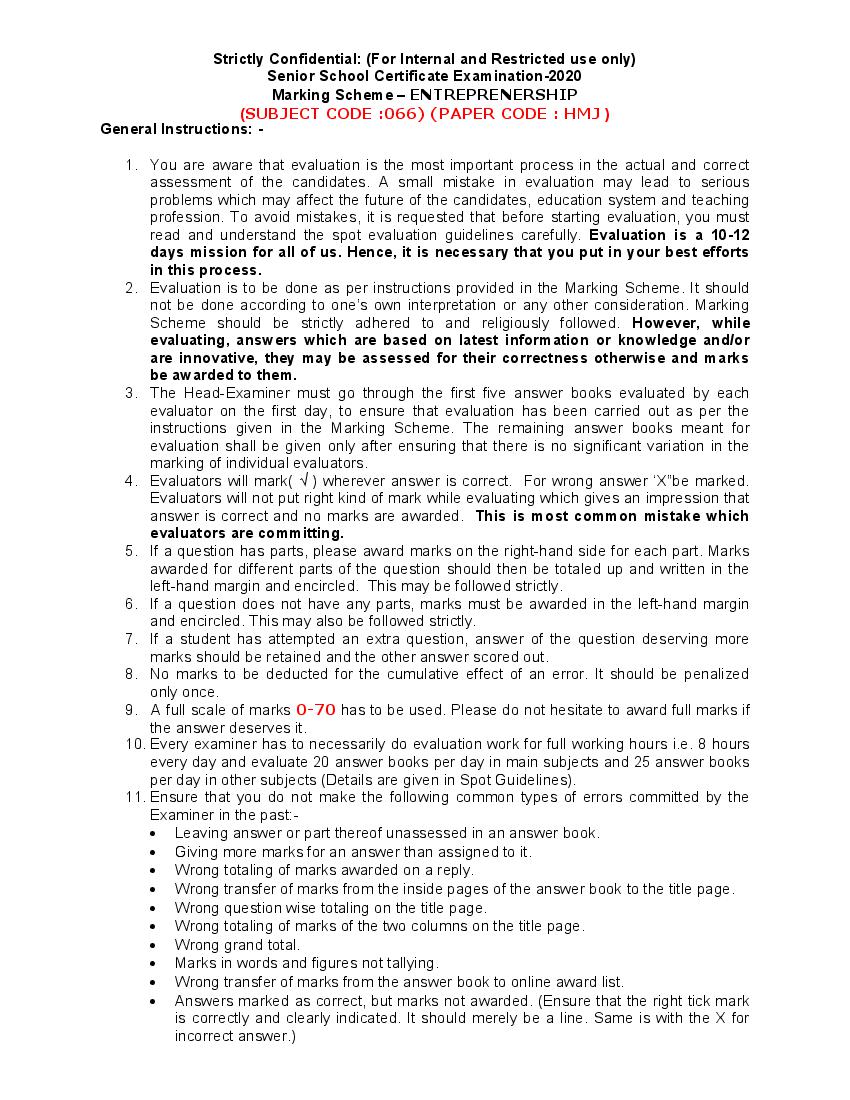
Senior School Certificate Examination-2020
Marking Scheme – ENTREPRENERSHIP
(SUBJECT CODE :066) (PAPER CODE : HMJ )
General Instructions: -
1. You are aware that evaluation is the most important process in the actual and correct
assessment of the candidates. A small mistake in evaluation may lead to serious
problems which may affect the future of the candidates, education system and teaching
profession. To avoid mistakes, it is requested that before starting evaluation, you must
read and understand the spot evaluation guidelines carefully. Evaluation is a 10-12
days mission for all of us. Hence, it is necessary that you put in your best efforts
in this process.
2. Evaluation is to be done as per instructions provided in the Marking Scheme. It should
not be done according to one’s own interpretation or any other consideration. Marking
Scheme should be strictly adhered to and religiously followed. However, while
evaluating, answers which are based on latest information or knowledge and/or
are innovative, they may be assessed for their correctness otherwise and marks
be awarded to them.
3. The Head-Examiner must go through the first five answer books evaluated by each
evaluator on the first day, to ensure that evaluation has been carried out as per the
instructions given in the Marking Scheme. The remaining answer books meant for
evaluation shall be given only after ensuring that there is no significant variation in the
marking of individual evaluators.
4. Evaluators will mark( √ ) wherever answer is correct. For wrong answer ‘X”be marked.
Evaluators will not put right kind of mark while evaluating which gives an impression that
answer is correct and no marks are awarded. This is most common mistake which
evaluators are committing.
5. If a question has parts, please award marks on the right-hand side for each part. Marks
awarded for different parts of the question should then be totaled up and written in the
left-hand margin and encircled. This may be followed strictly.
6. If a question does not have any parts, marks must be awarded in the left-hand margin
and encircled. This may also be followed strictly.
7. If a student has attempted an extra question, answer of the question deserving more
marks should be retained and the other answer scored out.
8. No marks to be deducted for the cumulative effect of an error. It should be penalized
only once.
9. A full scale of marks 0-70 has to be used. Please do not hesitate to award full marks if
the answer deserves it.
10. Every examiner has to necessarily do evaluation work for full working hours i.e. 8 hours
every day and evaluate 20 answer books per day in main subjects and 25 answer books
per day in other subjects (Details are given in Spot Guidelines).
11. Ensure that you do not make the following common types of errors committed by the
Examiner in the past:-
Leaving answer or part thereof unassessed in an answer book.
Giving more marks for an answer than assigned to it.
Wrong totaling of marks awarded on a reply.
Wrong transfer of marks from the inside pages of the answer book to the title page.
Wrong question wise totaling on the title page.
Wrong totaling of marks of the two columns on the title page.
Wrong grand total.
Marks in words and figures not tallying.
Wrong transfer of marks from the answer book to online award list.
Answers marked as correct, but marks not awarded. (Ensure that the right tick mark
is correctly and clearly indicated. It should merely be a line. Same is with the X for
incorrect answer.)
Page 2
awarded.
12. While evaluating the answer books if the answer is found to be totally incorrect, it should
be marked as cross (X) and awarded zero (0)Marks.
13. Any unassessed portion, non-carrying over of marks to the title page, or totaling error
detected by the candidate shall damage the prestige of all the personnel engaged in the
evaluation work as also of the Board. Hence, in order to uphold the prestige of all
concerned, it is again reiterated that the instructions be followed meticulously and
judiciously.
14. The Examiners should acquaint themselves with the guidelines given in the Guidelines
for spot Evaluation before starting the actual evaluation.
15. Every Examiner shall also ensure that all the answers are evaluated, marks carried over
to the title page, correctly totaled and written in figures and words.
16. The Board permits candidates to obtain photocopy of the Answer Book on request in an
RTI application and also separately as a part of the re-evaluation process on payment of
the processing charges.
Page 3
ENTREPRENEURSHIP (066), 2020
Q.No. Question with expected answers Marks
SECTION A
Q. 1 A prospective entrepreneur has to find an opportunity which would be 1
suitable for him/her in terms of ________________ and _____________
Ans Customers to be served, Profits expected 0.5 marks for
each correct
answer
0.5 x 2 = 1
Q. 2 __________ is a simple but powerful message that helps to communicate an 1
enterprise’s goals, mission, distinct qualities and so much more.
Ans Tagline 1
Q. 3 The Securities and Exchange Board of India performs various functions 1
which makes it very powerful. But to create accountability there is an appeal
process which lies with ___________ and ___________ .
Ans Securities Appellate Tribunal , Supreme Court 0.5 marks for
each correct
answer
Note: In case the candidate has given any other answer it should be 0.5 x 2 = 1
marked correct.
OR ___________ is an equity based investment in a growth-oriented, small to 1
medium sized business, which in most cases would not qualify for receiving
bank loans.
Ans Venture Capital 1
Q. 4 A viable venture is born when knowledge, skills, __________ and 1
__________ is strategically applied.
Ans Competency, Creativity 0.5 marks for
each correct
answer
0.5 x 2 = 1
Q. 5 The organization, management, membership and functioning of Stock 1
Exchange in India is governed by the provisions of ____________.
Ans The Securities Contracts (Regulation) Act, 1956 1
Q. 6 Piyush and Ramesh are engaged in wholesale business of pulses. They buy 1
pulses directly from farmers in bulk and sell in small lots to the retailers.
Both of them know their roles and responsibilities. They have also laid down
the procedure for solving conflicts between them, if any. All the above
information is described in an important component of a business plan. The
component is ____________ .
Ans Organisational Plan 1
Page 4
Q. 7 The secondary market offers opportunity to an entrepreneur to issue 1
additional capital as and when required.
Ans False 1
Q. 8 Business environment consists of three levels, i.e. SWOT analysis level, 1
micro level and macro level.
Ans False 1
Q. 9 Ravi created a portable incinerator to be installed in the houses. The dry 1
waste generated at homes can be converted by it into ash that can be used as
manure for plants. He has installed five prototypes of this incinerator in his
society to test its working and to prove its value. Ravi is in the verification
stage of his product.
Ans True 1
Q. 10 Devidayal Ltd. is into manufacturing of stainless steel and copper utensils 1
from last 20 years and has a good reputation in the market. The company
needs funds for expansion. It decided to bring a new issue of shares worth
Rs. 1 crore. Through a circular, these shares will be proposed to the existing
shareholders and in case they are not willing to subscribe, they can renounce
the same in favour of another person. Devidayal Ltd. is raising capital
through private placement.
Ans False 1
Q. 11 Direct sale of its securities by a company to a limited number of 1
sophisticated investors is known as Rights Issue.
Ans False 1
OR
When total current assets exceed total current liabilities it refers to Gross 1
Working Capital.
Ans False 1
Q. 12 ‘Free home delivery of food’ is a trading related idea. 1
Ans False 1
Multiple choice questions
Q. 13 In the drive to make the world ‘plastic free’, Aru designed a machine to 1
convert single-use plastic into very small granules that could be used for
making low cost roads. Her machine worked with the help of solar energy.
She put her idea before the venture capitalists by making an entertaining
slide show and oral narration. She also presented the executive summary of
her proposed venture and a few key graphs. The format of business plan used
by Aru is :
(A) Elevator pitch
(B) A pitch deck with oral narrative
(C) A written presentation for external stakeholders
(D) An internal operational plan
Ans B 1
Q. 14 The ‘marketing strategy’ and ‘action plan’ comprise of decisions pertaining 1
Page 5
(A) Potential hazards present in the competitive environment
(B) Product, place, price, promotion
(C) Customer’s characteristics
(D) Quantifying goals of the organization
Ans B 1
Q. 15 Which of the following is not a component of product mix : 1
(A) Branding
(B) Labelling
(C) Packaging
(D) Promotion
Ans D 1
Q. 16 Harjot is planning to set up a unit for manufacturing biodegradable bags of 1
different sizes by processing the sugarcane bagasse. She also plans to be
fully relieved of the problem of distribution and thus decides to hand over
her entire output to the selling agents. The channel of distribution used by
Harjot is:
(A) Zero level
(B) One level
(C) Two level
(D) Three level
Ans D 1
Q. 17 Raghav sells an air purifier for Rs. 2,100. If the purchase price of the product 1
is 80% of its selling price, the profit earned by Raghav is :
(A) Rs.1,700
(B) Rs.1,680
(C) Rs. 420
(D) Rs. 400
Ans C 1
SECTION – B
Q. 18 What is meant by environment scanning? Why does an entrepreneur need to 2
scan the environment?
Ans Meaning: Careful monitoring of an organization's internal and external 1 mark for
environment for detecting early signs of opportunities and threats that meaning + 1
may influence its current and future plans is called environment mark for need
scanning.
Need: The right information, combined with the right adaptations, can
determine an organization's future viability. If an entrepreneur is not
aware of the environment surrounding his/her business, he/she is sure to
fail.
OR
Description of business venture is an important component of a business 2
plan. Physical infrastructure is one of the key elements covered under this.
State about
(i) utilities, and
(ii) production process as part of the physical infrastructure.
Ans 1. Utilities: These include: power, fuel, water, gas, electricity, etc. 0.5 mark for
Business plan needs to clearly state: (a) type of utilities required, (b) mentioning only
Page 6
coal, coke, oil etc. required and the suppliers of the same. mark to be
given if
complete
explanation is
given.
2. Production process: A mention of the process involved in
production, the installed licensed capacity of the plant, the 1 mark for
technology to be used, whether available locally or imported, shifts complete
involved, needs to be present in the business plan. explanation
0.5 + 0.5 + 1=2
Q. 19 Sukrit is a green entrepreneur who has launched a new water conserving 2
apparatus for urban houses by the name of ‘JALASHAY’. This apparatus is
a compact system to be installed on the roof of the houses to harvest
rainwater. The uniqueness of the system is that it has an inbuilt water
treatment mechanism that makes the water ready for use as soon as it is
collected.
Sukrit has set up laboratories to test the water quality with the established
standards. By doing so, he is paying specific attention to one of the important
elements of the operational plan.
Identify the element and explain one more element of this plan.
Ans Identification of the element given in the statement of the question - 1 mark for
Inspection identification
and 1 mark for
(Any one of the following element) explanation of
one more
a. Routing – it is a process concerned with determining the exact element
route from raw material to finished product.
b. Scheduling – it means fixing the time, day, date when the
operation has to be commenced and completed.
c. Dispatching – this is the process of initiating production with
preconceived production plan.
d. Follow up – it relates to evaluation and appraisal of work
performed.
e. Shipping – this gives the chronological steps involved in
completing the business transaction efficiently and profitably.
Q. 20 How does stock exchange ensure the safety of the investment of an investor? 2
Explain by giving any two reasons.
Ans 1. Dissemination of useful information: Stock exchange publishes 1 + 1
useful information regarding price lists, quotations, etc., of
securities through newspapers and journals. The interested
persons buy and sell their securities on the basis of information
provided by the stock exchanges.
2. Investors' interests protected: Stock exchanges formulate rules
and regulations so that members may not exploit the investors.
Page 7
safely depend upon the information provided by the stock
exchanges.
(Any two)
(If an examinee has not given the headings as above but has given the
correct explanation, full credit will be given)
Q. 21 Giving any two reasons, explain how franchising is a viable option for the 2
growth of start-up firms.
Ans 1. Franchising offers startups an established product in the market for a 1 + 1
royalty which helps them.
2. Startups take up training to understand the product and franchisors
make franchises fully conversant with the product/services that they
have to offer for a fee. It is very important that the Sales-man must
know his/her product. In this case, start-ups are the sales person.
3. The start-ups can grow fast without having to increase labour,
operating costs and blocking running expenses because normally buyers
straight walk up to them.
4. In practical Franchises work for the benefit of franchisors.
(Any Two Reasons)
OR While selecting a distribution channel, the entrepreneur has to take into 2
consideration various factors relating to product, market, company and
government. Explain any two market-related factors.
Ans Market related factors: 1+1
1. Number of buyers- Services of middlemen when buyers are large
Direct channel when buyers are less
2. Types of buyers- General buyers – more middlemen
Industrial buyers- direct channel
3. Buying habits – when goods are sold on credit- middlemen
4. Buying Quantity- Goods purchased in smaller quantity-
middlemen
5. Size of market- Market area scattered – use of middlemen
(Any two)
(If an examinee has not given the headings as above but has given the
correct explanation, full credit will be given)
Q. 22 BarleAgro Ltd. is a famous name for bottled beverages like cold coffee, 2
flavoured milk, iced tea, etc. Now the company is planning to introduce a
range of fresh fruit smoothies giving competition to big multinational and
Indian brands. The company has a very effective marketing department.
Create a tagline and an individual brand name for the upcoming product
range of BarleAgro Ltd.
Ans Any relevant tagline and brand name. 1 mark for
Individual
Brand Name +1
Page 8
Q. 23 Understanding lifestyle changes and attitude towards work and leisure, 2
Flizon India Ltd. started an online shopping portal offering same day
delivery to its customers without any extra charge, on orders above Rs.500.
The company also installed an online payment security system where there is
end-to-end encryption of the banking details of the customer. Identify and
state the two environmental factors discussed above.
Ans Social Factor- Free home delivery, changes in lifestyle, attitude towards 0.5 mark for
work and leisure. identification
Technological – Secured online banking transactions and 0.5 mark
for statement
1+1=2
Q. 24 State how obtaining venture capital is different from raising loan from a 2
lender. Also state any two areas where venture-capitalists decide to invest.
Ans Obtaining venture capital is substantially different from raising debt or 1 + ½ + ½
a loan from a lender. Lenders have a legal right to interest on a loan and
repayment of the capital, irrespective of the success or failure of a
business. But, a venture capital is invested in exchange for an equity
stake in the business.
(Any two areas where venture capitalists decided to invest)
a. They may invest in any of the many opportunities presented to
them.
b. Looks for the extremely rare, yet sought after qualities such as
innovative technology, potential for rapid growth, a well-
developed business model, an impressive management team
c. Looks for an ‘exit’ in the time frame of typically 3-7 years
d. Inclined towards ventures with exceptionally high growth
potential.
SECTION C
Q. 25 There are various sources of idea fields like natural resources, existing 3
products or services, creative efforts, etc. The entrepreneurs who look at
ways to make an existing product or service better, have a number of reasons
for this. Giving example, explain any two such reasons.
Ans 1. Keep up with the competition: If you provide services or products in 1 mark for
an industry that is constantly changing, it's important to stay aware of example
the latest in industry trends so that one can continue to be competitive. 1 mark each for
reason
2. Increase sales: The main reason people will change and improve their
existing product line is to increase their sales and ultimately, their
revenue. By adding to the product line, one can take the company in a
new direction by increasing sales.
3. Working on existing products and services can generate a number of
ideas to improve them or to provide cheaper substitutes or to bring
about a reduction in price.
(Any two points with suitable examples)
Page 9
correct explanation, full credit will be given)
OR
Explain ‘product identification’, ‘application and use’ and ‘level of 3
operation’ as important steps in idea and opportunity assessment.
Ans 1. Product Identification – an idea should lead the entrepreneur to 1 x 3 = 3
a definite product/service which he can sell. He should also see
whether this product is already available in the market or not. If
it is, then, identify the reason for introducing the same product.
2. Application and use- ideas should be examined for their real life
use and application. If it already exists in the market, then find
out its present use and think of modifying it for better use.
3. Level of operation- depending upon the use of the product/service
the entrepreneur will produce it in a cottage industry or a small
scale industry or a large scale industry.
Q. 26 Rashi has done her Acharya degree in Ayurveda from Trichy. She is 3
planning to start a small scale enterprise of making herbal face care and body
care products by the name ‘Skinatural’. She makes use of her extensive
knowledge about herbs to create products that can suit all skin types. She is
also taking care of the allergen factor as the products have to be applied on
skin. She is planning to offer only dry mix of the herbs to be blended by the
user at the time of use.
Create an introduction for her product relating to the ‘Product details’ in the
business plan which will help her to attract the customers.
Ans Any three product details from the following with statement based on 1 x 3 = 3
the information given in the question:
1. Product utility
2. Product Range
3. Product design
4. USP of the product
Q. 27 Fa-Hein, a tourist from China came to India with his family. For a week-long 3
stay in Mumbai, he booked two rooms in a well-reputed international hotel
‘Milton’. During his stay, he experienced some problems in the services of
the hotel. He complained to the manager about the same. The manager tried
to resolve them to the best of his ability.
Fa-Hein, on returning back to China wrote a mail to the Chief Executive
Officer (CEO) of Milton Hotel, giving his feedback and stating his
dissatisfying experience at their hotel. The CEO apologized for the same and
gave Fa-Hein a complimentary stay with family for a week in any hotel of
the ‘Milton group.’
Identify the process which carefully manages the information of the
individual customers in order to manage the loyalty. Also explain the
benefits of this process to the businesses.
Ans The process is Customer Relationship Management. 1 mark for
identification +
Benefits of Customer Relationship Management are: 2 marks for
Page 10
CRM system comes directly from having all your business data
stored and accessed from a single location.
2. Other benefits include a 360 degree view of all the customer
information, knowledge of what customers and the general
market wants and integration with existing applications to
consolidate all business information.
Q. 28 ‘Meow Milk Center’ sells 3,000 bottles of flavoured milk per year. Cost of 3
one milk bottle is Rs.60. Holding cost per annum is Rs. 12. Ordering cost is
Rs. 500 per order. Calculate the ‘Economic Order Quantity’.
Ans C= Rs. 12 1 mark for
formula +
D= 3,000 bottles 2 marks for
P= Rs. 500 working
𝟐𝟐 × 𝒂𝒂𝒂𝒂𝒂𝒂𝒂𝒂𝒂𝒂𝒂𝒂 𝒅𝒅𝒅𝒅𝒅𝒅𝒅𝒅𝒅𝒅𝒅𝒅 × 𝒐𝒐𝒐𝒐𝒐𝒐𝒐𝒐𝒐𝒐𝒐𝒐𝒐𝒐𝒐𝒐 𝒄𝒄𝒄𝒄𝒄𝒄𝒄𝒄 𝒑𝒑𝒑𝒑𝒑𝒑 𝒖𝒖𝒖𝒖𝒖𝒖𝒖𝒖
EOQ= �
/𝑪𝑪𝑪𝑪𝑪𝑪𝑪𝑪𝑪𝑪𝑪𝑪𝑪𝑪𝑪𝑪 𝒄𝒄𝒄𝒄𝒄𝒄𝒄𝒄 𝒑𝒑𝒑𝒑𝒑𝒑 𝒖𝒖𝒖𝒖𝒖𝒖𝒖𝒖
𝟐𝟐𝟐𝟐𝟐𝟐
�
/𝒄𝒄
= �𝟐𝟐 × 𝟑𝟑𝟑𝟑𝟑𝟑𝟑𝟑 × 𝟓𝟓𝟓𝟓𝟓𝟓 / 𝟏𝟏𝟏𝟏
= 500 units.
Q. 29 Explain ‘production budget’, ‘cash budget’ and ‘project budget’ as types of 3
budgets.
Ans 1. Production budget – an estimate of the number of units that must 1 x 3 = 3
be manufactured to meet the sales goals. It also estimates the
various costs involved with manufacturing those units, including
labor and material.
2. Cash flow budget – used to determine whether an organization
long term investments such as new machinery, replacement
machinery, new plants, products and research developments
projects are work pursuing.
3. Project budget – a prediction of the costs associated with a
particular company project. These costs include labour,
materials, and other related expenses. The project budget is often
broken down into specific tasks, with task budgets assigned to
each.
Note: In case the candidate has given any other answer it should be
marked correct.
OR
Explain ‘Stock Keeping Unit Code’, ‘Lead time’ and ‘Safety aspects’ as 3
items that make up the inventory.
Ans 1. Stock keeping unit code: 1x3=3
Page 11
code which signifies certain aspects of the item. It can be color, size,
weight etc.,
2. Lead time:
Lead time to manufacture or procure an item depends on many factors.
Combined effect of these factors like standard or special raw material,
processing time, scheduling of machines, distance between source and
user point make up the lead time for an item.
3. Safety aspects:
Some of the items are hazardous in nature and special precautions have
to be taken in their storage.
SECTION – D
Q. 30 Why is a business plan valuable for an entrepreneur? Explain with the help 4
of any four points.
Ans The importance of business plan is as follows– 1x4
1. Helps in determining the viability of the venture in a designated
market.
2. Helps in providing guidance to the entrepreneur in organizing his/her
planning activities such as: i) identifying the resources required ii)
enabling obtaining of licenses if required etc. iii) working out with legal
requirements as desired by the government.
3. Helps in satisfying the concerns, queries, and issues of each group of
people interested in the venture.
4. Provides room for self-assessment and self-evaluation, requiring
entrepreneur to think through various scenarios and plan ways to avoid
obstacles.
5. Business plan helps to realize the obstacles which cannot be avoided
or overcome, suggesting to terminate the venture while still on paper
without investing further time and money.
6. Business plan reflects the entrepreneur's credit history, the ability to
meet debt and interest payments, and the amount of personal equity
invested thus serving as an important tool in funds procurement.
(Any four points)
Q. 31 Explain any four reasons for failure of merger and acquisition. 4
Ans Reasons for failure of Merger and Acquisitions (M & A) are as follows: 1x4
1. Unrealistic price paid for target: The process of M&A involves
valuation of the target company and paying a price for taking over the
assets of the company.
2. Difficulties in cultural integration: Every merger involves combining
of two or more different entities. These entities reflect different
Page 12
and functional differences.
3. Overstated synergies: Mergers and acquisitions are looked upon as an
important instrument for creating synergies through increased revenue,
reduced costs and reduction in networking capital and improvement in
the investment intensity. Overestimation for these can lead to failure of
mergers.
4. Integration difficulties: Companies very often face integration
difficulties, i.e., the combined entity has to adapt to a new set of
challenges given by the changed circumstances.
5. Poor business fit: Mergers and acquisitions also fail when the
products or services of the merging entities do not naturally fit into the
acquirer's overall business plan.
6. Inadequate due diligence: Due diligence is a crucial component of the
M&A process as it helps in detecting financial and business risks that
the acquirer inherits from the target company.
7. High leverage: One of the most crucial elements of an effective
acquisition strategy is planning how one intends to finance the deal
through an ideal capital structure. The acquirer may decide to acquire
the target through cash. To pay the price of acquisition, the acquirer
may borrow heavily from the market. This creates a very high leveraged
structure and increases the interest burden of the company.
8. Boardroom split: When a merger is planned, it is crucial to evaluate
the composition of the boardroom and compatibility of the directors.
9. Regulatory issues: The entire process of merger requires legal
approvals. If any of the stakeholders are not in favour of the merger,
they might create legal obstacles and slow down the entire process.
10. Human resources issues: A merger or acquisition is identified with
job losses, restructuring and the imposition of a new corporate culture
and identity. This can create uncertainty, anxiety and resentment among
the company's employees. These HR issues are crucial to the success of
M&As.
(Any four points)
(If an examinee has not given the headings as above but has given the
correct explanation, full credit will be given)
OR Explain any four requirements for ‘Value Chain Management’. 4
Ans 1.Coordination and collaboration: To increase efficiency within an 1 x 4 = 4
organization, coordination and collaboration is essential. Coordinate
work groups to ensure efforts are not duplicated.
2. Technology investment: Technology plays a large role in
manufacturing and distribution. With outdated technology, such as old
Page 13
3. Organizational process: In value chain management, every aspect of
an organization's process is identified.
4. Leadership: Strong leaders are crucial to the success in value chain
management. Good leaders earn the respect of their employees through
sound management practices.
5. Employee/human resources: A central hub of information on
benefits, company policies, hiring and conflict management is also
necessary for a corporation to function properly.
6. Organizational culture and attitudes: Organizations that foster
strong cultural identity with positive attitudes tend to attract and retain
top employees. Regular corporate sponsored activities are suggested to
help build cultural unity and keep attitudes positive while boosting
productivity.
(Any Four)
Note: In case the candidate has given any other answer it should be
marked correct.
Q. 32 Bright Lights Pvt. Ltd. started a business of making three varieties of bulbs. 4
From the following information, calculate breakeven for the three varieties
of bulbs for the company in units :
Particulars LED bulb Zero LED bulb 10 LED bulb 20
Watt Watts Watts
Sales Price (Rs) 80 45 60
Variable Cost 40 15 20
(Rs)
Sales Mix 50% 20% 30%
Fixed costs for the production process is Rs. 76,000.
Ans LED LED LED
bulb bulb 10 bulb 20
Zero watt watt
watt
Sales Price 80 45 60
Variable 40 15 20
Cost
Contribution 40 30 40
Sales mix 50% 20% 30%
Contribution 20 6 12
x Sales mix
2 marks for
working and
Page 14
weighted
BEP = Fixed cost/WACM = 76,000/38= 2000 units
contribution
0.5 mark for total
In Units:
BEP +
LED bulb Zero watt = 50% of 2000 = 1000 units 0.5 mark each for
individual break
LED bulb 10 watt = 20% of 2000 = 400 units even of the three
LED bulb 20 watt = 30% of 2000 = 600 units. varieties
SECTION – E
Q. 33 Explain any six components of a financial plan. 6
Ans A) Proforma investment decisions: This part of financial plan relates to 0.5 for heading
how the enterprise's funds are invested in different assets so that the + 0.5 for
enterprise is able to earn the highest possible returns on investment. The explanation for
entrepreneur should mention investment required in for: i) Land and each point
building ii) Machinery and plant iii) Installation cost iv) Preliminary
expenses v) Margin for working capital vi) Expenses on research and 1x6
development vii) Investment in short-term assets viz. raw material, level
of cash, etc. This part helps to understand the total amount of finance
required by the entrepreneur. Inadequate funds or excess funds, both
have the capacity to severely damage the financial fortune of a business.
Therefore, these decisions must be taken with utmost care.
B) Proforma financing decisions: This section summarizes all the
projected sources of funds available to the venture to raise finance.
Typically, sources of funds are: i) owners i.e. Owner's funds ii) outsiders
i.e. Borrowed funds The entrepreneur's job is to ensure the selection of
the best overall mix of financing for the enterprise so that: a) the cost of
capital and the financial risk stands minimized, b) return on investment
and profitability stands maximized.
C) Proforma income statement: The proforma income statement is the
projected net profit calculated from projected revenue minus projected
costs and expenses. Basically, it summarizes all the profit data during
the first year of operations of the new enterprises.
D) Proforma cash flow: Profit and cash flow are not the same, Proforma
cash flow reflects the projected cash available with the enterprise as a
result of subtracting projected cash disbursements from projected cash
accumulations. Cash flows only when actual payments are received or
made. Mere sale which might be on credit, will not generate cash.
E) Proforma balance sheet: This document helps the enterprise to
reflect the position of the business at the end of its first year. A summary
of the projected assets, liabilities and net worth of the entrepreneur is
depicted through proforma balance sheet.
F) Break–even point: Every firm wants to maximise its profits. The
Page 15
neither makes a profit nor a loss.
G) Economic and social variables: In view of the social responsibility of
business, the abatement costs, i.e. the cost of controlling the
environmental damage should also be stated in the plan.
(Any six points)
(If an examinee has not given the headings as above but has given the
correct explanation, full credit will be given)
OR
In addition to ‘number of persons’, ‘profit sharing’ and ‘agreement’, there 6
are various other features of partnership. Explain any six such features.
Ans 1.Unlimited liability: Mostly, the liability of the partners of a firm is 0.5 for heading
unlimited. Their personal properties can be disposed off to pay the debts + 0.5 for
of the firm if required. The creditors can claim their dues from any one explanation for
of the partner or from all of them, meaning partners are liable: each point
• Individually
• Collectively 1x6=6
2. Implied authority: There is an implied authority that any partner can
act on behalf of the firm. The firm stands bound by the acts of partners.
3. Mutual agency: The business of partnership can be carried on by all
the partners or any one of them acting for all. Thus, every partner is
principal as well as agent of other partners and of the firm. Thus, (i)
Each partner is liable for acts performed by other partners, (ii) Each
partner can bind other partners and the firm by his acts done in the
ordinary course of business.
4. Utmost good faith: Every partner is supposed to act honestly and give
proper accounts to other partners. Thus, mutual faith and confidence in
one another is the main strength of partnership.
5. Restriction on transfer of shares: No partner can sell or transfer his
share to anybody else without the consent of the other partners. By
giving a notice for dissolution of the firm, a partner can show intention
to discontinue as partner.
6. Continuity: A partnership continues up to the time that all partners
desire to continue it. Legally, a firm dissolves on the retirement, death,
bankruptcy lunacy, or disability of a partner if not otherwise provided
for in the partnership deed.
(If an examinee has not given the headings as above but has given the
correct explanation, full credit will be given)
Page 16
the situations when ‘Penetrating pricing’ and ‘Skimming pricing’ are useful.
Also state any two disadvantages each for Penetrating pricing and Skimming
pricing.
Ans Difference:
Penetration pricing is a pricing strategy where the price of a product is
initially set at a price lower than the eventual market price to attract 2 + 2 + 2
new customers. The strategy works on the expectations that customers
will switch to the new brand because of the lower price.
Under Skimming pricing the price of a product is initially set at a higher
price so that fewer sales are needed to break even. It is usually employed
to reimburse the cost of investment of the original research.
Situations where Penetration and Skimming are useful:
Penetration: it is useful for low priced goods. It is associated with the
marketing objective of increasing market share or sales volume rather
than to make profit in the short term.
Skimming: it caters to the consumers who are quality conscious rather
than price conscious. In this pricing method, products are sold at a high
price, sacrificing high sales to gain a high profit.
Disadvantages of Penetration pricing:
1. It establishes long term expectations for the product and image
preconceptions for the brand and company. This pricing attracts
only the switchers and they will switch again as the price rises.
2. Low profit margin may not be sustainable long enough for the
strategy to be effective.
Disadvantages of Skimming pricing:
1. This strategy can backfire if there are close competitors and they also
introduce same products at lower price then consumers will think that
the company always sells the products at higher prices which will result
in consumers abandoning other products of the company also.
2. Price skimming is not a viable option when there are strict legal and
government regulations regarding consumer rights.
3. If the company has history of price skimming then consumers will
never buy a product when it is newly launched, they would rather wait
for a few months and buy the product at lower price.
(Any two)
Document Details
| Board / Org | CBSE |
| Exam | Class 12 |
| Type | Solution |
| Pages | 16 |
| Updated | 22 Jul 2026 |