CBSE Class 12 Question Paper 2025 Solution Artificial Intelligence
Finished viewing? Save it for later —
Download CBSE Class 12 Question Paper 2025 Solution Artificial Intelligence (PDF · 11 pages)About CBSE Class 12 Question Paper 2025 Solution Artificial Intelligence
CBSE Class 12 Question Paper 2025 Solution Artificial Intelligence is available here for free download. Published by CBSE for Class 12, this solution can be viewed online or downloaded as a PDF (11 pages). Candidates preparing for Class 12 can use CBSE Class 12 Question Paper 2025 Solution Artificial Intelligence to understand the exam pattern, the type of questions asked, and the overall difficulty level.
Frequently Asked Questions
How can I download CBSE Class 12 Question Paper 2025 Solution Artificial Intelligence?
Open this page and click the Download button to save CBSE Class 12 Question Paper 2025 Solution Artificial Intelligence as a PDF. It is completely free on AglaSem Docs.
Is CBSE Class 12 Question Paper 2025 Solution Artificial Intelligence free to download?
Yes. CBSE Class 12 Question Paper 2025 Solution Artificial Intelligence can be viewed online and downloaded as a PDF free of cost on AglaSem Docs.
How many pages does CBSE Class 12 Question Paper 2025 Solution Artificial Intelligence have?
CBSE Class 12 Question Paper 2025 Solution Artificial Intelligence contains 11 pages, which you can read online or download together as a single PDF.
Where can I find more Class 12 study material?
You can find more Class 12 question papers, sample papers, syllabus, and answer keys on AglaSem Docs.
CBSE Class 12 Question Paper 2025 Solution Artificial Intelligence – Text
Read the full text of this solution below — useful to quickly search, copy and reference the content online without downloading the PDF.
📄 View text version (11 pages)
Page 1
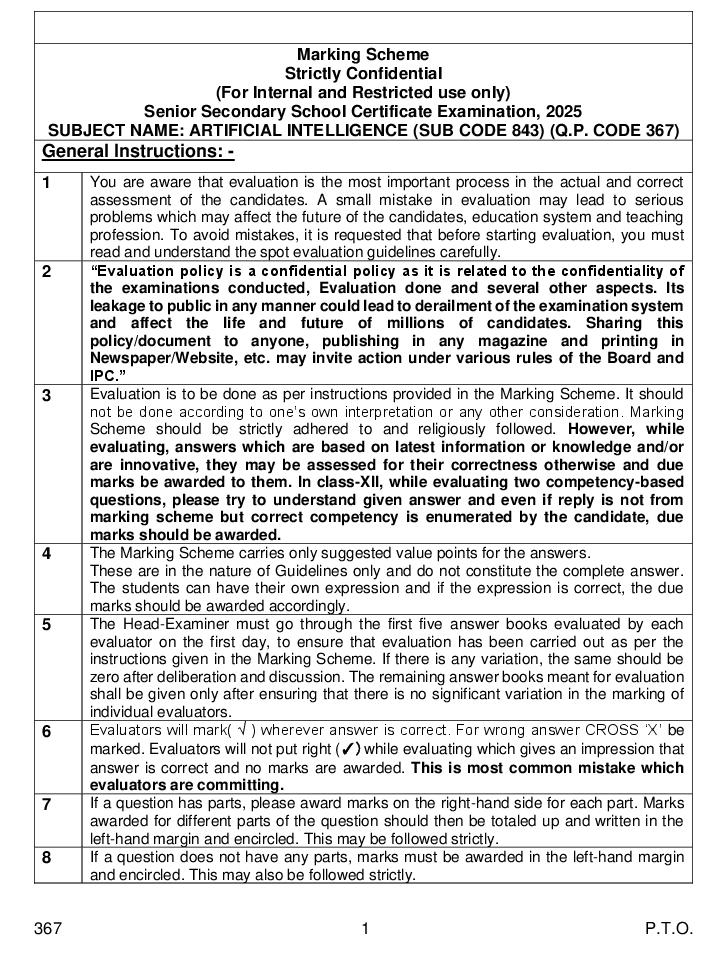
Strictly Confidential
(For Internal and Restricted use only)
Senior Secondary School Certificate Examination, 2025
SUBJECT NAME: ARTIFICIAL INTELLIGENCE (SUB CODE 843) (Q.P. CODE 367)
General Instructions: -
1 You are aware that evaluation is the most important process in the actual and correct
assessment of the candidates. A small mistake in evaluation may lead to serious
problems which may affect the future of the candidates, education system and teaching
profession. To avoid mistakes, it is requested that before starting evaluation, you must
read and understand the spot evaluation guidelines carefully.
2 “Evaluation policy is a confidential policy as it is related to the confidentiality of
the examinations conducted, Evaluation done and several other aspects. Its
leakage to public in any manner could lead to derailment of the examination system
and affect the life and future of millions of candidates. Sharing this
policy/document to anyone, publishing in any magazine and printing in
Newspaper/Website, etc. may invite action under various rules of the Board and
IPC.”
3 Evaluation is to be done as per instructions provided in the Marking Scheme. It should
not be done according to one’s own interpretation or any other consideration. Marking
Scheme should be strictly adhered to and religiously followed. However, while
evaluating, answers which are based on latest information or knowledge and/or
are innovative, they may be assessed for their correctness otherwise and due
marks be awarded to them. In class-XII, while evaluating two competency-based
questions, please try to understand given answer and even if reply is not from
marking scheme but correct competency is enumerated by the candidate, due
marks should be awarded.
4 The Marking Scheme carries only suggested value points for the answers.
These are in the nature of Guidelines only and do not constitute the complete answer.
The students can have their own expression and if the expression is correct, the due
marks should be awarded accordingly.
5 The Head-Examiner must go through the first five answer books evaluated by each
evaluator on the first day, to ensure that evaluation has been carried out as per the
instructions given in the Marking Scheme. If there is any variation, the same should be
zero after deliberation and discussion. The remaining answer books meant for evaluation
shall be given only after ensuring that there is no significant variation in the marking of
individual evaluators.
6 Evaluators will mark( √ ) wherever answer is correct. For wrong answer CROSS ‘X’ be
marked. Evaluators will not put right (✓)while evaluating which gives an impression that
answer is correct and no marks are awarded. This is most common mistake which
evaluators are committing.
7 If a question has parts, please award marks on the right-hand side for each part. Marks
awarded for different parts of the question should then be totaled up and written in the
left-hand margin and encircled. This may be followed strictly.
8 If a question does not have any parts, marks must be awarded in the left-hand margin
and encircled. This may also be followed strictly.
367 1 P.T.O.
Page 2
marks should be retained and the other answer scored out with a note “Extra Question”.
10 No marks to be deducted for the cumulative effect of an error. It should be penalized only
once.
11 A full scale of marks 0 to 50 marks as given in Question Paper has to be used. Please
do not hesitate to award full marks if the answer deserves it.
12 Every examiner has to necessarily do evaluation work for full working hours i.e., 8 hours
every day and evaluate 20 answer books per day in main subjects and 25 answer books
per day in other subjects (Details are given in Spot Guidelines).This is in view of the
reduced syllabus and number of questions in question paper.
13 Ensure that you do not make the following common types of errors committed by the
Examiner in the past:-
● Leaving answer or part thereof unassessed in an answer book.
● Giving more marks for an answer than assigned to it.
● Wrong totaling of marks awarded on an answer.
● Wrong transfer of marks from the inside pages of the answer book to the title page.
● Wrong question wise totaling on the title page.
● Wrong totaling of marks of the two columns on the title page.
● Wrong grand total.
● Marks in words and figures not tallying/not same.
● Wrong transfer of marks from the answer book to online award list.
● Answers marked as correct, but marks not awarded. (Ensure that the right tick mark
is correctly and clearly indicated. It should merely be a line. Same is with the X for
incorrect answer.)
● Half or a part of answer marked correct and the rest as wrong, but no marks
awarded.
14 While evaluating the answer books if the answer is found to be totally incorrect, it should
be marked as cross (X) and awarded zero (0)Marks.
15 Any unassessed portion, non-carrying over of marks to the title page, or totaling error
detected by the candidate shall damage the prestige of all the personnel engaged in the
evaluation work as also of the Board. Hence, in order to uphold the prestige of all
concerned, it is again reiterated that the instructions be followed meticulously and
judiciously.
16 The Examiners should acquaint themselves with the guidelines given in the “Guidelines
for Spot Evaluation” before starting the actual evaluation.
17 Every Examiner shall also ensure that all the answers are evaluated, marks carried over
to the title page, correctly totaled and written in figures and words.
18 The candidates are entitled to obtain photocopy of the Answer Book on request on
payment of the prescribed processing fee. All Examiners/Additional Head
Examiners/Head Examiners are once again reminded that they must ensure that
evaluation is carried out strictly as per value points for each answer as given in the
Marking Scheme.
367 2
Page 3
(i) Please read the instructions carefully.
(ii) This question paper consists of 21 questions in two Sections : Section A and Section
B.
(iii) Section A has Objective type questions whereas Section B contains Subjective type
questions.
(iv) Out of the given (5 + 16) = 21 questions, a candidate has to answer
(5 + 10) = 15 questions in the allotted (maximum) time of 2 hours.
(v) All questions of a particular section must be attempted in the correct order.
(vi) Section A : Objective Type Questions (24 marks) :
(a) This section has 5 questions.
(b) There is no negative marking.
(c) Do as per the instructions given.
(d) Marks allotted are mentioned against each question/part.
(vii) Section B : Subjective Type Questions (26 marks) :
(a) This section has 16 questions.
(b) A candidate has to do 10 questions.
(c) Do as per the instructions given.
(d) Marks allotted are mentioned against each question/part.
367 3 P.T.O.
Page 4
MARKING SCHEME
ARTIFICIAL INTELLIGENCE
SECTION A
OBJECTIVE-TYPE QUESTIONS
Q. Answer Marks
No.
Q.1 Answer any 4 out of the given 6 questions on Employability Skills (41=4)
i. (B) Feedback 1
ii. (A) Intrinsic 1
iii. (B) Paranoid 1
iv. By adding a password to the file. 1
v. (A) Availability of skilled labour 1
vi (C) Oxygen 1
Q.2 Answer any 5 out of the given 6 questions (51=5)
i. (A) Both Statement I and Statement II are correct 1
ii. (A) Data, visuals, and narrative 1
iii. (C) It helps to determine the accuracy of the AI model 1
iv. (B) Data visualization 1
v. (C) Problem definition 1
vi. (B) It is an iterative process 1
Q. 3 Answer any 5 out of the given 6 questions (51=5)
i. (B) Data cleaning 1
ii. (B) It supplies context, insight, and interpretation to make data 1
meaningful
367 4
Page 5
iv. (B) It makes information more memorable and easier to retain 1
v. (B) Solution-based approach to problem-solving 1
vi. (C) Cleaning and preparing the data 1
Q.4 Answer any 5 out of the given 6 questions (51=5)
i. (D) Requirement Analysis 1
ii. (B) Data storytelling 1
iii. (C) 180 1
iv. (C) Data 1
v. (D) Alexa AI 1
vi. (C) (A) is true but (R) is false 1
Q.5 Answer any 5 out of the given 6 questions (51=5)
i. (C) a – (iii), b – (i), c – (ii) 1
ii. False 1
iii. (B) Apple Siri 1
iv. (A) Empathise, Test 1
v. True 1
vi (C) Descriptive 1
367 5 P.T.O.
Page 6
Answer any 3 out of the given 5 questions on Employability Skills in 20-30 words.
(32=6 marks)
Q. 6. The stages of active listening are as follows. 2
1. Understanding
2. Remembering
3. Evaluation
4. Responding
1
( mark for specifying each correct stage)
2
Q.7. Personality traits are defined as relatively lasting patterns of thoughts, 2
feelings, and behaviours that distinguish individuals from one another.
Parameters (Any two) – Openness, consciousness, Extraversion,
Agreeableness, Neuroticism
1
(1 mark for correct definition, mark for each parameter)
2
Q.8. 1. Click File → Print. Print dialog box is displayed 2
2. Select number of copies
3. Select All/slides to be printed
4. Click ok.
1
( mark for each correct step)
2
Q.9. Qualities of a successful entrepreneur are : 2
• Initiative
• Willingness to take risks
• Ability to learn from experience :
• Motivation
• Self-confidence
• Hard work
367 6
Page 7
1
( mark for each correct quality)<Write any four>
2
Q.10 (Any two) 2
i. Reusing scrap material
ii. Ensuring quality control
iii. Waste exchange
iv. Managing E-waste
v. Use of eco-friendly material
(1 mark for each correct way)
Answer any 4 out of the given 6 questions in 20-30 words (42=8 marks)
Q.11. In cross-validation, we run our modeling process on different subsets of the 2
data to get multiple measures of model quality
(2 marks for correct procedure)
Q.12 The train-test split is a technique for evaluating the performance of a 2
machine learning algorithm. It can be used for classification or regression
problems and can be used for any supervised learning algorithm.
1
(1 mark for correct definition, mark for each correct problem)
2
Q.13. (Any two) 2
• Its attribute to make information more compelling
• Its ability to present a window in order to take a peek in the past.
• To draw lessons
• To reimagine the future by affecting necessary changes.
• It shapes, empowers, and connects people.
(1 mark for each correct factor)
367 7 P.T.O.
Page 8
(2 marks for drawing the correct diagram)
(Deduct ½ marks -1– 2 for incorrect order or incorrect name)
Q.15. These components are defined as follows : (Any two) 2
a. Level : The average value in the series.
b. Trend : The increasing or decreasing value in the series.
c. Seasonality : The repeating short-term cycle in the series.
d. Noise : The random variation in the series.
1
( mark for each correct definition)
2
Q.16. (Any two for each part) 2
(i) Python, R, Scala
(ii) Auto AI, Hyperparameter Optimization, Visual Modelling
1
(mark for each correct example)
2
Answer any 3 out of the given 5 questions in 50-80 words (43=12 marks)
Q.17. Some easy steps that can assist in finding compelling stories in the data sets 4
are as follows :
Step 1 : Get the data and organise it.
Step 2 : Visualize the data.
Step 3 : Examine data relationships.
Step 4 : Create a simple narrative embedded with conflict
(1 mark for each correct step)
367 8
Page 9
terms of being able to predict the expected outcome.
Two categories: Classification and Regression Loss. 1
(1 mark for correct definition
1
mark for each correct type)
2
(b) MSE is used when doing regression: 2
(i) believing that your target, conditioned on the input, is normally
distributed
(ii) wants large errors(Outliers) to be significantly more penalized
than small ones.
Example : when you want to predict future house price. The price is
a continuous value, and so we want to do regression. Hence MSE can
be used as loss function.
(1 mark for correct explanation)
(1 mark for correct example)
(Any other correct example may be marked)
Q.19. (a) Scoping (Requirements analysis) The first fundamental step when 2
starting an AI initiative is scoping and selecting the relevant use
case(s) that the AI model will be built to address. This is arguably the
most important part of your AI project.
1. This stage involves the planning and motivational aspects of your
project. It is important to start strong if you want your artificial
intelligence project to be successful.
2. In this phase, it’s crucial to precisely define the strategic business
objectives and desired outcomes of the project, select align all the
different stakeholders’ expectations, anticipate the key resources
and steps, and define the success metrics.
3. Selecting the AI or machine learning use cases and being able to
evaluate the return on investment (ROI) is critical to the success
of any data project.
(Any two valid points will be rewarded) (1 mark for each point)
(b) Design of Build phase, which can take from a few days to multiple 2
months, depending on the nature of the project.
The Design phase is essentially an iterative process comprising all
the steps relevant to building the AI or machine learning model : data
367 9 P.T.O.
Page 10
testing and running a set of models to try to predict behaviours or
discover insights in the data
(1 mark for each point)
Q.20. Selecting the right analytic approach depends on the question being asked. 4
Once the problem to be addressed is defined, the appropriate analytic
approach for the problem is selected in the context of the business
requirements. This is the second stage of the data science methodology.
• If the question is to determine probabilities of an action, then a
predictive model might be used.
• If the question is to show relationships, a descriptive approach may
be required.
• Statistical analysis applies to problems that require counts: if the
question requires a yes/no answer then a classification approach to
predicting a response would be suitable.
(1 mark each for explaining each category of questions)
(1 mark for a suitable example)
Suggested example can be like this:
(a) Sale/launch of a product
(b) Stock Prices
(c) Cricket Match Score (etc)
Q.21 2+2
367 10
Page 11
unravelled from data relationships. Closer scrutiny helps uncover
how each data point relates with others.
(2 Marks for the above answer also consider if the venn diagram is
given/explain)
(b) Option 2 is a better data story as it is explaining what is depicted in the
graph.
(1 mark for correct option and 1 mark for correct reason)
367 11 P.T.O.
Document Details
| Board / Org | CBSE |
| Exam | Class 12 |
| Type | Solution |
| Pages | 11 |
| Updated | 24 Sep 2026 |