CBSE Class 12 History Question Paper 2020 Set 61-1-1 Solutions
Finished viewing? Save it for later —
Download CBSE Class 12 History Question Paper 2020 Set 61-1-1 Solutions (PDF · 14 pages)About CBSE Class 12 History Question Paper 2020 Set 61-1-1 Solutions
CBSE Class 12 History Question Paper 2020 Set 61-1-1 Solutions is available here for free download. Published by CBSE for Class 12, this solution can be viewed online or downloaded as a PDF (14 pages). Candidates preparing for Class 12 can use CBSE Class 12 History Question Paper 2020 Set 61-1-1 Solutions to understand the exam pattern, the type of questions asked, and the overall difficulty level.
Frequently Asked Questions
How can I download CBSE Class 12 History Question Paper 2020 Set 61-1-1 Solutions?
Open this page and click the Download button to save CBSE Class 12 History Question Paper 2020 Set 61-1-1 Solutions as a PDF. It is completely free on AglaSem Docs.
Is CBSE Class 12 History Question Paper 2020 Set 61-1-1 Solutions free to download?
Yes. CBSE Class 12 History Question Paper 2020 Set 61-1-1 Solutions can be viewed online and downloaded as a PDF free of cost on AglaSem Docs.
How many pages does CBSE Class 12 History Question Paper 2020 Set 61-1-1 Solutions have?
CBSE Class 12 History Question Paper 2020 Set 61-1-1 Solutions contains 14 pages, which you can read online or download together as a single PDF.
Where can I find more Class 12 study material?
You can find more Class 12 question papers, sample papers, syllabus, and answer keys on AglaSem Docs.
CBSE Class 12 History Question Paper 2020 Set 61-1-1 Solutions – Text
Read the full text of this solution below — useful to quickly search, copy and reference the content online without downloading the PDF.
📄 View text version (14 pages)
Page 1
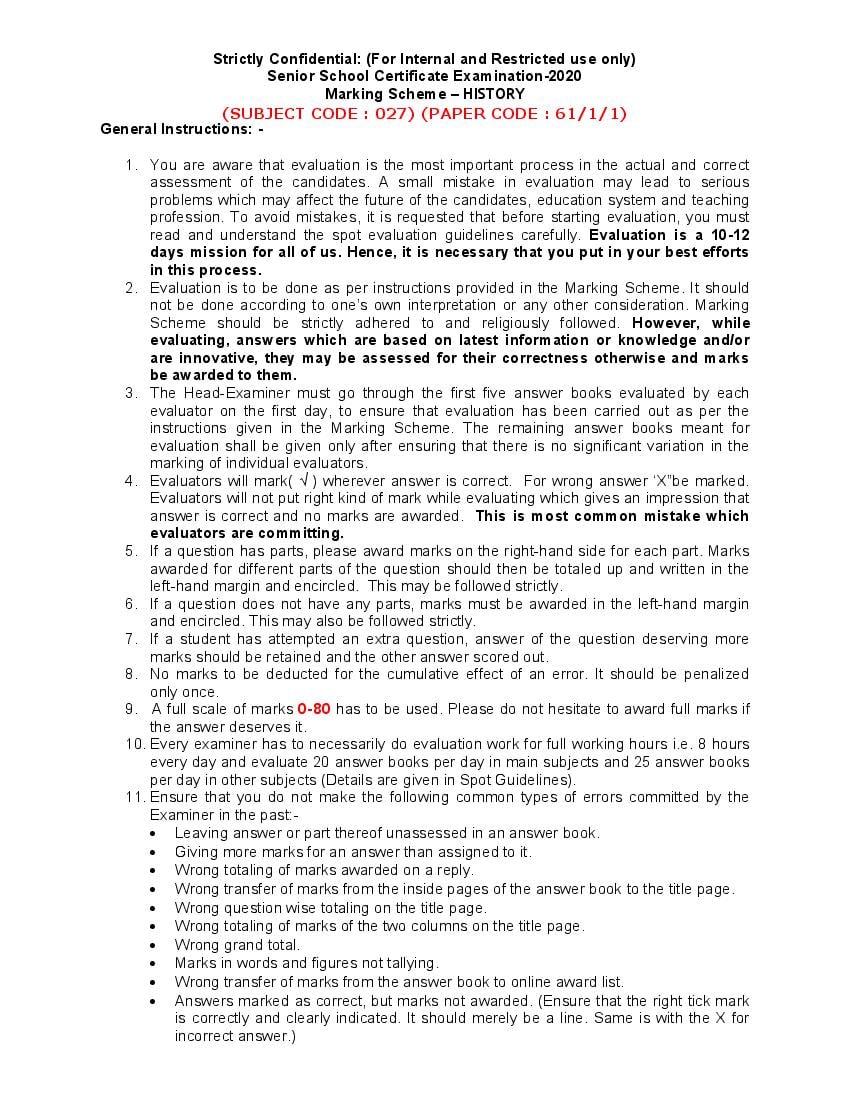
Senior School Certificate Examination-2020
Marking Scheme – HISTORY
(SUBJECT CODE : 027) (PAPER CODE : 61/1/1)
General Instructions: -
1. You are aware that evaluation is the most important process in the actual and correct
assessment of the candidates. A small mistake in evaluation may lead to serious
problems which may affect the future of the candidates, education system and teaching
profession. To avoid mistakes, it is requested that before starting evaluation, you must
read and understand the spot evaluation guidelines carefully. Evaluation is a 10-12
days mission for all of us. Hence, it is necessary that you put in your best efforts
in this process.
2. Evaluation is to be done as per instructions provided in the Marking Scheme. It should
not be done according to one’s own interpretation or any other consideration. Marking
Scheme should be strictly adhered to and religiously followed. However, while
evaluating, answers which are based on latest information or knowledge and/or
are innovative, they may be assessed for their correctness otherwise and marks
be awarded to them.
3. The Head-Examiner must go through the first five answer books evaluated by each
evaluator on the first day, to ensure that evaluation has been carried out as per the
instructions given in the Marking Scheme. The remaining answer books meant for
evaluation shall be given only after ensuring that there is no significant variation in the
marking of individual evaluators.
4. Evaluators will mark( √ ) wherever answer is correct. For wrong answer ‘X”be marked.
Evaluators will not put right kind of mark while evaluating which gives an impression that
answer is correct and no marks are awarded. This is most common mistake which
evaluators are committing.
5. If a question has parts, please award marks on the right-hand side for each part. Marks
awarded for different parts of the question should then be totaled up and written in the
left-hand margin and encircled. This may be followed strictly.
6. If a question does not have any parts, marks must be awarded in the left-hand margin
and encircled. This may also be followed strictly.
7. If a student has attempted an extra question, answer of the question deserving more
marks should be retained and the other answer scored out.
8. No marks to be deducted for the cumulative effect of an error. It should be penalized
only once.
9. A full scale of marks 0-80 has to be used. Please do not hesitate to award full marks if
the answer deserves it.
10. Every examiner has to necessarily do evaluation work for full working hours i.e. 8 hours
every day and evaluate 20 answer books per day in main subjects and 25 answer books
per day in other subjects (Details are given in Spot Guidelines).
11. Ensure that you do not make the following common types of errors committed by the
Examiner in the past:-
Leaving answer or part thereof unassessed in an answer book.
Giving more marks for an answer than assigned to it.
Wrong totaling of marks awarded on a reply.
Wrong transfer of marks from the inside pages of the answer book to the title page.
Wrong question wise totaling on the title page.
Wrong totaling of marks of the two columns on the title page.
Wrong grand total.
Marks in words and figures not tallying.
Wrong transfer of marks from the answer book to online award list.
Answers marked as correct, but marks not awarded. (Ensure that the right tick mark
is correctly and clearly indicated. It should merely be a line. Same is with the X for
incorrect answer.)
Page 2
awarded.
12. While evaluating the answer books if the answer is found to be totally incorrect, it should
be marked as cross (X) and awarded zero (0)Marks.
13. Any unassessed portion, non-carrying over of marks to the title page, or totaling error
detected by the candidate shall damage the prestige of all the personnel engaged in the
evaluation work as also of the Board. Hence, in order to uphold the prestige of all
concerned, it is again reiterated that the instructions be followed meticulously and
judiciously.
14. The Examiners should acquaint themselves with the guidelines given in the Guidelines
for spot Evaluation before starting the actual evaluation.
15. Every Examiner shall also ensure that all the answers are evaluated, marks carried over
to the title page, correctly totaled and written in figures and words.
16. The Board permits candidates to obtain photocopy of the Answer Book on request in an
RTI application and also separately as a part of the re-evaluation process on payment of
the processing charges.
Page 3
CLASS XII A I S S C E-March 2020
CODE NO. 61/1/1
Q.NO EXPECTED ANSWERS/VALUE POINTS PAGE MARK
. NO. S
SECTION-A
1. D- Archaeo- Botanists Pg-2 1
2. D- Its writing remains undeciphered to date. Pg-15 1
3. C- Brahmi and kharosthi Pg-28 1
4. Bhikkhuni Pg-92 1
OR
Buddha‟s last message to his followers was “Be lamps unto yourself as all Pg-92 1
of you must work out your own liberation.”
5. B- Uttaradhyayana Sutta Pg-88 1
6. Image of Tirthankara from Mathura(Lord Mahavira) Pg-88 1
For visually impaired : Sutta Pitaka Pg-91 1
7. C- I and III Pg-94 1
8. (A)-Both (A) and (R) are true and (R) is the correct explanation of (A). Pg-130 1
9. (A)This book is written in Persian. Pg-118 1
10. Mirabai Pg-164 1
11. Guru Gobind Singh Pg-164 1
12. Guru Ramananda Pg-162 1
OR
1
Page 4
13. (A)I, III and IV Pg-233 1
14. (D) Aurangzeb Pg-234 1
15. Tamil Veda Pg-144 1
16. (B) Cripps Mission Pg-363 1
17. (C) I, III and IV Pg-425 1
18. (C) Govind Ballabh Pant Pg-418 1
19. (C) To suggest a suitable political framework for free India. Pg-389 1
20. The reason for announcing „Direct Action Day‟ by the Muslim league in
August 1946, was to win its Pakistan Demand after it had withdrawn its
Pg-391 1
support from the cabinet mission.
SECTION-B
21. Lay out design of the Great Bath:
i. The Great Bath was a large rectangular tank in the courtyard
surrounded by corridor on all four sides.
ii. There were two flights of steps on the north and south leading
into the tank.
iii. The tank and steps were made water tight by bricks and
mortar.
iv. There were rooms on three sides in one of which was a large
well.
v. Water from the tank flowed into a huge drain.
vi. There were eight other bathrooms four on either side of the
corridor.
vii. Any other relevant point.
Any three points to be explained. Pg-8 3
2
Page 5
i. The first barrier was language.
ii. The second was difference in religious beliefs and practices.
iii. The third was self absorption and consequent insularity of the
local population.
iv. Any other relevant point.
Pg-124 3
Any three points to be explained
23. Colonial cities after 1857-
i. After 1857 the British attitude in India was shaped by a
constant fear of rebellion.
ii. They felt that towns needed to be better defended.
iii. White people needed to live in more secure and segregated
areas.
iv. Thus civil lines for white people developed.
v. Cantonments were built for stationing troops. Pg-
vi. Separate black area for Indians came up. 326-
3
vii. Any other relevant point. 327
Any three points to be examined
OR
Towns of South India- Main features-
i. In the towns of South India like Madurai and Kanchipuram,
the principal focus was the temple.
ii. These towns were also important commercial centres.
iii. Here religious festivals often coincided with fairs linking
pilgrimage with trade.
iv. Medieval towns were the places where everybody was
expected to know their position in the social order dominated Pg-
by the ruling elite. 318-
v. Any other relevant point. 319
3
Any three points to be examined
3
Page 6
i. Censorship on the press.
ii. Detention without trial.
iii. Any other relevant point.
Any one to be mentioned
Impact :
i. Shops shut down, schools closed in response of the act on
people of Punjab to a bandh call.
ii. Prominent local Congress men arrested and Punjab suffered
much.
iii. Jallianwala Bagh massacre in Amritsar.
iv. Any other relevant point.
Any two impacts to be mentioned Pg-349 1+2=3
SECTION-C
25. Familial ties during 600BCE-600CE:
i. Every family varied in terms of number of members.
ii. They had definite relationship with one another, common activities
and shared food and resources.
iii. They performed rituals together.
iv. They had larger network of people called Kinfolk.
v. The family ties were natural based on blood.
vi. Any other relevant point.
Description of any four points to be done.
Rules of marriage:
i. Sons were considered important to continue lineage and daughters
were married outside and had no claim on resources of the
household.
ii. Endogamy and exogamy were prevalent.
iii. Polygyny was also there.
iv. Polyandry- like in Pandavas were in practice.
4
Page 7
marriages out of which only four were considered good.
vi. The girls were married to the right person at a right time and
kanyadana was considered a religious duty of the father.
vii. Women were expected to give up their father‟s gotra and adopt
that of their husband on marriage.
viii. Members of the same gotra could not marry.
ix. Any other relevant point.
Pg- 55, 4+4=8
Description of any four points to be done
57-58
OR
Kinship:
i. Families were usually a part of kinship.
ii. This was regarded natural, based on blood.
iii. Kinfolk had relations with one another but sometimes they
quarreled.
iv. The feud of Kauravas and Pandavas reinforced the idea of
patrinity.
v. Sons could claim the resources and the throne.
vi. Any other relevant point.
Description of any two points to be done. (2)
Varna order:
i. Dharmasutras and Dharmashastras contained rules about ideal
occupations.
ii. Brahmins were supposed to study and teach Vedas, perform
sacrifices and rituals, give and receive gifts.
iii. Kshatriyas were to engage in warfare, protect people and
administer justice, study Vedas, get sacrifices performed and
make gifts.
iv. Vaishyas were to carry on trade, agriculture and pastoralism in
addition to study of Vedas, get sacrifices performed and make
gifts.
5
Page 8
varnas.
vi. Any other relevant point.
Description of any two points to be done. (2)
Instances to prove that this theory was not universally followed:
i. Non kshatriya kings- Contrary to the ideal occupations of the Varna
order.The Shungas and Kanvas were Brahmins.
ii. Some Satavahana queens retained their father‟s gotras even after
marriage.
iii. Examples of endogamy were found in the Satavahana rulers.
iv. Bhim‟s marriage with Hidimba was deviation from the
Dharmasutras.
v. The rule of gendered access to property defied in the case of
Vakataka queen Prabhavati Gupta.
vi. Eklavya acquiring archery skills and the Mandasor inscription of
guild of silk weavers from Lata Gujarat is an example of deviation Pg- 2+2+4=
from rules of ideal occupation. 55,56, 8
vii. Any other relevant point. (4) 60-65,
Description of any four points to be done. 68
26. Significance of Fortification of Vijayanagara:
i. Abdur Razzaq, an ambassador of ruler of Persia has mentioned
seven lines of forts and fortifications.
ii. The massive masonry construction was slightly tapered.
iii. No mortar was used as the stone blocks were wedge shaped.
iv. This not only encircled the city but also agricultural hinterland and
forests.
v. The outer most wall linked the hills surrounding the city.
vi. The significance about fortification was it enclosed agricultural
tracts.
vii. Often the purpose of medieval siege was to starve the people into
submission.
viii. Fields inside the fortification were, thus the source of providing
6
Page 9
ix. The fort gates were well guarded so that enemy could not have
easy access.
x. The roads inside the fortification were meant to serve the troops.
xi. The line of fortification was thus to provide safety to the king and
Pg- 8
the subjects.
177-
xii. Any other relevant point.
178
Any eight points to be explained
OR
Sources of water for the city of Vijayanagara:
i. River Tungabhadra was the main source of water to the city.
ii. Number of tributaries of Tungabhadra also supplied water for
people and for agriculture.
iii. A number of streams flew down from rocky outcrops.
iv. Embankments were built along these streams to create reservoirs
of varying sizes.
v. A huge reservoir was also constructed to store and supply water.
Now it is called Kamalapuram tank.
vi. Hiriya canal was another source of water for the people of city.
vii. Any other relevant point.
Description of any four points to be done.
Development of Trade of Vijayanagar empire :
i. Trade was carried out by the kings and traders.
ii. Horses for military were imported from Arabia and Central Asia.
iii. The trade was initially controlled by the Arab traders. Local
communities of merchants kudirai chettis or horse merchants
participated in these exchanges.
iv. Portuguese also brought superior technology for military.
v. Vijayanagara was also known for trading with spices, textiles and
precious stones.
vi. High value exotic goods were also traded. 4+4
Pg-
7
Page 10
viii. Any other relevant points 177
Description of any four points to be done
27. Why the Zamindars failed to pay the revenue:
i. The company felt that after fixing the revenue demand, the
zamindars would pay regularly along with unpaid balance.
ii. The zamindars failed due to very high initial demands.
iii. The high demand was imposed in 1790‟s that was the time when
agricultural produce was depressed.
iv. The zamindars could not collect rent, so how could they pay to the
company.
v. The revenue was invariable, regardless of the harvest and had to be
paid punctually.
vi. According to the sunset law, if payment did not come in by sunset
of the specified date, the zamindari was liable to be auctioned.
vii. The permanent settlement limited the power of zamindars to
collect rent from the ryots.
viii. Zamindars lost their power to organize local justice and the local
police.
ix. Sometimes due to bad weather or bad harvest the rent was difficult
to be collected.
x. Sometimes the ryots deliberately delayed the payments. Pg- 8
xi. Any other relevant point. 259-
To be assessed as a whole 260
OR
The Jotedars in the early 19th century in rural Bengal :
i. While zamindars were facing problems, some rich peasants called
Jotedars were consolidating their power in villages.
ii. By early 19th century Jotedars had acquired vast areas of land.
iii. They controlled local trade as well as money lending.
iv. They started exercising immense power over the village peasants.
8
Page 11
dependent on Jotedars.
vi. Within villages the power of Jotedars was more than the
zamindars.
vii. Since Jotedars were located in villages thus their control was over
a considerable section of poor villagers.
viii. They fiercely resisted zamindars to increase the jama of villages.
ix. They prevented zamindar‟s officials and mobilized peasants
against them.
x. That was why when zamindar‟s estates were auctioned the Pg-261
Jotedars were among the purchasers.
8
xi. Their rise inevitably weakened zamindari authority.
xii. Any other relevant point.
To be assessed as a whole
SECTION-D
28. What the king’s officials did
28.1 For what purpose were the king’s officials appointed?
Ans: The king‟s officials were appointed
i. To superintend or look after variety of jobs to serve the people.
ii. For administrative control on the people. (2)
28.2 Explain the types of jobs they carried out.
Ans:
i. Some officers superintended rivers.
ii. Some measured the land.
iii. Some inspected the sluices by which water is let out from the
canals.
iv. Some were incharges of huntsmen.
v. Others collected taxes.
vi. Some superintended occupations connected with land.
(Any two points to be explained) (2)
28.3 What was the need to superintend the work of the workmen?
Ans:
i. It was necessary to superintend the work of workmen to keep
9
Page 12
ii. To regulate their work. (2) Pg-34 2+2+2=
6
29. Classification of lands under Akbar.
29.1 Why was Chachar land left uncultivated for some three to four
years?
Ans: Chachar land was left uncultivated for three to four years
so that
i. It may regain its fertility within this period.
ii. It may recover its strength. (2)
29.2 Explain the basis of this classification.
Ans: The classification was based on
i. The fertility of the land.
ii. Capacity of soil to be cultivated annually or not. (2)
29.3 Do you think it was a sound basis to assess the revenue? Explain.
Ans:
i. This classification seems to be sound basis to assess the revenue as
it was fixed according to the type and productivity of land.
ii. It made payment of revenue easier for the cultivators. Pg-214 2+2+2=
(2) 6
30. Villagers as rebels
30.1 Examine the problem faced by the British in dealing with these
villagers.
Ans:
i. The British faced much problem in dealing with the villagers of
Oude. They used to move away at the sight of the British
officials.
ii. They collected again in large numbers with guns.
(2)
30.2 Why were people of oude (Awadh) hostile against the British?
Examine the reason.
Ans:
i. The people of Oude were hostile as Oude was annexed by the
10
Page 13
exiled to Calcutta.
ii. With the dissolution of the court many people lost their
livelihood. (2)
30.3 How did the British suppress the rebels?
Ans:
i. The British unleashed repressive measures with full force to
subdue the rebels. Martial law was imposed in north India. Pg-
ii. Ordinary processes of law and order was suspended and 296,
punishment for rebellion was death. 297, 2+2+2=
iii. Rebel landlords were dispossessed and loyal rewarded. 305, 6
Mention any two. (2) 306
SECTION-E
31 Map based work 1x6=6
31.1 Filled up map attached 1x3
31.2 Filled up map attached 1x3
For visually impaired:
31.1 Bardoli, Chauri-Chaura, Champaran, Dandi, Amritsar, Bombay, 1x3
Calcutta, kheda, Ahmedabad, Benaras, Lahore, Karachi.
Any three centres from given list.
OR
Magadha, Vajji, Koshala, Panchala, Kuru, Gandhara, Avanti, Rajgir,
Ujjain, Taxila, Varanasi(Kashi). 1x3
Any three centres from the list.
31.2 Sanchi, Ajanta, Lumbini, Bodh Gaya, Sarnath, Bharhut,
NagarjunaKonda, Amravati, Nasik. 1x3
Any three from the given list.
11
Page 14
Document Details
| Board / Org | CBSE |
| Exam | Class 12 |
| Type | Solution |
| Pages | 14 |
| Updated | 22 Jul 2026 |