CBSE Class 12 Marking Scheme 2021 for Business Studies
Finished viewing? Save it for later —
Download CBSE Class 12 Marking Scheme 2021 for Business Studies (PDF · 11 pages)About CBSE Class 12 Marking Scheme 2021 for Business Studies
CBSE Class 12 Marking Scheme 2021 for Business Studies is available here for free download. Published by CBSE for Class 12, this sample paper can be viewed online or downloaded as a PDF (11 pages). Candidates preparing for Class 12 can use CBSE Class 12 Marking Scheme 2021 for Business Studies to understand the exam pattern, the type of questions asked, and the overall difficulty level.
Frequently Asked Questions
How can I download CBSE Class 12 Marking Scheme 2021 for Business Studies?
Open this page and click the Download button to save CBSE Class 12 Marking Scheme 2021 for Business Studies as a PDF. It is completely free on AglaSem Docs.
Is CBSE Class 12 Marking Scheme 2021 for Business Studies free to download?
Yes. CBSE Class 12 Marking Scheme 2021 for Business Studies can be viewed online and downloaded as a PDF free of cost on AglaSem Docs.
How many pages does CBSE Class 12 Marking Scheme 2021 for Business Studies have?
CBSE Class 12 Marking Scheme 2021 for Business Studies contains 11 pages, which you can read online or download together as a single PDF.
Where can I find more Class 12 study material?
You can find more Class 12 question papers, sample papers, syllabus, and answer keys on AglaSem Docs.
CBSE Class 12 Marking Scheme 2021 for Business Studies – Text
Read the full text of this sample paper below — useful to quickly search, copy and reference the content online without downloading the PDF.
📄 View text version (11 pages)
Page 1
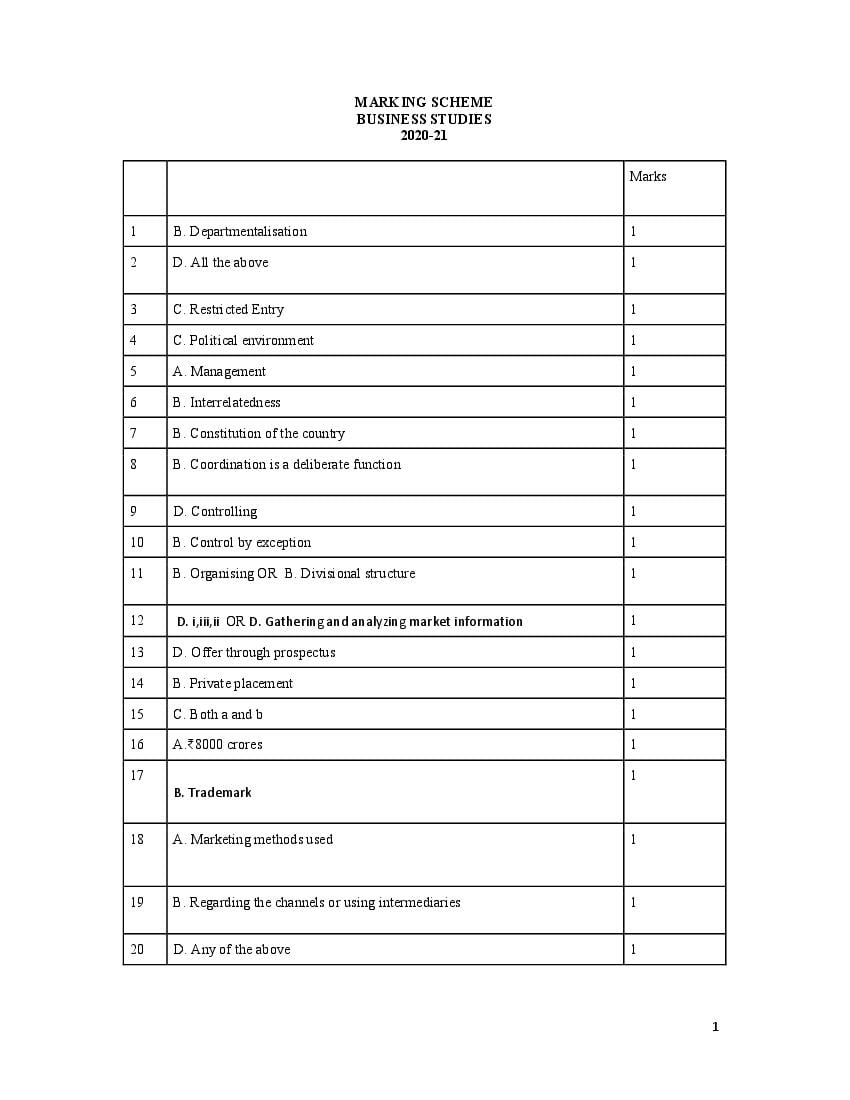
BUSINESS STUDIES
2020-21
Marks
1 B. Departmentalisation 1
2 D. All the above 1
3 C. Restricted Entry 1
4 C. Political environment 1
5 A. Management 1
6 B. Interrelatedness 1
7 B. Constitution of the country 1
8 B. Coordination is a deliberate function 1
9 D. Controlling 1
10 B. Control by exception 1
11 B. Organising OR B. Divisional structure 1
12 D. i,iii,ii OR D. Gathering and analyzing market information 1
13 D. Offer through prospectus 1
14 B. Private placement 1
15 C. Both a and b 1
16 A.₹8000 crores 1
17 1
B. Trademark
18 A. Marketing methods used 1
19 B. Regarding the channels or using intermediaries 1
20 D. Any of the above 1
1
Page 2
Functions of top-level management:(any two)
1. The top-level managers are responsible for the welfare and survival
of the organisation.
2. They analyse the business environment and its implications for the (1X2)
survival of the firm.
3. They formulate overall organisational goals and strategies for their (1 mark for
achievement. each
4. They are responsible for all the activities of the business and for its statement)
impact on society.
22 Internship training- is a joint programme of training in which educational
institutions and business firms cooperate. Selected candidates carry on 1
regular studies for the prescribed period.
Vestibule training-Employees learn their jobs on the equipment they will be
using, but the training is conducted away from the actual work floor. Actual 1
work environments are created in a class room and employees use the same
material, files and equipment.
Internship training can be classified as On-the-job method of training 1
Vestibule training can be classified as off-the-job method of training
23 Yes. Importance of controlling: (Any two)
1. Accomplishing organisational goals- The controlling function
measures progress towards the organisational goals and brings to
light the deviations, if any, and indicates corrective action. (1½ x 2)
2. Judging accuracy of standards: A good control system enables
management to verify whether the standards set are accurate and (½ mark for
objective. the heading+1
3. Making efficient use of resources: By exercising control, a manager mark for the
seeks to reduce wastage and spoilage of resources. Each activity is explanation)
performed in accordance with predetermined standards and norms.
4. Improving employee motivation: A good control system ensures that
employees know well in advance what they are expected to do and
what are the standards of performance on the basis of which they are
appraised.
5. Ensuring order and discipline: Controlling creates an atmosphere of
order and discipline in the organisation.
6. Facilitating coordination in action: Controlling provides direction to
all activities and efforts for achieving organisational goals.
OR
Measurement of Actual performance
Performance should be measured in an objective and reliable manner. There (1½ x 2)
are several techniques for measurement of performance. Wherever possible
measurement of work should be done during the performance. (½ mark for
the heading+1
Comparing actual performance with standards: mark for the
This step involves comparison of actual performance with the standard. Such explanation)
comparison will reveal the deviation between actual and desired results.
Standards become easier when standards are set in quantitative terms.
2
Page 3
1. Training of intermediaries of the securities market.
2. Conducting research and publishing information useful to all market (1x3)
participants. (1 mark for
3. Undertaking measures to develop the capital markets by adapting a each
flexible approach. statement)
OR
Money market instruments are: (Any three)
1. Treasury Bill is basically an instrument of short-term borrowing by the
Government of India maturing in less than one year. (1x3)
2. Commercial paper is a short-term unsecured promissory note, negotiable (1 Mark for
and transferable by e and delivery with a fixed maturity period. each
3. Call money is short term finance repayable on demand, with a maturity statement)
period of one day to fifteen days used for inter bank transactions.
4. Certificate of deposit are unsecured, negotiable, short term instruments in
bearer form, issued by commercial banks and development financial
institutions.
5. Commercial bill is a bill of exchange used to finance the working capital
requirements of business firms.
25 Selection: Selection is the process of choosing from among the pool of the (2x2)
prospective job candidates developed at the stage of recruitment. Even in
case of highly specialised jobs where the choice space is very narrow, the (1/2
rigour of the selection process serves two important purposes: (i) it ensures mark for
that the organisation gets the best among the available and (ii) it enhances naming and
the self-esteem and prestige of those selected and conveys to them the 11/2 marks for
seriousness with which the things are done in the organisation. the
explanation)
Placement and orientation: Orientation is introducing the selected employee
to other employees and familiarising him with the rules and policies of the
organisation. Placement refers to the employee occupying the position or
post for which the person has been selected.
26 Democratic or participative leader: (1+3)
A democratic leader will develop action plans and make decisions in
consultation with his subordinates. He will encourage them to participate in
decision making. This kind of leadership style is more common now-a-days,
since leaders also recognise that people perform best if they have set their
own objectives. They also need to respect the others opinion and support
subordinates to perform their duties and accomplish organisational
objectives. They exercise more control by using forces within the group.
27 Positive aspects of informal communication:
1. Sometimes, grapevine channels may be helpful as they carry (1x4)
information rapidly and therefore, may be useful to the manager at
times.
2. Informal channels are used by the managers to transmit information
so as to know the reactions of his/her subordinates.
Negative aspects of informal communication:
1. The grapevine/informal communication sometimes gets distorted. It
3
Page 4
sometimes may hamper the work environment.
2. It is very difficult to detect the source of such communication.
OR
(a). Leadership- Leadership is the process of influencing the behaviour of
people by making them strive voluntarily towards achievement of
organisational goals. Leadership indicates the ability of an individual to (2x2)
maintain good interpersonal relations with followers and motivate them to
contribute for achieving organisational objectives.
(b). Motivation- Motivation means incitement or inducement to act or move.
In the context of an organisation. It means the process of making
subordinates to act in a desired manner to achieve certain organisational
goals.
4
Page 5
Following are the factors affecting working capital requirement of a (1x4)
company: (Any four)
1. Nature of Business: The basic nature of a business influences the amount
of working capital required. A trading organisation usually needs a smaller (1/2
amount of working capital compared to a manufacturing organisation. mark for the
heading and
2. Scale of Operations: For organisations which operate on a higher scale of 1/2 marks for
operation, the quantum of inventory and debtors required is generally high. the
Such organisations, therefore, require large amounts of working capital as explanation)
compared to the organisations which operate on a lower scale.
3. Business Cycle: Different phases of business cycles affect the requirement
of working capital by a firm. In case of a boom, the sales as well as
production are likely to be larger and, therefore, a larger amount of working
capital is required.
4. Seasonal Factors: Most businesses have some seasonality in their
operations. In peak season, because of higher levels of activity, larger
amounts of working capital is
required.
5. Production Cycle: Production cycle is the time span between the receipt
the receipt of raw material and their conversion into finished goods.
6. Credit Allowed: Different firms allow different credit terms to their
customers. These depend upon the level of competition that a firm faces as
well as the credit worthiness of their clientele.
7. Operating Efficiency: Firms manage their operations with varied degree
of efficiency.
8. Availability of Raw material: Higher the quantity of material to be stored,
higher the amount of working capital required.
9. Growth Prospects: If the growth potential of a concern is perceived to be
higher, it will require a higher amount of working capital.
10. Level of competition: Higher level of competitiveness may necessitate
higher stocks of finished goods to meet urgent orders from customers.
Or
Ans: Following are the factors affecting capital structure of the company:
(Any four)
1. Cash Flow Position: Size of projected cash flows must be considered
before borrowing. Cash flows must not only cover fixed cash payment
obligations but there must be sufficient buffers also.
5
Page 6
number of times earnings before interest and taxes of a company covers the
interest obligation (1X4)
3. Debt Service Coverage Ratio (DSCR): Debt Service Coverage Ratio (1/2
takes care of the deficiencies referred to in the Interest Coverage Ratio mark for the
(ICR). The cash profits generated by the operations are compared with the heading and
total cash required for the service of the debt and the preference share 1/2 marks for
capital. the
explanation)
4. Cost of debt: A firm’s ability to borrow at a lower rate increases its
capacity to employ higher debt. Thus, more debt can be used if debt can be
raised at a lower rate.
5. Tax Rate: A higher tax rate makes debt relatively cheaper vis-a-vis equity.
6. Floatation cost: Process of raising funds involves some costs, these
considerations may affect the choice between debt and equity, hence the
capital structure.
7. Risk Consideration: Business risk depends upon fixed operating cost.
Fixed operating costs result in higher business risk and vice-versa. Total risk
depends upon business risk and financial risk.
8. Flexibility: To maintain flexibility it must maintain some borrowing
powers to take care of unforeseen circumstances.
9. Capital Structure of other companies: It has been observed that the capital
structure of competing companies also affect the capital structure of the
company in question.
10. Stock Market Conditions: Stock market conditions often affect the
choice between equity and debt.
6
Page 7
may suggest him to go with the labour-intensive approach to manufacture N- 2
95 masks. Since better technology would cost him much and his risk appetite
is not conducive for capital intensive techniques of production.
Financial Alternatives: As he wishes to stick to a low investment model, we 2
may suggest him to go with the lease option for fixed assets like building,
heavy machinery etc. as this may reduce his investments requirement in the
business.
30 2
a) Right to safety: The consumer has a right to be protected against goods
and services which are hazardous to life and health. For instance, electrical
appliances which are manufactured with substandard products or do not
conform to the safety norms might cause serious injury. Thus, consumers are
educated that they should use electrical appliances which are ISI marked as
this would be an assurance of such products meeting quality specifications.
(b)Right to Consumer Education: The consumer has a right to acquire
knowledge and to be a well-informed consumer throughout life. He should 2
be aware about his rights and the reliefs available to him in case of a product
or service falling short of his expectations.
31 Science not rule of thumb: (3 x 2)
Taylor pioneered the introduction of the method of scientific inquiry into
the domain of scientific inquiry into the domain of management practice. We
have already referred to the limitations of the rule of thumb approach of
management. As different managers would follow their indigenous rules of
thumb. It is but a statement of the obvious that all would not be equally
effective. Taylor believed that there was only one best method to maximise
efficiency. This method can be developed through study and analysis. The
method so developed through study and analysis. The method so developed
should substitute ‘Rule of Thumb’ throughout the organisation. Scientific
method involved investigation of traditional methods through work-study,
unifying the best practices and developing a standard method.
Harmony, not discord:
Factory system of production implied that managers served as a link
between the owners and the workers. Since as managers they had the
mandate to ‘get work done’ from the workers. Taylor recognised that this
conflict helped none, the workers, the managers or the factory owners. He
emphasised that there should be complete harmony between the
management and workers. Both should realise that each one is important. To
achieve this state, Taylor called for a complete Mental Revolution on part of
both management and workers. It means that management and workers
should transform their thinking. Management should share the gains of the
company with the workers. At the same time workers should work hard and
be willing to embrace change for the good of the company.
Development of each and every person to his or her greatest efficiency and
prosperity:
As such, scientific management also stood for worker development. Worker
7
Page 8
consequence of the scientific approach. Taylor was of the view that the
concern for efficiency could be built in right from the process of employee
selection. Each person should be scientifically selected. Then work assigned
should suit her/his physical, mental and intellectual capabilities. To increase
efficiency, they should be given required training. Efficient employees
would produce more and earn more. This will ensure their greatest efficiency
and prosperity for both company and workers.
32 Yes.
Importance of Planning (Any four) (1½x4)
1. Planning provides direction: Planning ensures that the goals or
objectives are clearly stated so that they act as a guide for deciding (½ mark for
what action should be taken and in which direction. If goals are well the heading
defined, employees are aware of what the organisation has to do and and 1 mark for
what they must do to achieve those goals. the
2. Planning reduces the risks of uncertainty: Planning is an activity explanation)
which enables a manager to look ahead and anticipate changes. By
deciding in advance, the tasks to be performed, planning shows the
way to deal with changes and uncertain events. Changes or events
cannot be eliminated but they can be anticipated and managerial
responses to them can be developed.
3. Planning reduces overlapping and wasteful activities: Planning
serves as the basis of coordinating the activities and efforts of
different divisions, departments and individuals. It helps in avoiding
confusion and misunderstanding. Since planning ensures clarity in
thought and action, work is carried on smoothly without
interruptions. Useless and redundant activities are minimised or
eliminated.
4. Planning promotes innovative ideas: Since planning is the first
function of management, new ideas can take the shape of concrete
plans. It is the most challenging activity for the management as it
guides all future actions leading to growth and prosperity of the
business.
5. Planning facilitates decision making: Planning helps the manager to
look into the future and make a choice from amongst various
alternative courses of action. The manager has to evaluate each
alternative and select the most viable proposition. Planning involves
setting targets and predicting future conditions thus helping in taking
rational decisions.
6. Planning establishes standards for controlling: Planning provides the
goals or standards against which actual performance is measured. By
comparing actual performance with some standard, managers can
know whether they have actually been able to attain the goals. If
there is any deviation it can be corrected. Therefore, we can say that
planning is a prerequisite for controlling.
8
Page 9
2
Identifying alternative courses of action: Once objectives are set
assumptions are made. Then the next step would be to act upon them. There
may be many ways to act and achieve objectives. All the alternative courses
of action should be identified. The course of action which may be taken
could be either routine or innovative. An innovative course may be adopted
by involving more people and sharing their ideas.
Remaining steps to carried out to complete the process are as follows: 1x4
1. Evaluating alternative courses: The next step is to weigh pros and
cons of each alternative. Each course will have many variables
which have to be weighed against each other. The positive and (½ mark for
negative aspects of each proposal need to be evaluated in the light of the heading
the objective to be achieved. and 1/2 mark
2. Selecting an alternative: This is the real point of decision making. for the
The best plan has to be adopted and implemented. The ideal plan, of explanation)
course, would be the most feasible, profitable and with least
negative consequences. Most plans may not always be subjected to a
mathematical analysis.
3. Implementing the plan: This is the step where other managerial
functions also come into the picture. The step is concerned with
putting the plan into action.
4. Follow up action: To see whether plans are being implemented and
activities are performed according to schedule is also part of the
planning process. Monitoring the plans is equally important to
ensure that objectives are achieved.
33 Decentralisation- 1
Importance of Decentralisation (Any five)
1. Develops initiative among subordinates-Decentralisation helps to 1x5
promote self-reliance and confidence amongst the subordinates. (1 mark for
2. Develops managerial talent for the future- Formal training plays an each
important part in equipping subordinates with skills that help them statement)
rise in the organisation but equally important is the experience
gained by handling assignments independently.
3. Quick decision making- The management hierarchy can be looked
upon as a chain of communication. In a decentralised organisation
however, since decisions are taken at levels which are nearest to the
points of action and there is no requirement for approval from many
levels the process is much faster.
4. Relief to top management- Decentralisation diminishes the amount
of direct supervision exercised by a superior over the activities of a
subordinate because they are given the freedom to act and decide
albeit within the limits set by the superior.
5. Facilitates growth: Decentralisation awards greater autonomy to the
lower levels of management as well as divisional or departmental
heads. This allows them to function in a manner best suited to their
department and fosters a sense of competition amongst the
9
Page 10
6. Better control: Decentralisation makes it possible to evaluate
performance at each level and the departments can be individually
held accountable for their results.
34 Following are the points of differences between advertising and personal (1x6)
selling (Any Six)
Advertising Personal Selling
1. Advertising is an impersonal Personal selling is a personal form of
form of communication. communication.
2. Advertising involves In personal selling, the sales talk is
transmission of standardised adjusted keeping view of customer's
messages, i.e., the same message is background and needs.
sent to all the customers in a
market segment.
3. Advertising is inflexible as the Personal selling is highly flexible. as
message can’t be adjusted to the the message can be adjusted.
needs of the buyer.
Only a limited number of people can
4. It reaches masses, i.e., a large be contacted because of time and cost
number of people can be considerations.
approached.
5. In advertising the cost per The cost per person is quite high in the
person reached is very low. case of personal selling.
6. Advertising can cover the Personal selling efforts take a lot of
market in a short time. time to cover the entire market.
7. Advertising makes use of mass Personal selling makes use of sales
media such television, radio, staff, which has limited reach.
newspaper, and magazines.
8. Advertising lacks direct Personal selling provides direct and
feedback. Marketing research immediate feedback. Sales persons
efforts are needed to judge come to know about the customers’
customers’ reactions to advertising. reactions immediately.
9. Advertising is more useful in Personal selling plays an important role
creating and building interest of the at the awareness stage of decision
consumers in the firm's products. making.
10. Advertising is more useful in Personal selling is more helpful in
marketing to the ultimate selling products to the industrial buyers
consumers who are large in or to intermediaries such as dealers and
10
Page 11
numbers.
OR
The marketing mix consists of various variables, which have broadly been
classified into four categories, popularly known as four Ps of marketing.
These are: (i) Product, (ii) Price, (iii) Place, and (iv) Promotion, and are
discussed as follows:
(1 ½x4)
1. Product: Product means goods or services or ‘anything of value’, which is
offered to the market for exchange.
The concept of product relates to not only the physical product as (½ mark for
mentioned in the above examples but also the benefits offered by it from the the heading
customer's view point (for example toothpaste is bought for whitening teeth, and 1 mark for
strengthening gums, etc.). The concept of product also includes the extended the
product or what is offered to the customers by way of after sales services, explanation)
handling complaints, availability of spare parts etc. These aspects are very
important, particularly in the marketing of consumer durable products (like
Automobiles, Refrigerators, etc.). The important product decisions include
deciding about the features, quality, packaging, labelling and branding of the
products.
2. Price: Price is the amount of money customers have to pay to obtain the
product. In the case of most of the products, the level of price affects the
level of their demand. The marketers have not only to decide about the
objectives of price setting but to analyse the factors determining the price
and fix a price for the firm’s products.
3. Place: Place or Physical Distribution include activities that make firm’s
products available to the target customers. Important decision areas in this
respect include selection of dealers or intermediaries to reach the customers,
providing support to the intermediaries (by way of discounts, promotional
campaigns, etc.).
4. Promotion: Promotion of products and services include activities that
communicate availability, features, merits, etc. of the products to the target
customers and persuade them to buy it. Most marketing organisations
undertake various promotional activities and spend a substantial amount of
money on the promotion of their goods through using a number of tools such
as advertising, personal selling and sales promotion techniques (like price
discounts, free samples, etc.).
11
Document Details
| Board / Org | CBSE |
| Exam | Class 12 |
| Type | Marking Scheme |
| Pages | 11 |
| Updated | 30 Apr 2026 |