CBSE Class 12 Marking Scheme 2021 for Carnatic Music Percussion
Finished viewing? Save it for later —
Download CBSE Class 12 Marking Scheme 2021 for Carnatic Music Percussion (PDF · 3 pages)About CBSE Class 12 Marking Scheme 2021 for Carnatic Music Percussion
CBSE Class 12 Marking Scheme 2021 for Carnatic Music Percussion is available here for free download. Published by CBSE for Class 12, this sample paper can be viewed online or downloaded as a PDF (3 pages). Candidates preparing for Class 12 can use CBSE Class 12 Marking Scheme 2021 for Carnatic Music Percussion to understand the exam pattern, the type of questions asked, and the overall difficulty level.
Frequently Asked Questions
How can I download CBSE Class 12 Marking Scheme 2021 for Carnatic Music Percussion?
Open this page and click the Download button to save CBSE Class 12 Marking Scheme 2021 for Carnatic Music Percussion as a PDF. It is completely free on AglaSem Docs.
Is CBSE Class 12 Marking Scheme 2021 for Carnatic Music Percussion free to download?
Yes. CBSE Class 12 Marking Scheme 2021 for Carnatic Music Percussion can be viewed online and downloaded as a PDF free of cost on AglaSem Docs.
How many pages does CBSE Class 12 Marking Scheme 2021 for Carnatic Music Percussion have?
CBSE Class 12 Marking Scheme 2021 for Carnatic Music Percussion contains 3 pages, which you can read online or download together as a single PDF.
Where can I find more Class 12 study material?
You can find more Class 12 question papers, sample papers, syllabus, and answer keys on AglaSem Docs.
CBSE Class 12 Marking Scheme 2021 for Carnatic Music Percussion – Text
Read the full text of this sample paper below — useful to quickly search, copy and reference the content online without downloading the PDF.
📄 View text version (3 pages)
Page 1
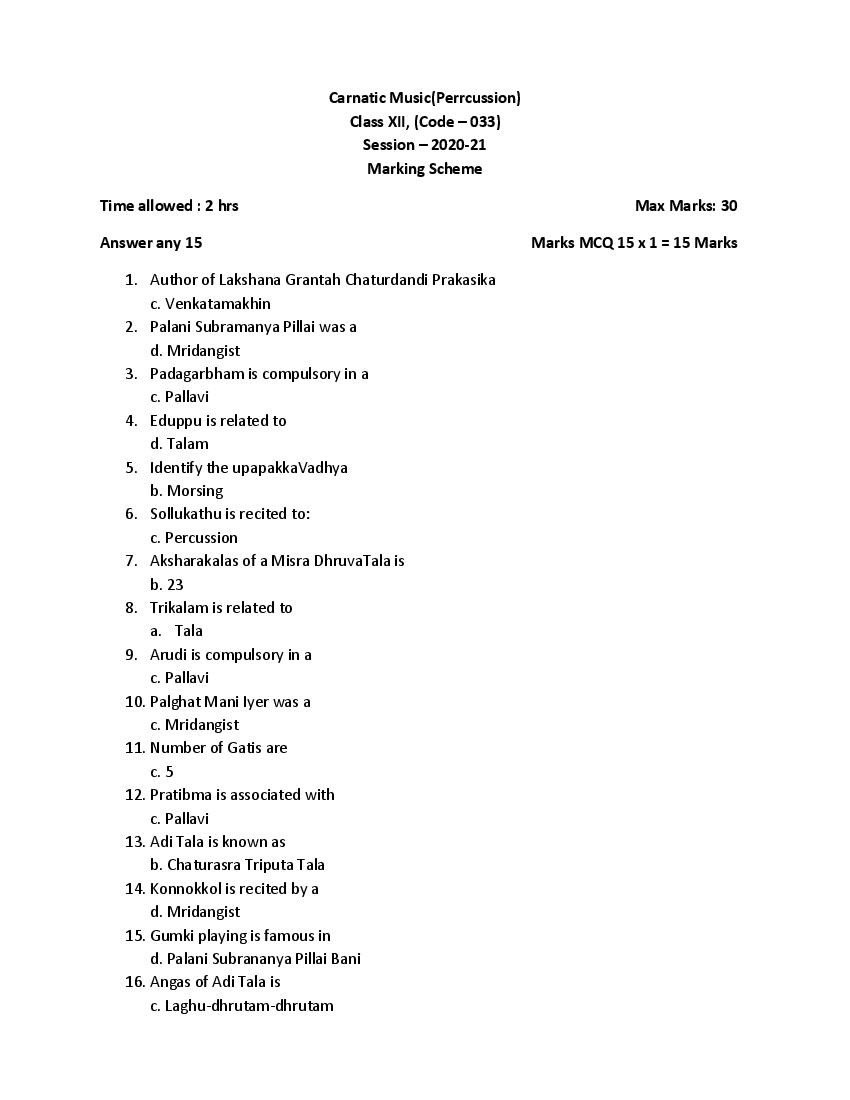
Class XII, (Code – 033)
Session – 2020-21
Marking Scheme
Time allowed : 2 hrs Max Marks: 30
Answer any 15 Marks MCQ 15 x 1 = 15 Marks
1. Author of Lakshana Grantah Chaturdandi Prakasika
c. Venkatamakhin
2. Palani Subramanya Pillai was a
d. Mridangist
3. Padagarbham is compulsory in a
4. Eduppu is related to
d. Talam
5. Identify the upapakkaVadhya
b. Morsing
6. Sollukathu is recited to:
c. Percussion
7. Aksharakalas of a Misra DhruvaTala is
b. 23
8. Trikalam is related to
a. Tala
9. Arudi is compulsory in a
10. Palghat Mani Iyer was a
c. Mridangist
11. Number of Gatis are
c. 5
12. Pratibma is associated with
13. Adi Tala is known as
b. Chaturasra Triputa Tala
14. Konnokkol is recited by a
d. Mridangist
15. Gumki playing is famous in
d. Palani Subrananya Pillai Bani
16. Angas of Adi Tala is
c. Laghu-dhrutam-dhrutam
Page 2
d. Mridangam
18. Vilamba-Madhya-druta is associated with
b. Laya
19. Anulama occurs in
20. Author of Sangita Ratnakara is
b. Saranga Deva
21. Pharan is an important factor in
b. Tani Avartamam
Part – B
1. Names of the Shadangas of Six angas of Talas are:
1) Anudhrutam – 1 akshara
2) Dhrutam – 2 aksharas
3) Laghu – 4 aksharas
4) Guru – 8 aksharas
5) Plutam – 12 aksharas
6) Kakapaadam – 16 aksharas
In these above angas there are varieties only with laghu which admits of 5 varieties
known as Jatis. They are Tisra jaati – 3, Chatusra jati – 4, Khanda Jaati – 5, Misra Jaati – 7, and
Sankirna jaati – 9. Unless it is specified specially or mentioned the laghu variety is taken for
chatusra jaati only.
2. Gati is the tempo used in Tala. They are 5 in number and are
1) Tisra Gati – 3
2) Chatusra Gati - 4
3) Khanda Gati – 5
4) Misra Gati – 7
5) Sankirna Gati – 9
Except Tisra and Chatusra the other gatis Khanda, Misra and Sankirna is used only in
Pallavi. Unless it is specifically mentioned it is understood that the composition is only in
Chaturasra Gati.
3. Trikaalam means three speed. The first, second and third speed. The student of music is
introduced in the very first lesson Sarli Varisai For example it is taught as
Page 3
Srgm
The four units of noted in the first speed is reduced to 2 notes by putting the line above
and rendering it in the second speed and in the third speed the four units is reduced to one
unit by doubling the speed.
4. Dhruva Tala – lakes laghu – dhrutam – laghu – laghu as its angas. In this the variation
occurs only in laghu which admits of five varieties.
They are Tisra – 3-2-3-3
Chaturasra – 4-2-4-4
Khanda – 5-2-5-5
Misra – 7-2-7-7
Sankirna – 9-2-9-9
Sankeerna Jaati Dhruva tala takes 9-2-9-9 totalling to 29 aksharakalas.
5. Korvai means joining. It is a technical word used in karnatic music to indicate a specific
rhythmic variety. It is not only used by percussionist but also by musicians to give an
aesthetic ending to the presentation. A korvai is used as a crown to conclude various
patterns of Sarvalaghu which eventually lead to the korvai. It is rendered thrice for
effect. The smaller variety is known as Teermaanam which occurs at the end of pallavi
and anupallavi and at the end of the composition korvai is played.
Mohra : It is a special pattern that precedes to the korvai and is an indicator that the
Tani avartanam is coming to an end Mohras will be preceded by Pharans which are fast
paced rhythmic patterns and generally these patterns do not have pauses in between
and are always with syllables without gap which is proceeded by Mohra and ultimately
ended with a korvai which is played thrice and the vocalist starts at the end of the third
round of the Korvai where he left.
6. In a carnatic music concert Mridangam is essential accompaniment whether Vocal or
Instrumental concerts.
Essential Instrument Mridangam the other percussion instruments are generally known
as Upa Pakka Vadhyas. The order of Upa Pakka Vadhyas are Kanjira, Ghatam, Morsing
and konnakkol other Melodic Instrumental artists generally have minimum two
percussion instruments. A combination of’
Mridangam – Ghatam
Mridangam – Morsing
Mridangam – Kanjira etc.
7. Palani Subramanya Pillai was a very well known Carnatic Music percussionist. He along
with his contemporaries Paghat Mani Iyer and C.S. Marugabhoopathy are revered as the
‘Holy Trinity of Mridanga’. He was adept in playing Mridangam and Kanjira. He was born
in the year 1908 and died in 1962. Playing gumkiss or gamakas in the mridangam was
his specific specialty, All popular musician of that era like G.N. Balasubramaniam,
Semmangudi Srinivasa Iyer wanted to have him as their accompanist. He was the Son
and Disciple of his father Palani Muthaiah Pillai.
Document Details
| Board / Org | CBSE |
| Exam | Class 12 |
| Type | Marking Scheme |
| Pages | 3 |
| Updated | 30 Apr 2026 |