CBSE Class 12 Marking Scheme 2021 for Carnatic Music Melodic Instrument
Finished viewing? Save it for later —
Download CBSE Class 12 Marking Scheme 2021 for Carnatic Music Melodic Instrument (PDF · 4 pages)About CBSE Class 12 Marking Scheme 2021 for Carnatic Music Melodic Instrument
CBSE Class 12 Marking Scheme 2021 for Carnatic Music Melodic Instrument is available here for free download. Published by CBSE for Class 12, this sample paper can be viewed online or downloaded as a PDF (4 pages). Candidates preparing for Class 12 can use CBSE Class 12 Marking Scheme 2021 for Carnatic Music Melodic Instrument to understand the exam pattern, the type of questions asked, and the overall difficulty level.
Frequently Asked Questions
How can I download CBSE Class 12 Marking Scheme 2021 for Carnatic Music Melodic Instrument?
Open this page and click the Download button to save CBSE Class 12 Marking Scheme 2021 for Carnatic Music Melodic Instrument as a PDF. It is completely free on AglaSem Docs.
Is CBSE Class 12 Marking Scheme 2021 for Carnatic Music Melodic Instrument free to download?
Yes. CBSE Class 12 Marking Scheme 2021 for Carnatic Music Melodic Instrument can be viewed online and downloaded as a PDF free of cost on AglaSem Docs.
How many pages does CBSE Class 12 Marking Scheme 2021 for Carnatic Music Melodic Instrument have?
CBSE Class 12 Marking Scheme 2021 for Carnatic Music Melodic Instrument contains 4 pages, which you can read online or download together as a single PDF.
Where can I find more Class 12 study material?
You can find more Class 12 question papers, sample papers, syllabus, and answer keys on AglaSem Docs.
CBSE Class 12 Marking Scheme 2021 for Carnatic Music Melodic Instrument – Text
Read the full text of this sample paper below — useful to quickly search, copy and reference the content online without downloading the PDF.
📄 View text version (4 pages)
Page 1
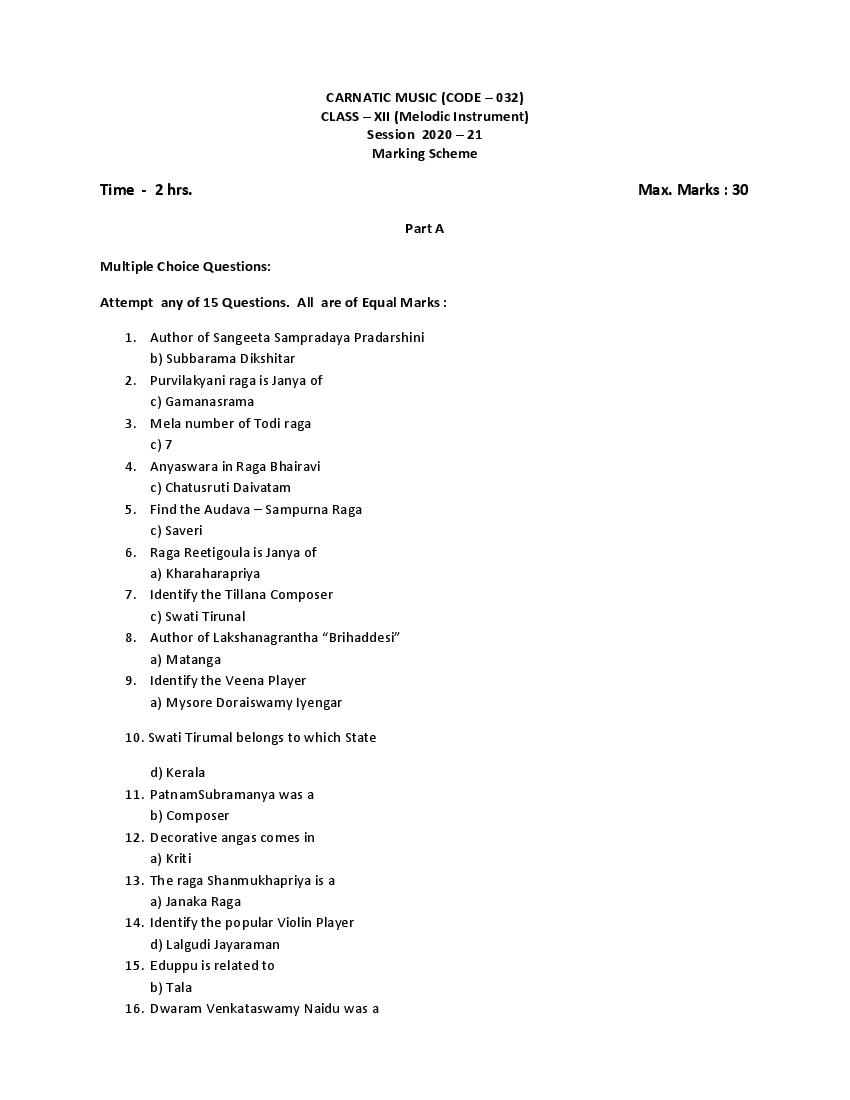
CLASS – XII (Melodic Instrument)
Session 2020 – 21
Marking Scheme
Time - 2 hrs. Max. Marks : 30
Part A
Multiple Choice Questions:
Attempt any of 15 Questions. All are of Equal Marks :
1. Author of Sangeeta Sampradaya Pradarshini
b) Subbarama Dikshitar
2. Purvilakyani raga is Janya of
c) Gamanasrama
3. Mela number of Todi raga
c) 7
4. Anyaswara in Raga Bhairavi
c) Chatusruti Daivatam
5. Find the Audava – Sampurna Raga
c) Saveri
6. Raga Reetigoula is Janya of
a) Kharaharapriya
7. Identify the Tillana Composer
c) Swati Tirunal
8. Author of Lakshanagrantha “Brihaddesi”
a) Matanga
9. Identify the Veena Player
a) Mysore Doraiswamy Iyengar
10. Swati Tirumal belongs to which State
d) Kerala
11. PatnamSubramanya was a
b) Composer
12. Decorative angas comes in
a) Kriti
13. The raga Shanmukhapriya is a
a) Janaka Raga
14. Identify the popular Violin Player
d) Lalgudi Jayaraman
15. Eduppu is related to
b) Tala
16. Dwaram Venkataswamy Naidu was a
Page 2
17. Annamacharya’s compositions are composed in
a) Telugu
18. Aksharakalas of MisraChapuTala
a) 7
19. Anuloma and Pratiloma are related to
d) Pallavi
20. Angas of Ata Tala
c) 4
21. Identify the Bow Instrument
b) Violin
Part B
Answer any five questions. All questions carry equal marks 5X3 = 15
1. Kriti : Kriti is the most important of the melodic goup of compositions. The term kriti
refers to the composition in which music take predominant place than the sahitya. The
Pallavi, Amunapllavi and Charana are the minimum and essential angas of a kriti. There
may be one or more charanas. The charanas are of the same length. The kriti
composition has been enriched by the introduction of ornamental angas which are
called as decorative angas. They are chittaswara, swara sahitya, Madhyamakala sahitya,
swarakshara, sangati etc. Some of the very popular kritis composed by different
composers. Example : (1) Vatapiganapatim Bhaje, Hamsadhwani raga – Adi Tala –
Muthuswamy Dikshitar (2) Nidhichala Sukhama – Kalyani raga – Misra chapu tala –
Tyagaraja.
Ragamalika: Ragamalika, as its name implies is a garland of ragas. Ragamalikas are the
most enjoyable of musical forms in a melodic system of music. Ragamalikas are the
longest compositions in Indian music. The ragamalika is a beautiful musical form which
is consisting of three sections i.e. Pallavi, Anupallavi and Charana. There may be more
charanas, which are haing the same length. All the sections are in different ragas and
sometimes raga mudras also can occur in the texture of the sahitya without affecting its
meaning. The sahitya of ragamalika is usually of a devotional character. Sometimes the
sahitya may also be on a love theme. While singing manodharama sangita musicians
may also sing the Slokas, Padyams, Viruttams in different ragas in their end of the
cocerts. 72 mela ragamalika in72 ragas are composed by Maha Vidyanatha Iyer. There
is a popular Chaurdassa raga malika is garland of 14 ragas in Adi Tala composed by
Muthuswamy Diskshitar.
2. Chapu tala is one of the time-measure used Indian Music from very early times. Chapu
means beat. There are many folk melodies in this tala. There are five varieties of chapu
talas. They are:
a) Misra Chapu : (3+4+=7) This tala has total 7 counts where the first beat has a
duration of three (3) units time and second beat four (4) units time.
Page 3
a duration of 4 units and second beat 3 units time. Syamasastri composed kritis
in this variety of tala.
c) Khanda Chapu : (2+3=5) This tala has total 5 units where the duration of first
beat is two units and the second beat has duration of three units. Many great
composers like Tyagraja and other composers are composed kritis in this tala.
d) Tisra Chapu : (1+2=3) where the duration of first beat is one unit time and
second beat 2 units time.
e) Sankeerna Chapu : (4+5=9) where the duration of first beat is four units time and
the second beat 5 units time. This tala is rather an uncommon variety and figures
in some pallavis.
3. Simhend ramadyamam : It is 57th melakarta raga (or) Janaka raga of 72 melakarta raga
system of karnatic music. It is a sampurna raga. Swarasthamas are Shadjam, Chatusruti
Rishabham, Sadharana Ghandharam, Pratimadhyamam, Panchamam, Suddha Daivatam
and Kakali Nishadam.
Saveri : This is derived raga. It is derived from 15th no. Mayamalavagoula. Saveri is a
Audava-Sampurma raga. Swarasthamas are Shadjam, Suddha Rishabham, Antara
Gandharam. Suddha Madhyamam, Panchamam, Suddha Daivatam and Kakali Nishadam.
4. Bhashaganga raga is a Janya raga where in one, two or three foreign notes ( Anya
swaras) come in for the sake of enriching it’s melodic beauty. There are 3 varieties of
Bhashaganga ragas:-
a) Eka Anyaswara Bhashagana raga: In this using only one foreign note (0r)
anyaswara. For example : Bhairavi Chatusruti Daivatam as foreign note in
Arohana.
b) Dvi Anyaswara Bhashanga raga : In this using only two foreign notes. Example :
Atana raga, kaisika Nishadam, Sadharana Gandharam as foreign notes.
c) Tri Anyaswara Bhashanga raga : In this using 3 foreign notes. Example Ananda
Bhairavi raga. Antara Gandharam, Kaisiki Nishadam and Suddha Daivatam as
foreign notes.
Shadava raga : A raga where in only six of the sapta swaras are represented in
both the Arohana and Avarohana i.e. one note is varja (or) absent both ways.
Example : Malayamarutam and Sriranjini.
5. Chittaswaram is one of the decorative anga which will occur in the musical form kriti. It
is a set of swara passages added to a kriti for additional beauty. It is sung at the end of
the Anupallaavi and charana. It may be set in the sama kala (Identical speed) of the
composition are usually composed, and added by the authors of the kritis themselves.
For example : The popular kriti Brochevarevarura – Khamas raga the chittaswaram is
composed by the composer himself i.e. Mysore Vasudevachar. But there are
chittaswaras added by other subsequent composers. For example: The chittaswara of
popular Tyagaraja’s kriti Sobhillu Saptaswara-Jaganmohini raga chittaswaram is
Page 4
makutams crown – like endings.
6. Varja raga means a Janya raga where in one, two or three swaras are absent in the
arohana or avarohana or both. For example : Abhogi, Sriranjini, Arabhi and kambhoji
ragas etc.
7. Vakra raga : Janya ragas whose arohana or avarohana or both take a crooked or zig-zag
course are called vakra ragas. Examples : Begada and Ritigoula ragas.
8. (i) Mysore Vasudevachar : He is perhaps the most importanat and one of the prominent
music composer of the 20th century. Vasudevachar was born in Mysore on 28 th May
1865. He was trained in Sanskrit by his maternal grandfather after the early demise of
his father. His initial musical training was from veena padmanabhayya
of Mysore, but his musical lineage can be traced to Saint-Tyagaraja through
Manambuchavadi Venkatasubbayyar and Patnam Subramanya Iyer. He was appointed
as a Astham Vidwan at the royal court of Mysore. He has composed more than 200
compositions. His mother tongue was kannada but he almost composed many of his
compositions in Telugu and Sanskrit. His compositions include padavarnams, Tana
Varnams, Kritis, Javalis, Tillanas and Ragamalikas. After a long and fruitful life he
breathed his last in May 17th 1961 at the age of 96.
(ii) Patnam Subramanya Iyer: Patnam Subramanya Iyer was born in 1845 in Tanjore
district, Tamil Nadu. He belongs to Sishya Parampara of Tyagraja. Patnam Subramanya
Iyer’s grandfather Bharatam Panchanada Sastri was one of the Asthan Vidwan of Serfoji
Maharaj of Tanjore. His father Bharatam Vaidyanatha Iyer was also a musician and
scholar. His main guru Manambuchavadi Venkatasubbayyar who is the guru of
Mahavaidyanatha Iyer and he is direct disciple of Tyagraja. The raga Begada was
patnam subramanya Iyer’s favourite raga, so he is known as Begada Subramanya Iyer.
He was a great lakshana lakshya vidwan. He was well versed in the tala system of
karnatic music. This is the reason he could sing a pallavi in simhanandana tala the
longest of the 108 talas with 128 aksharakalas. He was composed about a hundred
pieces, inclusive of Tana Varnas, Pada Varnas, Kritis, javalis and tillanas in Sanskrit and
Telugu. He has composed many songs in Adi, Desadi, Rupaka, Chapu and Jhampa talas.
He has invented the raga kadanakutuhalam. His prominent disciples are Mysore
vasudevachar and Ramanathapuram Srinivasa Iyengar. His signature (or) mudra is
Venkateshwara, Adi Vendkateswara and Sri Varada Venkateswara. In his last days he
had moved back to Thiruvaiyaru and he passed away there on 31st July 1902.
Document Details
| Board / Org | CBSE |
| Exam | Class 12 |
| Type | Marking Scheme |
| Pages | 4 |
| Updated | 30 Apr 2026 |