CBSE Class 12 Marking Scheme 2021 for Carnatic Music Vocal
Finished viewing? Save it for later —
Download CBSE Class 12 Marking Scheme 2021 for Carnatic Music Vocal (PDF · 5 pages)About CBSE Class 12 Marking Scheme 2021 for Carnatic Music Vocal
CBSE Class 12 Marking Scheme 2021 for Carnatic Music Vocal is available here for free download. Published by CBSE for Class 12, this sample paper can be viewed online or downloaded as a PDF (5 pages). Candidates preparing for Class 12 can use CBSE Class 12 Marking Scheme 2021 for Carnatic Music Vocal to understand the exam pattern, the type of questions asked, and the overall difficulty level.
Frequently Asked Questions
How can I download CBSE Class 12 Marking Scheme 2021 for Carnatic Music Vocal?
Open this page and click the Download button to save CBSE Class 12 Marking Scheme 2021 for Carnatic Music Vocal as a PDF. It is completely free on AglaSem Docs.
Is CBSE Class 12 Marking Scheme 2021 for Carnatic Music Vocal free to download?
Yes. CBSE Class 12 Marking Scheme 2021 for Carnatic Music Vocal can be viewed online and downloaded as a PDF free of cost on AglaSem Docs.
How many pages does CBSE Class 12 Marking Scheme 2021 for Carnatic Music Vocal have?
CBSE Class 12 Marking Scheme 2021 for Carnatic Music Vocal contains 5 pages, which you can read online or download together as a single PDF.
Where can I find more Class 12 study material?
You can find more Class 12 question papers, sample papers, syllabus, and answer keys on AglaSem Docs.
CBSE Class 12 Marking Scheme 2021 for Carnatic Music Vocal – Text
Read the full text of this sample paper below — useful to quickly search, copy and reference the content online without downloading the PDF.
📄 View text version (5 pages)
Page 1
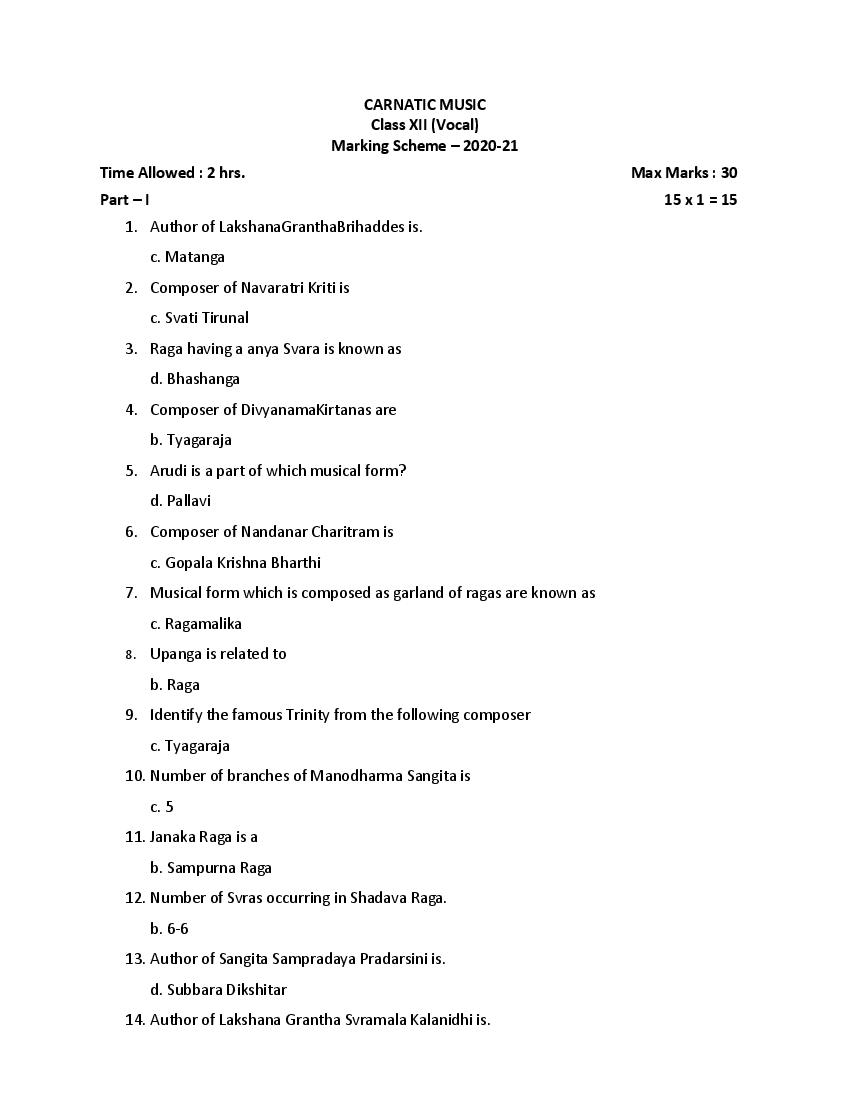
Class XII (Vocal)
Marking Scheme – 2020-21
Time Allowed : 2 hrs. Max Marks : 30
Part – I 15 x 1 = 15
1. Author of LakshanaGranthaBrihaddes is.
c. Matanga
2. Composer of Navaratri Kriti is
c. Svati Tirunal
3. Raga having a anya Svara is known as
d. Bhashanga
4. Composer of DivyanamaKirtanas are
b. Tyagaraja
5. Arudi is a part of which musical form?
d. Pallavi
6. Composer of Nandanar Charitram is
c. Gopala Krishna Bharthi
7. Musical form which is composed as garland of ragas are known as
c. Ragamalika
8. Upanga is related to
b. Raga
9. Identify the famous Trinity from the following composer
c. Tyagaraja
10. Number of branches of Manodharma Sangita is
c. 5
11. Janaka Raga is a
b. Sampurna Raga
12. Number of Svras occurring in Shadava Raga.
b. 6-6
13. Author of Sangita Sampradaya Pradarsini is.
d. Subbara Dikshitar
14. Author of Lakshana Grantha Svramala Kalanidhi is.
Page 2
15. Tanam is a branch of
b. Kalpana Sangita
16. Minimum three ragas occurs in a musical form
c. Ragamalika
17. How many varieties of Vakra ragas exist.
c. 3
18. Identify one of the forms composer of varnams from the following.
b. Patnam Subramanya Iyer
19. Alapana is a branch of.
a. Sabhna Gana
20. Audava-Shadava means ragas with
a. 5-6 Svaras
21. MinumAngas of a Kriti is
b. 3
Part – B
Answer any 5 questions 5 x 3 = 15
1. Janaka raga is also known as Sampurna raga, Kartha raga and Hela Raga. It means it
takes ame type of all the sevel svaas in the arohana and avarohana – for example:
s r1 g2 m1 p d1 n2 s1 - Arohana
s1 n2 d1 p m1 g2 r1 s – Avarohana
Janya raga is derived from Janaka raga and it has varieties. Ragas taking 5 notes in
arohana and avarohana is known as Audava raga. Raga taking 6 notes in both arohana &
avarohana is known as Shadava raga. Sometimes the janya raga takes it notes either in
arohana or avarohana. Following are the varieties of Janya raga.
Audava – Audava = 5-5
Audava – Sampurna = 5-7
Sampurna – Audava = 7-5
Shadava – Shadava = 6-6
Shadava – Sampurna = 6-7
Page 3
Audava – Shadava = 5-6
Shadava – Audava = 6-5
Sampurna – Sampurna = 7-7
In addition to these varieties ragas are classified as Bhashanga & Upanga, Vakra ragas.
2. The five important branches of Manodharma Sangita are
a. Raga Alpana
b. Tanam
c. Kalpana Svaram
d. Niraval
e. Pallavi
Raga alpana is a highly creative branch of Manodharma Sangita or Kalpana Sangita. It is
sung is many methods alpana for a small kriti, alpana for slow tempo kriti, alpana for
Ragan-Tanam-Pallavi and alapana exhibited in slokam singing. Then ragas are also
divided with ragas of with maximum scape, Minimum scape, and average scape for
alapana. It is abstract without any meaningful syllables or Tala. Ta, Da, ri na tom is used
to singthe alapana. Grammar has to be followed strictly varieties of speed is employed
in alapana according to the suitability of the mood of the raga and mobility of the
singer’s voice to sloken singing the words should be appropriately clothed with music.
3. Upanga raga is a raga which takes exactly the same type of svaras takes by its parent
raga. It may be a varja raga meaning some notes may be missed either in arohana or
avaorhana or both. For example of upanga ragas.
a) Raga Hamsadhvani Janya of 29th Mela Dheera Sankarabharanam
b) Raga Sriranjani and Abhogi Janya of 22nd Melakartha Kharaharapriya.
Bhashanga raga is raga which takes an extra note or phrase which its Janaka raga does
not take for example:
a) Ananda bhairaav Janya of 20th Mela Natabhairavi
b) Kambhoji Janya of 28th Mela Harikambhoji. In addition to Kaisikr Nishada it also
takes Kakali Nishada.
4. Ragamalika : Ragamalika means composition made up garland of ragas. Very famous
Ragamalika is SvatiTirunal’s Bhavayam Raghuramam.
Page 4
Ragamalika is also used in Slokan singing other well known ragamalikas are
Arabhimanam, Enakkunurupadam, Pannadendra Sayana, Nitya Kalyani etc.
Kriti : Kriti is a most sophisticated musical for existing in Carnatic music. All creative
branches are experiemtned with kriti like singing ragalapana before the composition.
Choosing a appropriate line for singing niraval and kalpana Svaram. Musical form kriti
was perfected by Tyagaraja when he introduced Sangatis or Variations in the form. He
introduced appropriate Sangatis in all angas like Pallavi, Anupallavi and Charana. Other
Trinity line Muthuswamy Dishitar and Syama Sastry also introduced decorative agas like
Madhyamukala sahitya, Svana sahitya, Ragamadra, Svarakshara, Kshetra Mudra etc. The
later composers followed this path shown by Trinity and perfected the kriti form.
5. Musical form are generally classified as stringed, word and percussion. Stringed
instruments has two varieties. Bowed and Plucked
Example : Bowed – Violin, Sarangi
Plucked – Veena, Sitar, Tanpura
Wind Instruments are those where air is blown in the instrument to emanate sounds.
For example : Flute, Nagasvaram, Shehnai. Percussion instruments are those which
maintain the rhythmic aspects. It is again has two varieties. Made out of skin and metal.
Skin – Tabla, Mridangam
Metal – Cymbals.
6. Gopala Krishna Bharati was born in India and a Junior Contemporary of Trinity. He has
compose many compositions in Tamil which are very popular with singers. In addition
composed the Nandanav Charitram who was moving popular composition of
Eppo Varuvaro – Jonpuri
Sabha Patikku – Abhogi
Sevika Venumayya – Andhoba etc.
He passed away in 1896. He is also popularly known as Tamil Tyagaraja. His
compositions are mainly upon Lord Shiva.
Svati Tirunal : Svati Tirunal Rama Verma was the Maharaja of Travahcore Kingdom. He
was born I the year 1813 and a was Junior Contemporary of Trinity. He is credited with
more than 400 classical compositions in both Carnatic and Hindustani Music. He was
Page 5
used the Mudra Padmanabha and its synonyms. His compositions are very popular with
students and singers. He died ata very young age of 32 in the year 1846.
7. Vakra ragas are those where the arohanam or Avarohanam of the raga is in a zig zag
manner. There are arohana Vakra ragas and avarohana vakra ragas. There are few ragas
where we find both arohana and avarohana are vakra. They are known as Ubhaya Vakra
ragas. Examples of all the varieties.
Examples:
a) Arohana Vakra – Begada, Khamas
b) Arohana Vakra – Kanada
c) Vbhaya Vakra raga – Ritigalla, Kannada etc
Document Details
| Board / Org | CBSE |
| Exam | Class 12 |
| Type | Marking Scheme |
| Pages | 5 |
| Updated | 30 Apr 2026 |